
February 19, 2026 - PBS News Hour full episode
2/19/2026 | 57m 46sVideo has Closed Captions
February 19, 2026 - PBS News Hour full episode
February 19, 2026 - PBS News Hour full episode
Problems playing video? | Closed Captioning Feedback
Problems playing video? | Closed Captioning Feedback
Major corporate funding for the PBS News Hour is provided by BDO, BNSF, Consumer Cellular, American Cruise Lines, and Raymond James. Funding for the PBS NewsHour Weekend is provided by...
February 19, 2026 - PBS News Hour full episode
2/19/2026 | 57m 46sVideo has Closed Captions
February 19, 2026 - PBS News Hour full episode
Problems playing video? | Closed Captioning Feedback
How to Watch PBS News Hour
PBS News Hour is available to stream on pbs.org and the free PBS App, available on iPhone, Apple TV, Android TV, Android smartphones, Amazon Fire TV, Amazon Fire Tablet, Roku, Samsung Smart TV, and Vizio.
Providing Support for PBS.org
Learn Moreabout PBS online sponsorshipAMNA NAWAZ: Good evening.
I'm Amna Nawaz.
GEOFF BENNETT: And I'm Geoff Bennett.
On the "News Hour" tonight: The U.K.
's# former Princ.. of the widening global fallout related# to the late sex offender Jeffrey Epstein.
KATTY KAY, BBC: It puts a real spotlight on# the process of the Epstein investigation,## and it raises questions about what is happening in# the U.K.
compared to what's happening in the U.S.
AMNA NAWAZ: Nations pledge billions of# dollars to President Trump's so-called## Board of Peace that promises# to rebuild war-torn Gaza.
GEOFF BENNETT: South Korea's former president is# handed a life sentence for imposing martial law.
And: (MUSIC) AMNA NAWAZ: A new album from singer-songwriter## Lucinda Williams hearkens back to# an earlier era of protest songs.
(BREAK) GEOFF BENNETT:## Welcome to the "News Hour."
There were shockwaves across the# U.K.
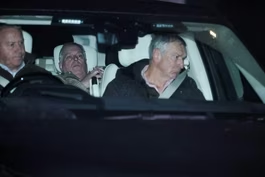
today after the arrest .. former Prince Andrew on suspicion# of misconduct in public office,## his arrest reportedly linked to the# latest release of the Epstein files.
AMNA NAWAZ: Andrew Mountbatten-Windsor, as# he's now known, was taken into custody at## the royal Sandringham estate and later# released.
An arrest of this magnitude## involving the sibling of a reigning monarch# has no precedent in modern British history.
We begin our coverage tonight with this report## from correspondent Chris Ship# and our partners at ITV News.
CHRIS SHIP: At breakfast time, a number of# unmarked police cars arrived unannounced,## their task, to arrest the# younger brother of King Charles.
Today, is Andrew Mountbatten-Windsor's# birthday.
He has spent most of it in## police custody answering questions.
By# 10:00 a.m.
this morning, Thames Valley## Police confirmed they had made an arrest on# suspicion of misconduct in public office.
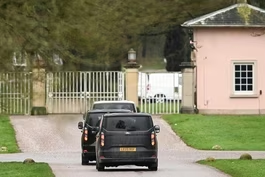
At Royal Lodge in Windsor, where Andrew had been# living until the start of this month, black vans## were filmed entering the grounds earlier today.# At midday, the first response from Buckingham## Palace and the statement was signed Charles# R., meaning this was from the king himself.
He spoke of how he had learned with the# deepest concern of his brother's arrest## and insisted a full, fair and proper# process should follow in terms of the## investigation.
The king repeated he was ready# to fully cooperate with the police and then,## in the starkest way possible, he wrote: "Let me# state clearly, the law must take its course."
And, this afternoon, just as he pledged he would,# the king continued with his public engagement.
QUESTION: Do you have any reactions# to the arrest of your brother, sir?
QUESTION: Your Majesty, how are you# feeling after your brother's arrest?
CHRIS SHIP: Today's diary did not change,# but the questions on his arrival did.
QUESTION: Have you spoken to# your brother, Your Majesty?
CHRIS SHIP: He had all his# senior staff with him.
He knows,## just as they know, what a# precarious moment this is.
As for another of Queen Elizabeth's children,## Princess Anne, her diary today included a# visit to a prison.
She didn't cancel it.
QUESTION: What's your reaction to# your brother's arrest, Your Highness?
CHRIS SHIP: So why did police launch a criminal# investigation?
It followed an assessment of the## most recently released Epstein files made# public by the U.S.
Department of Justice.
Those files appeared to show e-mails from# the then-Prince Andrew to Jeffrey Epstein## at around the time they were photographed# in Central Park in New York.
Police are## investigating if confidential papers about# business opportunities were shared by the## then-prince and if that amounts# to misconduct in public office.
At the time, Andrew was a trade ambassador# on behalf of the British government, a role## which would have given him access to sensitive# and confidential documents.
The arrest is not## connected to claims made by Andrew's accuser, the# late Virginia Giuffre, nor was it the result of## new claims a woman was trafficked to Andrew for# sex in 2010.
Police are still assessing those.
The prime minister, speaking before# today's arrest, said once again## whatever information Andrew has should be shared.
KEIR STARMER, British Prime Minister: Whether it's# Andrew or anybody else, anybody who's got relevant## information should come forward to whatever# the relevant body is.
In this particular case,## we're talking about Epstein, but# there are plenty of other cases.
It is anybody who's got information# relating to any aspect of violence## against women and girls has, in my view,# a duty to come forward whoever they are.
CHRIS SHIP: And after the arrest,## this response from the foreign secretary# speaking to ITV News in New York.
YVETTE COOPER, British Foreign Minister:# There is a police investigation under way.## And it is immensely important# that investigation can take## its course.
As the prime minister# has said, no one is above the law.
CHRIS SHIP: The king was not told# of his brother's arrest before it## happened.
This is a seismic moment for monarchy.
King Charles said today his family will# "continue in our duty and service to you all."
AMNA NAWAZ: Our thanks to Chris# Ship of ITV News for that report.
President Trump, meanwhile, is himself# facing ongoing questions about the Epstein## files.
He spoke about Andrew's arrest# on his way to Georgia this afternoon.
DONALD TRUMP, President of the United States:# I think it's a shame.
I think it's very sad.
I## think it's so bad for the royal family.
It's a# very, very sad -- to me, it's a very sad thing.
AMNA NAWAZ: For more on the# fallout in the United Kingdom,## I spoke earlier today with BBC studio# special correspondent Katty Kay.
Katty Kay, welcome back to "News# Hour."
Thank you for joining us.
KATTY KAY, BBC: Thank you for having me, Amna.
AMNA NAWAZ: So, this moment, the# arrest of the brother of a monarch,## just how extraordinary and# unprecedented a moment is this?
KATTY KAY: Look, we have known for a while# that Andrew had this shadow over him.
He'd## lost his titles.
He'd been alienated by# the world family.
He wasn't showing up to## Christmas events and holiday events.
He didn't# appear in any of the family photographs anymore.
So we knew that there was this cloud over# Andrew.
And yet I think, despite that,## I can't tell you how stunned people were in the# U.K.
I have been getting texts from people in the## U.K.
all day saying, this is front-page news.# Is it front-page news in the United States?
Which, clearly it is.
And it's# because it is unprecedented.## You have to go back to 1647 for a# monarch to be arrested like this## in the United Kingdom.
And I think there's now# -- of course, it begs a lot of questions about## the royal family.
It puts a real spotlight# on the process of the Epstein investigation,## and it raises questions about what is happening in# the U.K.
compared to what's happening in the U.S.
But, yes, everybody's stunned.
AMNA NAWAZ: And the reaction that we saw from# King Charles himself, right, basica.. in and saying the law has to take its course# now on the investigation, was that a surprise?
KATTY KAY: So what's unusual about that, and it's# something that may not have been picked up here,## is that he signed it himself.
That# statement is signed by Charles R. Normally, statements like that, Amna, come# from Buckingham Palace or the palace.
It's## very unusual for the monarch to put# their own name after a statement.
And## I think it was a sign that the king# was trying to show the British public## that he is fully supportive of this# investigation, wherever it may lead.
Now, he's already said that in public,# but the fact that he came out and he made## that statement about how the law# has to take its course, I think,## shows how desperate the royal family is# to say, this is Andrew's issue.
This is## not about the rest of the British royal family,# because this could be a huge body blow to them.
So they have to try to make this --# if they can, they have to try to show## the British public they're supporting the# investigation.
This is about one individual,## one bad apple.
It's not about the king,# and it's not about William and Catherine.
AMNA NAWAZ: And I want to underscore# here something.
This is not related## to the allegations that were made by the late# Virginia Giuffre, who said she was trafficked## by Jeffrey Epstein to Britain and had sex# with Andrew when she was a teenager years ago.## Andrew has consistently denied any wrongdoing# there.
And Giuffre died by suicide last year.
But her family today did praise# the arrest.
They said: "Today,## our broken hearts have been lifted at the news.# No one is above the law, not even royalty."
Katty, on those allegations, is that something## that people in Britain want# to see investigated further?
KATTY KAY: Ever since Andrew did that# disastrous interview with the BBC,## in which he failed to express any sympathy# for the survivors of Jeffrey Epstein,## that's been when he started to be shunned# by royal society and shunned in public life.
And I think there is a demand for# more information about that.
Now,## the issue for the royal family, which,# as I said, is trying to insulate itself,## is that if this goes to trial, there# are going to be awkward questions asked## to the royal family about the $15 million civil# settlement that Andrew paid to Virginia Giuffre.
Where did that money come from?
Did it come# from entirely Andrew?
We don't know.
All of## those finances have been so far kind of clouded in# secrecy.
It just came from the royal purse.
Well,## did it come from the king?
Did it come from only# Andrew?
Were there other sources of that money?
I think that's the kind of information that the# British public would like more answers to, and,## clearly, the American Congress# wants answers to as well.
AMNA NAWAZ: Another thing we have been reporting# on here is sort of the disparity of consequences## and accountability we have seen with the Jeffrey# Epstein files being released in some form,## investigations and resignations at very high# levels across Europe, not so much here in the U.S.
Is that resonating in the U.K.?
KATTY KAY: What we have had in the U.S.# is more private sector resignations and## stepping back from public light.
So you have# Bill Gates not attending an A.I.
summit,## speaking at an A.I.
summit in India, for example.
But then you don't get the investigations.# You don't get all of the information.
People## just step down from something.
They pull# back from public life.
They resign from a## high-profile business career, but it's# not the same as it being investigated.
And I think that's what the disparity# is, that you have actual investigations.## If Andrew goes to trial, it will be the Crown# Prosecution Service will conduct this.
The## Crown Prosecution Service will conduct,# will bring this trial to into fruition.
And it will be the king versus Andrew Mountbatten.# And I think that's what is the difference,## is that there is a perception in the U.K.# that the law is being applied equally.## Andrew Mountbatten-Windsor will be sitting in# a cell during this time waiting to find out## what he's going to be charged with.
And he will# be treated like a normal member of the public.
There are no favors being granted to him just# because he is the brother of the king.
And I## think that is what people are noticing# in the U.K.
and pointing to in the U.S.
Are people being protected?
Are certain# people not being investigated who should## be investigated?
And can we trust the reliability# of the Justice Department to follow through with## the rule of law in the way that the Crown# Prosecution Service now seems to be doing,## with the full blessing of King Charles, to be# honest and frank and do its job in this case?
AMNA NAWAZ: Katty Kay,# always great to speak to you,## especially at this extraordinary# moment in time.
Thank you so much.
KATTY KAY: Amna, thank you.
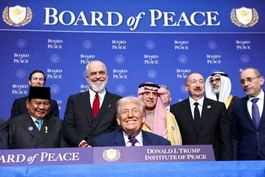
GEOFF BENNETT:## In the day's other headlines: President Donald# Trump convened the inaugural meeting of his## newly formed Board of Peace at the U.S.# Institute of Peace headquarters today,## a building that now bears his name.
The focus was Gaza, where a fragile cease-fire# between Israel and Hamas is still holding,## though tensions remain high.
The president# announced billions of dollars in reconstruction## pledges from the U.S.
and other nations,# outlining an ambitious plan to rebuild Gaza.
DONALD TRUMP, President of the United# States: Does everybody like the music?
GEOFF BENNETT: Today, in Washington,## President Trump's newly formed Board# of Peace met for.. DONALD TRUMP: Today, thanks to# unrelenting diplomacy and the## commitment of many of the great people# in this room, the war in Gaza is over.
GEOFF BENNETT: The president stood flanked by# representatives from more than 40 countries,## with observers from a dozen more,## gathered for what he called one of his# most important and consequential missions.
DONALD TRUMP: What we're doing is very simple,## peace.
It's called the Board of Peace, an easy# word to say, but a hard word to produce, peace.
GEOFF BENNETT: But the reality# in Gaza is far from peaceful.## Mourners gathered for a funeral for nine# Palestinians killed in Israeli airstrikes this## past weekend in what Israel's military called# a response to cease-fire violations by Hamas.
ALYAN AL-BAYOUK, Father of Killed Palestinian# (through translator): Do you believe that there## is a Board of Peace?
Do you beli.. is supplying Israel with weapons, money, with# protection, and with an international umbrella?
GEOFF BENNETT: In Washington, the president# announced the U.S.
would commit $10 billion toward## establishing the board.
It's unclear whether the# president has the authority to spend those funds.## Neither he nor the White House detailed where the# money would come from or how it would be used.
Mr.
Trump also said nine countries# pledged to combine $7 billion toward## a Gaza relief package.
Today's# session lasted several hours,## with dozens of speakers, including# Israel's foreign affairs minister.
GIDEON SAAR, Israeli Foreign Minister: Our# previous plans for Gaza failed because they## never addressed the core issues, terror,# hate, incitement, and indoctrination.
GEOFF BENNETT: And the head of the# Palestinian technocratic committee,## who outlined priorities for# Gaza, starting with security.
ALI SHAATH, Chief Commissioner, National# Committee for the Administration of Gaza: We are## operating in extreme.. President, step by step to build# the foundation for lasting peace.
GEOFF BENNETT: Key U.S.
allies, including the# U.K., France and Canada, were not in attendance.## The president said he intends to name his## son-in-law Jared Kushner as a# special peace envoy.
Kushner,## who has extensive and lucrative business ties in# the Middle East, defended the board's structure.
JARED KUSHNER, Former Senior Presidential# Adviser: A lot of these people are volunteers.## They're doing this not for any personal gain.# People are not personally prof.. GEOFF BENNETT: The head of a newly# announced International Stabilization## Force said several countries, including# Indonesia and Morocco, have pledged troops.
MAJ.
GEN.
JASPER JEFFERS, Commander, International# Stabilization Force: With these first steps,## we will help bring the security that Gaza needs# for a future prosperity and enduring peace.
GEOFF BENNETT: Secretary of State Marco# Rubio called the board the only way forward.
MARCO RUBIO, U.S.
Secretary# of State: There is no plan## B for Gaza.
Plan B is going back# to w.. GEOFF BENNETT: In Gaza, peace# feels remote.
Tents now cover## swathes of devastated land.
Children play with# makeshift lanterns made from empty soda cans.## And long lines for food remain a daily reality.
ISMAIL SHEIKH AL-EID, Displaced Palestinian# (through translator): Rain, wind and cold in## the tents.
What are people supposed to do?
How# can the young people live in tents like t.. GEOFF BENNETT: For now,## conditions on the grou.. And hopes for peace are also being tested in# the occupied West Bank.
The Palestinian Health## Ministry says Israeli settlers shot and killed# a Palestinian-American in a village north of## Jerusalem.
Mourners held a funeral today for# Nasrallah Abu Siam.
A witness said settlers## tried to attack a farmer and the 19-year-old# was killed in the violence that followed.
Israel's military says its soldiers had# stepped in to disperse a riot.
Human## rights groups say Abu Siam was the first# Palestinian killed by settlers this year.## The U.N.
estimates 240 Palestinians# were killed in the West Bank in 2025.
In Philadelphia, National Park# Service workers began restoring## a slavery exhibit today at the site of# George Washington's former residence.
CHERELLE PARKER, Mayor of Philadelphia,# Pennsylvania: And I want to say thank## you.
It's all right.
And I# want you to know I.. GEOFF BENNETT: The city's mayor, Cherelle# Parker, thanked workers during a visit there## this morning.
The exhibit tells the story of# nine enslaved people who lived there and has## become the focus of a legal battle between# the Trump administration and the city.
A federal judge ordered the displays# be restored earlier this week while## a lawsuit plays out.
The Trump# administration argues that it has## the power to decide what stories get# told at National Park Service sites.
President Trump's White House ballroom# proposal has been approved by a panel## whose members were handpicked by the# president himself.
The U.S.
Commission## of Fine Arts said the massive ballroom# will increase hosting capacity for state## dinners and other large events, which have# traditionally been held in outdoor tents.
Another body, the National# Capital Planning Commission,## will pick up the matter next month.
In October,# crews hastily demolished the entire East Wing to## make way for the ballroom.
A federal court case# seeking to halt construction is still pending.
Also today, workers installed a large# banner featuring the president's face at## the Justice Department in Washington, D.C.# The DOJ has a tradition of independence,## and its presence highlights Mr.
Trump's# growing influence over the department.
Separately, the military says Air Force# One is getting a new look, red, white,## blue and gold is seen in this artist's# rendering.
Mr.
Trump has been pushing to## replace the lighter blue Kennedy era# color scheme since his first term.
The nation's trade deficit posted# a small decline last year, even as## President Trump's tariffs upended the global# flow of goods and services.
The gap between## what the U.S.
sells overseas and what it# buys narrowed to just over $901 billion.## That's down slightly from the year before,# but is still the third highest on record.
And when it comes to physical goods, that is,# taking out services, the deficit actually hit## a record of around $1.2 trillion.
That's# despite President Trump's tariffs.
It all## comes as the U.S.
Supreme Court is due to rule on# the legality of those tariffs as soon as tomorrow.
Human rights experts at the U.N.
say the# Rapid Support Forces in Sudan carried out## a campaign of destruction last year# that bears hallmarks of genocide.
MONA RISHMAWI, United Nations: We reached# the point of genocide now.
Enough is enough.
GEOFF BENNETT: An independent fact-finding mission# found that the paramilitary group carried out mass## killings and other atrocities in the city# of El Fasher last October.
The report cites## sexual violence and public statements calling for# the elimination of non-Arab communities there.
At the U.N.
Security Council today,## diplomats called on nations to exert maximum# pressure to prevent any further bloodshed.
YVETTE COOPER, British Foreign Minister:# This is not just a humanitarian crisis.## It is a regional security crisis and a# migration crisis too.
This affects all## of us.
And that is why we need action,# and we need the United Nations to be## a force for countries to come together# from across the world to demand peace.
GEOFF BENNETT: Violence has raged in# Sudan since 2023, when tensions between## its military and paramilitary leaders# boiled over.
The U.N.
estimates that## at least 40,000 people have died, but aid# groups say the real figure is much higher.
On Wall Street today, stocks ended lower as# worries about a conflict with Iran weighed## on the markets.
The Dow Jones industrial# average fell nearly 270 points.
The Nasdaq## slipped about 70 points on the day.
The# S&P 500 saw its first loss in four days.
And at the Winter Olympics today,# there was a dash of disappointment,## but plenty of triumph for Team USA.# If you want to avoid some spoilers,## this is your warning.
Skating star Jordan# Stolz came up short in his bid for a third## gold medal of the Games, settling for# silver in the 1,500-meter speed skate.
But in women's figure skating, Alysa# Liu won the first gold medal for the## U.S.
in more than two decades.
And Team USA# women's hockey came up big when it counted,## beating archrival Canada 2-1 in# an overtime thriller.
That helped## bring the U.S.
into second place in the# overall medal count with 27 behind Norway.
Today was also the Olympic debut# for ski mountaineering, or skimo,## for short.
It involves athletes climbing# up the mountain first before skiing down.## Switzerland and Spain took home gold in# the women's and men's events respectively.
Still to come on the "News Hour": President Trump# tries to tamp down concerns about affordability;## Republican Congressman Ryan Mackenzie discusses## the partial government shutdown# and other divisions in Congress;## and prediction market platforms see# massive growth and mounting scrutiny.
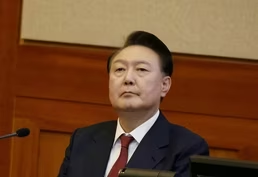
AMNA NAWAZ: In South Korea, a court# sentenced former President Yoon Suk## Yeol to life in prison after it found him# guilty of leading an insurrection.
While it## is a dark mark for the Congress, some argue# it's a bright spot for its young democracy.
Nick Schifrin details how a few short,# tumultuous hours challenged South Korea.
NICK SCHIFRIN: Today in Seoul, they watched# and cheered as if it were a play-by-play,## a judge making the final call in the# sentencing of former President Yoon Suk Yeol.
And after Yoon's fate was# sealed, his critics celebrated.
SONG JI-SEON, Seoul Resident (through# translator): I was watching the martial law,## which is something I'd only seen in# history books, unfold in real time.## I hoped for a harsher punishment so# that history wouldn't repeat itself.
NICK SCHIFRIN: His supporters were left shocked.
YOON KAB-KEUN, Attorney for Yoon# Suk Yeol (through translator):## Watching what appears to be a collapse of rule# of law today, I'.. we should proceed with an appeal or continue to# participate in these criminal proceedings at all.
NICK SCHIFRIN: It was December 2024 when# President Yoon declared martial law.
His## middle-of-the-night announcement sent# members of the military to Parliament.## Protesters protected the building and# their democracy, inside, the only thing## that stopped soldiers from Parliament floor,# furniture deployed by opposition staffers.
That bought time until a unanimous vote# lifted martial law.
From start to finish,## it was only six hours, but it was, and has# been, a test of South Korean democracy.
FRANK JANNUZI, President and CEO, Maureen# and Mike Mansfield Foundation: To me, the## most remarkable story is the .. democracy in the face of unprecedented challenges.
NICK SCHIFRIN: Frank Jannuzi is the president# of the Mansfield Foundation, which works on U.S.## relations with Asia.
He calls Yoon's the most# momentous domestic trial in more than 30 years## in a country that has a history of presidents# who've been impeached, jailed or overthrown.
FRANK JANNUZI: Over the last 14 months,# South Korea has emerged from this process## with due process sustained, rule of law# sustained.
Democracy itself was in the## docket in this trial.
And the South Korean# people affirmed the value of that democracy,## the resilience of that democracy,# without personalizing the crime.
NICK SCHIFRIN: The outcome for Yoon could have# been much worse.
The prosecution asked for the## death penalty.
And it wasn't only Yoon.
Five# other former officials were also convicted,## including the former defense minister, who# will spend the next 30 years in prison.
Current President Lee Jae Myung,## Yoon's longtime rival, has reframed from# politicizing the trial, says Jannuzi.
FRANK JANNUZI: This allowed him to cool down the# temperature a bit and also allowed him to focus## really on where he needed to focus, which was his# foreign policy priorities, sustaining an outreach## to Japan and reassuring the United States that# South Korea would be a loyal, faithful ally.
NICK SCHIFRIN: Over the past year,# South Korea's faced pressure over## trade and promised to increase defense# spending.
It's been a balancing act## for a democracy that has now sent a# former president to prison for life.
For the "PBS News Hour," I'm Nick Schifrin.
AMNA NAWAZ: President Trump is in Rome,# Georgia today, talking about affordability and## the economy, a theme he's expected to spotlight# again in next week's State of the Union address.
Our White House correspondent, Liz# Landers, has more on this and joins us now.
So, Liz, as you have been reporting, the president# has been frustrated he's not getting enough credit## when it comes to the economy.
That's why he went# to Georgia to talk about this.
What did he say?
LIZ LANDERS: Well, today he# was focused on affordability,## the economy.
This was also a political visit# for him.
This is a congressional district## that's going to have a special election soon,# so kind of several birds with one stone here.
He was touting the stock market.
He was touting## some signature legislation# that has also passed recently.
DONALD TRUMP, President of the United# States: The great Big Beautiful Bill is## basically a tax cut bill.
And when you hear# the fake Democrats talking about it, like,## oh, the great Big Beautiful# Bill, they try and mock it,## put four years' worth of goodies into that# bill and everybody said it couldn't be done.
LIZ LANDERS: The president# visited a restaurant there## and then he gave that speech# at a steel mill in Georgia.
This was his first domestic trip on this# issue talking about affordability in the## economy since he went to Iowa a few weeks ago.# But, Amna, there was some mixed messaging here## today.
He goes off on tangents when# he gives these speeches sometimes,## was talking about the operation in Venezuela a# few weeks ago at the beginning of the year, also## talking about a number of grievances on issues# where he doesn't think he's getting credit on.
So he still has trouble sometimes# sticking directly to the messaging.
AMNA NAWAZ: Liz, your reporting has# also shown that his chief of staff,## Susie Wiles, held a sort of unusual# closed-door strategy session this## week to talk about messaging for the# midterms.
What do we know about that?
LIZ LANDERS: Yes, a source who participated# in the meeting talked to me about this and## said that this was an effort to# get Republicans both inside the## administration and outside allies on the same# message and talking about the same priorities.
This person said that affordability is the number# one issue right now for the White House going into## the midterm election.
Susie Wiles, the chief of# staff, talked about this.
So did James Blair,## who is the deputy chief of staff,# and then pollster Tony Fabrizio,## who's worked with the president for a# while.
They were among the speakers.
And this Republican said that, look,# these issues like affordability on## energy prices on housing, on health# care, fuel prices and groceries,## those are sort of the main tenets# that they're focused on right now.
And this person said, the president has# now been in office for more than a year,## and there are only so many things that# he, the president, can blame Biden,## his predecessor, on at this point,# and recognizing that they need to## get out there and sell their affordability# message to the American public right now.
And so this was about that kind of coordination,# and also, Amna, I would add, getting Cabinet## members out on, not the campaign trail, per se,# but across the country touting these messages.
AMNA NAWAZ: At the same time, we know Democrats# have also sort of landed on affordability as one## of their primary messages going into the midterms.# What do we know about how effective that will be?
LIZ LANDERS: It probably will# be effective, based on polling.
Look, the White House actually doesn't have# bad economic numbers to be touting.
The jobs## report that came out for January was better# than anticipated.
Gas prices are dropping in## some parts of the country.
In Georgia, I was# looking at the average price of gas there is## $2.71, per AAA, which is lower# than it has been in the last year.
The average Georgia resident is also going to save## more than $3,000 on their taxes this# year from that signature tax bill## that passed.
That's according to the# conservative-leaning Tax Foundation.
But when you look at the poll numbers# of what Americans are actually feeling,## FOX News had a poll, found that 59 percent of# Americans disapprove of President Trump's job## handling on the economy; 68 percent say that# he's not spending enough time on the economy,## so going back to that sort of dual messaging that## the White House is dealing with between# foreign policy and also domestic issues.
AMNA NAWAZ: Meanwhile, we should# underscore, it's February.
LIZ LANDERS: Yes.
AMNA NAWAZ: We'r.. in November at the White House.
Why?# Why is it such a concern for them?
LIZ LANDERS: Because the margins# are so slim in Congress.
Right now,## the Republicans only have a four-seat# majority in the House.
And, historically,## a president loses the midterm elections.
President Trump experienced that in 2018.# Republicans lost 40 House seats in that## election.
And that also gave Democrats# the power to then set into motion some## of those impeachment trials, which we know# President Trump is already thinking about.
He has said in a few speeches recently to# Republicans that you have got to win the## midterms, because, if we don't win the midterms,## it's going to be -- I mean, they're# going to find a reason to impeach me.
So we know that this is sort of a concern# of President Trump's right now.
And also,## if Democrats win control, they can do a number# of other things.
They could stall other kinds## of legislative priorities for the White House# and also investigate the Trump administration.
AMNA NAWAZ: That's our White# House correspondent, Liz Landers.
Liz, thank you.
LIZ LANDERS: Of course.
GEOFF BENNETT:## The partial government shutdown that has# stalled funding for the Department of Homeland## Security has entered day six with no signs of# compromise between Congress and the White House.
The shutdown started last week after# congressional Democrats pushed for## reforms of the Trump administration's# immigration enforcement efforts.
Our Lisa Desjardins has more on the funding fight.
LISA DESJARDINS: Both the House and# the Senate are out of town this week,## but what they have heard from constituents at# home will matter when they return on Monday.
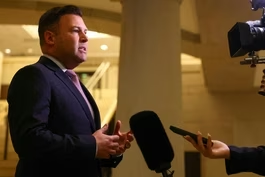
One key swing vote belongs to freshman# Republican Ryan Mackenzie.
He represents## Pennsylvania's Seventh District# bordering New Jersey.
It includes## the Lehigh Valley and the city of# Allentown, and he joins me now.
Congressman, ICE is a major issue# in your district.
I know that at## least one county has said they# will not cooperate with ICE.## There's a detention center coming in the# county next door outside of your district.## But I want to start with you.
How do you see# this immigration crackdown?
Do you support it?
REP.
RYAN MACKENZIE (R-PA): Well,# after four years of an open border## during the Biden administration, we were# seeing and feeling the impacts of that## illegal immigration flow right# here in our local community.
If you go on DHS' Web site, you can see some of# the violent offenders that have been arrested,## arrested in our cities, so very# heinous individuals that should## have been taken off the street.
And when# we do have those people that are detained,## we want ICE to be able to# appropriately pick them up.
As you mentioned, Northampton County,## unfortunately has a sanctuary policy# basically in place that does not allow## them to release those individuals directly# into ICE custody.
That leaves our community## vulnerable and less safe than it should be.
And# so I really push back on those policies strongly.
And I think we do need to make sure that we# are appropriately taking people off the street## who shouldn't be here and are committing# these violent crimes.
At the same time,## we are open and I'm certainly open to reforms# and the way that we can actually improve## these operations at the federal government level.
It's something that I think, in every case,## whenever you see instances like we saw in# Minneapolis, which are very unfortunate,## tragic situations involving American citizens, we# do want to look at, what are the possible reforms,## the way that we can improve the way that# everything is being conducted in law enforcement.
And so I have been open to those# discussions and a part of them as a## member of the Homeland Security Committee# recently, where I directly asked Director## Lyons about what we should be doing to improve# operations around and involving U.S.
citizens.
LISA DESJARDINS: OK, let's talk about those# key reforms because that's under discussion## right now.
That's why DHS essentially has# no funding, what Democrats are hoping for.
So they're saying they want a list of 10, but# I want to ask you about some of the key ones.## Tell me if you support or oppose any# of these ideas, banning face masks,## requiring identification for ICE officers# and whether there should be some kind of## increased warrant requirement for entering# homes.
Where are you on those ideas?
REP.
RYAN MACKENZIE: Well, I think we# do also have to balance the way that## the Democrats are approaching this.# They have been very public about it.## People like Senator Chris Murphy have# said that they want to handcuff ICE## and they actually want to limit the# way that they can conduct operations.
That is not something that we want to# do.
We want to make sure that they can## fully enforce federal law, taking those# violent criminals off the streets.
Now,## at the same time, when you're talking about ways# that we can identify our agents appropriately,## there should be identification on these# individuals.
Maybe it's not a name.
Maybe it's a badge number, but some way that# if an officer is involved in an instance,## an officer-related shooting or something else,## that they could be identified if they do have# a mask on.
And so the controversy around masks,## I think, is one that we do want these# individuals to be able to show their face.
At the same time, this is not a choice that# they made lightly.
They didn't do it because## they wanted to cover their faces or -- but# it's because they really needed to.
I mean, we## have seen instances where these individuals have# been doxxed, their families have been harassed.
So, if you're going to take a masking elements# away from these individuals, which I would be## open to having a discussion on that front, we# should also make sure that we have a good proper## enforcement around the harassment and doxxing# of these federal law enforcement agents.
So, there is an appropriate balance that I# think could be struck there.
And the Senate## and the White House are really taking the lead# on these negotiations.
And so we would like## to see some reforms, a reasonable reform# package that can get bipartisan support,## coming back to us in the House.
LISA DESJARDINS: At the same time, the top issue,## I don't have to tell you, for Americans# remains the economy, and that includes pri.. I looked at the largest grocery store in# your district, which I think is the giant## store in Allentown, and checked their# prices.
A honey crisp apple -- now,## given you that's a more luxurious# apple, I suppose -- even on sale,## that's 12 percent higher, the cost today,# than it was a year ago, national average.
Chicken breast -- I'm a mom, I# use chicken breast all the time.## That price is up 9 percent at your local# grocery store from last year.
President## Trump promised that grocery store --# grocery prices would come down.
How## do you respond to those who look at# you and say Republicans have failed?
REP.
RYAN MACKENZIE: Yes, I think the economy# is still a top issue for individuals right## here in our local community.
And# it's everything from food and fuel,## housing and health care.
All of those different# elements are things that we are working on.
When it comes to grocery prices in particular,# it is a challenge, there is no doubt, to make## sure that we provide the relief for individuals# in those necessary staples that you're talking## about.
And so one of the things that we can# provide relief on the flip side, not just in the## cost category, but the income side, is to provide# significant tax relief for every single American.
By increasing the standard deduction, we're# providing that.
And then in certain categories,## it's an expansion of no tax on tips or overtime,## AN increased deduction for seniors.
So in# all of those ways, people are going to be## seeing and feeling more money back# in their pockets this tax season.
And that is a very helpful thing when you're# trying to make ends meet in your family budget.
LISA DESJARDINS: Congressman Ryan# Mackenzie, thank you so much for joining us.
REP.
RYAN MACKENZIE: Thank you.
AMNA NAWAZ: Platforms that let you bet on the## outcomes of future events have# seen explosive growth recently.
Our economics correspondent, Paul Solman, explains# how so-called prediction markets work and why## they're so popular and controversial.
PAUL SOLMAN: These days, you can pretty## much bet anywhere, any time, on anything,# like a word Trevor Noah will say on camera.
TREVOR NOAH, Comedian: Potato.
If you# had me saying potato on Polymarket,## you just made a ton of money.
PAUL SOLMAN: That was a joke, no# payoff for potato.
But people were## betting on what words would be said at the# Grammys, not unlike betting on the weather.
MAN: According to the prediction# markets, at least the chance that## New York City gets over six inches of# snow, we're talking 51 percent chance.
PAUL SOLMAN: And get this, if Cardi B would# perform in Bad Bunny's Super Bowl halftime## extravaganza.
As to whether this was a performance# was hotly disputed by bettors yes and no.
Now, prediction markets are hardly new.
YESHA YADAV, Vanderbilt University Law School:# Prediction markets have been around since the## 16th century, much more recently since around# 1988, with the Iowa Electronic Markets.
JUSTIN WOLFERS, University of Michigan: We# had big political prediction markets running## literally on the curb of Wall Street# about elections back in the late 1800s.
PAUL SOLMAN: That was then, but this is now.
YESHA YADAV: Today's prediction markets are a# completely different game.
One can essentially## take positions across a host of different# questions, including, but definitely not## limited to politics.
Sports is by far the# major category that is currently looked at,## but certainly things like Oscars, who's# going to be next Federal Reserve chair.
So it's really tapping into this# appetite to grab people's attention,## to do so in a way that is heavily# influenced by social media.
So that## has really resulted in a mass appeal in a way# that prediction markets just didn't have before.
PAUL SOLMAN: Wagering has skyrocketed# on two dominant platforms, Polymarket,## which takes its bets in cryptocurrency,# and Kalshi.
In the week leading up to## the Super Bowl, trading volume on the# two platforms was almost $5 billion.
How does it work?
To wager, users# by a yes or a no event contract.
RAJIV SETHI, Barnard College, Columbia# University: It's really a bet on whether## something is going to happen or not# happen.
And just like stock markets,## you have two sides to a transaction.
There's# one side betting yes, one side betting no.
PAUL SOLMAN: Economist Rajiv Sethi has an example.
RAJIV SETHI: Who's going to get control of the# House of Representatives during the midterms?
PAUL SOLMAN: To bet on, say, the# Democratic Party taking control.
RAJIV SETHI: The price on the Polymarket# is about 82 cents.
So what that means is## that somebody bought the yes side of that# contract for 82 cents and somebody bought## the no side of that contract for 18# cents.
If the Democrats do retake the## House during the midterms, the yes side# gets the dollar, otherwise the no-side.
PAUL SOLMAN: Now, to market aficionados,## there's value in seeing what bettor do.# It's often called the wisdom of crowds.
YESHA YADAV: They actually put their money# where their mouth is.
And that means that the## bets that are taken on these prediction markets# tend to have some pretty informative content.
JUSTIN WOLFERS: What this does is it makes the# information embedded that's already being traded## transparent, so that we can all use it.
When# I see that there's a 22 percent chance of J.D.## Vance becoming the next president, that's# actually really useful information.
I can## start to plan for what sorts of regulations# my business might expect and things like that.
PAUL SOLMAN: In the run-up to# the 2024 presidential election,## polls showed Kamala Harris and Donald# Trump tied.
But the markets didn't.
YESHA YADAV: Prediction markets,# Polymarket in particular,## was pointing towards a very different outcome# than what the pollsters were suggesting.
PAUL SOLMAN: The day before the# election, Polymarket gave candidate## Trump a 58 percent chance of winning.# Now, part of the prediction market boom## has been relaxed regulation, the Supreme# Court OKing sports betting back in 2018,## the increased ease of using virtual private# networks, VPNs, to skirt restrictions online that## allows Americans to use Polymarket despite a U.S.# ban that began during the Biden administration.
RAJIV SETHI: There are many U.S.# traders who bet on Polymarket,## but they will use VPNs to operate as if they're# accessing it from outside the United States.
PAUL SOLMAN: Under the Trump administration,## the Commodity Futures Trading Commission allowed# Polymarket to open a regulated.. but it has a wait-list to use it.# The unregulated version does not.
RAJIV SETHI: Polymarket is much more like# the Wild West.
Polymarket itself doesn't## know who's trading on the platform# because these are crypto wallets,## and the real-world identities of those folks are# not visible even to the exchange in most cases.
PAUL SOLMAN: And, hey, that's not the only# downside.
How about insider trading?
One## Polymarket user made over $400,000 predicting the# removal of Venezuelan President Nicolas Maduro.
JUSTIN WOLFERS: Someone bet a lot of# money 12 hours before Maduro was ousted## that Maduro would be ousted.
They did that# in a way that kind of makes you think that## some information may have leaked from the# White House or the Department of Defense.
PAUL SOLMAN: Yes, insider trading plagues# all markets, but the sheer profusion and## anonymity of bettors make the likes# of Polymarket especially susceptible.
Then there are cases like Brian Armstrong, CEO of# crypto firm Coinbase, on an October earnings call.
BRIAN ARMSTRONG, CEO, Coinbase: I was a# little distracted because I was tracking## the prediction market about what Coinbase# will say on their next earnings call,## and I just want to add here the# words Bitcoin, Ethereum, blockchain,## staking and Web3 to make sure we get# those in before the end of the call.
PAUL SOLMAN: All words on which there were bets# as to whether or not Armstrong would say them,## though Armstrong said he was being spontaneous and# his firm prohibits betting on prediction markets.
RAJIV SETHI: Regardless of whether or not he had# a stake in the outcome -- and I believe that he## did not or at least he stated that he did not --# he had the ability to make some people a little## bit richer and others a little poorer.
And these# kinds of markets are troubling for that reason.
PAUL SOLMAN: And then there's# the risk of compulsive gambling.## Kalshi faces multiple lawsuits that cite its# potential to lure young traders into addiction.
JUSTIN WOLFERS: Gambling is just like many# other drugs.
It's highly addictive.
And if## you have ever had a friend who has# become a compulsive gambler -- and I## have -- they will bet money they don't have.# They will destroy their family's well-being.
PAUL SOLMAN: Of course, gambling# addiction has been a problem for eons,## but digital prediction markets, well, up the ante.
JUSTIN WOLFERS: Given the fact that# we all carry around a little screen## that is a bookie in our pocket, you# no longer need to walk to the corner.
PAUL SOLMAN: Which means that prediction# markets are a serious challenge for regulators.
YESHA YADAV: Questions with respect# to consumer protection are going to## be front and center.
What kind of disclosures# will be given to people?
Will there be limits## on how much they can put into various# markets?
What about insider trading?
PAUL SOLMAN: And in the end it matters# to bettors and the markets alike.
YESHA YADAV: If you want to have a healthy market,## you need to have healthy people who are# participating in that market, that don't feel## like that market is taking advantage of them,# but giving them real opportunities to learn,## to participate, to grow in ways that# don't result in them losing their skin.
PAUL SOLMAN: That would be nice.
But, in today's# deregulatory environment, would you bet on it?
For the "PBS News Hour," Paul Solman.
GEOFF BENNETT:## Lucinda Williams has been making music for# decades.
Now she's out with a new album and## embarking on a 20-city tour across Europe and# the U.S.
In it, she's speaking and singing## to this moment, calling it a battle cry,# finding grit and grace in a world on edge.
Our senior arts correspondent recently# sat down with her for our Art in Action## series exploring the intersection of art and# democracy as part of our Canvas coverage.
JEFFREY BROWN: Five years ago, Lucinda# Williams suffered a stroke.
She had to## learn to walk again and no longer plays# her guitar.
But here she is writing songs,## a new album out, and still performing.
How does she do it?
LUCINDA WILLIAMS, Musician:# Maybe a little stubbornness.## A little stubbornness never hurt anybody.
JEFFREY BROWN: Williams has long been known as# a musical storyteller, beloved by passionate## fans who followed her for decades and by other# leading singer-songwriters for her way with words.## And the story she's telling now is the title# of her new album, "World's Gone Wrong."
LUCINDA WILLIAMS: It's kind of a commentary# on things that have been going on and just## how it makes people feel.
And it helped me# to write about it.
That's why I write songs.## Maybe I'm old-fashioned, but I feel like the# artist's role is to speak about what's going on.
JEFFREY BROWN: Williams story goes# back to a peripatetic childhood,## most of it in town throughout the South,# as her father, the poet Miller Williams,## moved the family from place to# place for university teaching posts.
MILLER WILLIAMS, Poet: They will not forget.
JEFFREY BROWN: He would gain his# biggest audience reading a poem## written for Bill Clinton's# second inauguration in 1997.
Now 73, Lucinda recalls having her# 12-year-old mind blown in 1965,## when her father's friend brought over a new# album by Bob Dylan, "Highway 61 Revisited."
LUCINDA WILLIAMS: I started reading about him# and listening to other singer-songwriters from## that era, like Joan Baez and Judy Collins.# They were all writing these songs about## social injustice and anti-war.
And I# loved those songs and they spoke to me.
JEFFREY BROWN: And did you say# at some point, I want to do that?
LUCINDA WILLIAMS: Yes.
JEFFREY BROWN: Yes?
LU.. JEFFREY BROWN: She would go on to success,# including 17 Grammy nominations and three wins,## with her unusual blend of rock, country,# blues and folk, telling stories of hard## living and heartbreak in such critically acclaimed# albums as 1998's "Car Wheels on a Gravel Road."
The song "Passionate Kisses," which she recorded# in 1989, was covered and made famous by Mary## Chapin Carpenter three years later.
Williams built# and kept her faithful following over many years.
MAN: Now here is Lucinda Williams.
JEFFREY BROWN: But all along the way,# she battled a music industry that she## felt wanted to put her into a box,# a marketable genre.
She refused.
LUCINDA WILLIAMS: I just didn't think# in those terms.
They described it like I## fell in the cracks between country and rock,# because they have to have a market for you.
JEFFREY BROWN: Yes.
LUCINDA WILLIAMS: Beca.. JEFFREY BROWN: Hers is a story of# perseverance and resilience.
And more## recently she's felt caught up in the times,# angry at actions by the Trump administration,## responding through songs she# hopes hearken back to an earlier## era of 1960s protest music.
One is called,# "We've Come Too Far to Turn Around."
LUCINDA WILLIAMS: When I was writing that, I# was thinking a lot about songs like "We Shall## Overcome."
That's a very powerful feeling# to stand with a whole bunch of people,## like-minded people, singing songs like that.
I wanted to feel that again.
If you watch# the news on TV or read the newspaper,## there's something every day that's upsetting.
JEFFREY BROWN: Well, people have different# ways of responding to that.
You're a... LUCINDA WILLIAMS: They're not# responding enough, I don't think.
JEFFREY BROWN: You don't think so.
LUCINDA WILLIAMS: What I'd like# to see.. more demonstrations and all of# that, just speaking out more.
JEFFREY BROWN: On the new album, she# collaborates with renowned figures## like Norah Jones.
The two played# together recently on Jones' podcast.
Mavis Staples joined on a cover of Bob# Marley's "So Much Trouble in the World.
"## As for Williams' personal story of# resilience, she continues to deal## with the aftermath of her stroke, when# everything, she says, went haywire.
She## told us of promising new therapy she's undergoing# that's helping with what she calls her brain fog.
LUCINDA WILLIAMS: That's# probably been the hardest part... JEFFREY BROWN: Yes.
LUCINDA WILLIAMS: ... yes, is ju.. of that.
I just tried really hard to# focus and pay attention.
And I'm fine## when I go on stage and I know what# I'm supposed to do and all of that.
JEFFREY BROWN: So that's a lot to deal with.
LUCINDA WILLIAMS: Yes.
See, I# told you I was stubborn, though.
JEFFREY BROWN: Lucinda Williams continues her tour## in Europe and later back in the U.S.# playing to old and new fans alike.
For the "PBS News Hour," I'm# Jeffrey Brown in New York.
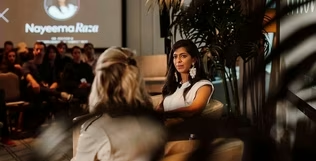
AMNA NAWAZ:## Well, tonight for our reef but spectacular# series, journalist and podcast host Nayeema## Raza shares what she's learning by asking# the questions we all secretly wonder about.
GEOFF BENNETT: Her new podcast called smart girl# dumb questions is all about embracing curiosity.
NAYEEMA RAZA, Host, "Smart Girl Dumb Questions":# So curiosity is one of these skills that I think## we have in spades as children.
And we# actually continue to have it as adults,## but we're like closeted curious people.
And# instead of asking the question out loud,## we're like underneath the table,# like, is taleggio a cheese or a## sex act?
What actually happened in# Ireland?
Why is that a good metaphor?
I feel like I grew up my whole life not knowing# things.
I'm Pakistani.
I was born in the United## States, but I grew up in Asia and Africa.
And# so I was constantly moving as a result of my## father's work at the World Bank.
And I was# always in cultures where I didn't know stuff.
And because I was an outsider, I had the ability# to ask questions.
"Smart Girl Dumb Questions" is## a new podcast that's about asking the questions we# all want to know the answers to.
A dumb question## I have that I want to figure out on the show is# this shift of gender roles.
How much of this is## feminism and how much of it is about working more,# buying more, being kind of an economic guzzler?
I, for example, feel a lot of pressure to# have a bigger career because I don't yet## have kids.
Or I know women who are really kind# of finding they need to explain away the fact## that they don't have a career because# they're at home watching their kids.## This expectation of, like, you need to# want to have it all is absolutely wrong.
What my parents instilled in me at a young age was# a ton of confidence that has lasted me a lifetime.## My father, Aftab Raza, he unfortunately passed# away a few years ago.
One regret I have of not## listening to my father while he was around# was the kind of importance of showing up.
If it was like a third cousin, once-removed,# kids, family friend, he would know about them## and want to know about them.
When I went to study# in California, my father's like, you got to call## your cousin who's out there.
And I'm like, Dad, no# kid in their 20s has time for these relationships.
When my father passed away, it was all of these# people that showed up.
What that showed me is## that we live in a world where we talk a lot# about boundaries and protecting self-care.## But I think sometimes we don't talk enough# about kind of care of others in our community.## And that's a lesson that I learned the# hard way through my father's passing.
So I have been a journalist now for six years.## I have been a video journalist at# The New York Times opinion section,## a podcast executive producer/editor at "Sway" at# The New York Times and "On With Kara Swisher."
I realized that I wanted to use my own voice# more.
And now it's very exciting because I## get to ask whatever I want to ask and be as# smart or dumb as I hope to be on a given day.
I'm Nayeema Raza.
I'm here for this# episode of long but unremarkable.
MAN: How dare you?
NAYEEMA RAZA: My name's Nayeema Raza,## and this is my Brief But Spectacular# take on smart girl, dumb questions.
AMNA NAWAZ: And you can watch more Brief But## Spectacular videos online# at PBS.org/NewsHour/Brief.
And join us again back here tomorrow# night for the analysis of the week's## news from David Brooks and Jonathan Capehart.
And that is the "News Hour"# for tonight.
I'm Amna Nawaz.
GEOFF BENNETT: And I'm Geoff Bennett.
For all of us here at the "News Hour,"..
 New
NewA Brief But Spectacular take on embracing curiosity
Video has Closed Captions
Clip: 2/19/2026 | 3m 1s | A Brief But Spectacular take on embracing curiosity and asking questions (3m 1s)
 New
NewEx-Prince Andrew arrested in fallout related to Epstein ties
Video has Closed Captions
Clip: 2/19/2026 | 4m 21s | Ex-Prince Andrew arrested in widening fallout related to Jeffrey Epstein ties (4m 21s)
 New
NewEx-South Korean president sentenced to life in prison
Video has Closed Captions
Clip: 2/19/2026 | 3m 25s | Former South Korean president sentenced to life in prison for imposing martial law (3m 25s)
 New
NewGOP Rep. Mackenzie on Trump's economic, immigration policies
Video has Closed Captions
Clip: 2/19/2026 | 6m 30s | GOP Rep. Mackenzie on Trump's economic and immigration policies (6m 30s)
 New
NewHow the UK is reacting to ex-Prince Andrew's arrest
Video has Closed Captions
Clip: 2/19/2026 | 6m 9s | How the UK is reacting to the arrest of former Prince Andrew (6m 9s)
 New
NewLucinda Williams channels protest music era on new album
Video has Closed Captions
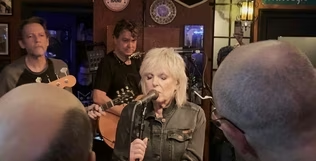
Clip: 2/19/2026 | 7m 8s | Lucinda Williams channels earlier protest music era on new album (7m 8s)
 New
NewNews Wrap: Palestinian-American killed by settlers
Video has Closed Captions
Clip: 2/19/2026 | 5m 44s | News Wrap: Palestinian-American killed by settlers in occupied West Bank, officials say (5m 44s)
 New
NewTrump focuses on affordability ahead of State of the Union
Video has Closed Captions
Clip: 2/19/2026 | 5m 17s | Trump shifts focus to affordability ahead of State of the Union (5m 17s)
 New
NewTrump says U.S. will give $10 billion to Board of Peace
Video has Closed Captions
Clip: 2/19/2026 | 3m 47s | Trump says U.S. will give $10 billion to Board of Peace promising to rebuild Gaza (3m 47s)
 New
NewWhy prediction markets are thriving – and facing scrutiny
Video has Closed Captions
Clip: 2/19/2026 | 7m 30s | Why prediction markets are thriving – and facing scrutiny (7m 30s)
Providing Support for PBS.org
Learn Moreabout PBS online sponsorship
- News and Public Affairs

FRONTLINE is investigative journalism that questions, explains and changes our world.

- News and Public Affairs

Amanpour and Company features conversations with leaders and decision makers.
Urban Consulate Presents










Support for PBS provided by:
Major corporate funding for the PBS News Hour is provided by BDO, BNSF, Consumer Cellular, American Cruise Lines, and Raymond James. Funding for the PBS NewsHour Weekend is provided by...