
The Story: A NEW LENS
Episode 8 | 24m 36sVideo has Closed Captions
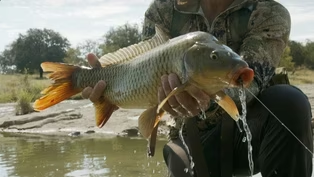
This episode highlights a species of fish that has gone from 'toss' to trophy.
A change in perspective can change everything. This episode features stories highlighting a species of fish that has gone from ‘toss’ to trophy, visionaries of a small town cinema revival, and a scientist who uses beach treasures to shed new light on our precious Gulf.
Problems playing video? | Closed Captioning Feedback
Problems playing video? | Closed Captioning Feedback
Production Support Provided By: H-E-B and Texas Parks & Wildlife Foundation
The Story: A NEW LENS
Episode 8 | 24m 36sVideo has Closed Captions
A change in perspective can change everything. This episode features stories highlighting a species of fish that has gone from ‘toss’ to trophy, visionaries of a small town cinema revival, and a scientist who uses beach treasures to shed new light on our precious Gulf.
Problems playing video? | Closed Captioning Feedback
How to Watch Texas Monthly Presents: The Story
Texas Monthly Presents: The Story is available to stream on pbs.org and the free PBS App, available on iPhone, Apple TV, Android TV, Android smartphones, Amazon Fire TV, Amazon Fire Tablet, Roku, Samsung Smart TV, LG TV, and Vizio.
Providing Support for PBS.org
Learn Moreabout PBS online sponsorship- [Sean] Texas is a big state.
We don't all agree on everything.
- People need to look at these films and see 'em in context.
- Working on this story, the main takeaway that I had is keeping an open mind to what you might be wrong about.
- You never know what you're gonna find.
(upbeat music) - I cover about 120 miles of the Texas Coast.
- [Juli] When something stays invisible, it's easy to forget about.
- [Sean] It really is a more dire situation than it used to be.
(soft upbeat music) (dramatic string music) (keys clacking) (dramatic music) (dramatic string music) - As a writer, as a journalist, you know you have to kind of keep your eyes open for the unexpected.
(dramatic string music) When I found this fly box, the last thing I was thinking about was writing a story.
(dramatic string music) But then like three years later, it turns out that this was a perfect way to write a story about this interesting fish species that we're changing our minds about and the experience of finding something you didn't know that you were looking for.
(subdued music) My name is Forrest Wilder.
I'm a Senior Writer at "Texas Monthly", and I wrote "My Quest to Lasso an Aquatic Bronco".
(engine humming) (footsteps tapping) (engine humming) (water ripples) (companion faintly speaks) - [Forrest] So, I grew up in South Texas, fishing from a very young age.
(companion faintly speaks) - Fished a lot in creeks and reservoirs for bass and catfish, and that sort of thing.
(subdued music) So, this all started in May 2020.
(water ripples) (insect chirping) I found this box of flies sitting right on the water's edge.
(water ripples) (subdued music) I could just tell these were like a curated collection from somebody that really knew what they were doing.
(subdued music) (water ripples) Then, I flipped the box over and there was a number on it.
So, I texted the number, and I said, "Hey, I found your fly box on the Pecos River."
This guy texted me back like five minutes later and he's like, "Oh man, wow.
I can't believe you found that.
Yep, that's mine.
Send it to me and I'll buy you a six-pack."
(dramatic string music) (car door slams) (object clicks) So, it turns out the box belonged to this guy named John Henry Boatright.
(dramatic string music) John Henry was part of this pretty small community of anglers in Texas that not only target carp, which is pretty unusual, but target them using fly fishing methods, which adds an extra challenge to a species that's already pretty hard to catch.
- It's a spectacular fish to target, side casting on a fly rod and fresh water.
My experience, it doesn't really get any better, especially in Texas.
- Growing up, I kind of regarded the carp as like a trash fish, invasive species that was in polluted water.
There's all these disparaging nicknames for them like mud minnow, ditch tarpon, sewer trout.
(gentle music) A couple years went by, my daughter was born.
I got very busy.
But then like the summer of 2022, had a little bit more time and I started reading about how the carp was having this renaissance in the US.
(soft upbeat music) The one the anglers are targeting is the common carp.
(dramatic music) In Europe, in the Middle Ages, it was associated with royalty.
In Asia, it's considered a very esteemed and honorable fish.
(dramatic music) It was brought to the United States in the 19th century actually to help feed a growing nation.
So, at that point in time, the carp was considered a helpful species until late in the 19th century when the fish started spreading.
Some carp actually are really invasive and a problem.
(dramatic music) At that point, it was the beginning of the trash fish thing.
Like, "Oh, this species has taken over.
It's a pest.
We need to get rid of 'em."
(dramatic music) Learning about all that made me realize like, hey, there's probably a good story in here.
What better way in than to go fishing with this guy I got to meet through this weird serendipitous thing of finding his fly box.
Maybe he'll take me fishing.
(dramatic string music) And he did.
(dramatic string music) To write the story, John Henry and I, we went fishing twice over a course of like two and a half days.
Fly fishing for carp is more akin to like bow hunting than your typical fishing than a lot of people do.
It's about stalking the fish and determining whether or not it's in a feeding pattern or whether you wanna make a cast.
I started finding out you can't spook the fish.
Well, when you're in clear water, that means you have to make really long cast to even have a chance that they're going to strike the fly.
(water blooping) (dramatic music) I realized that I actually had lots of misperceptions about the species.
One of the misconceptions is that carp only like nasty, polluted water.
They exist in all types of water, whether that's a polluted bayou in Houston or it's like a pristine spring-fed stream in the hill country.
Personally, I would look at them as a kid and be like, oh, what a hideous fish.
But I think that was completely wrong.
I actually think they're really beautiful fish.
(dramatic music) I was ignorant about the species and I just thought about it in the wrong way.
(gentle music) John Henry shared this saying from Thoreau, (gentle music) "Some men go fishing all their lives not realizing it's not fish they're after."
(gentle music) Working on this story, the main takeaway that I had is keeping an open mind to what you might be wrong about.
(gentle music) I had been taught carp are trash fish, they're bad, end of story, (gentle music) but it's cool to unlearn that.
(gentle music) I mean, it's only a fish, right?
Like who cares?
Except this fish has this bigger story.
(dramatic music) It came here, it was welcomed here, it was rejected, and that was the case for like a hundred years.
(dramatic music) And now, we've started to rethink our relationship to this fish that had been aligned for a long time.
(dramatic music) Reminded me that it's important to always be questioning conventional received wisdom.
(gentle music) (wind blowing) (pages flipping) (waves lightly crashing) (dramatic string music) - In Texas, we focus on our border so often, (dramatic string music) but we don't think about our border between land and sea.
(dramatic string music) The beach is the place where those worlds come together and it all collides for us to discover.
(dramatic string music) My name is Juli Berwald and I wrote "The Beachcombing King of Texas" for "Texas Monthly".
(gentle music) It's really hard to get people to pay attention to what's happening in our oceans.
I'm a science writer, but I start off as an oceanographer.
I've been on the ocean beat for my whole career and I've just come to understand how invisible our oceans can be to us up here on land.
(subdued music) Jace Tunnel is a marine biologist and also an incredible science communicator.
He works at the Heart Research Institute at Texas A&M Corpus Christi.
When COVID hit, he started doing these beachcombing posts and videos, and it just took off.
- Jace Tunnel here, Jace Tunnel here, Jace Tunnel here.
I go out at least once a week.
Now, look at all these.
I cover about 120 miles of the Texas Coast.
We got some real cool stuff washing in today.
(soft upbeat music) It's the best part of my week.
You know, I'm not having to be in the office.
(waves lightly crashing) Really being on the beach is what makes me happy.
(soft upbeat music) - Jace knows more about the beaches of Texas than anyone that I know of.
His father was a marine biologist at A&M Corpus Christi.
So, Jace would go out on the beach with his father and it wouldn't be like, "Go play in the waves."
It would be like, "Here's a sea.
Go count these little clams or help me count these endangered species of birds."
He was never just going to the beach to relax.
He was going there to learn.
(gentle piano music) - I grew up at the beach and some of the best experiences of my life were in the ocean.
I was baptized in the ocean.
- He learned the value of nature and the importance of looking at the world as opposed to just walking past it.
(gentle piano music) In the wake of the deep water horizon spill, Jace was involved in serving the beaches.
One day, he saw this doll head that he found, and I mean, there's no other way to say it.
It was a sex doll and it had this big open mouth and the mouth was just encrusted with all these like marine growths in there.
And its eye was busted out and it just looked like it had a hard time in the sea.
- I've had nightmares ever since.
- Jace posted it with this caption, like, who left this here?
(bright music) It went a little viral.
- John Oliver picked it up.
So, he did this 10-minute bit about all the dolls we were finding on the beach.
- Burn them, burn them now.
(crowd laughing) - [Juli] You realized, people like to see not just marine biology, but the other things that wash up on the beaches, the things that reflect who we are.
(Jace laughing) (soft upbeat music) (waves lightly crashing) (camera snaps) - [Jace] Anything that has a story to it or that gets people connected to the Gulf of Mexico, I think is a great thing to be able to find on the beach.
(subdued music) - You're finding this debris that drifted from Central America or even as far away as Africa.
They've come here because of this incredible prevailing current in the Gulf of Mexico called the Loop Current.
It is a super highway in the ocean that transports these things halfway across the earth onto the Texas beaches.
- Oh, oh.
Texas has 10 times the amount of marine debris washing up than any other state in the Gulf of Mexico.
Here's another sea turtle bone.
This loop current creates these eddies that spin off of it and anything in those eddies washes up towards the Texas Coast.
So, we really have a gem here and having debris washing up from all over the world.
(subdued music) - I went out beachcombing with Jace and it was one of the most fun days I've had in a long, long time.
(chuckles) His main rule is be prepared.
Use common sense.
(gentle music) Number two is get out and look around.
You can't beachcomb from your truck.
Walk the debris line and see what's there.
The other thing is to look for something different.
Try to get that eye for like the thing that shouldn't be there or wasn't there last time.
That's where you'll find the treasure.
- This is the biggest fireworm that I've ever seen before.
Oh man, would not want to be stung by that.
(subdued music) - [Juli] The greatest discoveries are those things that you like wanna share with other people.
- [Jace] It's cool to be able to see their eyes light up about stuff washing up at the beach.
(dramatic music) - [Juli] A lot of what you find on the Texas beaches is anthropogenic.
It comes from humans.
So, we have to encounter all of the things that we think are gone from our lives, but that have come back to us.
The dolls and the toys and the flip-flops and the coolers and the refrigerators and the boat engines and the life rafts.
- Bowling balls, safes, prosthetic leg.
- You never know what you're gonna find and it's not just stuff we threw away, it's stuff we didn't mean to lose also.
(tailgate thuds) We were driving along and Jace just stopped the car and he was like, "Okay, something important is out there."
It's a backpack and we're gonna open it, 'cause I always open backpacks.
It's probably gonna be full of trash or it might be full of clothes.
And he goes, "It's possible it's full of cocaine.
And if it's full of cocaine, we call the authorities."
That was like the preparation I got.
But anyway, we get to the backpack and he just put his arms up in the air and he is like, "Find of the day."
It was just full of creepy dolls.
One after the other kept coming out and there is a funny side to these dolls that have gotten really bedraggled in the ocean.
But I will say like as we unpacked it, I also had this wave of sadness wash over me because it was some kid's bag of dolls and that kid lost it.
There's no way to know the circumstances, but your mind kind of flutters too, like could it have been a migrant who just couldn't carry it any further and it got dumped?
You get the sense that everything that is found is just as much lost when you're out there.
(dramatic music) It's a pretty powerful feeling to sort of just sit with that on the beach.
(dramatic music) Understanding our relationship to the ocean is really critical.
(dramatic music) The problem of pollution on our planet is affecting marine life, maybe disproportionately, and those eddies that spin off of the Loop Current, if a hurricane sits on one of 'em, it's like sitting on a hot pot.
It can supercharge a hurricane that might otherwise die away, and that's what happened in Hurricane Harvey.
So, Jace has an understanding that the more you can get people to think about it, the better it is for the ocean.
When something stays invisible, it's easy to forget about and it's easy to trash.
He's able to bring so many people to the beach every week with all of his posts.
And just sharing the richness, the diversity, the life and the death, it's something I have so much admiration for, trying to tell this really hard story week after week.
(dramatic string music) In this place that brings together the land and the sea, the now and the past, what you find is this collision of so many, so many worlds in one place on this border.
(dramatic string music) It's completely unexpected.
(gentle music) (pages flipping) (birds chirping) (gentle music) (train clickety-clacks) (gentle music) - So, in Texas, even though we have a robust film industry, whether it's because of our ingrained culture wars or the way that people have started to regard art as political, there's generally a, I find an apathy towards movies and stories about movies.
And the comments of articles that I write about the movie industry here, I often find people saying, "Who cares?
This has nothing to do with Texas.
This is Hollywood.
Go back to Hollywood."
(gentle music) So, I really wanted to find a story that put the lie to that.
(dramatic music) I wanted to find a place that challenges a lot of our assumptions, (dramatic music) where people look at film (tape rolling) as a serious art worthy of contemplation and worthy of discussion.
(dramatic music) And doing so, I managed to stumble upon the Bosque Film Society.
(dramatic music) My name is Sean O'Neal and I'm a Writer-At-Large for "Texas Monthly", and I wrote "Art House on the Range".
(dramatic music) So, I found the Bosque Film Society's Facebook page.
I'm generally not sure how I got to it, other than Googling smallest Texas town with a film society.
(thrilling string music) And so, I found this guy who grew up in an oil field, as Western as they come, who is the most passionate fan of Nicolas Roeg and Akira Kurosawa.
(dramatic string music) They're headquartered inside this movie theater called The Cliftex, which is the oldest continuously operating movie theater in the state of Texas.
It was founded in 1916, so it's actually among the oldest movie theaters in the world.
- One of my best friend's grandmother was the lady in the ticket office.
(thrilling string music) My dad brought his dates here, you know, my mom went on dates here.
So, yeah, it is a very special part of our lives.
(thrilling string music) - [Sean] At the time that I was researching this story, there was just wave after wave of articles about movie theaters struggling.
So, to me, here's this movie theater that's survived not only the vicissitudes of the industry, but world wars and depressions and floods and droughts, that it was a symbol of how movies are important, even in a community that you wouldn't necessarily expect that from.
(gentle music) (wind blowing) The thing about Bosque County and Clifton is, it's not the most culturally equitable place.
And there's a lot of challenging those sort of cultural morays that goes into the Bosque Film Society and using film to sort of push against that.
- This is an extremely red county.
In fact, this most recent election, over 80% voted Republican, basically straight ticket.
But they're also artistically minded and well-educated.
So, they're wanting to explore that realm here in Bosque County.
- What Brett and the Film Society are doing is taking this small town that has always looked at movies as sort of nothing but a diversion and entertainment, and asking them to regard them seriously and think about them seriously.
(stranger faintly speaks) (engine humming) (dramatic music) (light switches clicking) (dramatic music) - So, the Bosque Film Society was founded by Brett Voss.
He is the founder and the president, and basically the driving force behind the Bosque Film Society.
(dramatic music) Well, one of the best things about this story was getting Brett Voss' backstory, which is a movie unto itself.
(thrilling string music) The first time I saw Brett, he was wearing his signature hat, which is a replica of Indiana Jones's fedora that he's made into his own sort of signature look.
(dramatic string music) He's the son of a Texas oil man who grew up in the Rio Grande Valley and moved to Iran and in Nigeria when he was about eight years old.
He met his wife when they were teenagers.
She was there from the Netherlands and they had this sort of soulmate connection over movies.
Brett wanted to be a pro ball player.
Eventually, he just became a journalist and a teacher, and taught all over the state.
- Sophomore year, he was my English teacher.
Love him so much.
He showed us a lot of cool films when we were in his class.
But the essay part, I didn't enjoy writing essays.
(dramatic music) - [Sean] Everywhere he went, he seemed to bring his passion for film.
- For all my youth, I was just a movie lover.
One of my college professors, Charlie Natha, stretched his students with the idea of watching films that not everybody else is watching and to see film in a different way.
And it opened my eyes to film in a way I'd never seen it before.
- A lot of kids who grew up in Bosque County and Clifton, like it's either football or farming.
But I think Brett challenges a lot of our assumptions and that's his intention with the Bosque Film Society.
- When this opportunity presented itself to have a film society where we could talk about film and look at film, and maybe open some other people's eyes to films they've never seen before, it was very exciting for me to be able to get to do that.
(engine humming) - [Sean] It's an uphill battle, for sure.
- We're not gonna watch all these.
It's almost four and a half hours of film.
- [Attendee] That's a lot of film.
- If there's one that you wanna see part of or whatever, then I wanna do that.
You want us to check out "Top Secret Jazz" first?
'Cause it's out there.
- Yes.
(Brett laughing) - Would you put on number four and block one?
- All right, y'all ready?
- Yeah.
(dramatic string music) - So, when they first started out, the Film Society would program what they called Art House Nights, and that was more of a warning, just kind of telling people it was not really what they were used to seeing at a place like the Cliftex.
One of the first movies at Art House Nights was "Don't Look Now", which is infamous for having one of the most graphic sex scenes ever committed to a mainstream film.
- [Crew Member] How did that go over?
(dramatic string music) - [Sean] The attendance of those was not great.
(dramatic string music) - We selected some films and some of them were a bit on the edgy side.
And I didn't do a good enough job of prepping them for what they might see.
But I definitely have done a better job of preparing and notifying our potential audience that, yes, there may be adult content in some of these films and there may be language, and whatever.
You need to be prepared for that.
And if you're offended, don't come because we're showing it.
(gentle string music) Good afternoon and welcome to the Bosque Film Society's third Annual Best of the Fest Showcase.
- They've brought film festivals into Clifton, which is something that has never existed there in the entire a hundred years plus of the Cliftex's existence.
(gentle string music) The residents around there had never maybe even heard of a film festival before.
They certainly never sat and watched multiple film shorts by independent filmmakers all on a robe.
(gentle string music) - I was curious.
Curiosity killed the cat, right?
(gentle string music) - [Sean] I think they've kind of learned how to meet the people halfway.
(gentle string music) For example, they have the Wild Western Weekend, which is three days of cowboy movies.
(gentle string music) And in their introductions, Brett will take the time to point out that these mythologies that we cling to sometimes have areas where we should learn from.
- People need to look at these films and see 'em in context.
(soft upbeat music) We have a balcony here that was exclusively the place that African Americans watched films back in the day.
(object squeaking) (gentle music) (footsteps tapping) And in fact, they were required to enter through a different doorway and did not come through the front door like everybody else did.
While we're almost embarrassed and ashamed to say that, every chance we get, we remind people that that was the case.
- I mean, it's cowardice to not have these discussions, to not challenge these assumptions, which sounds like a tall order, but it really is a more dire situation than it used to be.
(dramatic music) Texas is a big state.
We don't all agree on everything.
There's no hegemony in terms of our views here, (dramatic music) but there's value in just being exposed to something different than what you already know.
(dramatic music) - [Forrest] My attitude about the carp was all wrong.
We're not always exposed to different ways or modes of thinking, or new information that can challenge us.
- Every three steps, there's a new story if you know what to look for.
(dramatic music)
Video has Closed Captions
Preview: Ep8 | 30s | This episode highlights a species of fish that has gone from 'toss' to trophy. (30s)
Providing Support for PBS.org
Learn Moreabout PBS online sponsorship











Support for PBS provided by:
Production Support Provided By: H-E-B and Texas Parks & Wildlife Foundation