
A Stunning Portrait of Poet Andrea Gibson’s Final Year Fighting Cancer
Clip: 2/13/2026 | 18m 54sVideo has Closed Captions
Tig Notaro and Megan Falley discuss the Oscar-nominated documentary "Come See Me in the Good Light."
Come See Me in the Good Light" is a searing new documentary that follows Colorado poet laureate Andrea Gibson and their wife, Megan Falley, as they confront Gibson's terminal diagnosis. The film won the audience-voted festival favorite award at Sundance Film Festival and has been nominated for an Oscar. Megan Falley and co-producer and acclaimed comedian Tig Notaro join Hari Sreenivasan.
Problems playing video? | Closed Captioning Feedback
Problems playing video? | Closed Captioning Feedback
A Stunning Portrait of Poet Andrea Gibson’s Final Year Fighting Cancer
Clip: 2/13/2026 | 18m 54sVideo has Closed Captions
Come See Me in the Good Light" is a searing new documentary that follows Colorado poet laureate Andrea Gibson and their wife, Megan Falley, as they confront Gibson's terminal diagnosis. The film won the audience-voted festival favorite award at Sundance Film Festival and has been nominated for an Oscar. Megan Falley and co-producer and acclaimed comedian Tig Notaro join Hari Sreenivasan.
Problems playing video? | Closed Captioning Feedback
How to Watch Amanpour and Company
Amanpour and Company is available to stream on pbs.org and the free PBS App, available on iPhone, Apple TV, Android TV, Android smartphones, Amazon Fire TV, Amazon Fire Tablet, Roku, Samsung Smart TV, and Vizio.
Watch Amanpour and Company on PBS
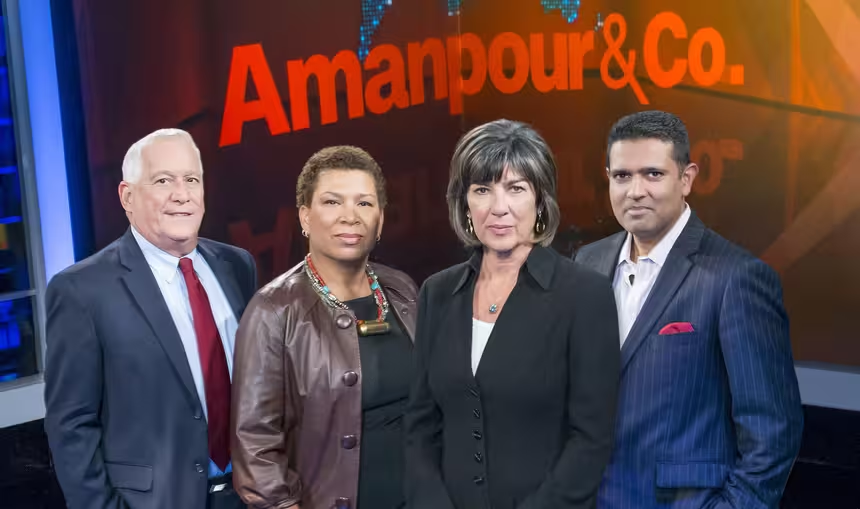
PBS and WNET, in collaboration with CNN, launched Amanpour and Company in September 2018. The series features wide-ranging, in-depth conversations with global thought leaders and cultural influencers on issues impacting the world each day, from politics, business, technology and arts, to science and sports.Providing Support for PBS.org
Learn Moreabout PBS online sponsorshipNow, the unvarnished portrait of a poet's final year, and the mission to make the most of every moment, "Come See Me in the Good Light" is the searing new documentary that follows Colorado poet laureate Andrea Gibson and wife Megan Falley as they confront Gibson's terminal diagnosis.
Here's part of the trailer.
At first I thought it was a stomach bug, but when it started feeling like a stomach anaconda, my doctor convinced me to get a CAT scan.
This is the beginning of a nightmare, I thought.
But stay with me, y'all.
Because my story is one about happiness, being easier to find, once we realize we do not have forever to find it.
I wrote a new kind of bucket list.
To sit with the mourning dove who cries for her lost love.
To perform one last show.
Why don't we just root for me being alive, and if I'm not, I will not feel bad about not being there.
We're almost there, Ang.
We're almost there.
You got it.
To touch Meg's face, and a hundred times again.
Emotional indeed, and the film won the Audience Award at the Sundance Film Festival, and has been nominated for an Oscar.
Megan Falley and one of the film's producers, acclaimed comedian, Tig Notaro, joined Harish Srinivasan to discuss how they transformed a story about dying into a meditation on life.
- Christiane, thanks.
Megan Falley and Tig Notaro, thank you both for joining us.
Tig, let me start with you.
You've said this project began with kind of an unconventional pitch.
We're talking about poetry, cancer, non-binary.
What made you think that this was really a joyful, even funny story that should be told?
Well, Andrea Gibson is, I mean, undeniably an incredible poet with levels of depth.
One of my favorite things over the years of knowing Andrea was their sense of humor and the ability to talk about anything and then a second later laugh about nothing was off the table.
And so it just made for a very dynamic human being.
And, and that dynamic person fell in love with another dynamic person.
And, you know, when you have that, those qualities in somebody or people, that's gonna make for an interesting subject or two to follow.
I wrote a new kind of bucket list.
It isn't an index of wild adventures.
It requires no bungee jumps, wingsuits, or hot air balloons, no passport stamps or dolphin swims.
As riveting as those things may be, none of them ignite me as much as what most of us were taught to think of as the little things.
Megan, we learned that this was not sort of like love at first sight per se, that you were friends, you're kind of on the poetry circuit.
What made you attracted to them?
As Tega was saying, Andrea is definitely an incredibly dynamic person, somebody with incredible depth and wisdom, but also a huge goofball.
Andrea and I fell in love right before their 40th birthday, and we were choreographing dance routines and making up parodies of songs.
And it felt like we were constantly two kids putting on a living room show when we were together for an audience of sometimes just ourselves.
And I think just the whole like, the spectrum of humanity fit in one like five foot four person, and they were incredibly lovable.
I think everyone who met Andrea fell a little bit in love with them.
Tig, someone even who is unfamiliar with Andrea's poetry gets a sense of what Megan just described, because there's lines in there, there's just really dark humor that you're, you know, you kind of have a license as an audience member to say, "Wow, I mean, if Andrew just laughed about that, I guess I can too."
I mean, these were clearly intentional choices from kind of a filmmaker's perspective of leaving these in there.
- I think it was something that between Ryan, the director, and Bernice, who edited the film, that they came to together, but there was also an understanding going into this project that there was going to be that openness.
There is that sense of humor, sometimes dark, sometimes, as Meg was saying, very goofy.
- Andrew is having a serious medical emergency, which is that their thumb is just coming off.
- I'm going to bring it up to the nurse when she comes back, because I think this might be a little bit more important than the tumors.
And, but I think that when things get dark, when you're able to find the right angle to cut in there with humor, the level of tension that it breaks is so astounding.
And I'm always blown away when people say that anything is off limits for comedy, because that's coming from the perspective of you think you know how they're gonna go in at it and you think and that's based on bad humor that didn't work but when someone comes in with that right slice it's the sweetest cut in the world because yeah again the the level of tension that it breaks and you go oh my god that's the way to get in to laugh about cancer that's the way in to laugh about death and and I just I don't know what's better than that I really don't it's a true gift but making there's you know conversation that the two of you have in the film about really the choice of words and how you have so many more words that you use when you speak and write versus Andrea that's the thing Mike you know so many words but one day we're gonna find out that all these words that Meg says are words aren't really words.
Okay let's take a vote what's more weird me knowing words as a poet and a writer or Andrea poet laureate knowing five.
Do you know how good of a writer you have to be to write as many poems as I have with five words?
It's interesting is this poetry even when you say that word it feels inaccessible to people and Andrea seems so intentional about not just the choice of words but making sure that they didn't write over people's heads.
Yeah, or hearts.
Yeah, Andrea and I, I just I love words and I love language.
So I might, Andrea and I could be driving and I would say, you know, point to the scenery and say, it's so bucolic.
And Andrea would be like, what the heck are you talking about?
And we had this joke because, you know, there's a famous saying, like, why say, why use like three words when you could use one, talking about the economy of language.
And Andrea would say to me, why use one word when you could use five or six?
Tig, what is the point of making a film like this?
Is this about an active choice to guide the film that this is about living, not necessarily about the end?
- I think what's so incredible, I remember when Ryan, the director, told me that he's never made a film before where the subjects never asked, "What story are we telling?
How do you have to be framed in the camera lens?"
There was pure trust in Ryan and Jess, the producer, and the crew, which was very small.
And having that openness and trust led to the moment of Ryan and Jess and everybody deciding like, "We can wrap this up."
We don't have... That was what they thought was like, "We don't need to see the hero die.
We can wrap this up now and leave it on this hopeful note," which is what the movie is.
People leave this movie with this sense of deep urgency about life.
Like, "What have I been doing with my time?"
And, "Oh, my gosh, thank you so much."
It's really something, because you can hear cancer and poetry, and it can paint this particular picture, but it's as dynamic as the subjects.
Megan, how comfortable did you get over time with a camera person somewhere in some of your most kind of intimate moments.
You're laying in bed together, you're in the kitchen, but there's also these scenes where Andrea is opening up an email to figure out what the latest sort of cancer score is and whether it's gonna be good or bad.
And the audience is watching, you know, it's almost like your lips are quivering, your anxiety.
Did you just forget that they were there?
Did they become kind of flies on the wall?
Yeah, they did not become flies on the wall.
They became friends who were in the experience with us.
And that happened really quickly.
The first day that we were filming, Ryan, the director told me, like, listen, you guys, we might film 1000 hours, and we'll cut it into, we'll use 1% of that.
So don't worry too much about anything that happens.
I think because of Andrea's impending mortality, and really, all of ours, but Andrea's awareness of it.
The idea of not forming intimate, close relationships with the people who were we were inviting into our home so frequently, that would have been the absurdity.
That would have been a ridiculous thing to do.
And so we both felt so grateful for those moments when we were opening those hard numbers, because we had built very quickly this beautiful community that was also holding us through it.
Tig, you've been public about your own experiences with cancer, and I wonder if that at all influenced or shaped your decision to be involved with this project and why you thought people should see Andrea maybe beyond the disease?
- Yeah, I mean, I haven't thought about that before because as soon as this idea was presented by Steph Willen, the other producer on the movie who is also an old friend of Andrea's, it was like the most obvious thing.
I couldn't even believe that I didn't think of it myself.
I feel so lucky that my story turned out differently.
Everything that I do is informed by my cancer diagnosis and making it through that and making sure that you can't help but be tethered to this reminder once you've gone through something like that.
And you can kind of slip away in moments of life 'cause you're human, but I'm forever tethered to what I went through.
And this was just an opportunity to kind of stay in that thankful elevating space, if that makes sense.
- Megan, you know, I think something revealing for a large part of the audience will be how Andrea's exes are part of this extended family now.
And you said something really powerful, which is that so many people don't realize that queer individuals lose so much family when they come out.
and that they work really hard to hold on to those people because it's family.
How is that family supporting you now as you're going through grief?
- Well, right now they're at home watching my dogs so that I can travel with this film.
And that is one of the major sports.
Andrea has a poem written about their best friend, Emily, called "Angel of the Get-Through" and it's a love poem for their best friend.
And Emily has really become my angel of the get-through throughout this time.
We're operating Andrea's business together and working to keep their legacy alive.
And I've also, this "Come See Me" and the Good Light family has just... I feel like what is on top of their minds at all time is like, "How can we take care of Megan better?"
And I don't know if it's a conscious discussion at all, or if it's just innate in every single person involved.
But the way that the caregiving has transferred from my role of giving to now my role of receiving by all these friends and beautiful people, it just feels like the most complete cyclical nature of love.
Like I don't so much so that it doesn't even feel like I've lost my love.
I just feel like it's changing, changing forms.
That's really, it's really touching.
I mean, because I remember the scene where Andrew was saying, Oh, you know, one of the things that I'm really gonna regret about this is that I'm not going to be around to help Megan.
And even at that moment, like, how am I going to be there for you?
And that there is this community that's helping you now is something that I'm sure Andrew would be incredibly happy about.
Tig, I wanted to ask, I mean, what do you hope that people carry forward from this, that are watching this, not knowing Andrea Gibson, not knowing any of the backstory, what do you want for them?
As I was saying before, that tethered feeling I have to the insight I got, I always say that like, my experience, I felt like I was on the edge of the universe and I thankfully was pulled back and it's hard to unsee what I saw and unfeel what I felt.
And as Andrea said, that they hope people don't wait for a diagnosis like this to start living their lives.
And it's so hard as a human being to stay in that sweet spot of gratitude.
But I really hope, because this could be the closest somebody comes to a diagnosis like that, is falling in love with Meg and Andrea in this film and becoming really in touch with and present to that feeling of live your life.
But that's what I hope is that, as Andrea said, to not wait for the diagnosis and let your love for these people be your close call, and that it stays with you.
Megan, what did Andrea, I guess, teach you that you hope people understand?
I think that the message that was really important to Andrea to relay to others is that we think when certain, what we might categorize as bad things happen to us, that we have to meet them with this like prescription of emotion.
So whether that's like, we have to feel sad when this thing happens, or we have to feel angry or bitter or resentful, or this, this induces rage, and this induces apathy, or, and Andrea really believed that this film would help not just people with cancer see that they didn't have to meet cancer with resentment or bitterness or anger or grief or, but that anyone going through anything challenging in life could meet that moment with joy, with acceptance, with love, with reverence.
And I think that, that being with Andrea, experiencing that firsthand, I had to become permeable to that mindset so that I wouldn't hold Andrea back when they were going through what was really the greatest journey of their life.
The film is called Come See Me in the Good Light.
You can see it now on Apple TV.
Tig Notaro, Megan Falley, thanks so much for your time.
Thank you.
Thank you.

- News and Public Affairs

Top journalists deliver compelling original analysis of the hour's headlines.

- News and Public Affairs

FRONTLINE is investigative journalism that questions, explains and changes our world.
Urban Consulate Presents











Support for PBS provided by: