
April 1, 2026 - PBS News Hour full episode
4/1/2026 | 57m 46sVideo has Closed Captions
April 1, 2026 - PBS News Hour full episode
Wednesday on the News Hour, President Trump again signals the war with Iran could end soon, but gives mixed signals on how that might be accomplished. The Supreme Court hears the Trump administration's case for ending birthright citizenship. Plus, after a trial that captured the world's attention, Gisèle Pelicot speaks out about her abuse at the hands of her husband and dozens of strangers.
Problems playing video? | Closed Captioning Feedback
Problems playing video? | Closed Captioning Feedback
Major corporate funding for the PBS News Hour is provided by BDO, BNSF, Consumer Cellular, American Cruise Lines, and Raymond James. Funding for the PBS NewsHour Weekend is provided by...
Support provided by:

April 1, 2026 - PBS News Hour full episode
4/1/2026 | 57m 46sVideo has Closed Captions
Wednesday on the News Hour, President Trump again signals the war with Iran could end soon, but gives mixed signals on how that might be accomplished. The Supreme Court hears the Trump administration's case for ending birthright citizenship. Plus, after a trial that captured the world's attention, Gisèle Pelicot speaks out about her abuse at the hands of her husband and dozens of strangers.
Problems playing video? | Closed Captioning Feedback
How to Watch PBS News Hour
PBS News Hour is available to stream on pbs.org and the free PBS App, available on iPhone, Apple TV, Android TV, Android smartphones, Amazon Fire TV, Amazon Fire Tablet, Roku, Samsung Smart TV, and Vizio.
Providing Support for PBS.org
Learn Moreabout PBS online sponsorshipAMNA NAWAZ: Good evening.
I'm Amna Nawaz.
Geoff Bennett is away.
On the "NewsHour" tonight: President Trump again signals the war with Iran could end soon, but gives mixed signals on how that might be accomplished.
The U.S.
Supreme Court hears the Trump administration's case for ending birthright citizenship.
And after a trial that captured the world's attention, Gisele Pelicot speaks out about her repeated abuse at the hands of her husband and dozens of strangers.
GISELE PELICOT, Author, "A Hymn to Life: Shame Has to Change Sides" (through translator): To be able to continue living, I have to rebuild a new perspective and almost invent it and also understand who I am.
(BREAK) AMNA NAWAZ: Welcome to the "News Hour."
The Trump administration is sending more military forces to the Middle East, while at the same time claiming Iran has asked for a cease-fire, a claim Iranian officials say is not true.
Meanwhile, one month into the war, President Trump is scheduled to address the nation later this evening.
He's expected to provide an update on the war effort and reiterate why he believes it was necessary for the United States and Israel to attack Iran.
Nick Schifrin begins our coverage.
NICK SCHIFRIN: In downtown Tehran today, the smoky aftermath of strikes in and near the former U.S.
Embassy that for decades has been controlled by Iranian forces.
And the U.S.
military continued to strike Iran's missiles, drones and defense industrial base.
DONALD TRUMP, President of the United States: We're finishing the job, and I think within maybe two weeks, maybe a couple of days longer, to do the job.
NICK SCHIFRIN: The U.S.
and Israeli strikes have led to the administration's public confidence.
MARCO RUBIO, U.S.
Secretary of State: And we can see the finish line.
It's not today, it's not tomorrow, but it is coming.
(BELL RINGING) NICK SCHIFRIN: The positive rhetoric has rallied the markets and reduced oil prices.
But the reality is more relentless.
For the fifth time today, Israelis headed to their bomb shelters after debris from a shot-down Iranian missile crashed into an apartment outside Tel Aviv, leaving behind a dusty baby stroller and rocker.
Independent researchers say Iran's daily missile launches, while reduced, are still as high as dozens, despite one month of war.
And Iran's stockpile of highly enriched uranium remains inside Iran, even if it's believed buried under nuclear sites attacked by the U.S.
last year.
And the Islamic Revolutionary Guard Corps reiterated today that the Strait of Hormuz remains -- quote -- "firmly and dominantly under its control."
Even modest estimates are that the reduction in oil and liquefied natural gas will stunt many countries' economic growth, International Energy Agency Director Fatih Birol warned today.
FATIH BIROL, Executive Director, International Energy Agency: The loss of oil in April will be twice the loss of oil in March.
On top of that, you have the LNG and others.
So it will come through the inflation.
NICK SCHIFRIN: Given all that reality, today, President Trump reversed previous statements about the strait not being a core issue and wrote on TRUTH Social that Iran asked for a cease-fire and -- quote -- "We will consider when Hormuz Strait is open free and clear.
Until then, we are blasting Iran into oblivion or, as they say, back to the Stone Ages."
Iran's Foreign Ministry denied there were talks at all, as read out by a state TV news anchor.
MAN (through translator): Trump statements about Iran's request for a cease-fire are false and baseless.
NICK SCHIFRIN: And Iranian President Masoud Pezeshkian added in a letter addressed to the American people -- quote -- "Throughout its millennia of proud history, Iran has outlasted many aggressors.
All that remains of them are tarnished names in history."
But, today, President Trump shrugged off Iran's public threats, telling Reuters -- quote -- "I'm dealing with a very good chance that we will make a deal because they don't want to be blasted anymore."
He also said those blasts could resume even after the war ended -- quote -- "I will leave," he said, "and I will take everyone with me.
And if we have to, we will come back to do spot hits."
And he told multiple news outlets he was considering withdrawing the U.S.
from the NATO alliance because it hasn't supported the war in Iran, as Secretary of State Marco Rubio echoed on FOX News last night.
MARCO RUBIO: We are going to have to reexamine whether or not this alliance that has served this country well for a while is still serving that purpose, or has it now become a one-way street, where America is simply in a position to defend Europe, but when we need the help of our allies, they're going to deny us basing rights and they're going to deny us overflight?
NICK SCHIFRIN: But, back in 2023, then-Senator Marco Rubio pushed a bill that was signed by President Biden into law that blocks a president from withdrawing from NATO without two-thirds of the Senate approving, Amna.
AMNA NAWAZ: So, Nick, tell us about the president's address tonight.
What exactly do we expect to hear from him?
NICK SCHIFRIN: A White House official tells my colleague Liz Landers the president is expected to give an operational update on the war and reiterate once again what the administration says has been consistent goals from the beginning of this war, destroying Iran's missile and missile production, its navy, ending support for proxies and ending its ability to have a nuclear weapon once and for all.
As one diplomat told me today, that is the speech that most presidents would have given before the war, because that is essentially a case for the war itself.
And, as we pointed out in our package, the public emphasis from Rubio, from the president on this is that the military operation is succeeding.
And Iran's missile and drone inventory has definitely been reduced and its capacity to have it in the future been reduced.
But the reality is that those missile strikes continue, especially on Israel, as we saw today.
It still has what the president calls nuclear dust, the highly enriched uranium inside Iran, and it now has the stranglehold on the Strait of Hormuz.
AMNA NAWAZ: Speaking of the Strait of Hormuz, you have mentioned there the efforts behind the scenes to try to reopen that critical lane.
What do we know about what's going on?
NICK SCHIFRIN: Yes, so, in public, we have seen the president say, go get your own oil and we might withdraw from NATO because of what the Europeans haven't given us when it comes to this war.
But, in reality, in private, the U.S.
has been coordinating with European countries and the Gulf for an operation that would secure the strait, presumably after the war ends, or at least when a lot of the violence has reduced.
And, as a reminder, this strait is crucial for the world economy; 20 percent of the world's oil and natural gas usually flows through here, but right now it's been largely closed to any tankers other than those that Iran has agreed to let pass.
And so three European officials, one U.S.
official and one regional official tell me tonight that the plan is largely to create a global coalition that would escort tankers, or at least defend tankers, as they go through the British -- as they go through the Persian Gulf.
The British government today announced summits of three dozen countries and senior military officials in the coming days to coordinate that effort.
Now, Amna, this will not be easy.
There are not that many countries that actually have the naval assets to be able to send to the Gulf to do this.
And so these countries tell me that they are certainly hoping that President Trump and the U.S.
would remain in the theater after the war is -- quote -- "over," especially the Marine expeditionary unit, the MEU, that is there right now.
They are capable of, for example, splitting up onto tankers.
You see the Marine expeditionary unit practicing there.
They can sail alongside tankers to help the effort.
They bring enormous capabilities that could help get these tankers through the Gulf.
And alongside those Marines, a U.S.
military official confirms to me tonight that plane, the A-10, could help in this effort, but also help in other efforts if the president chose to escalate this war in the coming weeks.
AMNA NAWAZ: Meanwhile, that Strait of Hormuz is going to be the subject of a Security Council resolution tomorrow.
What does that say?
NICK SCHIFRIN: The idea here is to give international legal authorization for that military effort that I just described.
And according to a text that we obtained today, it says -- quote -- "The resolution authorizes member states acting nationally or through voluntary multinational naval partnerships to use all necessary means, to measure it with the circumstances to secure transit, passage and to deter attempts to close, obstruct or otherwise interfere with international navigation through the Strait of Hormuz."
I'm told by one diplomat on the council, even that language, which has been pared back, is an uphill climb to get to the nine votes they will need for this passage for tomorrow.
But if it is, it would give Europe, it would give the Gulf the legal authorization to have a military operation in the Gulf after the U.S.
and Israel essentially declare the war to be over in order to secure the strait moving forward.
AMNA NAWAZ: Nick Schifrin beginning our coverage tonight.
Nick, thank you.
NICK SCHIFRIN: Thank you.
AMNA NAWAZ: And you can tune in tonight at 9:00 p.m.
Eastern for our special coverage of President Trump's address to the nation on the war with Iran.
You can watch that here on your local PBS station or on our YouTube page or our Web site.
Well, there was an unprecedented scene at the U.S.
Supreme Court today.
Donald Trump became the first sitting U.S.
president to attend oral arguments in a case that will decide the fate of one of the biggest and most controversial policies of his second term.
Our justice correspondent, Ali Rogin, has more on the consequential legal debate before the justices.
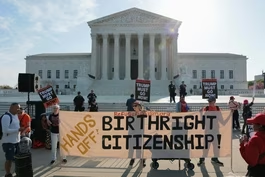
ALI ROGIN: On his first day back in office last year, President Trump signed an executive order seeking to end birthright citizenship, a cornerstone of immigration policy enshrined in the 14th Amendment to the Constitution and affirmed by the Supreme Court more than 100 years ago.
The principle is simple.
If you are born here, you are a citizen.
But now the justices are reexamining the core questions.
What makes an American citizen, and who gets to make the rules?
For a closer look at today's arguments and legal questions, we're joined now by our Supreme Court analyst and SCOTUSblog co-founder Amy Howe and Amanda Frost, professor of immigration and citizenship law at the University of Virginia.
Thank you both so much for being here.
You were both at the court this morning, and so was President Trump.
Amy, I want to start with you.
What was it like in the courtroom with him there?
AMY HOWE: So there's always a lot of security, and it's always a pretty solemn ceremony.
But there was sort of an extra layer of security, because, on top of the Supreme Court police, we also had a lot of Secret Service agents, extra police cars parked outside.
In terms of the president's presence himself, it really didn't make that much of a difference.
He sort of slipped in about 13 minutes before the argument started, and then he slipped out again shortly after his solicitor general, John Sauer, finished his time at the lectern.
There wasn't sort of an announcement that the president is here or that the president is leaving.
But the solicitor general himself, John Sauer, was very animated at the oral argument today.
And so whether or not that was a response to the fact that his boss was in the room watching, we won't know, but it certainly seemed possible.
ALI ROGIN: Did the justices have any response to President Trump being there that you could see?
AMY HOWE: None at all.
He was not acknowledged.
ALI ROGIN: Amanda, the administration sought to sort of give their argument as for what citizenship should really be defined as.
So what were they arguing makes a citizen, and how does it comport with these 100 years of legal precedent?
AMANDA FROST, University of Virginia School of Law: Yes, so this began on the first day of President Trump's presidency when he issued an executive order in which he said that birthright citizenship, which is guaranteed in our Constitution, he said it only applies to the children of U.S.
citizens and children of green card holders.
So that would exclude all the children of undocumented immigrants and also all the children born to temporary visitors, which includes people like H-1B skilled workers, student visa holders, as well as tourists.
So those are the arguments that we saw Solicitor General Sauer make today to try to support that executive order.
ALI ROGIN: And what was he trying to justify that on?
Is there -- was there language based in the 14th Amendment to the Constitution that he was saying indicates that position?
AMANDA FROST: So, yes, it all turns - - there's this one sentence in the 14th Amendment that said all persons born are naturalized in the United States and subject to the jurisdiction thereof are citizens of the United States.
So it all turned on that language subject to the jurisdiction thereof.
And the administration tried to say that's - - that language carves out all the children born to those two groups, the undocumented immigrants and the temporary immigrants.
ALI ROGIN: Amy, I want to ask you, what stood out to you in terms of what the justices were asking?
And did any of them seem particularly skeptical about the argument the administration was trying to make?
AMY HOWE: So, one of the things that really stood out was how much time the justices spent discussing an 1898 case called Wong Kim Ark.
So the 14th Amendment was intended to make clear that formerly enslaved people and their children were in fact U.S.
citizens.
But the Supreme Court in this Wong Kim Ark case held not only that it protects formerly enslaved people, but that essentially everyone, subject to a few exceptions, is a U.S.
citizen.
And so both sides in the case are relying on this 1898 decision.
The challengers in the case are saying, look, there's this 1898 case that says everyone is a U.S.
citizen.
The U.S.
government is essentially saying that case was different because the plaintiff in that case, who was born in the United States to the parents of -- who were Chinese nationals, went overseas, tried to come back to the United States.
Customs official said he's not a U.S.
citizen.
The Supreme Court agreed that he was.
But his parents had lived in the United States for a long time.
They were domiciled here.
And that's different from these temporary workers and people who are undocumented.
In terms of some of the conservative justices who were skeptical, Justice Neil Gorsuch was skeptical.
He said the 14th Amendment was enacted when we didn't have strict immigration laws.
There really wasn't such a thing as undocumented immigrants.
And if we looked at whether or not people were domiciled, perhaps a lot of people who are currently undocumented immigrants might in fact pass your test.
Justice Brett Kavanaugh also seemed skeptical of the government's position.
One of the government's arguments is that the United States is one of relatively few developed countries that has birthright citizenship.
And he, in essence, said, why should that matter with -- in terms of how we interpret the Constitution?
We should interpret the Constitution using U.S.
laws, U.S.
history.
That may be useful as a policy matter, but not how we should interpret the Constitution.
ALI ROGIN: Amanda, as somebody who looks very closely at the history of birthright citizenship, what were your main takeaways from the justices' questions today?
AMANDA FROST: Yes, a couple different points.
One is, Justice Barrett, so more often on the conservative side, she had some really hard questions for the solicitor general.
The solicitor general had argued that the children of undocumented immigrants are excluded, and he said they couldn't have intended to include the children of undocumented immigrants back in 1868 because no such category of people existed.
But, in fact, as Justice Barrett pointed out, there had been illegally imported slaves, people that were imported in violation of U.S.
law and enslaved in the United States.
And she said, of course, we all agree they're citizens, and the solicitor general agrees the children of those enslaved people are citizens.
And aren't they just in the same position?
They were illegally present.
They certainly didn't want to stay in the United States.
And she made that point as well.
One other point worth mentioning -- and this was both Justice Barrett and Justice Gorsuch -- it would be very, very difficult to implement the lines the government was trying to draw.
Back in 1868, we didn't have these immigration categories, so how would we determine whether someone was domiciled or not?
And that also goes to the original understanding and undermines the government's case.
ALI ROGIN: Amy, the administration's solicitor general, John Sauer, he pointed to how immigration has changed a lot since the 14th Amendment was ratified.
One of the examples he gave was that of birthright tourism, the practice of coming to the United States in order to give birth.
And that sparked a debate with Chief Justice John Roberts.
Take a listen.
JOHN ROBERTS, Chief Justice of the U.S.
Supreme Court: It certainly wasn't a problem in the 19th century.
D. JOHN SAUER, U.S.
Solicitor General: No, but, of course, we're in a new world now, as Justice Alito pointed out, to where eight billion people are one plane right away from having a child who is a U.S.
citizen.
JOHN ROBERTS: Well, it's a new world.
It's the same Constitution.
ALI ROGIN: Definitely going to be a memorable line there, "new world, same Constitution."
But this administration has made a practice of making these arguments that are sometimes very sweeping and dramatic and point to national survival, which is along the lines of what General Sauer was doing, but did any of the justices seem particularly compelled by that line of argument?
AMY HOWE: No, that was really the only time that birth tourism came up in the oral argument, and it sort of hearkened to me back to the tariffs argument, when the Trump administration had made claims about how important the tariffs were to the economy, and there was the famous line in the government's brief that, without tariffs, we would be a dead country.
And I think that the Supreme Court looks at some of these claims and says, well, that -- again, that may be true as a policy matter.
It may be sort of an interesting data point, but we're not going to let that factor into how we interpret the law in the tariffs case or the Constitution in this case.
ALI ROGIN: Amanda, several justices asked about the real-world consequences of changing birthright citizenship.
Here is what Justice Ketanji Brown Jackson asked about it.
KETANJI BROWN JACKSON, U.S.
Supreme Court Associate Justice: How does this work?
Are you suggesting that, when a baby is born, people have to have documents, present documents?
Is this happening in the delivery room?
How are we determining when or whether a newborn child is a citizen of the United States under your rule?
ALI ROGIN: If the court rules in the administration's favor, how transformative could that be?
AMANDA FROST: So the consequences of this executive order going into effect would be enormous.
So, first, it would prevent about a quarter-million children each year from gaining citizenship going forward, which they would otherwise have under the previous understanding of the citizenship clause.
It also would mean that every family who gives birth to a child going forward, and that's 3.5 million families a year, would have to prove their ancestry, their lineage before their child would be recognized as a citizen.
And, finally, I think it would change the meaning of what it is to be an American.
Born in the USA resonates with people, because that's the definition of American.
And if this executive order went into effect, it would change that for the nation.
ALI ROGIN: Amy Howe, Amanda Frost, thank you so much, both of you, for your insights.
AMANDA FROST: Thank you.
AMY HOWE: Thank you.
AMNA NAWAZ: Now for more on the president's unusual trip down Pennsylvania Avenue to the Supreme Court today, I'm joined by our Liz Landers at the White House.
So, Liz, let's begin with this remarkable moment of the president sitting in essentially as his own executive order is on trial.
What do we know about what's behind his unprecedented attendance?
LIZ LANDERS: Amna, President Trump has been talking about birthright citizenship since he launched his bid for the presidency in 2015.
And this has become a signature policy for the second Trump administration, immigration policy, and, in particular, clamping down on both illegal, but also legal pathways for immigration in this country.
They have managed to stop a lot of those southern border encounters.
But also, at the same time, we have seen in the past few months in particular ICE and CBP agents rounding up people throughout different American cities and deporting them.
And also Americans have been caught up in some of those actions as well.
This birthright citizenship is just another example of how the Trump administration is clamping down on both these legal and illegal pathways towards citizenship.
AMNA NAWAZ: Meanwhile, Liz, I know you have been talking to a number of your Republican sources today.
What are they telling you about how they're looking at this case and what the political ramifications of this court's decision could be for them, especially coming up with the midterm elections?
LIZ LANDERS: Amna, I spoke with one Republican who's close to the White House and in particular close to the political shop here, and this person told me that obviously if the Supreme Court sided with the president and ruled that birthright citizenship is no longer the law of the land, then that would be a big win for the president going into the November elections and could fire up his base, who is motivated by this issue of immigration.
But this person also acknowledged that overall this doesn't poll well in general with the American public.
Most Americans do support birthright citizenship.
This source pointed me to a Quinnipiac poll that came out last December that said that 70 percent of voters thought that the Supreme Court should keep this 1898 ruling in place and just 24 percent called on the court to reverse it.
In that same poll, they looked at Trump's overall handling of immigration issues, saying that 44 percent approved, while 54 percent disapproved.
Today, we heard some reaction from the president as he left the courthouse.
He posted on TRUTH Social a falsehood about birthright citizenship, saying that the United States is the only country in the world to allow this.
Amna, that is not the case.
There are a number of countries, including our neighbors to the north and the south, Canada and Mexico, that allow birthright citizenship, in addition to Argentina, Brazil, Pakistan, Peru, Venezuela, and other places -- Amna.
AMNA NAWAZ: And, Liz, as you have been reporting the president also continues to lie about some other issues as well, including widespread fraud in mail-in voting.
Last night, he just signed a related executive order.
That one delegates more authority to federal agencies to oversee elections.
It's already being met with a lot of pushback from some secretaries of state.
But what exactly does that attempt to do?
LIZ LANDERS: I want to be clear, Amna, that everyone that I have spoken with, both election attorneys, secretaries of state and other election officials in the country, have said in the last 24 hours to me that they do not think that this executive order is legal and will not stand up in court.
However, what the president is trying to do in this executive order is two things.
First of all, it's ordering the Department of Homeland Security secretary to compile a state citizenship list using information like Social Security data, naturalization records and other immigration records to determine who is eligible to vote.
Secondly, it would also direct the U.S.
Postal Service to create mail ballot envelopes with a bar code.
That would be used to track ballots that are put in through the mail.
And the United States Postal Service would also have to provide each state with a list of enrolled voters who are eligible for absentee and mail ballots.
Regardless of what this says, though, Amna, the president does not have constitutional authority over elections.
That is left to the states.
And then Congress has a limited role in overseeing election administration.
One top election official for Pennsylvania, a key swing state, the Republican Al Schmidt, he put out a statement saying that he's going to continue to ensure that voting is -- quote -- "not impeded by needless barriers justified by phantom threats of ineligible voters casting ballots."
Amna, Maine Secretary of State Shenna Bellows told me -- or said in a statement that it was laughably unconstitutional and she is not going to obey this order.
AMNA NAWAZ: And, Liz, to be clear, this mail-in voting method, it's the same one the president himself has used, right?
LIZ LANDERS: He used this in an election that happened just last week, Amna, a special Florida election.
He, his wife, the first lady and their son Barron all cast mail-in ballots.
I asked the president about this last week, asking him why he cast a mail-in ballot if he's repeatedly saying that this is not a reliable way of voting.
He didn't answer that question directly, but just said that he used the mail-in ballot because he's the president of the United States, he's busy, and, basically, that was the easiest option for him to use -- Amna.
AMNA NAWAZ: That's our White House correspondent, Liz Landers, reporting tonight.
Liz, thank you.
We start the day's other headlines with the latest on the partial government shutdown, which is now the longest in U.S.
history.
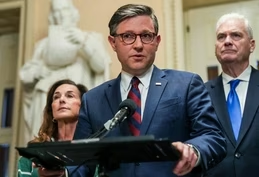
House Speaker Mike Johnson and Senate Majority Leader John Thune say they have agreed on a path to fund the Department of Homeland Security through September.
The plan would omit funds for Immigration and Customs Enforcement and Border Patrol, the agencies most directly responsible for President Trump's immigration crackdown.
Republicans would try to negotiate to fund those agencies later through separate legislation.
Lawmakers could vote on the plan as early as tomorrow, though the outcome is far from certain.
U.S.
and Iraqi officials say an American journalist was warned of threats against her in the days before she was kidnapped from the capital of Baghdad.
An Iraqi official says Shelly Kittleson entered Iraq from Syria prior to her abduction.
She remains missing.
Security footage obtained by the Associated Press appears to show the moment when two men push a person believed to be Kittleson into the back of a sedan in broad daylight.
Iraqi security forces say they have arrested one suspect.
U.S.
officials allege she was taken by Kataib Hezbollah, an Iran-backed militia operating in Iraq.
That group has not claimed responsibility.
Parts of the Israeli-occupied West Bank observed a general strike today.
Residents were protesting a new Israeli law that applies the death penalty for Palestinians convicted of murdering Israelis, but not the reverse.
Shops were closed and streets emptied in places like Hebron and Ramallah, as locals called on the international community to step in.
The pushback also took on more vocal forms.
(CHANTING) AMNA NAWAZ: In Ramallah, demonstrators carrying Palestinian flags and banners chanted "Freedom for the people."
One Palestinian politician says the measure is proof that Israel is not interested in peace.
MUSTAFA BARGHOUTI, General Secretary, Palestinian National Initiative: This law reflects how deep fascism has become, and this law is a reflection of how deep the system of apartheid against Palestinians is consolidated here.
AMNA NAWAZ: The law has drawn international criticism since its passage on Monday.
The U.S.
has not commented.
In Ukraine, a rare daytime drone attack by Russia killed at least four people in the center of the country, with other strikes hitting Ukraine's energy infrastructure.
In Western Ukraine, charred remains were cleared after a strike caused extensive damage on a warehouse and postal terminal.
Ukrainian President Volodymyr Zelenskyy condemned the attacks, as he continues to push for an Easter cease-fire.
In his nightly video address, Zelenskyy said he spoke with U.S.
officials on ways to, as he put it, strengthen diplomacy.
VOLODYMYR ZELENSKYY, Ukrainian President (through translator): I spoke to the American team today, in particular about this Russian attack.
Other signals are needed, and a truce on Easter could be just the signal that tells everyone diplomacy can be successful.
AMNA NAWAZ: A Kremlin official today dismissed Zelenskyy's truce proposal, calling it a P.R.
stunt.
In the meantime, Russia's Defense Ministry says its troops have taken full control of Ukraine's Eastern Luhansk region.
Kyiv disputed the claim, saying small areas are still held by Ukrainian forces.
Russia has previously made false claims of such advances.
Back here, the Food and Drug Administration approved Eli Lilly'S new weight loss pill, which will be branded as Foundayo.
It's the second daily oral medication to hit the U.S.
market after the Wegovy pill by Novo Nordisk, and it is expected to ship as early as Monday.
In trials, the company reported that people with obesity lost an average of 12 percent of their body weight after 72 weeks.
The drug will cost as little as $25 a month for those with insurance, though that goes up to $349 for the uninsured.
Kid Rock has welcomed news that the Pentagon lifted its suspension of the Army pilots who flew two helicopters near his home last weekend.
The musician and vocal Trump supporter reposted a statement from Defense Secretary Pete Hegseth that read -- quote -- "No punishment, no investigation.
Carry on, patriots."
Kid Rock posted videos this weekend in which he salutes one of the helicopters as it hovered outside his Nashville area home.
That prompted an internal Army investigation.
The helicopters also flew over a No Kings protest in the area, which some attendees viewed as intimidation.
SpaceX has reportedly filed paperwork for what could be the largest stock market listing in history.
Multiple media outlets reported the filing today, with some saying the stock could value the rocket and satellite maker at more than $1.7 trillion.
That could make its founder, Elon Musk, the world's first trillionaire.
In the meantime, on Wall Street today, stocks added to yesterday's gains amid ongoing hopes for an end to the Iran War.
The Dow Jones industrial average rose more than 200 points on the day.
The Nasdaq jumped 250 points, or more than 1 percent.
The S&P 500 also closed in positive territory.
And Apple is celebrating 50 years of ingenuity and innovation, setbacks and success.
On this date, in 1976, founders Steve Jobs and Steve Wozniak signed a two-page document that first created the company.
A year later, they had their first big success with the Apple II computer.
The company hit a rough patch in the 1980s, which saw Jobs leave the company.
He later came back, as did Apple, thanks to the iPod, iPhone and iPad.
And fun fact, if you bought 100 shares of Apple stock when it first listed in 1980 at $22 a share, you would have more than $5 million today.
If only.
Still to come on the "News Hour": rape survivor Gisele Pelicot authors a new book about her ordeal that sparked a global outcry; and the Artemis II rocket aims for the moon in NASA's latest mission.
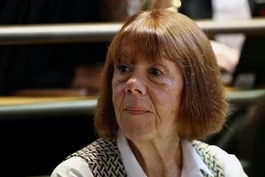
One November day in 2020, Gisele Pelicot was called to a local French police station, and life as she knew it ended.
Evidence mounted that her husband of 50 years had been secretly drugging and raping her and inviting dozens of strangers into their home to abuse her for nearly a decade.
Her resilience and resolve in a trial of over 50 men later led to a reckoning about sexual abuse and revealed the power of one woman's voice.
I met with Pelicot this week for a rare interview to discuss the publication of her memoir, "A Hymn to Life," with the subtitle "Shame Has to Change Sides."
And I began by asking her what it's like for her to now have her story out in the world.
GISELE PELICOT, Author, (through translator): I thought that my book could be useful, and to tell my story could tell the others who are victims of sexual violence that we have the resources within us to get back up and, through my story, where I write about a family saga of three generations of women that gave me the strength and this happiness in life, because they also lived through disease and grief.
But I always saw them as strong.
It is really this happiness that did not leave me throughout my childhood, and this resilience that is something within me.
AMNA NAWAZ: The more you speak about it, does it get easier at all to talk about all of this?
GISELE PELICOT (through translator): Easier, I don't think so, because I lived 50 years with Mr.
Pelicot, and it was my choice to live with him.
And I had three children.
And I always thought that these 50 years were not all a lie.
To be able to continue living, I have to rebuild a new perspective and almost invent it and also understand who I am.
AMNA NAWAZ: Before we go into more detail about your case, tell us about the man that you thought you were marrying, because, as you note in the book, you were very young when you both met.
You were escaping your own traumas.
He was escaping a very abusive household as well.
Who did you believe you were marrying 50 years ago?
GISELE PELICOT (through translator): So, when we met, we were two 19-year-old kids.
He had very difficult moments, a tyrannical and authoritarian father.
And I had a stepmother who was not loving, not loving at all.
It was another way to convince ourselves that we could save each other and that we could help each other.
And that's what I believed for many years.
We had to learn together, but we had always gotten over the obstacles, disease, financial challenges, and problems at work.
AMNA NAWAZ: You were living this very idyllic life, retired in the South of France.
You have a pool in the house.
The grandkids come to visit.
And everything changes in a moment when your husband reveals to you he's been arrested.
He was caught filming up women's skirts in a local store.
The police will want to talk to you.
In that moment, to be confronted with this with a man you have spent most of your life with, what is that like?
GISELE PELICOT (through translator): It was a moment where it was hard for me to understand what happened, because we have chosen this place to have a peaceful retirement, to be able to receive our children and our grandchildren.
It was a magical place to make others happy.
And when Mr.
Pelicot told me that he was caught filming under women's skirts, I was destabilized, because he had never done anything to me.
I have never seen him do anything out of place, like, suspicious or violent towards women.
I had to confront the reality, but I told myself that maybe he had these urges, and maybe I could help him, get him a psychological evaluation, and ask for forgiveness from these women.
AMNA NAWAZ: In that moment, Mr.
Pelicot knew that the police knew more about his crimes.
They have his computers.
They will have found the videos at that point, a file, a folder on his computer labeled abuse, videos of you being raped repeatedly by him, by dozens of other men while you were drugged into unconsciousness.
He doesn't tell you any of that, though.
The police have to tell you that.
When you're presented with this evidence and told what has been happening for the last decade, what goes through your mind?
GISELE PELICOT (through translator): It was very hard for me to imagine that it was true, and I thought it was Photoshopped videos.
I even thought that maybe somebody had something against Mr.
Pelicot.
Maybe it was a form of denial, but I think my brain really dissociated.
I could not realize the evil things that he had done.
Because the images were very violent, for me it was intolerable, so my brain dissociated.
And it's when I got home that, after five or six hours, I pronounced for the first time the word rape to a friend that came to see me so I could go sleep at her house that night.
That day, it's true that my life stopped.
It was very difficult and very painful.
We cannot imagine something so vile, so inadmissible, so unthinkable.
Everything was falling apart in my life at that moment.
AMNA NAWAZ: There are almost incomprehensible numbers.
You lay out in the book and we have seen in reports over 70 men in those videos, over 200 rapes.
For the man that you loved and shared your life with, to even do this once would be an extraordinary betrayal, but how do you begin to reconcile the scale of the deception and the abuse?
GISELE PELICOT (through translator): It was for like 10 years I had these memory lapses.
I consulted with neurologists, with gynecologists.
Nobody understood what was happening to me, also because we could not imagine that a woman who was accompanied by her husband, nobody could imagine that she was being drugged within her own home.
I am lucky that my body held up.
AMNA NAWAZ: You also write in the book that it's left to you to have to tell your children, your adult children.
And that, on top of your own trauma, your own shock, you, as a mother, you have to try to carry their trauma and their shock and their pain.
What is that like in that moment?
GISELE PELICOT (through translator): That was the hardest moment of my life, to call my children, because I did not know how to explain all of this.
This feeling of betrayal, everyone felt it.
It was complicated for them because they did not choose their father.
I chose him, and they did not.
So, for my children, they wanted to erase everything.
They wanted to destroy everything, because it was unbearable.
How could he have betrayed us like this, lie to us like this and hurt us this way?
The children still suffer.
AMNA NAWAZ: Your sons, your two sons deal with this in their own way, but your daughter Caroline, she struggles immensely, as you document.
And it's especially after photos of her are found on your husband's laptop, photos of her while she's sleeping she didn't know about, photos you describe as having what you call an unbearable incestuous gaze.
And so she naturally questions whether she herself could have been abused by her father.
Madame Pelicot, do you believe that Monsieur Pelicot could have abused your daughter, Caroline?
GISELE PELICOT (through translator): There are two photos that make us question what happened where she is in a hoodie and underwear.
She looks like she's sleeping on her side.
But there's no answer, because we don't see anything.
We don't see Mr.
Pelicot raping her or other people.
Of course, this incestuous gaze upon his daughter is intolerable, and I understand that Caroline is suffering.
And, for her, this doubt condemns her to a continuous hell.
And she filed a complaint against her father, and I hope that she will have answers.
Me today, I don't have an answer, but I try to be with her as she looks for the truth.
Now we're back to this mother-daughter relationship like we had before.
But this story has destroyed our lives, and we're trying to heal altogether.
AMNA NAWAZ: I'd like to ask you about the trial, because you write in the book that, for years, you resisted, you refused watching those videos, I assume as a form of self-protection.
But before the trial, your lawyers tell you that you should to be ready.
So, you watch these videos of your own assaults, one after the other.
And I'm curious, when you have so deliberately held this boundary for so long, and suddenly that boundary is gone, what changes for you, if anything?
GISELE PELICOT (through translator): These images are etched in my memory forever.
When we see the body of this abused woman who is given to these men who have no pity, we cannot describe videos of such horror.
So it helped me to think that this woman was not me, because she was just like a rag doll who had no more soul, no more life, who was being abused.
I told myself that I had to take the punches like a boxer, and I watched the videos one after another.
But, after a time, once I had finished screening the videos, I needed to walk for hours to tell myself that I have to do something.
I have to expose all these individuals so that they will pay dearly for what they did.
It was for them to bear the burden of shame, not the victims.
AMNA NAWAZ: There are over 50 men in that room, the largest mass rape trial in French history.
It is you against 50 men.
And you make what many consider to be an astonishing decision, that you don't want this to be a closed trial, to make sure the public knows what's happening inside that room.
Why?
GISELE PELICOT (through translator): I felt invested and felt like I had a responsibility.
And I had thousands of letters who came from all over the world that were just addressed to Gisele Pelicot France or Avignon.
I never thought that my voice could echo throughout the world beyond our borders.
And a lot of women identified with me, because it was an echo to their own suffering.
AMNA NAWAZ: For the first time, in that room, you are confronted with the faces and the voices of these men who committed unspeakable acts of brutality against you.
What's it like to see them there in that room?
GISELE PELICOT (through translator): What is shocking is that, when we see them, they are ordinary men.
Some are very young, from 22 to 70 years old.
I am not sure they even realize why they were there, because their behavior looked rather detached, without any empathy towards the victim.
They were even in denial and acted with cowardice.
That's what I lived through in these 3.5 months of trial.
I had to confront their lies, their denial, their sarcasm, their inappropriate looks.
The women who were outside made everything inside the trial more peaceful, there with the applause when I got out and when I came in, in the morning.
I believe that, without that support, it would have been even harder for me.
AMNA NAWAZ: So, Monsieur Pelicot is found guilty, sentenced to 20 years in prison.
And every other single man in that room is also found guilty.
Is it a moment of relief or justice?
GISELE PELICOT (through translator): Not relief, no.
I believe justice played its role and was able to name the crimes, recognize the suffering of the victim, and recognize that the crime should not go unpunished.
So that was a victory for me.
AMNA NAWAZ: Meanwhile, there are men who were not identified from the videos, who could not be caught, who are still out there.
What is that like for you to know that?
GISELE PELICOT (through translator): They must not have peace of mind, because they know that they must be watched from somewhere.
There are nine that we were unable to identify because their faces were blurred.
But maybe one day, we will be able to identify them.
AMNA NAWAZ: As you well know, your case, this trial, your story have now been splashed across global headlines, women showing up and chanting your name, Gisele, over and over again, becoming a global icon, someone that so many women look up to and find as a source of strength and resilience.
What's that like for you right now?
GISELE PELICOT (through translator): I am just a regular woman who was opposed to a closed trial.
I really like the word whistle-blower.
The historian Michel Perreault (ph) named me whistle-blower.
That is a word that describes me better, because I actually awakened people's collective conscience.
This is a name I like, and I believe that the next generation will continue the fight.
AMNA NAWAZ: You have also said that you would like to visit Monsieur Pelicot in prison.
Have you had a chance to do that yet?
GISELE PELICOT (through translator): No.
No.
First, I would not use the word chance, but I will go see him when I have a moment.
I have a very busy schedule.
No, I was not able to speak with Mr.
Pelicot since the 5.5 years of this trial, because every time I spoke to the president of the court when I had to speak to Mr.
Pelicot, yes, I have the intention of doing it, but that stays in my personal sphere.
AMNA NAWAZ: Why do you want to speak with him?
What do you hope you would get from that meeting?
GISELE PELICOT (through translator): I have the need to ask questions.
Why did he make us suffer this much?
Why did he not stop before?
Of course, these are questions that are still with me.
I don't know if I will be able to get answers, but I hope.
AMNA NAWAZ: I'm so happy to ask you about this as well, because, despite it all, you have found love.
You have found partnership and intimacy and trust, a man named Jean-Loup, who's here with you today.
And a lot of people will wonder how you do that.
How do you trust someone else after everything you have been through?
GISELE PELICOT (through translator): I believe that trust is part of the way I live.
It is true that I met this man.
I did not think that I would fall in love or even have wanted to, but life has changed trajectory.
And I met this young man of 73 years old, and he's also had some complicated times in his life.
Also, we met through friends, so I did not meet him randomly.
And I believe that changed our lives.
We hope to really enjoy our life together.
And he's with me and supports me while I do this book tour.
And I completely trust him, because we have the same values, and it's something very important.
AMNA NAWAZ: The book is "A Hymn to Life: Shame Has to Change Sides."
And the author is the extraordinary Gisele Pelicot.
Madam Pelicot (SPEAKING IN FOREIGN LANGUAGE).
Thank you so much.
GISELE PELICOT: (SPEAKING IN FOREIGN LANGUAGE) AMNA NAWAZ: For the first time in more than 50 years, the U.S.
is sending astronauts back toward the moon.
MAN: GLS is go for core stage engine start.
Integrity, good roll pitch.
MAN: Roger, roll pitch.
AMNA NAWAZ: Incredible stuff.
Just moments ago, NASA launched Artemis II from the Kennedy Space Center in Florida, sending a crew of four astronauts on a 10-day voyage around the moon and back to Earth.
If all goes as planned, they will travel farther into deep space than any humans before them.
The flight marks a key step in the broader Artemis program, which aims to put humans back on our moon's surface by 2028.
And joining me now from the Space Center in Florida is our science correspondent, Miles O'Brien.
So, Miles, take us into that moment.
What was it like to see liftoff there?
Just tell us what you saw and heard around you.
MILES O'BRIEN: Well, I have covered probably 40 shuttle launches in my career, and nothing was like this.
This was a much more powerful rocket, a rocket that is on its way to another celestial body, four people on board, lifted off the planet by an orchestra, a symphony of work on the part of a team here that put it all together.
There were some glitches in the countdown, which caused some concern, but, in the end, they worked them all out and they had a very clean ride to space.
They're now in space and beginning the process of checking out this vehicle on a test flight that will last nine days and take them around the moon.
AMNA NAWAZ: So, Miles, you mentioned a couple of glitches there.
I know folks who are watching may have seen some delays.
What was going on there?
What should we know?
MILES O'BRIEN: You know, in the end, it's minor stuff.
There was problems with some batteries and battery indications.
There was a loss of telemetry.
Briefly, there was concern about the launch termination system.
All of it got worked out.
I will say this.
There's been a lot of concern that this team here doesn't have enough practice, because Artemis has flown so infrequently.
But, clearly, they have done a good job practicing.
They worked these problems efficiently and they got this rocket into space safely, and so far, so good.
AMNA NAWAZ: So, Miles, stay with us.
I think we're having a few connection issues.
We will see if we can push through them here, because I'd love to hear more about what exactly this mission entails.
What are they hoping to do over the next nine or 10 days?
MILES O'BRIEN: They're going to take a long pass around the moon, and it's the first mission like in 53 years, since Apollo 17.
It begins a campaign which NASA hopes will lead to a permanent encampment on the moon and understanding how to live on a celestial body and do science there.
AMNA NAWAZ: And we want to reiterate here, of course, these astronauts are not going to land on the moon.
That's the work of Artemis IV down the line.
So what do they hope to pull from this that will help lead and help inform future missions?
MILES O'BRIEN: This is about wringing out the potential bugs in the space capsule, learning how to live in it, how to eat in it, how to cook food, how to go to the bathroom, make sure everything works well.
And then, ultimately, the most important thing is, will that heat shield do its job when they return?
It has to endure 5,000 degrees Fahrenheit heat as it comes in.
And, on Artemis I, they had some problems with it.
They made some redesigns and changed the flight plan.
Hopefully, that won't be an issue.
AMNA NAWAZ: So, there's a lot at stake for these four astronauts.
There's some firsts aboard that craft as well.
Tell us a little bit about the four astronauts on board this mission.
MILES O'BRIEN: It's one of the tightest crews I've ever seen.
Reid Wiseman, Navy test pilot.
Glover, who is his pilot and who is a Navy test pilot as well, he is the first African American to go to the moon, Christina Koch, who is the first woman to go to the moon.
And we have a Canadian astronaut, who is the first Canadian to go to the moon.
So it is a diverse crew, a crew that has been planning for quite some time for this moment, and we'll see how they do in space.
AMNA NAWAZ: So tell us about the journey that they're going on now.
I know they're traveling in NASA's newest spacecraft.
That's the Orion craft.
What should we know about what led to this craft taking off now?
What's it going to be like for them on board?
MILES O'BRIEN: Well, the Orion spacecraft is about the only thing that survives from the original George W. Bush Constellation plan to send astronauts to the moon, which was announced back in 2004.
The Obama administration canceled it, and what survived was Orion and a rocket called Space Launch System, which is derived from shuttle parts, shuttle solid rocket boosters, shuttle engines.
As a matter of fact, some of the engines we saw work today actually flew on the space shuttle, had been used on the shuttle.
And so that idea was to make it go faster.
But, in the end, it turned out using all those old parts, integrating them into the new system was -- actually slowed the process down.
AMNA NAWAZ: That is Miles O'Brien witnessing history there for us down at the Florida Space Center.
Miles, thank you so much.
MILES O'BRIEN: You're welcome.
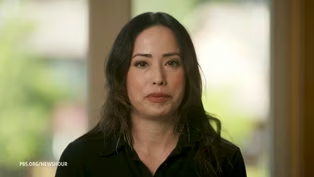
AMNA NAWAZ: Our Brief But Spectacular tonight comes from the Portland, Oregon-based multimedia artist Wendy Red Star.
She grew up on the Crow Indian Reservation in Montana, and her work celebrates Native identity.
WENDY RED STAR, Multimedia Artist: I grew up in a pretty funny family, so that will often show up in the work.
People might have that experience of looking at my work and feeling that it's ironic.
But, actually, what I think is happening is, I'm telling the truth.
I grew up on the Crow Indian Reservation in Montana.
What I remember was riding horses a lot with friends, going to an event that is held on the reservation every year called Crow Fair, wearing regalia that my grandma would make for me and my cousins.
When I was in undergrad at Montana State University, I was taking a Native studies class.
I came across this chief name Sits in the Middle of the Land, and he was important because he told the U.S.
government where Crow territory was.
And so he said: "My home is where my teepee sits."
And then he went to place the four poles in the major migration routes that we would travel throughout the season, and that mapped out like 38 million acres.
And within that was Bozeman.
And so I was really comforted to know that I was on Crow territory.
I wanted to make a piece that would honor that, and so I set up teepees around campus.
Historical images of Crow people have been a big source of inspiration for the work that I make, finding out their name and who they were and where that photograph was taken and the context of that.
Being an artist, making art, culturally, it is so important.
It's what we're remembered by.
I need to make art.
And if I don't make art, then I'm not fundamentally me.
So, I do know that really is important for my identity.
My name is Wendy Red Star, and this is my Brief But Spectacular take on channeling identity through art.
AMNA NAWAZ: And that is the "News Hour" for tonight.
I'm Amna Nawaz.
On behalf of the entire "News Hour" team, thank you for joining us.
 New
NewArtemis II launch sends 4 astronauts on mission around moon
Video has Closed Captions
Artemis II launch sends 4 astronauts on mission around the moon (5m 33s)
 New
NewA Brief But Spectacular take on identity and art
Video has Closed Captions
A Brief But Spectacular take on channeling identity through art (2m 29s)
 New
NewGisèle Pelicot chronicles resilience after abuse in new book
Video has Closed Captions
Rape survivor Gisèle Pelicot’s 'A Hymn to Life' chronicles resilience after abuse (14m 23s)
 New
NewNews Wrap: Johnson, Thune agree on path to fund DHS
Video has Closed Captions
News Wrap: Johnson, Thune agree on path to fund DHS through September (6m 11s)
 New
NewSupreme Court hears birthright citizenship case
Video has Closed Captions
Analyzing the arguments as Supreme Court hears birthright citizenship case (10m 2s)
 New
NewSupreme Court visit highlights Trump's focus on immigration
Video has Closed Captions
Trump’s Supreme Court attendance highlights his focus on immigration (5m 31s)
 New
NewTrump signals war could end soon, gives mixed signals on how
Video has Closed Captions
Trump signals Iran war could end soon but gives mixed signals on how (8m 18s)
Providing Support for PBS.org
Learn Moreabout PBS online sponsorship
- News and Public Affairs

FRONTLINE is investigative journalism that questions, explains and changes our world.

- News and Public Affairs

Amanpour and Company features conversations with leaders and decision makers.
Urban Consulate Presents











Support for PBS provided by:
Major corporate funding for the PBS News Hour is provided by BDO, BNSF, Consumer Cellular, American Cruise Lines, and Raymond James. Funding for the PBS NewsHour Weekend is provided by...