
April 27, 2026 - PBS News Hour full episode
4/27/2026 | 57m 46sVideo has Closed Captions
April 27, 2026 - PBS News Hour full episode
April 27, 2026 - PBS News Hour full episode
Problems playing video? | Closed Captioning Feedback
Problems playing video? | Closed Captioning Feedback
Major corporate funding for the PBS News Hour is provided by BDO, BNSF, Consumer Cellular, American Cruise Lines, and Raymond James. Funding for the PBS NewsHour Weekend is provided by...
April 27, 2026 - PBS News Hour full episode
4/27/2026 | 57m 46sVideo has Closed Captions
April 27, 2026 - PBS News Hour full episode
Problems playing video? | Closed Captioning Feedback
How to Watch PBS News Hour
PBS News Hour is available to stream on pbs.org and the free PBS App, available on iPhone, Apple TV, Android TV, Android smartphones, Amazon Fire TV, Amazon Fire Tablet, Roku, Samsung Smart TV, LG TV, and Vizio.
Providing Support for PBS.org
Learn Moreabout PBS online sponsorshipGEOFF BENNETT: Good evening.
I'm Geoff Bennett.
AMNA NAWAZ: And I'm Amna Nawaz.
On the "NewsHour" tonight: The accused gunman at the White House Correspondents' Dinner is charged with trying to assassinate the president.
What we know about the Secret Service' planning and response.
GEOFF BENNETT: Iran offers to open the Strait of Hormuz if the U.S.
ends its blockade.
AMNA NAWAZ: And Judy Woodruff reports on a controversial push to divide the autism spectrum based on the severity of the diagnosis.
ALICIA MESA, Mother: Parents like myself are exhausted.
He has the potential to disappear completely from the conversation.
(BREAK) AMNA NAWAZ: Welcome to the "News Hour."
The suspect who attempted to storm a press gala this weekend in Washington, D.C., has been charged with attempted assassination of President Donald Trump, among other federal weapons charges.
GEOFF BENNETT: If convicted, he could face up to life in prison.
Meantime, officials today confirmed a Secret Service agent wearing a bulletproof vest was shot during the incident and is expected to make a full recovery.
Our White House correspondent, Liz Landers, starts our coverage.
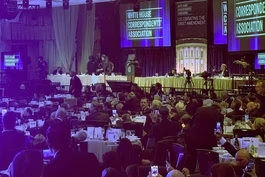
LIZ LANDERS: At a dinner celebrating the First Amendment and freedom of the press, at first muffled chaos, then Secret Service agents sprinting towards the main stage, the vice president quickly seized out of his seat and a frantic rush to encircle the president.
Agents swarmed the ballroom, climbing over chairs and tables in search of officials in the presidential line of succession, escorting them out first as over 2,000 journalists, high-profile guests and other government officials crouched under tables.
Just moments earlier in a hallway leading to the ballroom, a gunman stormed through the first layer of security.
A burst of gunfire followed.
The suspect, identified by officials as 31-year-old Cole Tomas Allen, was tackled to the ground.
He was armed with two firearms and knives.
Allen sprinted at least 60 feet before he was apprehended, reaching the top of a staircase that led to the ballroom.
At the bottom of the staircase, a set of doors opened to the room, with a clear vantage point of the president.
Allen was charged with the attempted assassination of President Donald Trump, as well as discharging a firearm during a crime of violence and transport of a firearm between states.
Acting Attorney General Todd Blanche called the incident an act of violence.
TODD BLANCHE, Acting U.S.
Attorney General: That horrible act was stopped because of the courage and professionalism of law enforcement, the officers who responded without hesitation and did their jobs as they were trained to do.
LIZ LANDERS: Officials say law enforcement fired five shots, while the suspect fired at least one shot.
One bullet hit a Secret Service agent, but did not pierce his bulletproof vest.
Shooting at the security barricades happened minutes after the event got under way.
In a hastily organized briefing after the incident, President Trump suggested his politics have made him a repeated target.
DONALD TRUMP, President of the United States: It's always shocking when something like this happens.
Happened to me a little bit, and that never changes.
LIZ LANDERS: Yet Saturday marked the third assassination attempt of President Trump in less than two years.
White House Press Secretary Karoline Leavitt today blaming the Democratic Party for threats to the president.
KAROLINE LEAVITT, White House Press Secretary: We disagree often, myself in this role and all of you in the news media, but those disagreements must remain peaceful.
Debating, peaceful protesting, and voting are how we need to settle disagreements, not bullets.
LIZ LANDERS: Though the president himself has threatened retribution against his enemies in the past.
Allen is believed to have traveled by train from California to Chicago and then to Washington, D.C., where he checked himself into the hotel where the gala was held.
DONALD TRUMP: It sounded to me -- I read the manifesto.
It's just -- he's radicalized.
He was a Christian believer, and then he became an anti-Christian.
And he had a lot of change.
He's been going through a lot, based on what he wrote.
LIZ LANDERS: On CBS's 60 Minutes, Trump lashed out when journalistic Norah O'Donnell read an excerpt of the suspect's reported writings.
NORAH O'DONNELL, CBS News Anchor: And he also wrote this: "I am no longer willing to permit a pedophile, rapist, and traitor to coat my hands with his crimes."
What's your reaction to that?
DONALD TRUMP: Well, I was waiting for you to read that, because I knew you would, because you're horrible people.
Horrible people.
Yes, he did write that.
I'm not a rapist.
I didn't rape anybody.
I'm not a pedophile.
NORAH O'DONNELL: Oh, you think he was referring to you?
DONALD TRUMP: Excuse me.
Excuse me.
LIZ LANDERS: The president also brushed aside conspiracy theories about the incident being staged.
NORAH O'DONNELL: I hesitate to ask you about this, but as you know, there's conspiracy theories out there on the left and the right that the event was staged or that it didn't happen.
And these conspiracy theories that are gaining traction on the Internet.
DONALD TRUMP: Well, and October 7 didn't happen, and World War II didn't happen, and the Holocaust didn't happen, and many things didn't happen.
Yes.
No, I hear it.
I don't know.
I think they're more sick than they are con people, but there's a lot of con in it too.
LIZ LANDERS: And even used the attack to make multiple pitches for his White House ballroom project, both on "60 Minutes" and in that press conference right after the incident.
DONALD TRUMP: They have wanted the ballroom for 150 years for lots of different reasons, but today's a little bit different, because today we need levels of security that probably nobody's ever seen before.
LIZ LANDERS: That security still praised by officials, despite reports it was lax.
TODD BLANCHE: We also should recognize what did not happen.
Law enforcement did not fail.
LIZ LANDERS: Yet questions remain, how to keep a president safe while he stays in the public eye.
GEOFF BENNETT: And Liz joins us now, along with Lisa Desjardins, our congressional correspondent.
You were both at the Correspondents' Dinner this past weekend when this all unfolded.
Walk us through what you experienced.
Liz, you first.
LIZ LANDERS: I heard the gunshots.
And at our table, we hit the decks.
We got under the table pretty quickly.
And I started recording on my phone.
I think that the instinct to be a reporter and document what you're seeing kicked in pretty quickly, so got some of that video.
And it was scary to be there and to not know what was happening.
And once we saw that the room was sort of stable and that the Cabinet secretaries had at least left, Amna and I tried to get out of the room to get cell phone service so that we could start doing reporting.
Outside of the ballroom, I ran into a White House official who was able to give us some preliminary information about the status of the president, vice president, and the first lady at that moment.
And then when we heard the White House Correspondents' Association president, Weijia, announce that the president was going to have a press briefing, I thought, OK, I have to get down to the White House for this.
And so... LISA DESJARDINS: And she said in 30 minutes.
LIZ LANDERS: And she said in 30 minutes.
Exactly.
So I thought, how am I going to do that in this amount of time?
The streets all around the Hilton were locked down.
I found a scooter and was actually able to hop on a scooter, get down to my apartment to grab my credential to get into the White House, scooted down to the White House and did make it in time for the president's briefing.
GEOFF BENNETT: And a photographer outside snapped that picture of you.
GEOFF BENNETT: So, Lisa, what was going through your mind?
LISA DESJARDINS: It's an incredible picture.
Liz's table was right on the aisle.
Mine was one row back from that.
Both of us were sort of closer to the back of the room, which is closer to where the shooting was up the stairs.
So I too heard the shots, but I heard also the crash of dishes.
A lot of people were confused.
Was this really a shooting?
Was this some crashing of dishes by a waiter?
But, instantly, I think training kicked in.
And just like Liz is saying, the professionalism and journalism, the training that we have, and also my experience of January 6 really kicked in, which was I think I know what to need to do and I need to make sure I know where all the exits are.
Make sure the team that I'm with is able to leave this room safely.
I need to watch law enforcement.
Are they yelling?
They weren't yelling.
That made me think, OK, there's not a threat in the room.
Now I can do my reporting.
I talked to several members of Congress.
They were mostly worried about their spouses.
The people most nervous in the room were those non-lawmaker spouses.
And I think, even in this moment, we should expect security at almost any number of events on the Capitol to change because of the people in that room and what they experienced.
GEOFF BENNETT: And, Liz, today, I know you have been speaking with your Secret Service contacts about presidential protection protocol.
What have they been telling you?
LIZ LANDERS: I spoke with two Secret Service agents today, and that agency has been under enormous scrutiny since the Butler assassination attempt happened against President Trump.
But both of these agents said that they felt that the agency and the training kicked in for what happened, for the incident, the shooting that happened on Saturday.
One of the points that people have been asking about is the time, how long the president stayed on the stage there on Saturday.
One of the agents that I spoke with said that the president, who said this in the "60 Minutes" interview, told the agents, wait a second, I want to see what was happening.
And this agent made the point to me that if they evacuated the president off the stage, and it had just been trays crashing, that would have sent panic throughout the room.
So that was one of the, I think, criticisms that the Secret Service is going to be answering.
And I do think that lawmakers on the Hill are asking for more answers and reporters are too.
GEOFF BENNETT: How is all of this landing on Capitol Hill, Lisa?
LISA DESJARDINS: We should expect hearings very soon, including with Secret Service and others.
But there's also a lot of questions about exactly who was there in the room.
It wasn't just the president and first lady at risk, of course.
Let's look at the line of succession and who was in the room.
Highlighted here, you see in yellow, those are people who were in the room.
You see right there, four -- five out of the first six in the line of succession.
And it wasn't just there.
Let's look at the rest of the Cabinet in the room.
These are those confirmed by the Senate.
You can see most of the Cabinet, most of the line of succession was in that room.
That's not unique, but it is unique for a hotel ballroom like that.
So there's double concern, especially that the suspected gunman seemed not to be all that well-trained, but did make it that far.
Still, there was a buffer between him and the president ultimately, but there are a lot of questions about this kind of event there.
Also, Republicans are raising the idea -- they say this is reason to fund the president's proposal for that big ballroom by the White House.
That is controversial.
Now, this was a private event.
This is not a kind of event that would ever happen at the White House.
So there are real questions about how exactly that would work.
GEOFF BENNETT: And what's next for the White House in all of this?
LIZ LANDERS: Well, we got a statement from a senior White House official earlier today, saying that the president does stand by the leadership of the Secret Service.
But, nevertheless, the White House chief of staff, Susie Wiles, is going to convene a meeting early this week with the White House operations team, the Secret Service, the Department of Homeland Security.
All of those leadership heads will be at the White House to discuss how to protect the president for major events going forward.
America celebrates the 250th anniversary of this country.
The president is supposed to attend a number of those events this summer.
There's also the World Cup happening here in the U.S.
So the president will be attending several large events, the White House saying that the president does have confidence in the Secret Service, but still taking these precautions, and Karoline Leavitt saying also from the podium today that security changes are never out of the question.
So we may see some changes to how the president moves and interacts in some of these political events.
GEOFF BENNETT: Liz Landers, Lisa Desjardins, our thanks to you and the entire politics team.
LISA DESJARDINS: Thanks, Geoff.
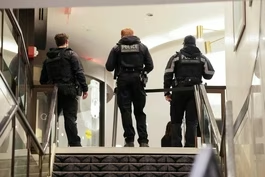
AMNA NAWAZ: For more on the questions surrounding Saturday's attack, let's turn now to Bill Gage, a Secret Service special agent for 12 years, including as a counterassault team leader.
He's currently executive protection director for the SafeHaven Security Group.
Bill, welcome to the "News Hour."
Thanks for joining us.
BILL GAGE, Former U.S.
Secret Service Agent: Hi.
Thanks for having me.
AMNA NAWAZ: So the attacker in this case did not make it into the ballroom.
No one was killed, thank goodness.
The White House has been saying, look, the security protocols worked.
The attorney general, acting attorney general, Todd Blanche said this was a massive security success story.
Do you see it that way?
BILL GAGE: I do see it that way.
Secret Service operates having sort of overlapping and concentric rings of security, sort of an inner perimeter, outer perimeter, middle perimeter.
And each of those perimeters are set up in a way that, if one of them sort of fails or is stretched, the overlapping one will sort of be able to stop an attacker.
And that's what happened here.
I think the acting attorney general has talked about how the attacker kind of breached.
I think he said some version of that, sort of breached the outer perimeter.
And so that's what happened here.
He was momentarily able to get through the magnetometer checkpoint by just sure speed before the agents working that main magnetometer checkpoint were able to engage him.
There also were agents stationed at the door and also on the inside of the event just inside the door.
So those were additional layers of security that he would have had to go through before sort of being able to fully carry out his attack.
So it did work here.
The Secret Service protective sort of model worked here.
But after each of these sort of incidents, the Secret Service studies political assassinations that happen all over the world and they use them to sort of refine and improve their own protective model.
I remember going as a young agent through training.
We studied these assassinations in depth.
And so what's going to happen here is the Secret Service is going to make changes to the protective model.
And, in fact, I think you're going to see some of those changes actually this week probably with the king of England visiting here.
There's going to be immediate impact to his security plan.
I think you're going to see those magnetometer checkpoints pushed out some and those checkpoints being staffed by additional agents, probably tactical teams.
So I think you're going to see an immediate impact.
AMNA NAWAZ: Well, let me ask you about this because I know you have been part of the preparations for these dinners in years past.
It's held at a working, functioning hotel, right?
It has been for 60 years.
There are other guests coming and going.
The fact that an armed assailant was able to check in with weapons and get as close as he did, even if he was stopped after that breach of the magnetometers there, what does that say to you?
Should there have been additional security measures or barriers in place here before the president of the United States was in there?
BILL GAGE: So, listen, that's a challenge for the Secret Service, right?
We're not a dictatorship.
We're not China or Russia, where Putin can go to a hotel and kick the guest out and shut the hotel completely down.
This event happens at a very public hotel in a major U.S.
city, right off of a very busy street.
And so it's very difficult for the service.
They have to strike a balance between getting a secure perimeter and securing the venue.
So you have to strike the balance between securing that venue, but also allowing the hotel to operate and not being overly burdensome on the hotel.
There are people there.
There are businesspeople, other travelers, tourists that are visiting that hotel at the moment.
They have nothing to do with the event.
And so the Secret Service has to strike a balance between not being overly intrusive to the day-to-day operations of the hotel, while also ensuring that they can have a secure venue.
So that's really part of the challenge.
And the service does it every day.
AMNA NAWAZ: Tell us about that balance and how it's struck, though, because our understanding is that this event reportedly was not given what is the highest level of security designation, a national special security event.
And yet you have the president, the vice president, the secretary of defense, senior Cabinet officials, members of Congress in the room.
Why doesn't it get that highest level security designation?
BILL GAGE: Yes, great question.
And so those National Special Security Events are called NSSEs, and those actually -- there's a whole procedure for an event to be designated an NSSE.
It has to be -- it's a joint agreement between Congress and the secretary of Department of Homeland Security.
So they sort of have to come together, reach an agreement.
It has to be designated an NSSE.
There's an entirely different budget procedure.
So it's not as simple as a president or somebody saying, hey, this event's going to be an NSSE.
There's been a procedure in place since September 11, since that part of the United States code set up the NSSEs.
And so, yes, was this a mistake probably that someone overlooked.
Most likely, yes, I think we can all agree that there should have been some more procedures in place.
One of the things that I talk about here is that the State of the Union, that happens every year.
We have to ensure the continuity of operations or the continuity of our government to make sure our government can function, we have a leader.
So the service, they operate that program for the designated survivor.
Why it wasn't done here, I don't know, but I think you're going to see moving forward you're going to see events like this that have all of the leadership and the members of the lines of succession in there.
There's going to be probably a designated survivor.
And one of the other things, let me just further the point here.
I think one of the things the service is going to improve on -- improve upon on their protective model here is going to be the evacuation of some of these other details for other Cabinet officials.
When you see some of the video footage, and I have seen it, where you have members of the government, very senior members, Kash Patel, the treasury secretary hiding under tables or motioning for their protective detail to come get them, and then you see RFK kind of stepping on people and being ushered out.
So that was a very chaotic moment for these other details of these other Cabinet officials.
So I think the Secret Service is going to improve that, where there's going to be some more procedures in place to evacuate some of these other Cabinet officials.
AMNA NAWAZ: So, if this dinner gets rescheduled, what are specific measures you would like to see in place?
BILL GAGE: The Secret Service is going to need to move those magnetometers further out from the entry doors, further out.
They're going to have to harden up those magnetometer checkpoints with additional agents and probably some tactical teams.
They're going to have to work on these evacuation plans if other members of the government are there.
And I think the Secret Service is going to probably, unfortunately, have to -- if it's at a hotel, they're going to have to start inconveniencing the hotel more than they already do.
Trump is the most threatened president in the history of the United States.
I mean, there's been three attempts now.
So I think the Secret Service has an incredible mission here.
It's a zero fail mission.
And they're going to have to improve, which I know they will.
They're going to study what happened on Saturday.
They're going to improve their protective model.
They're going to make immediate changes.
They probably already have.
So I think the magnetometers, pushing them out, hardening up the magnetometers, and also improving these evacuation plans I think are some immediate things that the Secret Service can do and what they will do for the next event if it happens.
AMNA NAWAZ: All right, that is Bill Gage, former Secret Service special agent now with the SafeHaven Security Group.
Bill, thank you so much for your time.
We really appreciate it.
BILL GAGE: Thanks for having me.
GEOFF BENNETT: Today, the U.S.
said it's discussing a new Iranian proposal to reopen the Strait of Hormuz, but pause all negotiations over at Iran's nuclear program.
AMNA NAWAZ: And Lebanon marked the deadliest day since the fraying cease-fire in that country went into effect two weeks ago.
Israeli attacks killed more than a dozen people in the south.
Nick Schifrin reports on tensions running high on the Israeli-Lebanese border and what appears to be an impasse in the war in Iran.
NICK SCHIFRIN: In the Strait of Hormuz today, tankers at a standstill, as the war's diplomacy is in a standoff.
Today, Iran's top diplomat visited with Russian President Vladimir Putin, a longtime ally who called Iran's struggle heroic.
And Foreign Minister Abbas Araghchi blamed the U.S.
for a lack of progress.
ABBAS ARAGHCHI, Iranian Foreign Minister (through translator): The Americans' approaches caused the previous round of talks, despite the progress that had been made, not to reach its objectives, the excessive demands they made and the incorrect approaches they adopted.
NICK SCHIFRIN: But an Iranian official and a senior regional official tell PBS "News Hour" Iran has made the latest proposal to reopen the strait if the U.S.
lifts its blockade, unfreezes blocked Iranian assets and pauses any negotiation of Iran's nuclear program.
The Iranian official said the U.S.
has already described this offer as not good enough.
KAROLINE LEAVITT, White House Press Secretary: The proposal was being discussed.
NICK SCHIFRIN: Today, at the White House, spokesperson Karoline Leavitt did not reject the deal out of hand.
MARCO RUBIO, U.S.
Secretary of State: They're very good negotiators.
NICK SCHIFRIN: But Secretary of State Marco Rubio told FOX News any deal would require Iran to dismantle its nuclear program permanently.
MARCO RUBIO: We have to ensure that any deal that is made, any agreement that is made is one that definitively prevents them from sprinting towards a nuclear weapon at any point.
NICK SCHIFRIN: And Rubio appeared to dismiss Iran's willingness to give up its choke hold on the straits.
MARCO RUBIO: And what they mean by opening the straits is, yes, the straits are opened as long as you coordinate with Iran and get our permission or we will blow you up and you pay us.
That's not opening the straits.
Those are international waterways.
They cannot normalize, nor can we tolerate them trying to normalize a system in which the Iranians decide who gets to use an international waterway and how much you have to pay them to use it.
NICK SCHIFRIN: But the fact is, that system did not exist before the war, a fact highlighted today by German Chancellor Friedrich Merz in extraordinary criticism of the U.S.
FRIEDRICH MERZ, German Chancellor (through translator): The Americans clearly have no strategy.
And the problem with conflicts like this is always that you don't just have to go in.
You also have to get out.
An entire nation is being humiliated by the Iranian state leadership.
NICK SCHIFRIN: This weekend, that Iranian leadership's main proxy, Hezbollah and Lebanon, marked the deadliest day since the cease-fire began two weeks ago, 14 dead, some celebrated at this Hezbollah funeral.
Israel is now demanding that residents in at least seven villages north of the Litani River evacuate above the area where Israel has invaded and occupied, leading once again to an exodus of residents from Southern Lebanon.
In that same area, Hezbollah continues to fight.
This weekend, Hezbollah released video of drone attacks on Israeli soldiers.
They killed 19-year-old Idan Fox, buried by his family today.
This sacrifice will continue until Hezbollah can no longer fire rockets or drones, Israeli Prime Minister Benjamin Netanyahu told senior military commanders today.
BENJAMIN NETANYAHU, Israeli Prime Minister (through translator): What I expect from you is to solve these two problems, because I believe we will be able to resolve the diplomatic aspect if we have solved these.
NICK SCHIFRIN: That diplomacy has been between Israel's and Lebanon's ambassadors in Washington.
But, today, Hezbollah accused the Lebanese government of treason during these talks.
Lebanon's president responded, accusing Hezbollah of its own treason for taking Lebanon to war to serve Iranian interests.
Back on the U.S.-Iran negotiations, an Iranian official tells me that Iran is unlikely to adjust its demands, despite what the official told me was the U.S.'
rejection.
And so the official called this moment -- quote -- "totally an impasse."
Iran won't give in to U.S.
nuclear demands, and the U.S.
hasn't been willing to give in to Iranian demands.
And so it's not clear how the two sides can find an off-ramp.
That said, the official told me Iran has been willing to consider a less-than-10-year freeze on domestic nuclear enrichment.
So far, that is not something the U.S.
has said it is willing to accept.
AMNA NAWAZ: In the day's other headlines: Tens of millions of people remain at risk tonight as dangerous storms batter the Midwest.
Parts of Missouri and Illinois in particular could see hail and possible tornadoes.
Weather officials say more than three inches of rain fell overnight in Kansas City.
The downpour comes after a weekend of violent storms across a number of cities, including in Northern Texas, where two people were killed.
WOMAN: You could hear the wind.
You could hear the sound of a freight train.
HERMAN WHITE, Mayor of Runaway Bay, Texas: Largest hail I have ever seen or heard in Runaway Bay ever since I have been here, 'since 85.
AMNA NAWAZ: The National Weather Service confirmed that a tornado with winds up to 135 miles an hour tore through Runaway Bay this weekend, a lakeside community northwest of Fort Worth.
Meantime in Georgia, firefighters are still working to contain two massive blazes even after a weekend of rain slowed them down.
State forestry officials say the damp weather wasn't nearly enough to put them out.
The largest fire has now topped 50 square miles and more than 100 homes have been destroyed.
The national fight over redistricting gained steam today with Florida Governor Ron DeSantis unveiling a new map that could help Republicans pick up as many as four seats in Congress.
The map was first reported by FOX News.
And it comes a day before the state's legislature is set to open a special session called by DeSantis with the goal of redrawing district lines.
Florida currently sends 20 Republicans and eight Democrats to Congress.
Meantime, Virginia's Supreme Court is debating whether to block a map that was approved by voters last week which could help Democrats pick up four seats there.
Britain's King Charles is in Washington, D.C., tonight as he kicks off a state visit steeped in history and set against present-day tensions.
Charles and his wife, Queen Camilla, touched down at Joint Base Andrews this afternoon before heading to the White House, where they were greeted by President Trump and the first lady.
The king's visit is intended to mark the 250th anniversary of America's independence from Britain.
But it also comes amid strained relations between the Trump administration and Britain's government due to disagreements on issues like the Iran war.
Ukraine and Russia traded strikes today, with a Russian official saying two people were killed in a Russian-controlled part of Ukraine's Kherson region.
Meantime, firefighters battled blazes in the southern Ukrainian city of Odesa after Russian attacks there injured at least 14 people, including two children.
President Volodymyr Zelenskyy said today Russia has fired over 1,900 drone attacks across Ukraine in the past week, along with aerial bombs and missiles.
The port city of Odesa itself has been a frequent Russian target since the start of the war more than four years ago.
United Airlines is dropping its pursuit of American Airlines for a possible merger.
In a statement, united CEO Scott Kirby tried to make the case that a combined company would benefit travelers and create jobs.
But he acknowledged the difficulty in moving forward after American said it was not interested.
It's the first time that United confirmed it had actually approached its rival over a possible merger.
Earlier this month, reports that Kirby had pitched President Trump on such a deal sparked concerns about competition in the sector and how it would impact consumers.
Meantime, on Wall Street today, stocks ended little changed amid ongoing uncertainty over the war in Iran.
The Dow Jones industrial average slipped about 60 points on the day.
The Nasdaq managed a slight gain of around 50 points.
The S&P 500 also started the week slightly higher.
In London, not one, but two long-distance runners officially shattered a historic barrier, completing a marathon in under two hours.
Kenya's Sabastian Sawe became the first person to do so in just one hour 59 minutes and 30 seconds.
Just 11 seconds later, Ethiopia's Yomif Kejelcha crossed the line as the second person to break the two-hour mark.
And he did so in his first ever marathon.
For those doing the math at home, that means Sawe averaged a pace of four minutes and 33 seconds a mile over the course of 26.2 miles.
And the last surviving member of the Ronettes, Nedra Talley Ross, has died.
Ross joined her cousins lead singer Ronnie and her sister Estelle Bennett on hits like "Be My Baby" and "Walking in the Rain."
With their powerful voices and beehive hairdos, the trio were icons of the 1960s, touring with the likes of the Rolling Stones and the Beatles.
They broke up in 1967 and were inducted into the Rock and Roll Hall of Fame four decades later.
Her daughter says that Ross died at home early yesterday.
Nedra Talley Ross was 80 years old.
Still to come on the "News Hour: the Supreme Court hears arguments over the weed killer Roundup; Tamara Keith and Amy Walter analyze the political fallout from the White House Correspondents' Dinner; and a controversial push to split the autism spectrum gains momentum.
GEOFF BENNETT: The U.S.
Supreme Court today heard arguments in a case that could reshape the yearslong legal fight over Roundup, the world's most widely used weed killer.
It's been a mainstay of industrial agriculture in the U.S.
and around the globe, but thousands of lawsuits allege that one of its key ingredients may be linked to cancer.
Our justice correspondent, Ali Rogin, has more on the debate before the court.
ALI ROGIN: For many years, researchers have debated if exposure to glyphosate, the herbicide and key ingredient in Roundup, causes cancer.
That debate has led to tens of thousands of lawsuits against Bayer, the company that makes Roundup, claiming it failed to warn consumers about potential health risks.
Bayer argues federal pesticide laws shield them and that the EPA has never declared their product contains cancer-causing ingredients.
Today's arguments unfolded against a backdrop of political tensions over pesticides, both within the Trump administration and the broader Make America Healthy Again movement.
To help us understand the potential real-world implications of whatever the court decides, we're joined by Helena Bottemiller Evich, founder of the Food Fix newsletter, who has been tracking the policy implications of this debate.
Helena, thanks so much, and welcome back to the "News Hour."
HELENA BOTTEMILLER EVICH, Food Fix: Thanks for having me.
ALI ROGIN: So, tell us, why do farmers and other folks in the agriculture business - - why is Roundup so widely used?
HELENA BOTTEMILLER EVICH: Yes, so it is the most widely used weed killer or herbicide in the U.S., and we particularly use it to raise crops like corn and soy and cotton.
And it is a really good way to handle weeds.
It is efficient, and, for decades, farmers were really marketed to that this was so much less toxic than other options.
And so it is commonly used.
It's also used in gardens and landscapes, around schools.
It is just very, very common in the U.S.
ALI ROGIN: What does this case boil down to in the Supreme Court?
HELENA BOTTEMILLER EVICH: So, really, at the heart of this is whether or not EPA has the final say on pesticides.
There's tens of thousands of cases where farmers and other occupational users of glyphosate have brought these cases.
They're arguing basically that the company didn't warn them of the potential risk of increase of cancer.
And so that's the issue.
It's either preemption or states' rights, and we will see what they decide.
ALI ROGIN: And while the justices weigh these regulatory questions, what do we know about the stated health risks and the unknowns of using Roundup?
HELENA BOTTEMILLER EVICH: Yes, so EPA has long maintained, has maintained for decades that glyphosate is not likely to be a human carcinogen.
But not everyone agrees with that assessment.
So, back in 2015, the International Agency for Research on Cancer, they determined -- that's a WHO panel -- they determined that it is likely to be a human carcinogen.
There's other places, like in the E.U., where they allow glyphosate, but they have much stricter controls on how it is used.
There is a really intense scientific debate about the extent to which glyphosate might be increasing cancer risk, particularly non-Hodgkin's lymphoma.
There is more evidence around the occupational uses, so think farmworkers, farmers, groundskeepers.
But a lot of the MAHA moms that you're hearing from right now are really concerned about the low-level residues found in food.
EPA maintains that these are below the levels that they would be concerned about, but there's a lot of worry, I think, of consumers about what the long-term implications of having these residues in our food supply might mean.
ALI ROGIN: Helena, earlier this year, President Trump issued an executive order which would boost domestic production of glyphosate, kind of going in the complete opposite direction of the MAHA movement and Health and Human Services Secretary Robert F. Kennedy.
What is the political debate here and is it driving a wedge between the Trump administration and the MAHA movement?
HELENA BOTTEMILLER EVICH: It has ripped open major tensions within this MAHA and MAGA coalition.
So, basically, when then-candidate Kennedy dropped out of the presidential race and endorsed Trump, we have created this MAHA-MAGA-like marriage.
And that marriage has been under strain as the Trump administration, as you mentioned, continues to back Bayer, the German chemical company that bought Monsanto, which was the maker of Roundup.
Bayer has been supported by the Trump administration at every turn through an executive order.
The Trump administration is actually before the Supreme Court arguing on behalf of Bayer as well.
And so MAHA is furious about this.
They feel that it is a betrayal of what Kennedy and Trump argued for on the campaign trail.
ALI ROGIN: You were at the rally in front of the Supreme Court today with MAHA supporters.
They called it the People vs.
Poison.
What are your takeaways?
HELENA BOTTEMILLER EVICH: There was a lot of energy there.
There were definitely not as many people as they had anticipated.
I think they were expecting 1,000 people or more.
There were not that many people.
There were a lot of reporters.
But there was a lot of energy.
The moms I talked to there were really excited to protest.
A lot of them had never been to a Supreme Court rally before.
And it was bipartisan.
When you look at the polling on these issues, like more regulations of pesticides, it is broadly supported across Republicans, Democrats, and independents.
So... ALI ROGIN: Helena, we don't know how this is going to end up.
But if Roundup is forced to accept these warning labels alleging warning of cancer, are there alternative products out there?
What else is available to people who use these products?
HELENA BOTTEMILLER EVICH: Yes, one of the big concerns is that whatever replaces Roundup or glyphosate might be more toxic.
So that is a big concern in the agriculture community to look at potential replacements.
We don't really have a natural replacement for glyphosate at this point.
It is such a major part of the U.S.
agricultural system.
There is some technology coming down the pike with lasers zapping weeds, and, like, there's some other things that are coming down.
But those are very expensive.
Those are years away.
And I think it's going to be a while before those are really viable technologies.
Bayer has really expressed concern that if this liability -- if they continue to face billions in liability in the U.S., that they might have to pull glyphosate from the market.
The Trump administration has argued that would be catastrophic.
Not everyone agrees with that assessment, but it would be extremely disruptive.
ALI ROGIN: Helena Bottemiller Evich, founder of Food Fix, thank you so much.
HELENA BOTTEMILLER EVICH: Thank you.
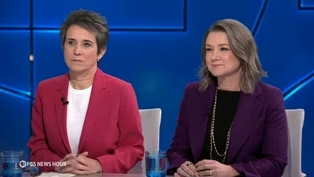
AMNA NAWAZ: To discuss the fallout from the White House Correspondents' Dinner shooting and another state's push for mid-decade redistricting, we turn now to our Politics Monday duo.
That is Amy Walter of The Cook Political Report With Amy Walter and Tamara Keith of NPR.
It's great to see you both.
AMY WALTER, The Cook Political Report: Hello.
TAMARA KEITH, National Public Radio: Good to be here.
AMNA NAWAZ: We covered at the top of the show Saturday night's events.
And I know, Tam, you were there as well.
We saw President Trump in that press conference after the attack call for unity.
The press secretary today started to talk about a call for unity, toning down the rhetoric, and then blamed a number of Democrats for their rhetoric and leading to the violence.
I want to point out too the president had joked his speech that he was going to deliver at the dinner was going to go after the press very hard.
I just want to get your reaction to all of this, especially someone who, as the former president of the White House Correspondents' Association, had to arrange this dinner.
TAMARA KEITH: Yes, not this one.
TAMARA KEITH: A past dinner.
And I'm very grateful that this was not my year, because this has been so challenging.
I went into the dinner Saturday night with a feeling of dread, but it was about -- it was a fear of what the president might say about the press, about the potential reputational damage for an organization that stands up for the First Amendment and a free press and a free and independent press to then have the president just tear into us, as he has done repeatedly through his presidency, punishing reporters for asking questions he doesn't like, news organizations for publishing stories he doesn't like, the lawsuits, all of this.
So that was what I was afraid of.
And we didn't ever get to that point because of this attempted act of political violence.
And it was just a real-time reminder that this is a very real and present problem in the country right now.
AMNA NAWAZ: Amy, what do you make this?
AMY WALTER: Yes, it is -- to me, the most surprising thing was learning about this -- I was at a different event -- and not being surprised, right, that we now have become almost numb to the fact that it's not simply that it's political violence, as Tam points out.
But you can't go a day in this country without getting some sort of alert that there has been a mass shooting or an attempt at a shooting in a public place, at a school.
The other thing I will note, that this isn't just something that is happening to the president.
Obviously, he was a target of this attempt, but we have seen in the last year Capitol Hill police saying more than 15,000 credible reports of violence against members of Congress or their staff.
The DHS, Homeland Security, recently put a briefing out saying that the harassment of federal judges has been surging.
So this is something that, if you are engaged in politics at all -- now, it's always been a business where there was a risk to you in deciding to be a public figure in politics.
Today -- and I have talked to people who have said, I would like to run, but I will not do that to my family and put myself at that risk.
(CROSSTALK) TAMARA KEITH: I would just... AMNA NAWAZ: Go ahead, Tam.
TAMARA KEITH: What Amy's saying makes me think about one of the things that just isn't on my mind permanently, which is, as I was underneath the tables, as we all were, waiting to see if it was safe, and I looked up and I saw Majority Whip Steve Scalise being escorted out the center aisle of the room.
And he walks with a little bit of a limp because he survived a politically motivated shooting in 2017 at the Congressional Baseball Game.
And so that's just seared into my mind seeing him going through another scare.
AMNA NAWAZ: Meanwhile, Tam, you know the president's calling for this dinner to be scheduled within 30 days.
Do you see that happening?
TAMARA KEITH: It causes me great stress even thinking about the possibility of it happening, because I'm just thinking about all of the logistics that went into planning the dinner that I planned.
Finding a date on the calendar at the Hilton or another ballroom in Washington, D.C., is very challenging, plus all of these security considerations, the after-actions that are still happening, although the deputy attorney general -- or acting attorney general, Todd Blanche, said the security worked the way it was supposed to.
AMNA NAWAZ: Yes.
TAMARA KEITH: I think it exposed all of the vulnerabilities that exist when you have a really large event, whether the president is there or not.
AMNA NAWAZ: Meanwhile, I need to ask you both about what we reported earlier on, Florida entering this mid-decade redistricting fight today.
Governor Ron DeSantis has shared proposed maps, Amy, as you saw, that could potentially help Republicans gain four seats.
He says it's necessary due to population changes.
And, of course, we also know that the Virginia map that voters passed just last week is now being challenged in court.
AMNA NAWAZ: What do you make of all this, especially the fact that it doesn't sound like Republican state legislators are particularly behind this?
AMY WALTER: Well, I think the worry among some of the state legislators is that it would impact their districts.
This is just a federal map.
There is also concern from federal Republicans that, in order to create four new districts for Republicans, it would put their own districts at risk.
At this point, if you look at the 2024 numbers, how Trump did in those districts and compare them to this new map, there's not one district in this that is a Republican district in which Trump did not get at least 10 points or more, win that district by 10 points or more.
And the Democratic districts are just overwhelmingly Democratic, so they basically packed all the Democrats into these four spots, and the rest, they spread their conservative voters, Republican-leaning voters, into these districts.
Look, it's the tit for that we talked -- we have been talking about for a while now.
Virginia's map, that nets Democrats four seats.
This potentially nets, potentially -- we still haven't had an election, but potentially nets Democrats four seats in Virginia.
Potentially, Republicans net four seats in Florida.
You had the Texas map, which was a plus-five R. Then we went to California, which is plus-five D, and we are going to, at the end of the day, look at basically a wash on all of this.
However, we do know that this is not the end of the story.
We know that the Supreme Court is going to come out probably this summer with a ruling on the Voting Rights Act, which could then lead to more redistricting in the South.
And then I suspect, if that happens, we are going to have conversations in states like Colorado and New York, who do also have ballot initiatives that put redistricting on the ballot, to go back and potentially undo those.
TAMARA KEITH: And yet, when you have more and more extremely safe seats, you have more races that are basically decided by the primary.
TAMARA KEITH: You have lawmakers who are less accountable to their entire electorate because they basically just have to make it through the primary.
And, generally, in a primary, it is not - - the more extreme voice is the one that wins in a primary.
And so you move away - - you move further and further and further polarized in the country.
At some point, people are going to get sick of this, you would think.
AMY WALTER: They are sick of it, but it keeps happening.
TAMARA KEITH: But it keeps happening, yes.
AMY WALTER: Yes.
TAMARA KEITH: Yes, people do say they hate how divided the country is.
AMY WALTER: Yes.
AMNA NAWAZ: I feel like we're going to be talking about this some more at some point.
AMY WALTER: Probably.
TAMARA KEITH: Yes.
AMNA NAWAZ: Tamara Keith, Amy Walter, thank you so much.
AMY WALTER: You're welcome.
TAMARA KEITH: You're welcome.
GEOFF BENNETT: Last year, U.S.
Health Secretary Robert F. Kennedy Jr.
thrust autism into the national spotlight, calling the developmental disability an epidemic and vowing to investigate what he characterized as its environmental causes.
His speech and the reaction to it struck a nerve in the autism community and reignited debate about whether the autism spectrum is too broad and whether those with the highest needs are being left out of the conversation.
Judy Woodruff and producer Mary Fecteau have this story.
It's part of our series Disability Reframed.
COMPUTER VOICE: Pizza.
Car.
ALICIA MESA, Mother: Oh, you want to go pizza, car.
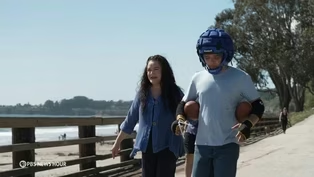
JUDY WOODRUFF: Twenty-four-year-old Pablo Mesa lives with his parents outside of Santa Cruz, California.
ALICIA MESA: We call him either Pabs or Pablito.
He is full of life and energy.
He absolutely loves listening to music.
He is also on the very severe end of the autism spectrum.
He's not able to tell me that something hurts.
JUDY WOODRUFF: His mother, Alicia Mesa, has been his principal caregiver since he was diagnosed at age 2.
ALICIA MESA: He lives with deep frustration from not being able to communicate because he's nonverbal.
His autism presents with severe self-interest behavior, aggression, destructive behavior.
JUDY WOODRUFF: And he has hurt himself over time?
ALICIA MESA: He has.
His aggression most of the time is trying to communicate that something's wrong.
So, instead of saying, oh, my head hurts, he will start hitting his head forcefully.
He has to go around wearing a football helmet in order to protect him from more brain injury.
JUDY WOODRUFF: Pablo is supported by an around-the-clock team of at least three people funded by the state of California who work with him to develop skills to become more independent and intervene if his behavior becomes aggressive.
ALICIA MESA: Systems are not built for individuals like Pabs.
JUDY WOODRUFF: High-needs individuals like Pablo once represented the vast majority of diagnosed autism cases.
CATHERINE LORD, Clinical Psychologist, University of California, Los Angeles: I mean, I remember the first patient I saw as a graduate student, people said, oh, he doesn't have autism because he's talking.
Can you help me make a cake?
Make it flat.
JUDY WOODRUFF: Catherine Lord is a clinical psychologist at the University of California, Los Angeles.
She has spent more than five decades researching and diagnosing what is now known as autism.
CATHERINE LORD: We thought it was a very rare disorder that was defined by this combination of behaviors that we still talk about, but we're definitely better at identifying autism in young kids and also autism in adults.
JUDY WOODRUFF: Once thought to be a form of schizophrenia in young children, autism wasn't even recognized as a distinct condition until 1980.
But, in 2013, people with lower support needs, including those with a condition known as Asperger's syndrome, were all folded into a new diagnosis that Catherine Lord helped create, Autism Spectrum Disorder.
CATHERINE LORD: I think the idea of a spectrum was really more than just one thing.
It was the idea of like a rainbow, where you have different hues and different levels of intensity and different subtle differences, but it's all together.
And I think it may have backfired in some ways because it is now so big and includes so many things.
JUDY WOODRUFF: Driven in part by the broadening of the definition, the number of children with the diagnosis has skyrocketed over the past 25 years.
Today, about one in 30 kids is diagnosed with autism.
But critics of the broad definition say it puts people like Pablo in the same diagnostic category as Elon Musk.
ELON MUSK, Owner, X: I'm actually making history tonight as the first person with Asperger's to host "SNL."
JUDY WOODRUFF: A 2021 "Lancet"-commissioned report on the future of autism research and care introduced the term profound autism for individuals needing 24/7 care, typically with I.Q.s below 50, minimal verbal ability, or both.
COLIN KILLICK, Executive Director, Autistic Self Advocacy Network: If you have a hard line, inevitably some people will get harmed by which side they fall on it.
JUDY WOODRUFF: Colin Killick is the executive director of the Autistic Self-Advocacy Network, a group led entirely by autistic people.
He says splitting the spectrum comes with a new set of issues.
COLIN KILLICK: The people who will be most hurt are the people who are right on either side of the line, the person who, if they get labeled profound, get stereotyped, get stigmatized, get shunted away from things like career services, or, if they don't get labeled profound, lose access to vital supports and services that could keep them in the community.
ROBERT F. KENNEDY JR., U.S.
Health and Human Services Secretary: These are kids who will never pay taxes, they will never hold a job.
JUDY WOODRUFF: But the deep divisions within the autism community were on full display last year after the way U.S.
Health Secretary Robert F. Kennedy Jr.
characterized autistic people during a news conference.
ROBERT F. KENNEDY JR.
: They will never write a poem.
They will never go out on a date.
Many of them will never use a toilet unassisted.
JUDY WOODRUFF: What was your response to that?
COLIN KILLICK: Horror, shock, anger.
I mean, that's incredibly untrue.
JUDY WOODRUFF: Alicia Mesa disagrees.
ALICIA MESA: A lot of people were offended.
However, as a mother of a severely autistic son, I felt relief.
Finally, someone in high office was acknowledging the reality that my son lives through every single day.
To me, that is not stigma.
That's truth.
JUDY WOODRUFF: Alicia says Pablo's high support needs have made it difficult to access services, even those provided by agencies that specialize in therapy for autistic people.
ALICIA MESA: I lost count after 15 agencies that all of them came in here one by one into our home, just to be disappointed a few days later when I got a call from them saying, sorry, but we're not actually able to take your case.
JUDY WOODRUFF: She thinks the autism spectrum diagnosis should be divided and people like Pablo should be classified separately.
ALICIA MESA: Let's go on the sidewalk, Pablo.
Pablito requires moment-to-moment supervision.
Someone on the more mild side of the autism spectrum, they could have a completely independent life, so it's not the same.
So there should be some distinction.
JUDY WOODRUFF: But over 2, 500 miles away near Akron, Ohio, 31-year-old Jordyn Zimmerman worries that those distinctions would have limited her opportunities.
Zimmerman is a non-speaking autistic woman who communicates through a text-to-speech program and, because of that, some of our questions were provided in advance.
JORDYN ZIMMERMAN, Disability Advocate (through computer voice): Before I had access to reliable communication, school was very difficult.
I struggled to regulate my body, which sometimes looked like frustration, like hitting others or banging my head on walls.
But it was really about not being able to express myself academically.
I was often asked to repeat the same tasks over and over, even things I had already learned years earlier.
So I wasn't just disconnected socially.
And, in society, I was also not even recognized for what I was capable of.
JUDY WOODRUFF: Her autism was thought to be too severe for her to learn in a classroom alongside her peers.
That changed when she started using a communication app in an iPad at the age of 18.
What was that like for you personally to experience that ability to communicate for the first time?
JORDYN ZIMMERMAN (through computer voice): It was painful to think about all I had missed and all the ways I had been so misjudged, but also incredible to think about how I could now have a say in my life.
JUDY WOODRUFF: And there's some other plaques, Ohio University.
JORDYN ZIMMERMAN (through computer voice): And Boston College.
JUDY WOODRUFF: Zimmerman earned a master's degree, built a career in inclusive curriculum development, and now shares her story at speaking engagements worldwide.
She questions whether those opportunities would have been possible if she had been labeled profound.
JORDYN ZIMMERMAN (through computer voice): Based on the information I have seen and heard, I would likely be classified as profound due to my need for support and being nonspeaking.
My worry with that for myself and everyone in the community is that the narrative doctors told my family when I was 4 years old, but also when I was 18, is wildly different than who I am.
It will more likely cause more health care disparities, because, once a formal label like profound autism is applied, it becomes easier for people to give up.
JUDY WOODRUFF: Back in California, Alicia Mesa says it's not about giving up.
It's giving her son a voice.
ALICIA MESA: Parents like myself are exhausted.
I can't go and advocate for him, just take a trip to Washington.
So he has the potential to disappear completely from the conversation.
You had a wonderful day today.
JUDY WOODRUFF: For the "PBS News Hour," I'm Judy Woodruff in Freedom, California.
GEOFF BENNETT: And that's the "News Hour" for tonight.
I'm Geoff Bennett.
AMNA NAWAZ: And I'm Amna Nawaz.
On behalf of the entire "News Hour" team, thank you for joining us.

Accused gunman charged with attempted assassination of Trump
Video has Closed Captions
Accused Correspondents' Dinner gunman charged with attempted assassination of Trump (5m 4s)
Ex-agent weighs in on Secret Service security concerns
Video has Closed Captions
Ex-agent weighs in on Secret Service security concerns (7m 55s)

The health concerns as Supreme Court hears Roundup case
Video has Closed Captions
A look at health concerns as Roundup case reaches Supreme Court (6m 33s)
New focus on autism fuels debate over splitting the spectrum
Video has Closed Captions
New focus on autism fuels debate over splitting the spectrum (9m 33s)

News Wrap: King Charles arrives in U.S. for state visit
Video has Closed Captions
News Wrap: King Charles arrives in Washington for state visit (5m 45s)
Reporters describe chaos at Correspondents' Dinner shooting
Video has Closed Captions
Liz Landers and Lisa Desjardins describe chaos at Correspondents' Dinner shooting (5m 37s)
Tamara Keith and Amy Walter on risks of political violence
Video has Closed Captions
Tamara Keith and Amy Walter on the growing risks of political violence (7m 48s)
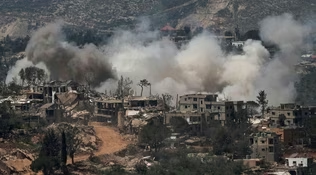
U.S.-Iran talks at impasse over nuclear program and Hormuz
Video has Closed Captions
U.S.-Iran talks at impasse over nuclear program and Strait of Hormuz (4m 34s)
Providing Support for PBS.org
Learn Moreabout PBS online sponsorship
- News and Public Affairs

Today's top journalists discuss Washington's current political events and public affairs.

- News and Public Affairs

FRONTLINE is investigative journalism that questions, explains and changes our world.
Urban Consulate Presents











Support for PBS provided by:
Major corporate funding for the PBS News Hour is provided by BDO, BNSF, Consumer Cellular, American Cruise Lines, and Raymond James. Funding for the PBS NewsHour Weekend is provided by...