
The cultural impact of Bad Bunny's Super Bowl halftime show
Clip: 2/9/2026 | 8m 19sVideo has Closed Captions
The cultural impact of Bad Bunny's Super Bowl halftime show
Bad Bunny's Super Bowl halftime show delivered a powerful message and made international headlines. The show was dense with symbolism, including messages of Puerto Rican pride and independence. But it also quickly became a magnet for criticism from President Trump. Amna Nawaz discussed more with Vanessa Diaz for our arts and culture series, CANVAS.
Problems playing video? | Closed Captioning Feedback
Problems playing video? | Closed Captioning Feedback
Major corporate funding for the PBS News Hour is provided by BDO, BNSF, Consumer Cellular, American Cruise Lines, and Raymond James. Funding for the PBS NewsHour Weekend is provided by...
Support provided by:

The cultural impact of Bad Bunny's Super Bowl halftime show
Clip: 2/9/2026 | 8m 19sVideo has Closed Captions
Bad Bunny's Super Bowl halftime show delivered a powerful message and made international headlines. The show was dense with symbolism, including messages of Puerto Rican pride and independence. But it also quickly became a magnet for criticism from President Trump. Amna Nawaz discussed more with Vanessa Diaz for our arts and culture series, CANVAS.
Problems playing video? | Closed Captioning Feedback
How to Watch PBS News Hour
PBS News Hour is available to stream on pbs.org and the free PBS App, available on iPhone, Apple TV, Android TV, Android smartphones, Amazon Fire TV, Amazon Fire Tablet, Roku, Samsung Smart TV, and Vizio.
Providing Support for PBS.org
Learn Moreabout PBS online sponsorshipAMNA NAWAZ: Last night's Super Bowl halftime show by Bad Bunny delivered a powerful message and made international headlines today.
The Grammy-winning Puerto Rican rapper, singer and producer, whose full name is Benito Antonio Martinez Ocasio, is one of the most popular musical artists on the planet.
His 13-minute set was historic, the very first in Super Bowl history performed nearly entirely in Spanish.
The show was dense with symbolism, including messages of Puerto Rican pride and independence.
But it also quickly became a magnet for criticism from the president and others even before he took the stage.
To help us unpack it all, we're joined now by Vanessa Diaz.
She's an associate professor at Loyola Marymount University and the author of the book "P FKN R: How Bad Bunny Became the Global Voice of Puerto Rican Resistance.
This is all part of our arts and culture series, Canvas.
Vanessa, welcome to the show thanks for joining us.
VANESSA DIAZ, Loyola Marymount University: Of course.
Thank you for having me.
AMNA NAWAZ: So you literally wrote the book on Bad Bunny.
You teach a course on his cultural impact.
For anyone unfamiliar, just how big a star is Bad Bunny?
VANESSA DIAZ: Bad Bunny right now is the world's most streamed artist.
So that just gives you a sense of the gravity.
This isn't someone who just is popular in his hometown.
On a global level, Bad Bunny is the number one artist.
And in fact, he was three other years as well, 2020 to 2022.
This isn't a new thing.
His popularity just keeps growing.
He just recently got the first ever Grammy Album of the Year for a Spanish-language album, his album "Debi Tirar Mas Fotos."
And he won two other Grammys last week.
So he has broken records we never imagined possible for a Spanish-language artist.
And he's been doing that for some time.
So on a global level, Bad Bunny is a massive, massive star.
AMNA NAWAZ: So your book situates Bad Bunny in the legacy of what you call Puerto Rican resistance.
Walk us through some of the moments in which we saw that play out during yesterday's performance.
VANESSA DIAZ: I think one of the most profound moments where Bad Bunny showed himself to be not just a figure of resistance, but carrying the long tradition behind him, is when, just before he started the song "El Apagon," he emerges from the fields with a flag, a Puerto Rican flag over his shoulder.
And if you notice, the triangle in blue is actually the light blue.
And the light blue is a symbol of Puerto Rican independence.
That's the color of the flag before the U.S.
in 1952 changed the color to the dark blue to mimic the colors of the American flag.
And so that light blue is really symbolic of advocating for Puerto Rican independence.
And as he walked out with that flag, we saw those folks who were the cane field workers in the beginning climbing these electrical poles.
And that was a reference to what was the longest blackout in American history following the devastating Hurricane Maria in 2017 that left Puerto Rico without power for almost a year.
So that song "El Apagon" means "The Blackout."
And so it was these workers, cane workers now climbing the poles to repair electrical issues.
And in the wake of the hurricane, one thing that was really striking was that the U.S.
was not responsive.
And Puerto Ricans with no experience often climbed these electrical poles to start reconnecting wires, risking their lives to try to bring their communities electricity.
And all of that was part of the meaning behind these things that some might not know.
AMNA NAWAZ: There were some special guest stars as well performing with him.
We saw Lady Gaga and Ricky Martin.
Tell us in particular about the song Ricky Martin sang.
Why is that important?
VANESSA DIAZ: Oh, so Ricky Martin took the stage to perform the song "Lo Que Le Paso a Hawaii," which is, "What Happened to Hawaii?"
And this song is perhaps the most pointed political song on the entire album "Debi Tirar Mas Fotos."
And it's really about Hawaii and Puerto Rico as two nations that were taken by the U.S.
in 1898 and one became a state and one is the commonwealth, some might call it a colony, of Puerto Rico, right?
And so there's this tension around what should happen to Puerto Rico.
And in that song, Bad Bunny is saying he doesn't want us to be like Hawaii, doesn't want Puerto Rico to become a state.
And Bad Bunny had people at his residency every Sunday night.
He had a guest sing that song.
And so this was a kind of nod to the residency and also giving Ricky Martin, who had to cross over in English to become the massive star that he became, and to have him take the world's biggest stage and be able to perform in his native language of Spanish representing Puerto Rico and do this political work he could never do as a mainstream artist 25 years ago was very significant.
AMNA NAWAZ: We mentioned some of the criticism.
You saw the president describe the performance as -- quote -- "an affront to the greatness of America."
He said: "Nobody understands a word this guy is saying."
As you also reported, Turning Point USA, the conservative political group that was founded by Charlie Kirk, held a counterprogramming halftime show.
They billed it as the All-American Halftime Show.
They saw upwards of some six million viewers.
What do you make of that sort of broader backlash both to his selection to perform in the first place and the performance?
VANESSA DIAZ: I mean, from the moment Bad Bunny was announced, there was immediate backlash.
And the reality is that has everything to do not just with the current political moment, but with the entire history of the U.S.
construing, in like a mainstream narrative, construing Latinos as perpetual foreigners who do not belong, who are a threat to the U.S.
And so this language of criticizing his performance and calling him un-American is just the perpetuation of these stereotypes, despite the fact that he is an American citizen.
And I think that the fact that the halftime show that Turning Point USA created was called the All-American Halftime Show just goes to show you that this isn't about citizenship.
This is actually about racism against Latinos.
And that's just blatant to see because it insinuates that Bad Bunny's halftime show was not American.
And that was the antithesis of what the performance was.
BAD BUNNY, Musician: God bless, America, Chile, Argentina, Uruguay, Paraguay.
VANESSA DIAZ: He talked about the fact that not only do Latinos belong here in the U.S., we are an integral part of American culture, and that America, America, as he says, is actually more than just the U.S.
It's all of the Americas.
AMNA NAWAZ: Despite the criticism, you may have seen the embrace that he and NFL commissioner Roger Goodell shared backstage after his performance.
The NFL even shared that moment online, clearly happy about their choice.
From a business and cultural perspective, why was Bad Bunny a good choice for the NFL?
VANESSA DIAZ: Well, the NFL is a business organization.
Their primary concern is, is this good business?
And there's no doubt, I don't think by anyone's -- there's no doubt from anyone that this was the smartest business decision.
Bad Bunny is the biggest artist in the world.
He's the most streamed artist in the world.
He is selling out stadiums all over the world.
So I think that Bad Bunny was not just a natural choice.
He was the best choice from a business standpoint.
And so this just happens to be a moment with something very political coincided with a strategic business decision.
And I'm really happy about that.
AMNA NAWAZ: That is Vanessa Diaz, associate professor at Loyola Marymount University.
Vanessa, thank you so much for your time.
Good to speak with you.
VANESSA DIAZ: You too.
Epstein files fallout grows as Maxwell pleads Fifth
Video has Closed Captions
Clip: 2/9/2026 | 7m 22s | Epstein files fallout grows as Ghislaine Maxwell pleads Fifth before Congress (7m 22s)

Jimmy Lai sentenced to 20 years by Beijing-backed court
Video has Closed Captions
Clip: 2/9/2026 | 11m 6s | Jimmy Lai sentenced to 20 years in prison by Beijing-backed court (11m 6s)
Minnesota ICE operation impacts medical care, mental health
Video has Closed Captions
Clip: 2/9/2026 | 7m 21s | How the ICE operation in Minnesota is affecting medical care and mental health (7m 21s)
News Wrap: Search for Nancy Guthrie enters second week
Video has Closed Captions
Clip: 2/9/2026 | 5m 8s | News Wrap: Search for Nancy Guthrie enters second week (5m 8s)
Reporter details life for children in Texas migrant facility
Video has Closed Captions
Clip: 2/9/2026 | 6m 14s | Reporter details life for children and families detained in Texas migrant facility (6m 14s)
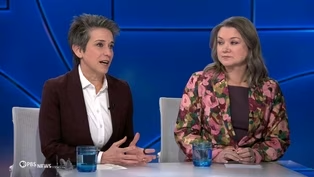
Tamara Keith and Amy Walter on Trump's low approval ratings
Video has Closed Captions
Clip: 2/9/2026 | 7m 3s | Tamara Keith and Amy Walter on Trump's low approval ratings (7m 3s)
Providing Support for PBS.org
Learn Moreabout PBS online sponsorship
- News and Public Affairs

FRONTLINE is investigative journalism that questions, explains and changes our world.

- News and Public Affairs

Amanpour and Company features conversations with leaders and decision makers.
Urban Consulate Presents











Support for PBS provided by:
Major corporate funding for the PBS News Hour is provided by BDO, BNSF, Consumer Cellular, American Cruise Lines, and Raymond James. Funding for the PBS NewsHour Weekend is provided by...