
Brooks and Capehart on the partisan redistricting battle
Clip: 4/24/2026 | 11m 22sVideo has Closed Captions
Brooks and Capehart on the partisan redistricting battle
David Brooks of The Atlantic and Jonathan Capehart of MS NOW join Geoff Bennett to discuss the week in politics, including the Justice Department dropping its probe into Fed Chair Jerome Powell after admitting it lacked evidence, voters in Virginia approving a redistricting effort benefiting Democrats and President Trump saying he's in no rush to end the Iran war.
Problems playing video? | Closed Captioning Feedback
Problems playing video? | Closed Captioning Feedback
Major corporate funding for the PBS News Hour is provided by BDO, BNSF, Consumer Cellular, American Cruise Lines, and Raymond James. Funding for the PBS NewsHour Weekend is provided by...
Brooks and Capehart on the partisan redistricting battle
Clip: 4/24/2026 | 11m 22sVideo has Closed Captions
David Brooks of The Atlantic and Jonathan Capehart of MS NOW join Geoff Bennett to discuss the week in politics, including the Justice Department dropping its probe into Fed Chair Jerome Powell after admitting it lacked evidence, voters in Virginia approving a redistricting effort benefiting Democrats and President Trump saying he's in no rush to end the Iran war.
Problems playing video? | Closed Captioning Feedback
How to Watch PBS News Hour
PBS News Hour is available to stream on pbs.org and the free PBS App, available on iPhone, Apple TV, Android TV, Android smartphones, Amazon Fire TV, Amazon Fire Tablet, Roku, Samsung Smart TV, LG TV, and Vizio.
Providing Support for PBS.org
Learn Moreabout PBS online sponsorshipGEOFF BENNETT: The U.S.
Justice Department dropped its probe into Federal Reserve Chair Jerome Powell after admitting it lacked evidence, and voters in Virginia approved Democrats' redistricting efforts.
For all of that and more, we turn now to the analysis of Brooks and Capehart.
That is "The Atlantic"'s David Brooks and Jonathan Capehart of MS NOW.
It's always great to see you both.
GEOFF BENNETT: So, the DOJ dropped its probe, as we said, into Federal Reserve Chair Jerome Powell, in part to clear a path for the confirmation of Kevin Warsh as his successor, but also because the federal judge effectively crippled U.S.
attorney Jeanine Pirro's investigation.
David, what do you see as the takeaways?
DAVID BROOKS: Who would have thought, lack of evidence hurts a prosecution?
DAVID BROOKS: I think, first of all, Donald Trump, like every president, frankly, would love to have a Fed chair do what he wants, because he can juice the economy at the right time for the election.
Trump is obviously the only one who would actually act on that.
And it should be said, we should appreciate the fact the Federal Reserve system is one of the crown jewels of our country.
It was passed obviously in the progressive era.
But you look at Greenspan.
What Bernanke did was miraculous.
I think Powell has been an excellent Fed chair.
The fact that we have these independent agencies who are doing their job, with civil servants doing their job, is just something we should be proud of.
And the fact that it's under threat and still under threat should still alarm us, even if we have had a reprieve on this.
The second point is that Thom Tillis, the senator who is retiring, who is holding up the Warsh nomination.
It would be interesting to see if other senators who are not retiring start doing that kind of thing, standing up to Trump now that his approval is in the 30s and not in the 40s.
And I anticipate that a few more senators will discover some courage when it comes time to standing up to the administration that they have lacked for the last eight years.
GEOFF BENNETT: What do you think about that, Jonathan?
As President Trump's approval rating starts to soften, do you think more Republicans will use leverage wherever they can find it?
JONATHAN CAPEHART: One can only hope.
Senator Tillis, he won this particular war because he made it clear for weeks he's not voting for anybody's confirmation until that lawsuit went away.
And, look, give the president a little bit of props here, in that he just said, OK, fine, fine.
The prosecution is over, I'm going to get my guy in, and maybe he will do what I want him to do on interest rates.
But we will have to take Mr.
Warsh at his word that he says that he's not going to be a puppet of the president.
We will see.
GEOFF BENNETT: And Powell's term ends next month.
Does this episode change the dynamics around his departure or the search, the appointment, the confirmation, the expected confirmation of his successor?
DAVID BROOKS: Well, I -- well, if you're Powell, you're worried that they're going to come after you again.
And I think that's one of the reasons he's reluctant to leave, because he won't have some certain protections.
But I think he kept on doing his job no matter what.
And this is just a very tricky economy with inflation rising.
And it was not expected that he would be able to drive down inflation without a recession.
And he did it.
That's amazing.
And I thought what Kevin Warsh is a pick -- the best possible pick that Trump could have had.
We have -- I have seen him speak at conferences for years.
And he's a serious guy who a normal Republican might have picked, which is not always the case with the Trump administration, substantive guy.
So I think, all things considered, that part of the government is in recently good shape.
And they have a gigantic new building.
(LAUGHTER) GEOFF BENNETT: That is true.
And, look, the Fed has spent decades really trying to guard its independence from political pressure.
Has that wall held or has something shifted in all of this?
JONATHAN CAPEHART: Well, it's held in -- for all the reasons that David was just talking about.
But now it's going to be tested with Kevin Warsh.
And you talked about he's serious and substantive.
And that is all great right now.
But how many serious and substantive people in the before times have gone into Trump 2.0 and have done exactly what the president wants to do that is in contravention of everything that they have said before?
And I'm thinking specifically of Secretary of State Marco Rubio in a lot of ways.
Will a Fed Governor Warsh still be serious, still be substantive and still have -- be in the good graces of the president?
GEOFF BENNETT: Let's shift our focus to Virginia, because Virginia voters this week approved a Democratic redistricting plan that could allow the party to pick up as many as four new seats in the upcoming midterm elections.
David, what do you take away from that result?
DAVID BROOKS: Well, as Jonathan may recall, I hate this whole thing.
DAVID BROOKS: I hated when Texas did it.
I hated when California did it.
I hated when Virginia did it.
I believe in elections.
I would like there to be districts where both parties have a shot of winning.
And the number of those districts in this country is now vanishingly small.
I understand why the Democrats did it.
The Republicans started it.
That's all fair.
But we have just become a less good democracy.
But for the Republicans, the lesson is, be careful what you start.
And it's weirdly like Iran.
In this case and in Iran, Trump did not anticipate that the other side would take some reaction.
He couldn't see like one step ahead.
I don't expect to see three steps ahead, one step ahead.
And so it was pretty inevitable, once they did Texas, that California would do this, and Virginia would do this.
And, on that, the Republicans are probably worse off than they were before this whole thing started.
The one thing I will add, and my Democrats should mute their enthusiasm, is that 2030 is coming.
And then you get real redistricting based on where populations are flowing.
And populations, nine out of the 10 fastest states are Republican states.
Nine out of the 10 fastest shrinking states or Democratic states.
Republicans are -- people are flowing to Texas and Florida and all those Republican states.
And it could be the case in 2030, even with all this the Democrats will be in rough shape, because it'll be very hard for them to win the Electoral College, as the Electoral College and House votes go to red states.
GEOFF BENNETT: You mentioned Florida.
Jonathan, Florida Republicans are apparently considering redistricting and redrawing their maps.
What do you make of this?
Is this just hardball politics, or is there something more corrosive happening here?
JONATHAN CAPEHART: Yes, it's hardball politics.
And we have the president to thank for it.
I'm surprised you did not -- maybe he's older than the singing demographic that you usually quote.
But I think of James Brown and his song "Static."
And there's a great line in it that says, don't start none, won't be none.
JONATHAN CAPEHART: And had the president not gone to Governor Abbott and said, give me five seats, then you wouldn't have had Governor Newsom jump out there and say, oh, wait, what?
No, we're going to do something.
So as much as we say that the president started this, I want to give kudos to Governor Newsom for having the backbone and the spine to stand up and say, this is not going to happen.
As bad as gerrymandering is, and elections should determine who elected officials are, when one side is trying to cheat before our eyes, we have to do something in response.
And I'm glad he did.
GEOFF BENNETT: In the time that remains, let's talk about Iran, because President Trump extended the cease-fire with Iran, but he also said he's in no rush and wants to take his time.
Is that measured patience or does it reflect the absence of a clear endgame?
DAVID BROOKS: Craziness.
I mean, I thought he wanted an off-ramp, and he doesn't seem to be asking.
He should be desperate for it.
This is an issue that could destroy or severely damage the Trump administration the way Iran-Contra severely damaged the Reagan administration.
Second, this is weirdly turning into the Suez crisis.
In 1956, the British -- it wasn't over the Straits of Hormuz.
It was over the Suez Canal.
They said, they're going to -- they're trying to block the canal.
We won't let them.
And then Dwight Eisenhower and the U.S.
said, too bad.
Too bad.
You're a weak power.
You thought you were a superpower.
Those days are over.
And a lot of people around the world are saying to America, you think you're a superpower?
You can't even open the Straits of Hormuz?
Your days as a superpower is over.
So Donald Trump should be eager to get the hell out of this fight.
GEOFF BENNETT: How do you see it, Jonathan?
JONATHAN CAPEHART: Similarly.
I mean, watching this whole thing, I have been confused from the moment the bombs started dropping on Iran, because I don't know why specifically the president took this action.
I don't know what his game plan was, has been or will be.
It's as if he's trying to -- he thinks of closing a diplomatic deal is the same as closing a business deal, that you can just do it overnight or one blustery performance and you get people to the table to agree to your terms.
That's not how this works.
I keep thinking about the Iran nuclear deal, the JCPOA.
You had five nations involved in this, plus the European Union, I believe.
And it took months and months of negotiation.
Where's the Wendy Sherman?
Where's Secretary Kerry?
Where's Ernest Moniz, the secretary of energy?
These were all people -- plus the treasury secretary.
These were all people who painstakingly negotiated the Iran nuclear deal.
And, instead, what we have from the Trump administration is Steve Witkoff and Jared Kushner, who happens to be, one, the president's son-in-law, and, two, has major financial interests in the region.
How on earth does anyone expect for the Trump administration to come to a deal that will be lasting, in the interests of the United States and that will put a lid on the damage that's being done in the Middle East right now?
GEOFF BENNETT: And adding to the perceived confusion, the secretary of the navy was also ousted, reportedly having nothing to do with performance in the field, but because of his closeness to President Trump and over a shipbuilding dispute with Pete Hegseth, Secretary Hegseth.
What does a leadership shake up like that signal, especially given that there's an ongoing naval blockade in Iran?
DAVID BROOKS: Well, he was part of the grownups.
He was -- he's a successful business person who probably knows how to run an organization and probably had his own ego, as successful as he's been, to say, like, I kind of know what I'm doing.
I'm not going to do a Pete Hegseth and do whatever Donald Trump tells me to do.
I'm not going to do a Pete Hegseth and basically be a buffoon on stage.
And so he tried to stand up for the strategy he thought was the right strategy.
And that's -- in the Trump second term, that doesn't get you very far.
I'm very struck by -- it's not only people like him.
I'm struck by how many of the more intellectual Trump supporters are really upset about this.
He's lost a lot of people, not only Tucker Carlson and people like that, but there's a writer named Chris Caldwell, who in that world is probably the smartest and the most intellectually sophisticated.
And they're all like, it's not only this was a bad idea, but even regular Trump voters are saying, where's the thinking process here?
Well, you had a red line and then you walked right through it.
GEOFF BENNETT: David Brooks, Jonathan Capehart, see you here next Friday.
(LAUGHTER) JONATHAN CAPEHART: Thanks, Geoff.
GEOFF BENNETT: Take care.
Have a good weekend.
 New
NewAdm. William McRaven reflects on American spirit in new book
Video has Closed Captions
Adm. William McRaven reflects on American spirit and the nation’s future in new book (9m 1s)
 New
NewArrest over Maduro raid bet fuels insider trading concerns
Video has Closed Captions
Soldier’s arrest over Polymarket bet on Maduro raid fuels insider trading concerns (5m 53s)
 New
NewDelegations head to Pakistan, renewing hopes for end to war
Video has Closed Captions
U.S., Iranian delegations head to Pakistan, renewing hopes for diplomatic end to war (3m 20s)
 New
NewInside Chornobyl, 40 years after the nuclear disaster
Video has Closed Captions
Inside Chornobyl, 40 years after the world's worst nuclear disaster (9m 57s)
 New
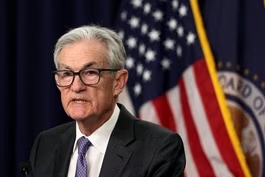
NewNews Wrap: DOJ drops criminal probe into Jerome Powell
Video has Closed Captions
News Wrap: DOJ drops criminal probe into Jerome Powell (5m 3s)
 New
NewSouthern Lebanon weighs losses as ceasefire hangs by thread
Video has Closed Captions
Southern Lebanon weighs losses from Israeli strikes as ceasefire hangs by a thread (6m 1s)
Providing Support for PBS.org
Learn Moreabout PBS online sponsorship
- News and Public Affairs

FRONTLINE is investigative journalism that questions, explains and changes our world.

- News and Public Affairs

Each week, explore science, health, and technology headlines with leading experts.
Urban Consulate Presents











Support for PBS provided by:
Major corporate funding for the PBS News Hour is provided by BDO, BNSF, Consumer Cellular, American Cruise Lines, and Raymond James. Funding for the PBS NewsHour Weekend is provided by...