
Brooks and Capehart on what's next as ICE leaves Minnesota
Clip: 2/13/2026 | 11m 8sVideo has Closed Captions
Brooks and Capehart on what's next as ICE leaves Minnesota
David Brooks of The Atlantic and Jonathan Capehart of MS NOW join William Brangham to discuss the week in politics, including the Trump administration pulling ICE back from Minnesota, European leaders reckoning with a new world order and parts of the U.S. government are about to shut down, again.
Problems playing video? | Closed Captioning Feedback
Problems playing video? | Closed Captioning Feedback
Major corporate funding for the PBS News Hour is provided by BDO, BNSF, Consumer Cellular, American Cruise Lines, and Raymond James. Funding for the PBS NewsHour Weekend is provided by...
Support provided by:

Brooks and Capehart on what's next as ICE leaves Minnesota
Clip: 2/13/2026 | 11m 8sVideo has Closed Captions
David Brooks of The Atlantic and Jonathan Capehart of MS NOW join William Brangham to discuss the week in politics, including the Trump administration pulling ICE back from Minnesota, European leaders reckoning with a new world order and parts of the U.S. government are about to shut down, again.
Problems playing video? | Closed Captioning Feedback
How to Watch PBS News Hour
PBS News Hour is available to stream on pbs.org and the free PBS App, available on iPhone, Apple TV, Android TV, Android smartphones, Amazon Fire TV, Amazon Fire Tablet, Roku, Samsung Smart TV, and Vizio.
Providing Support for PBS.org
Learn Moreabout PBS online sponsorshipWILLIAM BRANGHAM: The Trump administration pulls ICE back from Minnesota, European leaders reckon with a new world order, and parts of the U.S.
government are about to shut down again.
It is time for the analysis of Brooks and Capehart.
That's "The Atlantic"'s David Brooks and Jonathan Capehart of MS NOW.
Good evening, gentlemen.
Nice to see you on Valentine's Day eve.
JONATHAN CAPEHART: William, good to see you.
DAVID BROOKS: I can feel the romance.
(LAUGHTER) WILLIAM BRANGHAM: Well, this is going to turn out quite differently.
(LAUGHTER) WILLIAM BRANGHAM: President Trump put - - I'm talking about Minnesota -- put his border czar in charge of what was going on there.
And Tom Homan said, OK, we're going to now start to pull this back.
David, what do you make of this development?
DAVID BROOKS: Well, when Tom Homan is the reasonable and cuddly one, then you know we have come a long way.
(LAUGHTER) DAVID BROOKS: And I think it's partly because of the awfulness of those videos and the killings.
But it's partly because of citizen power.
We have been talking a lot over the months about a civic movement.
And the people of Minneapolis in bitter cold weather behaved in a self-disciplined, humane way that appealed to people across the political spectrum and in a disciplined way.
And they turned up the heat and they put the regime in an impossible situation.
Either behave brutally and generate more hostility or lose control of the streets.
And that's what a civic movement needs to do, put the pressure on the government and expose the moral distance between one side and the other.
And I was with a historian yesterday.
And she said, learn from the civil rights movement.
Everybody should be studying the civil rights movement.
That's what they did.
And it worked in this case in Minneapolis, and even the Trump administration had to back down.
WILLIAM BRANGHAM: Do you see it that way too, that this is power of the people?
JONATHAN CAPEHART: Absolutely.
And I saw it from the beginning.
Remember, I went to college in Minnesota.
And so Minnesota holds a special place in my heart.
And I was just there.
I wasn't on the show last weekend because I was at Carleton Board of Trustees meeting.
And what you were talking about in Minneapolis wasn't just in Minneapolis.
It was throughout.
In Northfield, Minnesota, they were dealing with ICE.
And they were dealing with ICE in a very quiet way, not the whistles and the horns, but text chains, people who were observing, taking license plates, letting people know.
I went to do something on Friday and the person who picked me up said -- apologized for the vehicle and then said to me, I was -- quote - - "underground railroading food all night."
WILLIAM BRANGHAM: Wow.
JONATHAN CAPEHART: And so to David's point... WILLIAM BRANGHAM: These are for people who feel that they can't go to the grocery store because they're scared of what... JONATHAN CAPEHART: Could not... (CROSSTALK) JONATHAN CAPEHART: They had not left home.
We're talking about people who had not left home in more than a month.
And so what you had in Minneapolis, what you had in Northfield, Minnesota, what you have throughout Minnesota are people coming to the aid of their neighbors and their loved ones, standing up for their communities in the face of incredible, I don't know any other word to use, but oppression from the federal government, targeting, targeting their communities.
WILLIAM BRANGHAM: We have still seen, though, this is now the third instance where ICE agents have shot people, one, this Venezuelan immigrant, plus the killings of Renee Good and Alex Pretti, where the federal government says one thing happened, and the video or testimonial evidence completely contradicts their story.
And yet they stick to that story over and over again.
And there's just an Orwellian quality to what is going on here.
They will not budge.
DAVID BROOKS: This has been a revelation since the first Trump term, that so much of government is governed by norms.
There's no rule.
But you assume, when you see a video like that, there's going to be an investigation and heads will roll.
And if you have an administration that's completely shameless, then heads -- there's going to be no real investigation and heads will not roll.
And even Kristi Noem, the head of the Department of Homeland Security, I mean, she -- you would think she'd be in trouble.
WILLIAM BRANGHAM: Right.
DAVID BROOKS: And she's in desperate trouble in her agency.
WILLIAM BRANGHAM: For calling Alex Pretti a domestic terror.
DAVID BROOKS: There was a fantastic Wall Street Journal piece this week.
She's firing a pilot because he forgot to bring her blanket off the airplane.
But the key thing in that story was, people were leaking from all across the agency.
They're offended by how she does her job.
And yet Trump again has endorsed her.
WILLIAM BRANGHAM: As I mentioned, tonight at midnight, we will start to see part of the government shut down because the Democrats are putting their foot down and saying, we need reforms to these agencies, and some of the Republicans are saying, you're asking for too much.
Do you think this is the fight worth having, that the Democrats are doing the right thing?
JONATHAN CAPEHART: Yes, and just give you two reasons, Renee Good, Alex Pretti, two American citizens who were killed by federal officers attached to that agency.
And let's also keep in mind that the government most likely will go into a partial shutdown at 12:01 because everyone's gone out of town anyway.
But keep in mind, ICE is fully funded for at least the next five to six years.
So we're talking about other agencies, TSA and others that will be hit by this shutdown.
The Democrats are right to demand not just reform, but some kind of accountability for what happened on the streets of Minneapolis and what could happen on the streets of other cities.
Let's not breathe too much of a sigh of relief for what's happening in Minnesota.
Great for the people of Minnesota and Minneapolis.
But in talking to the folks there, they're also concerned about, where will this be exported next?
And I think that's what Democrats are also thinking.
This -- folks should not view this as a partisan issue.
Folks should view this as holding the government accountable for what it is doing in the name of the American people to the American people.
DAVID BROOKS: Can I disagree?
WILLIAM BRANGHAM: Please.
JONATHAN CAPEHART: Oh.
(LAUGHTER) WILLIAM BRANGHAM: Just because it's Valentine's Day.
DAVID BROOKS: Thank you.
JONATHAN CAPEHART: Right.
DAVID BROOKS: I will disagree emotionally.
We have a democracy.
And when you have a disagreement and when something outrageous happens, you go to the voters.
And I think that's what the Democrats should do.
Look at what the Republicans are doing.
Go to the voters.
When you have a policy disagreement in between elections, you don't shut down the government.
We haven't done that in the last -- until Newt Gingrich walked into town, and he set a precedent, and now we're spiraling.
And so when you shut down the government, A, it hurts the government.
B, it hurts public faith in the government.
It makes us look ineffective.
And as Jonathan said, we're not taking this out on ICE.
It's the people at TSA who aren't going to get a check.
So I believe that if you weaken the institutions of democracy by shutting the government every time there's a policy of disagreement -- and, by the way, the Republicans are going to do this even more often in the future -- it's just terrible for our democracy.
WILLIAM BRANGHAM: I want to quickly pivot to what's happening overseas.
We have been seeing some of Nick's tremendous reporting from the Munich Security Conference, where European leaders are grappling with this idea that America is not what America was.
And, Jonathan, when you look at this, how they are reckoning with it and how Trump and his administration is pressing their case to the Europeans, how do you see that playing out?
JONATHAN CAPEHART: Well, I think the Europeans are right to look at the United States and think, you know what, we should probably not depend on them as much.
We should come up with contingency plans, because the United States is no longer a trusted friend, trusted ally.
In many instances -- take, for instance, Greenland - - it's become an adversary.
And their wariness is not new.
Four years ago, Vice President Harris went to the Munich Security Conference, gave a speech, and the first question to her from the president of the Munich Security Conference was, President Biden said America is back, but, Madam Vice President, the question is, for how long?
And now the Europeans have seen the answer to that question.
So they're absolutely right to be skittish, weary, whatever synonym Mr.
Thesaurus will throw out there.
WILLIAM BRANGHAM: But, David, we have seen some instances where European leaders have acknowledged that some of the things that Trump has pressed them to do, like to not rely on the United States as much, they are saying, some of them overtly, Trump is right.
We do need to shore our own defenses up.
DAVID BROOKS: There's always a kernel of truth in every attack Trump makes until he overreacts and destroys.
And I have said, you go to Trump -- Trump is like - - governs like, you go to the doctor saying, I have acne, and he says, OK, we will decapitate you.
That will solve your acne.
(LAUGHTER) DAVID BROOKS: And that's what he does.
He overreacts and destroys.
And the difference is, somebody made -- I think it was the German leader this week said, we have shared interests still, but we don't have shared values.
And I think that's the right distinction to make, because Trump fundamentally sees the world, not as the Western alliance, which has been built since 1945.
He sees the world as regional hegemons.
And that's just not how Europe sees the world.
And so Trump sees Russia over here, their hegemon, China's over there, their hegemon, we're a hegemon here in the Americas, and we get to rule our neighborhood.
And the problem with that is that you're asking for an invitation for bloodshed over and over and again.
And I mentioned this on the "News Hour" about a month ago.
If you go back to 2,000, there were about 15,000 people dying in a war all around the world.
Since 2013, it's been over 100,000 a year.
That's death.
That's death and violence caused by the destabilization of the American-led international order.
And for people who don't like that international order, wait until it goes away.
WILLIAM BRANGHAM: I mean, I hear you.
No one is here celebrating the idea that there's additional death.
Do you think, though, Jonathan, that there is any utility in Trump driving a wedge here that is help shoring up an alliance, maybe in the long run, that, when Trump is no longer here, that this will - - might clarify our alliance with our allies?
JONATHAN CAPEHART: I don't -- no, I don't see it that way, in the way you pose it, because the way the Europeans are looking at the United States, it's this international order that's been eight decades running with the Western alliance, but the United States is the foundation of it.
And so, without the United States being there as a trusted ally, then what does it mean?
What does it stand for?
And, great, they will spend more money on their defense, they will do all sorts of other things.
But, to David's point, if we're not sharing the same values, if Europe looks at us, the United States, and says, they're not like us, and so we need to just leave them out.
In fact, hey, China, let's talk to you about more deals, more collaboration.
WILLIAM BRANGHAM: We already see some of that happening.
JONATHAN CAPEHART: Yes.
WILLIAM BRANGHAM: Jonathan Capehart, David Brooks, so nice to see you both.
Thank you.
JONATHAN CAPEHART: Thanks, William.
DAVID BROOKS: Good to see you.

After 3 years of war, Sudan faces worst humanitarian crisis
Video has Closed Captions
Clip: 2/13/2026 | 6m 43s | After 3 years of relentless war, Sudan faces world's worst humanitarian crisis (6m 43s)

Citizens detained by immigration agents describe treatment
Video has Closed Captions
Clip: 2/13/2026 | 8m 28s | U.S. citizens detained by immigration agents describe how they were treated (8m 28s)
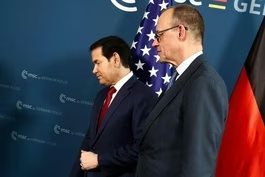
European weighs self-defense as U.S. reliability questioned
Video has Closed Captions
Clip: 2/13/2026 | 3m 22s | European leaders warn of urgent need for self-defense as U.S. reliability questioned (3m 22s)

'Forgotten Souls' explores the missing Tuskegee Airmen
Video has Closed Captions
Clip: 2/13/2026 | 6m 34s | 'Forgotten Souls' explores the legacy of the missing Tuskegee Airmen (6m 34s)

James Brown joins Amna Nawaz on ‘Settle In’
Video has Closed Captions
Clip: 2/13/2026 | 2m 12s | James Brown and Amna Nawaz discuss protest in sports on ‘Settle In’ (2m 12s)

News Wrap: Data shows inflation easing at start of year
Video has Closed Captions
Clip: 2/13/2026 | 6m 52s | News Wrap: Economic data shows inflation easing at start of year (6m 52s)

U.S. still a key ally for Europe, Finnish president says
Video has Closed Captions
Clip: 2/13/2026 | 6m 18s | World order in transition, but U.S. is still a key ally for Europe, Finnish president says (6m 18s)
Providing Support for PBS.org
Learn Moreabout PBS online sponsorship
- News and Public Affairs

FRONTLINE is investigative journalism that questions, explains and changes our world.

- News and Public Affairs

Amanpour and Company features conversations with leaders and decision makers.
Urban Consulate Presents











Support for PBS provided by:
Major corporate funding for the PBS News Hour is provided by BDO, BNSF, Consumer Cellular, American Cruise Lines, and Raymond James. Funding for the PBS NewsHour Weekend is provided by...