
Stephen Miller’s rise to power in the Trump White House
Clip: 2/12/2026 | 11m 57sVideo has Closed Captions
Stephen Miller’s rise to power in the Trump White House
Stephen Miller is no ordinary aide. He’s been with Trump since the beginning of his improbable run as the 21st century’s most important political leader. The panel discusses Miller's rise to become one of the most powerful figures in Trump’s orbit.
Problems playing video? | Closed Captioning Feedback
Problems playing video? | Closed Captioning Feedback
Major funding for “Washington Week with The Atlantic” is provided by Consumer Cellular, Otsuka, Kaiser Permanente, the Yuen Foundation, and the Corporation for Public Broadcasting.
Stephen Miller’s rise to power in the Trump White House
Clip: 2/12/2026 | 11m 57sVideo has Closed Captions
Stephen Miller is no ordinary aide. He’s been with Trump since the beginning of his improbable run as the 21st century’s most important political leader. The panel discusses Miller's rise to become one of the most powerful figures in Trump’s orbit.
Problems playing video? | Closed Captioning Feedback
How to Watch Washington Week with The Atlantic
Washington Week with The Atlantic is available to stream on pbs.org and the free PBS App, available on iPhone, Apple TV, Android TV, Android smartphones, Amazon Fire TV, Amazon Fire Tablet, Roku, Samsung Smart TV, and Vizio.
Buy Now
10 big stories Washington Week covered
Washington Week came on the air February 23, 1967. In the 50 years that followed, we covered a lot of history-making events. Read up on 10 of the biggest stories Washington Week covered in its first 50 years.Providing Support for PBS.org
Learn Moreabout PBS online sponsorshipWe're going to do something a little bit different tonight.
We're going to try to understand some of the most important and disruptive Trump policies through the prism of one aide, Stephen Miller.
He's no ordinary aide, as you well know.
He's been with Trump since the beginning of his improbable run as the 21st century's most important political leader, and no one seems to understand the president and his impulses better than Miller.
He's also a revolutionary.
His ideas come from far outside what we used to think of as the Republican mainstream, and he's a vociferous, uncompromising advocate for policies that only a few years ago would have been deemed unworkable and extreme.
Joining me tonight are 4 reporters who have covered Miller for years and know him well.
Leanne Caldwell is the chief Washington correspondent at Puck.
McKay Coppins is a staff writer at The Atlantic.
Zoen Kao Youngs is a White House correspondent at The New York Times, and Ashley Parker is a staff writer, also at the Atlantic.
Thank you all for, for joining me.
All of you have covered Miller for years.
You've written a lot about Miller Ashley very recently landed very recently, but I want to just start at the beginning.
Um, McKay, why don't I go to you because you wrote of the sort of definitive early profile of Stephen Miller in 2018.
So where does he come from?
Like, what, where did his politics develop?
Give us a little sense of of of the forces that created the Stephen Miller.
We, we, we know of today.
But before he entered the general political consciousness.
Yes, I think the thing that most struck me in talking to him years ago when I was profiling him was how much of his political worldview was forged in opposition to his upbringing, right?
He grew up in Santa Monica, family of very well off, progressive, uh, uh, Jewish parents and was surrounded by, uh, you know, what he would describe as kind of a bubble of progressive affluence, right?
Uh, he went to a high school where they would have, uh, you know, multiracial uh retreats and, you know, multiculturalism festivals and his first exposure to conservative politics was actually reading on a lark guns and Ammo magazine, which then led him to people like Rush Limbaugh, Larry Elder, David Horowitz, the kind of prominent conservative talk radio hosts and polemicists of the time, and you can see from the very beginning as a teenager in a very liberal high school, him kind of mimicking the political style of those people.
Wait, wait, you mentioned the high school.
Just watch with me for one moment, a quick clip of this is Stephen Miller running for student government, student government.
Watch this.
Am I the only one who is sick and tired.
to to pic rash, and we have pl ent y janitor.
s working for us So, so first of all, the Che Guevara look really is is I can't, doesn't do that anymore.
He's really into the silk suits now or something, but um, but, but you wrote part of your profile was focused on the fact that he's an expert troll, and so in your study of him in your conversations with him back then, was he, was he just trolling his liberal friends or liberal adversaries or, or was that something more serious?
Well, this was actually kind of the mystery of Stephen Miller to everybody who knew him at every stage of his life in high school, later at Duke when he went to college, he was, everyone was trying to figure out if this was performance art or if you really believed it.
And you know he would that was a classic example of teenage Stephen Miller, but he would write, you know, columns for the Duke campus newspaper, picking culture war fights on campus.
What I think, you know, where I landed because I asked him about this a bunch of times, and he at first would say, no, no, no, I believe everything that I say.
But then he at one point said, I do believe in constructive controversy for the sake of enlightenment.
Those were his words, and I think that that gets at something fundamental about him, which is he has always believed that there is a role for provocation and performance in politics.
So Ashley, let me ask you this.
Does he go further rhetorically than than he actually believes or when you're listening to him, especially in this second Trump term, is what he's saying, what he actually believes.
Is he trying to just provoke and kind of, then he'll bring it back a little bit.
I mean, again, I think with him at this point, both things are true, but, but we have sort of come full circle to where the caricature has become the character and it's really hard to differentiate.
You see in some of those early high school videos of Stephen Miller, him sort of occasionally breaking the fourth wall to kind of do a full face, toothy grin or kind of almost smirk at himself as if he can't believe he said what he's just said, but in reporting my profile, one of the people I spoke with was Ste ve Bannon, who recounted, I mean, early on, Stephen Miller would open for Donald Trump in 2015, 2016, that campaign, his rallies, and Stephen, Steve Bannon again, who loves all the incendiary stuff recalled saying to Stephen Miller, Look, the point of an opening act is so the main guy doesn't have to tap you, right?
You have to stop saying these things because Trump can't come out there and beat it.
And so people have told me in the White House, one of the things they like about him, perhaps counterintuitive ly is that he is incredibly dogmatic.
That intensity, maybe not the trolling, but that intensity and that passion is the same behind closed doors and in the Oval Office, as you see in front of the TV cameras and so whether you agree with them or not, you sort of always know where he stands, which is on the, the far extreme when it comes to immigration.
Zolin, you've watched this for a while as well.
Has his ideology shift and we'll talk about the the the the the the the linchpins of the ideology in a minute, but has he shift ed Has he become more extreme?
Because obviously the second Trump term is very much unlike the first Trump term.
I actually think from everyone I've talked to that Stephen's ideology has been rather consistent.
It's that he's more visible and more powerful in this second term.
You know, in the first term, he might have been limited in in many ways to being kind of the architect and overseeing immigration policy in the Department of Homeland Security.
And he was a speechwriter, of course, you know, getting involved in coms as well.
And now you have somebody who you know, is taking the the that ideology that was formed through his upbringing, through working with Michele Bachmann, now to uh uh imposing that on domestic policy, foreign policy as well.
Um, his role has expanded.
If I could also follow up on the previous subject, I think that the rhetoric and the provoking, Stephen also sees that as key to implementing his policy, right?
I mean, in the first term shelling the beach in advance of the actual policy and and.
he believes that America, as you often hear of America having a role as a sanctuary for immigrants being a pro-immigrant country.
He is trying to change um the perception in the nation towards immigrants.
2 basically make it so that the pendulum of politics shifts, and there's more of a tolerance for the policies he's trying to implement.
Leanne, talk about, so we know he was he was a expert at provocation.
He was a he was a serious conservative, more conservative than Republicans at the time as he was growing up.
He comes to Washington, talk about his course through Congress until he until he meets Trump.
Yes, well, yes, as you said, he worked for Michele Bachmann, who is a remind us, Michele Bachmann is someone who actually ran for president in 2008.
She was, she was a fringe candidate, an outlier, and she was also very provocative.
She crashed and burned very quickly.
He, she was a little bit ahead of her time in terms of she was kind of pre Lauren Boberg before Lauren.
Yeah, absolutely.
But then he found a home in Jeff Sessions.
Senator Jeff Sessions of Alabama, who was also very anti-immigrant.
um, and the ideologically they were on the same page.
Jeff Sessions was adamantly involved in comprehensive immigration reform during, you know, the Bush and early Obama years, Bush years really, and uh and trying to kill it.
And Jeff's and uh Stephen Miller was instrumental in that.
He had a reputation on the Hill.
He was a comms director at the time of being way outside the mainstream.
He would also an internal coms meetings with his fellow Republican coms directors would would provocate in the same way that he does publicly.
People used to just roll their eyes and dismiss him.
Now he has won probably the most powerful non-elected official in this country, and you still see actually that tension on Capitol Hill with Stephen Miller.
People remember Stephen Miller then and and there is a lot of, you know, grumbling on Capitol Hill, even among Republicans who think that Stephen Miller's policies are going too far and will hurt them.
It's hard just briefly to overstate.
I covered the Gang of Eight immigration bill for The New York Times is a congressional correspondent, and this was sort of the last time immigration bipartisan immigration, had any real momentum, right?
You had 4 Republicans, including Lindsey Graham, Marco Rubio, um, 4 Democrats.
You had the tentative cautious, but you had the buy-in of the tech community, of the business community, of the labor community, of the activist community, of the Hispanic community, and the reason that bill essentially sank and did not come up for a vote in the House, was single-handedly because of Jeff Sessions and Stephen Miller working alongside Breit b ar t News to kill it.
And remember, just during the end of the Biden administration when James Lankford was working on a bipartisan bill to close the borders and then Trump came in as a potential candidate and killed it Stephen Miller had a role in that too, right?
Well, let's talk about Sessions and the jump from Sessions to to try.
Obviously Sessions, we don't have to rehearse this one at length, but was a Trump loyalist and Trump turned on him because Jeff Sessions appointed the special prosecutor, etc.
how did Miller make the move to the big man?
So so I mean it's a classic Washington story also.
It's not that unusual, but did he discard Jeff Sessions when not yet.
So what happened is in January of 2016, Miller was one of the very first people to come and just leave Jeff Sessions' office and go to to his campaign, and this is when Trump was still improbable.
Yes, very improbable, before the Iowa caucuses, a good month before then, but Jeff Sessions a month later was the very first person, first senator to endorse Donald Trump.
And so they were still very close working together to promote this this enigma of Donald Trump.
But then, you know, fast forward to Jeff Sessions being attorney General, Jeff Sessions recusing himself into the Russia investigation.
Jeff Sessions losing his job, being fired because of that, and the person left standing is Steven Miller, who who discarded Jeff Sessions at that moment.
When you say discarded, what do you mean?
There is, there is no public statement of Stephen Miller supporting or saying anything nice about Jeff Sessions in that moment and then a person close to Stephen Miller said that no one at that time was more furious at Jeff Sessions than Stephen Miller.
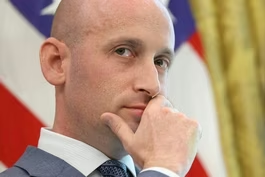
How Stephen Miller reshaped the GOP's immigration policies
Video has Closed Captions
Clip: 2/12/2026 | 11m 55s | How Stephen Miller reshaped the GOP's immigration policies (11m 55s)
Providing Support for PBS.org
Learn Moreabout PBS online sponsorship
- News and Public Affairs

Top journalists deliver compelling original analysis of the hour's headlines.

- News and Public Affairs

FRONTLINE is investigative journalism that questions, explains and changes our world.
Urban Consulate Presents











Support for PBS provided by:
Major funding for “Washington Week with The Atlantic” is provided by Consumer Cellular, Otsuka, Kaiser Permanente, the Yuen Foundation, and the Corporation for Public Broadcasting.