
‘America First’ policy reshapes how U.S. delivers health aid
Clip: 4/23/2026 | 8m 42sVideo has Closed Captions
‘America First’ aid policy reshapes how U.S. delivers global health assistance
Since the dismantling of USAID, the Trump administration has been revamping aid policies, focusing on smaller deals with recipient governments. Countries receiving American aid will be required to finance part, and eventually, the entire program. Fred de Sam Lazaro reports from Kenya and Uganda, two nations that have signed agreements under the new America First Global Health Strategy.
Problems playing video? | Closed Captioning Feedback
Problems playing video? | Closed Captioning Feedback
Major corporate funding for the PBS News Hour is provided by BDO, BNSF, Consumer Cellular, American Cruise Lines, and Raymond James. Funding for the PBS NewsHour Weekend is provided by...
‘America First’ policy reshapes how U.S. delivers health aid
Clip: 4/23/2026 | 8m 42sVideo has Closed Captions
Since the dismantling of USAID, the Trump administration has been revamping aid policies, focusing on smaller deals with recipient governments. Countries receiving American aid will be required to finance part, and eventually, the entire program. Fred de Sam Lazaro reports from Kenya and Uganda, two nations that have signed agreements under the new America First Global Health Strategy.
Problems playing video? | Closed Captioning Feedback
How to Watch PBS News Hour
PBS News Hour is available to stream on pbs.org and the free PBS App, available on iPhone, Apple TV, Android TV, Android smartphones, Amazon Fire TV, Amazon Fire Tablet, Roku, Samsung Smart TV, LG TV, and Vizio.
Providing Support for PBS.org
Learn Moreabout PBS online sponsorshipAMNA NAWAZ: Since the dismantling of the U.S.
Agency for International Development, or USAID, the Trump administration has been revamping aid policies, focusing on smaller, narrowly focused deals with recipient governments.
They will be required to finance part and it's hoped eventually entire programs now receiving American assistance.
In his second report, Fred de Sam Lazaro reports from Kenya and Uganda, two nations that have signed agreements under the new America First Global Health Strategy.
FRED DE SAM LAZARO: On a recent afternoon in this Nairobi public health center, Everylyn Minayo was girding herself for a dose of perhaps the most significant drug developed so far against HIV.
Minayo is considered at high risk for the virus, but on lenacapavir, she will be protected.
Lenacapavir is not the first HIV prevention drug.
There have been daily oral medications, for example, but this one is called a game changer because it's just one dose taken every six months and has been found nearly 100 percent effective in preventing HIV infection.
Lenacapavir is also the first drug made accessible in low-income countries soon after its release in rich nations.
It was approved just last June by the Food and Drug Administration in the U.S., where it is sold under the brand name Yeztugo.
The list price in America is $14,000 per dose, but under an agreement with the U.S.
government, its maker, California-based Gilead Sciences, is making lenacapavir available for two million people at -- quote -- "no profit," targeting patients in several nations that the U.S.
has approached with a new model for health care assistance.
EVERYLYN MINAYO, Lenacapavir Recipient (through translator): Sometimes, I forget to take the pills, so this gives me some reassurance that I won't get infected.
FRED DE SAM LAZARO: Everylyn Minayo, who struggles on meager earnings selling secondhand clothes, is one of the earliest beneficiaries.
EVERYLYN MINAYO: (through translator): I sometimes visit the clubs to see if I can get a client who can supplement what I earn by having sex with a man for payment.
FRED DE SAM LAZARO: The rollout here of lenacapavir is part of a new America first policy that, among other goals, aims to promote and showcase American products.
It will be added to drugs that treat HIV, which the U.S.'
PEPFAR program, aside from a brief interruption last year, has provided for years to some 20 million people worldwide.
WILLIAM RUTO, Kenyan President: I express profound gratitude to the United States.
FRED DE SAM LAZARO: Kenya's agreement signed in the presence of its president late last year will see the U.S.
provide $1.6 billion over five years.
The Kenyan government pledged to chip in $850 million.
Diseases like HIV, T.B.
and malaria are targeted particularly among young women.
And Kenya will share data, pathogens and biological samples with U.S.
experts for disease, surveillance and emergency preparedness.
WILLIAM RUTO: I assure you that every shilling and every dollar will be spent efficiently, effectively and accountably.
(APPLAUSE) FRED DE SAM LAZARO: Secretary of State Marco Rubio said the new approach works directly with governments and cuts out international agencies and nongovernment groups that contracted extensively to implement programs under USAID.
MARCO RUBIO, U.S.
Secretary of State: Bottom line is, if you want to help a country, work with that country, because that money is not just going to be spent to provide medicine and care.
It's going to be spent to improve the domestic infrastructure, health care infrastructure.
FRED DE SAM LAZARO: As part of that, Gilead Sciences has agreed to allow six generic drugmakers to make and sell lenacapavir in 120 low- and middle-income countries.
Some estimates predict a potential cost as low as $20 per dose.
However, the low-cost generics cannot be sold in several middle-income countries like Mexico, Brazil and Argentina, even though they have high HIV rates.
So this is where lenacapavir will be produced?
Ajay Kumar Pal is CEO of QCIL, a generics maker based in Uganda, which also signed an aid agreement with the U.S.
He says the deal helps not just his company, but the continent.
AJAY KUMAR PAL, CEO, Quality Chemical Industries Limited: It brings sustainability of access, because, if you look at access in the continent, it's mostly externally funded.
Africa even today imports more than 75 percent of its treatment from outside.
FRED DE SAM LAZARO: In about 3.5 years, he says, up to 11 million doses could be produced here targeting East African nations.
As for demand and pricing, he says, it's too early to predict.
AJAY KUMAR PAL: It depends upon the interest of people and how much advocacy happens about it and how the market accepts it, because, again, it's not a private product.
FRED DE SAM LAZARO: That is, governments will have to buy most of the product and promote it to generate public demand.
It's just one of several concerns that experts have for the new aid agreements.
DR.
KENNETH NGURE, Jomo Kenyatta University: If you don't get the product to people's hands or into people's bodies, then it's not helpful.
And we have seen that with a number of products.
FRED DE SAM LAZARO: Drs.
Kenneth Ngure and Elizabeth Bukusi are leading HIV scholars in Kenya.
DR.
ELIZABETH BUKUSI, Kenya Medical Research Institute: I think we have heard commitments in the past and there has been attempts to do it, but it doesn't -- the funding doesn't always follow through in the same way.
FRED DE SAM LAZARO: African governments burdened by debt and other compelling demands are often hard-pressed to fulfill commitments, she says.
And the new agreements also emphasize U.S.
priority, she adds.
And, right now, those do not include family planning services for the young women targeted for lenacapavir.
DR.
ELIZABETH BUKUSI: They fear getting pregnant even more than they fear getting HIV.
We do need to find products that do more than one thing.
It's about protecting them from HIV, protecting them from unplanned or unwanted pregnancies, but also other sexually transmitted infections.
FRED DE SAM LAZARO: In fact, Dr.
Ngure was working on a research project to combine HIV prevention drugs with contraceptives.
DR.
KENNETH NGURE: You have injectable contraceptives like Depo-Provera, and sort of work towards a mechanism where they can combine these drugs in a single injection.
FRED DE SAM LAZARO: His research into the idea ended abruptly last year, he says, along with its chief funder, USAID.
PETER WAISWA, Makerere School of Public Health: The U.S.
government has made clear America first, and I think there is no -- they have that right.
FRED DE SAM LAZARO: Dr.
Peter Waiswa is a public health scholar at Uganda's Makerere University.
Given its deep pockets, he says, America will always have the upper hand.
And he's concerned about what he calls strings attached to the U.S.
assistance.
PETER WAISWA: The only right we have is our data and the samples.
FRED DE SAM LAZARO: For example, he says African nations will be required to quickly detect outbreaks and send pathogens, data and biological samples to the United States.
PETER WAISWA: Once the samples have been exported to the U.S., who knows what is going to happen?
FRED DE SAM LAZARO: In fact, some countries have resisted, citing unfair terms, with Zambia drawing the ire of the Trump administration, which reportedly demanded a share of its mineral ores as a condition for receiving HIV assistance.
PETER WAISWA: We need to be looking at these pathogens as actually of economic potential.
FRED DE SAM LAZARO: Potential that he says could be realized if aid agreements included training to analyze data in Africa and build a biomedical industry here.
He sees a historic pattern being repeated.
Africa exports raw materials, but derives little benefit from products made from them.
PETER WAISWA: The biological samples can be a basis for making vaccines, making medicine, doing gene therapy and more.
And this is the future of science.
NARRATOR: One office visit every six months.
FRED DE SAM LAZARO: Lenacapavir is blockbuster profitable for its maker and touted as an American innovation, Waiswa says, but crucial clinical trials in its development were conducted across Africa, including here at Makerere University.
For the "PBS News Hour," I'm Fred de Sam Lazaro in Kampala, Uganda.
 New
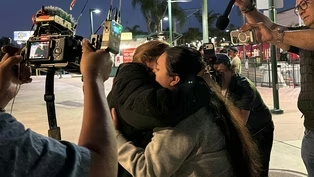
NewDACA recipient deported then returned to U.S.
Video has Closed Captions
'This is my home,' says DACA recipient deported then returned to U.S. (7m 24s)
 New
NewExhibit shines light on Romani persecution during Holocaust
Video has Closed Captions
Art exhibition shines light on Romani persecution during Holocaust (7m 9s)
 New
NewIsraeli UN ambassador: IDF most moral military in the world
Video has Closed Captions
Israel's UN ambassador says IDF is 'most moral military in the world' (7m 24s)
 New
NewNews Wrap: Wildfires threaten homes in southern Georgia
Video has Closed Captions
News Wrap: Wildfires threaten homes in southern Georgia (6m 44s)
 New
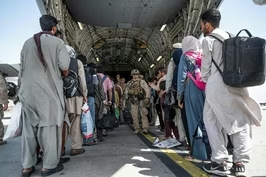
NewU.S. could send Afghans who helped its war effort to Congo
Video has Closed Captions
State Department proposes sending Afghans who helped U.S. war effort to Congo (6m 43s)
 New
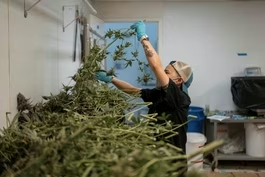
NewWhat marijuana's reclassification means for health, business
Video has Closed Captions
What marijuana’s reclassification means for public health and businesses (4m 4s)
Providing Support for PBS.org
Learn Moreabout PBS online sponsorship
- News and Public Affairs

FRONTLINE is investigative journalism that questions, explains and changes our world.

- News and Public Affairs

Each week, explore science, health, and technology headlines with leading experts.
Urban Consulate Presents











Support for PBS provided by:
Major corporate funding for the PBS News Hour is provided by BDO, BNSF, Consumer Cellular, American Cruise Lines, and Raymond James. Funding for the PBS NewsHour Weekend is provided by...