
December 10, 2025 - PBS News Hour full episode
12/10/2025 | 57m 46sVideo has Closed Captions
December 10, 2025 - PBS News Hour full episode
December 10, 2025 - PBS News Hour full episode
Problems playing video? | Closed Captioning Feedback
Problems playing video? | Closed Captioning Feedback
Major corporate funding for the PBS News Hour is provided by BDO, BNSF, Consumer Cellular, American Cruise Lines, and Raymond James. Funding for the PBS NewsHour Weekend is provided by...
Support provided by:

December 10, 2025 - PBS News Hour full episode
12/10/2025 | 57m 46sVideo has Closed Captions
December 10, 2025 - PBS News Hour full episode
Problems playing video? | Closed Captioning Feedback
How to Watch PBS News Hour
PBS News Hour is available to stream on pbs.org and the free PBS App, available on iPhone, Apple TV, Android TV, Android smartphones, Amazon Fire TV, Amazon Fire Tablet, Roku, Samsung Smart TV, and Vizio.
Providing Support for PBS.org
Learn Moreabout PBS online sponsorshipAMNA NAWAZ: Good evening.
I'm Amna Nawaz.
Geoff Bennett is away.
On the "NewsHour" tonight: The U.S.
seizes an oil tanker off the coast of Venezuela, escalating tensions with the Maduro regime.
The Federal Reserve cuts interest rates again amid mixed economic data and more divisions within its own ranks.
And one woman's journey to return home to Syria after the fall of the decades-long Assad dictatorship.
WAAD AL-KATEAB: The situation here is uncertain, but, for the first time in so many years, I can stand in my country and see a future here.
(BREAK) AMNA NAWAZ: Welcome to the "News Hour."
The United States today seized a tanker ship off the coast of Venezuela.
Attorney General Pam Bondi said in a social media post that a warrant was executed for the crude oil tanker that was once used to transport sanctioned oil from both Venezuela and Iran.
Nick Schifrin has been following this all and he joins me here now.
So, Nick, what happened today?
NICK SCHIFRIN: Well, as you just said, Pam Bondi just announced this, that the military with the Coast Guard and the FBI's help seized this tanker off the coast of Venezuela.
And Bondi also posted this video.
You can see it there, a helicopter hovering above the ship.
You can see service members rappelling down onto the ship.
Eventually, they draw their guns to seize this ship.
I mean, it goes without saying, but this is highly unusual to see in the Caribbean the military launching an armed seizure of a tanker.
It was announced today by President Trump.
DONALD TRUMP, President of the United States: We have just seized a tanker on the coast of Venezuela, a large tanker, very large, largest one ever seized actually.
It was seized for a very good reason.
NICK SCHIFRIN: So, as you said, Amna, Bondi said that the tanker was sanctioned by the U.S.
as part of an illicit oil shipping network for supporting foreign terrorist organizations.
But this is also a clear attempt to pressure Venezuelan President Nicolas Maduro.
And it's an attempt to pressure him through economic means, in the sense that it is an attempt to pressure Venezuela's exports of oil.
Take a listen to Ryan Berg at the Center of Strategic and International Studies, who calls today a significant escalation.
RYAN BERG, Center for Strategic and International Studies: This comes at a time when Maduro is under a lot of pressure to leave.
One of the key ways that he will think he can remain in power is if he has enough revenues in his coffers to pay off the people he needs to pay off.
This cuts directly against those revenue streams.
And it also drives up the discount that largely Asian markets will demand for Venezuelan crude, given the risk level associated with importing it.
NICK SCHIFRIN: So it drives up the cost, leading to decreased demand for Venezuelan crude, which, Amna, is more than 90 percent of the Venezuelan regime's revenue.
And that economic pressure is teamed with military pressure.
The Navy says that the largest aircraft carrier in the world -- you see that, the USS Gerald Ford -- is in the Caribbean; 15 percent of the Navy's deployed warships are there.
And just yesterday we saw two F-18s fly as close to as any plane has flown to Venezuela since the US increased its pressure.
It's worth noting here, Amna, that the administration has described this as an attempt to interdict narcotics from coming to the United States.
In total, we've seen 22 boat strikes, according to the U.S.
military, killing more than 80 people.
But after today, it is more clear than ever that this is as much about drugs as it is ousting Maduro.
AMNA NAWAZ: Meanwhile, we know there's another major event connected to Venezuela you have been following.
That's the daughter of Maria Corina Machado, who accepted her Nobel Peace Prize on her mother's behalf.
Tell us about that.
NICK SCHIFRIN: Yes, Maria Corina Machado is the Venezuelan opposition leader.
She was campaigning in the election last year until she was barred from running in that election.
She won the Nobel Peace Prize for her effort to bring democracy in Venezuela, but she's also endorsed President Trump's pressure campaign against Maduro.
And, today, Ana Corina Sosa, Maria Corina's daughter, accepted her mother's Peace Prize in Oslo and said in her mother's name that the Maduro regime had dismantled democracy and manipulated elections.
ANA CORINA SOSA MACHADO, Daughter of Maria Corina Machado: Oil money became a tool to purchase loyalty abroad, while, at home, criminal and international terrorist groups fused themselves to the state.
We have built new networks of civic pressure and disciplined disobedience, preparing for Venezuela's orderly transition to democracy.
That is how we reach this day, a day carrying the echo of millions who stand at the threshold of freedom.
NICK SCHIFRIN: An official close to Maria Corina tells me tonight, Amna, that she has left Venezuela and that she is arriving in Oslo overnight.
She will speak to supporters at 2:00 a.m.
local time.
And on her call for a democratic future of Venezuela, the question, of course, is will today's efforts or will the overall administration efforts so far get Maduro to actually leave?
Experts like Ryan Berg say not quite yet.
There is an expectation among multiple experts I talked to that there will have to be military strikes inside of Venezuela to convince Maduro to leave, finally once and for all.
And, until then, he's going to assume this is a bluff or he's going to really wait out the United States.
But the bottom line, the U.S.
military certainly has enough firepower if President Trump does order that.
AMNA NAWAZ: You mentioned those boat strikes in the Caribbean carried out by the Trump administration.
We have seen bipartisan pressure to release the full video of one of those strikes from back in September.
Where does that stand?
NICK SCHIFRIN: Yes, this is September 2, the very first strike in this campaign in the Caribbean.
You see right there President Trump personally released this video back on September the 2nd.
But the administration has not released any further videos than this, including of the second strike that U.S.
officials tell me killed two people that were not killed during the first strike.
And, as you say, there's been bipartisan pressure to release that video, even calls, questions about whether the military commander committed some kind of crime by ordering the death of those two survivors.
Just yesterday, Senate Democratic Leader Chuck Schumer said that he pushed Secretary Pete Hegseth in a classified briefing yesterday to at least release that second video to all of Congress, so Congress can see.
Schumer quoted Hegseth saying they're still studying it, so no movement yet.
AMNA NAWAZ: All right Nick Schifrin kicking us off tonight, thank you.
NICK SCHIFRIN: Thank you.
AMNA NAWAZ: The Federal Reserve cut interest rates today for the third time in a row, but left big questions about any additional rate cuts in the future.
The Open Market Committee voted to cut its benchmark rate by a quarter percentage point to between 3.5 and 3.75 percent.
But Fed Chairman Jerome Powell signaled a reluctance to lower rates more amid mixed economic signals.
JEROME POWELL, Federal Reserve Chairman: In the near term, risks to inflation are tilted to the upside and risks to employment to the downside, a challenging situation.
There is no risk-free path for policy as we navigate this tension between our employment and inflation goals.
AMNA NAWAZ: President Trump responded by calling Powell a stiff and making it clear he wanted a bigger cut.
DONALD TRUMP, President of the United States: He did a rather -- I would say a rather small number that could have been doubled, at least doubled.
And that's the other thing.
I think the rates for the United States are always the lowest in the world, because without us there is no world.
Without this economy, there's no world.
AMNA NAWAZ: With me now is Krishna Guha.
He's vice chairman of Evercore ISI.
It's an investment banking firm.
He's former executive vice president at the New York Fed.
Krishna, welcome to the "News Hour."
Thanks for joining us.
KRISHNA GUHA, Vice Chairman, Evercore ISI: Thank you.
AMNA NAWAZ: Let's just start with your reaction to the Fed's decision to deliver its third straight interest rate cut.
Is that what you expected?
KRISHNA GUHA: So it is what I expected.
But, of course, as you noted, there was a compromise here between the Fed doves, who want to cut rates, and the Fed hawks, who are skeptical about cutting rates.
And the compromise was this.
They cut rates, but they signaled that they're minded to take a pause here and see how the economy evolves.
They're certainly not ruling out cutting rates further.
And most of them expect that will ultimately be the right thing to do.
But right now, they're not in a rush, and there's a slightly higher bar for another near-term cut.
AMNA NAWAZ: So you heard what Chairman Powell had to say there, some warning signs about what's to come.
What do you take away from what he had to say, from the decision about the size of this cut and anything else from today's meeting?
KRISHNA GUHA: Well, I think what we saw is the Fed trying to come back together after a period where the divisions have been very much front and center between those more hawkish and more dovish members and find a middle path that most of them could sign up to.
The other thing that I think was interesting is the new economic projections that they delivered.
They do this once a quarter at their meetings.
They set out an economic outlook for next year and the years beyond.
And what I thought was really quite striking about the new outlook is, it looks like the Fed is starting to embrace some optimism about technology, productivity and the sustainable growth rate.
You might think of this as a 1990s-lite take on what the world might look like next year and beyond.
AMNA NAWAZ: You mentioned that compromise, the fact that this was the Fed coming back together and pulling together some disparate views.
Just they made clear there were two members who wanted to see no change at all, one member who wanted to see a deeper cut.
Just for context, how unusual are those kinds of disagreements?
KRISHNA GUHA: So you're certainly right to say that it's not normal to have two dissenters on one side, wanting no cut, and one dissenter on the other side wanting a double-sized cut.
So this is not normal.
But relative to where we were a few weeks ago, where it looked like the Fed Committee was splitting right down the middle, and you could have three, four, even five dissenters if Powell pushed through a rate cut, the committee looks just a little bit less divided in this moment than was feared.
But, certainly, there are deep disagreements on the committee about how restrictive their monetary policy still is and about the balance of risks that they're obligated by law to look at, the risks to employment on the one hand and inflation on the other.
And I think the truth is that these differences of economic analysis have been amplified by the political pressure on the Fed and the perception among Fed officials that their independence is under pressure.
And this is something that doesn't make it easy to come to the middle.
In fact, it tends to push people into their corners.
AMNA NAWAZ: Speaking of that political pressure, we know Fed Chair Powell's term ends in May.
President Trump is expected to name a successor in the coming weeks.
Has anything that you have seen tell you about who that next pick might be and whether or not President Trump's pressure campaign for deeper cuts could work?
KRISHNA GUHA: Well, it certainly looks, based on the media reporting, that White House economic adviser Kevin Hassett is in pole position for the nomination for next Fed chair.
It's not clear it's completely locked down yet.
There's talk of some further interviews taking place.
And I think there are other candidates, including former Governor Warsh, current Governor Waller, who might still be in with a small chance.
I also think that there is still some residual risk that the next Fed chair ends up being current Treasury Secretary Scott Bessent.
President Trump seems to have never really given up on the idea that Bessent would be a great Fed chair.
And Bessent has made it clear that he doesn't want the job.
But I wouldn't completely exclude the possibility that he could end up in that seat.
President Trump can be quite persuasive when he wants to be.
AMNA NAWAZ: All right, that is Krishna Guha, vice chairman of Evercore ISI, joining us tonight.
Krishna, thank you.
It's good to speak with you.
KRISHNA GUHA: So great to speak to you.
Thank you.
AMNA NAWAZ: In the day's other headlines: a federal judge in California is ordering the Trump administration to stop its deployment of National Guard troops in Los Angeles.
In his ruling, District Judge Charles Breyer wrote the government is meant to be a -- quote -- "system of checks and balances," adding that the -- quote -- "defendants, however, make clear that the only check they want is a blank one."
President Trump first called up more than 4,000 California National Guard members in June without Governor Gavin Newsom's approval.
Only about 100 troops remain today.
The judge has given the administration time to appeal.
A federal judge in New York today granted a Justice Department request to unseal grand jury transcripts from Jeffrey Epstein's 2019 sex trafficking case.
Judge Richard Berman reversed his earlier decision to keep the material under wraps.
What changed things, the judge said, is a new law signed by President Trump last month that requires the release of files related to Epstein by December 19.
It comes a day after a separate judge agreed to allow the release of files related to Epstein's longtime associate Ghislaine Maxwell for similar reasons.
In Florida, a Democrat will run the city of Miami for the first time in nearly 30 years after Eileen Higgins won yesterday's mayoral run-off election.
She's also the first woman to step into that role.
The local race gained national attention as a key electoral test in an area that's increasingly shifted to the right.
Today, Higgins celebrated Miami as an immigrant city and called out elected officials for what she called cruel and demeaning rhetoric amid a broader nationwide crackdown.
EILEEN HIGGINS (D), Mayor-Elect of Miami, Florida: When I speak to our residents, it's not just about frustration.
It's also about fear.
They have never been afraid of their government before.
And now they are.
AMNA NAWAZ: Higgins finished about 19 points ahead of her Trump-backed opponent, Emilio Gonzalez.
The win gives Democrats a political boost in one of the last electoral battles ahead of next year's midterms.
In France, a Senate inquiry into the Louvre Museum heist found that the thieves managed to escape with just 30 seconds to spare.
The probe also found that only one of the two cameras covering the break-in point was functional, that the staff lacked resources to monitor security footage in real time, and that when the alarm finally sounded, police initially went to the wrong location.
Authorities have arrested all four primary suspects in the October theft, but the missing jewels valued at more than $100 million have not yet been recovered.
Scientists in the U.K.
say they have found evidence of humans making fire far earlier than previously thought.
Archaeologists working at a site in what's now Eastern England say they found signs of deliberate fire making going back 400,000 years.
Before that, the earliest known evidence of humans making fires dated back just 50,000 years.
That's a 350,000-year difference.
The findings were published today in the journal "Nature."
Researchers say they could have a significant impact on what we know about human evolution.
New York's Metropolitan Museum of Art announced its co-chairs for next year's Met Gala today.
A trio of trend-setting titans, including Beyonce, who hasn't attended the event in a decade, plus Venus Williams and Nicole Kidman, will join "Vogue"'s Anna Wintour to host the event next May.
Wintour has long overseen what's been known as fashion's biggest night out, a star-studded fund-raiser for the museum's Costume Institute.
The official dress code is still a secret, but it will tie into the institute's spring exhibition titled Costume Art.
On Wall Street today, stocks ended higher after that Fed rate cut.
The Dow Jones industrial average added nearly 500 points.
The Nasdaq rose more than 70 points.
The S&P 500 also closed firmly in positive territory.
And former U.S.
Education Secretary Rod Paige has died.
He was the first African American to serve in that role during the administration of George W. Bush.
Paige oversaw the rollout of the No Child Left Behind law in 2002, which established universal testing standards.
The landmark legislation was modeled on Paige's work as a school superintendent in Houston.
It was also criticized for sanctioning schools that didn't meet certain standards.
In a statement, Bush said that Paige -- quote - - "worked hard to make sure that where a child was born didn't determine whether they could succeed in school and beyond."
Rod Paige was 92 years old.
And British author Sophie Kinsella has died.
Her novel about a young woman's retail obsession called "Confessions of a Shopaholic" in the U.S.
was a sensation when it came out 25 years ago.
She went on to write 10 "Shopaholic" books.
They sold more than 45 million copies and were translated into dozens of languages.
Kinsella, who also published under her real name, Madeleine Wickham, says the idea came to her when she received a staggering credit card bill back in 1999.
Sophie Kinsella had been battling an aggressive form of brain cancer.
She was just 55 years old.
Still to come on the "News Hour": a presidential speech billed as addressing affordability turns into a rant against immigrants; the Education Department ends a Biden era student loan repayment plan; and Judy Woodruff reconnects with people across the country to see how political divisions are affecting their lives.
President Trump was on the road in Pennsylvania last night to address affordability, an issue that's dragged down his approval ratings.
But at the event, the president reverted to campaign mode, delivering a speech that lasted more than an hour-and-a-half, including a rant about immigrants.
To discuss that, we turn now to Democratic strategist Ameshia Cross and Republican Tiffany Smiley, a former U.S.
Senate candidate in Washington state.
Welcome to you both.
Thanks for being with us.
AMESHIA CROSS, Democratic Strategist: Thank you.
TIFFANY SMILEY (R), Former Washington Senatorial Candidate: Thanks for having me.
AMNA NAWAZ: So for anyone who missed this speech last night, the president's remarks, here is just a part of what President Trump had to say, including confirming what he'd said earlier about Haiti and African nations during a 2018 meeting that was later widely reported on.
Take a listen.
DONALD TRUMP, President of the United States: We had a meeting.
And I say, why is it we only take people from shithole countries, right?
(LAUGHTER) DONALD TRUMP: Why can't we have some people from Norway, Sweden, just a few?
Let's have a few from Denmark.
Do you mind sending us a few people?
Send us some nice people.
Do you mind?
But we always take people from Somalia, places that are a disaster, right?
Filthy, dirty, disgusting, ridden with crime.
AMNA NAWAZ: Tiffany, he also called other countries, including Afghanistan and Somalia, hellholes.
This was billed as a speech about affordability.
Is this what voters want to be hearing about right now?
TIFFANY SMILEY: Well, look, President Trump was elected because we had an immigration crisis.
We had an open, porous border where illegals, terrorists, criminals, drugs were free flowing from our southern border into the United States of America.
And so, under President Trump, President Trump and the Republicans have provided the most secure border in American history.
And I simply - - Donald Trump is Donald Trump.
And what he is trying to say is, if you want to come here, come here legally.
And if you're going to come here, we want you to love America and work and give back and be a part of the system.
He doesn't want criminals and terrorists coming in and ruining our country or people coming in who hate our country.
And that's simply what he is stating.
And he has delivered on his promises to the American people to secure the border and stop the drugs and flow of fentanyl coming across or coming into our communities and causing harm and chaos.
AMNA NAWAZ: Ameshia, to Tiffany's point, this isn't necessarily new language from the president.
Is he returning to what's worked with his base in the past?
AMESHIA CROSS: He's absolutely returning to what's worked.
And Trump leans on cultural wars because he has nothing else.
We know that the prices of everyday goods have gone up since he's been in office.
We know that his tariff strategy has done nothing but tax the American people.
We know that the Big Beautiful Bill Act is the largest wealth transfer that the United States has ever seen.
People are having a hard time paying their rent.
They can't afford housing.
They can't afford to buy things at the grocery store.
He's eliciting a conversation that he knows is not a dog whistle.
This is racism writ large.
When Trump calls places where Black people live, countries outside the U.S.
where Black people live or where they're the predominant population shithole countries, he knows what he's doing when he says that.
He knows that it is a rallying cry for those who see America as a land of opportunity for whites only.
This is a guy who has used the segregationist platform before.
And he's a guy who continues to use it when asked to really speak to why his policies aren't working.
People in red states, blue states, purple states, and every color in between have said that affordability is their top-line issue.
But he gets up there and does is what he's done time and time again, castigate populations of color.
And to a point that was just made a moment ago that I think is really frustrating is that, when he's attacking these Somalians specifically, these are citizens of this country, many of whom came here as refugees, and under that refugee status have now had families here who have gone through the process, who are living, contributing, working in their communities, and who the governors of the states that they reside in have spoken about, who business leaders, many of them are contributing members of society.
They do not have criminal records, and they, again, are citizens of this country.
AMNA NAWAZ: Tiffany, to this point Ameshia is making about affordability being the number one concern for so many voters, the president did touch on it.
He said prices are coming down.
And some have, but inflation does remain stubbornly high year over year.
And he continues to call it a Democratic hoax.
So there's a big gap between what people are feeling, what they're concerned about, and what the president is saying.
Why?
TIFFANY SMILEY: Yes, it kind of reminds me a little bit of Joe Biden when he labeled Bidenomics, which I think was his downfall, because the American people knew that Bidenomics, it simply was not working for hardworking Americans.
But President Trump was very -- he was crystal clear in his approach to the new buzzword, affordability, or lowering the cost of living.
He wants to lower prices and increase higher paychecks.
It's simple.
And I think we need to go back and look at what President Trump inherited.
He really inherited an economy that was an absolute mess.
He inherited Democrats who were saying that inflation is transitory, transitory, while they doled out trillions in additional spending and greatly upscaled government, really leading us to a brink of economic failure and ruin in this country.
So that's what President Trump has inherited.
But I will caution Republicans, because heading into the midterms, they are going to have to deliver results on affordability for the American people.
The American people are going to have to be able to go to the grocery store and feel like I still have money in my bank account.
It is so expensive out there.
I know.
I have three growing boys who want to eat steak, and ground beef is nearly $10 a pound.
But it is trending in the right direction.
I think this time next year we may have a very different conversation.
But Republicans cannot just wish this away.
They need to roll up their sleeves, partner with President Trump, and start to address the affordability crisis.
President Trump is also huge on energy independence.
And I think this plays into lowering gas prices, which in turn will help lower grocery prices for hardworking Americans, so lots to be accomplished.
This was only President Trump's first year.
He has three more years to deliver for these results, and it's trending and looking positive going forward.
AMNA NAWAZ: Ameshia, we did see Democrats who leaned into this affordability message come across some big special election wins, right, in a number of recent races.
And Miami just elected its first Democratic mayor in 28 years.
Democrats flipped a Georgia Statehouse seat blue.
Is this going to be the main message for Democrats moving forward?
And I will allow you to respond to what you heard from Tiffany as well.
AMESHIA CROSS: Absolutely.
I mean, affordability is going to be the main message, because people's personal economies are greatly affected.
I agree with Tiffany on one point.
Things are going to be different this time next year, and it's going to be different because America is going to be blue.
What we are going to see is a wave of people voting Democrat, and in large part because they have seen the president ignore their crises.
He's telling them to ignore what they're seeing before their eyes.
Affordability isn't a feeling.
Either you can pay your rent or you can not.
Affordability isn't a feeling.
Either you can put food on the table for your kids or you can not.
Affordability isn't a feeling when health care is up for grabs.
And instead of utilizing the policies at bay to create an economy that works for the American people, he is creating an economy that works for the rich and powerful and leaving everybody else out.
We have seen that with his restructuring of student loans.
We have seen that with him deciding what counts as professional and what doesn't when it comes to who gets to buy into American education.
We see it every time this president decides that he is going to take one specific group of people and put a target on their backs.
Right now, it's immigrants.
It's been Black people.
It's been women.
So when you talk about the decreases of people being able to afford things, we also have to look at the fact that over 600,000 Black women are now out of work and more and more people are out of work or underemployed every single day.
So, no, there's no wage increases that we're seeing.
We're seeing massive layoffs.
We're seeing people not know where their next meal is coming from because they don't know where their next job is coming from.
This is a president who does not want to address any of that.
And it's really frustrating to hear it reframed in any other type of way than the reality Americans are currently living in.
AMNA NAWAZ: Well, there's so much more to discuss here.
We hope that you will both come back so we can continue this conversation.
We will have to leave it here for now, though.
Ameshia Cross and Tiffany Smiley, thank you both for joining us.
The Assad family's oppressive half-century rule ended one year ago this week, as Bashar al-Assad fled for Russia amid an insurgent takeover.
The Syrian president had spent more than 12 years slaughtering his own people in one of the world's worst wars of recent memory.
For the millions of Syrians who'd opposed him, losing family, friends and homes, his flight was a moment of joy and reckoning.
We bring you now a very personal look at going home back to Syria.
It comes from the Syrian filmmaker Waad Al-Kateab, an Oscar-nominated documentarian and activist.
And a warning: Images in her report may disturb some viewers.
WAAD AL-KATEAB (through translator): Can you believe what's happening?
What are we witnessing now?
It's real.
It's real.
It's 4:00 a.m.
on the 8th of December, 2024, in London, a historic moment none of us could imagine in our wildest dreams.
WOMAN: God is great.
The Syrian people have topped the regime.
WAAD AL-KATEAB: Assad as fallen and Syria is free.
I'm with Hamza, my husband, and with my mom and dad and our friends.
All of us were displaced by Assad's regime.
We decided to fly back to Syria as soon as we could.
Almost there.
We carry so many mixed feelings, shock, grief, fear, and hope.
Twelve years away from my hometown this year and eight years away from Aleppo.
All this ends today.
For fourteen years, Assad tried to crush us.
Millions of Syrians have been displaced in the war.
Over half-a-million have lost their lives, a generation lost.
But now Assad has gone, and we are back.
I see the flag of the revolution again as we cross the border, the same flag millions believed in, the one the regime tried to erase.
To hell with you, Assad.
To hell -- to hell with you.
Just one hour away from Damascus is a statue of Assad's father, a symbol of fear.
Now it's just trouble.
The long road to Aleppo reveals village after village destroyed, and the land is still full of unexploded weapons and mines.
This is the Syria the regime left behind.
The last time we left Aleppo, I was pregnant and holding my 1-year-old daughter, Sama, trying to escape.
Inside my clothes, I was hiding my footage, hundreds of hours documenting the war crimes we had witnessed.
I'd kept my identity secret from the regime, but my husband, Hamza, who was managing the last remaining hospital in besieged Aleppo, was always always on the news.
Hamza, are you scared of the regime checkpoints?
DR.
HAMZA AL-KATEAB, Husband of Waad Al-Kateab (through translator): Yes, of course.
Anything can happen.
WAAD AL-KATEAB: Back then, it felt like our life was ending.
And we feared we would never see our Aleppo ever again.
Returning now feels like reclaiming something the regime tried to take from us, our voice, our home, our right to exist.
Even our wedding rings bear the promise.
Together, we will be back, and here we are.
This is the last hospital in Aleppo, where Hamza worked and where we lived during the war and the siege.
From the outside, it looks just like how we left it.
Our friend Nabeel (ph), who was a nurse here, came back with us to look inside.
This building is a witness to the crimes committed here.
(EXPLOSION) (SCREAMING) WAAD AL-KATEAB: We make our way through the neighborhood to the house where we got married, where Sama, my daughter, was born.
The flowers now are growing back.
I got these plants that were grown out of Aleppo.
The last time I saw the garden was when I said goodbye in 2016.
Being here makes me feel there is some redemption.
Finally, we arrived in my hometown.
For 12 years, I couldn't visit (INAUDIBLE) because Assad hunted and punished activists.
I had to hide where I am from to protect my family.
But, today, I can come home.
I can say my family's name.
And Hamza, my husband, can finally meet all of them for the first time, our happiness mixed with grief for all those we lost.
Syria is exhausted, wounded, but it's still breathing, still dreaming.
The situation here is uncertain.
But for the first time in so many years, I can stand in my country and see a future here.
AMNA NAWAZ: The Trump administration has reached a joint settlement with seven states that will effectively shut down a key Biden era student loan relief program.
John Yang looks at what's behind the change and what it could mean for borrowers in the months ahead -- John.
JOHN YANG: Amna, it's called Saving on a Valuable Education, or SAVE.
It bases borrowers' monthly payments on their incomes and provides a faster path to loan cancellation.
The Trump Education Department doesn't like it.
Instead, it's created several other repayment options.
And with this proposed settlement of a lawsuit brought by seven Republican states, they're ending it.
But what about the roughly seven million people currently enrolled in it?
Danielle Douglas-Gabriel is The Washington Post's national higher education reporter.
Danielle, let's start with SAVE, this program that is going away, or if the judge approves it's going away.
What made it so attractive and what made it so generous for borrowers?
DANIELLE DOUGLAS-GABRIEL, The Washington Post: So, John, first, thank you for having me.
And, with SAVE, it is an income-driven repayment plan, one of four that the government offers.
What makes it different from the other existing income-driven payment plans, some dating back two decades, is that SAVE has a higher threshold for how much of your disposable income gets counted in the calculation for your monthly bill.
So, for a lot of people, that means that they saw their monthly payments go down pretty dramatically.
It also has a faster path to debt cancellation, meaning that, if you borrowed less than $12,000 from the government and have been in repayment for 10 years, your remaining balance would be forgiven.
And when it was implemented back in October of 2023, about 400,000 people saw their student loans forgiven as a result of this provision.
Well, that cancellation provision became the point of contention for the states that filed this lawsuit several months later.
As they said the Biden administration had exceeded its authority by offering this debt relief without congressional approval.
JOHN YANG: Tell us a little bit about the path this lawsuit has taken, because it essentially kept the program from being fully implemented, right?
DANIELLE DOUGLAS-GABRIEL: Yes.
So there were two lawsuits initially, and the one that was filed by or led by the state of Missouri and the six other states is the one that kind of had the biggest impact on the program, is that it effectively shut down the whole thing.
And, essentially, the Biden administration had phased in SAVE, and one phase of it was shut down initially by the courts, but the rest of it was allowed to go forward.
But this particular case shut down the entire thing.
There was an injunction that was pretty far -- far-reaching.
And as a result, the department placed about eight million people originally who were enrolled in the program in a form of forbearance, where their payments were being postponed and interest weren't -- wasn't accruing on their loans.
The problem is that, for folks who wanted to go into other income-driven payment plans, there was a -- as a result of the injunction, a lot of those plans were shut down for several months because the application for them were all a part of the SAVE.
It was also including SAVE.
And so the department had to reconfigure that and figure out how best to get people into these programs without running afoul of the courts.
Now, that has created so much chaos when it comes to people who are trying to figure out what's the best path to repaying their loans.
JOHN YANG: Why doesn't the Trump administration like this?
What's their objection?
DANIELLE DOUGLAS-GABRIEL: I think the student loan forgiveness component certainly is a huge part of the objection.
There's has been an ideological battle between conservatives, who feel that student loan forgiveness, any far-reaching student loan forgiveness in particular, really is an affront to people who have not gone to college.
They shouldn't have to foot the bill for folks who did pursue a college education.
At the same time, there are still existing loan forgiveness programs that are in place, such as Public Service Loan Forgiveness that teachers, social workers, and police officers take advantage of.
And so those things are safe.
But this particular plan, it was a signature part of the Biden administration's campaign to fix the student loan system.
And it also, I think, suffered from kind of the ongoing angst against student loan forgiveness that the program that was struck down by the Supreme Court really, really, really centered on.
And so even though this is totally different than that wide -- that far-reaching program that was struck down by the court, they were kind of viewed in the same lens.
Unfortunately, what that means for a lot of borrowers who benefited from SAVE is that they will no longer have this generous repayment option afforded to them.
JOHN YANG: And under this proposed settlement, what's the timeline?
When does this program wind down?
DANIELLE DOUGLAS-GABRIEL: That is the big question, John.
Everyone is trying to figure exactly when.
Now, keep in mind, the congressional One Big Beautiful Bill Act that passed this summer actually had wind -- was starting to wind down SAVE.
The congressional Republicans said that, by 2028, if you were in the SAVE plan, you had to get out.
It was over.
Now, what we don't know and what this settlement hasn't explicitly said is, what's the timeline?
So, I really think this is something that we will have to continue to pay attention to as it unfolds in the courts.
And then also the Department of Education is going to convene a panel of experts to kind of flesh out the details of how to wind down this program.
JOHN YANG: You have talked to a lot of people in this program.
What does this decision or this agreement do to them and the others who are in the program?
DANIELLE DOUGLAS-GABRIEL: I think it just heightens a lot of the confusion and a lot of the uncertainty, especially since this settlement hasn't offered a distinct and explicit timeline.
I spoke to a borrower who she already switched out of SAVE and into one of the other income-driven plans, one that was far more expensive.
And this woman, who's a teacher, has seen her payment go from $373 a month to $875.
Now, couple that with an increase in her health insurance at the same time, having to cover her mortgage and just other living expenses, it's a real strain.
And it's a real adjustment for a lot of Americans to have to make at a time when people are worried about inflation and gas prices and grocery prices.
So I think this is a huge adjustment for borrowers.
And hopefully there will be guidance to help them out of this.
What certainly no one wants to see is a huge rise in delinquencies on these loans and defaults on these loans that could really hurt people's financial lives.
JOHN YANG: Danielle Douglas-Gabriel of The Washington Post, thank you very much.
DANIELLE DOUGLAS-GABRIEL: Thank you.
AMNA NAWAZ: Over the past three years, Judy Woodruff has spoken with people across the country whose stories have helped us to understand this moment in America.
Tonight, she checks back in with some of them.
It's all part of her series, America at a Crossroads.
JUDY WOODRUFF: For nearly three years, I have been traveling the country hearing from people from all walks of life about how our political divisions are affecting their communities, friendships, and families.
And as we approach the end of this year, I wanted to reconnect with a handful of them to ask them what's changed, what still divides us, and what gives them hope.
From Michigan.
HOLLI VALLADE, Michigan Resident: It's so much worse.
JUDY WOODRUFF: To Illinois.
REV.
VICTOR LONG, First United Methodist Church: It's become one party defeating the other.
JUDY WOODRUFF: Texas and beyond.
ALEXIS USCANGA, Student: Whenever I speak my values, I fear that something bad may happen.
JUDY WOODRUFF: Nearly everyone we caught up with told us this moment feels like a breaking point.
VANESSA HALL-HARPER, Tulsa City Council: The current presidential administration seems hell-bent on dividing, not only socially, but even economically.
HOLLI VALLADE: People that don't like Trump will say he's very divisive, but those are the same people that say that Biden was great.
So I guess we will have to agree to disagree on that one as well.
JUDY WOODRUFF: This tension sits on top of pressures more and more people are already feeling, the increasing cost of living, housing shortages, and the erosion of shared spaces where people used to meet across political lines.
REV.
VICTOR LONG: People are a lot more anxious about the world than they were before the election.
JUDY WOODRUFF: It hits home for Reverend Victor Long, who leads the First United Methodist Church in Mount Vernon, Illinois.
REV.
VICTOR LONG: The lord's table is the place where Democrats can kneel alongside Republicans.
JUDY WOODRUFF: We first spoke to him in June of last year about the changing role of religion in our country.
But in recent months, he's more concerned about his community getting their basic needs met.
REV.
VICTOR LONG: We have a food pantry.
And a couple weeks ago, I stepped over there just before they thought the SNAP benefits would end, and it was packed like I'd never seen it before.
The woman who leads that ministry was visiting with somebody in line, and it was a federal worker.
And she said: "I never dreamed that I'd be in this situation."
JUDY WOODRUFF: Beyond the government shutdown, cuts to federal safety net programs like food assistance and housing support are also top of mind for Tulsa City Councillor Vanessa Hall-Harper.
VANESSA HALL-HARPER: The solution to homelessness is homes.
JUDY WOODRUFF: She gave me a tour of her North Tulsa district back in 2023, when we reported on the city's reckoning with its troubled history of race relations.
VANESSA HALL-HARPER: Most people who are experiencing homelessness work every day.
And I think that's a testament to living in America that tells us about our economy, right, and our system of capitalism.
It's a matter of prioritizing.
And right now, at our federal level of government, helping the general population is just not a priority.
SYLVIA GONZALEZ ANDERSH, Retired: I'm in communities where there's a lot of fear and there's a lot of anxiety.
I kind of had to get and step back from listening to the news, because it's so disconcerting and scary.
JUDY WOODRUFF: This is your parents.
Sylvia Gonzalez Andersh is a U.S.
Air Force veteran in Arizona.
We met in the months leading up to the 2024 election for a story about the many differences within the Latino community, including over how people vote.
What is it about the Trump administration's policies that you think has caused the most reaction or greater division?
SYLVIA GONZALEZ ANDERSH: I think the cruelty and the just broad-based attack on all people of color.
I feel like I have to carry my passport everywhere I go, because I have no idea when or where I could be interrogated or asked for my papers.
And that's just horrifying to me as an older woman has - - has lived in this country her whole life.
JUDY WOODRUFF: Even in conservative parts of Texas, some are bracing for the unknown.
STEVE RADER, Rancher: They don't know what effect they're going to have on us, each one of us.
And so they're cautiously optimistic about the good that can come from some of these rulings, tariffs and things like that.
JUDY WOODRUFF: We met Steve Rader at his ranch in the Panhandle of Texas shortly after the beloved local newspaper, The Canadian Record, folded, one of more than 3,500 newspapers to close in the past two decades.
Does it feel the same way now, almost 2.5 years later, without the newspaper?
STEVE RADER: Yes, it definitely does.
We are not near as well informed as I'd like to be as a community.
We just don't know what each other's doing.
And it hurts us as a community to not know more.
And, politically, our editor was so good about keeping us informed about what was going on in the politics.
And so we're missing that on that too.
JUDY WOODRUFF: That sense of community fraying was echoed by Holli Vallade of Michigan, who we first met in March while reporting on the lasting division left in the wake of the COVID pandemic.
HOLLI VALLADE: The biggest change, other than just the continuation of the Trump presidency, since March has been what happened in September to Charlie Kirk.
There was such a vitriol about it.
There was such a celebration and almost just lightheartedness and just a lack of humanity towards it.
To have such a large group of people in our community be celebrating that, and then also demonizing any of us who had a normal, healthy, I think, human reaction to seeing such a horrible thing happen, it was shocking and heartbreaking.
JUDY WOODRUFF: That rang true for college senior Alexis Uscanga, who we met this June at the University of Texas Rio Grande Valley.
He's the campus coordinator there for Turning Point USA, the conservative student organization co-founded by Kirk.
ALEXIS USCANGA: It impacted me in a very severe way because I believe in his values, I believe in what he said.
So sometimes I do have -- I do fear for my life in the same way.
JUDY WOODRUFF: But the past few months have also given Uscanga hope that his generation will come together to focus more on basics, rather than ideology.
ALEXIS USCANGA: Our generation is very just focused on housing affordability.
A lot of us are worried that we're not going to get the same opportunities that our parents did and that our grandparents did.
I don't see why there should be a lot of division into trying to make the American dream a possibility for us.
I hope that our generation can at least bridge the gap and to finding common ground.
JUDY WOODRUFF: For Reverend Long, he sees hope in his congregation and others like his.
REV.
VICTOR LONG: There is just a lot of venomous stuff out there.
And that doesn't do us any good.
And not until we can get to know our neighbor can we really begin to love our neighbor.
JUDY WOODRUFF: And how do you think we do that?
REV.
VICTOR LONG: We don't spend time face-to-face with other people.
And the church used to be one of those places where you should come together with differences of opinions, different world views and put those aside and be united to a greater purpose and know each other, care about each other.
And it's going to take us getting out of our silos, getting out of our houses, away from our screens, and I think meeting other people face-to-face and learning to care for them as human beings.
JUDY WOODRUFF: In Michigan, Vallade points to a lesson she says she learned from Charlie Kirk.
Engage more with people you disagree with.
HOLLI VALLADE: Let's look at both sides of these issues and let's think about some of these other points and then make your decision.
Don't just assume that that's how you feel as well.
And one of the best quotes of Charlie when it comes to that kind of issue is when he said it gets very dangerous when people stop talking.
That's when civil war happens.
That's when divorce happens.
When people stop talking, that's when they get violent.
JUDY WOODRUFF: In the midst of challenges, Steve Rader in Texas points to the way people show up for one another in his own community.
STEVE RADER: I see so many people stepping forward and helping other people and having a servant's heart to help our community.
And we saw that in that fire that we had.
It's just amazing to see that and really a blessing to see that, people taking care of each other.
JUDY WOODRUFF: Sylvia Gonzalez Andersh in Tucson says her hope persists, even as she grapples with how far the country still has to go.
SYLVIA GONZALEZ ANDERSH: If we get through this, we can finally have liberty and justice for all in a country that is going to live up to our American dream, which we were all sold as immigrants.
As a child, I bought all into the American dream.
And I achieved it in some ways, but it's really hard for me to see that so many others were left behind.
JUDY WOODRUFF: In Tulsa, hope comes from participation, from using your voice to shape what comes next.
VANESSA HALL-HARPER: The reality is, we live in a representative democracy.
And those who are in power are making policies that impacts everyone's lives.
And so we have to take that stand and be the voice and elect people who are going to be leading in our best interests, as opposed to the few.
JUDY WOODRUFF: Three years on, the divisions remain, but, in some quarters, so does the desire to find a way forward together.
For the "PBS News Hour," I'm Judy Woodruff in Washington.
AMNA NAWAZ: Remember, there's a lot more online, including a special PBS AMA -- that's Ask Me Anything -- on combating misinformation in science.
We answered your questions with a panel of more than a dozen experts.
And you can watch that on our Web site and on our YouTube page.
And that is the "News Hour" for tonight.
I'm Amna Nawaz.
On behalf of the entire "News Hour" team, thank you for joining us.
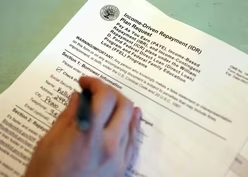
Education Department ends student loan repayment plan
Video has Closed Captions
Clip: 12/10/2025 | 6m 53s | What the end of a Biden-era student loan program means for borrowers (6m 53s)
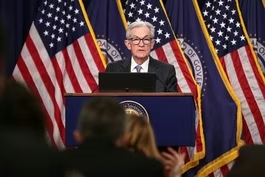
Federal Reserve cuts interest rates amid mixed economic data
Video has Closed Captions
Clip: 12/10/2025 | 5m 46s | Federal Reserve cuts interest rates amid mixed economic data and divisions in its ranks (5m 46s)
How political divisions are impacting people across the U.S.
Video has Closed Captions
Clip: 12/10/2025 | 10m 20s | Reconnecting with people in the U.S. to see how political divisions are affecting them (10m 20s)

Syrian filmmaker returns home after the fall of Assad regime
Video has Closed Captions
Clip: 12/10/2025 | 8m 13s | Syrian filmmaker gives an inside look at her return home after the fall of Assad regime (8m 13s)
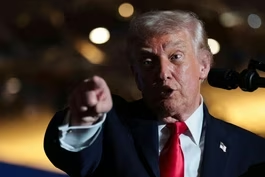
Trump’s affordability speech turns into a rant on immigrants
Video has Closed Captions
Clip: 12/10/2025 | 8m 38s | Trump’s affordability speech turns into a rant against immigrants (8m 38s)
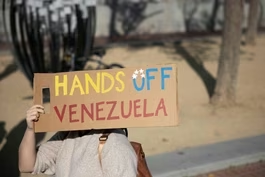
U.S. seizes oil tanker off the coast of Venezuela
Video has Closed Captions
Clip: 12/10/2025 | 5m 59s | U.S. seizes oil tanker off the coast of Venezuela, escalating tensions with Maduro (5m 59s)
Providing Support for PBS.org
Learn Moreabout PBS online sponsorship
- News and Public Affairs

FRONTLINE is investigative journalism that questions, explains and changes our world.

- News and Public Affairs

Amanpour and Company features conversations with leaders and decision makers.
Urban Consulate Presents











Support for PBS provided by:
Major corporate funding for the PBS News Hour is provided by BDO, BNSF, Consumer Cellular, American Cruise Lines, and Raymond James. Funding for the PBS NewsHour Weekend is provided by...