
February 13, 2026
2/13/2026 | 55m 28sVideo has Closed Captions
Ece Temelkuran; Sheikha Al Mayassa bint Hamad bin Khalifa Al Thani; Tig Notaro; Megan Falley
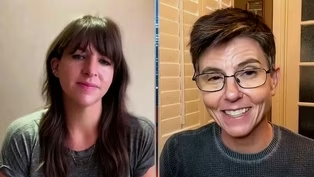
Author Ece Temelkuran discusses the parallels between her experience living under Turkey's authoritarian rule and the state of the U.S. Sheikha Al Mayassa bint Hamad bin Khalifa Al Thani shares more on Qatar's entrance into the art world. Tig Notaro and Megan Falley discuss the portrait of poet Andrea Gibson's final year fighting cancer in the new documentary "Come See Me in the Good Light."
Problems playing video? | Closed Captioning Feedback
Problems playing video? | Closed Captioning Feedback
February 13, 2026
2/13/2026 | 55m 28sVideo has Closed Captions
Author Ece Temelkuran discusses the parallels between her experience living under Turkey's authoritarian rule and the state of the U.S. Sheikha Al Mayassa bint Hamad bin Khalifa Al Thani shares more on Qatar's entrance into the art world. Tig Notaro and Megan Falley discuss the portrait of poet Andrea Gibson's final year fighting cancer in the new documentary "Come See Me in the Good Light."
Problems playing video? | Closed Captioning Feedback
How to Watch Amanpour and Company
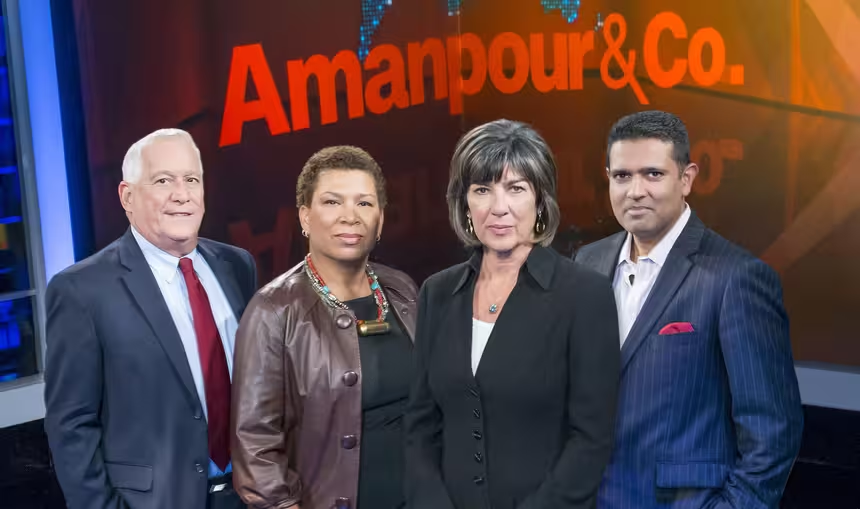
Amanpour and Company is available to stream on pbs.org and the free PBS App, available on iPhone, Apple TV, Android TV, Android smartphones, Amazon Fire TV, Amazon Fire Tablet, Roku, Samsung Smart TV, and Vizio.
Watch Amanpour and Company on PBS
PBS and WNET, in collaboration with CNN, launched Amanpour and Company in September 2018. The series features wide-ranging, in-depth conversations with global thought leaders and cultural influencers on issues impacting the world each day, from politics, business, technology and arts, to science and sports.Providing Support for PBS.org
Learn Moreabout PBS online sponsorship[MUSIC] Hello everyone and welcome to Amanpour & Company.
Here's what's coming up.
We are here offering our help because we are coming from those countries that we lost to fascism and we know how not to this time.
As an authoritarian wave sweeps the world, I speak to Turkish writer Ece Temurkaran about her new book "Nation of Strangers" and what history teaches us about how democracy can easily slide into dictatorship.
Then... It's not like, you know, one day we woke up and we said, "Okay, now we're going to fill the gaps of a knowledge-based society."
It was an intentional vision.
The woman behind Doha's bid to become the world's cultural capital, Sheikha al-Mayasa bin Hamad bin Khalifa Al-Thani, tells me about bringing contemporary art to Qatar.
Also ahead... I come from a family of makers, you know, woodworkers, seamstresses, poets, musicians, painters, performers.
A thousand influences.
Sculpture and sound take over the Smithsonian.
How the American artist Nick Cave brought his mammoth to life.
Plus... This is the beginning of a nightmare, I thought.
But stay with me, y'all.
Because my story is one about happiness.
Come see me in the good light.
- In the Oscar-nominated documentary about acclaimed poet Andrea Gibson's search for meaning, Hari Sreenivasan speaks to producer and comedian Tig Notaro and Gibson's wife, Megan Falley.
♪♪ >>Amanpour & Company is made possible by Committed to Bridging Cultural Differences in Our Communities, and by contributions to your PBS station from viewers like you.
Thank you.
- Welcome to the program, everyone.
I'm Christiane Amanpour in London.
Crackdowns on dissent, immigration raids, attacks on press freedom.
Is President Donald Trump pushing America towards authoritarian rule?
That's what the latest annual Human Rights Watch report is warning.
It says a worldwide authoritarian wave is becoming, quote, "the challenge of a generation."
And that nearly three-quarters of the global population lives under autocratic rulers, putting democracy at its lowest point in 40 years.
It's a bleak picture, it's a bleak reality, and one that our first guest saw coming.
Writer and activist Ece Tumalkuran left Turkey 10 years ago after learning that she might be arrested for criticizing President Erdogan.
Her new book is "Nation of Strangers" and it's long-listed for the 2026 Women's Prize for Nonfiction, and she's joining me now to talk about it right here.
Welcome to the program.
- Thank you for having me, Christine.
- I almost feel like I have to start with your previous book, the one that made you famous and actually probably helped propel you into exile.
So that was called "How to Lose a Country, "The Seven Steps from Democracy to Fascism."
So in view of what we just read out, the latest warnings from Human Rights Watch and elsewhere, do you feel you were kind of, you know, a soothsayer?
- Unfortunately, I've been a political Cassandra since 2016.
After having left Turkey, I saw that what had happened in Turkey was happening in Europe, in United States.
And I sat down to lay the global patterns of rising global fascism so that people could understand what will happen to them and how it will happen step by step.
But then I think Western countries were too, I don't know, dependent on their institutions.
They were too confident about their democracies.
- Well, hopeful, hopeful that we would be able to hang on to the democracies.
- Absolutely, but also I think they didn't want to associate themselves with those crazy countries such as India and Turkey.
They thought, oh, these are Muslim countries, these are, you know, immature democracies and so on.
Some might call them illiberal democracies.
That's become, and it's not just those countries or Muslim countries, it's even Hungary, which is self-declared a white Christian country, and it's an illiberal democracy which they claim proudly.
So just briefly, before I get into your new book, what are the seven steps?
Hmm.
Well, it begins with disruption of rationale, and then it goes with loss of shame, which is very, very prominent in the United States at the moment with Epstein-Files, I think.
And there are several other steps, but the last step is where you find yourself, you are not a citizen of that country anymore.
The country belongs to the regime or the leader.
- So that actually is a perfect segue into your new book because that one is called "Nation of Strangers" and you do actually, it's right there, talk about losing your country, losing your home, being essentially homeless, both physically and culturally and politically.
It's personal, very personal, right?
I mean, you've written it in a form of letters.
Yeah, it is written in letters that span three years, started from 2022.
It is personal, but I think it is more about the human condition.
It's about what we are all going through today.
It's about my homelessness perhaps, but also it's about the homelessness of humanity, because we are being unhomed on several levels.
Of course I lost my country to fascism, but people lose their countries to climate crises, war and so on.
Even if they're living in their homeland, Londoners or people in Minneapolis right now, even if they're sitting in their living room, they are feeling unhomed.
Because their government is attacking them in Minneapolis and in other countries where fascism is on the rise, they're feeling threatened.
So that is being unhomed.
Okay, so let's just, for everybody's knowledge, repeat why you actually did leave in 2016.
Absolutely.
Well, I mean, like, before I left, I was feeling homeless already because I was threatened.
I was a journalist, I was a columnist, I was a writer.
So, there were many threats.
Rape, especially very detailed rape.
It's very prominent online.
Yeah, it's a very good, you know, sign that the country is going towards darkness.
I think women journalists being threatened.
And then, of course, military coup attempt happened in 2016 in July.
And I was too much in media, under media spotlight.
So I thought it's time to leave.
There were other signs as well.
But my personal story is not that interesting because it happened to so many people.
Yeah, but it is interesting because there was a moment you decided, because it's very personal and this is part of your book is personal.
Yeah.
You write that your mother actually told you not to come back.
Remind us what made you decide not to come back.
Well, I went to Zagreb for a few days.
Croatian capital.
Yeah.
After the Mil iuku attempt.
And then I slept one night there, and I remember what sleeping was.
Because you see, fascism is a funny thing as well.
It makes you think about your nightwear, because all these guys, the foot soldiers of the regime, they come at five o'clock in the morning.
So you constantly think about, "What am I going to wear tonight?"
Because I might appear in front of the police with this nightwear.
So you're not fully dressed to bed?
No, not really.
You don't wear certain things.
(LAUGHS) So when I woke up in Zagreb, after not thinking about my nightwear, I thought, "Fascism already is in my head, and that fear has paralyzed me, so I have to leave now."
So I stayed in Zagreb.
And your mom?
Well, she was used to these telephone calls coming from me.
A few times it happened that I had to stay where I was, in Tunis for one year, in London for a few months, when there was a threat.
But this time it wasn't like that.
In 2016, when I said, "Mom, I'm not coming back home," this was the first time she said, "Okay, don't come back."
And it's an interesting, strange pain, this voice, that you're so used to hearing calling you back, this time not calling you back.
It's a different kind of pain.
- You mean wanting to welcome you back, instead doing the opposite.
Look, we've got a lot of really interesting passages we want you to read.
For instance, it's an exploration, as you said, of the concept of home.
And you write, "We're all losing home in some way or another.
"We're all becoming homeless.
"We're all becoming unhomed."
You just said that, and you've explained it.
Where do you think this all comes from?
There's a quote by a South African writer at the start of your book, and this is where he says, "Breaking, breaking back in the long march "from hearth to heart.
"One can replace to all intents and purposes "the word exile by refugee, misfit, outcast, outsider, "expatriate, squatter, foreigner, clandestine, heretic, "stranger, heretic, renegade, drifter, a displaced person, "marginal one, the new poor, the economically weak, dropout."
The irony is that if we were to add up all these individuals, we'd probably find ourselves constituting a new silent majority.
That's a really interesting way to flip this and to make it real.
- Yeah, I wanted to turn the tables with this book because, you know, "strangers" in London or in the United States, in Europe in general, now is a very problematic word.
Everybody hates strangers.
Whereas I wanted to say, we are the majority and we are at home in this world.
You who hate are not at home in this world.
And we strangers, we're not here asking for help.
We are here offering our help because we are coming from those countries that we lost to fascism and we know how not to this time.
So I think we also have the knowledge of survival, how to survive and how to stay humane at the same time which will be very much needed in United States and in Europe very soon.
You've mentioned the US twice.
Turkey is a democracy but as we said increasingly showing signs of illiberalism and I think as you say the crackdown on the press is a very very key indicator.
So what is it, because everybody looks to the United States as the epitome of the great hope for democracy, human rights, freedom.
What do you think, I know probably what you think and you're going to tell me, but what do you think people in Turkey or elsewhere who look to the US as a beacon, what do you think they're feeling right now?
There's a bit of schadenfreude, I have to admit, because it was like this all happened to us, and you didn't understand what was going on.
You thought it was about us being crazy, and now it's happening to you.
But there's also real, genuine pain as well, because when fascism was around for the first time during the Second World War, there was America, not only as a place to escape to, but also as an idea, land of the free.
And now that is disappearing.
And now we're seeing Americans talking to, you know, talking on social media, saying that, "Where should I go?"
That is painful, and we know how it feels to lose home.
And I think the entire world shares that pain in a genuine way.
Let me ask you to read something.
There's a passage that you wanted to read.
It's essentially, I found this really striking.
You describe writing this book as a homecoming, and actually, shortly after you'd left, a few years in 2022, you were diagnosed with homesickness by the doctor when you became ill and you went to get a checkup.
And you write about it at the start of your book.
I want you to read it, but wow.
I mean, to be diagnosed actually by a doctor as homesick is pretty intense.
Yeah, old school Viennese doctor who knew my work and he was very strict about this.
You know, it's over, you're homesick.
You have homesickness, you have to take care of your heart.
Okay.
I watch her like a too feeble to empathise for minor character in a movie.
The doctor says, "Your body is giving up.
"This is homesickness, meine Liebe.
Now is the time to stop and take care of your heart.
Loathing the vulnerability of the body, embarrassed by this meek quitter, I whisper, 'What a mess!
What a mess!'
As life drips back into my veins, I gradually re-enter my body, only to think bitterly, 'So that bloody organ has to defrost now, eh?
That probably rotten piece of flesh, the heart.
Who knows what kind of despicable state it is in?'"
That is very dramatic.
What did you feel when the doctor diagnosed?
Did you suddenly feel seen, heard?
I felt, you know, I've been really, really, you know, I did not have compassion towards myself after leaving the country because you took on some sort of moral and political responsibility to tell the world what's happening and what will happen to them.
So I didn't take care of myself and I didn't take care of my heart.
When you say heart, let's not give people the impression that it's an actual heart disease.
It's your self, your emotion, your feelings, your love.
Exactly.
And I thought in order to survive I have to numb myself, I have to be strong and so on.
Which I think many of us are doing at the moment to survive this cruelty of the world.
So I thought I can handle this until I go back home.
And then I realised that in order to survive we need beauty as well, we need our emotions, we need our fragility.
And that is the thing that makes us human while surviving.
And that's why I wrote the book.
I wanted all strangers to know that we are going to hold on to each other and we are going to hold each other even if our hands are full.
And this is the only way to survive this merciless world at the moment.
And you say strangers, you do write the book as letters to strangers.
I think each one starts, "Dear Stranger."
It could be impersonal or personal.
What was the reason behind that?
I wanted that intimacy.
Because when I wrote "How to Lose a Country," I was this Cassandra telling, warning people.
When I wrote "Together," I was saying, "This is the solution."
But then, you know, the world was in a different place.
Now we're on the same page.
Now we know what it feels to be a stranger in this world.
Now we know that we are losing our homes.
So I wanted to give them something so that they don't feel so lonely in this world.
I wanted to give them a language to talk to each other so they can reinvent their connections and they can refresh their faith in humanity.
A lot of people are exiles and refugees.
A lot of people haven't been back to their homelands for many years.
And a lot of people find connection in food, in sharing community, or their religious practices, or their art and culture.
Did you find, did you, once you've rediscovered your heart, did you find a way to connect with Turkey, even though you're not there?
Absolutely.
I'm living in Berlin now, and Berlin is the biggest Turkish city in Europe, so it's not very hard to do that.
Is that why you chose it?
No, I tried not to go to Berlin for such a long time.
I lived in Zagreb for six years.
But now, yeah, I feel at home in both realities.
I think the reality that I left behind and the reality I'm living now, here and now.
So what is your hope for the future?
I mean, one of the interesting things about your country right now is that the president, and I think backed by a lot of the party leaders, is talking about a peace deal with the Kurds.
Yeah.
And I wonder what you think will become of that.
Does it make a country less paranoid?
Does it make the president less feeling like he's under attack and therefore whatever, you know, conducting certain policies?
What do you think that that could bring to your country?
Um, Christiana, I don't believe in the word hope to begin with.
I believe in the word faith.
Because there are times, as we all experience now, that there is no hope.
There might not be hope.
Hope is too fragile a word.
I believe in faith and I believe in my people.
I choose to believe in people in general.
And I take this as a moral stance.
And for Turkey, it's the same.
I choose to believe in my people, even though there might have been some disappointing instances.
I think we all have to choose to believe in people.
That's what's happening in Minneapolis.
That's why it's so beautiful.
I think that's going to repeat itself in several places.
And so for Turkey, the only hope is to believe.
You see what's happening in Iran, as you just mentioned, Minneapolis.
Do you think-- I mean, you've studied this a lot, you've lived it-- do you think there is a sort of a reckoning right now?
People in many of these authoritarian and repressive regimes are really putting themselves on the line.
I think-- Whether it's, you know, ordinary Americans in Minneapolis under the federal essential, you know, goon squad of ICE, or whether it's in Iran.
I think, you know, what I foretold, let's say, in how to lose a country is happening now.
And I can see how people are terrified.
Not only people in Minneapolis or in Iran.
These are the front lines.
But in other countries, in European countries as well, the same thing is happening.
Not so strongly, perhaps, not so dramatically, but it's the same thing.
It's the same phenomena.
And this is what's stealing our home from us.
You are from Iran, so you would... This would resonate with you.
It doesn't have to be that you have... You leave your country in order to lose home.
When you're living in it, you can be unhomed.
All the women in Iran right now feel unhomed at their home.
It's very dangerous for them right now.
Exactly.
In Minneapolis, it's not only refugees or immigrants.
It's those people, you know, the settled down folk, American-Americans, they also feel unhomed because their friends, their neighbors, are being taken away.
At least two of them are being killed.
Exactly.
Edsher Temel-Koran, thank you very much indeed for being with us.
Thank you, Christy.
Next to Qatar, which is throwing its door wide open to the power of art, hosting a major fair that's drawing scores of international gallerists and collectors to the capital.
In the midst of a global slump in art sales, Art Basel Qatar is breathing new life into the market and platforming underrepresented artists from the region.
At the center of it all is Sheikha al-Mayasa bin Hamad bin Khalifa Al-Thani.
She is the sister of the ruling emir, who has driven Doha's art acquisitions and museum building for over two decades, with a budget reportedly in the billions.
But still, Qatar's record of censorship and restrictions on free expression does raise concerns.
Nonetheless, the Sheikha tells me that art is a way to eventually deliver knowledge and tolerance.
Sheikha Al-Mayasa, welcome to the program.
- Thank you.
- So you have spent the last 20 years essentially buying art for Qatar and running the museum culture of Qatar.
Why did the kingdom decide that this was something that you should be spending your money on?
- Well, actually from the last 50 years, Qatar was the first country in the Gulf to have a national museum built in 1975 by my grandfather, Sheikh Khalifa.
And it was really a way to preserve the history and the heritage and the culture of a nation that's going into a nation building, if you like.
It was the end of the British protectorate and one of the first things that we did was build a national museum of Qatar.
And I must say that it was a process that took us from the Museum of Islamic Art to the projects that we're starting and launching this year.
Two main projects I would say that we're focused on this year, which is the Lusail Museum, as well as the Children's Museum, which we call DADU.
DADU is a very old Arabic word to mean learning through play.
So the Children's Museum is all about investing into the future on the notion of globalizing the local and localizing the global.
So, you know, I think it became pretty much embedded into our national strategy that my father launched and my brother continues in terms of investing in culture as a socioeconomic means and a human development.
It was always about human development.
I want to ask about being a woman because you are the sister, you've just mentioned, of the current emir, the daughter of the previous emir who was there for a long time.
Were you enabled, empowered?
You know, this is a question I often get as a woman from the Middle East.
But really, as a child, you know, my parents, my father in particular, which is quite unusual in the Gulf, I would say, he never differentiated between his daughters and his sons.
He empowered all of us to reach our potential and also to kind of channel our passion and interests.
So for instance, when I wanted to go to university, I was planning to come to London as the closest city to, you know, and something, a place I was familiar with, but he encouraged me to go to the United States.
It was unusual at that time.
Today, many women and girls go and study abroad, but when I was younger, it wasn't the case.
So he had a national strategy to empower men and women.
Today they talk about women driving.
I mean, my father introduced this 30 plus years ago.
And in a conservative society, it was a bit problematic.
But his answer was, as families, you decide with your daughters whether they should drive or not.
If a family would like their daughter to drive, their wife to drive for whatever socioeconomic reasons or simply reasons of choice, then that's their decision.
But it's not for us to impose anything on anybody.
So today it's like all women have very important roles in society, women can drive.
In our organization, I would say 70% of the leadership roles are led by women and I didn't choose them because they're women, I chose them simply because of merit.
I would hate to be given something simply because I was a woman.
I always say I much prefer being given nothing than given something because of what I represent.
Well, what you've brought to Qatar for the first time is art Basel, right?
Doha art Basel, Qatar art Basel?
Indeed.
That was a decision of His Highness, my brother, the Emir.
He felt that Qatar was ready today to... And why was it important?
Precisely because he felt that we have such a surplus of talent right now, you know, with all the investments that we have done, in particular the last 20 years, we've invested a lot on cultural infrastructure, creative hubs, training centers, mentorship.
We give grants in all industries, whether it's film, fashion, design, photography.
And so my brother felt that now was the right time to link this pool of talent with the platform of the industry of galleries.
And I think... >> The global industry.
>> The global -- I mean, Art Basel have four stops already.
They're in four different cities around the world.
They're looking for a strategic partner in the Middle East, and I guess their natural choice was Qatar.
>> Here we are sitting in London.
They're saying that the art market in the traditional places is getting a bit soft, but not where you are, not in the Gulf region.
Do you see Qatar filling a space now and taking advantage of perhaps where the market is moving to?
I don't think so because we've been in this market for a very long time you know we've been collecting for over 30 years all with the intention of building museums as research and knowledge centers you know as I the intention of investing in culture was always about developing the resources that we have transforming our hydrocarbon economy into a knowledge based society.
So my grandmother, who's almost 100 years old, she was collecting in the 60s when Qatar was, you know, didn't have much money.
It's in our DNA, collecting and preserving our heritage, but also acquiring, you know, objects from all around the world to inform and educate the population.
You've mentioned several times the knowledge based economy, the knowledge based, future for Qatar.
What was lacking and how does a knowledge based economy fit into the way Qatar anyway does punch above its weight in diplomacy, obviously in wealth, it has the biggest US airbase in the world outside the United States.
Where does the knowledge based economy, why is that required?
First of all, I don't know why you describe us as punching above our weight.
Because you're little, you don't have a big population, and you have an outsized role on the international stage.
That's what it means.
Absolutely.
But I think that what's more important is the intention.
I think when Qatar involves itself in all forms of diplomacy, it's with the intention to foster dialogue and bring nations closer together, as opposed to leave room for more conflict and the escalation of that.
So you know, you ask a very interesting and an important question, one that I always ask myself, because from the very beginning, I started, I was appointed in this position I was quite young.
I had to deal with a lot of male egos, especially from the West, who wanted to tell me what to do, essentially.
But I was very fortunate to have the mentorship of my father and my brother that we ignored the noise and we focused on our priorities.
But if you look at history, you know, the oldest museum in the world, one would assume was in Europe, but it was in Mesopotamia.
It was led by a princess.
Her father was known as the oldest archaeologist of our time.
And so if we just go back, you know, it was discovered only 100 years ago in 1925.
Actually, Agatha Christie's murder in Mesopotamia was inspired by these findings when they discovered all these objects that, her name is Princess Anigaldi, Nana, and she was the daughter of the last emperor from Babylon.
And actually her brother built the gates of Ishtar, which you can find now in Berlin in the Pergamon.
So it's not like, you know, one day we woke up and we said, okay, now we're going to fill the gaps of a knowledge-based society.
It was an intentional vision.
I mean, I think my father's story is known.
He overthrew his father at a time where our economy was, you know, at its worst.
And he took the decision to invest in the LNG to support the growth of the economy at a time that nobody believed in the LNG.
And so in taking that risk and creating a national vision called 2030, it enabled us to quite understand what was happening in terms of the growth of the economy and how we're going to reinvest in the income of that economy into the local infrastructure.
Let me ask you about art is often oppositional, art is often a cultural and a political statement.
I know that you've recently had, or maybe it's still happening in one of your major museums of modern art, a very prominent Palestinian exhibition called Refused, and it's about Palestinian history, and it's the kind of thing, I was told, that probably no American university, American museum would put on right now.
Tell me about that.
You know, the cultural programs that we do is very much rooted in humanity and putting, giving an alternative voice to the absent voice, especially, you know, in the non-Arab world.
So when we were looking at our exhibition program, as this is a very important anniversary year, we are 20 years of the Qatar museums and 15 years of Madhhaf as well as the Doha Film Institute and the Qatar Cultural Village.
So we decided like what would be the best way to engage in a peaceful dialogue and bring the world together and allow artists who've been refused to represent themselves and their exhibitions in the West, and particularly in America.
Palestinians.
It's not just Palestinians.
It's Arab artists who had actually no political affiliation, but after October 7, there was some fear in American institutions in particular.
And so the exhibitions that were planned to take place there were canceled.
So instead of, you know, we couldn't bring all the exhibitions, what we did instead, what we chose 15 different artists to represent.
The intention was not to be political at all.
The intention was to bring artists who've been muted in different parts of the world to engage.
And it's very much with the philosophy of, you know, in Paris before the Second World War, they had all these salons.
So it's called the Salon de Refusé.
- So if this art couldn't be shown for whatever political sensitivities in the U.S.
right now, do you have any red lines?
There must be art and expression that potentially is against certain aspects of, I don't know, political or economic or social, cultural.
- Of course, of course.
- That you espouse, or rather the Qatar or the Gulf.
- No, no, and I always have these discussions because in the West, when we decide not to show certain things, they call it censorship.
For me, I call it cultural sensitivity because for me, my objective is to empower and not to provoke.
And there's so much art that you can show and you can choose the intention that you have.
Since our intention was always about human development and knowledge, investing in knowledge and also tracing back what art history meant and how to translate that vis-a-vis art parts of the world.
We're going to show and position Arab art, but also art from the global south vis-a-vis, you know, Western art and create a narrative and to show the influences like from artists like Matisse or Paul Klee, who are very much influenced by Islamic art, it will attract artists, it will attract creatives, allowing them to think beyond the box and you know with time, the level of tolerance towards different kind of art will probably expand.
But that's something that we have to decide over time and not, you know, shock people from the onset.
On that note, Sheikha Al-Mayasa, thank you very much indeed for being with us.
Thank you.
Sorry my name is so difficult.
It's very long so I just took the first bit.
Thank you.
From a fast rising art scene to an established cultural institution, the Smithsonian American Art Museum is unveiling an ambitious installation today.
Fittingly titled Mammoth, the show transforms an entire suite of galleries with sculpture, sound and video that explore issues like race and climate change.
The acclaimed American artist, Nick Cave, is the mastermind behind it.
And here's a look at how this monumental project came together.
- I'm witnessing a time in history where history is being erased, but yet history is being revealed at the same time.
And so when I think about mammoth, I think about at one point they existed and then buried and then rediscovered.
You know, what is erased becomes revealed.
What is removed shows up again.
These creatures are just one piece of Nick Cave's mammoth, a monumental new exhibition and the Smithsonian American Art Museum's largest ever commission by a single artist.
This vibrant, immersive world uses thousands of objects, costume, and video to both recall his own lineage and explore American history.
Mammoth has been in the works since 2017, and it never stopped evolving, even up to the last minute.
How am I feeling right now?
A bit, you know, it's a little overwhelming.
But things are coming together.
There's a lot of moving parts.
There is going to be 12 that will move through the Smithsonian.
Cave has become a leading voice in contemporary art, critiquing political, racial, and social structures through assemblage sculptures that burst with color and life.
For some 30 years, he has crafted over 500 so-called "soundsuits," sculptures, often wearable, that are made from found materials, meant to symbolize armor for marginalized groups.
I'm always sort of interested in pushing materials out of their familiar rolls.
I don't know necessarily like how everything will be used, but you know, I'm just like, this is like fabulous.
(train clacking) - How long does it take to assemble each one?
- You're learning, man.
- You're learning that now.
- We are on Lake Michigan here in Chicago, getting video footage for the gallery.
Action two, let's go.
Action three, let's go.
When I was building these, I thought I was going to cover the entire structure, but I loved that humanity was revealed.
I'm so excited about the show.
I go there next Tuesday and start the installation.
(drumming) It's really about sort of creating the abundance.
I know that everyone will be able to identify with something of their past.
After weeks in the gallery with the team, Mammoth is complete.
It was such a feat to pull this all together.
It's a very important project at this time of my life.
I come from a family of makers, you know, woodworkers, seamstresses, poets, musicians, painters, performers.
A thousand influences.
When I think about that, it's mammoth in terms of scale.
♪ Now, the unvarnished portrait of a poet's final year and the mission to make the most of every moment, "Come See Me in the Good Light" is the searing new documentary that follows Colorado poet laureate Andrea Gibson and wife Megan Falley as they confront Gibson's terminal diagnosis.
Here's part of the trailer.
At first I thought it was a stomach bug.
But when it started feeling like a stomach anaconda, my doctor convinced me to get a CAT scan.
This is the beginning of a nightmare, I thought.
But stay with me, y'all.
Because my story is one about happiness.
Being easier to find.
Once we realized we did not have forever to find it.
I wrote a new kind of bucket list.
To sit with the mourning dove who cries for her lost love.
To perform one last show.
Why don't we just root for me being alive.
And if I'm not, I will not feel bad about not being there.
(cheering) We're almost there, Rach!
We're almost there, you got it!
To touch Meg's face and a hundred times again.
Emotional indeed, and the film won the Audience Award at the Sundance Film Festival and has been nominated for an Oscar.
Megan Falley and one of the film's producers, acclaimed comedian Tig Notaro, joined Haris Srinivasan to discuss how they transformed a story about dying into a meditation on life.
- Christiane, thanks.
Megan Falley and Tig Notaro, thank you both for joining us.
Tig, let me start with you.
You've said this project began with kind of an unconventional pitch.
We're talking about poetry, cancer, non-binary.
What made you think that this was really a joyful, even funny story that should be told?
- Well, Andrea Gibson is, I mean, undeniably an incredible poet with levels of depth.
One of my favorite things over the years of knowing Andrea was their sense of humor and the ability to talk about anything and then a second later laugh about, nothing was off the table.
And so it just made for a very dynamic human being.
And that dynamic person fell in love with another dynamic person.
And when you have those qualities in somebody or people, that's going to make for an interesting subject or two to follow.
I wrote a new kind of bucket list.
It isn't an index of wild adventures.
It requires no bungee jumps, wingsuits, or hot air balloons.
No passport stamps or dolphin swims.
As riveting as those things may be, none of them ignite me as much as what most of us were taught to think of as the little things.
Megan, we learned that this was not sort of like love at first sight per se, that you were friends, you kind of on the poetry circuit.
What made you attracted to them?
I mean, as Teika was saying, Andrea is definitely an incredibly dynamic person, somebody with incredible depth and wisdom, but also like a huge goofball.
Andrea and I fell in love right before their 40th birthday, and we were choreographing dance routines and making up parodies of songs, and it felt like we were constantly two kids putting on a living room show when we were together for an audience of sometimes just ourselves.
And I think just the whole like spectrum of humanity fit in one like five-foot-four person, and they were incredibly lovable.
I think everyone who met Andrea fell a little bit in love with them.
Tig, someone even who is unfamiliar with Andrea's poetry gets a sense of what Megan just described, because there's lines in there, there's just really dark humor that you're, you know, you kind of have a license as an audience member to say, "Wow, I mean, if Andrea just laughed about that, I guess I can too."
I mean, these were clearly intentional choices from kind of a filmmaker's perspective of leaving these in there.
I think it was something that between Ryan, the director and Bernice, who edited the film, that they came to together.
But there was also an understanding going into this project that there was going to be that openness.
There is that that sense of humor, sometimes dark, sometimes, as Meg was saying, very goofy.
- Andrew is having a serious medical emergency, which is that their thumb is just coming off.
- I'm gonna bring it up to the nurse when she comes back because I think this might be a little bit more important than the tumors.
- And, but I think that when things get dark, when you're able to find the right angle to cut in there with humor, the level of tension that it breaks is so astounding.
And I'm always blown away when people say that anything is off limits for comedy, because that's coming from the perspective of you think you know how they're going to go in at it.
And that's based on bad humor that didn't work.
But when someone comes in with that right slice, it's the sweetest cut in the world.
Because, yeah, again, the level of tension that it breaks, and you go, "Oh my God, that's the way to get in to laugh about cancer.
That's the way in to laugh about death."
And I just, I don't know what's better than that.
I really don't.
It's a true gift.
- Megan, there's a conversation that the two of you have in the film about really the choice of words and how you have so many more words that you use versus Andrea.
That's the thing, Meg.
You know so many words.
But one day we're going to find out that all these words that Meg says are words aren't really words.
Okay, let's take a vote.
What's more weird?
Me knowing words as a poet and a writer or Andrea, Poet Laureate, knowing five?
Do you know how good of a writer you have to be to write as many poems as I have with five words?
[laughs] What's interesting is, is poetry, even when you say that word, it feels inaccessible to people.
And Andrea seems so intentional about not just the choice of words, but making sure that they didn't write over people's heads.
Yeah.
Or hearts.
Or hearts.
Yeah.
Andrea and I, I just, I love words and I love language.
So I might, Andrea and I could be driving and I would say, you know, point to the scenery and say, "It's so bucolic."
And Andrea would be like, "What the heck are you talking about?"
And we had this joke because, you know, there's a famous saying like, "Why use like three words when you could use one?"
Talking about the economy of language.
And Andrea would say to me, "Why use one word when you could use five or six?"
[laughter] >> Tig, what is the point of making a film like this?
Is this about an active choice to guide the film that this is about living, not necessarily about the end?
>> I think what's so incredible -- I remember when Ryan, the director, told me that he's never made a film before where the subjects never asked, "What story are we telling?
How do you have to be framed in the camera lens?"
There was pure trust in Ryan and Jess, the producer, and then the crew, which was very small.
And having that openness and trust led to the moment of Ryan and Jess and everybody deciding, like, we can wrap this up.
That was what they thought was like, we don't need to see the hero die.
We can wrap this up now and leave it on this hopeful note, which is what the movie is.
People leave this movie with this sense of deep urgency about life.
Like, what have I been doing with my time?
And oh my gosh, thank you so much.
It's really something, because you can hear cancer and poetry, and it can paint this particular picture, but it's as dynamic as the subjects.
Megan, how comfortable did you get over time with a camera person somewhere in some of your most intimate moments?
You're laying in bed together, you're in the kitchen, but there's also these scenes where Andrea is opening up an email to figure out what the latest cancer score is and whether it's going to be good or bad.
The audience is watching.
It's almost like your lips are quivering, your anxiety.
Did you just forget that they were there?
Did they become kind of flies on the wall?
Yeah, they did not become flies on the wall.
They became friends who were in the experience with us.
And that happened really quickly.
The first day that we were filming, Ryan, the director, told me, "Listen, you guys, we might film a thousand hours, and we'll cut it into... we'll use 1% of that.
So, don't worry too much about anything that happens."
I think because of Andrea's impending mortality, and really all of ours, but Andrea's awareness of it, the idea of not forming intimate, close relationships with the people who we were inviting into our home so frequently, that would have been the absurdity.
That would have been a ridiculous thing to do.
And so we both felt so grateful for those moments when we were opening those hard numbers because we had built very quickly this beautiful community that was also holding us through it.
Tig, you've been public about your own experiences with cancer and I wonder if that at all influenced or shaped your decision to be involved with this project and why you thought people should see Andrea maybe beyond the disease?
Yeah, I mean, I haven't thought about that before.
Because as soon as this idea was presented by Steph Willen, the other producer on the movie, who is also an old friend of Andrea's, it was like the most obvious thing.
I couldn't even believe that I didn't think of it myself.
I feel so lucky that my story turned out differently.
Everything that I do is informed by my cancer diagnosis and making it through that and making sure that you're all you can't help but be tethered to this reminder once you've gone through something like that and you can kind of slip away in moments of life because you're human, but I'm forever tethered to what I went through.
And this was just an opportunity to kind of stay in that thankful elevating space, if that makes sense.
- Megan, I think something revealing for a large part of the audience will be how Andrea's exes are part of this extended family now.
And you said something really powerful, which is that so many people don't realize that queer individuals lose so much family when they come out, and that they work really hard to hold onto those people because it's family.
How is that family supporting you now as you're going through grief?
- Well, right now they're at home watching my dogs so that I can travel with this film.
And that is one of the major sports.
But yeah, Andrea has a poem written about their best friend, Emily, it's called "Angel of the Get Through" and it's a love poem for their best friend.
And Emily has really become my angel of the get through throughout this time.
We've, we were operating, you know, Andrea's business together and working to keep their legacy alive.
And I've also, this like, "Come See Me in the Good Light" family has just, I feel like what is on top of their minds at all time is like, how can we take care of Megan better?
And I don't know if it's a conscious discussion at all, but, or if it's just innate in every single person involved, but the way that the caregiving has transferred from my role of giving to now my role of receiving by all of these friends and beautiful people, it just feels like the most complete cyclical nature of love.
Like I don't so much so that it doesn't even feel like I've lost my love.
I just feel like it's changing, changing forms.
That's really, it's really touching.
I mean, because I remember the scene where Andrew was saying, "Oh, you know, one of the things that I'm really going to regret about this is that I'm not going to be around to help Megan."
And even at that moment, like, how am I going to be there for you?
And that there is this community that's helping you now is something that I'm sure Andrew would be incredibly happy about.
Tig, I wanted to ask, I mean, what do you hope that people carry forward from this that are watching this not knowing Andrew Gibson, not knowing any of the backstory?
What do you want for them?
As I was saying before, that tethered feeling I have to the insight I got, I always say that like, my experience, I felt like I was on the edge of the universe and I thankfully was pulled back and it's hard to unsee what I saw and unfeel what I felt and as Andrea said that they hope people don't wait for a diagnosis like this to start living their lives and I, it's so hard as a human being to stay in that sweet spot of gratitude and, but I really hope, because this, this could be the closest somebody comes to a diagnosis like that is falling in love with Meg and Andrea in this film and becoming really in touch with and present to that feeling of, of, live your life.
But that's what I hope is that, as Andrea said, to not wait for the diagnosis and, and let your love for these, these people be your close call and, and that it stays with you.
Megan, what did Andrea, I guess, teach you that you hope people understand?
I think that the message that was really important to Andrea to relay to others is that we think when certain, what we might categorize as bad things happen to us, that we have to meet them with this like prescription of emotion.
So whether that's like, we have to feel sad when this thing happens, or we have to feel angry or bitter or resentful, or this, this induces rage and this induces apathy or, and Andrea really believe that this film would help not just people with cancer see that they didn't have to meet cancer with any kind of resentment or bitterness or anger or grief, but that anyone going through anything challenging in life could meet that moment with joy, with acceptance, with love, with reverence.
And I think that being with Andrea, experiencing that firsthand, I had to become permeable to that mindset so that I wouldn't hold Andrea back when they were going through what was really the greatest journey of their life.
The film is called "Come See Me in the Good Light."
You can see it now on Apple TV.
Tig Notaro, Megan Falley, thanks so much for your time.
Thank you.
- A powerful story, and that is it for our program tonight.
If you want to find out what's coming up on the show every night, sign up for our newsletter at pbs.org/amanpour.
Thank you for watching, and goodbye from London.
(upbeat music)
A Stunning Portrait of Poet Andrea Gibson’s Final Year Fighting Cancer
Video has Closed Captions
Clip: 2/13/2026 | 18m 54s | Tig Notaro and Megan Falley discuss the Oscar-nominated documentary "Come See Me in the Good Light." (18m 54s)
Providing Support for PBS.org
Learn Moreabout PBS online sponsorship
- News and Public Affairs

Top journalists deliver compelling original analysis of the hour's headlines.

- News and Public Affairs

FRONTLINE is investigative journalism that questions, explains and changes our world.
Urban Consulate Presents











Support for PBS provided by: