
February 16, 2026 - PBS News Hour full episode
2/16/2026 | 57m 46sVideo has Closed Captions
February 16, 2026 - PBS News Hour full episode
February 16, 2026 - PBS News Hour full episode
Problems playing video? | Closed Captioning Feedback
Problems playing video? | Closed Captioning Feedback
Major corporate funding for the PBS News Hour is provided by BDO, BNSF, Consumer Cellular, American Cruise Lines, and Raymond James. Funding for the PBS NewsHour Weekend is provided by...
February 16, 2026 - PBS News Hour full episode
2/16/2026 | 57m 46sVideo has Closed Captions
February 16, 2026 - PBS News Hour full episode
Problems playing video? | Closed Captioning Feedback
How to Watch PBS News Hour
PBS News Hour is available to stream on pbs.org and the free PBS App, available on iPhone, Apple TV, Android TV, Android smartphones, Amazon Fire TV, Amazon Fire Tablet, Roku, Samsung Smart TV, and Vizio.
Providing Support for PBS.org
Learn Moreabout PBS online sponsorshipAMNA NAWAZ: Good evening.
I'm# Amna Nawaz.
Geoff Bennett is away.
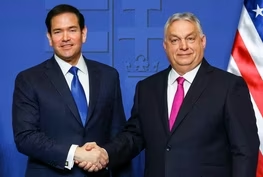
On the "NewsHour" tonight: Secretary of State# Marco Rubio gives Hungary's far right president## a reelection boost just days after trying to# smooth over relations with other European allies.
The Justice Department gives its reasoning# for how it redacted the Epstein files.
And the partial government shutdown# over Homeland Security funding drags## on with no end in sight.
We speak to# Democratic Leader Hakeem Jeffries.
REP.
HAKEEM JEFFRIES (D-NY): We# have an opportunity to make bold,## transformational and meaningful changes in the law## that will actually immediately impact how ICE# agents are permitted to conduct themselves.
(BREAK) AMNA NAWAZ: Welcome to the "News Hour."
America's top diplomat traveled to Hungary# today and endorsed that country's far right## prime minister, who's seeking his fifth straight# term in office this April.
Viktor Orban has## cracked down on the media, civil society and# weakened judicial independence in Hungary.
At a news conference in Budapest, Secretary# of State Marco Rubio said the extraordinarily## close relationship between President# Trump and Orban had tangible benefits.
MARCO RUBIO, U.S.
Secretary of State:# President Trump is deeply committed to## your success, because your success is our success.
AMNA NAWAZ: Orban has close ties to# Russian President Vladimir Putin.
And## while Europe has ended or significantly# reduced its reliance on Russian oil,## Hungary refuses to cut back on# the oil it buys from Russia.## President Trump has exempted Hungary# from U.S.
sanctions for those purchases.
Rubio's meeting with Orban came after the# secretary of state addressed world leaders## at the Munich Security Conference# this weekend.
Coming on the heels## of Trump's threats to Greenland, Rubio# tried to convey a reassuring message.
MARCO RUBIO: We care deeply about your# future and ours.
And if at times we disagree,## our disagreements come from our profound sense of## concern about a Europe with which we# are connected, not just economically,## not just militarily.
We are connected# spiritually and we are connected culturally.
The fundamental question we must answer at# the outset is, what exactly are we defending?## Because armies do not fight for abstractions.# Armies fight for a people.
Armies fight for a## nation.
Armies fight for a way of life.
And that# is what we are defending, a great civilization.
Acting together in this way, we will# not just help recover a sane foreign## policy.
It will restore to us a clear sense of# ourselves.
It will restore a place in the world.## And in so doing, it will rebuke and# deter the forces of civilizational## erasure that today menace# both America and Europe alike.
AMNA NAWAZ: After the secretary's speech,## Nick Schifrin, who was in Munich, spoke to# two senior European officials to ge.. reactions, beginning with the minister# of defense for Belgium, Theo Francken.
NICK SCHIFRIN: Defense Minister, thank# you very much.
Welcome to the "News Hour."
THEO FRANCKEN, Belgian# Defense Minister: Thank you.
NICK SCHIFRIN: You have desc.. You have referenced Venezuela.# You have referenced, of course,## the crisis over Greenland.
Secretary Rubio came# here to Munich, gave a speech that was described## by the chairman of the conference# as reassurance to European allies.
Where do you think transatlantic# relations are right now?
THEO FRANCKEN: I wrote a book# about the history of NATO,## and I said we have a marriage of# 76 years old and we're in a crisis.
Since one year, we're in a marriage crisis.
And# then you can -- I'm married for 20 years.
And## sometimes you have a fight, and we had some# fights the last couple of months.
Certainly,## on Greenland, we had a big fight.# And I think that you can choose## two ways or you do a divorce or# you try to fix your marriage.
And I think that in the main interest of the# United States, of American people is -- and## in European states and European people# is to stay together, to stick together,## because the threats, the storm is coming, is# already there, and the threats are increasing.
NICK SCHIFRIN: Some European officials I talk to# say that Greenland was basically a turning point## or almost a turning point, but that the lesson# learned was that Europe united to push back## on the United States and that's why President# Trump basically took an off-ramp on Greenland.
Is that how you sit?
THEO FRANCKEN: I'm really an Atlanticist thinker.# I'm somebody who really love.. civilization, American people.
And I always# defend you in my Parliament, in my public opinion.
But Greenland was the total red line.
You cannot# offend somebody by taking or by threatening the## territorial integrity of a country.
That is# just a red line.
You cannot do it.
I mean,## it's an ally, such a good and decent# ally like Denmark.
You just can't do it.
So, yes, the pushback was really, really# well-coordinated.
And I hope, I don't know,## but I see that the reaction now# is like appeasing and saying, OK.
NICK SCHIFRIN: From the U.S.,# you're saying, the U.S.?
THEO FRANCKEN: Yes.
Yes, absolutely.
NICK SCHIFRIN: So, does that mean that the lesson that Europe has taken# is.. THEO FRANCKEN: Pushback worked in this# specific situation with Greenland.## And I think the message has really been# clear.
And the reaction is also clear.
So, Mr.
Rubio now really opening up and saying,## OK, let's -- we have our problems, but we# have our problems also in the United States,## we have our problems in Europe, but# we -- let's try to fix them together.
And I think that, for me, it is# really a relief and I think also## for a lot of Europeans and a lot of# American people that are saying, OK.
NICK SCHIFRIN: And, later, I spoke to Kaja# Kallas, Europe's top diplomat, about Secretary of## State Marco Rubio's speech here in Munich and the# overall relationship between the U.S.
and Europe.
Kaja Kallas, thanks very much.# Welcome back to the "News Hour."
Secretary of State Marco Rubio in his address# to the Munich Security Conference said this of## the United States and Europe -- quote -- "Our# destiny will always be intertwined with yours,## and we want to do it together with you, our# oldest allies and our cherished friends."
But his agenda that he laid out,# including stopping immigration## that has caused what he called# European civilizational erasure,## and eliminating -- quote -- "the# global welfare state and the climate## cult," the chairman of the Munich Security# Conference said he was reassured.
Are you?
KAJA KALLAS, Foreign Affairs High# Representative, European Commission: The tone## was different.
That's fo.. NICK SCHIFRIN: Than Vice# President Vance last year.
KAJA KALLAS: Yes.
And, also, I mea.. we want to do this together with you.# We have always been together and we## will be also together in the future.# So that is the message that we heard.
We don't always see eye to eye on# issues.
And we still think that## if you're worried about migration, you should# be also worried about the climate change,## because people will have to leave their# homes because they can't live there.
So these are the debates that we definitely don't# always agree.
But I think, in the bigger picture,## the security issues, the message to us that we# want to work with you, I think it's important.
NICK SCHIFRIN: It does seem, though, that# some European concerns that already existed## of the Trump administration certainly# crescendoed after the Greenland crisis.
And I noticed that French President# Emmanuel Macron used a phrase at the## Munich Security Conference.# He said -- quote -- "We will## de-risk vis-a-vis all the big powers# in order to be much more independent."
He did not say de-risk from China,# right?
That's the phrase he used,## clearly implying the United States.
Is Europe de-risking from the United# States?
And what does that look like?
KAJA KALLAS: I mean, we are# strengthening our defense.
We are## really trying to get over our dependencies,# because dependencies make us vulnerable and weak.
We are diversifying our trade relationships.
We# are also diversifying our defense and security## partnerships, so that we are not putting all the# eggs in the same basket, because every tendency... NICK SCHIFRIN: The American basket.
KAJA KALLAS: Wha.. energy.
We learned the hard way# that it's going to be very costly.## Now we are also worried about dependencies# on technologies that come from China.
And, of course, in terms of security, we# have been dependent also on the United## States.
And we are doing more to be more# independent when it comes to security.
NICK SCHIFRIN: One of the examples# of perhaps Europeans thinking about## de-risking the United States is a# conversation about nuclear deterrence.
We heard from the chancellor# of Germany, Friedrich Merz,## saying openly that he was talking to France# about perhaps extending their nuclear## deterrence to Europe.
I've talked to other foreign# ministers who are certainly talking about that.
Is that a sign that Europe does not have# faith in the U.S.
nuclear deterrent?
KAJA KALLAS: These discussions are# out there.
I don't think it's good## for the overall peace of the world, because# these are very dangerous weapons, but... NICK SCHIFRIN: Not a good idea to# even have discussions or you're## saying not a good idea to extend nuclear weapons?
KAJA KALLAS: No, no, no, I think -- yes,# I think the discussions are there.
It's## always good to have discussions,# what are the options really?
But we are in this point where we are# entering into a very dangerous world,## where we might see more nuclear# weapons.
But at the same time,## I can understand where these countries are# coming from.
Exactly.
The risks are higher.
NICK SCHIFRIN: Let me ask about Alexei# Navalny, the former Russian opposition## figure who died in Russian detention.
Five# European countries have come out and said that## he was poisoned -- quote -- "with a lethal toxin# found in poisoned dart frogs in South America."
What does that say about Vladimir Putin's Russia?
KAJA KALLAS: Well, it says what we have always# known.
It is literally dictator's handbook.
How you remain in power is that you# eliminate all the potential competitors.## You keep the oligarchs and the power structures# happy, and you are staying in power.
So that's## very clear that he's operating like this.# He's killing his own people to stay in power.
NICK SCHIFRIN: And finally, on Ukraine,# European intelligence officials here## briefed reporters and said that Vladimir# Putin is not negotiating in good faith.
U.S.
officials, as you know, believe# they are making progress.
Who's right?
KAJA KALLAS: We see a strong push for peace,## but it's one-sided.
We have heard what# Ukraine is willing to also concede,## but Russians are just playing time and pretending# to negotiate, so that's not really serious.
They want to have absolute# maximalist goals delivered## by the Americans diplomatically what they# haven't been able to conquer militarily.## I don't know where this belief comes# that actually there's progress made.
NICK SCHIFRIN: Kaja Kallas, thank you very much.
KAJA KALLAS: Thank you.
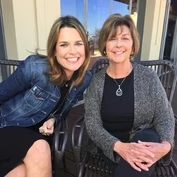
AMNA NAWAZ: Federal and state law enforcement# are still looking for Nancy Guthrie,## the mother of Today Show co-host Savannah# Guthrie.
Local police address rumors today## that Guthrie family members may have# been involved in her disappearance.
In a statement, Pima County sheriff said# they have been cleared as possible suspects## and that "to suggest otherwise# is not only wrong; it is cruel."
But there is some hope that a found glove# may contain DNA from a potential suspect.
Stephanie Sy has more.
STEPHANIE SY: As the search for# Nancy Guthrie enters its third week,## her daughter Savannah made another heartfelt# plea to whoever knows her mom's whereabouts.
SAVANNAH GUTHRIE, Co-Host, "The Today# Show": It is never too late to do the## right thing.
And we are here.
We believe.
STEPHANIE SY: Last week, The Today# Show anchor posted a home video of## her mom captioned: "We will never give up on her."
Authorities continued to chase down leads# after the 84-year-old was reported missing## on February 1.
The FBI said on Sunday that# a glove found two miles from Nancy Guthrie's## house appears to match those worn by the# masked person caught on her porch camera.
Let's just start with the glove.
Is that a major## break in its importance in being# able to potentially find a suspect?
RAY JOHNSON, Retired FBI Special# Agent: I would say it is.
STEPHANIE SY: Ray Johnson is a retired FBI special## agent who now teaches law at the# University of Nevada, Las Vegas.
RAY JOHNSON: The fact that the glove# was within a two-mile radius of the## house and the fact that they were# able to extract DNA from that glove,## taken as a totality and taken# together, that gives me hope.
STEPHANIE SY: Johnson said national# databases could help narrow down a suspect.
RAY JOHNSON: If we can link it together# with somebody who happened to match the## description of the offender or be in the# area or some of the Ring cameras that are## constantly being sought after now for# suspects, that helps us really get what## we need for legal prosecution later and# to get an answer as to what happened.
STEPHANIE SY: It's still not clear what the# motive behind Guthrie's apparent kidnapping## was.
Johnson says certain details# of the case make it untraditional.
RAY JOHNSON: It does not feel to me what a# garden-variety or a kidnapping for ransom## would look like.
In my experience, this# feels more like a premeditated crime,## either a burglary, either a robbery, something# different than a true kidnapping, because,## if you're planning the kidnapping, you're already# going to have those ransom channels set up.
STEPHANIE SY: Law enforcement# is also now reportedly using## a tracking device called a signal# sniffer.
Mounted on a helicopter,## it may be able to detect emissions# from Nancy Guthrie's pacemaker.
Savannah Guthrie's Today Show colleagues# have rallied behind her.
And in a call## with The New York Post today, President# Trump threatened the kidnapper with the## most severe federal consequences if# Nancy Guthrie is not returned safely.
For the "PBS News Hour," I'm Stephanie Sy.
AMNA NAWAZ: Also today, a major winter# storm is piling up snow in the mountains## of Northern California and hitting much of# the rest of the state with heavy rain and## strong winds.
In the Sierra Nevada, nearly# a foot of snow had fallen by this morning,## and forecasters say there# is plenty more on the way.
Much of California is under winter# storm warnings through Wednesday,## and in those upper elevations, forecasters# expect up to eight feet of snow.
In the meantime, residents in the center of the# country are facing a very different problem,## with fire warnings due to higher-than-expected# temperatures, gusty winds, and dry conditions.
In Georgia, a trial is under way for a# man whose teenage son allegedly killed## four people in a school shooting in 2024.# It's the latest instance of officials## trying to hold parents accountable# for the actions of their children.## During opening statements today, prosecutors# said Colin Gray knew his son, then 14 years old,## had an obsession with school shooters and# suffered from deteriorating mental health.
BRAD SMITH, Barrow County, Georgia, District# Attorney: This case is about this defendant## and his actions, his actions in allowing a# child that he has custody over access to a## firearm and ammunition after being warned# that that child was going to harm others.
AMNA NAWAZ: Despite the warning signs,# prosecutors say the elder Gray still## gifted his son a gun for Christmas.# He's pleaded not guilty to 29 counts,## including second-degree murder and# cruelty to children.
Two students and## two teachers were killed in the shooting at# Apalachee High School in September of 2024.
Ukrainian and Russian officials# are gathering in Geneva this week## for the latest U.S.-brokered# talks aimed at ending the war.## The Kremlin said today that the negotiations# will involve what it called the main issues,## such as the delicate question of how much# territory it wants Ukraine to give up.
Meanwhile, in Kyiv today... SEN.
RICHARD BLUMENTHAL (D-CT): Mr.# President, good to see you.
Thank you.
AMNA NAWAZ: ... Ukrainian President# Volodymyr Zelenskyy welcomed two## Democratic U.S.
senators and thanked them# for Washington's support in the talks.## This comes as the attacks# from both sides continue.
This weekend, Russian strikes in Ukraine's# Odesa region killed at least one person,## with both Ukraine and Russia reporting# further military attacks today.
Meanwhile, supporters of Russian opposition# leader Alexei Navalny have been marking two## years since his death in an Arctic penal colony.# In Moscow, mourners laid flowers at his grave,## as representatives from several European# embassies paid their respects.
The tributes## come just days after five European# nations released a joint statement## saying that Navalny was poisoned with a# rare toxin linked to poisoned dart frogs.
Navalny's mother, Lyudmila Navalnaya,## says it proves he was murdered# and called for accountability.
LYUDMILA NAVALNAYA, Mother of# Alexei Navalny (through translator):## Two years have passed and we already know# what he was poisoned with.
Of course,## we want justice to prevail and# for us to know all of their names.
AMNA NAWAZ: The Kremlin denied# the latest poisoning allegations,## calling them -- quote -- "biased and unfounded."
And the world of cinema has lost two giants.
We## start with documentary filmmaker# and producer Frederick Wiseman.
In his directorial debut,# "Titicut Follies," in 1967,## Wiseman took an unsparing look at conditions# inside a mental hospital in Massachusetts.## The title comes from the variety show put on# by inmates.
The film was banned for years,## but eventually aired on PBS in the# early 1990s once that ban was lifted.
Wiseman went on to create dozens of films over# a nearly six-decade career that explored and## sometimes exposed America's social and cultural# institutions.
He worked well into his 90s,## and in 2016 he received an honorary Academy Award.# His family announced his passing through Zipporah## Films, the distribution company he founded# in 1971.
Frederick Wiseman was 96 years old.
Also tonight, one of Hollywood's most# memorable legends, Robert Duvall,## has died.
The Academy Award winner enjoyed a long# and storied career, carving out a lane as both an## unorthodox leading man and a supporting player# in some of the greatest films in movie history.
ROBERT DUVALL, Actor: I love the# smell of napalm in the morning.
AMNA NAWAZ: Over a career spanning# more than 60 years, Robert Duvall## became one of America's most respected# and versatile actors in Hollywood history,## known for his incredible range# and command of the screen.
ROBERT DUVALL: Clarence, take it easy.
How the# hell could I see this?
It's just going on now.
AMNA NAWAZ: He got his start on an# early classic, playing Boo Radley## in 1962's "To Kill a Mockingbird," a# wordless role in which he made a mark.
A broad spectrum of films and roles followed,# the villain opposite John Wayne in the epic## American Western "True Grit," and the inept# and often pompous Major Frank Burns in "MASH."
ROBERT DUVALL: Keep your filthy mouth to yourself.
AMNA NAWAZ: But it wasn't until the role of# Tom Hagen for "T.. lawyer and consigliere for the Corleone crime# family, that would launch Duvall's career.
(CROSSTALK) ROBERT DUVALL: E.. Well, I always knew after "Godfather" one, I# would do maybe OK, but I knew that it might## happen in 10 years after everybody else.
And# I was -- somebody once said between 25 and 40,## they're good actors.
After that,# something happens in a negative## way.
So I always tried to remember that# and think of myself in the potential.
As I grow older, I have more experience# and I feel I have more to offer,## that I have become a better performer.
AMNA NAWAZ: Duvall was known# for bringing naturalism to## his roles.
His ability to transform# reached another high mark in 1979,## when he played a tyrannical father and# fighter pilot in "The Great Santini."
ROBERT DUVALL: Hey, hey, hey, mama's boy, I# bet you're going to cry.
Come on, mama's boy.
AMNA NAWAZ: That same year, some of# his most memorable work in less than## 20 minutes of total screen time playing# Lt.
Col.
Kilgore in "Apocalypse Now."
Duvall was nominated for seven# Oscars, winning his only one for## his performance as a washed-up country# music star in the much quieter "Tender## Mercies."
Duvall also stepped behind# the camera, writing and directing,## as well as starring in "The Apostle," as a# deeply flawed preacher seeking redemption.
The performance would earn him# another Academy Award nomination.## He was nominated for multiple Emmys as well,## including for one of his best roles in the# miniseries "Lonesome Dove" as ranger Gus McCrae.
ROBERT DUVALL: I'm giving you a# reason to go off on another adventure.
AMNA NAWAZ: The show was a huge hit and# set a new standard for television series.
In all, Duvall had more than 140 film and# television acting credits and remained active into## his 90s.
His family said he died peacefully in his# home in Virginia.
Robert Duvall was 95 years old.
Still to come on the "News Hour": Tamara# Keith and Amy Walter break down the latest## political headlines; the greatest achievements# and upsets halfway through the Winter Olympics;## and an historian joins our PBS# News podcast to ask a simple## question about modern politics:# What would Abraham Lincoln do?
Well, the fallout continues# from the Epstein files.
On Saturday, the Justice Department sent a# letter to Congress that included a list of## names of -- quote -- "politically# exposed persons" mentioned in the## files of convicted sex offender Jeffrey Epstein.
Our justice correspondent, Ali Rogin, has been# digging into all of this and joins us now.
So, Ali, let's start with that letter from the# Justice Department.
It contains hundreds of names,## very little context.
Why did# the DOJ release this now?
ALI ROGIN: So this letter was intended as# a communication to Congress saying that## they have released all the documents that are# relevant to the Epstein Files Transparency Act,## which required the release of these documents.
Of course, we also know that there are# another 2.5 million documents that are## remaining secret.
The law also required the# DOJ to release this list of all government## officials and politically exposed persons# named or referenced in the files.
The DOJ## says that's why they released this# list, which contains about 280 names.
But neither the Epstein law nor the DOJ defined# what politically exposed actually means.
So there## are a number of disparate names here with, as you# said, very little context.
It includes people that## Epstein was never known to have met, including# Princess Diana, Janis Joplin, Elvis Presley.
The DOJ did note that might be because some# people ended up in the files because they## were part of press clippings that# simply made their way into e-mails.
AMNA NAWAZ: Well, a number of lawmakers# have been calling for more transparency## from the Justice Department.# What's their response to this?
ALI ROGIN: We heard over the weekend from# both Congressman Ro Khanna and Thomas Massie,## who have been leading the# charge for more information.
In a post on X, Khanna said the DOJ# was once again purposefully muddying## the waters with this list that they have# provided.
And he called for three actions,## release the full files, stop protecting# predators, redact only the survivors' names.
And Massie said the DOJ still has to# produce internal documents explaining## their decision-making over declining# to investigate or prosecute certain## individuals.
So, Amna, this seems far from over.
AMNA NAWAZ: Meanwhile, we know the fallout# from this has spread overseas.
There's been## a number of people who faced backlash# in Europe as the Epstein vows have been## released.
The reaction here in the# U.S.
has been more muted, though.
What do we know about that?
ALI ROGIN: In Europe, there does seem to# be an Epstein domino.. we have seen Prime Minister Keir Starmer lose# an ambassador and two top aides because of their## connections to Epstein.
The former Prince# Andrew is also under police investigations,## royals and politicians in Sweden, Norway,# France, Slovakia all coming under fire.
So it does seem that while inclusion in the# files is not an indication of any wrongdoing,## the court of public opinion in Europe has# clearly been thoroughly rendered -- rendered## its judgment.
Here in the U.S., though,# the backlash, as you said, has been quieter## and the departures and resignations# have come from lower-profile people.
Talent executive Casey Wasserman announced he# would be selling his firm due to his connections## with Ghislaine Maxwell.
Obama era White House# counsel Kathy Ruemmler stepped down from her role## as chief legal officer for Goldman Sachs following# the release of her e-mails with Epstein.
And chairman of Hyatt Hotels Tom Pritzker# said he deeply regrets his association## with Epstein and Maxwell and that he is# stepping down from his post immediately.
But, Amna, there are many other high-profile## political figures who are going about# their business, including former Trump## adviser and MAGA star Steve Bannon# and Commerce Secretary Howard Lutnick.
AMNA NAWAZ: That's our justice# correspondent, Ali Rogin.
Great reporting.
Thank you.
ALI ROGIN: You bet.
AMNA NAWAZ:## A partial government shutdown is under# way.
And with Congress out this week## and unlikely to return until next week, many# employees of agencies under the Department of## Homeland Security will continue working# without pay for the foreseeable future.
Congressman Hakeem Jeffries of New# York is the top Democrat in the House,## and I spoke with him this afternoon.
Leader Jeffries, welcome back to the# "News Hour."
Thanks for joining us.
REP.
HAKEEM JEFFRIES (D-NY): Good to be with you.
AMNA NAWAZ: So, without a.. we're in day three of another partial government# shutdown.
We know Congress i.. so does that mean that a shutdown# is going to last at least that long?
REP.
HAKEEM JEFFRIES: Well, as# Democrats, we continue to be ready,## willing, and able to sit down# with our Republican colleagues## any time, anyplace in order to make# sure that we can get ICE under control.
The American people deserve to have# their taxpayer dollars used to make## their life more affordable and# not to brutalize or kill them,## as was tragically the case with# Renee Nicole Good and Alex Pretti.
And we simply believe, as a value proposition,# that immigration enforcement in this country,## it should be fair, it should be just, and it# should be humane.
Donald Trump promised to target## violent felons who are here illegally.
Instead,# ICE has been targeting law-abiding immigrant## families and brutalizing American communities.# That's unacceptable, and that needs to change.
AMNA NAWAZ: In terms of where talks are# to get to some kind of deal, though,## we know Democrats put forward a list of demands# last week.
We saw a senior White House official## on Thursday say that Democrats had rejected# what they called their latest counterproposal.
So, for folks who are already out# there working without pay right now,## what can you tell them about how much closer# you are to a deal today compared to last week?
REP.
HAKEEM JEFFRIES: It's very fortunate that# Republicans have decided that they would prefer## to shut down FEMA, shut down the Coast Guard, and# shut down TSA, as opposed to actually getting ICE## under control, reining them in, because the# American people know they have gone too far,## and ensure that ICE and CBP behave like every# other law enforcement agency in the country.
That's the objective that we are trying# to achieve.
Now, there are several things,## commonsense, strong proposals that we have put on# the table that to date Republicans have rejected,## including a requirement that# judicial warrants be obtained## before ICE agents can storm the homes of# the American people or private property.
We also believe that ICE agents,# of course, should be trained,## should have a excessive use of force policy that# they adhere to, and that they shouldn't be able## to target sensitive locations like schools and# hospitals, houses of worship, and polling sites.
And we finally believe, of course, in terms of# some of the top-line demands that we have made,## is that there should be independent investigations## whenever it is the case that ICE agents# or CBP agents break state and local law.
AMNA NAWAZ: Leader Jeffries, we# have reported extensively on,## I know, the Democrats' demands on# this case, but are you any closer## to a deal?
Have you talked to the# White House in the last three days?
REP.
HAKEEM JEFFRIES: I haven't had# direct conversation with the White## House.
My understanding, Donald Trump was down# in Florida on the golf course yesterday, which## is exactly what we saw from the president during# the 43-day Trump Republican shutdown, a lack of## seriousness as it relates to direct engagement# between House Democrats and Senate Democrats.
And as I have indicated, though there# are staff-to-staff conversations,## there have not been any principal-level# discussions to date, either with the White## House or with House and Senate Republican leaders.
AMNA NAWAZ: Can I put to you what your fellow# Democrat Senator John Fetterman of Pennsylvania## has said about where things are?
He pointed# out that the shutdown really is not going to## have an impact on ICE, which saw a huge influx of# funding from that so-called Big Beautiful Bill.
He said, what's really doing, as you have# pointed out too, is forcing TSA workers to## work without pay.
FEMA could also be affected.# So if ICE reforms are what you want to see here,## how does a shutdown that doesn't# really affect the agency get you there?
REP.
HAKEEM JEFFRIES: First of all, we have until# the end of the month to make sure that TSA agents## don't miss a single paycheck, and that is# our commitment as Democrats.
And we need,## of course, Republicans to join us with respect# to TSA, along with the Coast Guard and FEMA,## the other agencies that are part of# the Department of Homeland Security.
John Fetterman, of course, he# knows that the one big ugly bill,## which every single Democrat and every single# -- in the House and the Senate voted against,## was an egregious piece of legislation that# both ripped away Medicaid from about 14## million Americans, a trillion-dollar cut to# Medicaid, the largest in American history.
It stole food from the mouths of hungry children,# seniors, and veterans with a $186 billion cut to## SNAP, which also happens to be the largest# in American history, and then used that## money to provide massive tax breaks to the GOP's# billionaire donors and to create this $75 billion## slush fund for untrained and masked ICE agents to# be violently unleashed in American communities.
So, yes, we do have to address the# dynamics related to the one big ugly bill,## but, at this moment, in the context of the# appropriations battle that is in front of us,## we have an opportunity to make bold,# transformational, and meaningful changes in## the law that will actually immediately impact how# ICE agents are permitted to conduct themselves.
AMNA NAWAZ: That's House Democratic# Leader Hakeem Jeffries joining us today.
Leader Jeffries, thank you.# Good to speak with you.
REP.
HAKEEM JEFFRIES: Thank you.
AMNA NAWAZ: For more analysis of the# partial shutdown and other political## news on this Presidents' Day, we turn# now to our Politics Monday duo.
That is## Amy Walter of The Cook Political Report# With Amy Walter and Tamara Keith of NPR.
It's great to see you both.
And, Tam, I will start with you.
You heard#.. have been rejected by Republicans, that# there's been staff-to-staff communications,## no talks between the principals.# How do you see this deadlock ending?
TAMARA KEITH, National Public# Radio: So I spoke with a senior## White House official on Friday,# and I just want to read a quote.
This person says: "Ultimately,# there will have to be a compromise."
Now, that doesn't sound like breaking news, but# that's different than the White House position## was in the last government shutdown, where# they were unwilling to negotiate and said## Democrats just have to reopen the government.
So# I think that the posture is slightly different.
There is an awareness that many in the# public who may even support the president## controlling the border and other things# are not happy with the images they are## seeing of ICE and CBP and the Americans# who were killed in Minneapolis.
And so## I think that there is a window# here for something to happen.
But as your interview just points out, like, these# are not intense negotiations happening right now.
AMNA NAWAZ: Amy, what's your take on this?# I mean, the demands Democrats are making## here for ICE reforms are different than# the health care subsidy extensions they## wanted in that last government shutdown.# Are those seen differently by the public?
AMY WALTER, The Cook Political Report: Yes,# I think, for the first time in a long time,## Democrats are coming into a conversation# about immigration on the front foot,## rather than the back foot.
And it is Republicans who really do have# to deal with the fact that the po.. especially on ICE, is very, very unpopular.# It's interesting.
You will hear from in your## interview with Congressman Jeffries,# Leader Jeffries -- over the weekend,## we had Senator Schumer, as the leader of# Democrats in the Senate, use this term## commonsense reform, talk a lot about the# work they'd like with training officers.
When I see polling that's been put out there, one# in particular, Democratic poll that came out the## other week, this idea of training ICE better so# that there will not be violent -- there won't## be violence between ICE and those who they are# trying to apprehend is really pretty popular.
And so I think Democrats are in a much different# position today because of that, as well as the## fact that when it comes to immigration, the# lead person, the person who is always in focus,## is President Trump.
This is seen as his# immigration policy.
It's going to be very## hard to blame Democrats.
Republicans will have a# hard time blaming Democrats if things fall apart.
AMNA NAWAZ: Tam, to that point, it is such a# signature issue for this president.
What would## it mean if he were to compromise or authorize# compromise for his Senate and House Republicans?
TAMARA KEITH: Yes, President Trump# is very good at spinning everything## into a win.
You saw Tom Homan talk about# removing the surge in Minneapolis.
And## the way he talked about it was like, all# right, mission accomplished, moving on.
So I think that President Trump is not going# to have a hard time necessarily selling this## to voters, certainly not to selling# it to his base.
They are willing to## give him a lot of leeway.
And some of# the things that they're talking about## are like body-worn cameras for ICE agents# and Border Patrols.
And you had the heads## of those agencies in Congress in testimony# saying, please, we want this, give us this.
So I think that there are areas where the White## House can credibly spin it as# a win if there is a compromise.
AMNA NAWAZ: I want to get both of your takes,## meanwhile, on the latest on this# release from the Epste.. Amy, as Ali was reporting earlier, we have not## seen the kind of accountability here in# the U.S.
that some European leaders have## been subjected to.
There's this new letter# now from the DOJ that went to Congress.
From the perspective of the general public,## is all of this of interest?
Does# it hold a place of importance?
AMY WALTER: Well, what's really interesting,# watching Democrats react the other week to Senator## Jon Ossoff -- he's a senator from Georgia.# He gave a campaign speech the other day.
And what he did was to make# a link between the Epstein## files and voters' frustration with# their day-to-day living concerns,## with the feeling that the middle class has# been left behind.
And here's what he said.
He said: "We were told MAGA was# for working-class Americans,## but this is a government of, by and for the# ultra-elite.
This," he said, "is the Epstein## class," referring to the Trump administration.# "They're the elites they pretend to hate."
And I think you're going to hear that term# a lot on the campaign trail, this idea that## the folks who were -- it's not just whether# you were named or not in the Epstein files,## but this idea that this is an administration,# much like those who were in the Epstein files,## that are much more concerned# about protecting elites,## protecting wealthy people, than looking out# for the day-to-day concerns of Americans.
I think that is how it's going to be# shaped for this upcoming midterm election.
AMNA NAWAZ: Tam, what's your take?
TAMARA KEITH: Yes, I have to agree with# Amy th.. politics are where they are right# now is a distrust of the elites.
And what these files do, if nothing# else, is sort of confirm for people## their priors that the elites aren't# really working for the working people.
AMNA NAWAZ: Meanwhile, I need to# escape reality for just a moment## with both of you while we have you# on this Presidents' Day, because,## Tam, you have this wonderful report I want to# ask you about, which you talked about on this## Presidents' Day, your favorite fictional# president and why.
Please tell us more.
TAMARA KEITH: Yes, my favorite fictional# president is president Thomas J.## Whitmore, Bill Pullman, in "Independence Day."
AMNA NAWAZ: Yes.
TAMARA KEITH: And he delivers one of the# .. as they prepare -- a global force# prepares to take on the aliens.
The reason I love this is, it's escapist.# There's no nuance.
There's no -- you don't## have to have complicated feelings# about this president like people## have about every other real president.# You can just go kick the aliens' butts.
(LAUGHTER) AMNA NAWAZ: Amy,.. AMY WALTER: So here's the thing,## you guys.
In my spare time, I like# to not watch much about politics.
(LAUGHTER) AMNA NAWAZ: Good for you.
AMY WALTER: I sp.. Tam, I go to really, really,# really far away from politics.
AMNA NAWAZ: I think that's# probably good advice for us all.
Amy Walter, Tamara Keith, always great# to see you both.
Thank you so much.
TAMARA KEITH: You're welcome.
AMY WALTER: You're welcome.
AMNA NAWAZ: All right,## let's turn now to the Winter Olympics.# And there are some spoilers ahead.
In the women's bobsled, Elana Meyers# Taylor won the gold.
And her American## teammate Kaillie Humphries took bronze.
Meyers# Taylor has now won six medals in her career,## tying with Bonnie Blair as the most decorated# U.S.
female athlete in Winter Olympics history.
Eileen Gu, American-born but competing# for China, won silver in what's known as## the free ski big air event.
She was edged# out for the gold by Canada's Megan Oldham.
As for the medal leaderboard, the# U.S.
is now in third place with 19## medals total.
Norway leads with# 28, and Italy is second with 23.
Liz Landers has a look now at how Team USA is# doing overall, including the disappointment## for Ilia Malinin and a gold medal rematch in# women's hockey between the U.S.
and Canada.
LIZ LANDERS: Indeed, Amna, one of the most# shocking moments was when American figure## skating sensation Ilia Malinin, who's been# nicknamed the Quad God and was favored to## win gold, stumbled twice during the free# skate, leaving him with eighth place.
He posted on social media about the --# quote -- "invisible battles" that he## has been dealing with, which# concerned some of his fans.
I'm joined now by Christine Brennan, who's been# covering the Winter Olympics for USA Today.
Christine, thanks so much for joining us.
CHRISTINE BRENNAN, USA Today:# Oh, my pleasure, Liz.
Thank you.
LIZ LANDERS: Let's start with Ilia Malinin.
He was## favored to win gold in the men's free# skate.
He ended up in eighth place.
And Monday morning he shared on Instagram,## saying -- quote -- "Vile online hatred attacks# the mind and fear lures it into the darkness."
What do you think happened in that free skate?# Was it a technical issue or was it mental?
CHRISTINE BRENNAN: He said right afterwards, Liz,# that it was mental as he was doing interview after## interview, calmly, patiently, kindly answering# every question over and over again, remarkable, a## remarkable display for a 21-year-old who had just# had the worst performance of his young career.
But he talked about the mental aspect.
And I# have covered him through really the length of## his time at the top of the sport the last four# years.
He was the last skater.
He had a nice## lead.
All he needed to do was a few quads# and he would have that Olympic gold medal.
And he looked so nervous.
You could see it# in his face.
He was breathing deeply.
He was## looking over at his father, who's his coach,# and looking for reassurance.
So it was clear## to me when he came out onto that ice that the# pressure of the Olympics was extraordinary.
And if anyone, as you watch the Olympics# on TV, if you wonder, how difficult is it,## how much pressure is it, well, there's your# answer, because Ilia Malinin was a lock to## win the gold.
He's been skating great# for a year.
He hadn't lost since 2023.
So you could see how this young man crumbled# under the pressure.
So difficult to watch.## Such a tough thing.
But also his honesty and# the way he's handled it has been remarkable## and I think uplifting for a lot of# people who are worried about him.
LIZ LANDERS: The U.S.
women's hockey team just# put up a dominant performance against Sweden.## They had a shutout 5-0.
What is next for this# team on their way to maybe winning a gold medal?
CHRISTINE BRENNAN: Exactly.# Well, it is the finals.
That's where they -- we expected them to# be, this really superb U.S.
women's hockey## team.
And that is exactly where they will# be now.
And it's so interesting, because## they won two golds in the up to this point# seven Olympic tournaments.
This is the eighth## involving women's hockey at the Olympics.# And the Canadians have won the other five.
So the idea of the U.S.
and Canada just squaring# off, and one or the other probably is going to## win it.
But the United States a week ago# absolutely dominated Canadians in early## round action 5-0.
That's the same score the# U.S.
beat Sweden today here at the Olympics.
So this team has veterans, Hilary Knight,## Kendall Coyne, and younger players,# and they seem to be a juggernaut.
LIZ LANDERS: Switching to a different sport,# speed skater Jordan Stolz has been grabbing## headlines after he won the 1,000 and 500# meter races, capturing gold in both of those.
There was a bit of a wonky start in one of those.# How did he set an Olympic record in that race?
CHRISTINE BRENNAN: Because he's better# than anybody else.
And he's peaking at## the exact right moment.
We talked# about pressure with Ilia Malinin.
And Jordan Stolz and Ilia Malinin were both# born in 2004.
Jordan Stolz is about seven## months older than Ilia Malinin.
So these are# young men facing incredible pressure.
Stolz## had an Olympics before.
So he did not -- he# has one Games his belt in 2022 in Beijing.
And now he has become the first man since Eric# Heiden to win both the 500 and the 1,000 in## the same Olympic Games.
And Eric Heiden, of# course, did that with his five gold medals## in Lake Placid in 1980.
Stolz has two more# events.
If he goes four for four, he will## have achieved his great dream, although# that ice is slippery.
You never know.
But he is -- right now is truly on# a roll.
And I think everyone is just## watching -- enjoying watching one of these# superlative performances of these Olympic Games.
LIZ LANDERS: Despite some of these# highlights that we have seen from## Team USA, we have also seen some disappointments.
And there's a medal count battle# with the host country, Italy,## who's at number two with Norway leading in# first place.
Where do you see Team USA heading?
CHRISTINE BRENNAN: The last four Olympics# going -- actually the last five Olympics,## the U.S.
has had nine gold medals# when it ended going all the way## back to Salt Lake City.
Us can get to# nine gold at this Olympics as well.
But you're right.
When you look at Lindsey Vonn,# whether she would have won the gold or not,## but clearly that story riveting in# the first few days of the Olympics,## but obviously ultimate disappointment# and injury, of course, for Lindsey Vonn.
And then Madison Chock and Evan# Bates, three-time role champions,## gold medal favorites in ice dance, did# not win the gold.
They won the silver.
The## U.S.
did win the team competition in figure# skating.
And -- but there have been, again,## others right now.
Mikaela Shiffrin, we will see# how it goes with the slalom in a couple of days,## but she has not won a medal.
And, of course,# she was such a star in 2014 and then 2018,## and has gone through -- been so honest# about her struggles over the last few years.
But they're still -- the U.S.
is still doing# fine.
And with hockey and Jordan Stolz,## and of course, there could be# other events, the U.S., I think,## is going to hang in there.
But you're# right about Italy.
In the first few days,## they actually surpassed their greatest Winter# Olympic total going back to Lillehammer in 1994.
So the Italians are celebrating as only Italians# can.
They're loving these Olympics.
They are just## pouring it on, getting medals everywhere from# the mountains to figure skating and everywhere## in between.
And that often happens for a host# country, where you have put all that effort,## the pride, the support of the home# nation.
It's a home game, obviously.
And Italy is certainly showing that when you# have that home field advantage or home ice## advantage or home snow advantage, they're taking# a total advantage of it and clearly having the## Games of the entire nation, just something that# they have never seen quite like this before.
LIZ LANDERS: Christine Brennan of USA Today,## thank you so much for sharing# your Olympic reporting with us.
CHRISTINE BRENNAN: Oh, my# pleasure.
Thank you, Liz.
AMNA NAWAZ:## As we mark Presidents' Day, our podcast# "Settle In" asks a simple question:## What would Abraham Lincoln do?
A Substack by historian Matthew Pinsker uses## that question as a framework# to explore modern politics.
He spoke recently with Geoff Bennett about that# and his new book, "Boss Lincoln: The Partisan## Life of Abraham Lincoln," which examines# how Lincoln still shapes our country today.
GEOFF BENNETT: If he were watching politics# today, what do you think would surprise him## most about our political parties, and what# do you think wouldn't surprise him at all?
MATTHEW PINSKER, Author, "Boss Lincoln: The# Partisan Life of Abraham Lincoln": I don't know## if he would be surprised, but I think he would be## depressed that people seem to# be losing faith in democracy.
After 250 years, after just -- after# recovering from the trauma of the Civil War,## I think he would expect people to# have more faith in their creed.## That's part of the reason why I think, in my# Substack, I focus on, what would Lincoln do?
In my classroom, in my public speeches,# in the book, in everything I'm doing,## I'm trying to remind people the reason why Lincoln# called this the last best hope of Earth.
Democracy## is not the Greek word for perfect, OK, but it# might as well be the Greek word for disagreement.
And people should not be# demoralized by disagreements,## even ones that have high stakes, even# ones that feel angry.
People in America## have always been angry.
And that doesn't# have to mean the end of the republic.
And## if everyone would just kind of remember# that, we would all be in a better place.
GEOFF BENNETT: That's good advice.
The idea... MATTHEW PINSKER: That's straight .. GEOFF BENNETT: Yes.
Well, that was my next# question.. what would Lincoln do, what's the framework# you use to determine what in fact he would do?
MATTHEW PINSKER: Well, when he became president,# of course, seven states seceded from the Union,## in opposition, in protest against his# election as an anti-slavery president.## So these are seven states in the Deep South that# have slavery, and they put slavery above country.
But there are 15 slave states in the union# in 1861, and Lincoln uses his inaugural to## speak to the eight that are still within the# union.
The majority of slave states are still## there.
And he tells them, essentially, he# says, secession is the essence of anarchy.
And then, in the next sentence, he# basically defines union.
He says,## a majority held in restraint by constitutional# checks and limitations is the only true sovereign## of a free people.
Anything else,# you fly to anarchy or despotism.
And so what he's telling people is that# the union that he's trying to save,## it's not the compact of states, like the# Confederates are saying.
And it's not just## the platitude for we the people.
It's the union# between the winners and losers in the election.## And he's trying to reassure those eight slave# states that, even though he's anti-slavery,## he will respect the constitutional limitations# that protect their rights as slaveholders.
And it wasn't enough to win over those eight# states, but it split them.
Four stayed within## the union and four joined the Confederacy.
If he# had lost all eight, the Confederacy would have won## that war.
And so it was a great accomplishment,# even though it wasn't enough to prevent bloodshed.
GEOFF BENNETT: Yes.
As you said, your Substack invites thes.. would he look upon January 6, as an insurrection,# a political failure, or something else?
MATTHEW PINSKER: I mean, there's# no doubt that he would have looked## on it as an insurrection because# he dealt with it in his own time.
They didn't have the count for# the electoral vote on January 6.## Their count was on February 13.
The# inaugural was in March.
And Lincoln## wrote letters to subordinates warning# them that it was a dangerous moment,## that the forces for secession might try to# disrupt the count.
And he was planning for it.
He also worried about the possibility of# disruption during the inaugural.
He understood## how grave those kind of disruptions# could be.
He took nothing for granted.
But when I show my students the# picture of the man from Delaware## who was carrying the Confederate Flag# through the Capitol on January 6,## I ask them what they think Lincoln would see,# what they see.
And I get a variety of answers.
But I end that discussion by saying, what Lincoln# would see is Americans.
Even though he thought## they would be misguided, even though he clearly# would have thought January 6 was an insurrection,## or an attempted insurrection, he would still think# of them with malice toward none, and try to find## a way to reconnect, to persuade, to re-bind# that union that was shattered on January 6.
And I know people have tried, and# yet we still need to keep trying,## because that bond is still frayed.
GEOFF BENNETT: The symbolic weight of that# man with the Confederate Flag in the Capitol,## given that that was the very# thing that Lincoln fought against,## he tried to guard against, you think# he would see that man as an American?
MATTHEW PINSKER: I do, absolutely.
Look, he was the one who offered# amnesty to the Confederates.
Now,## the difference between his amnesty and# Trump's pardon of the January 6 rioters## is that Lincoln made it conditional.
This is# boss Lincoln at his best.
They not only had to## pledge future loyalty to the Constitution.# They also had to pledge loyalty to all the## anti-slavery proclamations and statutes# that had been adopted during the war.
He understood that he had to leverage his# offer of forgiveness for their recognition## that slavery was dead.
And that's how# amnesty proceeded during the Civil War.## That's why he was able to say with# malice toward none, we can provide## charity for all if you acknowledge# the wrongheadedness of your views.
And that's not easy for people.
Kevin Seefried was# the name of the man who carried that Confederate## Flag on January 6.
When he was sentenced, he# expressed remorse.
He brought with him his son,## who was the age of my students, on# that day.
He also expressed remorse.
Now that they have been pardoned, I hope they# still feel that remorse.
But I'm not sure they do,## because the pardon that President# Trump offered was just a blanket,## sweeping pardon.
He calls them victims.
Now, I don't think Lincoln would see them as# victims, but he would still see them as Americans.
AMNA NAWAZ: And you can find that# full episode of "Settle In" and## more on our PBS News YouTube page# or wherever you get your podcasts.
And that is the "News Hour"# for tonight.
I'm Amna Nawaz.
On behalf of the entire "News Hour"# team, thank you for joining us.
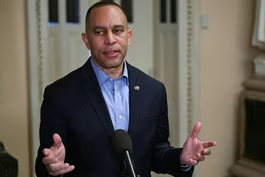 New
NewDemocrats pushing to 'get ICE under control,' Jeffries says
Video has Closed Captions
Clip: 2/16/2026 | 5m 48s | Democrats pushing to 'get ICE under control' with DHS shutdown, Jeffries says (5m 48s)
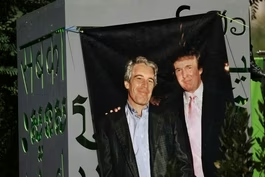 New
NewDOJ gives its reasoning for redacting Epstein files
Video has Closed Captions
Clip: 2/16/2026 | 3m 45s | Khanna says 'stop protecting predators' as DOJ gives reasoning for redacting Epstein files (3m 45s)
 New
NewHow Team USA is faring at the Winter Olympics
Video has Closed Captions
Clip: 2/16/2026 | 7m 40s | Gold and heartbreak: How Team USA is faring at the Winter Olympics (7m 40s)
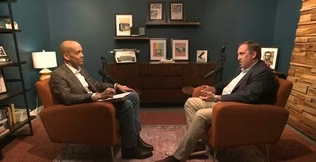 New
NewMatthew Pinsker joins Geoff Bennett on 'Settle In'
Video has Closed Captions
Clip: 2/16/2026 | 6m 33s | Matthew Pinsker and Geoff Bennett explore 'What would Lincoln do?' on 'Settle In' (6m 33s)
 New
NewNews Wrap: Winter storm piling up snow in Sierra Nevada
Video has Closed Captions
Clip: 2/16/2026 | 4m 13s | News Wrap: Winter storm piling up snow in Sierra Nevada range (4m 13s)
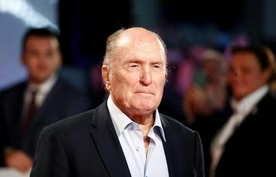 New
NewRemembering Robert Duvall and his storied career
Video has Closed Captions
Clip: 2/16/2026 | 3m 40s | Remembering Robert Duvall and his storied career (3m 40s)
 New
NewRubio bolsters Orban days after push to mend ties in Europe
Video has Closed Captions
Clip: 2/16/2026 | 10m 33s | Rubio bolsters Hungary's far-right leader days after push to mend U.S. ties in Europe (10m 33s)
 New
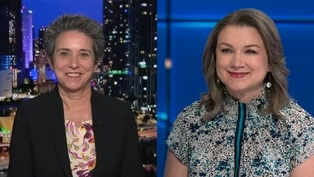
NewTamara Keith and Amy Walter on public reaction to Epstein
Video has Closed Captions
Clip: 2/16/2026 | 7m 13s | Tamara Keith and Amy Walter on the public's response to the Epstein files (7m 13s)
 New
NewWhere the Nancy Guthrie kidnapping case stands after 3 weeks
Video has Closed Captions
Clip: 2/16/2026 | 3m 2s | Where the Nancy Guthrie kidnapping investigation stands as it enters its 3rd week (3m 2s)
Providing Support for PBS.org
Learn Moreabout PBS online sponsorship
- News and Public Affairs

FRONTLINE is investigative journalism that questions, explains and changes our world.

- News and Public Affairs

Amanpour and Company features conversations with leaders and decision makers.
Urban Consulate Presents











Support for PBS provided by:
Major corporate funding for the PBS News Hour is provided by BDO, BNSF, Consumer Cellular, American Cruise Lines, and Raymond James. Funding for the PBS NewsHour Weekend is provided by...