
February 4, 2026 - PBS News Hour full episode
2/4/2026 | 56m 44sVideo has Closed Captions
February 4, 2026 - PBS News Hour full episode
February 4, 2026 - PBS News Hour full episode
Problems playing video? | Closed Captioning Feedback
Problems playing video? | Closed Captioning Feedback
Major corporate funding for the PBS News Hour is provided by BDO, BNSF, Consumer Cellular, American Cruise Lines, and Raymond James. Funding for the PBS NewsHour Weekend is provided by...
Support provided by:

February 4, 2026 - PBS News Hour full episode
2/4/2026 | 56m 44sVideo has Closed Captions
February 4, 2026 - PBS News Hour full episode
Problems playing video? | Closed Captioning Feedback
How to Watch PBS News Hour
PBS News Hour is available to stream on pbs.org and the free PBS App, available on iPhone, Apple TV, Android TV, Android smartphones, Amazon Fire TV, Amazon Fire Tablet, Roku, Samsung Smart TV, and Vizio.
Providing Support for PBS.org
Learn Moreabout PBS online sponsorshipGEOFF BENNETT: Good evening.
I'm# Geoff Bennett.
Amna Nawaz is away.
On the "News Hour" tonight: The expiration of a# nuclear arms treaty between the U.S.
and Russia## makes the future even more uncertain for# the world's two largest nuclear arsenals.
Federal agents' use of surveillance tools to track## immigrants and protesters raises# questions about civil liberties.
And we look at the influence of# presidential adviser Stephen Miller## on Trump administration policies and how# he rose to his position of prominence.
ASHLEY PARKER, "The Atlantic": Cultural# issues can kind of catapult someone like## Stephen Miller from the fringes to the center# of a conversation that's dominating the nation.
(BREAK) GEOFF BENNETT: Welcome to the "News Hour."
For the first time in more than a# half-century, there are no limits## on the world's two largest atomic arsenals.
The# sole remaining nuclear arms treaty in the world,## known as New START, is expiring, and arms# control advocates fear a new arms race.
Nick Schifrin starts our coverage.
NICK SCHIFRIN: They're the world's deadliest# weapons, able to obliterate entire cities and,## when mounted on missiles, can fly# thousands of miles in minutes.
And for the last 15 years, the# deployment of Russia and American## long-range nuclear weapons has been restricted.
BARACK OBAMA, Former President# of the United States: Today is an## important milestone for nuclear# .. NICK SCHIFRIN: It was 2010 when President# Barack Obama and then-Russian President## Dmitry Medvedev signed the New# Strategic Arms Reduction Treaty.## It limited the U.S.
and Russia to 700 deployed# intercontinental ballistic missiles on land,## at sea, and on heavy bombers, and it limited to# 1,550 the number of deployed nuclear warheads.
It also included extensive verification measures,# such as movement notifications, data exchanges,## and on-site inspections, although the inspections# stopped during COVID and never resumed.
JEN PSAKI, Former White House Press# Secretary: That the New START Treaty## is in the national security# interests of the United States.
NICK SCHIFRIN: In 2021, U.S.
and Russia agreed# to extend the treaty for another five years## until today.
Last year, Russian President Vladimir# Putin offered to extend it further into next year.
VLADIMIR PUTIN, Russian President# (through translator): In the past,## the New START Treaty worked.
It worked well,## fulfilling its fundamental role as a constraint,# curbing the arms race and controlling weapons.
NICK SCHIFRIN: But, today in Washington,## Secretary of State Marco Rubio said New# START was no longer .. MARCO RUBIO, U.S.
Secretary of State: In order# to have true arms control in the 21st century,## it's impossible to do something# that doesn't include China because## of their vast and rapidly growing stockpile.
NICK SCHIFRIN: For years, China's stockpile has# been a fraction of the U.S.
and Russian stockpile,## what Beijing has long labeled a minimum# level required for national security.## But the Department of Defense says, by 2030,# Beijing will have more than 1,000 warheads,## including lower-yield tactical nuclear weapons.
But regardless of adversaries' arsenals,## for decades, the U.S.'
nuclear deterrence# works thanks to trust that the U.S.
will## provide allies a nuclear umbrella.# But some allies are losing the faith.
LT.
COL.
JOHANNES KIBSGAARD, Norwegian# Armed Forces: I think one of -- sort## of one of the direct consequences of# the recent diplomatic noise is that## credibility that just isn't there right now.
NICK SCHIFRIN: Johannes Kibsgaard is a lieutenant# colonel at the Norwegian Armed Forces command and## a professor at the Staff College.
He says# the U.S.
can no longer be trusted to use## nuclear weapons to protect Europe and is urging a# Nordic nuke, allowing the U.S.
to focus on China.
LT.
COL.
JOHANNES KIBSGAARD: It's crucial that# America actually focuses on Southeast Asia, and## that means that European allies need to finally# step up and actually complete their defenses.
NICK SCHIFRIN: Back on New START,# there is a debate over whether the## U.S.
should extend or walk away from the treaty.
So, for that debate, we get two perspectives.## Rose Gottemoeller was the chief U.S.# negotiator for the New START agreement## during the Obama administration and is now a# distinguished lecturer at Stanford University.## And Frank Miller had a 30-year career in# government focusing on nuclear weapons and## national security.
He's now a principal at The# Scowcroft Group, an international consulting firm.
Thanks very much to you both.# Welcome back to the "News Hour."
Rose Gottemoeller, let me start with you. '
You think the U.S.
should continue to# abide by the limits in New START.
Why?
ROSE GOTTEMOELLER, Former U.S.
Undersecretary# of State for Arms Control and International## not only the United States under limits,# but they keep the Russians under limits,## at a time when the Russians could move# rather quickly to upload warheads and## put more warheads on each of their missiles# and, therefore, I think, outrun us in this## period when we are looking at China building# up, as Secretary Rubio quite rightly said.
They're building up quickly.
So it's, to my# mind, a no-brainer to keep the Russians under## limits as we ponder and plan and prepare# to confront the Chinese on this matter.
NICK SCHIFRIN: Frank Miller, is it a# no-brainer to extend the treaty for one year?
FRANK MILLER, Former Defense Department Official:# Absolute -- no, absolutely not.
Paradoxically,## getting rid of the treaty makes us# stronger, makes the world more peaceful.
The treaty kept U.S.
force levels, deterrence# force levels, at the 2010-2011 levels.
The world## is vastly different.
We now face an antagonistic# Russia and a growing, antagonistic China.
And so## if we are kept at deterrence levels that# are inadequate to deter Russia and China## simultaneously, which is a conclusion that a# commission that Rose and I both served on in '23,## then, by signaling that we're not prepared# to keep our deterrent at current levels,## we suggest to the Russians and the Chinese that we# are bluffing, not that we have a real deterrent.
NICK SCHIFRIN: Rose Gottemoeller, do# the caps limit our ability to deter?
ROSE GOTTEMOELLER: Well, Frank and I differ## on this quite clearly.
And he's# a greatly respected collea.. But I will say that it's a question of how# fast do we have to move right now.
President## Putin was talking about extending the limits of# New START for one year in order to prepare for## new negotiations and strategic stability# talks.
And I don't think anybody denies,## certainly I do not, that we have a very severe## development here with China building# up its nuclear forces all of a sudden.
And so we need to plan and prepare carefully# at this moment for what we do about China.## But what concerns me is the immediate# tactical move that the Russians might## make.
They are prepared to put more# warheads on their missiles.
That was## also a finding of the Strategic Posture# Commission that frank and I served on.
And it concerns me that the commission report# said, as soon as Russia's release from New START## limits, it may start to build up and put# more warheads on its missiles immediately.
NICK SCHIFRIN: So, Frank Miller, would# Russia do that if the caps are lifted?
FRANK MILLER: Russia could do that.
And to be# perfectly honest, that doesn't bother me one bit.
What bothers me is that the United States doesn't# have a deterrent force adequate to deter China and## Russia simultaneously.
And if the Russians want to# make the rubble bounce, that's up to them.
But we## can build up slowly.
Nothing's going to happen# overnight.
We're talking about taking warheads## out of storage and putting them on existing# submarines, on an existing land-based missiles.
This is a process that will take several years# to do.
So there will be nothing sudden.
And we## could always engage during those years# in new arms control negotiations with## the Russians and perhaps the Chinese.# But this treaty has run its course.
NICK SCHIFRIN: Rose Gottemoeller, what's wrong# with taking more warheads out of storage?
ROSE GOTTEMOELLER: Well, there's nothing wrong# with that.
And, in fact, we are planning and## preparing to do so.
But Frank said very clearly# this is going to take a couple of years to do.
So why would we take a chance# in this coming year?
As we're## preparing and planning for new talks# with both China and, I stress, Russia,## why not take a little time with an insurance# policy in place, the New START Treaty limits,## to plan and prepare and prevent the# Russians from suddenly starting to build up?
Whether or not they're making the rubble bounce,## one could say we're making the rubble# bounce if we're building up also.
But I## think it's important to bear in mind this# is not a question of disagreement between## Frank and me.
We need to counter both# of these powers, these nuclear powers.
It's, can we take a year to plan# and prepare and do it carefully,## when we know it's going to take us some# time to begin to upload our missiles anyway,## to put more warheads on our missiles anyway?
NICK SCHIFRIN: Frank Miller, I saw you# shaking your head during that answer.
FRANK MILLER: Well, my counter to my friend# Rose is that we have taken two years.
The## report from the commission came out in# '23.
The Biden administration embraced## the report's conclusions in '24.# We have given the Russians time.
It's now incumbent upon us to begin to take# our deterrent to the levels -- and we're## not talking large numbers of warheads, but to# slowly build up our force so that it can deter## Russia and China simultaneously, as U.S.
policy# stresses.
And if we can deter simultaneously,## the risk of their aggression, their attack# on us or our allies is dramatically reduced.
NICK SCHIFRIN: In the two# minutes that I have left,## can I bring us back to the argument you heard# from the Norwegian colonel in our story?
And, Frank Miller, let me actually start with# you.
Is it a good idea for U.S.
allies who are## doubting U.S.
nuclear credibility today# to consider their own nuclear weapons?
FRANK MILLER: No.
Nuclear proliferation# is not a good thing.
I don't know the## colonel.
He's clearly very young.
The fact# is, from the beginnings of NATO in 1949,## allies have always questioned, would# the U.S.
come to their aid in extremis?
We have done so for 80-odd years.
We# have deterred attack against the NATO## alliance.
And so people are going to have# to put their faith in the United States,## just as their fathers and grandfathers did.
NICK SCHIFRIN: But, Rose Gottemoeller,# there is clearly some European doubt,## some European loss of faith, if you will, in# the U.S.
nuclear guarantee.
Do you believe## that Europe, or, frankly, even Asian allies# today should doubt the U.S.
nuclear guarantee?
ROSE GOTTEMOELLER: This is one thing# that Frank and I do agree squarely on,## that the notion of friendly deterrence is not# going to -- I'm sorry -- friendly proliferation,## rather -- we need friendly deterrence, right?
But friendly proliferation will not serve us well,## because, for one thing, the NATO European# allies, as well as our Asian allies,## need to concentrate on conventional force# buildup and conventional force modernization.
These nuclear programs are# vastly expensive and cost## a grave amount.
And these countries have# other things to spend their resources on.
NICK SCHIFRIN: Well, it's always nice to end... FRANK MILLER: And possibly# have them within 10 years.
NICK SCHIFRIN: Yes, within 10 years, absolutely.
It's also -- it's always nice# to end with an agreement.
So.. Rose Gottemoeller and Frank Miller,# thank you very much to you both.
FRANK MILLER: Thanks for having us.
ROSE GOTTEMOELLE.. GEOFF BENNETT: In the day's other headlines:## The U.S.
Supreme Court is allowing# the state of California .. newly drawn congressional map that favors# Democrats in this year's midterm elections.
The justices today rejected a request# by California Republicans to override an## appeals court's approval of the map, which# could help Democrats flip five seats.
It## comes about two months after the court# cleared the way for Texas to use a map## aimed at helping Republicans pick up five# seats of their own.
That map was pushed## by President Trump and helped kick-start# a nationwide battle over redistricting.
Officials in Fulton County, Georgia,# are challenging the FBI seizure of## ballots and other documents related to# the 2020 election.
In a filing today,## they said they're seeking the return of# the materials that were taken during a## raid last week at the warehouse# where the records were stored.
County Chairman Robb Pitts, a Democrat, said# -- quote -- "This case is not only about## Fulton County.
This is about elections# across Georgia and across the nation."
Mr.
Trump has long falsely claimed that the# 2020 election was rigged.
Just this week,## he called for Republican officials to take# over voting and nationalize U.S.
elections.
In Gaza, several Israeli strikes today killed# at least 21 people including two infants.
Health## officials say that among the dead was a medic in# Khan Yunis who rushed to help two victims when he## was hit.
In a separate attack, Israeli troops# fired at a residential building in North Gaza.## Israel says the strikes were in response to# a soldier being injured by militant fire,## which it sees as a violation of its# cease-fire agreement with Hamas.
A relative of those killed said many of the# victims in one attack were from the same family.
MOHAMMAD JASER, Relative (through translator): We# can't comprehend why this is happening to us.
Our## relative his wife had given birth.
The baby girl,# who was 6 or 7 days old, was martyred.
They were## all killed.
What can we do?
Where can we go?# We don't know what to do.
This isn't a life.
GEOFF BENNETT: Also today, Palestinian# officials said that medical evacuations## at the Rafah Border Crossing were halted.# Israel insists that the border remains open## and that any delays were due to a lack of# coordination with the relevant agencies.
A top Ukrainian official says that talks today# in Abu Dhabi with Russian officials were,## in his words, substantive and productive.## The negotiations are aimed at ending the nearly# four-year war and are being brokered by the U.S.,## with envoy Steve Witkoff and President# Trump's son-in-law Jared Kushner attending.
Kremlin spokesman Dmitry Peskov said that# the doors for a peaceful settlement are open,## but added that Russia will continue its military# campaign.
Russian attacks today killed at least## nine people across Ukraine and wounded more than# a dozen others.
Separately, President Zelenskyy## told a French broadcaster today that an estimated# 55,000 Ukrainian soldiers have now died in battle.
There's been more fallout from the recent# release of millions of documents related## to the late convicted sex offender# Jeffrey Epstein.
Starting overseas,## the British government said today it'll# release documents related to Peter Mandelson,## who was appointed as ambassador to# the U.S.
despite his ties to Epstein.
Bill Gates said today he regrets every minute# he spent with Epstein after an e-mail alleged## that Gates was having an extramarital affair,# which he denies.
This all comes after lawyers## for Epstein's victims reached a deal with the# Justice Department to protect the identities## of nearly 100 women who were reportedly# affected by the release of the documents.
The man who tried to assassinate# President Trump at his Florida## golf course has been sentenced to# life in prison.
In court today,## Ryan Routh also received a seven-year sentence# for a firearm offense.
Federal prosecutors had## been seeking life, saying his crime was# unacceptable in this country or anywhere.
In 2024, a Secret Service agent spotted Routh# with a rifle aimed at then-candidate Trump.
He## was taken into custody without his ever firing a# shot.
Today, sentencing caps off a chaotic trial.## In September, Routh tried to stab himself with a# pen after the jury found him guilty on all counts.
Former Indiana Congressman Lee Hamilton has# died.
The Democrat served 34 years in the House,## where he led the powerful House Foreign# Affairs and Intelligence committees.
He## also served on the congressional probe of the# Iran-Contra scandal and later in life served## as vice chair of the 9/11 Commission on the# government's failures to prevent the attacks.
He made a number of appearances on this program,## where he spoke about the# complexity of foreign policy.
LEE HAMILTON, Former Co-Chairman, 9/11# Commission: You have to use other tools## of power.
And that can be covert action.
It# can be diplomacy.
It can be political st.. economic leverage, all kinds of things.
GEOFF BENNETT: His counsel was sought by# Democratic presidents, including Lyndon## Johnson and Bill Clinton.
In 2015, then-President# Barack Obama awarded him the Presidential Medal of## Freedom, the nation's highest civilian# honor.
Lee Hamilton was 94 years old.
On Wall Street today, stocks ended mixed# amid ongoing weakness in tech shares.## The Dow Jones industrial average added 260# points on the day.
The Nasdaq lost ground,## falling around 350 points.
The# S&P 500 also ended in the red.
And a Doberman pinscher named Penny is the latest## winner of the most prestigious# prize in the U.S.
dog show world.
MAN: The best in show at the 150th Westminster# Kennel Club dog show is the Doberman pinscher.
(CHEERING) out 2,500 other dogs spanning more than 200# breeds.
Penny becomes the fifth Doberman to win## top honors.
Runner-up and receiving just as many# cheers was a Chesapeake Bay retriever named Cota.
Still to come on the NewsHour: hundreds of people# are laid off at The Washington Post -- we speak## with its former editor Marty Baron; a report from# Antarctica, as researchers there face serious## obstacles to measuring the continent's fastest# melting glacier; and renowned dancer and educator## Alicia Graf Mack discusses her new position# leading the legendary Alvin Ailey company.
GEOFF BENNETT: President Trump's border# czar Tom Homan announced today that## roughly 700 immigration officers# will be withdrawn from Minnesota## after what he described as unprecedented# cooperation from local law enforcement.
But about 2,000 agents are still expected to# remain on the ground for what he described## as targeted operations.
During an interview with# NBC News today, President Trump was asked why he## directed Homan to withdraw some of the officers# and what he had learned from Minneapolis.
DONALD TRUMP: I learned that uh maybe we# can use a little bit of a softer touch,## but you still have to be tough.
These# are crim— We're dealing with really## hard criminals in Minneapolis and elsewhere.
GEOFF BENNETT: There continue to be real concerns## about ICE's tactics.
William Brangham# focuses on that part of the story.
WILLIAM BRANGHAM: That's right, Geoff.
Homan's announcement comes amid ongoing inte.. and the fatal shootings by them of Renee Good# and Alex Pretti.
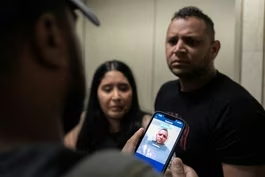
But there's a whole other set## of tactics that immigration officials are# using to track suspects and protesters.
This growing surveillance arsenal includes facial## detection apps and databases,# cell phone trackers and drones.
For more on how this technology# is being deployed on U.S.
streets,## we are joined by Joseph Cox of 404 Media.
Joseph, thank you so much for being here.
You have been covering all these different# technologies that ICE agents are using and## how they're able to scoop up information# about people without them really knowing## what they are doing.
Let's talk# about some of those technologies.
One of them is called Webloc.# Explain what that is, what it does.
JOSEPH COX, 404 Media: Yes, so Webloc allows## ICE to track the location of mobile# phones without a warrant, crucially.
Now, this data is not coming from the# telecoms.
It is not coming from AT&T or## Verizon or T-Mobile.
It is most likely# coming from the advertising ecosystem## behind ordinary apps on your mobile# phone.
So Webloc allows ICE to draw## a map around a particular neighborhood# or a block or a general area and then## see the location of all the phones in that# particular place that the tool has data on.
They could follow it from that location to# somewhere the phone stays overnight.
Presumably,## that's where the person is sleeping and maybe# where they live.
They can then follow it to their## potential employer as well.
And again, crucially,# it allows ICE to do this without a court order,## without a subpoena.
They're just# buying access to the data itself.
WILLIAM BRANGHAM: So if they knew my name# or they knew that I was a particular person## of interest, they can just scoop# up that publicly available data,## commercially available data,# and then use it to track me?
JOSEPH COX: They would most likely do it# based on a location.
So I do want to stress,## we don't know exactly what ICE is using this for,# but the tool has been marketed by the company that## sells it to monitor things like the Black Lives# Matter protest that we had several years ago.
What ICE would probably do is draw a map,# draw a circle around a particular location,## see the phones there, and then if those# people or devices are of particular interest,## they would then follow those and then# figure out who that person might be.
WILLIAM BRANGHAM: I see.
Another one of these devices# is called Paragon .. which is a phone hacking tool.
What does it do?
JOSEPH COX: I mean, Paragon sells some of the# most powerful surveillance technology that## law enforcement and intelligence agencies# are able to purchase.
It allows ICE or any## government customer to remotely break into# most likely fully up-to-date mobile phones.
Now, this is an exceptionally powerful capability.## It would allow ICE to read Signal messages, for# example, messages which are usually encrypted,## or all sorts of other data# on the mobile phone as well.
WILLIAM BRANGHAM: It's really extraordinary# that they would have that ability.
Another one called Mobile Fortify is somewhat# similar to what people might have seen at airports## when they go to check in for their flights.# What does that allow the government to do?
JOSEPH COX: So Mobile Fortify is ICE's and# now Custom and Border Protection's facial## recognition app.
An ICE officer can point# their mobile phone at any person inside the## United States.
It will then query a database# of hundreds of millions of images and other## government databases as well to verify whether# this person has been given a deportation order,## whether they're a citizen, bring up# other personal information as well.
And we have seen both ICE and Customs and Border# Protection using this tool on American streets,## where, instead of going up to somebody# and asking for their passport or other## identification document, perhaps# they don't want to hand that over,## the DHS officials will just use# this app to scan their face.
And, crucially, ICE argues and believes# you cannot opt out of this scanning.
If ICE## wishes to scan your face with Mobile Fortify,# they believe that you must comply with that.
WILLIAM BRANGHAM: Is any of this legal?
I# mean, anyone with even a cursory knowledge of## the Constitution knows there's a prohibition# against unreasonable searches and seizures.
I'm not a lawyer, but this certainly seems# to fall right squarely in the middle of that.
JOSEPH COX: I think that's a really# interesting thing about a lot of these## surveillance technologies, is that it# is a legal gray area, or, if anything,## ICE might actually be acting legally as well.
When it comes to Webloc, the phone location# data, they don't need a warrant because## they're buying it from a commercial broker.# They don't need to go to a court and get## permission to do that.
With the facial# recognition staff from Mobile Fortify,## they don't need to do that either, in their eyes,# because they already have all of that information.
It is already querying all of these government# databases.
Now, with the mobile phone spyware,## yes, hopefully, ICE would get a warrant# before deploying that.
When the FBI has## deployed hacking tools in the past,# they have sought a warrant as well.
But, again, the exact contours and context# which ICE is actually using that technology## is really unclear.
So, frankly, we don't know# if they have obtained a warrant to use that.
WILLIAM BRANGHAM: How can people protect# themselves from this?
I mean, we're not trying## to shield people from being able to escape# criminal activity or repercussions for it.
But if someone is legally protesting,## is there anything that they can do to try to# hold off some of these more invasive searches?
JOSEPH COX: Yes, I think that's# the thing with Webloc especially,## is that it's quite an indiscriminate tool.
This is not like it just includes the mobile# phone data of criminal suspects.
I would just## say that people should probably be cautious# and vigilant about the apps they install on## their phone.
If you install a video game, for# example, and it asks for your location data,## maybe take a minute and think, I don't know# if that game really needs my location data,## because ultimately you don't really know where# that information is being transmitted to.
And it could end up in the hands of any other# number of companies or potentially ICE as well.
WILLIAM BRANGHAM: Joseph Cox of 404# Media, thank you so much for being here.
JOSEPH COX: Thank you.
Really appreciate it.
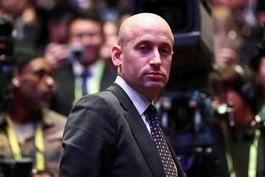
GEOFF BENNETT:## White House Deputy Chief of Staff Stephen# Miller is one of Washington's most polarizing## power brokers.
He's a chief architect of# the administration's immigration crackdown,## and his portfolio has expanded to# include foreign policy as well.
Our White House correspondent,# Liz Landers, has this closer look.
STEPHEN MILLER, White House Deputy Chief# of Staff: The U.S.
military is repatriating## illegal immigrants at a pace and a skill that# has never occurred before in American history.
LIZ LANDERS: One of the brains behind all# of President Trump's second-term policies,## Deputy Chief of Staff for Policy Stephen Miller.
STEPHEN MILLER: To all ICE officers, you# have federal immunity in the conduct of## your duties.
And anybody who lays a# hand on you, or tries to stop you,## or tries to obstruct you is committing a felony.
LIZ LANDERS: The 40-year-old# hard-lined conservative grew## up in Southern California and became# politically active at a young age.
WOMAN: I do like that he's really# good about voicing his opinions,## but I don't like the way he does it.
LIZ LANDERS: That's clear in this video made# by his classmates at San.. which has excerpts from his speech Miller# delivered while running for student government.
STEPHEN MILLER: Am I the only one who is sick# and tired of being told to pick up my trash,## when we have plenty of janitors# who are paid to do it for us?
LIZ LANDERS: Witnesses say those comments# got him escorted off stage.
Miller went on## to Duke University, which was thrust into the# national spotlight in 2006, when white members## of the school's lacrosse team were accused# of raping an exotic dancer who was Black.
BILL O'REILLY, Former Host, "The# O'Reilly Factor": You a student,## pretty much the only person who# talked to us.
What's going on?
LIZ LANDERS: Miller made multiple TV# appearances defending the players.
STEPHEN MILLER: This was never about# what happened to this particular woman,## according to her testimony, nor# was it ever about these players.
LIZ LANDERS: The state's attorney general# later dropped all charges against the players,## and the accuser eventually admitted to lying.
ASHLEY PARKER, "The Atlantic":# He is appearing as essentially## a spokesperson on major, major prime-time shows.
LIZ LANDERS: Ashley Parker is a writer# at "The Atlantic" who has covered Miller.
ASHLEY PARKER: These cultural issues can# kind of catapult someone like Stephen## Miller from the fringes to the center of a# conversation that's dominating the nation.
LIZ LANDERS: Miller began his career# in Washington working for influential## Tea Party Republicans like former Congresswoman# Michele Bachmann and then-Senator Jeff Sessions.
As a top aide to sessions, Miller helped craft# messaging against a 2013 bipartisan immigration## bill that would have created a path for millions# of undocumented immigrants to gain legal status.
FMR.
SEN.
JEFF SESSIONS (R-AL):# I believe the interest that needs## to be protected is the national# interest of the United States.
LIZ LANDERS: Other Republicans# lined up behind Sessions,## and although the bill passed in the# Senate, it eventually died in the House.
A few years later, Donald Trump# entered the political scene,## voicing his hard-line stance on immigration.
ASHLEY PARKER: The first senator to come on# board and endorse Donald Trump was Jeff Sessions,## and very shortly thereafter Stephen# Miller joins the Trump campaign.
LIZ LANDERS: Miller soon began writing speeches# for Trump with a heavy focus on immigration,## including his acceptance speech# at the 2016 Republican National## Convention in Cleveland that summer.
DONALD TRUMP: We are going to build a great# border wall to stop illegal immigration.
(CHEERING) LIZ LANDERS: Miller also delivered his# own speeches on the campaign trail.
STEPHEN MILLER: Everybody who is# trying to stop Donald J. Trump## wants that border to stay wide open.
They want## illegal immigrants to continue pouring in.
They# do not want to protect the American people.
ASHLEY PARKER: What it really is, is a# pairing, a kind of natural pairing of## two like-minded individuals when it comes# to immigration.
This was not a place where## Stephen Miller really had to pull Donald# Trump to the right or to the extreme, but## he did sort of provide an intellectual framework# and policy understanding and philosophy of these## views that Trump sort of intuited, but might# not have originally been able to articulate.
JOHN ROBERTS, Chief Justice of the U.S.# Supreme Court: Please raise your right hand.
LIZ LANDERS: President Trump quickly# put those words to action once he## entered the White House.
And as a# senior adviser to the president,## Miller was one of the architects of# some of his most controversial policies.
DONALD TRUMP: And this is the protection of the## nation from foreign terrorist# entry into the United States.
LIZ LANDERS: That includes the executive# order dubbed the Muslim travel ban.## It barred foreign nationals of seven# predominantly Muslim countries from## visiting the U.S.
and was an early signal of# how Trump would assert executive authority.
STEPHEN MILLER: Our opponents, the# media and the whole world will soon see,## as we begin to take further actions, that# the powers of the president to protect our## country are very substantial# and will not be questioned.
LIZ LANDERS: It also included the# administration's zero-tolerance## immigration policy of separating migrant# children from their parents at the border.
DAVID MUIR, "World News# Tonight" Anchor: Late today,## President Trump signing an .. LIZ LANDERS: Trump eventually ended# that policy amid political pressure## and the courts halted and narrowed the travel ban.
After President Trump's loss to Joe Biden in 2020,## Miller echoed lies that the election was# stolen.
He described on TV that December## the scheme to seat fake pro-Trump# electors to overturn the results.
STEPHEN MILLER: So we have more than enough# time to right the wrong of this fraudulent## election result and certify Donald# Trump as the winner of the election.
LIZ LANDERS: Ashley Parker says Miller# spent the time after Trump's 2020 loss## strategizing for a potential second term.
ASHLEY PARKER: He's learned things in# the first term.
He now understands,## for instance, why the travel ban executive# order he wrote in Trump's first term## was kind of a disaster.
It created chaos at# the airports.
There was a huge backlash in## the country and it was struck down by# the courts.
He now understands how to## craft that order in a way that will be far# more effective in achieving their goals.
And so he comes back with sort of a# battle plan for what he will do and## how he will do it if and when# Trump retakes the White House.
LIZ LANDERS: Trump tapped Miller# to be his deputy chief of staff## for policy when he returned to the# White House.
With Miller's oversight,## the administration hit the ground running# by issuing a flood of executive orders.
Miller has continued to push# his anti-immigration agenda.## He came up with a strategy of using the Alien# Enemies Act to quickly carry out deportations... STEPHEN MILLER: Birthright citizenship is the# biggest, costliest scam in financial history.
LIZ LANDERS: ... and has been a vocal# supporter of President Trump's executive## order ending birthright citizenship, which# the Supreme Court is set to rule on this term.
CHAD WOLF, Former Acting U.S.
Secretary# of Homeland Security: I think he's got## a more expansive rol.. LIZ LANDERS: Chad Wolf served as# acting homeland security secretary## during Trump's first term and# worked closely with Miller.
CHAD WOLF: He comes armed in this administration# with a lot more experience than I would say than## he did showing up in 2017.
I think he understood# immigration.
But then the question is, how do you## effectuate the policy within that executive# branch, within DHS, the Department of Justice## and State Department?
I think he understands# that a lot better today than he did then.
LIZ LANDERS: And last month, Miller delivered# the administration's early and forceful pushback## after the deadly shooting of Alex Pretti by# immigration agents in Minneapolis, calling## the ICU nurse a would-be assassin, before walking# that back as videos of the incident circulated.
Miller's role has expanded beyond immigration,## playing a key role in foreign# policy from Venezuela to Greenland.
STEPHEN MILLER: You can talk all you want about# international niceties and everything else,## but we live in a world, in the real world,## Jake, that is governed by strength, that is# governed by force, that is governed by power.
LIZ LANDERS: Ashley Parker says# it's all a sign that Stephen## Miller's importance has only grown this term.
ASHLEY PARKER: In the first Trump# administration, Stephen Miller was a## senior adviser.
He was incredibly powerful.
He# had the trust of the president.
But this term,## it is that on steroids.
And it is hard to# overstate just how broad Stephen Miller's## purview is in Trump's second term and# just how powerful and important he is.
LIZ LANDERS: "PBS News Hour" asked the# White House for an interview with Miller## for this report.
They did not make him available.
But White House Press Secretary Karoline Leavitt# sent this statement -- quote -- "Stephen Miller## is one of President Trump's most# trusted and longest-serving aides.## The president loves Stephen," further# evidence that, as Miller's portfolio## has grown inside the White House, so too# has his influence with President Trump.
GEOFF BENNETT: The Washington Post is laying# off a third of its work force across both the## newsroom and its business operations,# a massive blow at a storied newspaper## that has struggled in recent years to# stay profitable and retain subscribers.## The cuts reportedly affect more than 300# of the approximately 800 journalists in## the newsroom and include eliminating its# sports desk and books section entirely.
The Post's executive editor said the changes,## though painful, were meant to -- quote# -- "reinvent the paper for a new era."
For more on these cuts and their# implications, we're joined now by## Marty Baron, who was the editor of The# Washington Post from 2012 until 2021.
Welcome back to the "News Hour."
MARTY BARON, Former Executive Editor, The# Washington Post: Thanks for having me.
GEOFF BENNETT: You have described# this as among the darkest days## in The Post's history.
What do these# layoffs mean for the paper's mission## and its ability to continue doing# in-depth, substantial reporting?
MARTY BARON: Well, I think it's important to# keep in mind just how widespread these cuts are,## not only the sports desk, the books department,# but pretty much the entire arts department,## eviscerating the foreign staff, largely# eviscerating the local staff as well.
So these are huge, huge cuts, and they're going to## be -- they're going to do enormous damage to# the newspaper's ability to cover its community,## to cover the country, and to cover the# world in all the ways that it should.
GEOFF BENNETT: The executive editor, Matt Murray,## said today that the paper's structure was built# for a different era and that refocusing on## what he calls these core coverage areas like# politics and national security will help The## Post better navigate technological change,# shifting audience habits, cost pressures.
Do you buy that argument?
MARTY BARON: Well, I think Matt is# doing a really good job as editor## of The Post.
The Post is doing# extraordinary journalism every## single day.
And I commend them for# that.
I admire what they're doing.
That said, they have announced -- they seem# to have announced a new strategy just about## once a year now, saying that it would better# position themselves for the future.
And none## of those things have worked.
I don't think what# they're doing now helps position them for the## future.
It diminishes the brand.
It diminishes# the coverage.
It offers less to their readers.
They're going to have fewer subscribers# as a result of this, probably not more.
So## I understand why Matt is saying that.# He has to say something positive about## what's happening.
But I don't think# there's very much positive to say.
GEOFF BENNETT: You served as editor under Jeff# Bezos back in 2013 when he purchased the paper## and pledged long-term investment and support for# the newsroom.
What do you make of what appears to## be a shift in both his relationship to the paper# and his willingness to invest in its future?
MARTY BARON: Well, he was great at# the beginning, and for a long time,## as a matter of fact.
He set out a vision for The# Post to be national and international, as opposed## to regional, which it was largely before.
He# invested heavily in The Post.
We innovated## tremendously over the years.
We grew tremendously# as well, practically doubling the staff.
And we were profitable for about six# straight years.
And so that was a lot## of progress.
He was proud of it.
He spoke# proudly of it.
And so now we're seeing a## diminished outlook.
And I think that he# became sort of detached in about 2019,## when his marriage broke up, when# Amazon was struggling later in 2020,## when the -- Amazon was struggling with# the pandemic and all the aspects of that.
And then I think he really became -- took# a real turn after it looked like Trump## was going to be elected president yet again.# And that was in 2024.
And 11 days before the## presidential election in 2024, they# killed an editorial for -- that was## endorsing Kamala Harris.
He said the paper# wouldn't endorse ever again for president.
And hundreds of thousands of# subscribers canceled at that time,## aggravating the financial problems# that they had.
Subsequent to that,## he did all sorts of things that made things# even worse, appearing at the inauguration on## the stage with Donald Trump, buying the Melania# so-called documentary for an exorbitant price,## buying the right -- Amazon buying# the rights to "The Apprentice."
And Amazon had bought the rights to Melania's# documentary as well.
And then completely## changing the opinion pages so that essentially# they have no columnists who are really left## of center.
And they're very deferential to# Trump.
And I think they lack a moral core.
And so all of that has driven subscribers# away.
And so for every subscriber that## they get coming in through the front door# because of the high-quality news coverage,## I think they're losing maybe two# subscribers out the back door.
Of course,## I don't know the numbers exactly, but clearly# they have been losing a lot of subscribers.
GEOFF BENNETT: Why does an institution like The## Washington Post matter at# this moment in particular?
MARTY BARON: Look, I think# it's the reason that every## news organization matters.
It's an organization.
I think the role of a news organization is to give# the public the information it needs and deserves## to know so that they can govern themselves.# The Washington Post has a long history of that,## and particularly of holding the government to# account, keeping a close eye on government.
That happened, of course, during Watergate.# I think we did that when I was editor on## the first round of the -- Trump's time in the# White House, his first term.
And they continue## to do that today.
I think they're doing a# tremendous job of that.
People need to know## what's happening in their government.
They need to# know what's happening in the corridors of power,## whether in government or in business or# in nonprofits or wherever it might be.
And they need to know what's happening# around the world.
So if you don't have## reporters around the world, you're not# going to know what's happening.
And we## need more than one news organization doing that.# We need multiple news organizations doing that.
So, look, the press is built into our democracy.# It is provided for in the First Amendment to the## Constitution because the founders understood# that you needed an institution that would keep## watch on government.
And James Madison, who# was the principal author of that amendment,## talked about the need for freely# examining public characters and measures.
We are not stenographers and we should not# be propagandists.
And that is the role that## The Washington Post has historically played, and# that's the role that it should continue to play.
GEOFF BENNETT: Marty Baron, thank you for# your time this evening.
We appreciate it.
MARTY BARON: Thank you.
GEOFF BENNETT: Well, if you have been following# Miles O'Brien's reports from Antarctica on## our broadcast and online, you know he's# reporting on an international group of## researchers trying to measure what's happening# to one of the fastest melting glaciers there.
And their work is trying to capture information# in ways that have never been done before.
Tonight, he has an update on how all that turned# out, part of our periodic series Tipping Point.
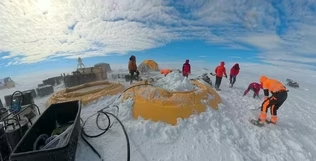
MILES O'BRIEN: At long last, they# got to the core of this far-flung## mission.
Hot water was sluicing through# glacier ice like a knife through butter,## a milestone moment at the most# menacing glacier of all, Thwaites.
It was a long, strange journey to get to this# place and time, 11 days on a Korean icebreaker## from New Zealand to West Antarctica, 10 days# waiting for the clouds to lift so the helicopters## could too, and 10 more setting up camp on the# vast void in the teeth of harsh Antarctic winds.
MAN: Finally.
(LAUGHTER) MILES O'BRIEN: R.. British Antarctic Survey, BAS.
They wrote# the book on this blitzkrieg boring method.
Pete Davis is a physical oceanographer.
PETER DAVIS, British Antarctic Survey: We# shovel for days and then the wind -- the## wind was too strong.
We had to delay.
It partly# is uncomfortable for us, but also the windchill## factor.
It just makes everything freeze,# and freezing, as we say, our worst enemy.
MILES O'BRIEN: This glacier is large enough# to raise global sea levels 2.5 feet.
It is## a river of ice flowing at a rate of 30# feet per day, ripping apart into chaotic## rifts strewn with ice boulders, melting# tens of times faster than its neighbors.
And this is the perfect spot to figure out why.# It's on the grounding line where the glacier,## the land and the Amundsen Sea meet 3,000 feet# below.
It was a little after 4:00 p.m.
January## 30 when they broke through the bottom of the# ice.
As they reeled in the hot water hose,## Pete Davis showed me a mother lode of# scientific instruments ready for dunking,## devices that measure salinity, temperature,# depth, current and dissolved oxygen.
PETER DAVIS: This is the take-up data.
If# we get this down to the bottom of the ocean,## even if we don't recover it, we have a profile.## And that is 100 percent more data# than we've ever had from here before.
MILES O'BRIEN: On the other side of the tent,# the mooring instruments designed to gather## all those readings continuously for perhaps a# year, transmitting the data in near real time.
PETER DAVIS: What we're trying to study here,## more to do with kind of processes and# the proc.. than enough to see the processes in action# and to get the understanding that we want.
MILES O'BRIEN: As Friday slipped into# Saturday in this place of no sunsets,## the temperature dropped, measured# invisible breath and what looked## like an invisible driller, his# gloves warming up on a hot hose.
The team gave the sensors a warm bath and# sent them down.
They got five profiles of## the water below, a successful# warmup act for the main event,## the mooring that would stay behind.
Down it# went.
But around 1:30 p.m.
on January 31,## there was trouble below.
Pete Davis logged into# the mooring instruments.
It looked good at first,## but then he realized they all had# identical temperature readings.
PETER DAVIS: OK, I'm pretty sure we're# stuck.
I think we are stuck at about## 650 decibars.
I'll come down and discuss options.
MAN: Thank you.
MILES O'BRIEN: They pulled a little bit,## but everyone here knew they'd lose this# tug of war.
Remember, freezing is their## worst enemy.
When super cold glacier ice# grabs an instrument, there is no plan B. KEITH MAKINSON, British Antarctic Survey: If# you linger at any one location with equipment,## it could freeze to the side.
And, unfortunately,# something along those lines happened.
MILES O'BRIEN: Keith Makinson# is a 37-year BAS veteran.## The instruments are frozen solid 2,300 feet below# the surface, 650 feet from the bottom of the ice.## The exhausted tight-knit team tried to console# each other, but there's a deep well of sadness.
KEITH MAKINSON: The whole team has worked really# hard for many years.
It's a really hard blow.
MILES O'BRIEN: And yet they did not walk away# empty handed.
They have a snapshot of data## from a place where none existed before.
And it's# not a pretty picture.
The water temperature here## is nearly 34 degrees, 5.5 degrees warmer than# the freezing point of glacier ice in seawater.
There's no question why the glacier# is melting.
But the forecast they## hoped to give the world remains elusive.# Antarctica does not give up its secrets## easily.
But the people who come here# to unlock them won't give up either.
For the "PBS News Hour," I'm Miles# O'Brien at the Thwaites Glacier.
GEOFF BENNETT: The Alvin Ailey# American Dance Theater has just## launched a 20-city U.S.
tour# under its new artistic director,## Alicia Graf Mack.
She's a renowned former# Ailey dancer herself and an educator who is## now fusing those roles to lead the modern# dance troupe which started back in 1958.
She joined me in the studio this week as# part of our arts and culture series, Canvas.
Alicia Graf Mack, welcome to the "News Hour."
ALICIA GRAF MACK, Artistic Director, Alvin# Ailey American Dance Theater: Thank you.## It's a pleasure to b.. GEOFF BENNETT: You're only the fourth artistic# director in the 70-year hist.. and you're launching your first season by# opening a national tour here in Washington.
When you step into rehearsal# now or even a performance,## what feels most different from the last# time, when you danced with the company?
ALICIA GRAF MACK: It does feel like# a wonderful homecoming to return to## the company now in this role, as I had# danced with the company for six years.
I have a great responsibility to hold this# very important organization in my hands.## I am so supported by the artistic team,# by our administration, by our audience,## by the community in this work.
And it# feels like nothing short of a blessing.
GEOFF BENNETT: I saw where you said# previously that the organization is## really rooted in Alvin Ailey's big dream.
How do you honor the specificity of# his vision and the tradition of Ailey,## while still making space for new voices# and new pieces, new choreography?
ALICIA GRAF MACK: Mr.
Ailey set# the blueprint so many years ago.
When he founded the company, he not only wanted to# highlight his own choreographic voice and create## the works that he made, as he said, from his# blood memories of growing up in rural South,## in Texas, but also that he wanted to provide# a platform for emerging choreographers,## for new voices and specifically# for choreographers of color,## as there was not that many platforms# for those artists to share their work.
And so this is the blueprint that I follow even# now, in 2026, that we honor his voice, and we## always perform his works, including "Revelations,"# which is a work that is seen by more people around## the world than any other modern dance work,# also that we find voices that reflect what## we are going through today, voices who will bring# their authentic truth and identities to the stage.
GEOFF BENNETT: To your point, I mean you've# emphasized that Ailey is for everyone.
It's## not in elitist art form.
In practical terms,# what does that accessibility look like?
ALICIA GRAF MACK: The Ailey organization is all# about accessibility.
The dancers, of course,## are elite artists.
They are world-class# dancers, but we are open for everyone.
We have an extensive school that offers dance# education for everyone and we also have an arts## and education and community outreach# program that touches students around## the country from curriculum in the school# systems to free performances for children.
GEOFF BENNETT: What did teaching dance reveal to## you about where the art form is# versus where you want it to go?
ALICIA GRAF MACK: Part of the work is# to empower the artist, the student,## the dancer to know their own story, their# own identity and to be able to let that## shine on stage and just watch them reach their# -- what I call their moving moments on stage,## these very high points that artists# on a very high level reach sometimes.
It's the high that you get when# everything comes together, the music,## the movement, the idea.
There's nothing like it.
GEOFF BENNETT: Let's talk more about that,## because you first experienced the magic# of Alv.. dreams.
Now you're launching your tour# here in your hometown, Washington, D.C.
What does that full circle moment,# what does that mean to you?
ALICIA GRAF MACK: It's everything.
I can recall## Ailey being my North Star# from the time I was a child.
And my parents -- I grew up in# Columbia, Maryland.
They would## expose me to dance both in Baltimore and# Washington and all around.
Being a young## person and seeing your dream on stage# and seeing people who look like you,## that the idea that representation matters# is real, that work is so important.
And it's so important that we keep the arts alive,## especially in the environment and# culture that we're living in today.
GEOFF BENNETT: A new sense of hope, and# there are also new works on stage that## people will see.
They pull from popular# music, folklore, spirituality, ancestry.
What connects the work thematically?
ALICIA GRAF MACK: All the works# that we perform are visceral.
When the dancers move, the audience will# feel affected by what they're doing.
We're## all about spirit, humanity, and truth.
There's# also an idea that the work is not so elite or## heady.
You can sit and enjoy it and feel# something, and I think that's really important.
GEOFF BENNETT: You have worked under# Judith Jamison.
You've worked under## Robert Battle.
Your experience really embodies the## legacy of Ailey.
How do you bring all# of that to bear in your current role?
ALICIA GRAF MACK: That is so correct.
I was hired by Judith Jamison when I first# started in 2005... I've looked up to forever, as she was a very# tall Black woman.
I myself am quite tall.
And## to know that she saw my gifts and my# instrument as an asset to the company## is one of the many ways in which the Ailey# organization has changed the climate and## the field in itself, that we look for# artists who are unique in every way.
And all that Robert Battle brought,# especially in his sense of curation## and bringing different voices to the# table.
I take all of that with me.
GEOFF BENNETT: When audiences encounter this tour,## when they leave the theater, what# do you want them to walk away with?
ALICIA GRAF MACK: I want them to understand# that, in the present moment, that we are boldly## presenting our work and that we are bravely# standing on that stage all over the world.
But I also want them to have a sense of# the history from where we come and the## legacy that Alvin Ailey set forth,# which required so much bravery,## so much courage in 1958.
And if Mr.
Ailey could# do that in 1958, I certainly can do that in 2026.
GEOFF BENNETT: Alicia Graf Mack, a real# pleasure to speak with you.
Thank you.
ALICIA GRAF MACK: Thank you.
GEOFF BENNETT:## And that's the "News Hour" for# tonight.
I'm Geoff Bennett.
For all of us here at the "PBS News Hour,"# thanks for spending part of your evening with us.

Alicia Graf Mack on leading the Alvin Ailey dance company
Video has Closed Captions
Clip: 2/4/2026 | 6m 58s | Alicia Graf Mack reflects on leading the legendary Alvin Ailey dance company (6m 58s)

Experts debate future of U.S.-Russia nuclear arms treaty
Video has Closed Captions
Clip: 2/4/2026 | 7m 29s | GOTTEMOELLER, MILLER DIS (7m 29s)

Former editor discusses The Washington Post’s mass layoffs
Video has Closed Captions
Clip: 2/4/2026 | 6m 53s | Sweeping layoffs at The Washington Post will do ‘enormous damage,’ former editor says (6m 53s)

Key U.S.-Russia nuclear arms reduction treaty expires
Video has Closed Captions
Clip: 2/4/2026 | 3m 11s | Expiration of U.S.-Russia nuclear weapons treaty sparks concerns of new arms race (3m 11s)
Researchers meet big setback to measuring ‘Doomsday Glacier’
Video has Closed Captions
Clip: 2/4/2026 | 5m 28s | Researchers face serious obstacles to measuring Antarctica’s fastest-melting glacier (5m 28s)
Stephen Miller’s influence on the Trump administration
Video has Closed Captions
Clip: 2/4/2026 | 8m 45s | Stephen Miller’s rise to prominence and influence on the Trump administration (8m 45s)
What to know about immigration agents’ surveillance tactics
Video has Closed Captions
Clip: 2/4/2026 | 7m 9s | Immigration agents’ surveillance tools and tactics raise questions about civil liberties (7m 9s)
Providing Support for PBS.org
Learn Moreabout PBS online sponsorship
- News and Public Affairs

FRONTLINE is investigative journalism that questions, explains and changes our world.

- News and Public Affairs

Amanpour and Company features conversations with leaders and decision makers.
Urban Consulate Presents











Support for PBS provided by:
Major corporate funding for the PBS News Hour is provided by BDO, BNSF, Consumer Cellular, American Cruise Lines, and Raymond James. Funding for the PBS NewsHour Weekend is provided by...