
New poll shows where Americans stand on debt ceiling debate
Clip: 2/23/2023 | 4m 27sVideo has Closed Captions
New poll shows where Americans stand on debt ceiling debate, raising minimum wage
The nation, and lawmakers, are facing some critical moments on major issues, including how to act on the debt ceiling. Some new numbers in our PBS NewsHour/NPR/Marist poll give a sometimes glaring sense of where the public is on the issue. Lisa Desjardins joined Amna Nawaz to go through the results.
Problems playing video? | Closed Captioning Feedback
Problems playing video? | Closed Captioning Feedback
Major corporate funding for the PBS News Hour is provided by BDO, BNSF, Consumer Cellular, American Cruise Lines, and Raymond James. Funding for the PBS NewsHour Weekend is provided by...
New poll shows where Americans stand on debt ceiling debate
Clip: 2/23/2023 | 4m 27sVideo has Closed Captions
The nation, and lawmakers, are facing some critical moments on major issues, including how to act on the debt ceiling. Some new numbers in our PBS NewsHour/NPR/Marist poll give a sometimes glaring sense of where the public is on the issue. Lisa Desjardins joined Amna Nawaz to go through the results.
Problems playing video? | Closed Captioning Feedback
How to Watch PBS News Hour
PBS News Hour is available to stream on pbs.org and the free PBS App, available on iPhone, Apple TV, Android TV, Android smartphones, Amazon Fire TV, Amazon Fire Tablet, Roku, Samsung Smart TV, and Vizio.
Providing Support for PBS.org
Learn Moreabout PBS online sponsorshipAMNA NAWAZ: The nation and lawmakers are facing some critical junctures on major issues, including how to act on the debt ceiling.
Some new numbers in our "PBS NewsHour"/NPR/Marist poll give a sense of where the public is.
And our Lisa Desjardins is here to walk through some of those numbers now.
Lisa, good to see you.
LISA DESJARDINS: Great to see you.
AMNA NAWAZ: So, start with the debt ceiling here.
LISA DESJARDINS: Right.
AMNA NAWAZ: Lawmakers need to raise it, and soon.
It would be catastrophic if they don't.
Do voters feel that sense of urgency too?
LISA DESJARDINS: Some really interesting number in our poll of national Americans, everyone included here.
When we asked the people surveyed what should lawmakers do, should they raise the federal debt ceiling to deal with the deficit, look at this?
Only half of Americans said yes, though we know that that is absolutely critical to the financial stability of this country and other countries as well.
So it's one way to look at it is that Americans still aren't quite convinced of the necessity of this, which we know is a necessity.
But let's also look back in time and see how this compares to 2011, the last time we had a major debt ceiling crisis.
So, really, Americans have changed.
They now believe more that the debt ceiling must be raised.
But it's still half and half.
And you won't be surprised that is split on partisan lines, with Republicans much less likely to think the debt ceiling needs to be raised.
AMNA NAWAZ: As we often see, right?
So what do they want lawmakers to do?
Did they talk about that?
LISA DESJARDINS: Yes.
Quickly, we asked, what do you think?
Should we increase taxes or should we perhaps cut some spending?
And on this question, again, we see a real divide in America, some things Judy Woodruff was talking about in her program, in her efforts.
And, again, this was also on partisan lines, with Democrats more likely saying increase taxes and Republicans say, no, we need to cut programs.
One note, though, younger Americans say they're more likely to say we should cut taxes -- or raise taxes, rather.
AMNA NAWAZ: That is interesting, among younger Americans.
So a lot of this gets to how they see the approach to governing, right?
This idea of brinksmanship, that people should push it as far as they can, how do voters feel about that?
LISA DESJARDINS: It's always a question, right?
Why can't lawmakers just get together and figure this out?
Do Americans want them to?
We asked, should lawmakers compromise or not?
And here's what they told us, those we surveyed; 70 percent said, yes, we want our lawmakers to compromise, only 28 percent saying stand on principle.
Here's where we want to bring out that partisan divide, though, because, obviously, we have divided government.
Republicans, far fewer believe in compromise, 44 percent of Republicans, not a majority, but a significant amount, still telling us they believe stand in principle.
What's interesting here, Amna, is that Democrats overwhelmingly say compromise, and yet we hear from the White House language about things not being negotiable.
So we kind of have sort of cross-purposes here between voters and sometimes their parties.
AMNA NAWAZ: We asked about a lot of other issues people talk about, things like minimum wage, how they feel about some of the investigations that House Republicans are now leading.
What did folks say about that?
LISA DESJARDINS: Yes, let's get into that, average daily life.
Now, right now, three states in this country have $15-an-hour minimum wages.
Most voters want that to change; 64 percent of Americans, about two-thirds, say, yes, it's time to raise the minimum wage.
And let's look at younger Americans in particular.
Look at that; 71 percent Gen Z, millennials.
So, there, you're talking about 20-year-olds, 30-year-olds, roughly.
They say, yes, let's raise the minimum wage.
That was certainly the highest we saw for any generational group.
But I want to say it's interesting.
Across incomes, whether you make more or less than $50,000, two-thirds of Americans say, yes, raise the national minimum wage.
So something I think we're going to hear more about.
A different kind of issue, Republicans talk a lot about investigations.
Hunter Biden.
We asked people, do you think that there should be more about Hunter Biden's laptop, the investigation into him?
; 57 percent of Americans said yes.
And I will say, notably, about a third of Democrats even say, yes, they'd like more on that investigation.
AMNA NAWAZ: So, a lot of this is about a moment in time, asking people how they feel right now.
Did you pull out any trends that you think are worth noting in this?
LISA DESJARDINS: Right.
Polls are polls.
All these, we're not sure what they mean in the long run, but people are changing in a few areas.
I saw really change -- changing numbers, especially from lower-income Americans and non-college-educated Americans.
President Biden picked up in both of those groups.
And, among Republicans, so did President Trump.
Those groups that are core voters were deciding in the past couple of months, and they decided for people who've been in office or in office now.
AMNA NAWAZ: Fascinating look at who we are in our new "PBS NewsHour"/NPR/Marist poll.
Lisa Desjardins, thanks for breaking it down.
LISA DESJARDINS: You're welcome.

Abortion pills latest battleground over reproductive rights
Video has Closed Captions
Clip: 2/23/2023 | 7m 57s | Abortion pills become latest battleground over reproductive rights (7m 57s)

How Larry Wilmore's 30 years in TV have shaped comedy
Video has Closed Captions
Clip: 2/23/2023 | 7m 51s | How Larry Wilmore's 30 years in TV have shaped comedy and challenged traditional notions (7m 51s)

NTSB releases preliminary report on Ohio derailment
Video has Closed Captions
Clip: 2/23/2023 | 3m 44s | NTSB releases preliminary report on Ohio derailment that led to toxic chemical spill (3m 44s)
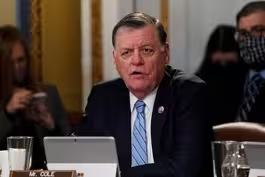
Republican Rep. Tom Cole discusses debt ceiling debate
Video has Closed Captions
Clip: 2/23/2023 | 7m 44s | Republican Rep. Tom Cole discusses debt ceiling and issues facing a divided Congress (7m 44s)

Ukraine's fight against Russia forges new levels of unity
Video has Closed Captions
Clip: 2/23/2023 | 6m 8s | Ukraine's fight against Russia forges new levels of national unity a year into war (6m 8s)
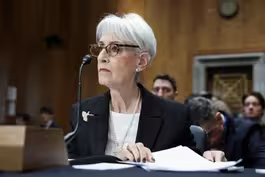
U.S. Deputy Secretary of State on status of war in Ukraine
Video has Closed Captions
Clip: 2/23/2023 | 7m 18s | U.S. Deputy Secretary of State on where Russia's war on Ukraine stands one year later (7m 18s)
Providing Support for PBS.org
Learn Moreabout PBS online sponsorship
- News and Public Affairs

FRONTLINE is investigative journalism that questions, explains and changes our world.

- News and Public Affairs

Amanpour and Company features conversations with leaders and decision makers.
Urban Consulate Presents









Support for PBS provided by:
Major corporate funding for the PBS News Hour is provided by BDO, BNSF, Consumer Cellular, American Cruise Lines, and Raymond James. Funding for the PBS NewsHour Weekend is provided by...