
January 21, 2026 - PBS News Hour full episode
1/21/2026 | 57m 46sVideo has Closed Captions
January 21, 2026 - PBS News Hour full episode
January 21, 2026 - PBS News Hour full episode
Problems playing video? | Closed Captioning Feedback
Problems playing video? | Closed Captioning Feedback
Major corporate funding for the PBS News Hour is provided by BDO, BNSF, Consumer Cellular, American Cruise Lines, and Raymond James. Funding for the PBS NewsHour Weekend is provided by...
January 21, 2026 - PBS News Hour full episode
1/21/2026 | 57m 46sVideo has Closed Captions
January 21, 2026 - PBS News Hour full episode
Problems playing video? | Closed Captioning Feedback
How to Watch PBS News Hour
PBS News Hour is available to stream on pbs.org and the free PBS App, available on iPhone, Apple TV, Android TV, Android smartphones, Amazon Fire TV, Amazon Fire Tablet, Roku, Samsung Smart TV, and Vizio.
Providing Support for PBS.org
Learn Moreabout PBS online sponsorshipGEOFF BENNETT: Good evening.
I'm Geoff Bennett.
AMNA NAWAZ: And I'm Amna Nawaz.
On the "News Hour" tonight: DONALD TRUMP, President of the United States: I don't have to use force.
I don't want to use force.
I won't use force.
AMNA NAWAZ: President Trump softens his threats to take over Greenland and backpedals on new tariffs against Europe.
GEOFF BENNETT: The Supreme Court hears arguments on the president's attempt to fire a member of the Federal Reserve in a critical test of the Central Bank's independence.
AMNA NAWAZ: And the mayor of St.
Paul, Minnesota, discusses unrest triggered by federal immigration raids, including the detention of a U.S.
citizen.
KAOHLY HER, Mayor of St.
Paul, Minnesota: People are afraid.
They are frustrated.
They are angry.
But, I mean, there's also a lot of hope that we see on the ground as well with the love and the care and the kindness that people are showing each other.
(BREAK) AMNA NAWAZ: Welcome to the "News Hour."
Tonight, President Trump announced what he called the framework of a deal over Greenland, the Danish island that until today he threatened to take over, if needed, by military force.
GEOFF BENNETT: There are not a lot of details at the moment, but the president said it would allow the U.S.
to build missile defense bases and mine for minerals under Greenland's ice.
But even though President Trump has taken an off-ramp, many Europeans and Canadians say the damage has already been done to the U.S.
relationship with its most trusted allies.
Nick Schifrin starts our coverage.
NICK SCHIFRIN: In Davos today, after a week of threats against the U.S.'
closest allies, a week in which he tied a possible takeover of NATO territory to not winning the Nobel Peace Prize, President Trump walked back from the precipice.
DONALD TRUMP, President of the United States: We have a concept of a deal.
I think it's going to be a very good deal for the United States, also for them.
NICK SCHIFRIN: A deal for Greenland, the world's largest island which has been part of the kingdom of Denmark since 1721.
President Trump said he would no longer tariff European allies over Greenland and the deal would allow the U.S.
to expand its military presence on Greenland for a new missile defense network.
DONALD TRUMP: The Golden Dome -- they're going to be involved in the Golden Dome, and they're going to be involved in mineral rights.
And so are we.
JOE KERNEN, CNBC Anchor: Is -- you can't -- it's not specific enough to know at this point how long this lasts, how -- whether it's... DONALD TRUMP: Forever.
JOE KERNEN: Forever?
DONALD TRUMP: It'll be forever.
JOE KERNEN: For Greenland at this point?
DONALD TRUMP: Yes, forever.
MARK RUTTE, NATO Secretary-General: So you can be assured, absolutely, if ever the U.S.
will be under attack, your allies will be with you.
NICK SCHIFRIN: The announcement came after President Trump met NATO Secretary-General Mark Rutte.
And a NATO official says the deal will boost NATO presence around Greenland and the Arctic and block Russian and Chinese military and economic access to Greenland.
Earlier today, President Trump for the first time took the military option off the table.
DONALD TRUMP: People thought I would use force.
I don't have to use force.
I don't want to use force.
I won't use force.
NICK SCHIFRIN: But he once again saved his greatest grievances for America's greatest allies.
DONALD TRUMP: The United States is treated very unfairly by NATO.
We have helped them for so many years.
We have never gotten anything.
It's the United States alone that can protect this giant mass of land, this giant piece of ice, develop it and improve it.
NICK SCHIFRIN: Never mind that Greenland and Denmark insist the island is not for sale.
NARRATOR: For the first time binds this country to a military agreement during days of peace.
NICK SCHIFRIN: And never mind that, for 77 years, the United States has anchored NATO's promise of collective defense for all members' territory.
DONALD TRUMP: And all we're asking for is to get Greenland, including right, title and ownership, because you need the ownership to defend it.
You can't defend it on a lease.
NICK SCHIFRIN: Greenland sits in the middle of the shortest route between the U.S.
and Russia, and, for decades, it hosted multiple U.S.
air defense bases.
But after the Cold War, the U.S.
closed all but one, which today is the U.S.'
northernmost base.
DONALD TRUMP: Greenland is sitting undefended in a key strategic location between the United States, Russia, and China.
URSULA VON DER LEYEN, President, European Commission: The threat of additional tariffs for security reasons is simply wrong.
NICK SCHIFRIN: But Trump's threats have deeply damaged transatlantic trust, leading European Commission President Ursula von der Leyen today to argue the U.S.
is shooting itself in the foot.
URSULA VON DER LEYEN: If we are now plunging into a dangerous downward spiral between allies, this would only embolden the very adversaries we are both so committed to keeping out of the strategic landscape.
NICK SCHIFRIN: And, yesterday, of all countries, Canada suggested a new world order in which relatively smaller countries resist the superpowers, even neighbors.
MARK CARNEY, Canadian Prime Minister: Let me be direct.
We are in the midst of a rupture, not a transition.
The middle powers must act together, because, if we're not at the table, we're on the menu.
We shouldn't allow the rise of hard power to blind us to the fact that the power of legitimacy, integrity, and rules will remain strong if we choose to wield them together.
NICK SCHIFRIN: So even if there is a Greenland deal, this week perhaps finally proved that Trump's art of the deal and pressure tactics threaten the U.S.'
oldest alliances.
For the "PBS News Hour," I'm Nick Schifrin.
GEOFF BENNETT: And for perspective now, we turn to Rebeccah Heinrichs, a senior fellow at the Hudson Institute.
That's a think tank in Washington, D.C.
Thanks for coming in.
REBECCAH HEINRICHS, Hudson Institute: Good to be here.
Thanks for having me.
GEOFF BENNETT: I want to start with your reaction to President Trump today calling off tariff threats he had issued to help secure ownership of Greenland, while also backing away from a military invasion of that territory.
REBECCAH HEINRICHS: Right.
So, I think two big points.
It was clear to me during his speech at Davos that he wanted to disabuse anybody of the notion that the United States was credibly thinking of using military force against Greenland.
And the other thing I think is important is that President Trump threatened these tariffs against these particular allies in response to what he perceived as those allies potentially threatening the United States.
It was clarified that the reason those allies were deploying troops there was in response to President Trump alerting them to the threat from Russia to Greenland.
So they're responding within the alliance framework.
That seemed to satisfy the president as well.
And then he had some good conversations on the sidelines at Davos and then informed everyone that he would be calling off those tariffs, which is good news.
GEOFF BENNETT: To what degree, though, is this just a tactical reset after blowback from the markets and from allies?
REBECCAH HEINRICHS: Well, I think what we have seen from President Trump again and again is, he comes up with these attempts to effect policy, and then he looks for a response.
If there's strong pushback or a pushback from the markets -- on this particular case, you saw not just Democrats, but Republicans push back on even the implied threat, even if it was never explicit, that we might use military force or that we might forcibly annex Greenland by some other means.
And we saw that pushback coming from the House and the Senate.
So I think President Trump received all of that, took all of that in.
There was a couple of different polls across the American people.
There's no support or appetite across any political faction in the United States to do something like this.
So I think all of that was taken into consideration.
President Trump was convinced the juice wasn't worth the squeeze and decided to look for a more productive way to meet our security needs in the Arctic, which is what it looks like we're going to do.
GEOFF BENNETT: If his tone and his approach change seemingly day to day, how do NATO allies plan around that kind of volatility?
REBECCAH HEINRICHS: Well, I think that there's a lot of volatility.
It's not just that President Trump himself and his personality can be unpredictable.
We also have, of course, many shared adversaries in the Chinese Communist Party, the Russian Federation.
Russia is still engaged in its war of aggression against Ukraine.
So we still have the Iranian protests are still being cracked down on the part of the Iran regime now.
So, I mean, allies have a diverse set of threats all around them.
They have the president and the United States to work with.
He has done some very good things.
And I think, at this point, they should understand that the best way, when President Trump does something that surprises them, is to take a beat and look for a calm and a prudent way forward, give the president lots of options to find a collaborative path.
And that's what is going to work this time.
GEOFF BENNETT: There are critics who argue that even talk of acquiring an allied territory like Greenland destabilizes not just NATO, but the entire postwar order, to which you would say what?
REBECCAH HEINRICHS: I would say it's damaging.
One of the great benefits of being an ally of the United States is, the world's most powerful military, which we have seen demonstrated now with Venezuela and with Operation Midnight Hammer in Iran, that, if you're a friend and ally of the United States, we pose no threat to you.
And I think that that's something that the United States should not take for granted, should cultivate that carefully.
And I would expect there to be plenty of points of departure and disagreement between the United States and our allies.
And so I think it's regrettable, but I also think that the allies understand that it's an aberration.
It's not something that's going to be the norm from the United States.
GEOFF BENNETT: On that point, I wonder what you make of what we heard from Canada's Prime Minister Mark Carney, who said in Davos this week that the postwar bargain that the U.S.
made, where smaller countries depend on the U.S.
for leadership in exchange for protection, that that no longer works because the U.S.
has sought to use that as leverage even with its allies.
How significant a statement is that coming from one of our closest partners, one of the U.S.'
closest partners?
REBECCAH HEINRICHS: Well, there was lots in that speech from Carney.
I would say that some of it, I think, is understandable that he would be frustrated.
But there's parts of it that I kind of left my head -- scratching my head and thinking this sounds to me sort of like Angela Merkel, the former chancellor of Germany, who really didn't understand how to navigate the Trump era during the first administration and made some serious strategic errors for Germany and for Europe at large, including maintaining close relations with Russia and relying on Russian energy.
Or looking for investments in China, which, of course, is what Carney said in his speech, that, if we care about the rule of law, if we care about national sovereignty, we care about pluralism and freedom and liberty of the individual person, you don't hedge towards the Chinese Communist Party.
So I take what he said as -- I know it's an uncomfortable time, but he needs to be realistic about what he needs to do now to defend Canada and to provide more for collective security for the alliance.
GEOFF BENNETT: Rebeccah Heinrichs of the Hudson Institute, good to speak with you.
REBECCAH HEINRICHS: Good to be here.
Thanks.
AMNA NAWAZ: For a deeper look at President Trump's speech in Davos today and what it signals to the rest of the world, we return to our On Democracy series, which explores the laws, institutions and norms that have shaped America and the pressures they face today.
Tonight's conversation is with Pulitzer Prize-winning journalist and historian Anne Applebaum, who's also the host of "The Atlantic"'s "Autocracy in America" podcast.
Anne, welcome back to the "News Hour."
Thanks for joining us.
ANNE APPLEBAUM, "The Atlantic": Thanks for having me.
AMNA NAWAZ: I want to talk to you about the events of the last 24 hours.
Just as a quick note of transparency, because we're speaking about Europe and our allies so much, we should note your husband is currently the foreign minister of Poland.
But moving into your field of work here and your expertise, I just want to get your reaction to what we have seen in the last 24 hours.
President Trump going into Davos, threatening U.S.
military action in Greenland, threatening potential tariffs against European allies, walking both back on the ground and saying there's a potential framework deal.
What do you make of that?
ANNE APPLEBAUM: I think the most important speech at Davos that has been made was the one made by the Canadian prime minister, Mark Carney.
And he used the word rupture.
He said, this is not a moment of transition.
It's a moment of rupture.
Everything is changing.
And, actually, the substance of President Trump's speech doesn't really change that feeling, the feeling of American allies that the United States that they knew for so long has changed in some fundamental ways, that the principles of collective security, which bound all of us together for a long time, are no longer valued, or at least not as valued as they once were in Washington, and that new, different -- new alliances and new kinds of relationships and organizations and institutions are going to have to be created to meet this moment.
AMNA NAWAZ: You saw that remarkable speech from Carney.
We also saw other longtime allies across Europe really start to chafe and push back against that growing pressure from Trump in recent days.
When you look at the transatlantic alliance, has it been bent, but not broken?
What is happening there, in your view, right now?
ANNE APPLEBAUM: I don't think bent and broken are the right metaphors.
It's evolving.
The president's national security strategy made it clear that the United States doesn't see itself necessarily linked to its old allies in the way that it once was.
It's very skeptical specifically of Europe and of the nature of European liberal democracy.
And everybody's got the message, and they understand that now Europe will need to act independently economically, that seeking to mollify or even bribe the president, which some countries have tried to do, doesn't succeed, that Europe needs to have economic sticks, and, of course, that European - - Europe needs independent security.
It's actually gone quite a long way in that direction already.
Remember, the Europeans are now almost the sole supporters of the Ukrainians, both financially and militarily.
The United States provides intelligence and a few other things, but it's really now Europe's war already.
And we're moving in a direction when Europe will also be separated in other ways as well.
And I think that's the -- I think that's -- I don't think that's going to change.
In fact, both Carney and Ursula von der Leyen, who's the president of the European Commission, both used this word permanent.
We have had a permanent change.
In other words, it's not going to go back if there's a different president.
It's not going to change if President Trump once again changes his tone, which he often does.
This is a permanent change, and we need to think differently about the role of Europe in the world.
AMNA NAWAZ: Separately from Europe and from our transatlantic alliances, you wrote recently in "The Atlantic" about this idea of American dominance that we hear from President Trump, this apparent return to the policy of spheres of influence, right, where major powers sort of dominate their own backyards and neighborhoods.
You wrote in that piece: "Far from making us more powerful, the pursuit of American dominance will make us weaker, eventually leaving us with no sphere and no influence at all."
As we're marking the first year of this second Trump presidency, what are you taking away about how this president views America's place in the world?
ANNE APPLEBAUM: So there's sometimes a conflict between what President Trump says and what his advisers say, so you have to be careful about talking about a Trump doctrine or Trumpism.
Trump himself doesn't -- I don't think has a strategy.
He's interested, rather, in winning each conflict as it comes along.
But clearly there is -- there are people around him who believe that the role of the United States and the world should be to dominate the Western Hemisphere, to dictate the way the countries in our hemisphere work, who they trade with, who they're allowed to associate with, maybe even determine what kind of governments they have, and that that should be the role of the United States in the world.
And this is in the understanding, I think, of Trump himself and also, again, his -- some people around him, this is good, that we don't need allies, that allies are burdened, they're a cost, and they won't help us.
As I said, I -- if you look at the world that America built after the Second World War, the degree to which it was peaceful and the degree to which it helped America become prosperous was largely based on the fact that we had these allies, we had these alliances.
We had countries who were loyal to us, not because they were afraid of us, but because they felt that we had shared values.
This is the president -- this is actually the first president since 1945 who doesn't see himself as a leading democrat leading another group of democracies.
He's not interested in that idea at all.
AMNA NAWAZ: Picking up on that idea, what does all this mean for America as a democracy?
I mean, you have studied and written extensively on autocracies around the world and throughout history.
You warned previously about a potential democratic decline being set into motion in President Trump's second term.
How do you look at where we are now?
ANNE APPLEBAUM: So, there is a connection between foreign policy and domestic policy.
For many years, the fact that the United States led democracies in the world or described itself doing that -- sometimes we failed, but we talked about doing that.
Democracy was at the heart of our foreign policy.
It was the heart of our national identity.
Now that that's no longer true, then what is America?
What does it mean to be American?
There are other competing ideas now.
Maybe to be American means to be a white heritage American, meaning that you're descended from somebody who came over on the Mayflower or the rough equivalent.
Maybe it means being part of a Christian nationalist movement.
Maybe they're the real Americans.
And so the emphasis on democracy and the role that democracy played in our national sense of who we are has really begun to diminish.
And that has a foreign policy face and it has a domestic policy face.
The value of democratic institutions, of courts, of a neutral and meritocratic civil service, all those things were part of what made American democracy.
And we now have, as I said, first administration in a long time, at least certainly at the federal level, who didn't think those things were important and rather sought to politicize those institutions, to make them partisan, to change their nature and in some cases to undermine them.
And that has made us into a different country.
We see ourselves differently and others see us differently now as well.
AMNA NAWAZ: That is journalist and historian Anne Applebaum, host of "The Atlantic"'s "Autocracy in America" podcast.
Anne, thank you.
It's always good to speak with you.
ANNE APPLEBAUM: Thank you.
AMNA NAWAZ: In the day's other headlines: Much of the country is bracing for what weather officials are calling an expansive weekend winter storm, as frigid temperatures and snow are hitting the Great Lakes and parts of the Northeast.
So-called lake-effect snow is already pummeling places like Upstate New York, causing whiteout conditions on the roads.
By Friday, arctic air will reach farther south, with more than two dozen states expected to see some combination of heavy snow, freezing rain and ice through Sunday.
Forecasters warn the weather could knock out power and heat to hundreds of thousands of Americans and disrupt travel for days.
Nearly 20 nations have now said they will join President Trump's Board of Peace.
That's according to an Associated Press tally.
Saudi Arabia, Turkey, Egypt, Jordan, Indonesia, Pakistan, Qatar, and the United Arab Emirates issued a joint statement today saying they have accepted Trump's invitation.
Earlier, Israel's Prime Minister Benjamin Netanyahu said he would join after his office initially objected to the makeup of its members.
And Italian Prime Minister Giorgia Meloni says Italy needs more time to consider the invitation due to constitutional concerns, but she remains open to joining.
Meanwhile, Sweden and France said today they won't take part.
A court in Japan sentenced the man who killed former Prime Minister Shinzo Abe to life in prison today.
Tetsuya Yamagami admitted to assassinating Abe during a campaign event in 2022 in a bid to expose ties between Japanese politicians and a controversial South Korean church.
The 45-year-old is said to have blamed the Unification Church for his family's financial problems after his mother began making massive donations and neglecting her family.
Yamagami's lawyer said the sentence was regrettable and did not take into account his client's difficult upbringing.
TAKASHI FUJIMOTO, Attorney For Tetsuya Yamagami (through translator): The aspect most closely tied to the motive for this crime is, to put it simply, the misery he endured since his minor years due to his mother joining the unification church.
AMNA NAWAZ: Yamagami's lawyers say they will consider an appeal after consulting with their client.
A judge in Virginia has temporarily blocked government officials from reviewing materials seized from a Washington Post reporter's home last week.
The raid was part of an investigation into a Pentagon contractor who's accused of illegally handling classified information.
The Post has also asked the federal court to force the government to return electronics taken from her home, writing that -- quote - - "The outrageous seizure chills speech, cripples reporting and inflicts irreparable harm every day the government keeps its hands on these materials."
A hearing is scheduled for February 6.
A Texas jury heard closing arguments today in the trial of one of the first officers on the scene of the Uvalde school shooting in 2022.
Prosecutors urged the jury to convict former school's officer Adrian Gonzales for failing to protect children that day.
BILL TURNER, Special Prosecutor: If you have a duty to act, you can't stand by while the child is in imminent danger.
AMNA NAWAZ: Gonzales has pleaded not guilty to 29 counts of child abandonment or endangerment.
His attorneys argue he was not responsible for the shooting that left 19 children and two teachers dead.
JASON GOSS, Attorney For Adrian Gonzales: The memory of those children that I agree should be honored is not honored by an injustice in their name.
It's not.
AMNA NAWAZ: Gonzales was one of nearly 400 officers on the scene at Robb Elementary School.
It took more than an hour for a team to breach a classroom and kill the gunman.
Astronaut Suni Williams, whose extended stay at the International Space Station grabbed worldwide headlines, has retired after 27 years at NASA.
Williams and her crewmate, Butch Wilmore, were meant to spend a week in space in 2024, but problems with Boeing's new Starliner capsule extended their stay to nine months.
Williams visited the ISS three times and holds the women's record for the most space walking time with more than 62 hours.
Separately, a Russian cosmonaut still on board the space station posted this stunning footage of the Northern Lights from earlier this week.
He said it felt like they were sailing inside the light.
Nathan's Famous hot dogs is being sold to packaged meat giant Smithfield Foods in a deal worth $450 million.
The Coney Island icon started as a stand more than a century ago selling 5 cent hot dogs.
More recently, it's faced pressure from rising prices.
Shares of Nathan's close more than 8 percent higher after the news.
Elsewhere on Wall Street today, investors cheered news that Trump's tariff threats over Greenland may be fading.
The Dow Jones industrial average gained nearly 600 points.
The Nasdaq jumped around 270 points.
The S&P 500 recovered about half of yesterday's losses.
And pop superstar Taylor Swift is among this year's inductees to the Songwriters Hall of Fame.
When did my hair, I was there, I remember it all to the world.
At the age of 36, Swift is the second youngest inductee ever and the youngest woman.
She will be joined by Alanis Morissette, whose alt-rock angst dominated the '90s, Kenny Loggins, known for movie soundtracks like "Footloose" and "Top Gun," Gene Simmons and Paul Stanley of the rock band Kiss, as well as non-performers like Christopher "Tricky" Stewart, hitmaker for Beyonce, Mariah Carey, and more.
An official induction ceremony will be held in New York in June.
Still to come on the "News Hour": the mayor of St.
Paul, Minnesota, discusses protests in response to President Trump's immigration crackdown; we examine how the affordability crisis has evolved a year after President Trump took office; and a new exhibition explores the unexpected connections between art and sports.
GEOFF BENNETT: The U.S.
Supreme Court heard arguments today in a landmark legal battle centered on President Trump's efforts to shape the Federal Reserve in his image.
Our justice correspondent Ali Rogin has more on the case that could threaten the independence of the nation's Central Bank -- Ali.
ALI ROGIN: Geoff, you may recall it was a key moment in the president's standoff with the Federal Reserve.
Back in August, President Trump posted on his social media platform that he was firing one of the Central Bank's governors, Lisa Cook, alleging she'd committed mortgage fraud.
But Cook, who was appointed by President Biden, sued Trump to block her removal, claiming her firing was illegal, and lower courts have blocked her dismissal.
A majority of the justices had tough questions today for Solicitor General John Sauer, expressing skepticism about the rushed nature of the case and Cook's lack of recourse.
SAMUEL ALITO, U.S.
Supreme Court Associate Justice: Is there any reason why this whole matter had to be handled by everybody, by the executive branch, by the district court, by the D.C.
Circuit, in such a hurried manner?
KETANJI BROWN JACKSON, U.S.
Supreme Court Associate Justice: Was Ms.
Cook given the opportunity in some sort of formal proceeding to contest that evidence or explain it?
D. JOHN SAUER, U.S.
Solicitor General: Not a formal proceeding.
She was given an opportunity in public because she was notified.
KETANJI BROWN JACKSON: In the world?
D. JOHN SAUER: Yes.
KETANJI BROWN JACKSON: Like, she was supposed to post about it, and that was the opportunity to be heard?
ALI ROGIN: The case comes as the Trump administration has moved to exert greater control over the Federal Reserve.
This month, the Justice Department opened a criminal investigation into Chairman Jerome Powell over comments he made to Congress about a building project.
For analysis on today's argument, we're joined now by "News Hour" Supreme Court analyst and SCOTUSblog co-founder Amy Howe and David Wessel, director at the Hutchins Center on Fiscal and Monetary Policy at the Brookings institute.
Thank you so much, both of you for being here.
Amy, this case has massive implications for the independence of the Federal Reserve.
What were the key questions that were being looked at today and what are your major takeaways?
AMY HOWE: So the key questions -- I mean, as a really technical matter, the questions before the justices was simply whether to leave in place an order by a federal judge in Washington, D.C., that leaves Lisa Cook in office.
This case came to the Supreme Court on its emergency docket.
The Trump administration was seeking permission to fire Cook and asking the justices to put this order by U.S.
District Judge Jia Cobb on hold.
And after nearly two hours of oral arguments today, the justices seemed inclined to leave Cook in office, to turn down the Trump administration's request to pause Cobb's order.
The real question is how they are going to do it.
Are they going to just send the case back to the lower courts and let the litigation play out there?
Or are they going to try to resolve some of the thorny issues that are in play, things like what does it mean for the president to fire someone for cause?
Can courts review a president's determination that he has fired a governor of the Federal Board -- Federal Reserve Board for cause?
What kind of process is someone entitled to before she can be fired?
And the justices really sort of weren't sure.
Several of them seemed inclined to send the case back to the lower courts.
Chief Justice John Roberts, on the other hand, seemed to suggest that the court maybe should go ahead and decide the case right now.
ALI ROGIN: Yes, it was interesting, David.
Some of the conservative justices seemed to engage in some of those thorny questions that Amy was talking about.
Justice Kavanaugh raised concerns about what this attempted dismissal code means for the Fed's independence.
He said that, if the president alone can determine whether somebody can be removed for cause and what that cause is, that that could -- quote -- "weaken, if not shatter the independence of the Fed."
Why is the independence of this body so important?
DAVID WESSEL, Brookings Institution: So the argument is that politicians, if they set interest rates, will tend to sit them too low in order to get more growth now and at the cost of more inflation later.
And so the U.S.
and other major capitalist democracies have decided it would be better to have an independent Central Bank that is insulated from that political pressure.
The Fed has a mandate set by Congress, maximum employment and price stability.
And Congress has said, you guys decide what's the best interest rate to achieve that goal.
ALI ROGIN: And we have heard from a number of bankers, economists had written briefs in favor of Lisa Cook today, saying why this would be such a bad idea.
Why is there so much concern now over the firing for cause of just this one person on the Board of Governors?
DAVID WESSEL: If President Trump gets his way, he will be able to fire any Fed governor for anything he deems is cause.
The administration argues that the courts can't even review that.
So, for instance, his attacks on Jay Powell, the Fed chair, over the building, the Fed's handling of the building, not its finest hour, by the way, could become perhaps a reason to fire him for cause.
And if the president can get rid of all seven members of the Federal Reserve Board, he would have control.
In fact, one of the questions that lawyers were asked today was, well, if we let Trump do this, will his successor just do the same and get rid of all the Trump appointees?
ALI ROGIN: The Supreme Court, Amy, has had to weigh in on a number of these sort of existential questions this term.
They have looked at different ways the president has tried to exert control.
They heard a case just this month, last month, about Rebecca Slaughter, a member of the Federal Trade Commission whom Trump had dismissed.
How is the court grappling with Trump's efforts to reshape the federal government in this major way?
AMY HOWE: So up until the case of Lisa Cook, the Supreme Court has green-lit Trump's efforts to remove the heads of independent multimember agencies.
And so most of that has happened on the court's emergency docket.
The Supreme Court has given the OK to the Trump administration to fire members of the National Labor Relations Board, the Merit Systems Protection Board, the Federal Trade Commission, the Consumer Product Safety Commission, even though there are similar statutes that only allow the president to remove officials at those agencies for cause.
And then the Supreme Court heard oral arguments, as you said, in December, in the case of Rebecca Slaughter, a commissioner on the Federal Trade Commission whom Trump fired.
And they seemed inclined to rule in favor of the Trump administration.
So in one of the orders on the emergency docket, the Supreme Court rejected an argument that members of the NLRB and the MSPB had made that said, if you are allowed to -- if Trump is allowed to fire us, what happens to the Fed?
Because the statutes are similar.
And the Supreme Court in that case said, essentially, the Fed is special, and don't worry about the Fed.
And so the case of Lisa Cook today suggests that the Supreme Court does regard the Fed as special.
ALI ROGIN: Yes, we are now worrying about the Fed.
David, last question to you.
Today's arguments, of course, were part of a longstanding -- just the latest in the longstanding effort by President Trump to take on the Fed.
We mentioned the investigation into Jerome Powell.
It's hard not to look at these things all in concert together.
Are they all of a piece, or should we be looking at them discretely?
DAVID WESSEL: They are definitely all of a piece.
I mean, as Amy pointed out, the court is a hard time here to explain why the Fed is special.
I can argue why the Fed is special, but I don't have to make a legal argument.
Jerome Powell was in the courtroom today, and I think that was a reminder to the justices that this is not about one Fed governor who may or may not have made a mistake or cheated on her mortgage application.
This is about the very concept that people are appointed to the Federal Reserve Board for terms of up to 14 years, and they can only be removed for cause, and most of the justices seem to think that whatever she did on her mortgages wouldn't qualify.
ALI ROGIN: Amy Howe with SCOTUSblog, David Wessel of the Brookings Institution, thank you both so much.
DAVID WESSEL: You're welcome.
AMY HOWE: Thank you.
GEOFF BENNETT: The Trump administration is ramping up its aggressive approach to immigration as it begins its second year.
The Associated Press reported today that an internal memo shows some new federal immigration officers have been trained to forcibly enter homes without a judge's warrant, a sharp reversal of guidance that protected constitutional limits.
That comes amid news that ICE's latest surge has targeted the state of Maine.
At least 50 people were arrested there earlier this week.
Some top local officials have condemned ICE's aggressive approach, including Portland Mayor Mark Dion during a news conference today.
MARK DION, Mayor of Portland, Maine: While we respect the law, we challenge the need for a paramilitary approach to the enforcement of federal statutes.
What we have been concerned with as a council is the enforcement tactics that ICE has undertaken in other communities, which to our mind appear to threaten and intimidate populations.
GEOFF BENNETT: In Minnesota, there's been no letup in ICE's surge there now in its third week.
Today, a federal appeals court put a hold on a lower court's order that had restrained federal immigration agents' use of force against peaceful protesters.
State and local officials are continuing to push back against the federal presence in the Twin Cities.
And more details are coming to light about a naturalized U.S.
citizen with no criminal record, according to his family, who was arrested and detained by ICE in an incident that went viral.
Chongly Scott Thao, a resident of St.
Paul, Minnesota, was later released and spoke recently about the ordeal after he was pulled from his home out through the snow.
CHONGLY SCOTT THAO, Detained By ICE: So I just said, OK, let's open the door, see what they want.
And then, suddenly, there's guns pointed at us.
I was like, whoa.
Then, suddenly, they just handcuffed me.
They didn't ask for my I.D.
or anything until after they handcuffed me.
GEOFF BENNETT: And we are joined now by Kaohly Her, the mayor of St.
Paul, Minnesota.
Thank you for being with us.
Give us the latest picture of what's happening right now on the ground in your city with federal immigration enforcement.
And is there any coordination between ICE and local law enforcement?
KAOHLY HER, Mayor of St.
Paul, Minnesota: So there is no coordination between ICE and local law enforcement.
We are not informed when they go out on their assignments or who they're targeting.
We do not get that kind of information.
And I think that that is what is causing the environment on the ground right now.
People are afraid.
They are frustrated.
They are angry.
But, I mean, there's also a lot of hope that we see on the ground as well with the love and the care and the kindness that people are showing each other.
And so I feel hopeful about what can be the outcome, even if it feels like there's despair all around us right now.
GEOFF BENNETT: The police chief of the Minneapolis suburb Brooklyn Park said that off-duty police officers of color had been targeted by ICE, at least on one occasion with guns drawn.
Are St.
Paul officers seeing that kind of activity?
KAOHLY HER: We are seeing accounts of off-duty officers being stopped by ICE.
This is not an isolated incident of in the Brooklyn Park area.
We have heard accounts across the state of law enforcement being stopped by ICE.
GEOFF BENNETT: I also want to ask you about this incident in St.
Paul where protesters disrupted a church service where one of the pastors is an ICE official.
At this moment, when tensions are already high, do you believe entering a house of worship during a service is an acceptable form of protest or does that cross a line?
KAOHLY HER: You know, there is an active investigation into that situation.
I wouldn't -- police did arrive on the scene, but by the time they got there, the individuals who disrupted the service were already gone.
So I can't expand too much on really that particular situation, but I will say that, for me personally, I am somebody who is a person of faith.
I'm a Christian.
I think that places of worship are sacred spaces.
But I have said this before, is that, if our federal government and our friends from the other side of the aisle want us to respect sacred spaces, which I believe are churches, a place of worship is a sacred space, that means that we have to also respect other spaces, such as hospitals, places of which people are needed to get exams or needed to be treated because of the hands of ICE have been injured.
That means that schools, where children are present, should be off-limits.
And so I think that it is really important that if there's going to be call for respecting sacred spaces, then our federal government and the agents of the federal government should be respecting those sacred spaces as well.
That is the only way that we're going to bring calm and order back to our city is if everyone on both sides of the spectrum agree that they're going to respect sacred spaces.
GEOFF BENNETT: You are among a number of Democratic state and local officials to receive a Justice Department subpoena tied to an investigation into alleged disruption of ICE operations.
What's your reaction to being subpoenaed and how will your office respond?
KAOHLY HER: Yes, I mean, I wasn't surprised by it.
Our president has stated very clearly that he -- that there's retribution to be paid by states and municipalities that do not agree with him.
And so -- but we remain committed to protecting our residents, our neighbors and our communities.
It doesn't change the process or our actions moving forward.
But, yes, I wasn't surprised by it.
GEOFF BENNETT: How do you intend to respond?
KAOHLY HER: I mean, we are having our legal team look at it right now.
I mean, we will -- we are law-abiding citizens.
We will comply with this subpoena.
But it doesn't mean that it's lawful what has been done and what we have been served with.
But we will comply and we will work with our legal team to figure out the best steps forward.
GEOFF BENNETT: What do you want people to know about what's happening in your city right now and how the folks you represent are responding?
KAOHLY HER: I mean, I think it's important for people to remember that they should not just believe in the rhetoric from their sides of the party, that the -- what I'm hearing out there is, if people would just comply with the law, that if they would just not resist, that if they were here legally, that they have nothing to worry about, that they shouldn't be scared.
And that is just not true.
I mean, ICE has made it very clear, the federal government, HSI, has made it really clear that anybody in the path of anything that they're -- any task that they're executing on or any mission that they're executing on in that, they are fair game.
And so we're allowing people to target based on the way someone looks and the way that they sound.
And now we have incident after incident after incident of American citizens being detained and being injured at the hands of ICE, people with no criminal record at all.
We are hearing more of those cases than actual situations where somebody had a criminal record or is a danger to our communities, that we are hearing less of those stories and more of just everyday Americans being targeted.
We should not listen to the rhetoric of just our own sides of the party and hear the real stories of individuals who have been impacted.
And I want people to know that this administration can punish our city and can punish our state, but they will never break our spirit, and that we will show and continue to love each other and create networks to support each other and that we will continue to show kindness to those who are the most hurt by what this federal government is doing.
We will continue to be Minnesotans.
GEOFF BENNETT: Kaohly Her, the mayor of St.
Paul, Minnesota, thanks again for your time this evening.
KAOHLY HER: Thank you for having me.
AMNA NAWAZ: President Trump marks his first year in office with an economy that looks a lot like the one he inherited, low unemployment, strong consumer spending and inflation gradually improving.
After year one of the second Trump presidency, inflation has slightly decreased and currently sits at 2.7 percent.
Tariff revenue soared to more than $200 billion after a sweeping slate of new levies in April, but the trade deficit still totaled over $1 trillion.
Hiring slowed significantly, with 2025 the slowest year for job creation since 2003.
But the economy proved resilient and GDP grew by 4.3 percent in the third quarter last year, the biggest jump in two years.
At yesterday's White House briefing, President Trump hailed his policies and hit on the number one issue for Americans, affordability.
DONALD TRUMP, President of the United States: We have taken a mess and made it really good.
It's going to get even better.
But if you look at prices from a year or a year-and-a-half ago, you look at the Biden prices, they were way up through the sky.
And they use the word affordability.
They just say affordability, and they don't talk about it.
They created the affordability problem, and we are solving it.
AMNA NAWAZ: For a closer look, I'm joined now by Heather Long, chief economist at Navy Federal Credit Union.
Great to see you.
Thanks for being here.
HEATHER LONG, Navy Federal Credit Union: Thank you.
AMNA NAWAZ: So, as you well know, President Trump returned to office promising a golden age for the American economy.
He said he was going to lower prices, bring back manufacturing jobs.
Big picture overall, how is he doing on those promises?
HEATHER LONG: Well, it's incomplete, let's call it.
There's been some movement on inflation, but not a lot.
And that's why Americans are still really frustrated with the economy.
And in particular on this affordability issue, some of the costs in the past year, like electricity, grocery prices, and health care are starting to rise.
And these are basic items that really hit home for a lot of American budgets.
The other thing that's been really hard for a lot of people on Main Street to reconcile is they see these really strong GDP growth numbers, they see the stock market at a record high, but they don't really feel it, because I have been calling this a jobless boom.
There's a boom, but we have had virtually no job creation outside of health care since April.
And that's really weighing on a lot of everyday middle-class Americans.
AMNA NAWAZ: You know, a lot of analysts had predicted that tariffs would have much more of a negative impact on the economy than they have had so far.
But why haven't we seen this spike in prices many people predicted?
HEATHER LONG: Well, you're right.
We certainly haven't seen the worst-case scenario.
I mean, people were warning of recessions.
They were saying that inflation could be back at 5 percent.
And that's not at all where we are sitting here today.
But I think it's also fair to say there has been some impact on the economy.
We're raising about $30 billion a month in tariff revenues.
That works out to $100 to $200 per household in America.
Now, that doesn't mean every American's paying it.
Some of it is being absorbed by businesses.
But there is -- Americans are paying the bulk of that tariff cost.
And, really, who's been hit hard, Amna, is small businesses.
Small businesses brought that Supreme Court case against Trump's tariffs.
And then again, we have also seen the manufacturing sector really struggle in the past year, be in a bit of a slump for a lot of the manufacturing industry.
AMNA NAWAZ: We know one of the goal of the tariffs was to reduce trade deficits, and the deficit did narrow significantly at the end of last year.
Is that the tariffs doing what they were intended to do?
HEATHER LONG: Sure.
I mean, in some ways, yes, we are raising a bunch of revenue, and we are certainly shifting a lot of things in the economy.
But I think if the real goal here is to create an industrial boom and to bring jobs back to the United States, we are not seeing a lot of evidence of that so far.
And certainly a lot of Americans are frustrated that -- if you have gone shopping for a sofa in the past year, I feel sorry for you.
People can really start to see some of the areas, like appliances or household furnishings or electronics.
And I can tell you, in our data at Navy Federal Credit Union, we have seen this massive shift of Americans spending more at Costco and Walmart and Sam's Club and Aldi, all these warehouse and discount retailers, because they are feeling the strain.
AMNA NAWAZ: One of the major significant accomplishments the president touted from his first year was the passage of that Big Beautiful Bill, including those big tax breaks and tax cuts.
He even mentioned it in his remarks at Davos.
Have we seen the impact of that already or will most of that come in this year?
HEATHER LONG: It's coming, and it's coming really soon here in the tax season.
People will be getting larger tax refunds, on average about $600 larger.
And, look, that's meaningful money right now, particularly to the middle-income families and to more moderate-income families.
This will be a big boost to the economy this year, both the corporate and the individual tax reductions.
And that's why a lot of economists think 2026 will be a hot economic year, at least for growth.
Looking at growth maybe 2.5 to 3 percent this year, which is very strong.
But the big question is what we have been talking about.
Will middle-class families feel it this year?
AMNA NAWAZ: Well, on this issue of affordability, which is the number one issue for Americans, you mentioned a mixed picture there when it comes to different prices, price of gas coming down, other goods, milk, bread, beef going up.
You add to that rising health care premiums, which you mentioned, the enhanced subsidies that expired.
Have we seen this administration yet do enough to tackle those issues, the everyday costs and affordability issue for Americans?
HEATHER LONG: I think we're starting to see them recognize it and pivot to it, which is encouraging.
But, so far, a lot of the things that they have suggested in these areas, they seem a little bit small potatoes to me.
And I think you look at housing affordability, the number one -- one of the number one issues of young Americans, and they have thrown out things like, OK, maybe you could borrow money from your 401(k) for the down payment, or maybe we could do a 50-year mortgage.
And again, a lot of these things, they're very small impact.
What we really need in the United States is more housing supply.
We need a construction boom, build, build, build homes, particularly smaller homes, townhomes, duplexes, homes on smaller lots like they have in Houston.
We are capable of doing this, but we really need effort from Congress and the president to make this the year of housing affordability.
AMNA NAWAZ: Heather Long, chief economist at Navy Federal Credit Union, good to talk to you.
Thanks for being here.
HEATHER LONG: Thanks a lot.
AMNA NAWAZ: The art of sports and sports as art.
Two worlds collide and complement each other in an exhibition now traveling the country as the Winter Olympics starts soon.
Senior arts correspondent Jeffrey Brown had a chance to take it all in for our arts and culture series, Canvas.
JEFFREY BROWN: It's the rare museum exhibition where visitors can get in the game themselves.
And that's the name of an exhibition put together by the San Francisco Museum of Modern Art and now at the Crystal Bridges Museum of American Art in Bentonville, Arkansas, exploring the intersection of sports and American life, paintings and other traditional art forms, fashion and design, even sports equipment, fishing rods, surfboards, bicycles hung on gallery walls like sculptures.
One idea here, to bridge a perceived divide between two worlds, one that Crystal Bridges curator Laura Pratt felt herself.
LAURA PRATT, Crystal Bridges Museum of American Art: I came into this show thinking, oh, I'm not a sports person.
And then I took a... JEFFREY BROWN: You're not?
LAURA PRATT: Well, I thought that I was no sports person.
As it turns out, I think I am.
It touches so many parts of people's lives, and this is a -- really a way to make that connection and bring them in for closer conversations.
JEFFREY BROWN: There's the spectacle and effort, homages to key figures in sports history, such as Althea Gibson, also explorations of gender and race, as in Deborah Roberts' Red, White, and Blue, and Health and Violence, CTE brain scans drawn in charcoal by Shaun Leonardo.
Jennifer Dunlop Fletcher was one of the San Francisco MoMA co-curators.
JENNIFER DUNLOP FLETCHER, Curator, San Francisco Museum of American Art: Throughout the development of the exhibition, we started to see so many more parallels than we thought possible between sports and art.
Derek Fordjour has a beautiful painting in the exhibition called Open Swim.
And that was really about the limited hours that Black citizens had to the public pool, one hour a day versus seven hours a day.
Many of the artists both note a personal connection to sports, as well as just seeing a cultural aspect, where sports are permeating so many different aspects of contemporary culture.
JEFFREY BROWN: There's a different kind of battle in Hank Willis Thomas' quilt of team jerseys, a take off of Picasso's famous anti-war painting Guernica.
Indigenous artist Jeffrey Gibson embellishes a punching bag with beads and Native American regalia in a work titled What We Want, What We Need.
A number of the artists in the exhibition have themselves also been competitive athletes.
One is Savanah Leaf, a star collegiate professional and Olympian volleyball player who's now a film director and video artist, with a work here titled Run.
To her, connecting art and sports comes naturally.
SAVANAH LEAF, Artist: From the creation and the intuitiveness of being an artist, what it's like to be on the court as a volleyball player, it's like very much you have to be physically present in the moment while also reacting and responding to all the problems that unfold.
And I think that feels very much like being an artist.
There's things that aren't the same.
JEFFREY BROWN: You're not trying to win the artwork, are you?
SAVANAH LEAF: Exactly.
Like, you can't be competitive with -- in art, you can't be in the same way competitive with someone else.
But the creation of a project can feel very similar at times.
JEFFREY BROWN: Leaf noted how the exhibition highlights the gains of women in a variety of ways.
SAVANAH LEAF: Thinking about women not even being able to play sports for a while, and then, as society changes, also women have -- people are starting to invest now in female athletes a lot more than they ever did before.
And so you can kind of see that in parallels.
And I think the art is kind of like a greater reflection on that and allows us to kind of step back and analyze all of those shifts and changes.
JEFFREY BROWN: Crystal Bridges curator Laura Pratt brought us to an athlete artist of an earlier time, Ernie Barnes, a child of the segregated south who became a professional football player and successful artist.
His teammates called him Big Rembrandt.
LAURA PRATT: Ernie Barnes is such a perfect example of the integration of art and athletics.
And he was born in such a pivotal time in both cultural and sports history.
He was able to get that real-life experience, but he was so dedicated to his craft as an artist and taking those experiences and translating it into his paintings.
JEFFREY BROWN: There are lighter moments here, including Jean Shin's Altered Trophies Everyday Moments, awards given for sewing, pushing a stroller, a trophy for everyone, and creating an exhibition for everyone was also a key part of this.
LAURA PRATT: The hope is that we attract more people in, people who thought that they would never find something relevant in a museum and get them to hear for a show that shows there's actually a lot in common between these areas.
JEFFREY BROWN: So some of this is about bringing more new people into a museum?
LAURA PRATT: Yes, absolutely, so thinking about people who've never been in our museum, but also there's also an opportunity for all of our art-loving guests to experience art in new ways and with topics that they might not have thought of.
JEFFREY BROWN: Taking the art, the issues and ideas, and on an elongated foosball table created by Maurizio Cattelan, see if you too can score a goal.
Get in the Game moves to the Perez Art Museum in Miami in mid-March.
For the "PBS News Hour," I'm Jeffrey Brown at the Crystal Bridges Museum of American Art in Bentonville, Arkansas.
AMNA NAWAZ: Remember, there's always a lot more online, including a look at some very unusual icebergs that are clogging a river in Northern Germany.
You can see that on our Instagram.
GEOFF BENNETT: And that is the "News Hour" for tonight.
I'm Geoff Bennett.
AMNA NAWAZ: And I'm Amna Nawaz.
On behalf of the entire "News Hour" team, thank you for joining us.

'Get in the Game' explores connections between art, sports
Video has Closed Captions
Clip: 1/21/2026 | 5m 52s | 'Get in the Game' exhibition explores connections between art and sports (5m 52s)
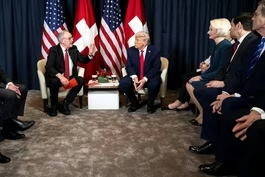
Greenland push addressed Arctic security, Heinrichs says
Video has Closed Captions
Clip: 1/21/2026 | 5m 21s | Greenland push helped Trump address Arctic security, Rebeccah Heinrichs says (5m 21s)

How the affordability crisis evolved since Trump's return
Video has Closed Captions
Clip: 1/21/2026 | 6m 48s | How the affordability crisis has evolved since Trump's return (6m 48s)

News Wrap: Much of U.S. bracing for 'expansive' winter storm
Video has Closed Captions
Clip: 1/21/2026 | 6m 20s | News Wrap: Much of U.S. bracing for 'expansive' winter storm (6m 20s)

St. Paul mayor responds to unrest triggered by ICE raids
Video has Closed Captions
Clip: 1/21/2026 | 7m 24s | St. Paul mayor responds to unrest triggered by federal immigration raids (7m 24s)
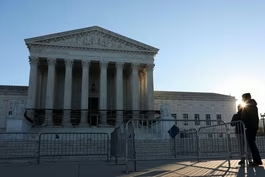
Supreme Court hears case on Trump's attempt to control Fed
Video has Closed Captions
Clip: 1/21/2026 | Supreme Court hears case on Trump's attempt to control Federal Reserve
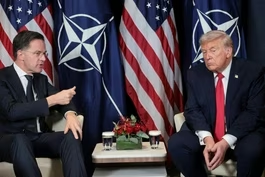
Trump backs down on threats against Greenland
Video has Closed Captions
Clip: 1/21/2026 | 4m 29s | Trump backpedals on threats against Greenland, but allies say damage has been done (4m 29s)
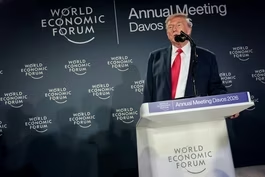
What's next for U.S., allies after Trump's Greenland demands
Video has Closed Captions
Clip: 1/21/2026 | 7m 47s | Anne Applebaum on what's next for U.S. and allies after Trump's Greenland demands (7m 47s)
Providing Support for PBS.org
Learn Moreabout PBS online sponsorship
- News and Public Affairs

FRONTLINE is investigative journalism that questions, explains and changes our world.

- News and Public Affairs

Amanpour and Company features conversations with leaders and decision makers.
Urban Consulate Presents











Support for PBS provided by:
Major corporate funding for the PBS News Hour is provided by BDO, BNSF, Consumer Cellular, American Cruise Lines, and Raymond James. Funding for the PBS NewsHour Weekend is provided by...