
January 28, 2026 - PBS News Hour full episode
1/28/2026 | 57m 46sVideo has Closed Captions
January 28, 2026 - PBS News Hour full episode
January 28, 2026 - PBS News Hour full episode
Problems playing video? | Closed Captioning Feedback
Problems playing video? | Closed Captioning Feedback
Major corporate funding for the PBS News Hour is provided by BDO, BNSF, Consumer Cellular, American Cruise Lines, and Raymond James. Funding for the PBS NewsHour Weekend is provided by...
January 28, 2026 - PBS News Hour full episode
1/28/2026 | 57m 46sVideo has Closed Captions
January 28, 2026 - PBS News Hour full episode
Problems playing video? | Closed Captioning Feedback
How to Watch PBS News Hour
PBS News Hour is available to stream on pbs.org and the free PBS App, available on iPhone, Apple TV, Android TV, Android smartphones, Amazon Fire TV, Amazon Fire Tablet, Roku, Samsung Smart TV, and Vizio.
Providing Support for PBS.org
Learn Moreabout PBS online sponsorshipAMNA NAWAZ: Good evening.
I'm Amna Nawaz.
GEOFF BENNETT: And I'm Geoff Bennett.
On the "News Hour" tonight: FBI agents raid# an.. as part of a probe into the 2020 election, which# President Trump continues to falsely claim he won.
AMNA NAWAZ: Political tensions intensify, as# a Minnesota Democrat is attacked at a town## hall and Congress faces another# potential government shutdown.
GEOFF BENNETT: And a family detention# center criticized for substandard living## conditions is put on lockdown.
We speak to# the lawyer of one family being kept there.
ERIC LEE, Immigration Attorney: This is# the reaction of the Trump administration## to individuals expressing their free speech rights## both inside these facilities# and outside these facilities.
(BREAK) GEOFF BENNETT: Welcome to the "News Ho.. The FBI executed a search warrant at# an election center in Fulton County,## Georgia, today seeking records# related to the 2020 election.
AMNA NAWAZ: Federal agents were seen entering# the office outside of Atlanta this afternoon.## Baseless claims of voter fraud in# Fulton County have been a focus of## President Trump since he lost the 2020 election.
Our White House correspondent, Liz Landers, has# been following all of this, and she joins us now.
So, Liz, the search is a remarkable# escalation of the president's unfounded## claims about the 2020 election.# What do we know about what happened?
LIZ LANDERS: The FBI confirming to us this# afternoon that they are conducting what## they say is a court-authorized law enforcement# action at that Fulton County election center.
And just moments before we got on the air,# we obtained the search warrant that they## have there in Georgia.
It was signed today by a# federal judge.
And in it, it gives us some more## information about what the FBI is seeking.# It says they're looking for physical ballots## from the 2020 election, envelopes, provisional# ballots, ballot images and voter rolls, Amna.
So I spoke earlier with David Becker, who's# an elections attorney and former Department of## Justice civil rights attorney, and he said that# the ballots in Fulton County have been counted## many times.
They have been counted three times# actually.
And one of those times was by hand.
So the idea that the FBI may find something# new here is unlikely.
But, as you mentioned,## this remains a fixture for the president.
He# continues to lie about the 2020 election results,## and in particular in Georgia.
Remember he had that# phone call with the secretary of state in 2021,## Brad Raffensperger, where he asked him# to find basically the vote margin that## would push him over the edge to# win the state of Georgia there.
Just last week, the president said in a# speech, people will soon be prosecuted## for what they did in the 2020 election.
Amna,# he talks about this on almost a daily basis.
AMNA NAWAZ: Liz, we're at the beginning# of another election year.
How does## what we saw today play into the larger# preparations for those upcoming midterms?
LIZ LANDERS: That's right.
This# comes as the Trump administration## has been requesting voter information# from states.
And the president hints## that he thinks he could use the National# Guard to, in his view, secure elections.
I spoke earlier with two secretaries# of state, Democrat Shenna Bellows of## Maine and Republican Michael Adams of# Kentucky about this raid today and how## they're preparing for elections this year amid# debates over ballot security and voter access.
Welcome to "News Hour."
Thanks# so much for joining us here.
MICHAEL ADAMS (R), Kentucky# Secretary of State: Thank you.
SHENNA BELLOWS (D), Maine Secretary# of State: It's.. LIZ LANDERS: Secretary Bellows, I want# to start with you about some.. the day that we're hearing today.
What# is your reaction to this FBI search of## the Fulton County Georgia elections# office?
This is apparently part of a## probe related to the 2020 election.# What do you make of that search?
SHENNA BELLOWS: We're still waiting for more# information, but this is deeply concerning.
The fact that the lies of 2020# have not ended and we're still## relitigating the presidential election# then, these lies are very dangerous.## And I think it's really concerning and# doesn't bode well for 2026 and 2028.
LIZ LANDERS: Secretary Adams, are you concerned# that DOJ could target other states like this?
MICHAEL ADAMS: Well, I think it's# really telling that we have had,## I think, 24 states now in litigation with the DOJ# on our voter rolls, and there's .. So I don't want to overread into this where# they might be there.
My understanding is,## this is a situation where the state election# board is adverse to the county of Fulton and## has asked the DOJ to intervene.
So that# doesn't mean that it's all fine.
I don't## know more facts than you do about it,# but I don't rush to judgment on it.
LIZ LANDERS: Secretary Bellows, last week# Attorney General Pam Bondi sent a letter## to Minnesota to the governor there on Saturday# right after that fatal shooting that we saw in## Minneapolis asking the governor to in part turn# over voter rolls to the Department of Justice.
Your state is experiencing right# now a surge in federal immigration## agents.
Has the attorney general sent# a letter like this to you?
And why do## you think the Department of Justice is# gunning so hard to get this information?
SHENNA BELLOWS: So I think it's deeply concerning.
And keep in mind, for your viewers in# Maine, ICE is surging.
They're calling it.. grotesquely, Catch of the Day, which# is just truly gross.
We're in the## bottom quartile in terms of percentage of# immigrants, refugees, and asylum seekers.
So for them to send a letter on the heels# of the killing of Alex Pretti and demand## Minnesota's voter rolls as a condition for# ICE leaving indicates that ICE's presence## in Minnesota isn't really about immigration at# all.
It's about intimidating election officials.
And we're going to continue to fight to protect# the integrity of American voter information,## because the Constitution places the# states, not the federal government,## not the president, in charge of elections.
LIZ LANDERS: Secretary Adams, I# know that you have provided the## Department of Justice some of the# public voter files right now.
How## are you complying with this and# navigating this as a Republican?
MICHAEL ADAMS: So I think there are# opposite poles here.
One poll is never,## ever cooperate with the administration.
And that's# not the right posture, I don't think, on the law.
The other is just give everything# that they ask for and not run your## traps.
We're doing something more in the# middle, which is that we have our own## data privacy laws in Kentucky.
We have our# own personal privacy laws in Kentucky.
And## any citizen of the United States can# ask for our voter rolls and many do.
And every campaign asks for them.# The state parties asked for them,## and we provide that information.# But when we're dealing with people's## personally identifying information, their driver's# license number, their Social Security number,## that's in a different field.
We don't give# those to the candidates and the parties.
Candidly, the law is not super clear on# this.
No one -- no DOJ has ever asked## for this before.
So there's no FAQ on my# Web site to tell me what to do on it.
So## it may come down to litigation.
It may# come down to us getting guidance from## the courts to see where the federal# law stops and the state law begins.
SHENNA BELLOWS: And I appreciate# what Secretary Adams is saying,## because I think this is really important.# We're an open book with regards to what we do,## our procedures, our list maintenance.
We provided# that information to the Department of Justice.
Where we draw the line is the sensitive# personal data of every American.
LIZ LANDERS: What are you both doing to reassure# both the public and the Trump administration that## the elections in your states are secure?
Because# we hear the president questioning that frequently.
SHENNA BELLOWS: We see it in# terms of voter turnout.
So,## Maine routinely ranks in the top of the nation# in voter participation.
In 2022, we were## number one.
Minnesota was number two.
In 2024,# Minnesota was number one.
We were number two.
And, in fact, election integrity was on# the ballot in Maine just this past November## with a question about voter I.D.
and absentee# voting; 63 percent of Mainers voted, basically## showing their confidence in our elections by# rejecting any changes to our election laws.
So we do believe our elections are free,# safe and secure.
We have post-election## audits.
We have frequent recounts given how# close, how purple Maine is.
And the voters## tell us that they think our elections are# free, safe and secure because they show up.
MICHAEL ADAMS: Well, at the risk of bragging, I'm# the top vote getter in my state of both parties,## so I think that's a big vote of# confidence in our election process.
But also the Trump administration# has routinely filed briefs and other## pleadings in cases that we have in federal# court, taking our side of the argument on## saying that we don't need to be supervised# by a federal court on our voter rolls,## that they're clean, that they're# up to date, they're accurate.
So I feel like we have to date satisfied both the# public in my state and also the administration.
LIZ LANDERS: Secretary Bellows,# the president recently told The## New York Times that he regretted# not ordering the National Guard## to seize voting machines in swing# states after those 2020 elections.
What would you do as the top elections official in## Maine if he made that request# after the midterms this year?
SHENNA BELLOWS: We would not give him the ballots# or -- and I think this is important, right?
The Constitution places responsibility for the# elections in the people that the people trust,## the people closest to them on the ground,# the local and state election officials.
And## in Maine, we have strict chain of# custody controls over our ballots,## when the ballots are centralized for# recounts or ranked-choice voting.
There are only two people that# have the key.
One of them is me.## And he is not getting our ballots.# He's not getting our voter rolls.
LIZ LANDERS: Is that something# you would comply with?
MICHAEL ADAMS: I would comply with any legal court# order, but I wouldn't just t.. issued to me and let that trump the law of my# own state.
I'd follow the law of my own state.
LIZ LANDERS: Both of you work closely# with local election officials in your## states.
What's the biggest operational# challenges that you're facing right now?
I will start with you, Secretary Bellows.
SHENNA BELLOWS: So we're really challenged# to recruit folks int.. retirement of the Baby Boomers and# also fears about threats because## of misinformation and lies about the election.
So it's a much more challenging environment.# So we're always working hard to recruit new## clerks, to train our folks.
And I think# that's probably the biggest challenge.
MICHAEL ADAMS: So I was elected in 2019.# And before I was even sworn in 2020,## I was called to my legislature and asked,# what's the biggest concern that I had?
And I said having enough poll workers# and enough voting locations.
And that## was before COVID.
It was before# all the stuff that we have seen,## all the crazy elections the last several# years.
And that's an ongoing issue.
To Secretary Bellows' point, our generation# is just not volunteering at the level that## our parents did and grandparents did.# But we also have locations that don't## want to be voting locations anymore.# Schools are nervous about being public## voting locations.
They're worried about# active shooters being able to scope out## buildings and look for ways in and then# come back later when the kids are there.
Churches are getting more -- either more# political or apolitical, but, either way,## they have less comfort with being a voting# location.
So it's getting harder for us to## recruit people to want to be part of# the process and locations as well.
LIZ LANDERS: You two are here in the area# for a conference right now.
Talk about the## relationship between you as secretaries of state.# What is the information-sharing like right now?
MICHAEL ADAMS: We talk every day,# not all 50 of us to each other, but## I'm in lots of calls with these folks.# We have regular calls every Thursday## at 3:00 or what have you.
But we also# have a lot of private conversations.
And one thing that's changed over# time is, when I first got here,## it was really a debating society between those# of us on the right and those of us on the left## about voter I.D.
and other little things.# And then we went through 2020 together.
And## then the misinformation stuff wasn't just# about certain states.
It was all 50 of us## dealing with the same threats on our person, the# same threats to the system, the same concerns.
We really kind of bonded over that,# because we're all fighting the same battle.
SHENNA BELLOWS: I think that's right.
And I think, on election securi.. back in 2023 and 2024, I was threatened and# doxxed and swatted.
And when I came to the## NAAS (ph) conference, my Republican colleagues# were giving me hugs and praying for me.
I do think that there is a lot of bipartisan# conversation and dialogue.
We are not going## to agree on certain policies.
But I think this# is something that the American people can have## confidence in.
It doesn't matter what state# you are in, whether it's Maine or Kentucky.
We may not agree on certain voting# rights policies, but in terms of the## integrity of election administration,# in terms of the checks and balances,## and the state and local control of the elections,# that's something that I think we all really value.
And I think it's really important today.
LIZ LANDERS: Secretary Bellows, Secretary# Adams, thank you so much for joining us.
MICHAEL ADAMS: Thank you.
SHENNA BELLOWS: Thank you.
GEOFF BENNETT: We start today'.. Homeland Security officials now say that the# two federal agents who fired shots in the## death of U.S.
citizen Alex Pretti have been# on administrative leave since it happened on## Saturday.
That contradicts a prior comment# from Border Patrol official Gregory Bovino,## who had said the agents had been transferred,## but were still working.
They have# not been publicly identified.
It follows Trump aide Stephen Miller# suggesting yesterday that the agents## may not have been following# protocol before the shooting.
Secretary of State Marco Rubio today# defended the Trump administration's## military operation to seize# then-Venezuelan President## Nicolas Maduro.
Appearing before the# Senate Foreign Relations Committee,## Rubio said President Trump had acted to take# out a major national security threat to the U.S.
During what was the first public hearing since the# January 3 raid, Rubio also pledged to work with## Venezuelan authorities to stabilize that country.# And he stressed that there was no other option.
MARCO RUBIO, U.S.
Secretary of State:# You couldn't make a deal with this guy,## right?
This guy has made multiple# deals.
He's broken every one of## them.
It's not going to be like from one# day to the next we're going to have this## thing turn around overnight.
But I think# we're making good and decent progress.
GEOFF BENNETT: Democratic Senator# Tammy Duckworth pressed Rubio over## the administration's decision to invoke# a wartime law when entering Venezuela.
SEN.
TAMMY DUCKWORTH (D-IL): And the president has# already said that he's not ruled out the military## option.
And you have also just said that, yes,# we are at war.
The president has wartime powers.
MARCO RUBIO: But every president retains# the power to use military protection.
SEN.
TAMMY DUCKWORTH: So, it's# reasonable for me to ask you... MARCO RUBIO: And I gave you a# very specific example.
Every## president retains the right to defend the# United States against an imminent threat.
GEOFF BENNETT: During his testimony, the secretary# of state also tried to ease concerns among## Democratic lawmakers about the administration's# approach to Greenland NATO, Iran, and China.
The Federal Reserve is hitting the brakes on# interest rate cuts after three cuts last year.## It comes despite relentless pressure from the# Trump administration to lower rates even more.
Speaking this afternoon, Federal Reserve Chair# Jerome Powell said the economy's outlook has## clearly improved since the Fed's last meeting# in December.
That's despite stubbornly high## inflation.
And he signaled that Fed officials# see little reason to rush further cuts.
JEROME POWELL, Federal Reserve Chairman:# The economy's growing at a solid pace.
The## unemployment rate has been broadly stable,# and inflation remains somewhat elevated.## So we will be looking to our goal variables# and letting the data light the way for us.
GEOFF BENNETT: Powell was asked about his# appearance last week at the U.S.
Supreme Court for## a hearing into the Trump administration's efforts# to remove Fed Governor Lisa Cook.
Powell called## it -- quote -- "perhaps the most important# legal case in the Fed's 113-year history."
Weather officials are warning of what# they're calling the longest duration## of cold in several decades for parts of# the Southern and Eastern U.S.
Many areas## remain covered in ice following last weekend's# storm that has now claimed at least 50 lives.
In Mississippi, crews worked to restore power# and clear trees toppled by last weekend's winter## storm.
Nearly 400,000 customers were still# without power today from Texas to Tennessee.
Further north, in places like Pennsylvania,## many people have been waiting days for# their streets to be plowed.
That's as## another significant winter storm looks set# to hit the Eastern U.S.
this coming weekend.
For the first time in history, a# woman now leads the Church of England.
WOMAN: Archbishop Sarah, we welcome you.
CONGREGATION: We welcome you.
GEOFF BENNETT: Sarah Mullally was officially# confirmed as the 106th archbishop of Canterbury## at a ceremony today at St.
Paul's Cathedral# in London.
The 63-year-old former nurse will## serve as the spiritual leader for some# 85 million Anglicans around the world,## though King Charles remains# supreme governor of the church.
Mullally takes over and mid-divisions# on issues like the role of women in the## church and its treatment of LGBTQ people.# And while her legal duties begin today,## she will start her public-facing work# after one final ceremony in March.
Football fans are fuming over news that former# New England head coach Bill Belichick is not## going to be a first-ballot Hall of Famer.
ESPN# first reported that the eight-time Super Bowl## champion fell short of the required vote# threshold in his first year of eligibility.## His longtime quarterback Tom Brady told a# sports radio program: "I don't understand it."
Three-time Super Bowl champion Patrick Mahomes# called the news insane.
And NBA legend LeBron## James called the snub disrespectful.
Belichick's# career was not without controversy.
In 2007,## he was fined $500,000 after New England# was caught filming signals from an opposing## team.
The NFL will formally announce this# year's Hall of Fame class on February 5.
Amazon is cutting about 16,000# corporate jobs and says further## layoffs are possible.
It's the second# round of cuts for the e-commerce giant## in just the past few months.
And it comes# a day after the company said it's closing## the rest of its brick-and-mortar# Amazon Go and Amazon Fresh stores.
The online retailer has been# slashing costs as it turns its## attention to A.I.
Shares of Amazon# ended slightly lower after the news.
Elsewhere on Wall Street today,# stocks mostly held steady after## that Fed decision.
The Dow Jones industrial# average added 12 points, so basically flat.## The Nasdaq managed to gain up about# 40 points.
The S&P 500 crossed the## 7000-point threshold for the first time# today, before ending virtually unchanged.
Still to come on the "News Hour": the leader of# New Jersey's largest Catholic diocese calls for## defunding ICE after the killings of U.S.
citizens;# Judy Woodruff kicks off another year of America## at a Crossroads by asking what it means to be# an American; and our science correspondent,## Miles O'Brien, on the 40th anniversary of# this space shuttle Challenger disaster.
AMNA NAWAZ: For U.S.
senators, today was# the first full day back in Washington after## the killing of Alex Pretti and ahead# of their Friday deadline to fund the## Department of Homeland Security and some# of the government's other large agencies.
They arrived as news is still unfolding on the## Pretti shooting and as another# lawmaker faced a new threat.
Our congressional correspondent, Lisa# Desjardins, joins me now for more on all of this.
So, Lisa, we have been covering the# outrage after the Pretti shooting,## the sense that something# shifted.
As you talk to senators,## are you sensing a shift in how they're# viewing the immigration crackdown?
LISA DESJARDINS: We did.
We have# been watching that carefully.
And, today, I have to tell you we heard# from Republicans a new kind of very open## sense that federal enforcement officers# went too far in a dangerous way.
Now,## some of them word this carefully, but, more,# we are seeing Republicans say this sharply.
That includes Homeland# Security Chairman Rand Paul.
SEN.
RAND PAUL (R-KY): We can't just# say, oh, nothing to see here, and he## was obviously an assassin and a domestic# terrorist.
When we say things like that,## it leads to no confidence in -- so I think there# really has to be an independent investigation.
And this is going to be an investigation# outside of DHS.
They should themselves## immediately appoint a commission.
If# they don't, I think Congress may do it.
LISA DESJARDINS: So there we# go, a commission potentially.
Now, Rand Paul is known to break with# President Trump, but I heard this kind## of idea, concern from more Republicans# who don't usually do that.
Of course,## for Democrats, it's more than just concern.
An example is this from Senator# Cory Booker of New Jersey: SEN.
CORY BOOKER (D-NJ): This agency is out of# control.
Its leadership is out of control.
Its## leadership should step down, if not be impeached.# So we are in a serious, serious crisis right now.
LISA DESJARDINS: And there# are calls to impeach Kristi## Noem.
We're going to be talking# more about that in coming days.
But I want to also point out one other group# of Republicans.
These are Republicans who say,## even as they express some concern about# ICE, that they think protesters are being## too aggressive.
One example of# that is Florida's Rick Scott.
SEN.
RICK SCOTT (R-FL): You have a# right to protest in this country,## but you don't have a right to interfere with# law enforcement.
So don't be stupid.
Don't## interfere with law enforcement.
We all are going# to have to work together to get the criminals out## of our country.
Local law enforcement should be# working to work hand in glove with ICE right now.
LISA DESJARDINS: One other standout# note, Republican Leader John Thune## told reporters he thinks this is in# fact potentially an inflection moment.
AMNA NAWAZ: So, when it comes to leaders who have# concerns about the tactics of federal agents,## especially Democrats, what are they# going to do about ICE and what does## this mean for the chance of a potential shutdown?
LISA DESJARDINS: Those are intertwined questions.
And let's start with Democrats.
Many people# have been wondering.
Senator Sc.. told reporters what Democrats want to fund DHS.# There are three things that he listed today,## first, that they would end roving# raids, enforce code of conduct,## and hold agents accountable for harming# people, and also that there would be no## more masking, that they would require# bodycams and I.D.s on all officers.
But the problem is, the DHS funding bill,# of course, already passed the House,## along with all these other funding bills.
So to# change it now would cause that partial shutdown.
The White House says, if Democrats# demand a legislative fix, there will## be a shutdown.
And that's the point we're# at right now.
One difference, though, is,## people seem to want a solution, but, honestly,# they're just far apart on how to get there.
AMNA NAWAZ: So let's leave Washington# for just a moment and talk about this## climate of political violence I know# you spend a lot of time covering.
Another attack on a member of Congress.
This time,## it was Democrat Ilhan Omar last# night.
Bring us up to speed.
LISA DESJARDINS: Viewers may know# Omar represents Minneapolis.
She## herself is a Somali immigrant.
She also is# someone who has really received the most## vitriolic rhetoric from President# Trump while he's been in office.
She was speaking at a town hall in# Minneapolis last night when a man## ran toward her.
He squirted a syringe with# an unidentified liquid.
And a reporter said## there was a vinegar smell afterward.# Police have arrested a man who the## Associated Press said supported Trump# online and also called Democrats liars.
As for Omar, she kept going at that town hall.# And she posted some defiance on social media,## writing that: "This small agitator isn't going## to intimidate me from doing my# work.
I don't let bullies win."
But President Trump was asked about this.# He told ABC that he didn't watch the video,## but he called Omar a fraud.
He gaslit her,# saying she probably had herself sprayed.
Now, we raise that because that's# a message, even if it is a joke,## that is part of this climate of intimidation.
AMNA NAWAZ: Meanwhile, we know there's# some new information about the level of## threats against lawmakers.
What# should we understand about that?
LISA DESJARDINS: Capitol Police came out with some## eye-popping statistics over the number# of threats they .. Let's take a look at this.
It came out just# yesterday, last night.
Look at this.
These are## the number of threats that Capitol Police# have investigated in the last few years.
And you see that spike?
That is last# year, 14,000-plus threats against## members of Congress investigated.
Amna,# that's more than a 50 percent increase## from the year before.
So they do# have more funding for security.
But I can tell you personally# lawmakers are feeling this,## some of them having to move their# residence, taking careful plans## with family vacations.
This is a real# climate of political violence and threat.
AMNA NAWAZ: Lisa Desjardins, thank you, as always.
LISA DESJARDINS: You're welcome.
GEOFF BENNETT:## One of the country's highest-ranking Catholic# leaders and a top ally of Pope Leo is sharply## criticizing the Trump administration's immigration# enforcement, calling ICE a lawless organization.
During an interfaith service this week,# Cardinal Joseph Tobin, the head of the## Archdiocese of Newark, urged members of the# church to pressure lawmakers to block funding## for ICE.
His remarks come after the deaths of# Alex Pretti and Renee Nicole Good, and after## the detention of Liam Conejo Ramos, a 5-year-old# boy who was taken into custody by federal agents## after arriving home from preschool and sent with# his father to a family detention center in Texas.
For more now, we're joined# by Cardinal Joseph Tobin.
Thanks for being with us.
CARDINAL JOSEPH TOBIN, Archbishop# of Newark: Good ev.. GEOFF BENNETT: Before speaking out, I imagine# you must have weighe.. specific moral and theological convictions# ultimately compelled you to speak publicly?
CARDINAL JOSEPH TOBIN: I think the principle# motivator was a concern for the common good.
In the Catholic way of thinking and# approaching social-moral questions,## it's not simply the vindication of# competing rights, but it's rather the## preservation of the common good.
And so to# look at how the actions in Minneapolis or## anywhere else affect the common good, those are# people like whom you mentioned, the refugees,## people without legal status, as well# as the citizens of the United States.
GEOFF BENNETT: And you have# called not just for prayer,## but for political action, calling for# the defunding of ICE, as we mentioned.
What concrete changes do you envision?
CARDINAL JOSEPH TOBIN: Well, I think what# we want to do is -- as much as possible,## is use as a principal motivator# the human dignity of people.
And I think what I was calling for and I# still call for and will call for is the## recognition of the dignity of human beings,# no matter what their legal status may be.
GEOFF BENNETT: How do you reconcile this call to# push back against actions you believe are unjust## with the church's teaching and the Scripture's# teaching of respect for government authority?
CARDINAL JOSEPH TOBIN: Well,# I think that we pray for## our government officials.
And as# St.
Paul says in First Timothy,## we pray that in order that we can live tranquil# and decent lives and following our values.
And so we not only pray for ourselves, but# we pray for others, because we recognize,## in human dignity, the dignity of especially people# who don't -- do not necessarily look like us.
GEOFF BENNETT: In your message, you also# invoked the rise of authoritarianism.
Do## you believe the country is headed in that# direction or that we're presently there?
And,## if so, what are the biggest moral# choices facing Americans right now?
CARDINAL JOSEPH TOBIN: Well, I# think we have to ask ourselves## about the ongoing discord within our# society and ask what the roots are.
We also have to ask ourselves, as Americans,## where do we want our country to go?
What# do we want it to be, both here within our## national borders and in the community of# nations?
These are questions that require,## I think, respectful listening to each other# and also the freedom to express our opinions.
GEOFF BENNETT: Separate from the moral# question, there is the political question.## And you could argue that President Trump won# the Electoral College, he won the popular vote,## he won every battleground state running# on tougher immigration enforcement and## that lax enforcement under the Biden# administration caused real harms.
CARDINAL JOSEPH TOBIN: Well, I'd like# to make it clear that I'm not endorsing## anybody's political program or even# that -- the values of a movement.
Rather, I think what we need to do is see what's# happening in front of us and then recall what## I think is a fundamental value for# any of us with faith, without faith.
I## really hope that the recognition of the# human dignity of others is important.
And when we see that dignity# violated sometimes in a very## egregious and even fatal manner,# then we have to say something.
GEOFF BENNETT: As a faith leader looking at this# moment in American life marked by deep turmoil,## but also by people coming together in# unexpected ways, do you see signs of hope?
CARDINAL JOSEPH TOBIN: I really# believe that, without hope,## we're truly in a miserable# state.
There has to be hope.
And part of my hope is that, when people# recognize the humanity of the other,## they change.
On the contrary, if you want to do# inhuman things to people, what you strive to do## is take away their dignity, to call them names# and not recognize them for who they really are.
GEOFF BENNETT: Cardinal Joseph Tobin, thanks again# for your time this evening.
We appreciate it.
CARDINAL JOSEPH TOBIN: My# pleasure, Geoff.
God bless you.
AMNA NAWAZ: Two Democratic members of Congress# visited the ICE family detention center in Dilley,## Texas, today, where 5-year-old# Liam Ramos is being detained,## along with many other children and families.
Congressman Joaquin Castro posted this# image of his meeting with Liam and his## father and shared this update on his condition.
REP.
JOAQUIN CASTRO (D-TX): His father# said that Liam has been very depressed## since he's been at Dilley, that he hasn't# been eating well.
I was concerned with,## you see how he appears in that photo# with his energy.
He seemed lethargic.
AMNA NAWAZ: Over the weekend, hundreds of# detainees inside the facility protested## their conditions and treatment in# this remarkable display of defiance.
Immigration attorney Eric Lee was at the# center that day, and I spoke with him earlier.
Eric Lee, welcome to the "News# Hour."
Thank you for joining us.
ERIC LEE, Immigration Attorney:# Thanks for having me.
Hi.
AMNA NAWAZ: So I want to ask you about that day# .. But I want to start with the news today,# because you shared earlier that ICE put## the entire Dilley facility on lockdown# today.
What does that mean when that kind## of a place goes on lockdown?
And what do# you know about why that went into place?
ERIC LEE: Well, it's because of the# demonstration that took place today in Dilley.
We also know that, last night, guards# burst into one of the women's dormitories,## ordered everybody out of the room, stopped# people who were in the middle of prayers,## and rummaged through everybody's# personal belongings to find any## evidence of signs or participation# in the planned protest for today.
So there's no question that this was a# significant attack on the First Amendment## rights of all of the people in this# facility.
What it's looked like today,## from what we have been hearing from many# detained families, is that people are not## allowed to leave their rooms.
They were# escorted to the lunch area for meals.
And so this is the reaction of the Trump# administration to individuals expressing## their free speech rights, both inside these# facilities and outside these facilities.
AMNA NAWAZ: So, this weekend -- I want to# get to a piece of video that you recorded,## because I understand you were at the facility# meeting with clients.
You saw firsthand## some of these images that we saw going viral,# getting a lot of media attention and headlines.
And you recorded this piece of video# on Saturday.
Just take a listen.
ERIC LEE: Can you hear that?
They're# shouting: "Let us out, let us out."
AMNA NAWAZ: Eric, tell us more about what you saw,## what you heard that day.
And what# prompted the protest in the first place?
ERIC LEE: Well, I was visiting a family that I# represent.
Their name is El Gamal.
There's six of## them.
There's a mother and her five children,# two 5-year-old twins who have spent almost## 20 percent of their lives at this facility,# a 9-year-old, a 16-year-old, an 18-year-old## who has since Saturday been separated from her# family and denied visitation rights as a result,## retribution for her decision to speak out# previously about conditions in this facility.
The protest, as I understand, was triggered by# the fact that people inside saw the size of the## general strike and the massive demonstration# that took place in Minneapolis on Friday,## and they were -- they wanted to join# this growing movement from below,## a movement of the American population# against the Trump administration's effort.
AMNA NAWAZ: You mentioned the El Gamal family# that you represent.
We should note their## father was convicted of domestic terrorism.
The# family says they knew nothing about that.
And,## as you mentioned, they have# now been detained for months.
Why are they being held?
Are they being charged## with something?
What's the# government's plan for them?
ERIC LEE: The government has detained this# family solely because of something that## somebody else did.
That offends every# basic democratic principle upon which## this country was founded 250 years ago this year.
The individual responsibility is required# for civil and other forms of incarceration## in this country.
This family, an# immigration judge has determined## that they did not know and that they could# not have known what their husband/father was## planning.
They have publicly denounced# the attack that took place in Boulder.
The Trump administration from the very beginning# has been punishing this family in a cruel and## sadistic way, 5-year-old children,# not because they did anything wrong,## but because of somebody to whom they were# related did.
And that is not how things## are supposed to work in this country.# That's how things work in police states,## where the regime punishes people# because of their associations.
And it's extremely concerning that this is being# done to this young family.
All they need is to## get out.
They have a supportive community# in Colorado ready to welcome them home.## An immigration judge denied# them bond last week because## the children and the mom lack sufficient# property and assets, among other things.
How does a 5-year-old have property?
He# made that decision about each individual## child.
That's what's happening in the American# immigration system.
That's what immigration## attorneys unfortunately see every day.
To the# American people, it's worse than you think.
AMNA NAWAZ: You shared online a photo drawn by# what I understand is the youngest child in the El## Gamal family.
You posted it online.
It shows the# family behind bars and the caption: "Let us go."
So, from your perspective, Eric, if immigration# judges are denying bond here, if this is the## system as it's working right now, what's the# recourse for a family like this or others?
ERIC LEE: I think, in the medium and long# term and actually even in the short term,## it's the development of this mass movement of## the population of this country# standing up, stepping forward.
Change and reform isn't possible within# the framework of the present political## establishment.
Press conferences by politicians# are great, but they go away after the midterms,## things stay the same.
Dilley was founded by# Obama and kept opened by Biden for three years.
What's required is this mass movement# from below which we're beginning to see## in this country.
That has to continue# to find independent expression.
And I## think that the fact that these children# are risking everything -- they could be## separated from their families.
They could be# deported in retribution for participating.
If they're standing up and speaking out, then that## is a message to the population# of the country and the world.
AMNA NAWAZ: Immigration attorney# Eric Lee joining us tonight.
Eric, thank you for your time.
We appreciate it.
ERIC LEE: Thank you.
GEOFF BENNETT: As our country observes the 250th# anniversary of the Declaration of Independence## this year, Judy Woodruff is kicking off a new# chapter in her series America at a Crossroads.
AMNA NAWAZ: This year, she will explore# what it means to be an American,## how that idea has evolved since the nation's# founding, and where we might be headed.
She begins by looking at how closely# our identity as Americans hews to the## template created by war hero and# first President George Washington.
LINDSAY CHERVINSKY, Presidential Historian:# We refer to this as our smoking gun letter,## because you can start to see him# thinking about the fact that,## because he's an American, he's# actually a second-class citizen.
JUDY WOODRUFF: Inside a temperature-controlled# vault, historian Lindsay Chervinsky is showing me## a letter written by a then 25-year-old commander# of the Virginia regiment, George Washington.
He'd been fighting alongside the British# during the French and Indian War and was## angry at the lack of royal commissions# for him and his fellow Virginia officers.
LINDSAY CHERVINSKY: When you think about what it# means to be a full-fledged citizen, we think about## economic participation, political participation,# but also can you advance on your own merits?
And he has this realization early that# he's not going to in the British system.
JUDY WOODRUFF: Nearly two decades before the# American Revolution, Washington foreshadowed## the collision with Britain that would lead# to the creation of the United States and our## identity as Americans, a question that, 250# years later, many continue to wrestle with.
EMILY CHAFFIN, Mesa, Arizona: Being an American## means being able to pursue life# liberty and happiness unimpeded.
RICHARD WATKINS, Memphis, Tennessee:# Believing in those ideals that were set up## at the founding of our nation,# that's what being an American is.
JUDY WOODRUFF: We asked our viewers about being an## American and the responsibilities# that come with that identity.
JEN THISSEN, St.
Paul, Minnesota: In# order to be a citizen, that is an active## job description.
You need to learn.
You need# to understand.
And you need to participate.
KATHLEEN SINCLAIR CANNULI, San Jose, California:# To live by who got elected, all the various## viewpoints that people have, you don't have to# embrace them, but you have to live with them.
IAIN BURNETT, Raleigh, North Carolina:# We are a nation of immigrants.
And## except for those that are fully# Native American, at some point,## in the last 15 generations,# our ancestors immigrated here.
TONYA BAXTER, Grapevine, Texas: We're the# beacon on the hill.
Everybody wants to come## here.
Everybody has opportunity, no matter who# you are.
Come, do your best, and you can succeed.
LINDSAY CHERVINSKY: There was never one answer# to the question of, what is an American?
JUDY WOODRUFF: Chervinsky is the# executive director of the George## Washington Presidential Library and the# author of two books on the founding fathers,## including "The Cabinet: George Washington# and the Creation of an American Institution."
LINDSAY CHERVINSKY: They didn't necessarily# agree amongst themselves as to what was## the ideal American, what was the# right culture, the right religion,## the right economy, who belonged in that equation.
And from the founding, of course,# most people of color were excluded,## most women were excluded, Native Americans# were seen as sort of a separate entity.
And## then over the course of American history,# this has evolved and changed.
So it should## give comfort to people that we# have never had a clear answer.
JUDY WOODRUFF: After the# Revolutionary War was over,## Washington returned here to# his estate at Mount Vernon.
LINDSAY CHERVINSKY: He had# about 8,000 acres when he died.
JUDY WOODRUFF: The nascent nation was struggling# under the weak Articles of Confederation.
And in## 1787, Washington became a delegate to the# Constitutional Convention in Philadelphia.
The view that emerged was that this country,## rather than 13 squabbling colonies,# needed a strong central government.## Why did George Washington come to# believe that was the right answer?
LINDSAY CHERVINSKY: Well, they believed that# they needed a strong central government,## but they also believed that they needed# what they called an energetic executive.## Washington and many of the other military# officers understood how inept Congress was,## because it had failed to raise money for the army.
And so they really believed in a# stronger national government.
They## were sort of early nationalists# in a true sense of the word.
JUDY WOODRUFF: Washington supported ratification# of the new Constitution that created branches## of government, Congress in Article I and# an executive or president in Article II.
LINDSAY CHERVINSKY: Everyone knew that, if this# worked, he was going to be the first president.
JUDY WOODRUFF: No dissension?
LINDSAY CHERVINSKY: No dissension.. And so when we look at Article II, it's very# short, especially compared to Article I. And## I think and I think a lot of historians# believe that a lot of the silence there is## because they just figured he would figure# it out once in office, and they trusted## him to establish precedents and norms that# would be good for the future of the nation.
JUDY WOODRUFF: As president, Washington was# committed to civilian control of the military,## the peaceful transition of power, and the# idea that everyone is held to the same laws.
But as a wealthy landowner in Virginia, Washington# also embodied the contradictions at the heart of## our founding documents, including the# idea that all men are created equal,## while codifying enslaved people as unequal,# including the more than 300 people enslaved## by George and Martha Washington at Mount Vernon# at the time of George Washington's death in 1799.
LINDSAY CHERVINSKY: They continued to sort of buy# and sell without thinking about the implications## for the people that they were buying and# selling until the revolution.
And then,## in the record, we can see a pretty distinct# shift in how Washington thinks about slavery.
First, he is interacting with free Black# communities in places like Philadelphia## and Baltimore and Boston.
He was also seeing# different types of agricultural production.## He also was interacting with ardent abolitionists,## including the Marquis De Lafayette, who was# very outspoken about his distaste for slavery.
But, lastly and I think most# importantly, by the end of the war,## some estimates suggest that about 30# percent of the Continental Army was Black.
JUDY WOODRUFF: In his will, Washington# stated that the people on his estate## that he controlled would be# free upon his wife's death.
LINDSAY CHERVINSKY: There's a lot that# he didn't do.
He didn't speak out against## slavery as president.
He did continue to# track down people who had run away.
And it## is in no way an excuse or a justification for# all of the people that he did hold in bondage.
But he knew his will was# going to be a public document,## and he knew it was going to be a major statement.
JUDY WOODRUFF: Chervinsky sees# Washington's evolution on slavery## as a reminder that the founding# fathers expected things to change.
LINDSAY CHERVINSKY: They didn't think what they# were creating was perfect.
They genuinely believed## that they were trying to create something# that was just a little bit better than## what they had had before.
They had all made# compromises to try and ensure ratification.
And they understood that there were problems they# were sweeping under the rug.
They could not figure## out how to solve the issue of slavery.# They also knew that there were problems## they couldn't possibly foresee because they# didn't have the ability to predict the future.
And I think what they hoped was, even if# the Constitution didn't survive forever,## that the republic would survive because# each generation was willing to embrace## that challenge to try and make the# nation just a little bit better.
VERONICA WILLIAMS, Paris, Tennessee:# We as Americans have found our way to## pull up our bootstraps in times of# dire need and in times of stress.
EMILY CHAFFIN: I believe the civil# rights movement was an overall success,## right.
Women's suffrage was# a success.
We can vote now.## We have basic rights.
I think that# we still have a lot of work to do.
AKSHAY SINGH, Tukwila, Washington: I# think the Congress should be expanded,## the House of Representatives should# be expanded to represent more people.
RICHARD WATKINS: We have really given up on filing# amendments to make our system more adaptable to## where the world is going, the way society is# going, particularly now in the 21st century.
ELENA SOTELO MCCRARY, San Ramon, California: I'm# still sad about the Equal Rights Amendment because## that's simple, two-paragraph language.
If that# had been adopted, it would have covered everybody.
JEN THISSEN: Thank you for your service, founding# fathers.
Great job, but now it's time to evolve.
JUDY WOODRUFF: Modern polling tells us we# are extremely divided along partisan lines,## and while feelings of pride in being# an American remain relatively high,## they have fallen significantly from# almost unanimous levels in the mid-'80s,## and those declines in the last decade have# mostly been among Democrats and independents.
LINDSAY CHERVINSKY: So this is Washington's# study.
This was his most private space when## he was here at Mount Vernon.
It was where he# did a lot of his thinking about the presidency,## where he reflected on things# like his farewell address.
JUDY WOODRUFF: In 1796, George Washington# published a farewell address that first## and foremost announced that he would# not seek a third term as president.
LINDSAY CHERVINSKY: He believed it was# essential that that first transition## happen while he was alive and happen in an# intentional way, so it would be less chaotic,## but also so that he was establishing a# precedent that presidents didn't serve for life.
JUDY WOODRUFF: The address also provided# warnings to his fellow Americans for## the future, cautioning against foreign# entanglements, regionalism, and partisanship.
LINDSAY CHERVINSKY: At this point, Washington# wasn't actually opposed to political organizing.## He was saying, don't allow political# parties to break the bonds of citizenship.
JUDY WOODRUFF: It seems so prescient today... LINDSAY CHERVINSKY: It's unbelievably prescient.
JUDY WOODRUFF: ... as we are so divided.
LINDSAY CHERVINSKY: Yes.
JUDY WOODRUFF: A.. LINDSAY CHERVINSKY: He did.
Our divisions and our partisan rancor have# been somet.. again over the course of the last 250 years.# And so he was certainly living it in the 1790s.## And I don't know that he would have been terribly# surprised that it came up again and again, but I## do think that he would hope we could find a way# to put that American identity above the others.
It was a revolutionary thing to# do to form a nation based on an## idea.
Because it has survived and maybe we# have become a little bit jaded about it... JUDY WOODRUFF: Yes.
LINDSAY CHERVINS.. JUDY WOODRUFF: This visit to Mount Vernon,# reflecting on George Washington's influence.. country to be, is just the start of our plan for# a yearlong inquiry as America observes its 250th.
We will be sitting down with more# people from across the country to## ask how they see their role as Americans,# especially at this deeply divided moment.## And we will be looking for lessons from history# to how we begin to reach that more perfect union.
For the "PBS News Hour," I'm Judy# Woodruff in Mount Vernon, Virginia.
AMNA NAWAZ: Forty years ago today, the Challenger# space shuttle exploded on live television just 73## seconds after liftoff.
All seven astronauts# aboard died, including Christa McAuliffe,## the first teacher and ordinary citizen to fly# in space, plunging the nation into mourning.
GEOFF BENNETT: I spoke with# our science correspondent,## Miles O'Brien, who has covered# the space program for decades,## about that moment and how it changed the# country for our video podcast "Settle In."
Here's some of that conversation.
Why was this particular launch -- why did it## capture the public's imagination in# a way that previous launches hadn't?
MILES O'BRIEN: It was all# about the teacher, Geoff,## Christa McAuliffe, elementary school# teacher from Concord, New Hampshire,## who had participated in a nationwide contest# to become the first teacher in space.
She was a fabulous, interesting character# and won the rights to fly on the shuttle as## the shuttle program turned toward allowing# civilians to fly in space.
And they were## leaning toward trying to show the world that# the space shuttle system was routine and could## get people to space, everyday people to# space, in a relatively inexpensive way.
1986, they had 15 flights on the manifest, way,## way beyond anything it had attempted in the# past.
It was going to launch spy satellites,## commercial satellites, scientific missions.# And they were really kind of hell-bent to## prove that this system was reliable enough# for a teacher to fly and give lessons.
And so the world was fixated on that after 24# previous flights.
The first flight, of course,## in 1981 got a lot of attention.
Then many of the# flights fell off the front page of the newspapers,## but this one really captured# hearts and minds and pointedly,## sadly, was watched by hundreds of thousands of# schoolkids in their classrooms that morning.
GEOFF BENNETT: You happened to be there that# day.
Set the scene for us.
What was it like?
MILES O'BRIEN: Well, I wasn't quite# there.
I was -- but I was close enough.
You have to remember this was a record cold snap# in Florida, a 100-year record.
I was a 26-year-old## green reporter working in local news in Tampa,# Florida.
And I had spent the entire night in a## citrus grove doing live reports with a grower who# was worried about losing his crops because of the## bitter cold.
It was down in the teens, and, in# Florida, that's something that people remember.
And after a full night of work, I went to# sleep and was awakened by the assignment## editor at my station, saying: "The shuttle has# exploded."
And I couldn't even process that.
And I went outside in my house -- at my# house in Tampa, and I looked up in this## impossibly Bluesky, and I could see the# remnants of the contrail of Challenger,## and it was like a big, giant Y in# the sky.
This is 150 miles away,## and it just kind of hung there like# a pall over the state and the city.
And so I got busy doing the local news assignment,## but it's hard to overstate how much of a shock# this was to the country.
Up until that time,## NASA, despite the fact that it had a terrible# accident in 1967, the Apollo 1 accident, where## three crew members were incinerated on a launchpad# during a test, but that was out of public view.
This was something everyone saw instantly.
It was# broadcast live on CNN.And the world watched it,## and children were connected to it.
And there was# a profound sense of loss of innocence, I think,## for NASA, which at that point really,# in the public's mind, could do no wrong.
GEOFF BENNETT: A loss of innocence for NASA.
I mean, did it feel like the nation and the world## in mourning in real time?
What# was the immediate aftermath like?
MILES O'BRIEN: Yes, it was a pall.
And Ronald Reagan was supposed to deliver his# State of the Union address tha.. for a time, he thought -- they thought they would# press on and actually give that address, but,## eventually, they canceled the State of the Union.
And, instead, he gave an Oval Office speech## that was -- it was authored by his# famous speechwriter Peggy Noonan.
RONALD REAGAN, Former President of the# United States: The crew of the space## shuttle Challenger honored us with the# mann.. We will never forget them, nor the last time# we saw them this morning, as they prepared for## their journey and waved goodbye, and slipped the# surly bonds of Earth to touch the face of God.
MILES O'BRIEN: It was a collective## tragedy that I think at that point# only rivaled the assassination of JFK.
GEOFF BENNETT: And you can find that# full conversation and all episodes of## "Settle In" from PBS News on our YouTube# page and wherever you get your podcasts.
And there's a lot more online, including a# breakdown of an ongoing trial where social## media giants are being accused# of harming minors by making their## platforms addictive.
That's at PBS.org/NewsHour.
AMNA NAWAZ: And that is the "News# Hour" for tonight.
I'm Amna Nawaz.
GEOFF BENNETT: And I'm Geoff Bennett.
For all of us here at the "News Ho..
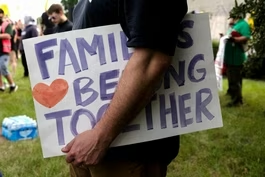
Detainees at Texas ICE facility protest living conditions
Video has Closed Captions
Clip: 1/28/2026 | 6m 46s | Detainees held at Texas ICE facility protest living conditions and treatment (6m 46s)
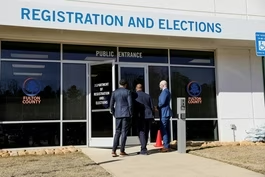
FBI raids Georgia elections office as Trump seeks voter data
Video has Closed Captions
Clip: 1/28/2026 | 11m 40s | FBI raids Georgia elections office as Trump administration seeks voter data from states (11m 40s)
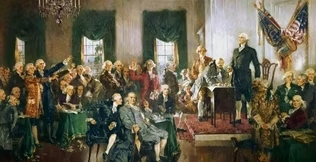
George Washington’s vision for American identity
Video has Closed Captions
Clip: 1/28/2026 | 11m 21s | George Washington’s vision for American identity tested 250 years later (11m 21s)
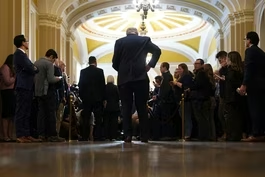
Immigration fuels tensions as Congress faces shutdown threat
Video has Closed Captions
Clip: 1/28/2026 | 5m 17s | Immigration crackdown fuels tensions as Congress faces shutdown threat (5m 17s)

Miles O’Brien joins Geoff Bennett on ‘Settle In’
Video has Closed Captions
Clip: 1/28/2026 | 5m 24s | Miles O’Brien joins Geoff Bennett to discuss the Challenger disaster on ‘Settle In’ (5m 24s)
News Wrap: DHS says agents in Alex Pretti shooting on leave
Video has Closed Captions
Clip: 1/28/2026 | 6m 2s | News Wrap: DHS says agents in Alex Pretti shooting on leave (6m 2s)
U.S. cardinal calls for the defunding of ICE
Video has Closed Captions
Clip: 1/28/2026 | 5m 52s | U.S. cardinal urges defunding of ICE: 'We need to see what's happening in front of us' (5m 52s)
Providing Support for PBS.org
Learn Moreabout PBS online sponsorship
- News and Public Affairs

FRONTLINE is investigative journalism that questions, explains and changes our world.

- News and Public Affairs

BREAKING the DEADLOCK sparks bold, civil debate on America’s toughest issues.
Urban Consulate Presents











Support for PBS provided by:
Major corporate funding for the PBS News Hour is provided by BDO, BNSF, Consumer Cellular, American Cruise Lines, and Raymond James. Funding for the PBS NewsHour Weekend is provided by...