
March 12, 2026 - PBS News Hour full episode
3/12/2026 | 57m 46sVideo has Closed Captions
March 12, 2026 - PBS News Hour full episode
March 12, 2026 - PBS News Hour full episode
Problems playing video? | Closed Captioning Feedback
Problems playing video? | Closed Captioning Feedback
Major corporate funding for the PBS News Hour is provided by BDO, BNSF, Consumer Cellular, American Cruise Lines, and Raymond James. Funding for the PBS NewsHour Weekend is provided by...
Support provided by:

March 12, 2026 - PBS News Hour full episode
3/12/2026 | 57m 46sVideo has Closed Captions
March 12, 2026 - PBS News Hour full episode
Problems playing video? | Closed Captioning Feedback
How to Watch PBS News Hour
PBS News Hour is available to stream on pbs.org and the free PBS App, available on iPhone, Apple TV, Android TV, Android smartphones, Amazon Fire TV, Amazon Fire Tablet, Roku, Samsung Smart TV, and Vizio.
Providing Support for PBS.org
Learn Moreabout PBS online sponsorshipGood evening.
I'm Jeff Bennett and I'm Amna Nas.
On the NewsHour tonight, an attack on a synagogue and a shooting at a university renew security concerns in the US.
Iran's new Supreme Leader vows to keep blocking the street of Hormuz.
We examine whether there's an off-ramp from the war that's rattling the global economy.
and Christians in Lebanon are forced from their homes, caught in the middle of the escalating conflict between Israel and Hezbollah.
There is no reason to bomb us and we're not threatening anyone.
And you know very well uh that we're an innocent people and we need to stay in our land.
Major funding for the PBS NewsHour has been provided by Qard is a proud supporter of public television.
On a voyage with Qard, the world awaits, a world of flavor, diverse destinations, and immersive experiences.
A world of leisure and British style, all with Kunard's White Star service.
Certified financial planner professionals are proud to support PBS NewsHour.
CFP professionals are committed to acting in their clients best interest.
More information at let'smakeplan.org.
And friends of the NewsHour, including Robert S. Kaplan and Wendy J. Seldon through the Raymond James Charitable Endowment Fund.
And with the ongoing support of these individuals and institutions, This program was made possible by the contributions to your PBS station from viewers like you.
Thank you.
Welcome to the NewsHour.
We're following several major stories tonight, including an attack on a synagogue in Michigan and a shooting at Old Dominion University in Virginia.
But first to the war with Iran.
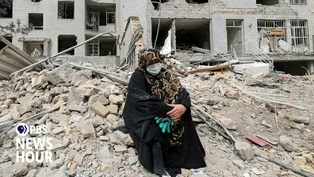
The new supreme leader of Iran, Mosha Baham, vowed in a written statement today that Iran's retaliation throughout the Gulf will continue and the widening conflict pushed oil back above $100 a barrel, rattling global markets.
We start our coverage again tonight with special correspondent Leila Milana Allen in Qatar.
After 13 days of war, Iran punctuated its strikes with a fiery statement read aloud today by a news anchor on Iranian state TV.
We will not refrain from avenging the blood of your martyrs.
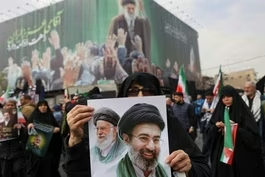
They're the first words in this war from Ayatah Moshtab installed just this week after the former Supreme Leader, his father Ali Hmon was assassinated by US-Israeli bombardment on day one.
That attack killed his wife, son, and mother as well.
Today's statement dismissed any hope of Iran backing down from its unrelenting attacks in the Gulf.
As we had given an explicit warning and without carrying out any aggression against those regional countries, we remain committed to the necessity of friendship between ourselves and those neighbors and have merely targeted those US bases.
From now on, we will also be compelled to continue this action.
and on the global oil supply.
Certainly, the leverage of blocking the straight of Hormuz must continue to be used and opening other fronts where the enemy is highly vulnerable if the war continues will be considered while observing strategic interests.
It comes as Iran has ramped up its assault on the narrow but critical straight of Hormuz.
The sea is becoming littered with damaged tankers charred and abandoned after Iranian strikes.
These were hit offshore from Iraq's Bazra port.
Iraqi officials say all oil terminals there have been completely shut down.
Other energy infrastructure too was set ablaze today, like this facility in Bahrain.
The strategic blockade has sent oil futures spiking back up to more than $100 a barrel.
That's up nearly 40% from before the war started.
The United States says it plans to release 172 million barrels from its strategic reserves after initially opposing yesterday's historic effort by the International Energy Agency to ease prices.
Meanwhile, USIsraeli strikes continue their efforts to hollow out Tean.
Caught in the crossfire, everyday residents forced to live amongst the rubble.
You can see for yourself.
Everything is damaged.
The bathroom wall has fallen apart.
the ceiling, the cabinets as well.
Thank God we are safe ourselves.
The United Nations Refugee Agency says that as many as 3.2 million Iranians have been displaced by the bombing.
Israel said a widescale wave of strikes targeted Iranian drone stockpiles and for the first time security checkpoints, while satellite images showed damage to a military complex key to Iran's nuclear development program.
And in Lebanon, the scope of Israeli attacks is getting wider by the day.
The IDF bombed this building in central Beirut twice.
It's the first such attack in the capital's busy commercial district.
Overnight, Hezbollah launched more than 200 missiles toward Israel, the largest barrage so far, and for the first time coordinated its attack with Iran, according to Israeli military officials.
Here in Qatar, the conflict continues with missile defense systems fending off Iranian drone and missiles daily, in stark contrast to President Trump's claims that Iran has been virtually destroyed.
In fact, US intelligence indicates that Iran's leadership is still largely intact and shows no signs of collapse anytime soon.
And Tehran is stepping up its repression tactics, too, with state TV programs like this one threatening any critics who dare take to the streets to demonstrate.
We'll grab you by the collar, every single one of you.
And that's already happening.
Confiscating your property is nothing will make your mothers mourn you.
Those of you now who have foolish ideas and think things are chaotic and must be done, this message is for you both inside and outside the country.
Israel's Prime Minister Benjamin Netanyahu today encouraged Iranians to ignore those threats.
You can lead someone to the water trough, but you can't force them to drink.
We will create the optimal conditions to do that, including air strikes like we did yesterday, like we are doing these days to try to give them the space they need to take to the streets.
But those are our goals.
Skyhigh tensions and even higher stakes for a region riven by war.
For the PBS NewsHour, I'm Leila Milana Allen in Doha, Qatar.
Meanwhile, rescue efforts are underway tonight for an American refueling aircraft that went down in western Iraq.
A second aircraft landed safely.
US Central Command says the incident was not due to hostile or friendly fire.
For an assessment now of where things stand with this war, we get two views.
Alan Ay served in the US government for four decades and was part of the Obama administration's negotiating team for the nuclear deal with Iran.
He's now at the Middle East institute.
and Benham Ben Taliblau is at the Foundation for the Defense of Democracies where he is the senior director of its Iran program with a welcome to you both to the program this evening.
Allan, we'll start with you when you read this statement from Iran's new supreme leader.
What stands out to you?
Well, first of all, the fact that he made it because what's most important for those running Iran now is continuity of the hardline during this time of war.
Um and again it hit all the usual spots.
The things that I found most important were the emphasis on keeping the straits closed.
This the statement that he's going to seek either reparations from the west or causing an equivalent amount of damage to western assets and then the rest was just the usual rhetoric that his late father used to use.
So again this wasn't Ayatollah issuing this.
This was Ayatollah IRGC showing that the IRGC and the betari the leadership apparatus around uh the new leader is still firmly in control and are moving forward.
Benham, do you read the statement the same way?
What does it say about the regime's mindset right now in your view?
Pleasure to be with you all.
Uh I read it similarly but not exactly the same.
The fact that first this is a press release rather than audio, rather than video, rather than actually any images or signs of life uh really from the new supreme leader is perhaps the most telling part that he's operating in the background that his lack of presence is leading to jokes in Iran that he's the new quote unquote hidden imam and that the regime would play to this myth to try to limp along and signal continuity or even feain continuity.
That I think has to be said.
But otherwise, yeah, this is the Middle East.
The trend line unfortunately is that things will go from bad to worse.
And you know, three supreme leaders into a 47year Islamic Republic.
It's interesting that neither the Islamic nor the Republican institutions are the ones that matter.
This is a coarssening national security deep state that we see in Tehran today and one that you know is best exemplified by the son of Iran's longest serving contemporary autocrat now being at the helm and uh putting out uh such a firm and aggressive statement.
Yeah.
And I want to come back to this but but Allan first looking at the battlefield so far what has actually been accomplished in this war launched by the US and Israel?
Um, lots have been accomplished.
Unfortunately, most of it is not good.
But when you look at the desperate spectrum of of US administration goals that have been put forward, one of them has been destroying Iran's ability to project power.
And we've by and large done that in terms of the nuclear program, in terms of missiles, in terms of the navy putitively, in terms of its ability to support proxies.
Unfortunately, at the same time we've destroyed their current ability to do so, we've vastly increased their future desire to do so.
So, this war is almost in a way locks us in in terms of path dependency to future policy of mowing the lawn in Iran if they do in fact try to reconstitute strategic deterrence or being faced with an Iran that's got lots of missiles and quite possibly is very close to or has a nuclear weapon.
Benham, from your perspective, how significant are the losses for Iran?
And and how fundamentally weakened is the regime's strategic position right now, if at all?
Well, a couple of interesting dichotoies here.
Weak does not necessarily mean not lethal.
And what that's what we've seen from the Islamic Republic in 2025 and 2026.
The regime is weak and has been getting weaker even really before the 12-day war last year and even really before the protest in the month of January.
This regime was becoming or auditioning to become the next failed state uh in that part of the world anyway due to central government policy.
Uh the war certainly is accentuating that.
If you want to, you know, put a fancy military label on both what Israel is doing and what America is doing in terms of military capacity right now, that's a combination of decapitation and defanging.
But there's an outsized question here right now as to can a military victory take the place of a political victory and even if President Trump or Prime Minister Netanyahu does get a military victory credibly setting back the regime's missile program, nuclear program, ability to project power abroad, how will it, if at all, take it to the next level given that of course the forcing function for the crisis is not the nuclear issue, not the missile issue, not the drone or terrorism issue, but really again back to the month of January early this in the biggest nationwide anti-regime uprising and where President Trump not once, not twice, but between eight and nine times promised help to Iranian protesters.
So, how this military win is nested into a larger political strategy is going to matter very very much for the future of US Iran policy and matter very much for the future of what comes next inside Iran, whether that's Islamic Republic 2.0 or 3.0 or potentially something else.
So, at this point, Alan, should President Trump be thinking about declaring a military victory and bringing this conflict to a close?
Or does that risk leaving the job, however the job is defined, leaving it unfinished?
Yeah.
I mean, rule number one, when you're digging a hole and you want to get out is stop digging.
The US administration should stop digging.
President Trump should declare a victory.
He could say we have uh eliminated Iran's ability to project power past its borders, which was one of the stated goals of this war.
And he can also say, and we've, you know, the rest of the job is up to the Iranian people, even though he's made it much harder, in fact, for the Iranian people to try to seize government and try to move Iran toward a better future.
But yeah, you know, what's the the physician's oath is first do no harm.
We should stop doing more harm.
We should just stop and pull out.
How do you see it, Benham?
Listen, I think there's nothing more than the Islamic Republic would want would be for the president to prematurely pull out and declare a victory at the moment.
I mean, Iran's most powerful person uh which is not at the moment uh Mosha, but I would argue Ali Larani, the secretary of the Supreme National Security Council, a deep state veteran and bureaucrat of this regime's myriad Byzantine institutions.
uh someone like him has literally just said that that he wants time to be on his side and that they're going to be forcing America to prematurely end operations.
Uh whether you were for the conflict or not, I think we are in one right now.
It's one that the Islamic Republic is intent to widen.
I think it is going to be a core interest for US policy to make sure that the regime doesn't win this war of wills and pays a price for it because the price of leaving the regime standing, the price of not actually having a larger containment and roll back policy uh if major military operations commence is going to be significant here given the stakes and again the stakes are not just nuclear and missile military but it's that we have a massive chasm between state and society inside that country and that will be the yard stick by the end of the Trump administration.
term by which success or failure will be judged.
Alan, if this regime survives this conflict, to use Benham's term, regime 2.0, does it come out more cautious or more emboldened and therefore more dangerous?
I think again all of this prediction is hard so I don't want to give a false certitude but it seems probable to me that this regime if it emerges will be more oppressive to its own people and will be more frantic in trying to reestablish strategic deterrence by rebuilding its missiles by possibly moving deliberately not necessarily racing toward a nuclear weapon.
So I think the possible consequences, the probable consequences are unfortunately destabilizing for the region.
Alan Air.
Oh, I hope I'm wrong.
Yeah, Alan Air and Benham Ben Taliblau, our thanks to you both.
Thank you.
Today, two violent attacks left communities in separate states on edge with investigators searching for answers.
In Michigan, a driver ran a truck into a synagogue and school.
The latest incident involving a temple and the Jewish community in North America.
No one but the gunman was killed, but law enforcement officials told reporters they believe he had a large amount of explosives in the vehicle.
And earlier in Virginia, a university campus was once again the scene of deadly gunfire.
FBI officials say this afternoon that the gunman wanted the attack to be similar to the Fort Hood shooting back in 2009.
Authorities say ROC students subdued and killed the shooter.
Officials say they are investigating a shooting this morning at Old Dominion University as a possible act of terrorism.
Authorities say the gunman, Muhammad Jalo, killed one person and wounded two others.
The gunman was also killed in the shooting.
It wasn't immediately clear how he died.
The school says the gunman opened fire shortly before 11:00 a.m.
Eastern at a building on the university's Northol campus.
The gunman was a former National Guard member who previously served prison time after pleading guilty to attempting to aid the terror group ISIS.
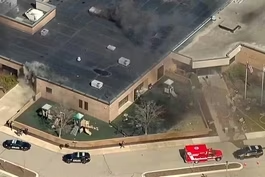
Then in Michigan this afternoon, billowing smoke and a swarm of law enforcement vehicles at a synagogue outside Detroit.
More than 200 officers responded to reports of an active shooter at Temple Israel, which is the nation's largest reform synagogue, which also houses an on-site preschool.
Authorities say the suspect drove a car into the synagogue building before security guards on site opened fire.
We can't say what killed him at this point, but security did engage the suspect with gunfire.
He breached the building, drove down the hall, and uh and he was engaged by security.
Smoke could be seen pouring out from the synagogue's roof as officers wearing respirators moved in to secure the building.
One security guard who was knocked unconscious is expected to recover.
None of the 140 children at the school or any of the teachers were hurt.
There were multiple security officers on scene and the one that was hurt was pulled from that area by his team.
The incident in Michigan comes as several synagogues across North America have been targeted in recent weeks, including in Toronto.
Officials said law enforcement in the area were prepared for the potential of violence and FBI agents had trained for an active shooter event there back in January.
Anytime there's a concern, there's communication, there's extra patrol, extra attention, extra warnings that had all happened for the weeks leading up to this.
The team inside that building was very queued up.
And I know the chief had communicated directly with their head of security weeks ago.
Local authorities say there are no ongoing threats to the community and Temple, Israel today called its security personnel heroes.
For more on today's attacks, I'm joined now by Juliet Cayam of the Homeland Security Project at Harvard's Kennedy School.
She previously served as assistant DHS secretary during the Obama administration.
Julia, thanks for joining us.
Let's begin with the university shooting in Virginia.
We have the suspect's name from officials now.
We know he was a former Army National Guardsman, as Jeff just reported, with a previous conviction in 2016 providing material support to ISIS.
What do you take away from this right now?
What questions do you still have?
Well, he he was just recently uh released.
Uh and this is someone who has who who was not purged, so to speak, of the of his in in in interest uh in ISIS and in violence.
Uh how you put that together with his target, we do not know yet.
It just may be that this was a this was a target-rich environment, a university, and he went in um uh uh to kill.
the the good news in both instances in this horrible world we live in in which good news is did they minimize uh the harm is that the quick action by ROC students apparently uh led to no additional uh casualties and that's what you know in some ways that's how you judge success is that can you just minimize the harm but right now the linkage between why this location at this time we do not know yet let's turn now to the Michigan synagogue attack.
And if you have previously noted, as we have talked about, synagogues have been on high alert for years.
You wrote a piece about this back in 2022 when you talked about how synagogues shouldn't have to be fortresses, but they do have to maximize defenses here.
It does seem like the armed guards in this case played a role in minimizing the harm.
What do you what do you see in this incident?
That that's absolutely right.
I mean it is uh as far as we know from early reporting that the car uh was a a weapon of mass destruction.
It comes into the building and that uh the the perpetrator uh the terrorist wanted to kill lots more people including likely children.
It was the quick action by uh not one but several internal security officers that that essentially minimized the harm in this instance.
is I of course am not talking about the emotional harm that is impacting uh members of that community of the Jewish community there but obviously throughout the United States.
We do not know but I think it's fair you know to to to at least raise a possibility that this is also related to Islamic terrorism just given the focus of the synagogue um at this time in uh in the United States and in in the threat environment.
Uh we've been we talked about this just a few days ago.
Uh it is an elevated threat environment for uh in particular or specifically Islamic related terrorism.
Whether that comes from someone who just got out of prison and is still interested in ISIS or something that is state sponsored either uh mostly from Iran that we don't know yet.
And I will say, you know, the environment is so high.
We we sometimes the exact motive of that particular individual, we do not know.
We know many countries in the Middle East are now impacted uh by the war.
And if it's related to uh what's happening in Iran or in the Gulf or Lebanon, we do not know um at this stage.
But um you'd have to every law enforcement person I have talked to in the last two weeks, this is the thing that they fear the most that the war um unleashes something unforgivable, unjustifiable, but nonetheless somewhat predictable and that is that is terrorism uh that is that is inspired by Islam.
And we know of course officials specifically with the Michigan synagogue attack are going to be briefing.
We'll continue to post updates online for anyone following the latest news.
But Juliet is someone who has worked in this space and studies this space.
How are investigators approaching both of these incidents if there's a common thread between both of them or not to try to get some answers and try to prevent similar attacks from happening in the future?
So right now we are there there are a variety of ways I will say they will look at at the connections between the two but just given the the the the mo of each it is hard to see whether there is a direct connection.
may just be a coincidence of timing.
What they what we can do now is two things.
One is obviously it's defense right now.
It is it is fortifying um institutions that we think might be subject to harm or focus.
That includes uh not you know that's not just the the the US stuff like embassies or consulates.
It is of course synagogues and places of worship here in the United States, places where the Jewish community may convene.
It is not good that we have to do this.
This is a threat that the Jewish community has faced uh for many many years, but it's more acute now.
The other is that in almost all of these cases, someone around the person doing it may have known.
We call it spillage and law enforcement.
They talk about it.
They show an interest in something they hadn't shown before.
They seem to be secretive.
Maybe the guns are noticed in the room.
This is where we are ve the uh law enforcement is very dependent on the community right around these people whether it's a social community, family community or religious community to step forward early and say they don't like what they're you know something is different about this individual.
Julia Cayam of Harvard's Kennedy School always good to speak with you and hear your expertise.
Thank you so much.
Thank you.
In the today's other news, the Senate voted down a measure aimed at reopening the Department of Homeland Security as a partial government shutdown looks set to enter its second month.
It was the fourth time that Democrats have blocked such legislation as they push for reforms at ICE and Customs and Border Protection or CBP.
Also today, the yays are 89, the nays are 10.
The bill, as amended, is passed.
The Senate overwhelmingly passed a major bipartisan bill to address housing affordability.
The measure would reduce regulations and put limits on corporate investors, but it faces an uncertain future in the House.
After President Trump signaled that a voting reform bill known as the SAVE Act must be the priority for Republican lawmakers, Representative James Klyurn said today that he will seek an 18th term in Congress.
I do believe that I'm very well equipped and uh healthy enough uh to move uh into uh the next term.
The 85-year-old made the announcement this morning in his home state of South Carolina.
His re-election bid comes even as younger Democrats are challenging the old guard in primaries across the country.
Klyurn has served more than 30 years in the House.
That includes a long run as the number three House Democrat alongside Nancy Pelosi and Stenny Hoyer, who are both retiring after this term.
His support was vital in helping Joe Biden secure the Democratic presidential nomination in 2020.
Well, it's a tale of two very different weather patterns this week at either end of the country.
Western states are facing record temperatures ahead.
Already, Los Angeles reached the 90s today and parts of the Southwest are nearing triple digits.
While in the east, winter weather has rushed back in after a taste of spring with cold rain and snow hitting Washington DC among other places.
Looking ahead to next week, a dramatic split screen with roughly half the nation seeing above normal temperatures and the other half below.
This comes even as the cleanup continues in Illinois after a massive tornado with winds up to 150 mph destroyed homes and businesses there.
A Russian court convicted 19 people today in connection with a deadly shooting at a Moscow concert hall in 2024.
15 were sentenced to life in prison, including the four gunmen and 11 accompllices.
The others received 19 to 22 years each.
Authorities say the gunmen were citizens of Tajikistan who opened fire at a rock concert before setting the building on fire.
All told, 149 people were killed, more than 600 injured in the country's worst such attack in two decades.
A branch of the Islamic State group claimed responsibility for the attack.
In Ethiopia, at least 50 people have died and more than 125 remain missing after landslides hit three of the country's southern districts.
A local official says that most of the victims were found buried in the mud after days of heavy rains.
Rescue efforts are continuing and residents have been advised to move to higher ground as the rain continues.
Mudslides and floods are common in Ethiopia during the rainy season.
In 2024, heavy rains killed nearly 230 people.
On Wall Street today, stocks sank after the latest spike in oil prices with no end to the Iran war in sight.
The Dow Jones Industrial Average dropped more than 700 points or about 1 and a.5%.
The Nasdaq gave back more than 400 points.
The S&P 500 also fell sharply on the day.
Still to come on the NewsHour, Congress faces a raft of ethics concerns among its own ranks.
This is the PBS NewsHour from the David M. Rubenstein studio at Weta in Washington, headquarters of PBS News.
The Israel Defense Forces issued their first evacuation order for downtown Beirut today ahead of air strikes along with a sweeping new evacuation order across southern Lebanon.
About 10% of Lebanese territory is now under Israeli evacuation notices.
This latest war has killed nearly 700 Lebanese and displaced some 800,000, including many Christians.
Special correspondent Simona Fine reports from Beirut.
In Beirut, a Christian community from Lebanon south mourns one of their own.
That's him.
He was a beautiful soul.
Sami Rafari was killed in an Israeli strike on Sunday in his village of Al-Mashab.
He had recently celebrated his 70th birthday.
Maria is his niece.
He was watering his plants.
That's it.
He was watering his plants and he was murdered.
We can't find an explanation for why would could this happen.
Just an innocent man who wanted to stay in his land where he grew up.
The mayor of Al-Mashab, Shahi Se says there were no Hezbollah fighters in the village.
We thought that there's no reason to bomb us and we're not threatening anyone.
and you know very well uh that we are an innocent people and we need to stay in our land.
That's it.
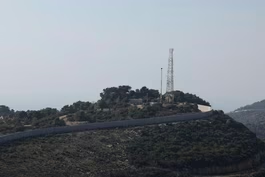
Al-Mashab is a Christian majority village 70 mi south of Beirut close to Lebanon's border with Israel.
It was one of the first to be drawn into the conflict in October 2023.
Back then, Hezbollah, a Shia paramilitary group, did use its surroundings to fire rockets into northern Israel beginning the day after the Hamas attacks on southern Israel.
The NewsHour visited Al-Mashab last summer after a ceasefire went into effect.
The villagers had raised funds to renovate the church.
The bakery had reopened.
Despite regular Israeli ceasefire violations, villagers like Sammy hoped they could rebuild, that life could return to what it once was.
But after Hezbollah re-entered the war last week, Israel dramatically escalated its attacks on Lebanon.
On March 4th, Israel warned dozens of villages in southern Lebanon, including Al-Mashab to leave.
Rights groups say these evacuation orders constitute force displacement and are illegal under international law.
At first, the residents refused to comply.
They gathered in the basement of the church seeking protection.
The mayor encouraged them to stay.
Why would we leave our land and our people?
It's our right to protect our homes.
Of course, we believe that maybe in 23 24 they had the excuse to bomb because Hezbollah was there or whatever.
But now in that moment uh 1 year 4 month there is no one.
Despite that the IDF began striking the village.
First they hit a police vehicle.
We thought it was a message not to move around.
saw on uh Sunday they killed Sammy.
I was next to him like 30 m away.
I saw him.
They directed him directly.
No one felt safe after that.
The Lebanese army had already withdrawn, leaving the 83 remaining residents with no protection.
Shotti had no choice.
This is him organizing an evacuation convoy escorted by UN peacekeepers.
Maybe two wants to stay.
I go pack them, kiss their hands.
Please leave.
Please leave.
An old woman.
I I told her, "Please leave."
She She told me where to leave.
I don't have money.
There's no place to go.
So, because if you stay your dad, definitely your dad.
And so, the people of Al-Mashab left at the funeral wake.
They mourn not just Sami, but also their village.
Everybody is depressed.
Everybody is sad.
Everybody feels like we're never going back again.
I mean, uh, I lost my home as well where I grew up for 18 years and I lived there.
The story of Al-Mashab illustrates how Christians are being drawn into a conflict that is not their own.
In another border village, a priest was killed on Monday in a double tap Israeli attack.
Father Pierre Alahi had also refused to leave.
The war has deepened sectarian tensions between Christians and Shia Muslims with some worried it could lead to internal strife reminiscent of the Lebanese civil war.
In Beirut, flags of the Lebanese forces, a Christian party have been put up to demarcate Christian areas.
The party is a staunch opponent of Hezbollah.
Well, Hezbollah decided single-handedly to reenter the war triggered by the events in Iran, of course.
So, this is a suicide action uh by Hezbollah, taking the whole country, the whole of Lebanon uh into a regional conflict uh into the unknown.
Rasan Hbani blames Hisbah for bringing Christian villages under Israeli fire.
In some occasions, Hezbollah has been able to infiltrate some of those villages, endangering the people who decided to remain in the villages and not to be part of that conflict.
This has made some Christian towns reluctant to accept Shia Muslims fleeing war.
More than 800,000 people, that's 13% of Lebanon's population, have been displaced.
In Razir, a small town just north of Beirut, only a few dozen families have been assigned to the local school.
None of them wanted to show their faces on camera.
When the shelling started, the children were crying.
We were forced to leave.
We couldn't find a place to stay.
This place was available through the Lebanese Army.
They provide all the services.
Everyone here has a family member in the army.
The schools turn shelters in Christian areas are tightly controlled and that is to keep tensions at bay and to manage fears that they could become targets for Israeli air strikes.
Now the officials at this school were reluctant to speak on camera but they told us that the only families sheltering here at the moment are those affiliated with state institutions like the Lebanese army and the civil defense.
The locals in Kazir have mixed feelings about taking in the displaced.
On the one hand, they have empathy towards innocent civilians.
They are invited.
We are like each other.
It's not their fault.
What happened is not their fault.
But they're also worried that they could bring the war with them.
It's better for us if we don't take them.
We need to protect ourselves.
If Israel wants to kill someone, if they want an Iranian or Hezbollah, they will hit us like any other area.
Despite the divisions, there are also calls for unity.
The solution is for people to wake up to just understand that we're all one, that we're all humans who live in this on this planet.
As Israeli troops launch a fresh ground incursion into the south, all of its inhabitants, Christian or Muslim, stand to lose.
For the PBS NewsHour, I'm Simona Fine in Lebanon.
The NewsHour requested comment from the Israel Defense Forces on some of the attacks Simona just reported.
They did not respond.
Tomorrow evening, we'll have a report from northern Israel looking at the war's effects there.
Congress is charged with writing the laws that govern the rest of us.
But who holds lawmakers accountable when they break the rules?
Tonight, we take a closer look at a number of sitting members of Congress facing active ethics investigations and the largely invisible and many argue ineffectual system that's designed to police them.
Congressional correspondent Lisa Dejardan has that story.
Let's start with Texas Congressman Tony Gonzalez.
Of late, his seat at the capital is mostly empty.
This after news broke of text messages showing he had a sexual relationship and seemed to pressure a married younger staff member.
Regina Santos Ales died by suicide last fall.
Gonzalez adamantly denied the affair until last week, the day after the Republican primary.
I made a mistake and I had a lapse in judgment and there was a lack of faith.
Um, and I take full responsibility for those actions.
The affair is a clear violation of House rules.
House Republicans have just a one vote majority right now.
And while a handful of them called on Gonzalez to resign, GOP leaders pushed Gonzalez to end his reelection campaign, but to stay in the job right now.
Tony Gonzalez broke House rules.
Why not ask for him to resign?
We put out a statement today.
We'll let it speak for itself.
The independent body that looks into House misconduct reportedly launched an investigation months ago.
Its report first goes to the House Ethics Committee made of House members, which now is investigating, too.
All of that happens behind closed doors and often takes months or more.
The Gonzalez case is not isolated.
Multiple sitting members are under scrutiny.
Florida Republican Cory Mills faces that on several fronts.
an investigation into whether he solicited gifts and took government contracts while in office, a restraining order related to threats his ex-girlfriend alleges, and a police investigation into a reported assault of another woman.
Mills denies wrongdoing and charges were not brought in any of these cases.
But the ethics process started in the fall, is still unresolved.
Democratic Congresswoman Sheila Shurilis McCormack, also of Florida, was indicted on federal criminal charges that she funneled millions in COVID relief funds to her campaign.
She pleaded not guilty and is scheduled for a rare public trial before the House Ethics Committee later this month.
We're in a situation where we need more ethics enforcement and we need more accountability when uh violations are found.
Kendrick Payne worked for the House Ethics Committee and now leads the ethics program at the campaign legal center.
He fears ethics issues in Congress have become normalized and shrugged off.
Dynamics he sees enforced by President Trump.
The tone that's set at the top with the White House and the entire administration is that ethics is not a priority.
But now some House members are taking things into their own hands.
Congresswoman Nancy Mace of South Carolina is leading a charge to reveal the names of members of Congress who settled past sexual misconduct accusations and used taxpayer funds to do it.
Her bill to do that was blocked on the House floor.
But minutes later, she and others deployed an unusual workaround.
This would be a subpoena for information on the sexual harassment slush fund, pushing the House Oversight Committee to subpoena that information.
I will get information on the slush fund, how it was paid out, and by for which members of Congress.
Mace is both accuser and accused, currently facing an ethics investigation over whether she overbuild Congress for her housing allowance.
Now, what she wants to reveal could be a landmark event.
Mace plans to release all the lawmaker names from sexual misconduct settlements from before 2019 when a new system went into place.
All helped shepherd the new law.
She herself experienced harassment from a US senator as a young staffer.
While Call respects Mace as a survivor of sexual assault, she worries Mace's method could do unintended harm.
For people who were coming forward with information before 2019, they were told certain information about how their information would be handled.
It can really undermine trust in employees coming forward if they feel like, you know, might not be true or could be changed in, you know, six or eight years from now.
Speaking with lawmakers, we found there is concern that whatever is revealed from the past that the system now is still not working.
I've learned from some staff that even when they report, their case goes up in the air somewhere and nothing really happens.
The House Ethics Committee did not give an on-record response to this story, but consider this.
The House process, however flawed, is far more accountable than the Senate's.
Right now, if you look at just the data, you would think that all the problems are happening in one chamber in the House, but really, we don't know what we don't know in the Senate because there's nobody there to actually investigate misconduct.
The Senate does not have an independent ethics process.
The ethics committee made of senators has a staff, but its findings only become public when senators choose to release them.
The committee received 181 complaints last year.
We don't know who those are about, but it has only acknowledged four investigations into specific members over the last decade.
For the Committee on Ethics to truly investigate something, it has to be egregious and on the headlines of almost every paper and then they will take action.
And there are more issues beyond blatant law or rulebreaking.
Case in point, Democratic Congressman Chewy Garcia, who announced his retirement after the deadline to run for the office and after his chief of staff filed her paperwork, making her essentially the only viable Democratic candidate.
Garcia said he made his decision late because of family concerns and followed the rules.
But the House did vote to rebuke him, and while rare, that has nothing but symbolic effect.
I'm grateful to God for allowing me to serve.
And just last week, Republican Senator Steve Danes of Montana did essentially the same thing, announcing retirement with no time for other candidates except his preferred successor to file.
He said the state would avoid an ugly primary.
I'd rather take the arrows in other people if I'm happy to do it here for the sake of my state and country.
When lawmakers don't look at their office as something that belongs to the public and to the voters, then they can go into this area where they're just looking out for themselves or for their friends.
There is no effort currently to rebuke Danes.
Reformers say blueprints for a better system already exist.
More transparency, independent investigators, real subpoena power, and equal accountability in both chambers of the capital.
But only Congress can decide whether to implement any of that.
For the PBS NewsHour, I'm Lisa Dejardan.
We'll be back shortly with a look at the artistry behind Neon Signs.
But first, take a moment to hear from your local PBS station.
It's a chance to offer your support which helps to keep programs like this one on the air.
For those of you staying with us, as artificial intelligence improves, it's harder to distinguish from human work.
And it's shaking academia to its core with some very big questions.
Special correspondent Fred de Sam Lazero has this encore story from our series rethinking college.
And the principle of humanity says, "Treat all people as ends in themselves, never merely as means."
About two years ago, Megan Fritz, a philosophy professor at the University of Arkansas at Little Rock, began spotting something unusual about her students writing.
you suddenly get an essay or a test answer, some kind of assignment from a student whose normal writing you're familiar with and you get something back that sort of sounds like an official business document or a piece of technical writing.
Writing that sounds very highly polished uh but but very impersonal uh you know impersonal because it likely wasn't written by a person.
This was the beginning of a turning point for higher ed as generative AI had swept through not only her campus but college campuses across the country.
A survey last year found that 86% of college students are now using AI tools like chat GPT, Claude AI and Google Gemini for school work.
If I'm reading the writings of chat GPT uh and instead of my students, I have lost the very best tool that I have to see if I am being effective in my capacity as an instructor or not.
We really need a framework in which people can use these things and innovate while minimizing the risk.
University policy makers have scrambled to stay ahead.
I think the realization over the past year and a half is the technology is outpacing our ability to detect it.
Vice Provost of Research Brian Barry leads one of U.A.
Little Rock's committees tasked with creating clear campuswide policies on AI.
I think it really comes down to us helping students understand what's at risk, helping them understand that if they use AI in the right way, it's literally the most powerful tool that they've ever been able to use.
and it will make huge differences, but if they use it in the wrong way, it could shortcircuit their learning process.
The university is finalizing a policy that lets professors determine what AI use is acceptable in their classrooms as long as they clearly outline it in their syllabus.
But for Fritz, who has a strict no AI policy, identifying it has been complicated and timeconuming.
So Frasley is one of the softwares that I use.
If I suspect AI use, then the first thing I do is I do use detection softwares.
I actually use eight different detection softwares.
If her suspicion is confirmed, she does meet with the student and if they can talk uh about the thing that they wrote about, then great.
But a lot of times they can't.
Sounds like it's tedious and a lot more work for professors like yourself.
It certainly cuts into my life quite a bit.
It at least has sometimes made teaching feel like policing.
And these detection methods are not foolproof.
Students online say that they're caught in the middle.
I've been falsely accused by my university of using AI to write a paper.
My final paper got detected as 60% AI.
We might be about to find out if I'm going to falsely get kicked out of college for Ashley Dunn was a senior at Louisiana State University when she was accused of using AI to write a short essay for a British literature class after a detection tool flagged her writing last year.
And I was like, am I going to fail this class?
Am I going to get a zero?
Every college takes plagiarism and that kind of thing very seriously.
So I was just freaking out.
After communicating with her professor, Dunn says she was eventually given an A for the assignment, but the response to her on TikTok proves that this is a widespread issue.
A lot of people ended up making responses to my video, pretty much saying that they had gone through the same thing, but that they didn't really get as lucky and they ended up either getting zeros or failing the class.
you're going to be asked to go out and venture into Gen AI.
Not all schools are anti-AI.
Some are actually looking for ways to embrace it.
Lorie Kendall teaches an entrepreneurship class in the Fiser College of Business at the Ohio State University.
When Gen AI came out, I and every other instructor did, "Oh, great.
Now what?
Do we allow AI?
Do we not allow AI?"
And the reality is, you know what, they're going to use it anyway.
She now encourages her students to use AI to critically examine their original work and as a learning aid.
If you don't use AI or the next technology that comes along to be more effective, you're not going to be competitive in the job market.
The job market's changing right underneath your feet.
As the chief academic officer, I get to decide on academic integrity issues, honor code, and violations.
Ravi Bellancond is executive vice president and provost at Ohio State University.
He says he was struck by one alleged violation last year.
A student accused of using AI.
It was a case of cheating, he says, but it made him think.
What if there existed technology that indeed lets our students produce work of very high quality?
Shouldn't we investigate this a little further?
Balam Kundas spearheaded Ohio State's new AI fluency initiative which requires all undergraduate students across academic disciplines learn and use AI tools.
The trick is to figure out like any human interaction with technology, what can we offload to technology and what do we need to add the value to?
Ohio State wants to be at the front of that creation of those rules.
But inevitably, these tools also bring major disruption to academia and to the jobs students hope to someday fill.
How do we go through a transformative moment like this with the disruptions that it is going to cause and yet do this in a way that ultimately is additive to us as a society that it improves our lot as human beings.
A question without a clear answer, he says, but one that students should help tackle.
For the PBS NewsHour, I'm Fred D. Sam Lazero in Columbus, Ohio.
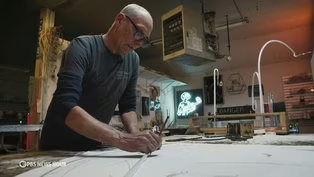
Neon signs aren't as ubiquitous as they once were, but the artistry has been receiving renewed appreciation.
One creator, Will Kirkman of Boise, Idaho, was well known for his ability to make both make and repair the intricate and fragile glass lights.
Kirkman died of cancer late last year, but Marsha Franklin of Idaho Public Television got the chance to see him at work before his passing.
She brings us this story for our arts and culture series, Canvas.
I am nearly the last neon glass bender in the state.
I'm working on a neon butterfly.
It will be blue, purple, and gold.
It's about 18 by 20 in.
And it's just kind of a fun little project.
I love the aha moment.
Um, when I think of something that I want to make, that's fun.
I really enjoy making that idea reality.
I use mainly two kinds of gases, neon and argon.
Neon is an orangish color, argon is blue.
And then the rare earth coatings on the inside of the tube will determine the actual color.
It's it's sort of a dance, if you would, between the fires and the pattern and the table.
The world sort of disappears and all I see is the glass and the fires.
You kind of go into this flow state, I think, is what they call it.
It's a great feeling.
When I first started, illuminated signs were all neon and now now it's LEDs and they don't have that oh that warm glow that reaches out to you and sucks you in.
I'm not dissing LEDs.
They have their place, but neon is my heart.
We're going to be putting 22,000 volts through this thing.
You have to heat the tube up hot enough that any sort of impur in the glass vaporizes.
We want to get it up to about 600° F, 300° C. And then this blue knob here is the argon, which I will put into the tube.
You know, you look at each piece and it frankly does not look like anything, but it it will when it's finished.
Why not?
Looks good.
Looks real good.
You take some static piece of glass tubing and when it's finished and lit, it literally comes alive.
And that's the NewsHour for tonight.
I'm Jeff Bennett and I'm Amna Nas.
On behalf of the entire NewsHour team, thank you for joining us.
Major funding for the PBS NewsHour has been provided by Carnegi Corporation of New York.
Working to reduce political polarization through philanthropic support for education, democracy, and peace.
More information at carnegi.org.
Certified financial planner professionals are proud to support PBS NewsHour.
CFP professionals are committed to acting in their clients best interest.
More information at let'smakeupplan.org.
And with the ongoing support of these individuals and institutions and friends of the NewsHour including Leonard and Norma Chlorine and the Judy and Peter Bloom Coobler Foundation and with the ongoing support of these institutions and friends of the NewsHour.
This program was made possible by the contributions to your PBS station from viewers like you.
Thank you.
You're watching PBS.
 New
NewIran’s leader vows retaliation on Gulf and oil supply
Video has Closed Captions
Clip: 3/12/2026 | 5m 14s | Iran’s new supreme leader vows continued retaliation across Gulf and oil routes (5m 14s)
 New
NewLebanese Christian villages caught in Israel-Hezbollah war
Video has Closed Captions
Clip: 3/12/2026 | 7m 42s | Lebanese Christian villages caught in Israel-Hezbollah war (7m 42s)
 New
NewMideast experts on Iran war achievements and how it may end
Video has Closed Captions
Clip: 3/12/2026 | 8m 41s | Middle East analysts on what the Iran war has accomplished and how it might end (8m 41s)
 New
NewNews Wrap: Senate votes down measure to reopen DHS
Video has Closed Captions
Clip: 3/12/2026 | 4m 2s | News Wrap: Senate votes down measure to reopen Department of Homeland Security (4m 2s)
 New
NewRemembering neon artist and glass-bending master Wil Kirkman
Video has Closed Captions
Clip: 3/12/2026 | 2m 52s | Remembering neon artist and glass-bending master Wil Kirkman (2m 52s)
 New
NewSynagogue attack, Virginia shooting renew security concerns
Video has Closed Captions
Clip: 3/12/2026 | 8m 48s | Synagogue attack and Old Dominion shooting renew security concerns in U.S. (8m 48s)
 New
NewWho holds Congress accountable? A look at the invisible ethics system for lawmakers
Video has Closed Captions
Clip: 3/12/2026 | 7m 12s | A look at the invisible ethics system for Congress (7m 12s)
Providing Support for PBS.org
Learn Moreabout PBS online sponsorship
- News and Public Affairs

FRONTLINE is investigative journalism that questions, explains and changes our world.

- News and Public Affairs

Amanpour and Company features conversations with leaders and decision makers.
Urban Consulate Presents











Support for PBS provided by:
Major corporate funding for the PBS News Hour is provided by BDO, BNSF, Consumer Cellular, American Cruise Lines, and Raymond James. Funding for the PBS NewsHour Weekend is provided by...