
March 23, 2026 - PBS News Hour full episode
3/23/2026 | 57m 46sVideo has Closed Captions
March 23, 2026 - PBS News Hour full episode
March 23, 2026 - PBS News Hour full episode
Problems playing video? | Closed Captioning Feedback
Problems playing video? | Closed Captioning Feedback
Major corporate funding for the PBS News Hour is provided by BDO, BNSF, Consumer Cellular, American Cruise Lines, and Raymond James. Funding for the PBS NewsHour Weekend is provided by...
Support provided by:

March 23, 2026 - PBS News Hour full episode
3/23/2026 | 57m 46sVideo has Closed Captions
March 23, 2026 - PBS News Hour full episode
Problems playing video? | Closed Captioning Feedback
How to Watch PBS News Hour
PBS News Hour is available to stream on pbs.org and the free PBS App, available on iPhone, Apple TV, Android TV, Android smartphones, Amazon Fire TV, Amazon Fire Tablet, Roku, Samsung Smart TV, and Vizio.
Providing Support for PBS.org
Learn Moreabout PBS online sponsorshipGEOFF BENNETT: Good evening.
I'm Geoff Bennett.
Amna Nawaz is away.
On the "News Hour" tonight: President Trump teases a potential way to end the war with Iran, but Iran pushes back.
We report from on the ground in the third nation key to any peace deal, Israel.
A fatal plane collision at LaGuardia and ICE agents try to assist understaffed TSA.
The widespread problems plaguing airline travel today.
JOHN SANDWEG, Former Acting ICE Director: This idea of using ICE agents at the TSA checkpoints is something that has never happened in the history of the agency.
GEOFF BENNETT: And when is it too late for mail-in ballots to be counted?
The U.S.
Supreme Court takes up a case likely to affect the midterm elections.
(BREAK) GEOFF BENNETT: Welcome to the "News Hour."
we are following two major ongoing stories tonight.
The troubles facing air travel continue to be compounded first by the congressional funding fight and now by a fatal collision at a New York City airport.
But we start with the latest in the war with Iran.
President Trump today hinted the conflict could be over soon, something met with immediate pushback from Iran.
That's as the U.S.
and Israel continue their strikes and Iran retaliates.
Our Nick Schifrin reports tonight from Israel.
NICK SCHIFRIN: Today, following Israeli strikes on Tehran and U.S.
threats to target Iran's energy facilities, President Trump signaled an off-rack.
DONALD TRUMP, President of the United States: We have points, major points of agreement, I would say almost all points of agreement.
NICK SCHIFRIN: President Trump said that top envoy Steve Witkoff and his son-in-law, Jared Kushner, had spoken to an official that he hoped would prove a possible Iranian Delcy Rodriguez, the Venezuelan leader largely following U.S.
direction.
DONALD TRUMP: We are doing so well in Venezuela with oil and with the relationship between the president-elect.
And maybe we find somebody like that in Iran.
And if it goes well, we're going to end up with settling this.
Otherwise, we will just keep bombing our little hearts out.
NICK SCHIFRIN: But Tehran denied any diplomacy.
Powerful speaker of Parliament Mohammad Bagher Ghalibaf posted on X: "Iranian people demand complete and remorseful punishment of the aggressors, and no negotiations have been held with the U.S.
And fake news is used to manipulate the financial and oil markets and escape the quagmire in which the U.S.
and Israel are trapped."
The president's signaling rallied the market and drove down the price of Brent crude by nearly 20 percent.
FATIH BIROL, Executive Director, International Energy Agency: No country will be immune to the effects of this crisis.
NICK SCHIFRIN: Before the president's announcement, International Energy Agency Executive Director Fatih Birol laid out the toll paid by the energy market, 40 oil institutions severely damaged across nine countries, including long-term physical damage predicted to reduce natural gas exports for years.
FATIH BIROL: The global economy is facing a major, major threat.
I thought I should say a few things, because I thought the depth of the problem was not well appreciated by the decision makers around the world.
NICK SCHIFRIN: Today, the U.S.
military continued its campaign targeting Iranian drones and missiles.
And the military accused Iran of hiding launchers among civilians, leading the military's top Middle East commander to urge civilians to stay home for now.
ADM.
BRAD COOPER, Central Command Commander: There will be a clear signal at some point, as the president has indicated, for you to be able to come out.
NICK SCHIFRIN: In his first interview of the war, Admiral Brad Cooper also told the anti-regime channel Iran International that Israel is helping defend Arab countries from Iranian attacks.
ADM.
BRAD COOPER: We continue to stand shoulder to shoulder in what has been established as the largest umbrella of air defense in the Middle East history.
Israel is attacking drones and ballistic missiles that are aimed at Arab countries and attacking and defeating them.
NICK SCHIFRIN: But Israel itself has faced more than 400 missile attacks, including ones this weekend it could not prevent.
On Saturday night, an Iranian ballistic missile struck the city of Dimona, home to Israel's nuclear facility, as well as an apartment building in the nearby city of Arad, with both strikes injuring more than 100.
By day, the missile's blast radius revealed, entire families' daily lives crushed in what used to be a home, and this community still in shock.
Israel says it has blocked more than 90 percent of Iran's ballistic missiles, and that Iran has fired fewer weapons in the last three weeks than it did during 12 days of war last summer.
But the residents of this part of Israel did not think they would be targeted.
The people who lived here believed that they were safe, and so this damage here with a high number of casualties pierces Israelis' sense of their own security.
Olga Naumov is a Russian immigrant who's lived here for 26 years.
OLGA NAUMOV, Arad, Israel, Resident (through translator): It's a bomb, a really loud boom sound, and we were all scared.
Some people started crying.
Some people started yelling.
It was really loud.
Everything fell from the ceiling.
NICK SCHIFRIN: Does this make you feel less safe?
Does this make you think that anywhere in Israel isn't safe right now?
OLGA NAUMOV (through translator): There isn't a single place in this country that we can say is OK and safe.
There's nowhere to run.
People have to think.
first and keep themselves safe.
NICK SCHIFRIN: This city has long been home to Russian emigres.
Now it's also filled with the ultraorthodox, many of whom have historically ignored bomb shelters, believing God would protect them.
COL.
NADAV SHOSHANI, IDF International Spokesperson: We want to learn, we want to be perfect, but no aerial defense system in the world is perfect.
NICK SCHIFRIN: Colonel Nadav Shoshani is the military's international spokesperson.
He acknowledged the military's failure to shoot down this missile, but blamed Iran.
COL.
NADAV SHOSHANI: In the direct proximity of this area, there's no military installations.
And throughout this war, we have seen Iran, both in intelligence and in actions, we have seen them strike civilian areas.
NICK SCHIFRIN: Including this street in downtown Tel Aviv, where Iran used an increasingly common weapon.
The majority of missiles that Iran is now firing at Israel have cluster munitions.
That's when a missile actually releases tiny bombs that fly across five to 10 miles and are designed to penetrate through a roof before exploding.
And that's what happened here.
A bomb exploded inside that apartment.
Luckily, no one was home, no casualties here, but it shows the ongoing risk to Israeli civilians.
Last week, a cluster munition pierced this roof south of Tel Aviv to explode inside.
It was a school whose students, like all students here, are studying from home.
And so Tel Aviv and Israel are shaken today, even as they also clean up and try to remain resilient.
GEOFF BENNETT: And Nick joins us now from Tel Aviv.
Nick, how is Israel reacting to President Trump's statement today that the U.S.
and Iran are close to a deal?
NICK SCHIFRIN: They were surprised, according to an Israeli official and a regional official I spoke to.
They were surprised by this announcement, taken aback a little bit by the fact that suddenly President Trump was moving so rapidly toward diplomacy.
And you can see a little bit of that in the tone of a statement released by Prime Minister Benjamin Netanyahu, which reads in part: "Trump believes there is an opportunity to leverage the tremendous achievements we have reached alongside the U.S.
military, to realize the goals of the war through an agreement, an agreement that will safeguard our vital interests."
But it goes on to say: "Just a few days ago, we eliminated two more nuclear scientists and we are still active."
And that reflects a little bit, Geoff, what I'm hearing from Israeli officials that, on the one hand, they have been trying to prepare this country to be at war through the Passover holiday.
That means through the next two weeks, a holiday that usually Israelis spend traveling with other family.
Possibly, they won't be able to do that.
That was the preparation.
But at the same time, the army was preparing not to be able to continue this operation.
They were trying to speed up their targeting, knowing that President Trump could declare some kind of victory quickly.
So that's been happening in Israel, but, definitely, this announcement catching Israel by surprise.
GEOFF BENNETT: And what more have you learned about these negotiations, Nick?
NICK SCHIFRIN: Three diplomatic officials tonight tell my colleague Liz Landers and I that Pakistan has emerged as the possible intermediary, in fact sees itself as responsible to be that intermediary between its relationship with the president and with Iran.
But as one diplomatic official puts it to me, the U.S.
does not need, or at least the Trump administration does not feel it needs any kind of intermediary.
This would be a venue, presumably, that Pakistan or another country would offer to the United States.
And so Pakistan playing a part, other diplomats telling us that Egypt and Turkey are trying to play a part.
And, again, the president, as you heard earlier today trying to find the equivalent of a Delcy Rodriguez, trying to find a leader inside Iran already who he can make a deal with, Geoff.
GEOFF BENNETT: Nick Schifrin reporting tonight from Tel Aviv.
Nick, our thanks to you.
NICK SCHIFRIN: Thank you.
GEOFF BENNETT: Shifting now to the day's other major story, federal investigators are trying to figure out what led to a collision between a commercial airliner and a fire truck on the runway at a New York airport last night.
The two pilots of the plane are dead and dozens more are injured.
The officials say LaGuardia Airport will operate at a reduced capacity for some time.
As Stephanie Sy reports, it comes at a moment when the nation's air system is under considerable stress.
STEPHANIE SY: A jet barrels down a rainy runway and crashes into a crossing truck.
The late-night collision wrecked the cockpit and jolted passengers.
MAN: We were -- I was, honestly, sleeping and landing, and, all of a sudden, boom, woke up in shock.
Just didn't know what to do.
STEPHANIE SY: Minutes before midnight, a plane carrying 72 passengers and four crew members collided with the fire truck on the tarmac of one of New York's busiest airports.
The pilot and co-pilot were killed.
And dozens of passengers, as well as Port Authority officers in the fire truck, suffered injuries.
WOMAN: One of our friends was several rows back from us.
And we walked past him on the way out because he was trying to find his glasses.
And his nose was totally broken, bleeding on his face.
Like, a lot of people smacked their head against the seat in front of them.
STEPHANIE SY: The impact was enough to crush the Air Canada jet's nose, tilting the plane on its tail.
The fire truck was mangled beyond recognition.
Minutes before the collision, an air traffic controller had cleared the truck to cross the runway.
An audio recording reveals the moment a controller tries to prevent the crash.
MAN: Stop, truck one.
Stop.
Stop, truck one.
Stop.
STEPHANIE SY: He's then heard frantically redirecting other flights about to land to different runways.
And then, later, this conversation is picked up.
MAN: I tried to reach out to my staff, and we were dealing with an emergency earlier.
I messed up.
STEPHANIE SY: He says: "I messed up."
Whether he did or not, investigators with the National Transportation Safety Board are now on site at LaGuardia to get to the bottom of what happened.
The airport was closed for most of the day.
KATHRYN GARCIA, Executive Director, Port Authority of New York: We will follow their lead on what their investigation requires, and they will have the time they need to make that determination.
STEPHANIE SY: The latest runway incursion is raising alarm among aviation analysts.
MILES O'BRIEN: The air traffic control system is kind of a shadow of what it should be.
STEPHANIE SY: Miles O'Brien is "News Hour"'s aviation correspondent.
MILES O'BRIEN: It's way understaffed, and, as a result, the controllers are working mandatory overtime as a matter of routine.
There's a lot of stress and fatigue that is built into this system and, frankly, a lot of heroic efforts on the part of the air traffic controllers to make the system safe.
But we shouldn't be relying on heroic efforts to make a system safe.
STEPHANIE SY: He also says LaGuardia's runways are designed to prevent this kind of crash.
MILES O'BRIEN: So there are 20 airports, give or take, in the U.S.
that have this technology called runway status lights.
It basically detects the movement of an aircraft takeoff or landing when the runway should be cleared except for that aircraft.
And when it detects the presence of the aircraft, if it's working properly, it should have a red light on the taxiway leading to the runway.
This system is designed to prevent exactly what we just saw.
And if it failed, it's something that needs to be considered, along with the overall problems with air traffic control.
STEPHANIE SY: The latest deadly incident occurs amid turmoil at many of the nation's airports.
A partial government shutdown due to political disputes over immigration enforcement tactics has led to gridlock for travelers.
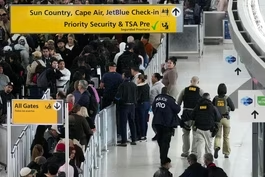
The shortage of TSA workers, combined with heavy spring break traffic, has meant long lines at airports.
Travelers leaving Atlanta today were advised to arrive four hours early to make their flights.
ANDRES CAMPOS, Air Traveler: Oh, my God, this is insane.
I mean, I have never experienced anything like this.
It's crazy.
It's insane.
I mean, I have never seen an airport like this.
STEPHANIE SY: In a controversial step, President Trump has directed DHS to deploy federal Immigration and Customs Enforcement agents at TSA checkpoints.
The ICE officers are fanning out across more than a dozen airports today.
DONALD TRUMP, President of the United States: I want to thank ICE, because they stepped in so strongly.
They will do great.
And if that's not enough, I will bring in the National Guard.
STEPHANIE SY: Meanwhile, the political stalemate continues.
DONALD TRUMP: And I told the people, don't settle.
Don't settle, because we have something bigger.
STEPHANIE SY: The lack of a political settlement means air travel may also remain unsettled for millions of travelers.
For the "PBS News Hour," I'm Stephanie Sy.
For more now on the deployment of ICE agents to airports, I'm joined by John Sandweg, who served as acting ICE director under President Obama.
John, thank you so much for joining the "News Hour."
So, hundreds of ICE agents were deployed to more than a dozen airports today, including New York, Chicago, Houston, and Atlanta.
What are you seeing and hearing about how this is going so far?
JOHN SANDWEG, Former Acting ICE Director: Well, I think, thus far, it's basically what I expected when I heard about this plan, which is there are real limitations on what those ICE agents can do.
The jobs of these TSA agents are actually very highly skilled, require skill and training, right, things that, although ICE agents have tremendous law enforcement experience, they're not -- they can't step in and run the X-ray or conduct one of those pat-down searches, or even do the baggage inspection that happens behind the scenes.
So I think this -- what we have seen thus far is these agents are providing more of a visible presence, perhaps helping them a little bit with perimeter security, but the bottom line is that that's just not going to be the types of activities that are going to free up TSA agents and help shrink those lines that we're seeing in some of these airports.
STEPHANIE SY: I understand that the ICE agents don't even have the same security clearance that TSA agents might have, and 12 percent of those TSA officers called out yesterday, 3,200 employees that didn't show up for work.
The problem, as you know, is these long lines, leading to air travel disruptions.
How much will having ICE agents deployed help address that problem?
JOHN SANDWEG: Well, what ideally - - I think, for this to work, right, for this to actually let ICE replace those missing TSA agents, you need ICE agents to be able to do tasks that would otherwise be required by TSA agents.
Now, as Tom Homan said when he kind of explained this yesterday, that you could have ICE agents manning those security checkpoints at the exits, right, as you leave the security or the airport.
You will often see a TSA agent or two sitting at a podium there, making sure someone doesn't enter through the exit line.
Basic tasks like that, ICE could do.
The problem is, though, that's about it.
And the majority of those TSA agents are doing things like operating the metal detectors and other screening devices when people enter, operating those X-ray devices.
Those are simply tasks that ICE agents can't do without extensive training.
And so I think that's the -- from an operational perspective, it's really hard to see a lot of value with this, right?
For this to work, you want ICE agents to be able to come in, do some of these basic jobs, free up a lot of those TSA agents, so they can help screen the passengers, move things along.
But, again, without that specific training, it's just not something that ICE or any law enforcement agency can do.
So, ultimately, in terms of reducing the size of those lines, this is really not going to be operationally all that impactful.
STEPHANIE SY: When have immigration agents ever been used in this way?
JOHN SANDWEG: Well, they're not.
They have never been used this way.
They're -- with one exception.
If you are down at smaller airports right next to the U.S.-Mexico border or sometimes in places like Puerto Rico, you will sometimes see a Border Patrol presence there outside the TSA checkpoint.
And what there is providing another layer of security, trying to protect people who've crossed that border unlawfully, might now be trying to board a flight into the interior of the United States.
Outside of that area, we have never -- certainly never seen ICE deployed in the air environment, and certainly never -- never near the TSA checkpoints.
ICE does play a role in terms of having -- as a presence traditionally at the airport.
But those are Homeland Security Investigations special agents, so criminal special agents who are there primarily responding to situations inside the Customs and Border Protection, that port of entry, right, where international travelers are arriving, or potentially making apprehensions of individuals who are smuggling goods or have caught smuggling items out of the United States or international fugitives trying to board a flight to depart the United States, situations like that.
But this idea of using ICE agents at the TSA checkpoints is something that has never happened in the history of the agency.
STEPHANIE SY: To that point, John, President Trump posted that these ICE agents will -- quote -- "do security, including the immediate arrest of illegal immigrants."
What do you expect we might see unfold at airports now?
And can you see these ICE deployments potentially leading to more chaos?
JOHN SANDWEG: Stephanie, I think that is the big question is, will they be doing immigration enforcement?
I certainly think if we start seeing immigration enforcement operations in conjunction with these TSA checkpoints, you will see a lot of chaos.
You're going to see a lot of people who are legally present and probably some U.S.
citizens who are going to detained and kind of forced into questioning because, for one reason or another, some suspicion was generated with the I.D.
they presented at TSA.
I would say this, that I'm sure there are some in the administration who've always looked at these TSA checkpoints as a potential source of making a lot of immigration arrests.
You have individuals in a secure environment, so it's a safer environment to make arrests.
But, more importantly, it's one of the few places in the United States where people have to present an identification, almost like an I.D.
checkpoint.
And you could see a scenario where TSA agents are just looking for anyone who presents a foreign passport or a driver's license that's not Real ID-compliant, something that doesn't clearly show they are entitled to be in the United States, referring them for further questioning by ICE officers.
I think, if we saw that, though, we're going to see real chaos at that point.
You are going to see people who have a legal right to be in this country who are going to be pulled aside and questioned.
You're going to have a lot of fear, probably a lot of people deciding they'd rather not run the risk of facing those questions and not flying.
So it'll be very interesting.
I know the president said that immigration enforcement would be part of this mission.
Thus far, it doesn't appear that we have seen that.
But I think that will tell us whether or not this will be, in many ways, operationally unimpactful, where people just won't impact their travel, rather, and their TSA experience, or whether or not this becomes a much bigger and potentially chaotic ordeal.
STEPHANIE SY: That is John Sandweg, the former acting ICE director under the Obama administration, joining us.
John, thank you.
JOHN SANDWEG: Thank you.
STEPHANIE SY: A note that the "News Hour" requested interviews today with White House border czar Tom Homan, Transportation Secretary Sean Duffy, and acting ICE Director Todd Lyons.
The invitation still stands.
GEOFF BENNETT: The new deployment of ICE agents to airports comes as the partial DHS shutdown near the 40-day mark.
The president nixed one potential solution over the weekend that would have funded some agencies, including TSA.
Our congressional correspondent, Lisa Desjardins, is here with more on the negotiations to fully reopen the government.
So, Lisa, we will start there.
What's the latest?
LISA DESJARDINS: All right, if you remember nothing else from this report -- and I know our viewers remember everything.
GEOFF BENNETT: they certainly do.
LISA DESJARDINS: Remember these three things.
Number one, the president just made this more complicated.
Number two, the chances of ending this DHS shutdown this week have now become slimmer.
GEOFF BENNETT: Really?
LISA DESJARDINS: But, number three, everything can change quickly.
(LAUGHTER) GEOFF BENNETT: OK.
So say more about that.
How?
LISA DESJARDINS: Right.
OK.
So let's talk about these dynamics that made it more complicated.
First of all, I'm going to recap what has become a very chaotic weather system.
Let me look at this a little bit more clearly here.
President Trump last night posted on TRUTH Social in his account.
He wrote that: "I don't think we should make any deals with Democrats."
He wants that election I.D.
law, the SAVE America Act, to pass first.
That's what he's prioritizing here.
He said Republicans should stay in Washington, all Congress should, through the Easter recess.
Now, with that, what he's doing is, he's making things more complicated, not for Democrats, but for Republicans, who don't have the votes for the SAVE Act.
Now, yesterday, sources familiar told me that Senate Republicans raised the idea of funding all of DHS except for ICE, White House staffers briefed the president, and he personally rejected that idea in a phone call with Senate Majority Leader John Thune.
Meanwhile, what about Democrats?
Well, last week, moderate Democrats were talking with Tom Homan from DHS about trying to find a deal.
But instead now they are more united in trying to get more from the administration.
And those talks from Democrats are in limbo.
So President Trump said today, trying to blame Democrats for where we are, that Democrats insisted that they want a deal.
But Democrats say there was no such phone call at all, and they don't know what the president is talking about.
GEOFF BENNETT: So how are the TSA lines, the airport safety issues that we reported on earlier, how is that affecting these talks?
LISA DESJARDINS: Right.
I have to say from talking to sources in both parties that, in a counterintuitive way, I think that these lines are actually making it more difficult to reach a solution right now.
Let me explain why.
Democratic sources see the polling, including from Quinnipiac, that shows more Americans blame Republicans for what's happening at our airports than blame Democrats.
Usually, the party that starts the shutdown, in this case, Democrats sparked it, gets the blame.
But Democrats are saying, hey, we will fund TSA.
And they're blaming Republicans for this.
Meanwhile, President Trump is seeing the solution as sending ICE agents to airports, not in compromising with Democrats.
So that also is making it harder to reach that kind of compromise.
GEOFF BENNETT: So, what should we watch for now?
LISA DESJARDINS: There's a lot to watch for.
First of all, the question is, does Congress stay in town this weekend or not?
They are leaving supposedly for a two-week recess.
You and I both know nothing motivates Congress more than a kind of Easter recess.
But in this chaotic weather system, that really has become just kind of like a fragment blowing around in the wind.
We will see what happens in the next few days.
The other pressure points will be TSA workers.
Hundreds of thousands of workers will miss perhaps a month of paycheck by the end of this week.
So we will see if there's more stories about that.
Now also, Trump, how much is he pushing for the SAVE Act?
How much does he keep that up?
In all, remember those three points I said?
Number one, they're still true.
This has become more complicated.
It has become more uphill ending the shutdown.
But it's day by day.
It could change quickly.
GEOFF BENNETT: Lisa Desjardins tracking it all.
I don't know how you do it.
Thank you.
LISA DESJARDINS: You're welcome.
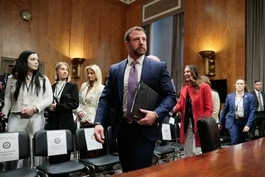
GEOFF BENNETT: The day's other headlines also start on Capitol Hill, where the Senate is set to vote tonight on Markwayne Mullin's confirmation to be homeland security secretary.
The numbers are in his favor, putting him on track to replace Kristi Noem, who was fired amid public backlash over the Trump administration's immigration enforcement operations.
Senators advanced Mullin's nomination over the weekend with support from two Democrats.
The Republican senator from Oklahoma has long backed President Trump's immigration agenda.
But at his confirmation hearing last week, he vowed to keep the department off the front page of the news.
Law enforcement officials in London are investigating an apparent arson attack as an antisemitic hate crime.
Four ambulances belonging to a Jewish volunteer organization were set on fire overnight.
Multiple oxygen cylinders on the ambulances exploded, shattering nearby apartment windows and leaving behind only the vehicle's charred remains.
The North London neighborhood where the incident occurred has a large Jewish population.
No one was injured.
Police say they are looking for three suspects, but have not made any arrests yet.
Prime Minister Keir Starmer told reporters such an attack has no place in their society.
KEIR STARMER, British Prime Minister: Well, this is a horrific antisemitic attack.
And, of course, my thoughts, I think all of our thoughts will be with those in the vicinity, the residents who are understandably very concerned, a Jewish community across the country deeply concerned.
GEOFF BENNETT: Advocacy groups say nearly 4,000 antisemitic incidents were reported in the U.K.
last year.
That's more than double the amount back in 2022 before Hamas' attack on Israel.
In Cuba, officials say power is slowly being restored after the country's electric grid collapsed again this past weekend.
It's the island's third blackout this month amid an ongoing U.S.
oil blockade.
In Havana, it's now routine for people to try to take advantage of the daylight, but by nightfall, with much of the city pitch black, many residents say they're just trying to survive.
MAIKEL PENA, Havana Resident (through translator): Now, with these blackouts, the little food people have spoils, and you don't know what to do anymore.
You don't know if you can buy food for a month or for a week or for a day, because you never know when the electricity will go out.
One minute, everything is lit up.
And, the next minute, everything goes down.
GEOFF BENNETT: Cuba only produces 40 percent of the fuel it needs to power its economy.
The country's president says the island hasn't gotten oil from much-needed foreign suppliers for three months.
A statue of Christopher Columbus was quietly installed this weekend on the White House grounds.
The replica statue of the explorer now stands outside the Eisenhower Executive Office Building adjacent to the White House itself.
The original was toppled and tossed into Baltimore's Inner Harbor during the 2020 racial justice protests following the death of George Floyd.
Other statues of Columbus were taken down at the height of those protests for his role in colonization.
The White House has called Columbus a hero.
Washington Capitals legend Alex Ovechkin scored his 1,000th career NHL goal in a loss yesterday to the Colorado Avalanche.
His teammates swarmed him as he reached the milestone in the game's third period.
Ovechkin joins Wayne Gretzky as the only players to reach 1,000 goals when combining the regular season and the playoffs.
Gretzky finished his NHL career with 1,016.
Ovechkin is not far behind.
The Great 8 already broke Gretzky's previous regular season record of 894 goals last year.
And stocks rallied today on the news that President Trump would defer strikes on Iran to allow for negotiations.
The Dow Jones industrial average jumped 631 points, or more than a percent.
The Nasdaq made the exact same gain of 1.38 percent.
And the S&P 500 also ended more than a percent higher.
Still to come on the "News Hour": the U.S.
Supreme Court weighs in on mail-in ballots; Tamara Keith and Amy Walter break down the latest political headlines; and what I learned while writing my new book on the revolutionary history of black comedy.
The U.S.
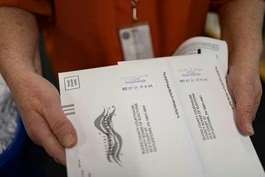
Supreme Court heard arguments today in a case that could reshape how millions of mail-in ballots are counted in this fall's elections.
Our justice correspondent, Ali Rogin, has more on the ensuing legal background.
ALI ROGIN: Geoff, currently, 14 states and the District of Columbia allow elections officials to count mail-in ballots that arrive after Election Day, as long as they are postmarked by Election Day.
But the Republican National Committee is challenging that procedure, arguing it undermines trust in elections.
In today's arguments, the justices appeared to be divided along ideological lines.
SAMUEL ALITO, U.S.
Supreme Court Associate Justice: Labor Day Memorial Day, George Washington's birthday, Independence Day, birthday, and Election Day, and they're all particular days.
So if we start with that, if I have nothing more to look at than the phrase Election Day, I think this is the day in which everything is going to take place.
KETANJI BROWN JACKSON, U.S.
Supreme Court Associate Justice: This idea of the votes being cast by Election Day and counted after Election Day has been around, right?
I mean, it's not like we're talking about a brand-new thing from Mississippi from the standpoint of no one ever had a post-Election Day ballot deadline before.
ALI ROGIN: If the court sides with the RNC, it could significantly change voting rules just months ahead of this year's midterms.
For more on the fight over voting by mail, I'm joined now by Nate Persily, an election law scholar at Stanford University.
Nate, thank you so much for being here.
What is the core argument here?
Why are Republicans fighting against this law?
NATE PERSILY, Stanford Law School: Well, what the Republicans are saying is that there is a federal law that sets the date for the election as a particular day, and so they are suggesting that any ballots that are received after that day should not be counted because the federal law trumps the state law, in this case, Mississippi's law.
ALI ROGIN: And how did this become such a partisan idea?
Is there a partisan preference for mail-in voting in one party over the other?
NATE PERSILY: In the last decade, we have seen a partisan polarization on the issue of mail balloting, in no small part because Donald Trump has made the central part of sort of his election reform agenda and claims of massive fraud that he suggests that mail voting is inherently insecure.
And so you have seen Republicans in general being more restrictive on issues of mail voting and Democrats being more liberal.
I should say that's not uniformly true.
Places like Utah, which is a heavily Republican state, have all mail voting.
And so both Republicans and Democrats take advantage of that as a way of casting their ballots.
ALI ROGIN: If the court rules against this state law, what happens in terms of elections come the fall?
Does anything change immediately?
NATE PERSILY: Well, we will see how they phrase the opinion.
One would expect that this decision would come down around June.
That would definitely throw a wrench in the gears for a lot of the election planning at the states.
But what it would mean is that states would not be able to count ballots after -- if they're received after Election Day.
And so they would have to change some of their state laws.
And you may actually have a situation where in some states they will count ballots for state offices like governor after Election Day, but they won't be able to count congressional races after Election Day.
ALI ROGIN: Right.
That was a big part of the argument too, whether it's a state election or a federal election.
We heard a lot today about what defines Election Day and that conversation included a lot of talk about things like early voting.
So is there a chance that this court ruling could extend beyond mail-in ballots and have farther reaching implications for how we run elections?
NATE PERSILY: Well, one of the problems with the Republicans arguments here is that, if you really believe that the casting and counting of ballots happens has to happen on one day, then that would seem to not only affect the receipt of ballots after that day, but also the casting of ballots beforehand.
However, they said, no, they wouldn't take that argument that far.
And so everybody in the case agreed that early voting, which is to say casting of ballots and giving them into the election officials before Election Day, would still be allowed.
But whether -- the sort of liberals on the court were trying to say is that, look, if you really believe Election Day means Election Day, that should apply to the counting of ballots and the casting of ballots before Election Day as well.
ALI ROGIN: How does this case play into the Supreme Court's broader efforts to reshape election law?
And to what extent is the Supreme Court here taking over making policy where Congress also has a role to play?
NATE PERSILY: Well, that's a very good point to make, which is that this is a statutory case.
The only question in this case is whether the federal law passed by Congress is inconsistent with the state law passed by Mississippi that would allow for ballots to be received and counted after Election Day.
And so everyone agrees that Congress could have clarified this to make clear that you couldn't have ballots received after Election Day.
The question is whether a vague law that just declares the Election Day as being a particular Tuesday in November, whether that says something about the ability to count ballots after the fact.
ALI ROGIN: And, of course, at the same time, Congress is talking about the SAVE Act, which is a big priority for President Trump and would significantly affect the way that Americans can vote.
What is the context here in terms of one of these battles playing out in the Supreme Court and the other making its way through Congress?
NATE PERSILY: Well, so the SAVE Act does have provisions related to mail balloting, but it goes much farther.
It deals with things like voter I.D.
in the polling place, as well as citizenship requirements for registering.
And so one of the questions here is whether Congress would be able to essentially go farther than even those in this case are suggesting to have a sort of greater federal law that would supplant a lot of these state laws with respect to voter access and the casting and counting of ballots.
ALI ROGIN: Nate Persily with Stanford University, thank you so much for breaking this down for us.
NATE PERSILY: Thanks for having me.
GEOFF BENNETT: Air travelers met with long lines.
And, for travelers looking to drive, instead they're facing rising gas prices as the war with Iran continues.
Lots to discuss with our Politics Monday duo.
That's Amy Walter of The Cook Political Report With Amy Walter and Tamara Keith of NPR.
Another Monday, another opportunity for me to get to welcome you to the program.
Good to see you both.
TAMARA KEITH, National Public Radio: Good to see you.
GEOFF BENNETT: So we are almost about to hit day 40 of this DHS funding shutdown.
Today, we're seeing something new, ICE agents assisting with the TSA staffer shortfall.
Amy, is this a practical solution to a real problem or does it just raise more concerns than it solves?
AMY WALTER, The Cook Political Report: Yes, it doesn't seem like it's going to solve the real problem, which is getting people through lines.
What they need are people who can actually do the machines and do the scanning and all of that.
That is not what ICE is there to be able to do.
It makes it seem as if they're trying to find a solution, but it's not going to solve the problem.
The real challenge -- and I think Lisa laid it out very well -- is the fact that there was actually at one point, it seemed we were this close to a solution to this, that Republicans came to the table saying, we will split off this battle over ICE from DHS funding.
And Republicans can agree, Democrats agree, boom, bang, boom, we're done.
In comes the president saying not without the voting act.
And so now what it has done is essentially put the issue of the shutdown promptly in the president's lap.
It is now his shutdown.
He says, it's unless they pass a bill that I would like to see that everybody agrees is not going to be able to pass, this shutdown continues.
GEOFF BENNETT: Tam, why is the president making this SAVE Act a red line now?
TAMARA KEITH: Well, that is -- this goes back a very long time.
He has raised concerns falsely about people who are not in the country legally, people who are not citizens voting in elections going back at least to the 2016 election.
This is a longstanding issue that he cares about a lot.
He has now said that he thinks that this is something, the SAVE Act, SAVE America Act, as he has rebranded it, Is something that Republicans could run on in the midterms.
But the problem is, it's a boxed canyon.
He is taking a stand, making a really big deal, now saying, I will even own the shutdown, more or less, all for a piece of legislation that simply does not have enough Republican support to make it out of the Senate.
And there are reasons for that.
The legislation would require people in order to register to vote to show proof of citizenship.
Well, in rural states, that would mean, one, finding the documents, and, two, actually traveling.
In Alaska, people might have to get on a plane in order to prove that they are a citizen to be able to register to vote.
And he also wants to take away most absentee voting.
Well, Republicans like absentee voting.
And, like, there are certainly ways that it could be tightened up and things like that.
But he is essentially taking a stand on a thing, saying, stay in through Easter, do this for Jesus, when -- literally, he said that.
GEOFF BENNETT: I was going to ask you.
OK.
AMY WALTER: Yes.
TAMARA KEITH: Yes.
He said that.
He is doing this on an issue where he's actually making it really tough for members of his own party who don't support it.
GEOFF BENNETT: Let's talk about the war with Iran.
It's unpopular.
The public does not support it.
That's according to a number of polls.
Americans are now feeling it at the pump, gas prices rising.
How much political pressure, Amy, does this create for Republicans, especially in this election year?
AMY WALTER: Yes.
They are already facing the traditional headwinds of being the in-party and then facing a public that feels very frustrated with inflation, and, now on top of this, an unpopular war and high gas prices.
Not that good.
The issue, though, really at the end of the day, comes down to, it seems to me, on how unpopular this is and how long this becomes a political issue for Republicans is about how long we stay in Iran.
I thought one of the most interesting questions that -- CBS released a poll this weekend.
They asked, what do you think the priority should be for success?
No more nuclear weapons for Iran.
They don't harass their neighbors.
Those were popular.
But the most popular by far with 92 percent is that this ends quickly.
That's what Americans want above all else.
The longer it drags out, the harder it will be for Republicans to put this in the rear-view mirror, because it is true, if, by November, we may not be remembering TSA lines and gas prices, but the longer the war drags on, the more unpopular it is going to become, even with people who may support it right now.
GEOFF BENNETT: And one way we know the president believes this to be a political liability is that he was in Memphis today trying to shift the focus to issues like crime, Tam.
TAMARA KEITH: Yes.
AMY WALTER: Yes.
TAMARA KEITH: And I have spent a lot of time talking to swing voters in the last several weeks, and no one brought up crime.
They talked a lot about the economy, about the cost of living, and then more recently about gas prices.
But certainly President Trump has promised that he's going to go out on the road and he's going to campaign.
And something like crime should be a winning issue for the president.
The problem is, there are just other higher priorities that voters are having right now.
And, yes, so he's trying to reclaim the issue of crime, the issue of immigration by getting rid of his homeland security secretary and bringing in a new one.
He's really trying to get a reset and take back control of these issues that have helped propel him and Republicans in the past.
AMY WALTER: That's right.
GEOFF BENNETT: We should also, before we wrap up this conversation, talk about what happened over the weekend.
We reported the White House installed this statue of Christopher Columbus.
It was a replica.
You see it there.
It's a replica of the one that was torn down in 2020.
And he also approved a commemorative coin that bears his own image, President Trump's image.
I'm not sure we have a picture of that.
But Amy, what's the -- strategy is not the right word.
There might not be a strategy.
But what does this symbolism, what does this iconography, what does it suggest?
AMY WALTER: This is a president who has long loved seeing his name on things, buildings, et cetera.
So that's not particularly new.
But it's also a president who wants -- who believes very strongly in putting his stamp on Washington, not just figuratively, but literally,this will stand the test of time.
It's also -- going back to Tam's point, especially with the Christopher Columbus statue, it's going back to the things that have traditionally worked for the president, especially when it's about keeping his base engaged and excited are things that evoke what that Christopher Columbus statue looks, which is, we're in a battle for the identity of the U.S.
The left is supporting this woke ideology.
We're supporting sort of where real Americans are.
So it is his comfortable place.
And that is also the place, when he's talking about those things, his base does get united, even as they're getting divided, at least in Congress, on this issue of the shutdown.
GEOFF BENNETT: How do you read it, Tam?
Is it symbolism as politics or distraction from bigger challenges, or both?
TAMARA KEITH: It is a strong focus of the president.
Whether it's a distraction for others or not, he's very focused on it.
And this is the 250th anniversary of the signing of the Declaration of Independence.
President Trump has a very specific view of what should be part of American history.
He is attempting to airbrush American history, to sort of remove any hints that maybe America wasn't always perfect.
And this statement from Davis Ingle, a White House spokesman, just part of it here, I think gets at this: "President Trump has rightly hailed Christopher Columbus as the original American hero, a giant of Western civilization."
This is very in line with the way President Trump views America.
He's also working on this Garden of American Heroes, which are statues that were removed from town squares because of complicated history.
GEOFF BENNETT: Tamara Keith, Amy Walter, thank you both.
AMY WALTER: You're welcome.
TAMARA KEITH: You're welcome.
GEOFF BENNETT: In the 1990s, a remarkable wave of Black sitcoms and sketch comedy reshaped American television.
Shows like "In Living Color" and "Living Single" reflected a wide range of Black life and helped broaden how millions of Americans understood Black experiences.
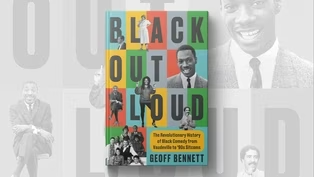
That moment and the long history that helped make it possible are at the core of my new book, "Black Out Loud."
I recently spoke with Amna Nawaz about it.
AMNA NAWAZ: Congratulations on the book.
GEOFF BENNETT: Thank you.
AMNA NAWAZ: I'm so happy to talk to you about this.
So this is a book that looks at the long history of Black comedy in America.
You focus on the 1990s in particular though, right?
GEOFF BENNETT: Yes.
AMNA NAWAZ: Why?
GEOFF BENNETT: It was this question that I kept coming back to.
What was it about the '90s that allowed all of these shows to exist on the air at the same time and thrive?
These shows were at the top of the ratings.
They had broad appeal, but they were at the same time unapologetically specific and authentic.
And as a journalist who covers American life and culture, as we do, I realized that the story of these shows, what they meant, what they gave us, the overall cultural imprint, had never really been told.
So I wrote the book I wanted to read and in the process spoke to the performers and the producers who really built that era, not just about what existed on screen, but what it all really meant.
So here's a glimpse of some of the conversations that informed the book.
WOMAN: Ladies and gentlemen, Keenen Ivory Wayans.
(CHEERING) GEOFF BENNETT: On a Sunday night in April of 1990, something quietly radical happened on American television.
FOX aired the first episode of "In Living Color"... MAN: Jewelry, jewelry, jewelry.
GEOFF BENNETT: ... a sketch comedy show created, written, and controlled by Black artists.
DAMON WAYANS, Actor: Homey don't play that.
(LAUGHTER) GEOFF BENNETT: It was a cultural shockwave that helped ignite a boom of Black comedy on TV,when millions of Americans saw versions of themselves on screen that felt specific and True.
Erika Alexander played Maxine Shaw on the FOX sitcom "Living Single," about young Black professionals navigating work, friendship, and dating in Brooklyn.
The '90s were the golden age of Black sitcoms.
What did it feel like to exist inside that ecosystem?
ERIKA ALEXANDER, Actress: It was amazing.
It was amazing to be in that era.
It felt like anybody could be done and that we in large measure could start to achieve some of the things that in the '60s people said would happen.
GEOFF BENNETT: But to understand how that door opened, you have to go back, all the way back, because, for decades, Black comedy existed inside narrow limits, propping up America's first form of mass entertainment, minstrelsy.
Comedians like Bert Williams became stars even while navigating an industry that demanded Black performers play degrading caricatures.
MAN: Mom, take it away.
GEOFF BENNETT: Decades later, Moms Mabley mixed sharp social commentary with disarming warmth.
In the 1960s, Dick Gregory carried stand up directly into the civil rights movement.
DICK GREGORY, Comedian: Have you ever stopped to think that, if all the Negroes left the South, buses would ride like this?
(LAUGHTER) ANNOUNCER: "The Flip Wilson Show."
GEOFF BENNETT: By the early 1970s, Flip Wilson broke new ground as the first Black comedian to host a major network variety show.
FLIP WILSON, Comedian: You destroyed my whole image.
RICHARD PRYOR, Comedian: The damndest thing I have ever heard of in my life.
GEOFF BENNETT: Richard Pryor, whose approach was raw, fearless and deeply personal, reshaped what comedy could do.
RICHARD PRYOR: All the people you ever heard of freebasing, have you ever heard of anybody blowing up?
(LAUGHTER) RICHARD PRYOR: Why me?
GEOFF BENNETT: Comedian Sinbad says Pryor changed everything.
SINBAD, Actor and Comedian: Richard was so real.
The first album I bought, comedy album, I was playing it.
My father, who was a preacher, was in the hallway.
And mother, my mother, who's a mother of the church, they were both cracking up.
They said: "Who's that?"
I said: "It's Richard Pryor."
So he called everybody.
GEOFF BENNETT: By the 1990s, the TV industry was shifting.
Networks and advertisers began recognizing the buying power of a growing Black middle class.
For the first time, Black audiences weren't just being counted.
They were being courted.
And sitcoms became the perfect vehicle.
"A Different World" proved comedy could tackle serious ideas... ACTRESS: You can't trust anybody in a uniform.
GEOFF BENNETT: ... gender, class, racism, without losing its audience, since comedy has a way of lowering defenses, while making a point, says Sinbad.
SINBAD: We're the ones you can bring in and talk about what's happening in the world, and we can bring it away that's funny, and somebody in the audience that might not even agree with the viewpoint, if you do it right, you can get somebody to go like, OK, I will cast you that side of it.
GEOFF BENNETT: "Living Single" captured the lives of young Black professionals years before mainstream TV caught up.
ACTRESS: So good to see a woman on the job.
ERIKA ALEXANDER: It's good to be one.
GEOFF BENNETT: Erika Alexander says the influence of her character, a high-powered attorney, still surprises her.
ERIKA ALEXANDER: These amazing people started coming up to me saying they went into law, they went to executive positions, they went into education, leadership positions because they were very inspired by Maxine Shaw, attorney at law.
I knew that representation mattered, but there was proof positive.
They had actually done the things that Maxine Shaw was purporting to have done.
ACTOR: Go put on your work clothes.
GEOFF BENNETT: "The Fresh Prince of Bel-Air" presented a Black family whose lives were shaped by affluence and aspiration.
ACTRESS: How's your job going?
GEOFF BENNETT: Karyn Parsons played Hilary Banks, a character who could have become a one-note punchline, but became something far more enduring.
WILL SMITH, Actor: You know he likes you.
KARYN PARSONS, Actress: Oh, and I'm supposed to be nice to everyone who likes me?
How much time do you think I have?
(LAUGHTER) KARYN PARSONS: Well, I hear people a lot say stuff about her being ditzy.
And the younger generations didn't see her that way.
They look at her as a role model, because she went out there and she went after what she wanted.
And she had no problem saying, this is who I am and I'm beautiful and I'm going to do this, and no holding back, no trying to make nice for people or try to make people comfortable.
GEOFF BENNETT: Did you feel the weight of representing a version of Black life which at the time really contradicted so many dominant narratives?
KARYN PARSONS: No.
I think at the time, for one thing, it was hard to comprehend that so many people were actually watching and that so many people would watch.
"Cosby Show" was happening at the time.
And they were the -- they were kind of like the epitome of Black family and family period because it was a number one show, period.
So we were kind of this -- to me, it was kind of like this very odd cast of characters, strange, kind of all very different, all of these things that were actually very important, I would find later, I think for representation.
They were such different Black characters, people.
GEOFF BENNETT: Different voices, different visions of Black life airing the same week, sometimes even the same night.
And that mattered because audiences were finally seeing a range of stories instead of just one.
ERIKA ALEXANDER: I think up, until that point, everybody was thinking about the weight of what it would mean and how we told those stories.
But there was a specific freedom in maybe saying, well, we don't have to because there's all sorts of different people telling the stories.
There was just a feeling that the sky was the limit and that we were suddenly being supported.
That's different when you're being funded and supported.
GEOFF BENNETT: Supported and, for millions of viewers, that expanded what seemed possible.
AMNA NAWAZ: That is so incredible to hear from these folks, a sneak peek into your book.
But, big picture, at this moment, Geoff, why does all this matter, like, beyond being nostalgic about some of these characters and shows?
GEOFF BENNETT: I think it matters because cultural memory is fragile and it requires tending.
For Black viewers, these shows were important because there was a sense of recognition, there was a rhythm, there was a familiarity that we saw when watching these programs.
And for everybody else, there was something just as powerful.
It was this intimate window into lives and experiences they might not have otherwise encountered.
Having covered national politics and having covered cultural issues, I can tell you that culture is where politics gets debated first.
It is where society often tells the truth about itself first.
And Black comedy has always done that.
That is the legacy and lineage of Black comedy.
So this book really speaks to that.
And I should say this book is part oral history, it's part serious scholarship, but it's also a lot of fun.
It's meant to be a fun read.
So anybody who grew up in the '90s watching these shows, anyone who's rediscovering them now, this is a book for them.
AMNA NAWAZ: Well, I know you have poured yourself into it.
It's been a lot of hard work, but it's clearly been joyful for you too.
So, congratulations again, my friend.
GEOFF BENNETT: Thank you.
I appreciate it.
And you can hear my full conversation with Amna about my new book, the writing process, and much more on a special episode of this week's PBS News podcast "Settle In."
That's on our YouTube page or wherever you get your podcasts.
And that is the "News Hour" for tonight.
I'm Geoff Bennett.
For all of us here at the "PBS News Hour," thanks for spending part of your evening with us.
 New
NewGeoff Bennett explores Black comedy in 'Black Out Loud'
Video has Closed Captions
Geoff Bennett explores Black comedy’s history and cultural impact in 'Black Out Loud' (8m 57s)
 New
NewICE deployed to airports as TSA faces shutdown shortages
Video has Closed Captions
ICE agents deploy to major U.S. airports as TSA faces shutdown shortages (6m 14s)
 New
NewLaGuardia collision comes as U.S. air system faces stress
Video has Closed Captions
Deadly LaGuardia plane collision comes as U.S. air system faces significant stress (4m 49s)
 New
NewNews Wrap: Senate on track to confirm Mullin as DHS head
Video has Closed Captions
News Wrap: Senate on track to confirm Mullin as DHS secretary (4m 12s)
 New
NewSupreme Court hears ballot case that could impact midterms
Video has Closed Captions
Supreme Court hears mail-in ballot case that could impact the midterms (6m 17s)
 New
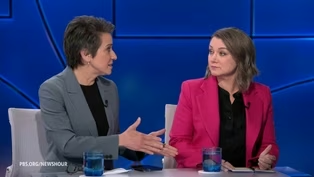
NewTamara Keith and Amy Walter on GOP's midterm pressure
Video has Closed Captions
Tamara Keith and Amy Walter on GOP facing midterm pressure from DHS shutdown, Iran war (8m 48s)
 New
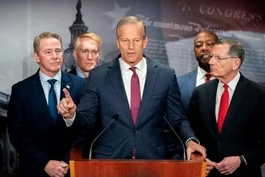
NewTrump rejects deal to reopen DHS without ICE funding
Video has Closed Captions
Trump rejects Senate proposal to reopen DHS without ICE funding (3m 52s)
 New
NewTrump says Iran wants to end war, but regime denies talks
Video has Closed Captions
Trump says Iran wants 'deal' to end war, but regime denies talks and strikes continue (8m 18s)
Providing Support for PBS.org
Learn Moreabout PBS online sponsorship
- News and Public Affairs

FRONTLINE is investigative journalism that questions, explains and changes our world.

- News and Public Affairs

Amanpour and Company features conversations with leaders and decision makers.
Urban Consulate Presents











Support for PBS provided by:
Major corporate funding for the PBS News Hour is provided by BDO, BNSF, Consumer Cellular, American Cruise Lines, and Raymond James. Funding for the PBS NewsHour Weekend is provided by...