
Artemis II astronauts embark on voyage around the moon
Clip: 4/2/2026 | 5m 2sVideo has Closed Captions
Artemis II astronauts embark on voyage around the moon
A day after liftoff, Artemis II is now well on its way. Four astronauts are on a ten-day voyage around the moon and back, traveling deeper into space than any human has ever before. For more about what’s happening now and what comes next, Amna Nawaz spoke with science correspondent Miles O’Brien.
Problems playing video? | Closed Captioning Feedback
Problems playing video? | Closed Captioning Feedback
Major corporate funding for the PBS News Hour is provided by BDO, BNSF, Consumer Cellular, American Cruise Lines, and Raymond James. Funding for the PBS NewsHour Weekend is provided by...
Support provided by:

Artemis II astronauts embark on voyage around the moon
Clip: 4/2/2026 | 5m 2sVideo has Closed Captions
A day after liftoff, Artemis II is now well on its way. Four astronauts are on a ten-day voyage around the moon and back, traveling deeper into space than any human has ever before. For more about what’s happening now and what comes next, Amna Nawaz spoke with science correspondent Miles O’Brien.
Problems playing video? | Closed Captioning Feedback
How to Watch PBS News Hour
PBS News Hour is available to stream on pbs.org and the free PBS App, available on iPhone, Apple TV, Android TV, Android smartphones, Amazon Fire TV, Amazon Fire Tablet, Roku, Samsung Smart TV, and Vizio.
Providing Support for PBS.org
Learn Moreabout PBS online sponsorshipAMNA NAWAZ: A day after liftoff, Artemis II is now well on its way, four astronauts on a 10-day voyage around the moon and back, traveling deeper into space than any human ever before.
For what's happening now and what comes next, I'm joined by our science correspondent.
That is Miles O'Brien, who is just back from witnessing that historic launch yesterday.
Miles, it's great to see you.
So give us an update.
In those first 24 hours since liftoff, what have the astronauts been up to and how's everything going so far?
MILES O'BRIEN: The mission is going smoothly, Amna.
I don't want to hex it or anything, but things are going well.
It is a test flight.
And one of the things that was high on the list of things they wanted to understand was, how well does the Orion capsule maneuver when it is manually controlled in space?
So they separated from the second stage of the rocket, which is no longer needed for them, pulled back and attempted to get close to it as if it was docking, although they did not dock.
There was a docking target as if there had been a docking mechanism on it.
And it gave the crew an opportunity to fly the Orion, see what it's like as it got closer to that other object, obviously to tell them a little bit about how it handles for future docking.
I was watching as the navy test pilot and astronaut Victor Glover handled this situation.
And why don't you listen in?
I think you will agree he's got the right stuff.
VICTOR GLOVER, Artemis II Pilot, NASA: And now I see ICPS in the docking camera field of view.
OK, waiting for 550.
I'm on the THZ (ph).
There's 550.
It's got a little rough like we're driving on a rocky road, but it's much quieter than in the sim eight.
I can see the side docking target.
That is a good-looking American flag.
Happy -- going off, Fox.
Great flying with you, Houston.
Nice vehicle.
WOMAN: Great job, Victor, and to the entire crew, and we enjoyed your excitement at seeing ICPS out the window.
MILES O'BRIEN: Smooth flying by a steady hand and someone who knows a lot about flying, but this time in space on a brand-new vehicle, Amna.
AMNA NAWAZ: That is so very cool to hear.
So, Miles, not because I want specific details, but because it got attention, there was a report about some issues with the onboard toilet after launch.
Is everything OK now?
MILES O'BRIEN: Well, I guess you could say it's a number one problem as well.
But, yes, the toilet did fail initially.
This was a big deal, because the Apollo capsules had no toilet.
They had to use bags, and this was a big deal.
They had to do a reboot on the system because a fan wasn't operating.
The urine collection capacity was out of commission.
But they got it rebooted, and everybody's fine and dandy on that priority.
AMNA NAWAZ: Good to hear.
So, walk us through what the next big hurdle is for these astronauts.
What are they preparing for?
What comes next?
MILES O'BRIEN: It's a historic moment, Amna, and it's going to happen potentially in about an hour or so.
It's called the translunar injection burn.
This is when they will fire the rocket motors enough to increase the speed of the spacecraft by about 800 miles an hour.
And that will be enough to pull the Orion capsule away from the gravitational pull of Earth and more toward the moon.
Once this burn is done, they're pretty much on their way to the moon, and they will get their honor about Sunday for this ride around the moon.
AMNA NAWAZ: So if they expect to get there on or around Sunday, tell us a little bit about how much the rest of us down here on Earth will be able to witness and able to see of this historic journey.
MILES O'BRIEN: Well, the new administrative NASA, Jared Isaacman, had made it possible for them to bring their iPhones.
They had been banned for astronauts by NASA because they were concerned about them being flammable.
He said, that's crazy.
Bring your iPhones.
So we're going to get some great selfies for sure.
But I will tell you this.
If you go back to 1968, Apollo 8, perhaps the most audacious Apollo mission of them all, the world was just completely gobsmacked by the image captured by Bill Anders, one of the crew members on that Apollo mission.
As they orbited the moon, they saw this blue orb arise and it was Earth.
It was an Earthrise shot.
And it took everybody back.
It helped really in many ways start the environmental movement here on Earth.
And I have talked to several Apollo astronauts, and almost all of them to a person say, they went to the moon.
What they ended up being more fascinated about and more appreciative of was Earth itself.
It will be interesting to see if this crew has the same experience.
AMNA NAWAZ: Miles O'Brien, always great to talk to you.
Please come back soon, update us on the mission.
Thank you.
MILES O'BRIEN: You're welcome, Amna.
 New
NewGulf nations, European allies respond to Trump's Iran speech
Video has Closed Captions
How Gulf nations and European allies are responding to Trump's Iran address (7m)
 New
NewHow 'No Kings' events fit into America's history of protest
Video has Closed Captions
How 'No Kings' rallies fit into America's history of protest (8m 49s)
 New
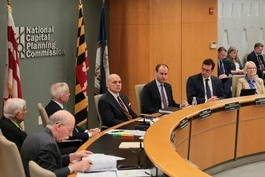
NewNews Wrap: Planning commission approves ballroom project
Video has Closed Captions
News Wrap: National Capital Planning Commission approves Trump's ballroom project (6m 9s)
 New
NewRepublicans in Congress announce plan to end DHS shutdown
Video has Closed Captions
Republicans in Congress announce plan to end DHS shutdown, but political battle continues (4m 30s)
 New
NewRussian corruption fuels massive casualties in Ukraine
Video has Closed Captions
Russian corruption fuels massive casualties in Ukraine (8m 17s)
 New
NewWhat's next for the Justice Department after Bondi's firing
Video has Closed Captions
What's next for the Justice Department after Bondi's firing (7m 3s)
 New
NewWorld leaders work to ease markets as Trump signals more war
Video has Closed Captions
Global leaders work to ease oil price surge as Trump signals more weeks of Iran war (4m 53s)
Providing Support for PBS.org
Learn Moreabout PBS online sponsorship
- News and Public Affairs

FRONTLINE is investigative journalism that questions, explains and changes our world.

- News and Public Affairs

Amanpour and Company features conversations with leaders and decision makers.
Urban Consulate Presents











Support for PBS provided by:
Major corporate funding for the PBS News Hour is provided by BDO, BNSF, Consumer Cellular, American Cruise Lines, and Raymond James. Funding for the PBS NewsHour Weekend is provided by...