
Republicans in Congress announce plan to end DHS shutdown
Clip: 4/2/2026 | 4m 30sVideo has Closed Captions
Republicans in Congress announce plan to end DHS shutdown, but political battle continues
Any nominee that President Trump selects to replace Pam Bondi as Attorney General will have to face confirmation in the Senate. To discuss how that could play out, and a Republican deal to fund the Department of Homeland Security, Amna Nawaz sat down with Andrew Desiderio of Punchbowl News.
Problems playing video? | Closed Captioning Feedback
Problems playing video? | Closed Captioning Feedback
Major corporate funding for the PBS News Hour is provided by BDO, BNSF, Consumer Cellular, American Cruise Lines, and Raymond James. Funding for the PBS NewsHour Weekend is provided by...
Support provided by:

Republicans in Congress announce plan to end DHS shutdown
Clip: 4/2/2026 | 4m 30sVideo has Closed Captions
Any nominee that President Trump selects to replace Pam Bondi as Attorney General will have to face confirmation in the Senate. To discuss how that could play out, and a Republican deal to fund the Department of Homeland Security, Amna Nawaz sat down with Andrew Desiderio of Punchbowl News.
Problems playing video? | Closed Captioning Feedback
How to Watch PBS News Hour
PBS News Hour is available to stream on pbs.org and the free PBS App, available on iPhone, Apple TV, Android TV, Android smartphones, Amazon Fire TV, Amazon Fire Tablet, Roku, Samsung Smart TV, and Vizio.
Providing Support for PBS.org
Learn Moreabout PBS online sponsorshipAMNA NAWAZ: Any nominee the president selects to replace Pam Bondi will have to face confirmation in the U.S.
Senate.
For more on how that could play out, as well as a Republican deal to fund the Department of Homeland Security, I'm joined by Andrew Desiderio.
He's senior congressional reporter for Punchbowl News.
Good to see you again.
ANDREW DESIDERIO, Punchbowl News: Great to see you.
AMNA NAWAZ: So let's pick up here on who could replace Pam Bondi.
The president has not yet said who his pick would be, but how do you see that confirmation process playing out and could it move as quickly as we saw Markwayne Mullin's, who became the new DHS secretary in a matter of weeks?
ANDREW DESIDERIO: Well, there's a lot that the Senate has to do when it comes back from recess on April 13.
But, on top of that, I think this move has the potential to backfire on the president, in the sense that it will reignite the Epstein files conversation, right?
One of the reasons it's been reported why the president fired her was because he was uncomfortable with how she handled the whole matter.
And this will be another opportunity for senators to question whoever the nominee is in a confirmation hearing about that very issue, which is something that we know gets under the president's skin, and that's going to be broadcast for everyone to hear.
In terms of the prospects for confirmation of the new individual, I don't -- I mean, unless there's someone really out there like Matt Gaetz, for example, which I don't think it will be, I think Senate Republicans will be able to get behind the ultimate nominee.
AMNA NAWAZ: All right, let's turn now to this partial government shutdown, nearly 50 days in now.
Senator Thune, Speaker Johnson announced a plan to fund most of DHS.
They're punting on funding ICE and CBP to a later deal.
How did this deal that they are talking about now, how did this become the deal?
ANDREW DESIDERIO: Well, the Senate passed it by unanimous consent at 2:30 in the morning last week.
I was there in the Senate chamber watching it.
But it's interesting because, the very next day, the House speaker, Mike Johnson, rejected it, said -- he called it a crap sandwich.
House Republican leadership was just like, no, we're not doing this.
This is a complete joke, right?
And Leader Thune thought he had the buy-in from the House and from the White House on this.
And then we were out of stalemate.
Both chambers left for recess.
It was, OK, the DHS shutdown is going to drag on now.
Fast-forward just five days later, and the speaker and Leader Thune have now come to an agreement that the House is just going to pass what the Senate passed.
So, early this morning, at 7:00 a.m.
during a pro forma session of the Senate, Leader Thune went to the floor and effectively sent that bill back to the House, so that they can vote on it.
Now, House Republicans had a call earlier today in which Speaker Johnson got a lot of pushback for his agreement with Leader Thune on proceeding with this deal, because it leaves out ICE and CBP funding.
So that's going to be a big point of contention for Republicans.
AMNA NAWAZ: So, look ahead for us now.
What could be the House timeline on this if they vote on it, and will it pass if it does move forward?
ANDREW DESIDERIO: Well, it's a recess week next week, and it sounds like it's very unlikely that the speaker will bring the House back to vote on this legislation.
Again, it would pass overwhelmingly, right?
That's not the issue.
The issue is, for Mike Johnson, he cannot put something on the floor that doesn't get a healthy number of Republicans supporting it.
So if you have got less than half of the conference, for example, that's not going to vote for this, but then you get every Democrat voting for it, that's really bad for Mike Johnson's standing in terms of either continuing to be speaker or to be House minority leader if Republicans lose control of the chamber later this year.
So that's something he's got to consider.
And it means that this shutdown is just going to drag on unnecessarily, I would say, for an extra two weeks here because the speaker did not just try to pass the bill that the Senate originally passed, which they sent back to them now.
It's like this game of ping-pong right now.
AMNA NAWAZ: So walk us through what this Republican plan could look like to fund CBP and ICE later.
What's that process?
ANDREW DESIDERIO: So they're going to use a process called budget reconciliation, which is a process that allows them to pass something with only Republican votes.
They can evade the filibuster.
They don't have to worry about Democrats.
The catch is that it has to deal with things that are budgetary in nature.
So ICE and CBP funding obviously qualify there.
But it has to have offsets too.
It has to be deficit-neutral.
So we're talking about, what are the Republicans going to try to cut?
There have been reports that they would look at health care-related cuts again, like they did last year in the One Big Beautiful Bill Act.
So that's going to be a politically fraught process for them.
And the president has said he wants that bill on his desk by June 1.
It's essentially two months from now, pretty quick timeline for a process as complicated as this.
AMNA NAWAZ: Andrew Desiderio of Punchbowl News, always great to have you here.
ANDREW DESIDERIO: Thank you.
 New
NewArtemis II astronauts embark on voyage around the moon
Video has Closed Captions
Artemis II astronauts embark on voyage around the moon (5m 2s)
 New
NewGulf nations, European allies respond to Trump's Iran speech
Video has Closed Captions
How Gulf nations and European allies are responding to Trump's Iran address (7m)
 New
NewHow 'No Kings' events fit into America's history of protest
Video has Closed Captions
How 'No Kings' rallies fit into America's history of protest (8m 49s)
 New
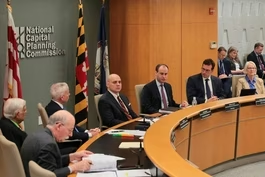
NewNews Wrap: Planning commission approves ballroom project
Video has Closed Captions
News Wrap: National Capital Planning Commission approves Trump's ballroom project (6m 9s)
 New
NewRussian corruption fuels massive casualties in Ukraine
Video has Closed Captions
Russian corruption fuels massive casualties in Ukraine (8m 17s)
 New
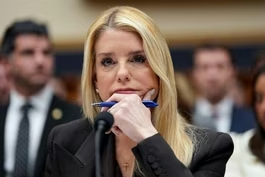
NewWhat's next for the Justice Department after Bondi's firing
Video has Closed Captions
What's next for the Justice Department after Bondi's firing (7m 3s)
 New
NewWorld leaders work to ease markets as Trump signals more war
Video has Closed Captions
Global leaders work to ease oil price surge as Trump signals more weeks of Iran war (4m 53s)
Providing Support for PBS.org
Learn Moreabout PBS online sponsorship
- News and Public Affairs

FRONTLINE is investigative journalism that questions, explains and changes our world.

- News and Public Affairs

Amanpour and Company features conversations with leaders and decision makers.
Urban Consulate Presents











Support for PBS provided by:
Major corporate funding for the PBS News Hour is provided by BDO, BNSF, Consumer Cellular, American Cruise Lines, and Raymond James. Funding for the PBS NewsHour Weekend is provided by...