
U.S. still a key ally for Europe, Finnish president says
Clip: 2/13/2026 | 6m 18sVideo has Closed Captions
World order in transition, but U.S. is still a key ally for Europe, Finnish president says
At the Munich Security Conference, Nick Schifrin spoke with Finnish President Alexander Stubb about the future of Europe's relationship with the United States.
Problems playing video? | Closed Captioning Feedback
Problems playing video? | Closed Captioning Feedback
Major corporate funding for the PBS News Hour is provided by BDO, BNSF, Consumer Cellular, American Cruise Lines, and Raymond James. Funding for the PBS NewsHour Weekend is provided by...
Support provided by:

U.S. still a key ally for Europe, Finnish president says
Clip: 2/13/2026 | 6m 18sVideo has Closed Captions
At the Munich Security Conference, Nick Schifrin spoke with Finnish President Alexander Stubb about the future of Europe's relationship with the United States.
Problems playing video? | Closed Captioning Feedback
How to Watch PBS News Hour
PBS News Hour is available to stream on pbs.org and the free PBS App, available on iPhone, Apple TV, Android TV, Android smartphones, Amazon Fire TV, Amazon Fire Tablet, Roku, Samsung Smart TV, and Vizio.
Providing Support for PBS.org
Learn Moreabout PBS online sponsorshipNICK SCHIFRIN: To discuss all of this, I spoke with Alexander Stubb, the president of Finland.
President Stubb, thanks very much.
Good to see you.
The German chancellor, Friedrich Merz, opened this conference saying the current world order as we know it is over.
And the written report that was published ahead of this conference blamed President Trump for -- quote -- "taking the axe" to the system that has ensured European security for decades.
Do you agree with those statements?
ALEXANDER STUBB, President of Finland: No, I've just written a book saying that the world order is actually in transition.
So let's not throw the baby out with the bathwater.
World orders change.
After World War I, it lasted for two decades, after World War II, for four decades, and after the Cold War for three decades.
And now we're looking for something new.
And, for me, it's very important that the transatlantic partnership still stands in the middle of it.
NICK SCHIFRIN: There is enormous angst among some of the Europeans I speak to.
And I acknowledge it's divisions within Europe, but, still, enormous angst.
And I had a European foreign minister at this conference tell me that Europe cannot defend itself conventionally, lack of a trust in the United States or losing trust.
This minister is going to raise the idea of more European countries getting nuclear weapons beyond France and the United Kingdom.
Is that a conversation that's actually been happening?
Is that a good idea?
ALEXANDER STUBB: Well, first, I disagree with the minister in question.
I mean, the full Finnish defense composure, with 830 miles of border with Russia is based on our capability to defend ourselves.
NICK SCHIFRIN: Conventionally.
ALEXANDER STUBB: Conventionally.
The reason we have one million men and women who have been trained in Arctic conditions.
We have 62 F-18s.
We just bought 64 F-35s.
We have long-range missiles, air, land and sea, and we have the biggest artillery in Europe together with Poland.
So I don't want to hear anyone telling me that we can't defend ourselves.
Then, as far as nuclear weapons are concerned, I think we still need the U.S.
nuclear umbrella.
NATO is based on three deterrent pillars, and nuclear is one of them, of course, we have some nuclear weapons in the U.K., obviously in France, but the key umbrella comes from the United States.
NICK SCHIFRIN: Chancellor Merz said today that he was speaking to Emmanuel Macron of France the idea of France providing protection to Europe with its own nuclear weapons, something that France, a decision that France has not made yet.
Is that a sign, you think, that there is some doubt in the U.S.
nuclear umbrella?
ALEXANDER STUBB: No, I don't think there should be any doubt in that.
I think the whole nuclear posture of the world is changing, in the sense that previously had two big players, Russia and the U.S.
Now you have a third one, in other words, China with 600 nuclear warheads.
NICK SCHIFRIN: Going to 1,500.
ALEXANDER STUBB: Going to 1,500.
So this sort of changes the landscape.
And, of course, Europe has to look at its own protection, but, at the end of the day it is in the vested interest of the United States to give the nuclear umbrella to Europe and for Europe to accept that as well.
NICK SCHIFRIN: You have a close relationship, of course, with President Trump, as many have pointed out.
And some of your European counterparts, I think, have taken a lesson from the Greenland crisis and why President Trump chose to defuse that or take the off-ramp that was offered him by the secretary-general.
And that is that strength, the European strength pushing back against President Trump, rather than giving in, somehow was a better way to deal with President Trump.
Is that how you see it?
ALEXANDER STUBB: Well, I mean, always in diplomacy you can either de-escalate or then you can escalate to de-escalate.
I think that it's always best to do the de-escalation publicly and the escalation privately.
NICK SCHIFRIN: So is that how Greenland got solved?
Publicly, you reassured the president, but actually privately you said, hey, this is a little bit of threatening?
ALEXANDER STUBB: No.
No, no.
I mean, no, I think what we had were three scenarios, the good, bad and the ugly.
So the good was to de-escalate, find an off-ramp and focus on Arctic security.
A bad one was a trade war and increase of tariffs.
And the ugly one was the continued threat of a military threat.
So we sort of played two and three out, and now we're working on number one.
And I think these kinds of off-ramps and processes are important.
NICK SCHIFRIN: Let's talk about Russia a little bit, of course, as you mentioned, the longest border with Russia and NATO.
Russian forces are building up or have been building up military bases on the other side of Finland infrastructure as well.
What do you think Russia is after and how concerning have Russian moves been, in your opinion?
ALEXANDER STUBB: Well, again, we're not concerned.
And we also accept the fact that there have always been Russian troops or Soviet troops by our border.
And when the war ends, there will be more.
I actually think that Russia is losing this war.
I think starting the whole war with Ukraine was a strategic mistake of Putin.
He wanted to Russify Ukraine.
It's becoming European.
He wanted to prevent the enlargement of NATO.
He got Finland and Sweden.
And he wanted to keep European defense expenditure down, and we're going to 5 percent.
So I'm not excessively worried.
And I don't like this rhetoric that the Nordics are next or the Baltics are next.
No.
No, they're not.
I mean, Russia is not going to test Article 5.
NICK SCHIFRIN: But does that mean that Russia is not the long-term threat that... ALEXANDER STUBB: It is a long-term threat.
NICK SCHIFRIN: OK.
ALEXANDER STUBB: There's no question about that, because in its DNA is imperialism and expansion.
It's done that throughout its history.
And to, be honest, it hasn't been able to cope with its own history in an honest kind of way, Soviet era or otherwise.
I think what we need to do in the future is to make sure that those imperialistic threats don't move over to the Southern Caucasus or to Central Asia.
NICK SCHIFRIN: Do you think Putin, do you think Russia is serious in the conversations about ending the war?
ALEXANDER STUBB: I hope they are.
But some people are saying that Russia is not ending this war because they want to continue to acquire territory.
I don't believe in that at all.
I think Russia is not able to end this war because the social and political cost for Putin not being able to pay the soldiers when they go back is too high.
So that's why I'm skeptical about Putin's intention.
NICK SCHIFRIN: Finland President Alexander Stubb, thank you very much.
WILLIAM BRANGHAM: You can see an extended version of Nick's interview with President Stubb and other leaders at the Munich Security Conference on "Compass Points."
Find that on our YouTube page and on your local PBS station this weekend.
After 3 years of war, Sudan faces worst humanitarian crisis
Video has Closed Captions
Clip: 2/13/2026 | 6m 43s | After 3 years of relentless war, Sudan faces world's worst humanitarian crisis (6m 43s)
Brooks and Capehart on what's next as ICE leaves Minnesota
Video has Closed Captions
Clip: 2/13/2026 | 11m 8s | Brooks and Capehart on what's next as ICE leaves Minnesota (11m 8s)
Citizens detained by immigration agents describe treatment
Video has Closed Captions
Clip: 2/13/2026 | 8m 28s | U.S. citizens detained by immigration agents describe how they were treated (8m 28s)
European weighs self-defense as U.S. reliability questioned
Video has Closed Captions
Clip: 2/13/2026 | 3m 22s | European leaders warn of urgent need for self-defense as U.S. reliability questioned (3m 22s)
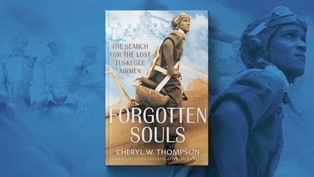
'Forgotten Souls' explores the missing Tuskegee Airmen
Video has Closed Captions
Clip: 2/13/2026 | 6m 34s | 'Forgotten Souls' explores the legacy of the missing Tuskegee Airmen (6m 34s)

James Brown joins Amna Nawaz on ‘Settle In’
Video has Closed Captions
Clip: 2/13/2026 | 2m 12s | James Brown and Amna Nawaz discuss protest in sports on ‘Settle In’ (2m 12s)

News Wrap: Data shows inflation easing at start of year
Video has Closed Captions
Clip: 2/13/2026 | 6m 52s | News Wrap: Economic data shows inflation easing at start of year (6m 52s)
Providing Support for PBS.org
Learn Moreabout PBS online sponsorship
- News and Public Affairs

FRONTLINE is investigative journalism that questions, explains and changes our world.

- News and Public Affairs

Amanpour and Company features conversations with leaders and decision makers.
Urban Consulate Presents











Support for PBS provided by:
Major corporate funding for the PBS News Hour is provided by BDO, BNSF, Consumer Cellular, American Cruise Lines, and Raymond James. Funding for the PBS NewsHour Weekend is provided by...