
After 3 years of war, Sudan faces worst humanitarian crisis
Clip: 2/13/2026 | 6m 43sVideo has Closed Captions
After 3 years of relentless war, Sudan faces world's worst humanitarian crisis
The United Nations is accusing a paramilitary group in Sudan of committing widespread atrocities that amount to war crimes and possible crimes against humanity. The nearly three years of relentless conflict in Sudan have triggered the world’s largest humanitarian crisis. Amna Nawaz discussed the situation with Ann Curry.
Problems playing video? | Closed Captioning Feedback
Problems playing video? | Closed Captioning Feedback
Major corporate funding for the PBS News Hour is provided by BDO, BNSF, Consumer Cellular, American Cruise Lines, and Raymond James. Funding for the PBS NewsHour Weekend is provided by...
Support provided by:

After 3 years of war, Sudan faces worst humanitarian crisis
Clip: 2/13/2026 | 6m 43sVideo has Closed Captions
The United Nations is accusing a paramilitary group in Sudan of committing widespread atrocities that amount to war crimes and possible crimes against humanity. The nearly three years of relentless conflict in Sudan have triggered the world’s largest humanitarian crisis. Amna Nawaz discussed the situation with Ann Curry.
Problems playing video? | Closed Captioning Feedback
How to Watch PBS News Hour
PBS News Hour is available to stream on pbs.org and the free PBS App, available on iPhone, Apple TV, Android TV, Android smartphones, Amazon Fire TV, Amazon Fire Tablet, Roku, Samsung Smart TV, and Vizio.
Providing Support for PBS.org
Learn Moreabout PBS online sponsorshipWILLIAM BRANGHAM: The United Nations is accusing a paramilitary group in Sudan of committing widespread atrocities that amount to war crimes and possible crimes against humanity.
In a report out today, the U.N.
found more than 6,000 people were killed in the first three days of the Rapid Support Forces offensive in El Fasher, which is in Sudan's Northwestern Darfur region.
It's been nearly three years of relentless conflict in Sudan, and it has triggered the world's largest humanitarian crisis.
Amna Nawaz filed this report earlier.
AMNA NAWAZ: This week, hundreds of shelters at a displacement camp in the North Darfur region of Sudan were burned down, pushing an already traumatized people through more hardship.
What began as a power struggle between Sudan's military and the paramilitary Rapid Support Forces has now become one of the world's gravest humanitarian crises.
Nearly two-thirds of Sudan's population now need assistance, with hunger rising, health systems shattered, and families fleeing across borders.
Veteran journalist and humanitarian Ann Curry has made her way to South Sudan, is at a camp for displaced people, and joins me from there now.
So, Ann, you're there on the border with Sudan -- in South Sudan.
What more can you tell us about the impact this war has had in the state of that war today?
ANN CURRY, Journalist: Well, as you well know, "News Hour" has been reporting in fact that this catastrophic war in Sudan has caused the world's largest humanitarian crisis, and it has got unprecedented numbers of displacement, recently rising to 13.6 million people.
And many are fleeing to neighboring countries, and about a million have arrived here in South Sudan since the war started, about three years ago, Amna.
AMNA NAWAZ: With so many people displaced, I'm sure the stories that you're hearing are just heartbreaking.
Can you tell us more about where exactly you are and what you're seeing there?
ANN CURRY: I'm on the border of Renk in South Sudan.
It's in the northernmost part of South Sudan.
And this is where people, survivors have been arriving by bus and by car, by donkey cart and by foot.
And they're arriving hungry and thirsty and they're in need of -- desperate need of shelter.
But there is a massive gap now as you well know as you have been reporting between the need, the desperation here and the humanitarian tearing funding cuts, especially from the United States.
And this has caused a lot of extra suffering here.
I can tell you I'm walking into a transit center which was set up by UNHCR, which is the United Nations Refugee Agency.
And this center was built to house 3,000 people.
And it -- they were supposed to be here just for a few days.
And they're given blankets and they're given tents and they're given best basic necessities.
But, in fact, there are 9,000 people here, Amna.
And what you're going to see here is not just these buildings, which are the shelters.
But you're going to see that there are so many people that there are makeshift tents here.
People are sleeping outside in the elements.
Children are among them.
You can see they have used fabric to figure out a place to stay.
UNHCR is heartbroken about this, as are all humanitarians in the area, because not only are these people who have fled war and persecution and seen violence and experienced trauma in great need.
They are really hoping for the world's compassion, Amna.
AMNA NAWAZ: And, Ann, have you been able to speak to any of the people or any of the families who've arrived there?
Have they shared with you what they went through just to get to this camp?
ANN CURRY: That's right.
Some -- one actually said that she had traveled for years.
What has been happening is, they are experiencing -- in many cases, they tell me about being struck with aerial bombs, being in areas that are being bombed from the sky, running with their children, not always able to grab all of their children.
There was a woman we spoke to who carried her mother, her elderly mother, on her back because she was aging and ran with four kids and keeping them all in line to leave as the bombs were falling.
And she said that her mom eventually died.
And so that's the story we're hearing.
People did not want to leave Sudan.
What they wanted is to find a safe place, and then they couldn't find a safe place.
And so they ended up having to cross the border and come here.
AMNA NAWAZ: As you have mentioned, the impact of the funding cuts, their not being enough support.
What does the future hold for these families?
And is there any hope for more international intervention?
ANN CURRY: Well, there are movements, but there isn't any clear sense that the funding will come.
I think that there is a real wish that the world will know that people here exist and will care about their suffering, even in this time when we are distracted by so much else in the world, that we will know that these people matter.
We have also been able to document, in speaking to these survivors, that some have described not only seeing with their own eyes people being killed on the streets and running, but one told us today she witnessed sexual violence upon women and was herself a victim and that they're -- and this was in an attack.
So I think the atrocities, when the full story is told about what is exactly happening in Sudan -- and we should probably also mention that there is a tremendous famine occurring in several parts of the country that has reached acute levels, and that in some areas more than 50 percent of the children are at such acute levels that there is fear that they could succumb.
So hope is hard to find.
But the ultimate hope is in us, is in the people in the outside world and whether we have the capacity, the compassion still within us to care for people who are suffering the most in the world, or at least, one should say, in the largest humanitarian disaster in the world.
And AMNA NAWAZ: Ann, we're so grateful to you for helping to make sure that we can all bear witness along with you.
That is Ann Curry reporting from the South Sudanese border.
Ann, thank you.
ANN CURRY: Thanks, Amna.

Brooks and Capehart on what's next as ICE leaves Minnesota
Video has Closed Captions
Clip: 2/13/2026 | 11m 8s | Brooks and Capehart on what's next as ICE leaves Minnesota (11m 8s)
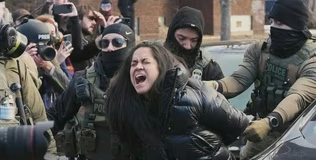
Citizens detained by immigration agents describe treatment
Video has Closed Captions
Clip: 2/13/2026 | 8m 28s | U.S. citizens detained by immigration agents describe how they were treated (8m 28s)
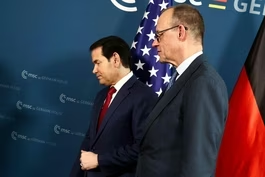
European weighs self-defense as U.S. reliability questioned
Video has Closed Captions
Clip: 2/13/2026 | 3m 22s | European leaders warn of urgent need for self-defense as U.S. reliability questioned (3m 22s)
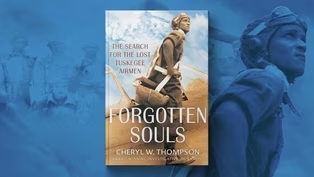
'Forgotten Souls' explores the missing Tuskegee Airmen
Video has Closed Captions
Clip: 2/13/2026 | 6m 34s | 'Forgotten Souls' explores the legacy of the missing Tuskegee Airmen (6m 34s)

James Brown joins Amna Nawaz on ‘Settle In’
Video has Closed Captions
Clip: 2/13/2026 | 2m 12s | James Brown and Amna Nawaz discuss protest in sports on ‘Settle In’ (2m 12s)

News Wrap: Data shows inflation easing at start of year
Video has Closed Captions
Clip: 2/13/2026 | 6m 52s | News Wrap: Economic data shows inflation easing at start of year (6m 52s)

U.S. still a key ally for Europe, Finnish president says
Video has Closed Captions
Clip: 2/13/2026 | 6m 18s | World order in transition, but U.S. is still a key ally for Europe, Finnish president says (6m 18s)
Providing Support for PBS.org
Learn Moreabout PBS online sponsorship
- News and Public Affairs

FRONTLINE is investigative journalism that questions, explains and changes our world.

- News and Public Affairs

Amanpour and Company features conversations with leaders and decision makers.
Urban Consulate Presents











Support for PBS provided by:
Major corporate funding for the PBS News Hour is provided by BDO, BNSF, Consumer Cellular, American Cruise Lines, and Raymond James. Funding for the PBS NewsHour Weekend is provided by...