
Trump Wants to Cap Interest Rates on Credit Cards. What It Could Mean for You
Clip: 1/20/2026 | 8m 34sVideo has Closed Captions
The president gave credit card companies until Jan. 20 to cap interest rates at 10%.
The White House has not provided any detail about what will happen to credit card companies that don’t lower card rates.
Problems playing video? | Closed Captioning Feedback
Problems playing video? | Closed Captioning Feedback
Chicago Tonight is a local public television program presented by WTTW
WTTW video streaming support provided by members and sponsors.
Trump Wants to Cap Interest Rates on Credit Cards. What It Could Mean for You
Clip: 1/20/2026 | 8m 34sVideo has Closed Captions
The White House has not provided any detail about what will happen to credit card companies that don’t lower card rates.
Problems playing video? | Closed Captioning Feedback
How to Watch Chicago Tonight
Chicago Tonight is available to stream on pbs.org and the free PBS App, available on iPhone, Apple TV, Android TV, Android smartphones, Amazon Fire TV, Amazon Fire Tablet, Roku, Samsung Smart TV, and Vizio.

WTTW News Explains
In this Emmy Award-winning series, WTTW News tackles your questions — big and small — about life in the Chicago area. Our video animations guide you through local government, city history, public utilities and everything in between.Providing Support for PBS.org
Learn Moreabout PBS online sponsorship>> President Trump is giving credit card companies until today to comply with this call to cap interest rates at 10%.
The proposal was unveiled this month as credit card debt reached a staggering 1.2, 3 trillion dollars in the 3rd quarter of 2025. the move is estimated to save Americans around 100 billion dollars after the first year.
But critics are sounding the alarm saying it would mean lower credit limits and more fees for consumers.
Joining us now by zoom are band finance professor at Loyola University.
Chicago's School of Business is also chair of the Finance Department and director of the risk management and Insurance Center.
And I see amend as president and CEO of the Woodstock Institute Institute, an organization dedicated to economic justice within financial systems.
Gentlemen, thank you both for joining us this evening.
Mr.
Mendez of like to start with you.
What was your reaction to the president's call for a 10% cap?
>> It was an unexpected because he's been talking about this for a while in the campaign trail.
I don't I want to provide a little bit of context for the talking do was create about 50 years ago to address the issue of redlining.
General you discussed during the show last night.
Well, I have a lot to do with mortgage lending.
We realize that the same practices exist in virtually every financial product throughout the financial industry, including small business, small farm in consumer lending like credit card.
So at the end of the day, we passed a number of lives and regulations that banned the practice of discriminating against viable customers, the most helpful manner in which to view the way the industry operates is kind of the same way you would view telling your 5 year-old to do something they don't want to do.
They'll do it, but they're not going to do it well.
And they're probably gonna make you pay one way or another.
So let's talk institutes purpose is to really dig deeply into the business model of how financial products and services are provided to segments of the out of the population that are traditionally ignored or preyed upon in trying to find a way for it to less.
So let's youth that lens to view this proposed credit card interest rate cap and filter it through credit card companies and banks really work for at the top of this financial food pyramid or shareholders.
could range from big institutional investors to your 401 k and nobody wants their retirement funds to underperform or go down and CEOs get to keep their jobs and their million dollar paychecks of their stock goes on.
So shareholders come first a close second.
Are the regulators since nobody wants end up in jail and they go too far in the pursuit of profit trailing in the rear consumers livelihoods and future depend on excessive responsible and affordable financial products and services.
So with this idea forces credit card companies and banks to make less money.
And there isn't any political or regulatory pressure to force him to just deal with it Paso floor profits on to their investors, then you're going to see them take a number of actions to limit those losses and try to find different ways to make money.
And I can walk you through what some of those actions might look like.
But they're not great from the consumer standpoint.
>> certainly some some concern from you and your colleagues about the potential fallout of this 10% cap K'Lavon.
Same question to you.
What was your reaction when you heard about this 10% limit?
I think I have.
First of thank you for having me.
>> I think I have 2 reaction.
Number one is that 10% is very arbitrary.
And the second question is that I have always felt that the interest rate that credit card companies or banks are charging.
He's probably one of the most one of the least transparent part of the financial transaction.
Be think the banks consumers what the rates really indicate, which is called average basically or a PR.
It's really not correct in a sense because if you are as a consumer late every months, then the rate that applies to you, it is going to be compounded and the reaction is going to be a lot higher.
And it is very interesting that the rate primarily determined by the by the banks and the Consumer Financial Protection Bureau really doesn't have any authority to regulate that right?
So I think it's a good idea to to focus on on the development the determination of that trade and to figure out how it has to be applied to various the structures of society.
Do you think there's some risk companies might simply increase annual fees to make up some of the difference?
If if the cap does go into place.
>> I think yes, because some of these fees, as I said, is a question of Some of those fees are are not clearly determined so they can basically had.
>> Those rates age is also possible that they may basically reduce level of funding to to some of the consumers.
And I think from a macro perspective, really the credit worthiness of a concealment is also a function of of of the financial, didn't receive education that consumers have had.
And I think just building on Rice who was was talking about in the United States, about 40% of the adult population is considered to be financially literate.
If you spend money and providing access to financial literacy education than their credit worthiness is going to increase and that these actually to a lower rate.
And that is also good for the credit companies.
So I like to propose that credit companies actually offer access to modify financial emergency education their consumers so that ripple effect Ascension you do sister age in the future?
Well, what I see are talking about some of the other possible ways to get at these issues that folks are concerned about them.
You know, Illinois has the Predatory Loan Prevention Act.
>> Do you think something like that could serve as a model for potential national legislation that tackles some of the same issues as folks were calling for a cap.
Want to see.
>> Absolutely globally.
There's mixed positions with regard to blanket 3 camps.
But when you think about the most and a Tory of the lenders were talking about title loans, high-cost installment loans, payday loans with an average interest rate of 391%.
Compare that with an average credit card interest rate, you know, opaque or not somewhere north of 20%, today.
So the administration really wanted to tackle the financial day-to-day drain of lending.
That's truly predatory.
They can learn a thing or 2 from one point.
Like you said, we pass a phone 2021, it mayor the military Lending Act which has a cap of 36%, which for a lot of people still was really high.
But these way to sell something new to politicians is to make it feel old use the military lending act and what we ended up finding was that the predatory lending industry said that Illinois would be in financial Armageddon if this long past he didn't happen.
Actually.
Bankruptcies in Illinois dropped compared to neighboring states that did not have the cap.
And in the first year of enactment, Illinois and saved 600 million dollars, at least 600 million dollars in taxes, interest and fees and then put that in a national context.
45 states and the District of Columbia have some version typically weaker.
Then what we have in Illinois engine at the fragmentation of the industry to be able to provide consumer loans working under 45 46, different rules.
So you're talking about trillions of dollars of savings that you had a national version.
enjoy what we enjoy here in Illinois.
>> Apple and we've got just about 30 seconds left.
But you know how much we mentioned that the huge debt Americans are facing.
How much have high interest rates contributed to that?
has a compounding effect really just the interest rate is added this year.
And then do you never know if that goes off?
And interest rate is added to >> Of the previous interest rate and the level of that that you have, I we are.
>> With.
>> As we talk about the debt to GDP ratio for the country.
I think if we add the consumer debt and the corporate debt, those numbers are more staggering done.
What we have to lean is a real problem.
>> Yeah, certainly a significant issue facing many folks and much more to talk about this topic.
But unfortunately, that's where we'll have to leave it
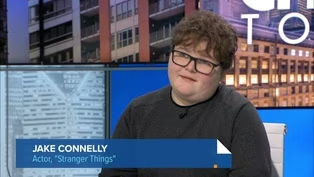
'Stranger Things' Actor Jake Connelly on His Character and Stardom
Video has Closed Captions
Clip: 1/20/2026 | 7m 57s | Meet the Chicago-area native who played Derek Turnbow on the Netflix series. (7m 57s)
Providing Support for PBS.org
Learn Moreabout PBS online sponsorship
- News and Public Affairs

Top journalists deliver compelling original analysis of the hour's headlines.

- News and Public Affairs

FRONTLINE is investigative journalism that questions, explains and changes our world.
Urban Consulate Presents











Support for PBS provided by:
Chicago Tonight is a local public television program presented by WTTW
WTTW video streaming support provided by members and sponsors.