
Trump backs down from threats to destroy Iran infrastructure
Clip: 4/7/2026 | 5m 26sVideo has Closed Captions
Trump agrees to 2-week ceasefire, backs down from threats to destroy Iran's infrastructure
President Trump is backing off, for now, from destroying Iran's civilian infrastructure and wiping out its civilization. He also said he agreed to suspend bombing for two weeks if Iran reopens the Strait of Hormuz. Trump called an Iranian proposal for a 10-point peace plan “a workable basis on which to negotiate.” Nick Schifrin reports.
Problems playing video? | Closed Captioning Feedback
Problems playing video? | Closed Captioning Feedback
Major corporate funding for the PBS News Hour is provided by BDO, BNSF, Consumer Cellular, American Cruise Lines, and Raymond James. Funding for the PBS NewsHour Weekend is provided by...
Trump backs down from threats to destroy Iran infrastructure
Clip: 4/7/2026 | 5m 26sVideo has Closed Captions
President Trump is backing off, for now, from destroying Iran's civilian infrastructure and wiping out its civilization. He also said he agreed to suspend bombing for two weeks if Iran reopens the Strait of Hormuz. Trump called an Iranian proposal for a 10-point peace plan “a workable basis on which to negotiate.” Nick Schifrin reports.
Problems playing video? | Closed Captioning Feedback
How to Watch PBS News Hour
PBS News Hour is available to stream on pbs.org and the free PBS App, available on iPhone, Apple TV, Android TV, Android smartphones, Amazon Fire TV, Amazon Fire Tablet, Roku, Samsung Smart TV, and Vizio.
Providing Support for PBS.org
Learn Moreabout PBS online sponsorshipGEOFF BENNETT: Welcome to the "News Hour."
President Trump is backing off for now his threat to destroy Iran's civilian infrastructure and wipe out its civilization.
In a social media post, he said he has agreed to suspend the bombing and attack of Iran for two weeks, calling it a double-sided cease-fire.
That's if Iran immediately reopens the Strait of Hormuz.
And the president added that the U.S.
received a broad proposal from Iran that is -- quote -- "a workable basis on which to negotiate."
Nick Schifrin starts our coverage.
NICK SCHIFRIN: Today, after rockets rained onto Tehran and U.S.
and Israeli strikes smashed buildings and carcasses, President Trump provided a reprieve, accepting Pakistani Prime Minister Shehbaz Sharif's proposal for the president to delay his ultimatum by two weeks and for Iran to lift its choke hold over the Strait of Hormuz also for two weeks.
This morning, President Trump's ultimatum was his most severe yet: "A whole civilization will die tonight, never to be brought back again.
I don't want that to happen, but it probably will," calling tonight's original deadline one of the most important moments in the long and complex history of the world.
DONALD TRUMP, President of the United States: Every bridge in Iran will be decimated by 12:00 tomorrow night.
NICK SCHIFRIN: Yesterday, President Trump said, if Iran didn't reopen the strait and make a deal, he would launch a four-hour bombing mission beginning tonight at 8:00 p.m.
Eastern, dramatically expanding last week's strike on a bridge that a U.S.
official says was a planned Iranian resupply route.
Military officials told "PBS News Hour," if the president ordered the new campaign, they would target bridges and power plants that have connections to the Iranian military.
J.D.
VANCE, Vice President of the United States: There are still some things that we'd like to do, for example, on Iranian ability to manufacture weapons that we'd like to do a little bit more work on militarily, but, fundamentally, the military objectives of the United States have been completed.
NICK SCHIFRIN: Today, in Budapest, Vice President J.D.
Vance, on a visit designed to politically support Hungarian Prime Minister Viktor Orban's reelection, said U.S.
demands included Iran halting all support for regional proxies, including Hezbollah.
J.D.
VANCE: They have got to know we have got tools in our toolkit that we so far haven't decided to use.
The president of the United States can decide to use them and he will decide to use them if the Iranians don't change their course of conduct.
NICK SCHIFRIN: But, today, Iran continued to strike the U.S.'
Arab Gulf allies, targeting a Saudi petrochemical complex.
Israelis rushed to shelters as Iranian missiles targeted Tel Aviv and its suburbs.
And, today, Iran's president called for volunteers to protect the country's infrastructure.
He said 14 million young Iranians answered the call to create human chains around bridges and even the country's nuclear facilities.
AMIR-SAEID IRAVANI, Iranian Ambassador to the United Nations: There must be no doubt Iran will take all necessary measures to defend its people.
NICK SCHIFRIN: And tonight's pause does not change Iran's long-term public demands, laid out today by Iran's U.N.
ambassador, Amir-Saeid Iravani, which, at least in public, includes financial control of the Strait of Hormuz.
But the U.S.
and Israeli campaigns in Iran also continued today, including what a U.S.
official identified as naval mine and missile storage and other military targets struck on Kharg Island, through which Iran exports 90 percent of its oil.
Israel also targeted some of Iran's railway network.
And one strike even hit a Tehran synagogue and its irreplaceable handwritten copies of the Torah.
Before President Trump's pause, Israeli Prime Minister Benjamin Netanyahu said the campaign would continue.
BENJAMIN NETANYAHU, Israeli Prime Minister (through translator): I tell you constantly that we are crushing the terrorist regime in Iran, but we are doing so with even greater vigor and with increasing force.
NICK SCHIFRIN: But, tonight, a White House official tells me that Israel too has agreed to stop firing and to the president's cease-fire, Geoff, and so it does appear that, at least for two weeks, this war is now over.
GEOFF BENNETT: And, Nick, what are the implications of the president's announcement tonight beyond this two-week delay, this two-week cease-fire?
Is there sort of an infrastructure here for a longer-term peace?
NICK SCHIFRIN: So I think the president is saying there is.
So I think the first part of that is that the U.S.
is emphasizing, U.S.
officials are emphasizing tonight that Iran has to reopen the Strait of Hormuz.
So none of this works unless there's a reopening.
So, assuming for a second there is a reopening, the president is emphasizing tonight that Iran's 10-point plan that it has sent to the United States over the last week or so is a -- quote -- "workable agreement" and a workable basis on which to negotiate.
Here's the thing about that 10-point plan, Geoff.
It includes things like Iran will maintain financial control over the Strait of Hormuz, the U.S.
and Israel have to send reparations to Iran and that the U.S.
has to lift all sanctions on Iran.
None of that, at least publicly, assuming that it's still in there, has been acceptable to the United States, Israel or any of its allies.
And so the president is emphasizing that we got the job done, we hit our marks militarily, now's the time for long-term peace.
But Iran still maintains the ability to launch missiles and drones across the region.
And, at least publicly, Iran's demands for that long-term peace are unacceptable to the United States, to the Israel and their allies.
So there is a long way to go if this is going to become anything more than a two-week cease-fire before the war resumes.
GEOFF BENNETT: Nick Schifrin, thanks, as always, for that reporting.
Thank you.
 New
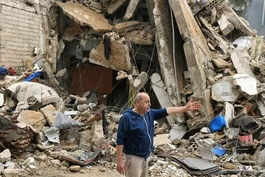
NewCivilians caught in path of Israeli invasion in southern Lebanon
Video has Closed Captions
Civilians caught in path of Israeli invasion in Lebanon (7m 57s)
 New
NewEstrogen patches face shortage as more seek hormone therapy
Video has Closed Captions
Estrogen patches face shortage as more women seek hormone therapy (9m 34s)
 New
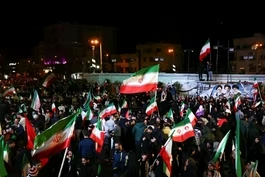
NewHow Iran is reacting as Trump pulls back from threats
Video has Closed Captions
How Iran is reacting as Trump pulls back from threat to wipe out civilization (4m 17s)
 New
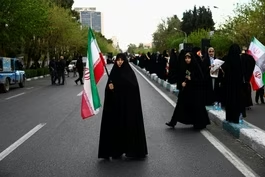
NewMideast experts weigh Iran's leverage in U.S. negotiations
Video has Closed Captions
Mideast experts weigh Iran regime’s leverage in negotiations with U.S. (8m 46s)
 New
NewNews Wrap: Vance backs Orbán in visit ahead of election
Video has Closed Captions
News Wrap: Vance backs Orbán in visit ahead of Hungarian elections (5m 32s)
 New
NewPatrick Radden Keefe joins Amna Nawaz on 'Settle In'
Video has Closed Captions
On 'Settle In,' Patrick Radden Keefe and Amna Nawaz discuss 'London Falling' (3m 38s)
 New
NewTBIs become defining injury for U.S. troops post-9/11
Video has Closed Captions
Traumatic brain injuries become defining injury for U.S. troops in post-9/11 conflicts (6m 52s)
Providing Support for PBS.org
Learn Moreabout PBS online sponsorship
- News and Public Affairs

FRONTLINE is investigative journalism that questions, explains and changes our world.

- News and Public Affairs

Amanpour and Company features conversations with leaders and decision makers.
Urban Consulate Presents











Support for PBS provided by:
Major corporate funding for the PBS News Hour is provided by BDO, BNSF, Consumer Cellular, American Cruise Lines, and Raymond James. Funding for the PBS NewsHour Weekend is provided by...