
April 17, 2026
4/17/2026 | 55m 20sVideo has Closed Captions
Gen. Stanley McChrystal (ret.); Aziz Abu Sarah; Maoz Inon; Michael Pollan
Gen. Stanley McChrystal (ret.) analyzes the impact of the U.S.' war in Iran. Palestinian peace activist Aziz Abu Sarah and Israeli peace activist Maoz Inon discuss their new book "The Future Is Peace" and finding hope in unbearable loss. Best-selling author Michael Pollan explores our collective consciousness in his new book "A World Appears."
Problems playing video? | Closed Captioning Feedback
Problems playing video? | Closed Captioning Feedback
April 17, 2026
4/17/2026 | 55m 20sVideo has Closed Captions
Gen. Stanley McChrystal (ret.) analyzes the impact of the U.S.' war in Iran. Palestinian peace activist Aziz Abu Sarah and Israeli peace activist Maoz Inon discuss their new book "The Future Is Peace" and finding hope in unbearable loss. Best-selling author Michael Pollan explores our collective consciousness in his new book "A World Appears."
Problems playing video? | Closed Captioning Feedback
How to Watch Amanpour and Company
Amanpour and Company is available to stream on pbs.org and the free PBS App, available on iPhone, Apple TV, Android TV, Android smartphones, Amazon Fire TV, Amazon Fire Tablet, Roku, Samsung Smart TV, LG TV, and Vizio.
Watch Amanpour and Company on PBS
PBS and WNET, in collaboration with CNN, launched Amanpour and Company in September 2018. The series features wide-ranging, in-depth conversations with global thought leaders and cultural influencers on issues impacting the world each day, from politics, business, technology and arts, to science and sports.Providing Support for PBS.org
Learn Moreabout PBS online sponsorship[ Music ] >> Hello everyone and welcome to Amanpour and Company.
Here's what's coming up.
>> The only thing that really matters is the outcome of the contest.
And so what I think we need to think about is not trying to talk our way to victory, although there's obviously a narrative in every case, but to let the actions on the ground and the outcome with our allies be what speaks for us.
>> Reshaping the world order or more of the same?
How long will the United States remain in the Middle East?
I asked General Stanley McChrystal, one of America's most influential military leaders.
Then... We can counter those war mongers by crying together, by supporting each other and working together, working together to achieve dignity and quality for all, security and safety both for Palestinian Israelis and across the Middle East.
The future is peace, a plea from one Palestinian and one Israeli, using their shared trauma to build bridges.
Will their call be heard?
Plus... It's the one thing we all know for sure.
Everything else we know is an inference.
The material world out there is all mediated by consciousness, yet we have a lot of trouble saying what it is.
understanding consciousness one of nature's great mysteries perspectives from science philosophy spirituality and more [Music] Amenpour & Company is made possible by The Anderson Family Endowment Jim Atwood and Leslie Williams Candice King Weir The Sylvia A. and Simon B. Poita Programming Endowment to Fight Antisemitism The Strauss Family Foundation The Peter G. Peterson and Joan Gantz Cooney Fund Charles Rosenblum Monique Schoen Warshaw Ku and Patricia Ewan Committed to Bridging Cultural Differences in Our Communities.
Barbara Hope Zuckerberg.
And by contributions to your PBS station from viewers like you.
Thank you.
- Welcome to the program, everyone.
I'm Christiane Amanpour in London.
The United States is currently locked in a stalemate standoff with Iran and facing an escalation trap that could prove highly costly to a nation scarred by the memories of Iraq and Afghanistan, not to mention costly to Iran, as well.
On the other hand, President Trump indicates another round of talks could take place soon, with Pakistan again hosting.
From the very start of this war, Donald Trump never laid out a coherent exit strategy, and the regional implications have been massive, a complete upheaval all over the Middle East, with Gulf allies of the U.S.
dragged into a war they wanted no part of.
Are there winners and losers, and who are they?
Does this war set the United States on an accelerated route out of the Middle East?
My first guest has unique and valuable perspective on all of this, retired four-star General Stanley McChrystal, led U.S.
and NATO forces in Afghanistan, and before that was Special Forces Commander in Iraq, where he led missions to capture Saddam Hussein and finally kill the al-Qaeda leader Abu Musab al-Zarqawi.
General McChrystal is joining me now from Washington.
Welcome back to the program.
>> Thank you for having me, Christiane.
>> So, look, this war between the United States and Iran -- and I'm not even sure whether the United States has declared it officially a war, but it has veered and swung from the early parts to now.
Would you say right now, with this U.S.
blockade of Iranian ports, that for the moment, it's swung back to the U.S.
advantage?
Like, the amount of hold Iran had on the Hormuz Strait is now America's hold on Iranian ports.
Yeah, I think it's dangerous to look at a war, and this is a war because we're killing each other.
We may or may not declare it, but that's what on the ground it is.
To look at it like a game where we go by innings and see what the score is in the second inning of the third inning and the fourth inning.
In reality, the only thing that's going to matter is what happens at the end of the day.
And so, a cease-fire, which is a great thing, is not an outcome.
The outcome will take time, to be clear.
And as your lead-in said, that outcome won't just be how many targets we hit in Iran.
It won't be the length of our blockade and the straight of our moves.
It will be what the status or what is the condition of the region afterward.
What do our regional allies feel about their security?
How does essential commerce flow, primarily oil?
What kind of regime remains in Iran?
And what are their intentions?
And so all of those things will play out over time.
So I think it's too early for us to call the outcome.
Well, then I'm going to ask you, given what you say, that it shouldn't be viewed as innings.
I'm going to play what Secretary of Hegseth says often and said again today, excoriating the press, saying you can't see victory when it slaps you in the face.
Basically, I'm paraphrasing.
Donald Trump saying that we've decimated everything and we're having a really great victory.
This is Hegseth.
Operation Epic Fury was a historic and overwhelming victory on the battlefield.
A capital V military victory.
By any measure, Epic Fury decimated Iran's military and rendered it combat ineffective for years to come.
Do you agree with that?
Fundamentally, no.
I don't agree with the approach to it.
I used to play sports and you'd be play against people who talked a lot of trash.
The only thing that really matters is the outcome of the contest.
And so what I think we need to think about is not trying to talk our way to victory, although there's obviously a narrative in every case, but to let the actions on the ground and the outcome with our allies be what speaks for us.
>> I'm trying to figure out which you think is more important, 'cause I've heard you say "outcome with our allies."
So I do actually want to focus on that for a moment, because there really does seem to have been, you know, a total upheaval in the way the allies, i.e., the Gulf allies in this case, were looking at the United States for protection, hosting U.S.
bases.
And for them, their nightmare, their insurance policy, was precisely against Iran.
And they do not appear to have come out, you know, with that insurance having worked for them.
Would you agree?
And what do you think is the outcome for them?
I think they are in an uncertain position.
If we think back to which I know we both experienced our incursion into Iraq in 2003, there was the idea that we would remove a dangerous regime of Saddam Hussein.
And he was a dangerous person.
But in reality, Iraq was not a threat to us, certainly not to the United States and not generally to the world.
Iran regionally has been a threat to the Gulf states, of course a threat to Israel.
The question will be, at the end of this, have we created the conditions for them to have unity of effort for us to put together a strategic framework that guarantees commerce, that guarantees the ability to do collective defense against the kinds of threats that Iran can put forward.
And to be sure, Iran has been weakened militarily tremendously.
But their biggest threats, really the biggest threat they posed in the past, really came through their proxies, through Hezbollah, through the Houthis, what we struggled with in Iraq.
And I don't think that that capability has currently been reduced.
And some would say also their even bigger threat was their nuclear program.
Only, this is what analysts say, they have revealed that, actually, their biggest threat is the control or the ability to control the Strait of Hormuz.
So, when the next round of talks happens, if it does, do you think they go in strong on the Strait of Hormuz or now weak on the Strait of Hormuz?
And could the United States again say, "These are our terms, and now take them or leave them"?
>> Well, I think in this particular case, the United States has got to establish freedom of navigation through the straits.
And that won't be just the United States, but that has got to be the outcome.
The challenge there, of course, by geographic location, is it doesn't take a lot for Iran to maintain enough threat to make commercial shipping too high risk for most companies to do.
And so we would have to likely completely destroy Iran's capability, which might mean putting soldiers and Marines on the ground to do that.
And so a negotiated settlement that opens up that strait, I think has to be a critical or maybe the critical outcome.
>> Okay, so, given the last round failed, or now they're saying there was enough progress to have another round, what do you think -- If you could, because, you know, you did sort of grow up as a young officer at the time of the 1979 Islamic Revolution.
You obviously studied the situation.
You've worked so much as an officer, as a commander, in the Middle East region.
What do you think the U.S.
side should know about their adversary and about how that adversary thinks and approaches negotiations.
Of course, I'm a great believer we should go back and reorient ourselves on the history, even just as recently as 1953, with the American and British involvement, the overthrow of the elected prime minister, the support of the Shah for decades.
And then, when the Iranian revolution came, there were two perspectives of what happened after that.
Our perspective is our people were taken hostage in the embassy.
There was a series of friction points.
An Iranian perspective, which can't be discounted, includes the fact that we helped Saddam Hussein during the Iraq-Iran war.
We shot down an Iranian airliner, mistakenly, but the USS Vincennes did that.
And so, from their standpoint, they see things very differently.
And after the invasion of Iraq, you had American forces on the West in Iraq, American forces on the East in Afghanistan, the American fleet to the South.
And so I think it would be expected that the Iranians would feel as though we were surrounding and constraining them, whether that was our intent or not.
I think one of the most important things is warfare is understanding what motivates your enemy.
What's their frame of reference?
Because if we think that everybody sees it the same and they're just being difficult, I think that's a big mistake.
And so the people who are leading Iran now have gone through a problematic last few decades.
And so particularly that the Iranian Revolutionary Guard Corps, those are some pretty determined people.
And so I think we need to take that into account.
>> And what -- you know, the opposite side, what do you think, given the beginning of this year when President Trump literally did a pivot and went from no foreign wars to many foreign wars, including the decapitation of the leadership in -- well, the leader in Venezuela, and now this, what do you think the Trump doctrine is?
Do you see a coherent Trump doctrine for the world?
I think that the administration and the president are still formulating their doctrine.
I think they have used military force in Venezuela and now in Iran.
And there is a reinforcing aspect to it.
We were able to bring out the president of Venezuela.
We were able to hit a tremendous number of targets with relatively limited American losses in Iran.
The problem with military force is it has its limits.
I refer to the length of the dog's chain.
Once you bomb Iran for 30-plus days and you don't topple the government, at a certain point they become a nerd to it.
And I think that when you see American military force, you're awed by the technology, as people should be.
But there are limits to what it can do, both by how much we can apply, how long we can apply it, and then our own limits.
You know, we can have thousands of nuclear weapons, but if we aren't willing to nuke somebody, it's really not a threat to them that they have to take seriously.
And so I think having a doctrine that says, a muscular U.S.
doctrine, that by some people can be viewed as adventurism or going places that we wouldn't have otherwise gone, it can be a challenge.
I believe we need a strong military.
I think we need a strong policy.
But I would like to see us respond to the behaviors of a country like Iran more than to say we have to topple their regime.
Because once we talk about regime change anywhere, we start to make everybody a bit nervous.
You know, you just talked about nuclear weapons, and I don't know whether you sort of absorbed it, but many people around the world were really afraid that Trump was signaling the use of a nuclear weapon when he said about Iran, "We will, you know, wipe out your civilization.
You'll never recover from it."
I don't know what you thought, but also the threat against power plants and bridges.
People were saying that that could constitute a war crime because many of those are for civilian use.
It's civilian infrastructure.
What do you think would have happened to US service people, whether in their bombers or wherever they might be, operating their drones or whatever, had they followed those orders?
- I think any time we even hint at the use of nuclear weapons, there's a danger to it worldwide.
Because we threaten to lower the threshold for anyone who has nuclear weapons to contemplate using them.
Remember, a few years ago, we were worried about Vladimir Putin using them in Ukraine.
I don't think he was going to do it.
But as soon as you start to talk about it a lot, it seems to become more of a realistic possibility.
And I don't think that we should be pushing in that direction.
Similarly, if we talk about destroying the infrastructure of a country, I think we need to think the long-term implications of that.
I believe that, over time, what we're hoping to happen is Iran becomes a regional player in the Mideast, a sovereign country with a healthy economy that's part of the world order.
And the more damage we do, the longer it takes them to get back and be in a position to be that.
Let me ask you to respond to what a former officer, a former official in the in the Pentagon said.
This is Wes J. Bryant, who blew the whistle on dismantling the office at the Pentagon, which was charged with reducing civilian harm.
And we were speaking about the bombing of the girls' school in Minarb on day one, which it's been essentially forensically looked at, and essentially the United States does not admit it.
This is what he said, basically, you know, for adhering to the laws of war.
When the Trump administration states that part of their mission here anyway is to free the oppressed Iranian people, well, killing hundreds, likely thousands of civilians, including small children.
And then on top of that, showing absolutely no remorse for it, doesn't send that message whatsoever.
And then what you have is, you're very clearly, you're going to turn the population against the US cause.
- And given that Hegseth has said, has disparaged the so-called rules of engagement, what do you make of what Brian said?
You've been, you know, in the field trying to win hearts and minds.
First, there is a law of war which we have to adhere to because we want other people to adhere to the law of war.
And we've been pretty good about that.
We make mistakes and we cause collateral damage, but hopefully it's never done intentionally.
The other part of it is the narrative around the use of American power.
And that is, as you'll remember from my time in Afghanistan, became a point of discussion because what we were trying to do is win the support of the Afghan people.
I think with our actions in Iran, we should be trying to win the support of the world.
We should be showing people that our use of military force has a level of maturity, reflects values that they can respect.
We become the kind of country that people want to ally with and, I think, a responsible player in the world.
So to have a responsible military, you've got to have one, as you say, that follows the rules, international law, et cetera, and also has buy-in.
What do you make, in all your years as a soldier and an officer, now retired, of the Pentagon, what we know about firing people based on DEI and other political grounds, talking about stopping promotions based on similar criteria?
What do you think, in general, that will do to the military?
>> Well, I think it's disappointing and I think it's dangerous.
There are comparisons made sometimes to General George Marshall's cutting a number of general officers before the Second World War.
But he did it for an entirely different reason.
He was taking out aging people who he knew wouldn't be prepared to lead effectively in what he assumed was going to be America's entry into the Second World War.
There's also a perception that this is sort of like a corporate turnaround.
You have a new CEO come into the Department of Defense and bring the people together and tell them they're not focused enough and they're overweight, and start to purge those people who aren't effective.
You know, that could be -- that could be a good move, a necessary move, but that's not my perception of what's happened.
My perception of what's happened is, you have had very capable leaders, very respected leaders removed largely for political reasons.
And so, when that happens, even just the perception of it happens, it resonates through the force.
We've always had, particularly for the last 60 or so years, we've had a very apolitical military.
And we want that.
We don't want Republican and Democratic generals.
We want a military that is very connected to the civilian leadership and subservient to it.
But at the same time, we want a technocratic ethos in it that says we are going to serve the popularly elected leaders.
But we also expect that the force is going to be protected from the idea that if you aren't aligned enough with a certain political feeling, that you are vulnerable.
I think that would be a mistake.
And I think we've lost too much talent already.
>> It's really important to hear that.
General Stanley McChrystal, thank you so much for being with us.
>> Thank you.
I appreciate you having me.
>> There is so much despair in the Middle East, it is hard to know where to start.
In Gaza, the brutality of Israel's response to the grotesque Hamas attacks of October 7th is still being felt.
Annexation by another name is taking place in the occupied West Bank.
Hope is in short supply.
But it still burns bright in my next guest, who have opted for friendship and peace despite suffering unbearable loss.
Palestinian Aziz Abu Sarah and Israeli Maoz Inon just released a book called "The Future is Peace, "A Shared Journey Across the Holy Land."
Their commitment and belief are enough to melt the hardest of hearts, as I found.
Aziz Abu Sarah and Maoz Inon, welcome to the program.
>> Thank you.
>> Thank you for having us.
>> And we've spoken before about how difficult it is to, you know, to have peace when you've both experienced and your peoples have both experienced such trauma.
So, let me first ask you where you stand, how you're feeling right now, Maoz.
Your parents were brutally murdered on October 7th when Hamas stormed even their kibbutz, their village, and burnt the house to the ground.
What kind of pushback did you get when you basically put out a family statement saying that you were not seeking revenge, rather peace?
Yes, only two days after losing our parents and many of our childhood friends and people we knew my entire life, me, my three sisters and my young brother, we took a decision.
We took a decision not to reject revenge, that we don't want to avenge the death of our parents, realizing avenging their death will only escalate the cycle of bloodshed, terror, and suffering and we, Palestinian Israelis, have been trapped with for a century.
And of course it's not going to bring them back to life.
And we say it's within our family mission, based on our parents, beloved parents' legacy, to break this cycle and pave a new path, a path to peace and reconciliation.
And two days after making this decision, Aziz reached out to me.
Aziz reached out to me, offering his condolences, and it was exactly the end we needed.
We needed to save ourselves from drowning into the ocean of sorrow and pain.
>> It's really a remarkable story, and, Aziz, obviously, you two knew each other, and you reached out to Maoz, and I think you wondered whether you should.
I mean, when you hear what Maoz is saying -- I'm going to get to your tragedy in a second -- but as the other side, so to speak, when you hear what he's saying about what happened to his parents, the decision they made as a family, what did you think and what was making you hesitate from reaching out yourself?
Well, the only hesitation is, would he respond or does he want to hear from me right now?
I've known, I was very briefly, I only met him once about 10 years earlier, but it felt like it would be a mistake not to reach out.
It's in times of these that empathy is very important, and in times of these that we should take out those lines of Israeli and a Palestinian and see each other as a human being, and that every life matters.
>> And, Maoz, how did you react to Aziz, given that he lost his own brother at the hands of Israelis during the first intifada, Tayseer, who was so close to him?
And I'll ask you about him, Aziz, but how did you feel about Aziz reaching out to you?
>> I just sent him back a broken heart, because my heart was broken at the time.
And like Aziz shared, we didn't really know each other.
So, just a week after, we went on our first meeting on Zoom, and Aziz shared with me about his brother, about his personal loss and tragedy, and also how we overcome and how we choose also to work for peace, to avoid others, to suffer from the same pain he suffered.
And then in the last two and a half years, we've been working together, co-authoring The Future is Peace and speaking in many places.
And now I can say proudly, I can proudly say that, yes, I lost my parents on October 7th, but I want Aziz.
I want Aziz as a brother.
So, again, every time, I want to, again, acknowledge that and to thank him for being there for me in the most devastating time of my life.
>> So, what you just did was really beautiful and surprising.
I haven't had people hug on air, particularly in this circumstance, and it's really something to behold.
Tell me about Taysir Aziz, the brother you lost.
>> Yeah, Taysir is -- I'm the youngest of seven.
Taissier is the one just older than me.
We are nine years difference.
We share the same room.
We shared actually the same bed.
And he functioned more as my parent than as my brother.
He's the one who took me to school.
And my first day, he was arrested from home, an allegation of throwing rocks.
He was 18 at the time.
I was nine.
He was tortured in prison, which resulted in his death.
As soon as he got out of prison, he was 19 at the time and I was 10.
And it was, I felt like an orphan at that point.
I felt like I've lost the person who protected me all my life.
- And I have to say, as you're speaking, and both of you, you know, Moaz, you're talking about trying to, you know, bridge the gap and have some peace.
And Aziz, you're talking about this torture in prison.
It's still all going on.
I mean, it's still going on in the midst of the current war on Gaza and even on the West Bank that hasn't stopped yet.
And it's keeping the communities apart in a very real way.
But I want to quote something from what you wrote, Aziz, about the moment you told Maoz how long it took you to move past the pain of losing Taysir.
You said... "the pain and bitterness that was consuming me from within."
The first time Maoz and I spoke, I asked him how he was able to make the transition so quickly.
Do you remember what you told me, Maoz?
"When you are in a desert, you cry out for water.
When you are in a war, you cry out for peace."
That's exactly where I was after losing my parents.
I was crying day and night, and I was crying for peace.
And so, it's when Aziz reached out to me and many other Palestinians, and I reached out to others, and now, thanks to Aziz, I have many friends in Gaza, in the West Bank, in Lebanon, in Jordan, and even in Iran.
And we believe that when our tears come together, this is the cure.
This is the cure for the bloodshed, for the devastation, for the polarization that politicians, unfortunately, thrive upon.
And we can counter those war mongers by crying together, by supporting each other, and working together, working together to achieve dignity and quality for all, security and safety both for Palestinian Israelis and across the Middle East.
And this is exactly the work we are doing.
>> Yes, unfortunately, as you put it, the war mongers are still in charge, and the peace nix, the peace camp is very much on the back foot.
I just want to ask you, before moving back to Aziz, when you reach out, as you said, you have friends in Gaza, on the occupied West Bank, even in Iran, Lebanon.
What do they say to you?
What do you say to them?
>> They -- Again, first, I share my empathy and offering my condolences, unfortunately, when it's needed, and it's needed.
And we just say, "What can we do together?
How we can act together to create hope?"
And this is something, Christian, I learned in your show.
When you interviewed my brother Magian and Hamze Awad, the Palestinian peace activist, only a few months after October 7th, you asked Hamze, "Hamze, how can you find hope?"
And Hamze said a beautiful sentence that basically this has been our motto ever since.
"Hope is in action.
Hope is in action that we create together by envisioning a better future and acting on the ground to make this vision into a reality.
The future is peace only if we work together and we see ourselves on the same side, the same side of equality and dignity, shared acknowledgement and recognition, justice and peace.
>> And what I hear there is you talking also about hearing the story of the other.
And, Aziz, you did that in a major way, as well.
At 18, you went to Yad Vashem, the Holocaust memorial in Israel.
What made you do that?
Why did you do it, and how did you come away feeling?
Until I was 18, the only Israelis I've known were soldiers and settlers.
And so at 18, I went and studied Hebrew.
I met this incredible teacher who was the first Israeli I met who treated me like a human being.
And one of the things she taught me is that I need to learn about what Israelis think, what their background is, what their feelings, what made Israelis who they are today.
And she challenged me and said, "You should go to Yad Vashem to learn about Jewish history."
And I did.
I took a bus, and I did on my own.
And I was terrified.
I honestly walked in there, seeing soldiers all over, and I felt, "Nobody wants me to be here.
I should just walk back."
But I continued.
And as you walk through, suddenly those lines, "I'm Palestinian, they Israeli," "I should empathize," "shouldn't empathize," all of that, it all falls apart, because the moment you see a human being suffering, the moment you see what humanity does to each other sometimes-and it's brutal-I could see myself in these people, and I didn't see them as the other.
And I remember, by the end, I was crying.
I was weeping, walking out of there, and I watched right after Schindler's List.
And there's a scene in Schindler's List in which he says-in the film, he says, "Only if I could have sold my ring, I could have maybe saved one more life."
And that stuck with me.
And I keep thinking, like Maoz said, what is it that we're not doing that could save one more life?
And the biggest lie we continue to be sold again and again and again by our politicians, by people who claim to be our leaders, is despair and hopelessness, and that we do not have a voice to change reality.
And what we're fighting against together with the Future's Peace, with everything we're doing, is saying that's not true.
Every one of us has the agency to change that future, and we should not give up or give in.
Despair is the end of our future, and we cannot give in to despair.
>> It's really heartwarming, and I just hope a lot of people listen to this.
You've also had encounters with the Pope, haven't you?
And Pope Francis, he called into Gaza, to the Catholic parish there, almost every day during the Gaza War.
Tell me, Maoz, what the Pope -- who have you met in the Vatican, and what did they tell you?
-Yeah, we met Pope Francis in May 2024 at the Arena di Pace in Verona.
And for two hours, Pope Francis was talking about the importance of dialogue, which makes sense and obvious, but also of the importance of conflict.
Pope Francis said that in a place there is no conflict, there is oppression.
And maybe it can happen only in cemetery and where everyone are already dead.
So we need to embrace the conflict.
We need to thrive and we can evolve through conflict.
And that we human beings are the only creature on planet Earth that can choose.
That can choose.
This is the divine part within each one of us.
That we can choose to solve conflict through dialogue and not through war.
And I think it was a very powerful message and it was an amazing -- For me, I keep saying it was out-of-body experience.
And when Pope Francis called us to approach him and when he embraced us, it was one of the greatest moment in my lifetime.
>> And, Aziz, you also met last year Pope Leo, and he's the American pope, and he's all over the news right now because he's used these words, "I am not afraid," when he found himself at odds with President Trump over war.
And it's really remarkable that he was able to stand up and say that.
What did you feel Aziz when you met Pope Leo?
It was exactly the same.
This is exactly the message that he shared with us also.
Is that blessed are the peacemakers.
Love your enemies.
That, you know, the teachings of the gospel is not about war and prayer for destruction and so on.
And so we both were-felt loved and felt supported, but also the fact that the church today-I think we need leaders in the world, politicians that we have, whether it's the United States, whether it is even in the West Bank, in Gaza, or in Israel.
We don't have leaders.
What we have are a bunch of politicians who thrive on destruction.
The fact is, we have a ceasefire that President Trump is very excited about, and yet, every day in Gaza, people are dying.
I have friends in Gaza who can't get medication for diabetes, for pain medication.
This is unacceptable.
And so we need leaders.
And for Pope Leo to realize and to speak up and say, "I will speak for those whose voices are not reaching the world.
I will support those who are suffering.
And I will put peace as a top priority of the church.
We need much more of that.
We need others to take that courage in Europe for sure and around the world and say, "We're not going to watch killing happening on a daily basis and normalize it, and rather, we will believe that the future must be peace."
It's not that it can't be peace.
It must be peace, because what's happening in Gaza is spreading around the world.
The moment you normalize violence in one place, it goes everywhere, and from Gaza to Lebanon to Iran to Venezuela to other places around the world, and it will come to every person's home in Europe and in America as well.
I know that you've chosen for me and for us a couple of passages from your book.
So I would like to ask you to end each reading the passage you've chosen.
Yes, so thank you.
"There is a mirror between Israel and Palestine, each one of us reflecting our own rage back at ourself.
We must break this mirror and look one another in the eye, to humanize the other side, but even more important, to recognize our own humanity.
Beautiful.
Our book is "The Journey," and so this is a part of the trip where we go through the Christian-the Jesus Trail.
And as I-as we walked, I kept thinking that Maoz and I weren't only walking the physical path of Jesus, but also of his Sermon on the Mount teachings.
Two thousand years later, another resident of Galilee, Samih al-Qasim, wrote one of my favorite poems titled Travel Tickets, which proclaimed the same truth and echoed this message of peacemaking.
The day I'm killed, my killer rifling through my pockets will find travel tickets-one to peace, one to fields in the rain, and one to the conscience of a humankind.
So I beg you, my dear killer, do not ignore them.
Don't waste such a thing.
Please take and use the tickets.
Please, I beg you, go traveling.
And that's our invitation for everyone.
Come and travel with us.
Well, I have to say, it is a very, very, very dramatic way to end this interview and totally appropriate.
And I really do appreciate it.
And thank you for the book, "The Future is Peace."
Aziz Abu Sarah and Maoz Inon, thank you for being with us.
- Thank you very much.
- Thank you.
- A much needed reminder of the goodness that still does exist in this world.
The rise of artificial intelligence is prompting some pretty big questions around human consciousness and what it means to feel.
The celebrated best-selling author Michael Pollan used his previous books to challenge our understanding of food and drugs, and now he's turning his attention to our sense of self, asking, "What really makes us human?"
It's all in his new book, "A World Appears, A Journey Into Consciousness," as he explains to Walter Isaacson.
Thank you, Chris John and Michael Pollan.
Welcome back to the show.
Thank you, Walter.
So, a book on consciousness.
I've tried to study consciousness my whole life.
I've read everybody from Descartes to Daniel Dennett.
And the more I think about consciousness, the less I have any clue what it is.
Tell me, what is consciousness?
Well, the definition I work with is simply subjective experience.
You know, you have subjective experience of the world.
Your toaster does not.
And it's, another way to look at it is, you know, there was a famous essay by Thomas Nagel, who said, it was called, "What is it like to be a bat?"
And if we can imagine that it's like something to be a bat, even though we don't know exactly what it's like, but going through the world, echolocating instead of using vision, well, then that animal, that creature is conscious.
So is a bat just as conscious as me and you?
Well, we don't know the degree of consciousness, because we can't really penetrate its point of view.
But we know it's conscious.
I think most animals are conscious, but in different ways.
Humans have a particularly complex form of consciousness.
We're not just aware the way the bat is aware, but we're aware that we're aware.
We have metaconsciousness.
So it gets very complicated when it comes to humans.
But as you move through nature, you can find kind of simpler forms of consciousness.
And I look at plants as an example.
Are they conscious?
Is it like anything to be a plant?
And I'm kind of on the fence about that.
I think they're sentient, which is to say they're aware of their environment and that they're positive and negative changes, that they gravitate toward one and away from the other.
That may be a property of life.
But you're right, there's a lot we don't know about consciousness, which is really weird because it's the one thing we all know for sure.
There's everything else we know is an inference.
The material world out there is all mediated by consciousness, yet we have a lot of trouble saying what it is.
I loved your previous book, How to Change Your Mind.
And, of course, you talk about psychedelics.
You talk about various things you can do.
And that comes into this book as well.
What do psychedelics and other mind-altering materials help you understand about consciousness?
How do they weave into this book?
Well, in this book, they inspired it, actually.
I mean, there's something really interesting that happens during psychedelic experience.
It sort of foregrounds consciousness.
You know, many of us can go through life not thinking about consciousness.
It's just the water we swim in, and it's just utterly transparent.
The way I put it in the book is that psychedelics smudge the windshield through which we're normally perceiving reality.
And suddenly we realize, hey, there's a windshield.
What's that about?
So for me, it really began this whole quest to understand consciousness.
And I think that's something that psychedelics do.
One of the things that struck me is a surprisingly large number of the scientists I interviewed for this book were taking psychedelics themselves to help them with the problem.
And one of them that I detail in some depth had an experience on ayahuasca that convinced him that consciousness is a field that exists outside of the brain, which is a theory that's out there.
This is a guy who had been, you know, just a dedicated brain scientist.
He'd run the Allen Brain Institute in Seattle and was working with neurons.
But he had this intellectual crisis because of this experience on ayahuasca and is now exploring these alternative metaphysics where consciousness is a field that our brains are involved in, but as like radio receivers or TV receivers channeling consciousness rather than generating it.
It's a radically different way to think about it.
We can't dismiss it because the more conventional idea that brains generate consciousness really isn't panning out yet.
I mean, no one has established the link between a single conscious experience and brain activity.
- What is the study of AI teaching us these days about consciousness?
Well, I think this is one of the most interesting developments in the whole field.
There are people now trying to create conscious AIs.
There are other people who believe they're already conscious in some sense.
You know, the CEO of Anthropic, you know, has worried publicly that Claude is anxious.
That implies a degree of consciousness.
So does the whole concept of hallucination.
How do you have hallucinations if you're not a conscious being?
I don't think the effort to make a conscious AI will succeed.
I think there are a lot of reasons why, which we can go into.
But the effort to try, I think, may teach us new things about consciousness.
Even if we fail, in the process of failing, we may learn important things about it.
And if we succeed, that'll teach us some interesting lessons, too.
So I think it's the biggest development in consciousness studies, certainly in our lifetime.
You know, there's a neuroscientist in your book, I think somebody else in your book, who says sort of what you just said, which is that it's a moral imperative to try to make AIs conscious.
Explain that to me.
Yeah.
Well, the theory is, you know, because I've asked a lot of people in Silicon Valley, "Well, why would you want a conscious AI?
It doesn't seem like something you could monetize the way you could superintelligence."
And the way they put it to me is that only a conscious AI will have compassion and therefore take pity on us and not destroy us.
I think it's a crazy argument.
If you've read Frankenstein, the problem there was not that Dr.
Frankenstein gave his monster intelligence, but that he also gave it consciousness.
And it was the fact that the feelings of his monster were hurt because it was treated so badly by humans that he wrecked vengeance on humans and went on a homicidal spree.
So the idea that consciousness will automatically lead to compassion, I think, is a false one.
I love your use of the Frankenstein story, and it's become sort of a metaphor, that and Prometheus.
Yes.
Be careful of what you invent.
Matching fire from the gods may not be a great idea.
Do you worry about a Frankenstein tendency in modern technologists?
Yeah.
I mean, they are Promethean.
I think a lot of what's driving the effort to create things like a conscious computer or to upload consciousness onto the internet or onto Silicon is an age-old desire for immortality.
I think that this is our modern religion, is we're going to transcend the mortal coil by uploading ourselves onto Silicon.
And you have these people in Silicon Valley, they're billionaires many times over, and they suddenly are like, "Wait a minute, I'm a billionaire and I still have to die?"
And so, the next step is how can we transcend this problem?
And they're looking to AI and computers as a way to do it.
I think it's completely mistaken that you can do this.
I think brains are very different than computers.
I think the metaphor that the brain is a computer is a deeply faulty metaphor.
It implies that you have this neat separation and you can take the consciousness out of the brain and put it in on some other substrate.
But you know in your brain every experience you have, every memory physically changes your brain.
So your brain is different than mine.
They're not interchangeable like the usual software or hardware distinction.
You don't have that distinction in brains.
So I think that there's a lot of sloppy thinking going on, and I don't think it's going to produce conscious machines.
But I have to add to that that even if you accept the argument you can't make a conscious machine, we will believe they're conscious.
And we already do.
You said something about how Silicon Valley billionaires who are interested in AI are doing it because they want to transcend death in some ways.
Maybe they want to put their consciousness into a machine.
I'm going to ask you a really philosophical question.
How important is the concept of death to the concept of consciousness?
I think it's central, actually.
You know, I mean, the most interesting research that I follow in the book is a line of research that is emphasizing feeling over thought, that basically thinks Descartes got it wrong.
It's "I feel, therefore I am."
And that consciousness begins with feelings generated in the body.
Very simple things like hunger and thirst and itch.
And that it begins in the brain stem, not in the cortex, where we think our most advanced, you know, cogitation happens.
And if you accept that, consciousness is embodied.
It depends on having a body and feelings.
Now, if you think about feelings, they depend on our vulnerability.
And in the final analysis, on our mortality.
Your feelings would be completely weightless if you were going to live forever.
You could disregard pain, you could disregard anything you wanted to.
So I think it's mortality.
Franz Kafka allegedly said, I haven't been able to nail this down, that the meaning of life is that it ends.
And so I think it's very central to the human experience and very, very foreign to the experience of the computer.
Why did nature develop consciousness in us or evolution?
How did it come about?
It's a great question.
Why do we need it?
I mean, 90% at least of what your brain does, you're not aware of, right?
It's monitoring your body 24/7.
It's taking in information and processing it all without crossing the threshold of awareness.
So why does any of it need to be aware?
Why aren't we zombies?
Why can't we just automate everything?
The best explanation I've had is that when you exist as humans do in a social world, I mean, we are absolutely dependent on other people, you know, beginning as babies, right?
We have this long childhood, utter dependence.
When you live in such a world, it's impossible to automate something as complex as human social life.
So there's a premium on being intuitive, on being able to read someone else's mind, predict what they're going to do, empathize with what's going on in their head, and see it from their point of view.
All of that can't be automated.
It requires consciousness.
Consciousness creates a space for imagination, counterfactuals.
If we're trying to figure out what our consciousness is, different from machines, and maybe different from animals and stuff, one way to go at it is the deep feelings, or even shallow ones, like disgust.
Tell me about disgust, how you would use that as a feeling when you're looking at animals, looking at machines, looking at us.
Yeah, disgust is a fascinating emotion.
It's one of the big six emotions, according to psychologists.
Yet it is very closely tied, not just to our brain, but to our gut.
And there was this really interesting experiment that I came across where they gave two groups of people, one got a lot of ginger, which settles the stomach and the other did not.
And then they presented a morally repellent, disgusting scenario involving incest or something like that.
And the people who'd had the ginger were much less judgmental about this than the people who hadn't, which tells you that the emotion of disgust, which applies to morality, not just rotten food, is channeled through the gut, literally in some ways.
And that it's more evidence that we are not just brains perched on the top of bodies, but that consciousness is deeply embodied.
And that, you know, think about what we're learning about the microbiome and how you're, you know, the bacteria in your colon are influencing your mood.
So we're more deeply embodied creatures, I think, than we ever realized, and certainly than Descartes ever realized.
And I think that's, I think that's fascinating.
I think it's a challenge for machines that don't have bodies, you know?
I mean, when a machine-when a computer reports its-what would a feeling be?
I need more electricity.
I need to be cooled down.
That's going to be information, but it's not going to have the qualitative dimension that a feeling like disgust has.
You say feelings, even consciousness, have to be embodied.
You talk about Descartes.
Descartes called it the mind-body problem.
Could the mind be separated from the body?
Can it be?
No, I don't think so.
We think of it, you know, intuitively we're all dualists.
You know, we think of mental stuff as different than physical stuff.
And that may be the inheritance of Descartes.
You know, we live in a world that he created to a large extent.
But if you look at a brain, you cannot separate a brain from thought.
These things are deeply integrated.
And then you have to add the body to.
You have to remember that the brain exists to keep the body alive, not the other way around.
And we're so cerebrocentric, right?
I don't know why, but we think it's all up here.
And that it may be because our sense organs are mostly in our head.
But that's, you know, that's wrong.
And it's historical, too.
There was a time when people thought the heart was the center of the action.
Are there forces in our society today that are making us less conscious?
Absolutely.
I think, you know, as I reach the end of this journey, I realized that there is, yes, there is the hard problem of consciousness.
How is it produced?
Can you do it in a computer?
But then there's the fact of consciousness, this miracle that all of us have this space of interiority, utterly private, we can think whatever we want.
And I think we're squandering it.
I think people are less conscious today than they were once upon a time.
I think, you know, we assume animals are less conscious than we are, dogs and things like that.
But in fact, they need to be more conscious than us because they live in a world where you have to be present and alert to what's going on at all times.
We can check out.
We have technologies.
We have the whole superstructure of civilization that allows us to, you know, muffle consciousness.
People do it with drugs.
People do it with distraction.
I think social media makes us less conscious.
I think when you're scrolling on your phone, yes, you have to be conscious, but minimally so.
You're not thinking your own thoughts.
You're thinking someone else's thoughts.
And now with chatbots, you have, you know, social media hacked our attention.
We all understand that now.
It monetized our attention, sold it to the highest bidder.
Now chatbots are hacking our emotional attachments.
People are, there's an article in the paper about this woman, she fell in love with a chatbot, and that's her companion, and she's perfectly content with the relationship.
I'm sorry, to me, the very definition of dehumanize is when you fall in love with a machine.
And so I worry that we are less conscious, we're allowing machines and distractions to hijack our consciousness.
And we're polluting our consciousness.
And we need to we need to think a little bit more about consciousness hygiene.
And you know, ways to draw a line around this space and defend it.
We happen to have a president who's you know, whether you like him or hate him, is so good at hijacking our attention and getting us to think about him for a substantial piece of every day.
And we've never had a politician like this in our lives.
That I think it's, I think we need to reclaim the space.
I think we need to defend it.
And I'm giving a lot of thought to exactly how we might do that.
But I think meditation is one way.
I think, you know, taking a rest from social media is another.
I think getting out in nature is an excellent way to reclaim your consciousness.
So yeah, I think we could be more conscious than we are, and it's something we have to actively work on.
- Michael Pollan, thank you so much for joining us.
- Thank you, Walter.
Thanks for having me on.
- And that's it for our program tonight.
If you want to find out what's coming up every night, sign up for our newsletter at pbs.org/amanpour.
Thank you for watching and goodbye from London.
[Music] Amanpour & Company is made possible by The Anderson Family Endowment Jim Atwood and Leslie Williams Candice King Weir The Sylvia A. and Simon B. Poytuk Programming Endowment to Fight Antisemitism The Straus Family Foundation The Peter G. Peterson and Joan Gantz Cooney Fund Charles Rosenblum, Monique Schoen Warshaw Patricia Ewan, Barbara Hope Zuckerberg And by contributions to your PBS station from viewers like you.
Thank you.
You're watching PBS.
You're watching PBS.
You're watching PBS.
♪ ♪ ♪
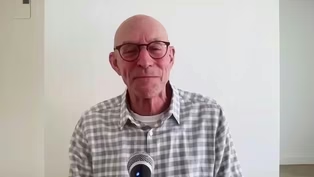
Michael Pollan: Social Media Sold Our Attention. We Are Now Less Conscious
Video has Closed Captions
Best-selling author Michael Pollan explores our collective consciousness in "A World Appears." (18m 3s)
Providing Support for PBS.org
Learn Moreabout PBS online sponsorship
- News and Public Affairs

Top journalists deliver compelling original analysis of the hour's headlines.

- News and Public Affairs

Today's top journalists discuss Washington's current political events and public affairs.
Urban Consulate Presents











Support for PBS provided by: