
How the birthright citizenship ruling impacts Trump's agenda
Clip: 6/30/2026 | 4m 43sVideo has Closed Captions
How the birthright citizenship decision impacts Trump's immigration agenda
To discuss the Supreme Court's birthright citizenship ruling, Amna Nawaz spoke with Amanda Frost. She is a professor at the University of Virginia School of Law, and the author of “You Are Not American: Citizenship Stripping from Dred Scott to the Dreamers."
Problems playing video? | Closed Captioning Feedback
Problems playing video? | Closed Captioning Feedback
Major corporate funding for the PBS News Hour is provided by BDO, BNSF, Consumer Cellular, American Cruise Lines, and Raymond James. Funding for the PBS NewsHour Weekend is provided by...
How the birthright citizenship ruling impacts Trump's agenda
Clip: 6/30/2026 | 4m 43sVideo has Closed Captions
To discuss the Supreme Court's birthright citizenship ruling, Amna Nawaz spoke with Amanda Frost. She is a professor at the University of Virginia School of Law, and the author of “You Are Not American: Citizenship Stripping from Dred Scott to the Dreamers."
Problems playing video? | Closed Captioning Feedback
Where to Watch PBS News Hour
PBS News Hour is available to stream on pbs.org and the PBS app.
Providing Support for PBS.org
Learn Moreabout PBS online sponsorshipAMNA NAWAZ: For more on the court's birthright citizenship ruling, we're joined now by Amanda Frost.
She's a professor at the University of Virginia School of Law and the author of "You Are Not American: Citizenship Stripping from Dred Scott to the Dreamers."
Her second book on birthright citizenship is due out in September.
Amanda Frost, welcome back to the "News Hour."
Thanks for being with us.
AMANDA FROST, University of Virginia School of Law: Thank you for having me.
AMNA NAWAZ: So the argument we heard by President Trump against birthright citizenship has been that the 14th Amendment was intended to be very limited, just applying to the children of enslaved people.
What did the justices say today about that argument?
AMANDA FROST: Yes, so they rejected -- the majority rejected that argument.
They said the language, which is universal in application, doesn't limit itself to the enslaved or formerly enslaved, would apply to everyone.
They noted that during the, debates over that language, it explicitly came up whether the language was supposed to cover the children of Chinese immigrants -- and Chinese immigrants at the time were a very disfavored and unpopular group.
And the answer was, yes, it was intended to cover the children of Chinese immigrants.
So the reading of the citizenship clause as just applying to the formerly enslaved is wrong.
Of course, it applied to them, and that was a major impetus for the decision, but it was not limited to them.
AMNA NAWAZ: We saw President Trump react to the ruling by posting this online in part.
He wrote that: "It's too bad for our country, but we can easily make it up in Congress through legislation."
He went on to say: "No long and unwieldy constitutional amendment is necessary."
He's basically saying he could effectively end birthright citizenship through Congress.
Can he?
AMANDA FROST: No, that's just wrong.
The Constitution of the United States is the supreme law of the land.
On the first day of law school, you learn, if you didn't know it already, that legislation that violates the Constitution is invalid.
So, this executive order is invalid because it violates the U.S.
Constitution, said five justices.
And any legislation Congress passed would similarly be invalid.
AMNA NAWAZ: I want to put to you another thing we heard during this debate, which was that opponents of birthright citizenship talk about the incentives it provides to illegal immigrants.
And we also heard a lot about birth tourism.
How prevalent is that?
AMANDA FROST: Yes, so a couple points about that.
One is, even anti-immigration groups estimate birth tourism to be fairly low, a small percentage of the overall births.
But I understand that it offends certain groups, or maybe a lot of people.
And the answer is to target that.
And, in fact, there's laws on the books that allow Customs and Border Protection officials to stop people from coming to the United States on short-term visas who are visibly pregnant and look like they're coming to give birth.
And the question is, should we enforce that, rather than end birthright citizenship for hundreds of thousands of children born to people who are in the United States for years?
And there's a targeted enforcement mechanism that we could use to prevent birth tourism, if that's the problem.
We don't need to end birthright citizenship for everybody.
AMNA NAWAZ: As we reported, the decision was 6-3.
The majority was written by Chief Justice John Roberts.
Given everything you know about birthright citizenship, did it surprise you that three justices would have overturned this 150-year precedent?
AMANDA FROST: I was a little surprised, in part based on the oral argument, where we heard more skeptical questions from Justice Kavanaugh and Justice Gorsuch.
It was clear Justice Alito was very skeptical of birthright citizenship from the oral argument.
But I think that the key point here is that, by a vote of 6-3, these justices said no.
This signature executive order by President Trump when he felt so strongly about that he attended the oral argument is invalid either under the Constitution or Kavanaugh said, Justice Kavanaugh said under federal law.
Either way, President Trump cannot decide who is and who is not a citizen unilaterally.
AMNA NAWAZ: You have written so extensively on this topic and on its history.
So after this decision, do you believe that the constitutional debate over birthright citizenship has been effectively settled?
AMANDA FROST: I think it's been settled for the time being.
I will say that we continue to have this debate as a nation over who belongs.
And I think there's a reason for the 200 pages that the court wrote, and that's because they're debating who is an American and what the meaning of American is.
And that's a debate I think we will continue to have as a country.
But I'm glad to say that, for the time being, hundreds of thousands of newborn children in the United States will be secure in their citizenship.
And all Americans giving birth going forward won't have to prove their status to the federal government's satisfaction, which is what would have happened had this executive order gone into effect.
AMNA NAWAZ: That is Amanda Frost, professor at the University of Virginia School of Law, joining us tonight.
Amanda, thank you so much for your time.
Good to speak with you.
AMANDA FROST: Thank you.
Dave Portnoy joins Amna Nawaz on 'Settle In'
Video has Closed Captions
Dave Portnoy and Amna Nawaz discuss media and controversies on 'Settle In' (5m 19s)
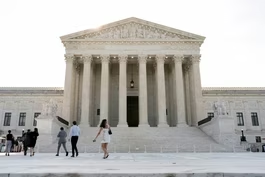
Examining the Supreme Court's birthright citizenship ruling
Video has Closed Captions
Examining the Supreme Court's birthright citizenship, campaign finance rulings (5m 40s)

Hopes of finding earthquake survivors fade in Venezuela
Video has Closed Captions
Rescue efforts continue, but hopes of finding earthquake survivors fade in Venezuela (4m 59s)
News Wrap: Central and eastern U.S. face dangerous heat
Video has Closed Captions
News Wrap: Heat wave brings dangerous temperatures to central and eastern U.S. (7m 15s)
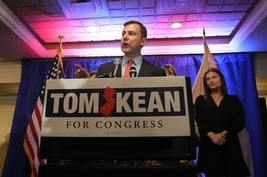
Rep. Kean returns to Congress after mysterious absence
Video has Closed Captions
New Jersey Rep. Tom Kean returns to Congress after mysterious absence (5m 48s)
Supreme Court lifts limits on political party spending
Video has Closed Captions
Supreme Court transforms campaign finance rules, lifting limits on party spending (5m 30s)
Trump's response to Supreme Court rulings and what's next
Video has Closed Captions
Trump's response to the landmark Supreme Court rulings and what's next (6m 24s)
Who is affected by Supreme Court's ruling on trans athletes
Video has Closed Captions
Who is affected by the Supreme Court's ruling on trans athletes in women's sports (6m 24s)
Providing Support for PBS.org
Learn Moreabout PBS online sponsorship New Episode
- News and Public Affairs

Today's top journalists discuss Washington's current political events and public affairs.

- News and Public Affairs

FRONTLINE is investigative journalism that questions, explains and changes our world.
Urban Consulate Presents
 New Episode
 New Episode
 New Episode
 New Episode
 New Episode
 New Episode

 New Episode
 New Episode
Support for PBS provided by:
Major corporate funding for the PBS News Hour is provided by BDO, BNSF, Consumer Cellular, American Cruise Lines, and Raymond James. Funding for the PBS NewsHour Weekend is provided by...