
Brooks and Capehart on Supreme Court standing up to Trump
Clip: 7/3/2026 | 10m 56sVideo has Closed Captions
Brooks and Capehart on whether the Supreme Court has stood up to Trump
David Brooks of The Atlantic and Jonathan Capehart of MS NOW join Amna Nawaz to discuss the week in politics, including major Supreme Court decisions and more primary upsets in a busy lead-up to the nation’s 250th anniversary.
Problems playing video? | Closed Captioning Feedback
Problems playing video? | Closed Captioning Feedback
Major corporate funding for the PBS News Hour is provided by BDO, BNSF, Consumer Cellular, American Cruise Lines, and Raymond James. Funding for the PBS NewsHour Weekend is provided by...
Brooks and Capehart on Supreme Court standing up to Trump
Clip: 7/3/2026 | 10m 56sVideo has Closed Captions
David Brooks of The Atlantic and Jonathan Capehart of MS NOW join Amna Nawaz to discuss the week in politics, including major Supreme Court decisions and more primary upsets in a busy lead-up to the nation’s 250th anniversary.
Problems playing video? | Closed Captioning Feedback
Where to Watch PBS News Hour
PBS News Hour is available to stream on pbs.org and the PBS app.
Providing Support for PBS.org
Learn Moreabout PBS online sponsorshipAMNA NAWAZ: It's been a busy week leading up to the nation's 250th anniversary, with major Supreme Court decisions and more primary upsets.
To discuss all this further, we turn now to the analysis of Brooks and Capehart.
That's "The Atlantic"'s David Brooks and Jonathan Capehart of MS NOW.
Great to see you both.
JONATHAN CAPEHART: Hi, Amna.
AMNA NAWAZ: Let's begin with this Supreme Court, closing out a term with some major decisions.
A quick recap for everyone following along.
Over the term, they handed the president some losses on signature issues like tariffs, birthright citizenship, mail-in ballots, that he couldn't fire a member of the Fed board.
But they also said he could fire members of independent agencies.
They upheld a state ban on trans women in sports.
They sided with him on immigration restrictions.
David, one common thread seems to be an expansion of executive authority given to President Trump.
Is that a good thing?
DAVID BROOKS: No, but I would say have to say, on the big authoritarian power grabs that Trump tried, whether it's the Federal Reserve, birthright citizenship, the tariffs, whether he could put National Guard troops in Chicago against the local officials' interests, the court stood up to Trump and slapped him back down.
And the court hates to take on a sitting president because they don't want to take on an elected official.
Remember, the Roberts courts upheld Obamacare because they just didn't want to upset what democracy had brought to us.
And so I'd say, on the big authoritarian power grabs, the Supreme Court did pretty good.
And it is -- this is grading on a very low curve, but it's the most effective branch of government we have right now.
And so on the Slaughter case, which was about the FTC and all those -- semi-independent agency... AMNA NAWAZ: The firing of the commissioner of the FTC, yes.
DAVID BROOKS: The firing of the commissioner.
It's not my preference.
I like the idea that starting mostly in the 1930s, Federal Reserve was obviously earlier, that we set up some agencies that are protected from raw politics.
DAVID BROOKS: And I think that was a good thing to do.
But a significant branch of legal thinkers have thought, no, they're -- the administration is elected by a president.
It should not be cushioned off from democracy.
I think that's the wrong decision, but it's a reasonable decision.
And so what the court did on this Slaughter case with the FTC and all the other independent agencies was not my preference, but reasonable.
And I'd have to say, on the big issues of preserving our democracy, the Supreme Court did OK this year.
AMNA NAWAZ: And the Slaughter case, we should also underscore, overturned a 100-year-old precedent as well.
DAVID BROOKS: Right.
AMNA NAWAZ: Jonathan, how did you look at this?
JONATHAN CAPEHART: Well, I don't know if the Supreme Court did OK by democracy.
I mean, David said you thought that the court didn't want to upset what democracy brought to us.
Democracy brought to us the Voting Rights Act of 1965.
And the Supreme Court just gutted it, decimated it.
And states around the country, particularly in the South, moved quickly, with the same speed, if not faster, than when the court took the first whack at it in Shelby v. Holder.
So I'm not as cheerful when it comes to the court in terms of standing -- yes, standing up to the president on the big authoritarian pieces.
But the VRA and Particularly Chief John Roberts really wanting to do something to, to his mind, correct it, predates President Trump.
But the other thing about the Supreme Court's term is that a lot of the decisions that they made, it would have been nice if Congress were functioning and had actually exercised its Article I branch powers to do some of these things.
I mean, it's great that the judiciary is functioning, but it'd be really nice if the legislative branch started acting like a coequal branch of government, instead of the staffing arm of the executive.
AMNA NAWAZ: Well, let's talk a little bit about what could happen in the legislative branch, some of those primary upsets we talked about earlier, because, in the past few weeks, we have seen anti-establishment wins for Democratic candidates in particular.
First to New York.
We saw the Democratic socialist candidate there, Darializa Avila Chevalier, unseat the five-term congressman Adriano Espaillat.
We also saw a former New York Comptroller Brad Lander unseat representative Dan Goldman.
Then, in Colorado, we saw Democratic socialist Melat Kiros oust a 30-year incumbent in Diana DeGette.
And we saw the state A.G., Phil Weiser, there, who ran to the left of Senator Michael Bennet, beat him in the gubernatorial primary there.
So, David, you see New York and Colorado.
Does two make a trend?
DAVID BROOKS: I think so.
I think this is a big -- the Colorado story is a bigger story than the New York story.
New York's my hometown.
I love it, but Brooklyn hipsters and Columbia University are not exactly normal America.
But Colorado is Colorado.
It's a semi-purplish state.
Michael Bennet was elected three times to the U.S.
Senate statewide, and he lost.
And then you had the Democratic Socialist candidate win.
And what you see, it's been -- it's been compared, I think, accurately, to when Dave Brat beat Eric Cantor in the Republican primary, and you saw a bunch of people said, these -- my party, screw them.
We're going to tear it all down.
And in that case, and I think, in this case, Democrats are -- they're just looking around through the most furious candidate because they're furious at what's happened.
And so they're doing that.
And I understand the fury.
My problem is, the DSA, the Democratic Socialists of America, should not be where you go.
The Democratic Socialist Party was started in the 1980s by Michael Harrington, a very wonderful guy, a serious intellectual, and he wanted the DSA to move us toward Denmark, a perfectly good political position.
Over the last five years, that party has been hijacked and taken over by an authoritarian wing, which supported Hamas in October 7, who supports Cuba, who supports China, who supports Maduro's Venezuela, who supports pretty much every left-wing authoritarian regime in the country.
So I understand wanting to register a protest against Washington.
But are the Democrats really going to take a position that we're going to become left-wing authoritarians, just as the Republicans become right-wing authoritarians?
And the final thing to be said is, the Democratic Party became great not by fighting the right, but by fighting the left.
It was Hubert Humphrey in 1946 who pushed the communists out of the Democratic Farmer - - the DFL, the Democratic Farmer Labor Party.
It was George Meany who pushed the communists out of the labor movement, basically.
And they defined who they were by pushing against the right, but also by pushing against the left.
And we're going to see if the Democratic mainstream has the guts, the conviction, or even the clarity of thought to push against what's happening.
And we will see.
AMNA NAWAZ: Jonathan.
JONATHAN CAPEHART: I'm going to get -- outrage -- I'm not going to I'm not going to fall into the Democratic trap of, oh, my God, the Democratic socialists are taking over the country when we're talking about, one, wins in deep blue seats in congressional districts, two, when we're talking about what really to me is the big trend here is that the establishment, the incumbents are being thrown out.
And folks are angry.
They're angry because of affordability.
They're angry because the president is robbing the nation blind.
They're angry because it doesn't seem like it any of these elected officials are doing anything to hold the president accountable for what's happened.
I mean, Diana DeGette is no conservative.
She was a progressive.
Congressman Dan Goldman, not big capital-P progressive, but he was left of center.
Brad Lander, who -- another person who beat Dan Goldman, he's no socialist.
He's basically like a mainstream Democrat in New York City.
And so, to my mind, I think we need to pay attention to what voters are saying.
If they're choosing the Democratic Socialist candidate, then Democrats need to pay attention to, well, why did they choose the DSA candidate and not someone who's a little closer to the center?
Could it be that their message on the economy, their message on what they're going to do is resonating?
And, quite honestly Mayor Mamdani, who has put his weight behind a lot of these candidates, the thing he has going for him is, New York City is doing fine.
A lot of people predicted that, oh, you put you elect a Socialist, and then the city will go to pot.
And instead, it's -- I'm not going to say it's the opposite, but the dire predictions haven't proven true.
And so I think it there's still time to look at other races to see whether the DSA is actually a thing, and a thing in the way that the Tea Party had become for Republicans in the way-back.
AMNA NAWAZ: Lots more races ahead.
We will talk about it some more, but I'm not sure if you heard or not, in the meantime.
America's turning 250 tomorrow.
AMNA NAWAZ: We have been talking about it a little bit.
When we step back to see how Americans are looking at their own country right now, we have some insights from our latest PBS News/NPR/Marist poll.
It found 65 percent of people say that they're proud to be American; 83 percent say the country has moved away from its founding principles and ideals.
And at the same time, some 53 percent of Americans say the country's best days are still ahead of us.
So, David, do you see more reason to be concerned then or more reason to be hopeful?
DAVID BROOKS: I'm hopeful.
We go through this.
We go through periods every few decades where people just want to burn everything down.
And it was brutal to live through those periods, but we get through them.
And we get through them because we're a nation of awesome vitality.
We have the vitality to change and to fix things, and we have done it again and again in the 1770s, 1830s, 1890s, the 1960s.
So we're going to do it again.
And I have tremendous love for the country, but also tremendous compassion for the country, for the evils we have done, for those who've suffered from those evils, and you got to have love for your country and compassion for the country at the same time.
AMNA NAWAZ: Jonathan, last word to you on this, I should say your birthday weekend.
Belated happy birthday to you.
JONATHAN CAPEHART: Well, thank you very much.
I consider myself to be part of the 65 percent who are proud of their country.
It's times like these when I feel most patriotic, because this is when I get to say, you know what, this country's mine.
This country is mine too.
My ancestors were brought here in chains, and they helped build this country and to help to make it a great power.
My ancestors, meaning Black community, writ large, marched in the streets demanding that this country live up to its ideals in the 1950s and the 1960s, which made it possible for me to sit here right now.
There's backtracking.
There's regression.
But I am optimistic because this is America.
How could I not be optimistic when the history that allowed me to be here is going to be the history that is going to keep us going forward?
AMNA NAWAZ: Jonathan Capehart, David Brooks, thank you so much.
JONATHAN CAPEHART: Thanks, Amna.
AMNA NAWAZ: Happy fourth.
JONATHAN CAPEHART: And to you.
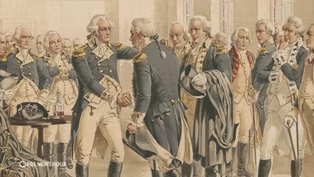
George Washington’s belief in the power of differing views
Video has Closed Captions
Why George Washington believed in the strength of differing viewpoints (3m 51s)

How climate change endangers historic sites like Jamestown
Video has Closed Captions
How climate change and rising seas endanger historic sites like Jamestown, Virginia (5m 49s)

News Wrap: Iran begins funeral ceremonies for Khamenei
Video has Closed Captions
News Wrap: Iran begins funeral ceremonies for late Supreme Leader Khamenei (5m 34s)

Parents push for safety a year after fatal Camp Mystic flood
Video has Closed Captions
One year since deadly flood at Camp Mystic, parents push for better safety standards (11m 40s)

Record heat engulfs parts of the U.S. ahead of July 4th
Video has Closed Captions
The growing dangers of record heat waves like the one engulfing July 4th celebrations (5m 38s)

Russia lures African soldiers to deadly front in Ukraine
Video has Closed Captions
Lured by Russia, African soldiers end up on deadly front lines of Ukraine war (8m 21s)
Providing Support for PBS.org
Learn Moreabout PBS online sponsorship New Episode
- News and Public Affairs

Today's top journalists discuss Washington's current political events and public affairs.

- News and Public Affairs

FRONTLINE is investigative journalism that questions, explains and changes our world.
Urban Consulate Presents
 New Episode
 New Episode
 New Episode
 New Episode
 New Episode
 New Episode

 New Episode
 New Episode
Support for PBS provided by:
Major corporate funding for the PBS News Hour is provided by BDO, BNSF, Consumer Cellular, American Cruise Lines, and Raymond James. Funding for the PBS NewsHour Weekend is provided by...