
Castle Farms, Hour 2
Season 30 Episode 11 | 52m 24sVideo has Closed Captions
See Michigan marvels unveiled during ROADSHOW’s stop at Castle Farms in Charlevoix!
See Michigan marvels unveiled during ROADSHOW’s stop at Castle Farms in Charlevoix. Which historic treasure has a $75,000 value?
Problems playing video? | Closed Captioning Feedback
Problems playing video? | Closed Captioning Feedback
Funding for ANTIQUES ROADSHOW is provided by Ancestry and American Cruise Lines. Additional funding is provided by public television viewers.
Support provided by:


Castle Farms, Hour 2
Season 30 Episode 11 | 52m 24sVideo has Closed Captions
See Michigan marvels unveiled during ROADSHOW’s stop at Castle Farms in Charlevoix. Which historic treasure has a $75,000 value?
Problems playing video? | Closed Captioning Feedback
How to Watch Antiques Roadshow
Antiques Roadshow is available to stream on pbs.org and the free PBS App, available on iPhone, Apple TV, Android TV, Android smartphones, Amazon Fire TV, Amazon Fire Tablet, Roku, Samsung Smart TV, and Vizio.
Buy Now

ANTIQUES ROADSHOW's 2026 Production Tour
Enter now for a chance to win a pair of free tickets to one of the three stops on ANTIQUES ROADSHOW's 2026 Tour. Sweepstakes entry deadline is April 6.Providing Support for PBS.org
Learn Moreabout PBS online sponsorship♪ ♪ CORAL PEÑA: "Antiques Roadshow" is ready for all things wonderful and wild at Castle Farms.
APPRAISER: What kind of person do you think would have owned this?
High muckety-muck.
(chuckles) (laughing): Oh.
I'm shocked.
♪ ♪ PEÑA: The stately Castle Farms, where "Roadshow" is today, is in Northern Michigan, near Lake Charlevoix.
It's no longer a working farm, but its history goes back to 1918, when it began as Loeb Farms, named after its original owner, Albert Loeb, who was an executive at Sears and Roebuck Company.
After several owners and periods of time when the estate fell into disrepair, the barn complex and grounds were brought back to life by Linda Mueller, who purchased the property in 2001.
The beautiful gardens, French Renaissance-style architecture, and whimsical collections on site make this a unique spot for discovering treasures arriving from all over the Midwest.
♪ ♪ (cheering) This super-fantastic bracelet is from the Pueblo of Zuni.
It's called the Knifewing, and the Knifewing is a deity.
It's sort of a, a manifestation of a human and a almost thunderbird... Mm-hmm.
...and, and bird-like figure.
That's great.
This is really well-built.
I wish it fit... (laughs) ...but it doesn't.
Okay.
It's probably worth about $3,200 to $3,500.
Oh.
Wow.
Yeah.
Did you do okay?
GUEST 1 (laughs): We did okay, yeah.
Yeah-- I know when I really like something because I don't want to give it back.
I know!
I was, like... (laughs) I'm, like, "Hey."
"Give it to me, give it."
"Hold on."
(squealing): Give it, give it, give it!
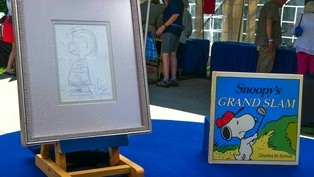
(laughs) GUEST: I grew up in Santa Rosa, California.
Charles Schulz's first wife was a patient of my father's.
My father and Charles Schulz played golf together, so the Schulzes became friends of the family.
When I was about 15, I g, wasn't old enough to have a job yet, and I guess during a golf game or something, my father's, was talking to Charles, and asked if we, he could come over and help with babysitting-- they had four children.
So I drove over to their house, which was called Coffee Grounds.
It was really a cool place, and-- had a swimming pool and everything.
My job was primarily babysitting, but I also taught the kids how to swim, 'cause I had been on a swimming team.
His wife was always running around and Charles was always in his office.
Charles, A.K.A.
Sparky.
One day, I went up to get my paycheck, and he was doing one of the scripts for the, um, syndicate that was in New York.
And he said, "Here, you want this?"
And he handed me a book that was behind him, and I said, "Sure."
This was January 7, 1973, and he signed it "To Carole," and he screwed up the A here.
(laughs) "With memories and friendship," and it's Snoopy, who is swimming.
And he said, "Carole taught me all I know about the dog paddle."
And I thought that was pretty cool.
And then he just drew a picture of Linus, because I told him I really like Linus.
He was the nicest guy-- he was very quiet, very soft-spoken.
His wife was not.
(both laugh) It takes two-- it takes two different types.
(laughing): It does take... Yin and yang, right?
No kidding.
I'm a big dog fan.
Are you?
So of course I love Snoopy.
Me, too, yes.
And that's what I loved about your inscription here.
Yeah.
Is that you have Snoopy swimming.
Yeah.
And he's doing the doggy paddle.
Yeah, he was.
(laughing) And it's also fun that he signed it "Sparky."
He was born in 1922, and within days of being born, there was a popular comic character at the time called Spark Plug, that was a horse.
That's it!
Yeah!
(laughs) I remember, yeah.
And so he became Sparky.
Yeah.
So, he, his nickname from the time he was born... Right, that's right!
...was actually a popular comic character.
I remember that, yeah.
So, he, he was meant to do this.
Yeah.
Their value is probably about equal.
Oh, really?
Um, because he signed this one "Schulz."
It's framed, it's easy to display.
This one's inside a book.
Yeah.
So, if you did want to display it, you'd have to kind of have it open.
Yeah, right.
At auction, I would expect them to bring anywhere in the $1,000 to $1,500 apiece.
Hm, really?
Really?
Okay!
Did you hear that?
(laughing): Talking to my daughter.
These are old cast-iron pans.
They're actually called spider skillets.
And as far as I know, I think they're probably from the early 1900s, possibly a little bit earlier.
I got 'em at an estate sale for two dollars.
I haven't cooked with these yet, but I cook with cast iron a lot, so I'm excited about these.
They'll be great on the campfire.
I used it out in the yard a couple of years, um, for vines to grow up on it as, as metal art.
I think it's supposed to be a coat rack.
I really don't know anything about it other than it's made of metal, it looks like a vine, and I really like it.
GUEST: It belonged to a friend of mine's father.
He had purchased it probably in the early '80s for his wife at that time.
And we had moved him up from Florida to, up to Michigan here.
This was to be discarded, and so I saved it, and I've had it for close to 18, 19 years.
And the gentleman that had it before, was it displayed or not?
You can see some of the color discoloration up there, and that was, we always felt, due to the Miami sun.
He had it in his condo.
Did you see it on display in the condominium?
I did, I, and I immediately just fell for it.
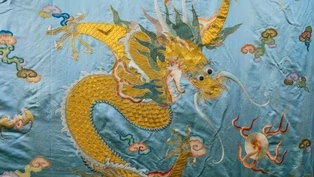
This is... (exhales) ...exactly what it appears to be: a silk hanging panel with gold wrap thread, and the thread likely is also silk.
Wow.
The brilliant color of the blue, which you can see at the very tip top, is sky blue.
And that's the unfaded part.
Mm-hmm.
Right below that, you can see a yellow line.
But the original color would've been a very vibrant sky blue.
And that was purposeful, because what it is representing is the sky.
Beautiful.
So, we have clouds, we have bats, we have dragons.
And down here at the bottom, we have these phoenix, which are these mythical birds that are perched on rockwork, and at the base is the Earth.
So, this has all kinds of different emblems that are all positive.
They are meant to project strength.
Mm.
They're meant to project importance.
What kind of person do you think would have owned this?
Um... A high muckety-muck.
(both laugh) Someone important.
I don't know-- yeah, absolutely.
Well, I think it could've easily been the, an, a commission for the imperial household... (gasps) ...during the reign of the Emperor Guangxu, who reigned from 1875 to 1908.
And behind the scenes was the Dowager Empress Cixi, who died also in 1908.
She was kind of the power behind the throne.
I believe it was meant to show imperial power.
The five claws of the dragons are representative of the imperial throne and household, shows that this was an important object that likely was in a reception hall where important people would have come.
And it was a place, because of this kind of color palette, that probably was frequented by the dowager empress.
So you have an important object.
Incredible-- incredible.
And it's actually in remarkably good condition.
A lot of the colors, particularly these down at the bottom part, are just as vibrant as they were when they were originally made.
I think for replacement value purposes, a reasonable figure would be around $30,000.
(stifles laugh) (inhales) (chuckling): Wow, thank you.
Wow.
Incredible.
PEÑA: Castle Farms has embraced the lore of European castles, with a vigilant knight and their very own dragon.
Norm the dragon, a ten-foot-tall creature made from metal by artist John Andrews, has been a favorite fixture at Castle Farms since 2012.
I brought a necklace that was given to my grandmother for her wedding.
She passed it on to me to wear my wedding day.
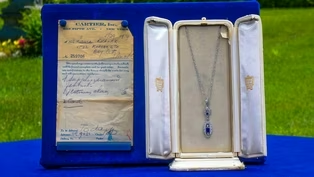
It's a beautiful Cartier Art Deco platinum, diamond, and sapphire pendant.
You have over one-and-a-half carats of diamonds... Wow.
...and over one carat of sapphires total weight there.
Wow.
And you have these great geometric square cut sapphires.
We sometimes call them emerald cuts.
Mm-hmm.
Beautiful platinum chain.
So it's stamped on the side "Cartier" here, and it's small.
You really do need a loupe to see it.
Mm-hmm.
And then on the opposite side, it has the numbering.
What I love about it is, it's almost a transitional piece.
This part, right here?
Uh-huh.
It's so geometric, right?
You have... Yes.
It's really a square.
A perfect square.
It's really that typical Art Deco period.
Yeah.
Mm-hmm.
But then here, it's a little bit softer.
Mm-hmm.
Because in jewelry making, there's really no hard stop, right?
Like, you start doing Belle Époque, then you stop, then you do Art Deco.
Now there's kind of a little bit of a blending.
You have the receipt... Mm-hmm.
...from 19, May of 1929, right before the stock market crash.
What's great about this is, it closes, and then you have the date here, your relative's initials on the other side, and then my favorite, how it just pops open.
Magic.
Like an armoire, yeah.
Yes.
I love that.
Do you have any idea of the value of your piece?
I had it appraised maybe ten years ago, and I'm thinking that she maybe said $1,500 to $3,000.
But the reason I didn't like it was, she just didn't look at the box, or this, or any of the other information that was with it, and didn't seem to see it as a whole package.
And to me, that's part of what makes it really special.
I agree-- it's the whole package.
People collect just Cartier boxes.
(chuckles): Oh, gee, I didn't know that.
I would appraise your set, retail, at $15,000.
Wow.
(laughing): Wow, I didn't expect that.
Yeah, it's, it's really, really remarkable.
It was a beautiful gift.
I wonder if that was kind of done that often for an engagement gift, 'cause I got, like, Crock-Pots and... (laughs) ...things like that.
(both laugh) Well, I guess it depends on your relative, right?
(laughing): Yeah.
GUEST: I came upon this flag cleaning out my parents' home.
I've had it for about 30 years, and it had been stored in a biography of Abraham Lincoln.
My dad was a World War II veteran.
He loved Americana.
He loved American history.
He loved to go to auctions, estate sales, and collect things.
However, I don't know where he got this or when he got it.
I never knew about it during his lifetime.
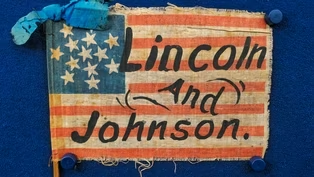
Of course, this is President Lincoln and his running mate, Andrew Johnson, and I... Uh, I believe that this was the 1864 campaign.
That's correct.
It was an interesting campaign.
The Civil War was still grinding on.
Lincoln was afraid that he might lose the election.
In fact, he was pretty sure he was going to lose.
He was running against George McClellan, who was a celebrated, uh, Civil War general, at, at least among some circles.
Lincoln was thinking, "What can I do to help my ticket?"
And he turned to the border states and found Andrew Johnson, who was a staunch Unionist from Eastern Tennessee.
He'd been the governor of Tennessee, and Lincoln looked at him, he said, "He's sort of a Southerner.
"This might swing Kentucky and, and Missouri into my camp.
Let's get Andrew Johnson on the ticket."
I think that he probably chose him reluctantly.
Johnson was a virulent racist.
I mean, he was the antithesis of, of Lincoln.
Mm-hmm.
But he fit the bill.
And they did get elected, as you know.
After the election and after Lincoln was assassinated on April 15, 1865, Johnson, who succeeded him, proceeded to try to undo everything he did that was helping, uh, African Americans.
Mm-hmm.
But this is a flag that would-- I think you're correct-- probably would've been used in a local campaign... Mm-hmm.
...where it might've been waved in a little parade.
The flag itself is made out of polished cotton.
Okay.
It's a printed flag.
The "Lincoln and Johnson" has been hand-painted.
Normally, they're mass-produced, they're stenciled on.
The ribbon is actually a piece of silk.
Lincoln campaign flag collectors find flags from this election are much scarcer than the 1860 campaign, and so they're willing to pay a premium for those flags.
A name flag, which is what this is... Mm-hmm.
...it just has names of the candidates on there... Mm-hmm.
...is considered great, but if you're really looking for the greatness of the greatness of the greatness, you want a picture of the candidate.
They're very rare-- incredibly rare.
This flag is a pretty rare flag.
It's rare because it's small.
Most of the campaign flags are 18 by 24.
This is the first one that I've seen this size, and certainly the first one that I've ever seen where it's been hand-painted.
What do you think it's worth?
I hope it's worth a couple thousand dollars.
I would place an auction value on it of between $5,000 and $7,000.
Okay.
Wow!
Excellent-- excellent.
(chuckles) My dad would just love seeing it here.
(chuckling): So, thank you.
My parents, they lived out west.
They spent their summers out there, and they traveled a lot and hit every antique show, flea market.
And they brought this back when I was in high school, and I had it on my wall in my dorm room for a while.
And it has just always traveled with me.
And I'm trying to find a little bit more history about it.
My stepdad gifted to them is, this to me when I was a teenager, but he bought it at a pawn shop in Chicago in, in the mid-'70s.
He said it was covered in dirt.
The guy wanted $200 for it, he offered him $100.
I believe it's an ES-225.
Other than that, I've had a real hard time finding a blonde version of this.
Mm-hmm.
You see a lot of sunbursts, but you don't see the blonde ones as much.
Yeah.
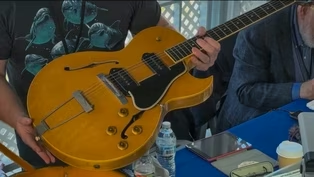
Well, what you have is a 1959 Gibson ES-225 TDN.
Okay.
The TDN stands for "thinline, dual-pickup, natural."
And the reason you can't find these quite as easily as the sunburst is because a natural finish required nicer wood.
What we've got here is some bird's eye maple that is absolutely beautiful on the top.
Original P-90 pickups, three-way toggle switch, two volumes, two tones.
Uh, great wide-bevel pickguard.
This is beautiful.
I would say, conservatively... Yeah.
...$5,000 to $6,000.
I love this.
(laughs) Thank you so much for bringing it.
No, thank you for helping me know what it is.
Oh!
My mother was an artist.
She studied at the School of Craft in Penland, and it was a, a summer kind of retreat... Mm-hmm.
...for artists to go and study under other artisans.
And she was fortunate to get to study under this artist, Toshiko, who, they developed a friendship and relationship, and she gifted my mother this piece at the end of their time together.
Well, your mother must have been skilled, because Penland is one of the big art schools.
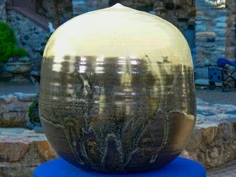
(laughs) Toshiko Takaezu, the maker of this pot, famous, uh, Japanese American potter from Hawaii.
She started studying ceramics in Hawaii, came to the mainland, went to Cranbrook, another one of the major art schools.
Wow.
Then went to Japan and studied Japanese ceramic making and Zen Buddhism.
Okay.
And she studied tea ceremony, which is an adjunct of Zen.
And, and so she was deeply steeped in the culture.
Mm-hmm.
And the idea for her was, there's only one space, whether it's inside a pot or out of it, but it's all connected.
So there's a certain, uh, spiritual basis to the work that Toshiko was doing.
She was born in 1922, she died in 2011, so she had a fairly long life and career.
But she really hit her stride in the late '50s, early '60s, after Cranbrook, and became a, a potter, but working in the Abstract Expressionist style.
This probably dates to about 1970, 1975.
Just a guess, because she very seldom, if ever, dated her pieces.
The glazing on these pieces are viewed as Abstract Expressionist in their influence.
Mm-hmm.
And you can see, this is a pretty good glaze on one of her pieces.
But on top of that, this is larger than most.
This is a moon pot.
Mm-hmm.
Which is a classic form of Toshiko's.
They tend to be globular in form, but they have a nipple opening.
Mm-hmm.
Tiny, so she probably had a matchstick or a small tool when she threw this pot to have just such a small opening at the top like that.
Oh!
They don't always have a rattle.
(piece rattling) Mm-hmm.
I think they were all meant to have a rattle, but the way you put a rattle inside of a pot is, you get a ball of clay and you wrap it in paper, you put it in the pot, you close it, and then when you fire it, the paper burns away and it leaves the ball free-rolling.
Mm.
But sometimes, it adheres to it, and so you won't get the rattle.
So, signed on the bottom... (piece rattles) ...with, uh, the double T mark.
Mm, mm.
Toshiko Takaezu.
Mm-hmm.
She then later taught in Princeton.
Mm-hmm, mm-hmm.
At Princeton University.
There are record prices being paid for Toshiko's work these days.
Wow.
If I was going to put an estimate on this at auction, I would say between $8,000 and $12,000.
Oh, okay.
But this wouldn't bring less than $10,000, 'cause my estimates tend to be a little conservative.
Okay.
And it could bring as much as $20,000, easily.
That's not a stretch.
Wow.
Now, so, why would I have an $8,000 to $12,000 estimate if it's worth $10,000 to $20,000?
Because you want people to bid.
Right, right.
If I put $10,000 to $15,000 or $12,000 to $16,000, that would be accurate, at auction, but then people would say, "Meh, it's worth that, but I, I, I don't need it."
Mm-hmm.
$8,000 to $12,000, you have people saying, "I'd pay that."
Wow.
Estimates are a secret part of the auction game.
Okay.
My stepdad was doing some demo on a house where he was working, and found this watch, and he gave it to me.
That's all I know about it.
I grabbed it out of the curio cabinet this morning and came here.
In 1971, I happened to go on a honeymoon with my brother and his, my new sister-in-law.
We saw this in an antique store and they couldn't afford to buy it.
Next thing you know, we turned around, and my father had went back and bought it for 'em as a wedding present-- he bought it for $50.
Great story, and all I can take away from that is, you went on a honeymoon with your brother, which is weird, and... (laughs) The whole family went-- we had a, we were at the cottage.
It's a lovely poster, it's dated 1907.
It's an ad for Budweiser, and it's in this original frame.
People love collecting what we call breweriana, like, things about the brewing industry, about, about beer history.
Mm-hmm.
And obviously, Budweiser is a classic American brand.
So, it was $50 when you went on your brother's honeymoon.
(laughing) Right.
At auction, I would conservatively estimate its value between $800 and $1,200.
Good, wonderful.
Good purchase.
(chuckles) Thank you.
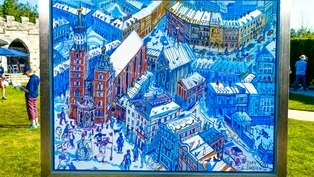
My sister Ruth worked for the State Department and had two years that she spent, uh, working in Kraków, and so she traveled around Poland.
She bought it as a souvenir of her time there.
And then, she has since passed away, so now I have the painting.
Oh, I'm sorry, I... Thank you.
My condolences.
Thank you.
You know where she would have bought it and how much she might have paid for it?
I'm guessing when she was traveling in Warsaw, because I believe she bought it directly from the artist.
There's a note on the back that I believe he wrote to her.
From what I remember her telling me, I believe she told me she paid $4,000 for it.
Ah, okay.
What do you know about the artist?
I don't know a lot.
I know he is sort of famous, at least in Poland, and I believe he's passed away now.
But other than that, not much.
And his name is?
Edward Dwurnik.
Probably not cor... Uh... Very good-- good pronunciation.
Better than mine, I think.
(laughs) And we, we see the signature down here and the, the date, 2004.
The artist was born in a town just outside of Warsaw, but Warsaw was really his home base, and that's where he studied art and also taught art there.
And he was born in 1943.
He died in 2018.
He really worked in series throughout his life.
Around about 1966, he started a series called "Hitchhiking Trips," and it was basically views of Polish cities, but it's a bird's-eye view.
Mm-hmm.
You have the "Sportsmen" series and also the "Workers" series.
This is a later series, when he returned to the "Hitchhiking" series... Okay.
...but he called it the "Blue Cities," for obvious reasons.
Oh, obvious.
And I like to think of them, they're less about the topography of the city than perhaps the character.
Mm-hmm.
He imbues it with a real personality.
Yes.
It's almost like a portrait of the city.
And just to reemphasize that, there are two characters here with names beside them.
One of them, with the wheels, is the highly controversial now film director Roman Polanski... (chuckles): Yes.
...who grew up in Kraków.
And then, right beside you, we see T. Kantor.
Mm-hmm.
Do you know who that is?
I believe he is some sort of a playwright or had something to do with the theater.
I believe it's Tadeusz Kantor.
I was hoping you were going to pronounce the first name.
(laughs) He is a well-renowned avant-garde director.
And the title of the painting, as we can clearly see, is "Kraków."
The artist was very prolific.
There's at least around about 8,000 canvases... Oh.
...known to be done by him.
Okay.
(chuckles) And 20,000 works on paper.
It's thought that sometimes he prepared about three canvases in a day.
Mm.
And this is acrylic on canvas.
And I think he probably favored acrylic because it dries much more quickly than oil paint.
Oh, sure.
So, he was really, without being mean about it, cranking these out.
(chuckles) He thought artists should live well.
He painted to make the money.
Okay.
(chuckling) So, he would buy expensive cars, he had several lady friends, I understand.
He liked to travel.
(chuckling) So he, he lived the good life, and he supported it through his art.
Have you ever thought about the value of it?
I had it appraised a few years ago.
May I ask you what it was appraised for?
Yes, $25,000.
And was that for insurance?
For insurance purposes.
Okay.
Mm-hmm.
So it's an insurance figure that you would like.
Yes.
Well, I think you need to at least double it.
Okay.
So... All right.
You're looking at $50,000.
(inhales) Okay.
I think my sister would be thrilled.
She is probably laughing somewhere right now.
I think it's rather lovely... (laughs) ...that you have this memory of your sister.
Yeah.
And she obviously meant a great deal to you.
Yes, very much-- mm.
So... (chuckles) PEÑA: A collection of items from Sears and Roebuck catalogues during World War I can be found at Castle Farms.
MUELLER: The 1918 Museum was my idea.
The property was built during World War I. Albert Loeb, who built the estate, was an executive of Sears.
And I started finding things in the Sears catalogue.
And I have a few pictures of children playing with the toys so that you can see what they looked like in World War I.
♪ ♪ GUEST: It came from my great-grandfather, who was a hotelier in Winnipeg, Manitoba, and he, uh, won it, allegedly, in a poker game.
My dad was a banker in the '70s and '80s, and he used to wear it with a lot of pride.
He would wear it with a three-piece vest.
He liked the fact that it chimed.
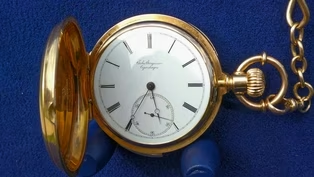
The watch is made by Jules Jürgensen.
Phenomenal quality.
Everything made by hand.
This watch dates from about 1880 to 1885.
Solid gold case, 18-karat gold.
It's an 18-size case, which is a large size.
Man-sized case for a pocket.
Mm-hmm.
But mostly it would be worn in a vest, as your dad did.
As you said, it chimes.
And this is what's called a repeater watch.
It's a minute repeater that operates by the slide, a slide repeater, three-finger bridge.
It's got two hammers that strike the gongs, and the hammers are beautifully jeweled, as is the movement.
And we've also got a glass exhibition back.
Jules Jürgensen was so proud of this watch... Mm-hmm.
...that they wanted you to open it.
They wanted you to see this movement.
The case, on both sides, the hunting case, not engraved.
Typically, these would be engraved with the owner's name or initials.
Right.
This one is not.
That's unusual.
Mm-hmm.
Adds to the value.
The age of the chain is exactly the same as the watch.
We found hallmarks.
It's marked "15K"-- 15-karat solid gold.
So, that's typical of chains made in England.
I noticed the watch is fully wound and it's not running.
In its current condition, the watch on its own has a value in today's retail market of $12,000.
Wow, didn't see that coming.
The chain, being 15-karat gold, is going to have a value, by itself, $2,000 to $3,000.
Wow.
To fix this watch... Mm-hmm.
...you would be looking at maybe $500 to $1,000.
That is going to bring the value up.
The watch and the chain, retail, $15,000 to $18,000.
Wow.
I could throw a heck of a watch party with that.
That's pretty good.
Wow, that's pretty, that's pretty impressive.
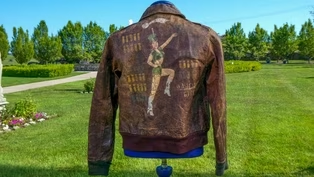
This jacket was my husband's father's.
It was his during World War II.
His father was a engineer on a B-24 Liberator bomber, and he served in the South Pacific.
That's really about all I know.
I did a little digging.
I found a photograph of the aircraft that shows the exact same nose art on it with the female figure here and the same name, "Major Ette."
That was a B-24D that served in the 13th Air Force in the Pacific Theater, in the 372nd Bomb Squadron of the 307th Bomb Group.
That was the group that was known as the Long Rangers.
And really one of the reasons why the B-24 is so prevalent in the Pacific Theater, it had a couple of features about it that made it advantageous compared to other aircraft, range being primary among them.
Mm-hmm.
So, the name "the Long Rangers" factors into that bomb group.
Their biggest enemy out there wasn't necessarily the people shooting at them.
It was mechanical problems or navigation errors that would bring the biggest enemy into play, and that's the Pacific itself.
Mm-hmm.
The distances are so vast that one little error or m, mechanical problem, losing two engines on one of those aircraft, could be kind of a death sentence to those guys.
So they saw an entirely different war than they saw in Europe.
And I was just struck by this jacket when you came up with it, because it's got this interesting painted majorette.
We've got 13th Air Force in this shooting star, the bombs signifying completed missions.
And then, if we look at the front of this jacket, you've got the squadron insignia.
And then on the other side, closer to you, is actually painted "307th Long Rangers."
Oh, I... I see something, yeah.
It's a little hard to make out, but when you know ahead of time what you're looking for... If you're looking for it.
...then you can see it.
It is a wonderful painted leather flight jacket.
We see a lot of these where you can tell that it was really cool artwork, and now it's been worn to the point where you can just see a ghost of it.
Even though you've got the wear on this, this is still quite displayable.
On the market today, an auction estimate on this jacket would be $6,000 to $8,000.
Mm, mm-hmm.
Well, it's not going on the market.
(laughs) So, I'm just so proud to have it and the story behind it.
My dad passed away at 90 a couple years ago, and it had been in his house at least 50 years that I knew of.
And I just have it in my basement as decoration.
I got this in Louisiana at the Angola prison just after Katrina.
I was a Red Cross volunteer.
So this painting was done by an inmate at the Angola prison?
Yes, and I actually met him.
It was his view from where he stayed in Cypress 3, which was a block building.
How much did you pay for it?
I paid $40.
The painting is signed R. Adams... Mm-hmm.
...and it's '05, dated.
Richard Adams is the artist.
These paintings don't circulate very much.
Mm-hmm.
It's difficult to place a value.
Okay.
But if I were to insure it... Mm-hmm.
...I think I would insure it for about $1,200.
Wow.
It's a beautiful painting.
Thank you so much.
Thank you much, thank you.
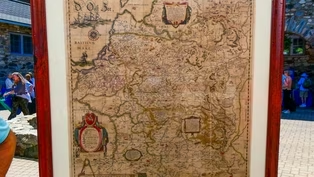
GUEST: It's an old map of Lithuania, and it was given to my father from a prominent Detroit resident.
My father was an oncologist, and he treated the man's wife.
My dad is Lithuanian.
He was a displaced refugee between the First and Second World War.
He was displaced from, uh, Lithuania by Stalin.
He was arrested and thrown into a Russian forced labor camp.
And then when the Germans invaded during the Second World War, they liberated his camp and put him into a German forced labor camp.
How old was he at the time?
He st, he was arrested at the age of 13.
As the Germans pulled out of what became the Soviet Union, he was pulled out with them.
And he did stuff like digging tank traps and stuff like that.
And he ended up in Frankfurt at the end of the war.
As part of the Marshall Plan, the U.S.
government paid for his education.
With an eighth-grade education, he went to the University of Frankfurt until he got his medical degree and then came to the United States via the U.S.
Army, so... (chuckles) Well, incredible story.
Yeah.
What an, what an appropriate gift.
Yeah.
This is a map of Lithuania, uh, which includes parts of Poland and Ukraine and Russia.
And it was commissioned by Prince Radziwill, whose name is on the title cartouche.
Mm-hmm.
And he hired... Mm-hmm.
...the most famous cartographer of the region, his name was Strubicz, to do the survey.
Mm-hmm.
The prince wanted the best map of Lithuania that was out there, 'cause one didn't exist.
Mm-hmm.
So, this is what's called a mother map.
This is the first map of the area that was surveyed properly, and it really influenced every map of this region for the next couple of hundred years.
Wow.
So, the cartouche in the corner... Mm-hmm.
...is, uh, the Lithuanian coat of arms.
Mm-hmm.
And below it, it says-- in Latin, so it's hard to read... Mm-hmm.
...Guilhelm Janssonius, which is the name of Guillem Blaeu.
So, he changed his name right after he made this map.
Mm-hmm.
So it's very hard to identify it as him, because he doesn't use the name that he used after this.
Mm-hmm.
And below it is en, the engraved date of 1613, and it was engraved by a famous engraver, a Hessel Gerritsz.
The 1613 map was a wall map, separately issued.
Mm-hmm.
And they didn't change the date on the map as they released new editions.
Your edition is the seventh version of the map, and it's from 1645.
Okay.
And the only reason we know that is a tiny change in one of the towns.
Hm.
Der Memel on the Baltic is named there, and that is a guarantee that it was made in 1645.
And it was, in fact, an atlas map.
Mm-hmm.
So it was tipped into a, a book.
The map was produced in Amsterdam... Mm.
...and it was engraved onto plates and finished by hand with watercolor.
Mm-hmm.
It's the most beautiful version of this map I've ever seen.
In a retail setting, a map of this caliber... Mm-hmm.
...even though it's the seventh state, would be in the value range of $7,000 to $8,000.
Mm-hmm, that's great, great-- yeah, it's not going anywhere.
We'll keep in the family forever.
I found it in the garage, on the rafters, in a house I was living at in West Chicago.
And I took it with me, and I've had it in my kitchen, up against a railing, for the past 20-some-odd years.
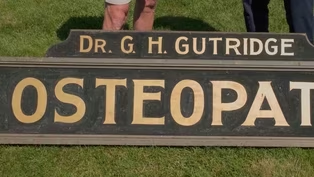
I know Dr.
Gutridge graduated from, I believe it's the Illinois Osteopath School of Medicine, or something similar to that, in 1921.
So I presume this is from the mid-'20s or shortly thereafter, when he set up his practice.
The construction of it makes me want to say 1880, 1890.
And there's a couple of reasons for that.
Okay.
One being this deep-dish molding... Mm-hmm.
...that's around the sign.
Mm-hmm.
And the other is, do you feel it over here?
That's smalt.
Mm-hmm.
It's actually crushed glass.
Oh.
It protects the wood.
This is one of the reasons the sign is in such tremendous condition.
Mm-hmm.
And this is gold leaf.
Retail value, I think this is a $5,000 piece.
Holy smokes!
Yeah.
Sound of a gun.
Yeah.
(chuckles): Well, thank you.
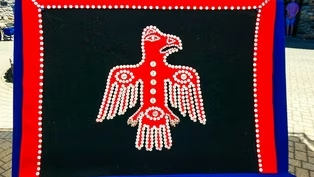
This is a blanket that I got from my grandmother, Tlingit Native, which is Alaska Native.
Each time I would visit her, she would give me pieces, and this is one of my treasures.
The pattern is of an eagle.
We're divided into two moieties, the eagle and the raven.
It's a matriarchal society, so it follows the mom.
Um, so she's a eagle, my father's an eagle, and I'm a raven.
She told me at the time that the buttons were over 100 years old.
And I've had this for over 30 years now.
Your society, the Tlingit... Yes.
...it ranges all the way from Alaska to British Columbia in Canada.
Mm-hmm.
So it's a multinational group.
Yes.
The buttons are over 100 years old.
The medium-sized buttons, all the way around, that outline everything, those are handmade mother-of-pearl buttons.
Mother-of-pearl.
Yes.
Okay.
Some of those larger ones are not so old.
These fabrics are 100% wool.
Generally it came from Belgium or Northern Scotland.
It's not inexpensive.
Can run hundreds of dollars a yard very easily.
Looking at the piece itself and how it's constructed, I would expect that it's somewhere between 50 and 70 years old.
Who was this made for?
My cousins wore them for dances, and I'm not exactly who it was made for, but it's a child-size blanket.
The adult size were a lot larger and cloaked over.
We got together for dances for a potlatch, which is, the community of Natives would come together from all parts of Southeast Alaska.
They would bring food, and they would bring carvings and do some trading.
And it was several days long.
And it was a time where our families who moved away from us could gather together and be with each other.
I know this is not something you would ever sell.
This is part of your family and your heritage, and it will continue to be that way.
Yes.
And, so, I'll give an insurance value, and I think it's going to be $1,800 to $2,200.
Oh!
Somewhere in that range, uh... Oh, fabulous.
...to insure it, to protect it.
I'm very proud of it.
Well, you should be.
(laughs) Yes.
Thank you so much.
Thank you.
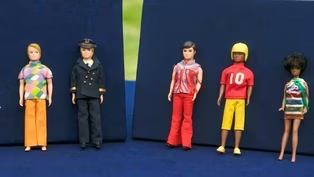
GUEST: I brought my Dawn dolls.
I know that they were produced by Topper and they were supposed to be a competitor for Barbie.
I was a Barbie girl, and my mother would go to garage sales, church sales, whatever, and bring home a case of dolls.
And frequently, these were in there, as well.
And I was disappointed because I wanted Barbie, but I got these.
Also, they were inexpensive, and so I could buy them on my allowance.
These six dolls here are Dawn dolls, and they are made by the Topper Toy Company, and they were made from 1969 to 1973, when the company went out of business.
When these first came out, they were a competitor to Barbie, and they were able to surpass Barbie for a little while in sales, which was crazy to think about.
Price for these dolls, originally new, was anywhere from a dollar to three dollars.
Barbie at the time, for the same-era doll, was five to ten dollars.
So, for affordability for a kid on allowance, you could afford these guys.
Clothing, a dollar or under.
The story with these guys is that Dawn is the owner of a fashion model business and all of her girlfriends were also fellow models.
And all of these fellas were the friends.
Dawn is made up of vinyl and hard plastic, and all of them are done similarly.
The girls all had rooted hair and eyelashes, whereas the boys had molded hair and painted features, no eyelashes.
They did have bendable limbs.
They've got holes in their feet, which would hold the stands.
All of them are like that.
It was meant to go up in the shoes.
You could have 'em stand out and hold positions, and they were a lot of fun.
This is the original Dawn in her original outfit.
And all the other guys are wearing different variations of outfits that were available at the time.
Originally, when Dawn came out, you could get 44 outfits.
Okay.
And part of what made them go out of business is because they started doing some specialty Dawn dolls.
And then the outfits sort of repeated, and then people stopped buying them because there was nothing new.
Now, I have never had the boys come in.
I think it's sort of like Barbie and Ken.
Everybody had one Ken.
They didn't need all the other dolls, so the boys weren't bought as much.
Little girls didn't buy the boy dolls.
For sale at a doll show or retail, your boys average $250 apiece.
(laughing): I had no idea, I really-- everybody says that, "I had no idea."
(laughs) Oh, my gosh!
The girls that you have here are $150 to $200 apiece.
Some of the outfits are worth more than others.
So, total, with all of them, I would say a retail range is going to be anywhere from $1,300 to $1,500... Wow.
...for just what you have right here with us.
Wow-- oh, my gosh, thank you.
I had no, I had no idea that that was, that that was anywhere near that value.
Wow.
Holy cow.
(laughing) (laughs) I'm shocked.
(laughing): I'm sh, I'm really shocked.
Especially for the boys.
JESSICA ANDERSON: Linda has many collections on the property that she's worked tirelessly for years to collect.
My personal favorite is our 1918 Museum.
We also double that as our World War I Museum, because that's what was happening at the time that the castle was being built.
PEÑA: In the World War I exhibit, you can find things that would've been taken to the battlefront, like this gas mask.
Worn by American, French, and British troops, it was used to protect soldiers from the effects of chlorine gas.
I know who made it.
It was a friend of my parents.
I grew up outside of Toledo, and there was a group of artists and in the late '40s, early '50s that all got together weekly.
Mr.
Simms, the artist, was one of them.
My parents probably got this through a trade, or possibly bought it from him, but I, I think they probably just did a trade.
This is a fantastic and very exciting discovery.
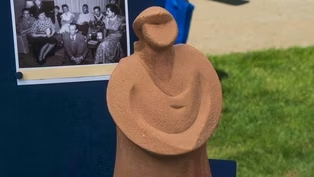
A very early terra-cotta sculpture by Carroll Harris Simms.
He was a student at the Toledo School of Art.
Mm-hmm.
He was in Toledo in, in the late 1940s.
Mm-hmm.
As we can see in this picture, he's an African American young man in the center.
Carroll Harris Simms was a ceramic artist, a sculptor, a potter.
He studied at the Cranbrook School, and one of the first African American artists to study there.
Mm-hmm.
And then he became best known for his work in Texas.
He was a professor of sculpture at Texas Southern University, which is in Houston.
It's a HBCU-- historically Black college or university.
Mm-hmm.
And he worked with John Biggers, who's a, quite a famous painter, a muralist.
And it really was a very important place for learning, for visual arts, and for African American art.
Both were pioneers.
Mm-hmm.
Both were important trailblazers.
I have not seen, in person, his work before.
I've seen pictures.
There's a famous history of African American art that was written by Romare Bearden... Mm-hmm.
...and Harry Henderson, who's a writer.
Bearden's probably the best-known African American artist.
Mm-hmm.
And there's a chapter on this gentleman.
(laughs) Oh, wow.
Wow.
We can see here this abstracted figure, very unified, simple form.
It's painted.
Looks like there's sand mixed in the paint.
And on the verso is his signature and the date, 1947.
This photograph is dated '49.
This artist's work does not come to the market very often.
Mm-hmm.
Do you have any sense of the value?
I, I really had no clue.
I tried to look up auction things and stuff... Yes.
...and I, I couldn't find anything.
You didn't find anything because there isn't anything.
(laughs) Yeah.
So at auction, it's going to be kind of a broad range... Mm-hmm.
...because this is uncharted territory.
Mm-hmm.
Conservatively between $5,000 and $10,000.
Wow!
Well, that's kind of cool.
That's... I guess I'll keep it out.
I think it's a wonderful, wonderful example.
Cool.
It's an old wood carpenter's chest.
We believe it's from, like, the late to early 1800s.
They have different types of lathes that make different types of molding that they did back in the day.
It has been sitting for years in a garage.
(both laugh) GUEST: I inherited this from my dad.
He had it autographed by Neil Armstrong, Buzz Aldrin, and Michael Collins.
He was in the Air Force during the Apollo 11 mission.
He was a weatherman stationed at Patrick Air Force Base and then supported the Apollo 11 mission.
And where is Patrick Air Force Base?
Um, in Cape Canaveral, Florida.
And that's where the mission launched from.
Yep.
It's signed, this is a cover.
It was canceled by-- which means when they mail something, they, they put a cancellation... Okay.
...on July 16, 1969, which was the day that the mission launched.
Okay.
Uh, there are a lot of these commemorative covers out there that are canceled, not so many that are signed.
And these signatures appear to be authentic signatures.
I would estimate this conservatively at auction to be between $3,000 and $4,000.
Wow, awesome.
Awesome, thank you.
That's great news.
When I got married, my mother-in-law gave these to me, and they were my husband's great-grandmother, and she was, lived in England.
I've worn them a few times.
Do you wear it all together, all at once?
I have, and it's unbelievable.
The effect is incredible.
Absolutely.
And that's what stopped me in my tracks.
One, that it's a complete set.
Right.
And two, that it's in its original box.
I know, it's so sweet.
Which, as a jewelry purist, is so nice to see.
Right.
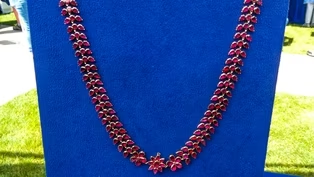
This is a Bohemian garnet Victorian suite-- parure, you might say-- which, it fully encompasses a necklace, both bracelets... Right.
...a pair of earrings, and a brooch, which can be suspended from the center element of the necklace.
Right.
It's very, very rare to see all the pieces together.
I would date this to the late Victorian period, probably circa 1880s.
Bohemian garnets are referred to as Bohemian garnets because they were mined in what is today the Czech Republic... Oh.
...but at that time was considered Bohemia.
Their technical name is a kind of garnet called a pyrope garnet.
They're favored for that lovely kind of raspberry, deep raspberry-red color.
That... They almost read purple sometimes.
Exactly.
Yeah.
It's very customary that these would be set in a heavy gold foil.
So, sort of a gold shell on a base metal.
That's why they have this closed backing here.
I looked it all over to see if I could find any sort of markings, but I don't see any markings that would say it is English for sure.
Mm-hmm.
But it absolutely could be.
It was a style of jewelry that was very popular in the U.K.
and in America at the time.
It does have a couple spots with a little bit of damage.
Because Victorian jewelry in today's market can be kind of a difficult sell... Mm-hmm.
...in a retail environment, a whole suite in its original box would probably bring somewhere in the neighborhood of $5,000.
Great-- I mean, I don't want to ever sell it.
I'm going to pass it on.
You could insure it for the same amount.
I actually thought it was going to be more.
This is my great-grandfather's violin.
He played dances in the early 1900s.
At one point, it was damaged heavily by a relative.
I'm hoping to see whether or not it's worth, uh, fixing up.
Both my wife and I played the violin in high school, and it would be nice to have an heirloom that we could pass down to our children.
This is a portrait of my great-great-grandfather and his mother, my great-great-great-grandmother, painted about 1850.
We think he was born in 1844.
And where were they, where were they living?
Northern New Jersey.
I'm told the dog is fictitious, that there was no real dog.
Okay.
There was an awful lot of itinerant artists that traveled... Right.
...New England, up and down the Atlantic... Right.
...that did portraits for families.
This is a rather nicely painted portrait.
It's a nice composition.
If this were in an auction, I'd probably put $4,000 to $6,000 on it.
Okay, great.
And, um, it might do better.
You know, the dog is always a popular selling point.
Yeah.
(laughs) And the sitters are attractive people, and... Mm-hmm.
...it matters.
(laughs) Right, right, right.
GUEST: I wanted a grandfather clock, and I bought it.
It was online.
It was damaged when I bought it.
Water and insect damage.
So, I had it restored.
They added new feet, and the scroll on top was damaged, as well.
So, the restorer resolved that.
What did you pay for the clock originally?
Well, it was listed for $500.
Yeah.
And with the damage, I offered them $300.
And so, they took it.
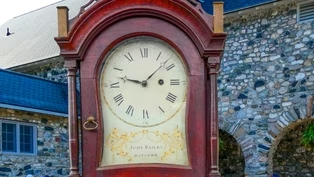
This is a Massachusetts dwarf clock made by John Bailey in Hanover, Massachusetts, which is on the South Shore of Massachusetts.
Made circa 1800 to 1805.
It's a scaled-down tall case clock, but it's a kidney-dial dwarf clock.
Mm-hmm.
Dwarf clocks are rare to begin with, but kidney-dial dwarf clocks-- and it refers to the shape of this dial-- are even rarer.
I only know of a handful of them in existence.
John Bailey was a really important clock maker.
He was a Quaker, he was a preacher, he was an ingenious mechanic.
He took out a patent in 1792 on a steam jack, which was for roasting meat.
Mm.
And he was really responsible for clock making in the South Shore, Massachusetts, area, which was a thriving region.
He had a sizable shop, and he apprenticed important makers who in turn would train other clock makers, and really competed with the Boston clock makers.
Hm.
And I think one of the reasons why this clock was designed is because it was a lot less expensive than a competing tall clock that was made in Boston.
They found an invoice for one of these that was sold for about $40 originally.
Hm.
A full-scale tall case clock would've sold for about $60 to $90 at the time.
The dial is fantastic.
It has John Bailey-type hands that you expect to see.
The signature is perfect.
This dial is like the day it was made.
The swag, this is all raised gild beading.
Perfect condition.
The dial is a ten.
It just doesn't get any better than that.
Equally as great is this case.
Mm-hmm.
It's a pine case, grain painted to look like a more expensive exotic wood.
And they did a fantastic job, and the details are phenomenal.
I'm going to pull this bonnet off.
And you can see that everything is original.
It has its original brass movement that runs for eight days on a wind.
This is what we call a fall-off strike.
So it strikes once every time the hour passes.
Has its original seat board here, and that's really important.
You can see that there's a restoration here on the back right foot.
Mm-hmm.
This side's original.
So in the clock world, normal restorations are to the feet and to the fretwork.
They're the two most fragile points, so you expect to see some restorations.
But in general, this clock is just in great condition.
How much did you pay for the restoration?
So, around $4,000 to $4,500.
It sounds like a lot, but in this case, it was worth it.
This is probably the second-greatest clock I've ever seen at the "Antiques Roadshow" that I've been doing for 20 years.
I would put a retail value on this clock of $75,000.
(makes hitting sound effect) That's amazing.
Very amazing.
Well, geez.
Thanks for all the information.
(chuckling) Yeah.
(chuckling): And I'd like to point out that this is the one that got away.
(chuckles) Oh, it got away?
I saw this on an online auction years ago.
I don't remember how I missed it, but, uh, I would've been pretty good competition for you at the time.
(both laughing) PEÑA: And now it's time for the "Roadshow" Feedback Booth.
My clamshell watch, um, that I spent $20 on is worth $200.
And my complete set of Kenner "Star Wars" Last 17 figures and coins, including Yak Face here, is worth $6,000 to $9,000.
BOTH: Thanks, "Antiques Roadshow."
I brought the pinnacle of my retirement portfolio.
Unfortunately, it did not belong to King Arthur and the Round Table.
(chuckles) So, sorry, Julie, about your inheritance.
(laughs) I brought in my scarab poison ring, my engagement ring, and I learned that it is not as old as I thought it was.
But, on the plus side, it's probably not cursed.
What I brought to the party today is a one-owner 1970 Dodge Charger promotional model from a dealership.
And I got this when I was 11, hence being the original owner.
And now I believe, finding out what the value of this little car is, I am definitely going to have to buy the real thing and play with that.
My Rembrandt turned out to not be a Rembrandt.
In fact, the frame is worth more than the print.
I was hesitant to buy these two maps... Yeah.
...from our local thrift store at $15 each.
I thought they were worthless, but... And they are worth about $500 to $600 each.
Yeah.
So, pretty pleased with that.
I'm wrong, yep.
Yep, he's wrong.
I have here a land patent with a genuine autograph of President Ulysses S. Grant... 's secretary.
If I sell it in the parking lot, we should get enough money to get halfway home.
PEÑA: Thanks for watching.
See you next time on "Antiques Roadshow."
 New
NewAppraisal: 1645 "Magni Ducatus Lithuaniae" Atlas Map
Video has Closed Captions
Clip: S30 Ep11 | 3m 12s | Appraisal: 1645 "Magni Ducatus Lithuaniae" Atlas Map (3m 12s)
 New
NewAppraisal: 1864 Lincoln & Johnson Campaign Flag
Video has Closed Captions
Clip: S30 Ep11 | 3m 11s | Appraisal: 1864 Lincoln & Johnson Campaign Flag (3m 11s)
 New
NewAppraisal: 1947 Carroll Harris Simms Terracotta Figure
Video has Closed Captions
Clip: S30 Ep11 | 2m 39s | Appraisal: 1947 Carroll Harris Simms Terracotta Figure (2m 39s)
 New
NewAppraisal: 1959 Gibson ES-225 TDN Electric Guitar
Video has Closed Captions
Clip: S30 Ep11 | 1m 4s | Appraisal: 1959 Gibson ES-225 TDN Electric Guitar (1m 4s)
 New
NewAppraisal: 1973 Charles Schulz-signed Drawing & Book
Video has Closed Captions
Clip: S30 Ep11 | 2m 39s | Appraisal: 1973 Charles Schulz-signed Drawing & Book (2m 39s)
 New
NewAppraisal: 2004 Edward Dwurnik "Kraków" Acrylic Cityscape
Video has Closed Captions
Clip: S30 Ep11 | 3m 46s | Appraisal: 2004 Edward Dwurnik "Kraków" Acrylic Cityscape (3m 46s)
 New
NewAppraisal: Bohemian Garnet Suite in Original Box, ca.1880
Video has Closed Captions
Clip: S30 Ep11 | 2m 23s | Appraisal: Bohemian Garnet Suite in Original Box, ca.1880 (2m 23s)
 New
NewAppraisal: Cartier Art Deco Pendant Necklace with Box, ca. 1929
Video has Closed Captions
Clip: S30 Ep11 | 2m 21s | Appraisal: Cartier Art Deco Pendant Necklace with Box, ca. 1929 (2m 21s)
 New
NewAppraisal: Chinese Imperial Silk Panel, ca. 1900
Video has Closed Captions
Clip: S30 Ep11 | 3m 14s | Appraisal: Chinese Imperial Silk Panel, ca. 1900 (3m 14s)
 New
NewAppraisal: John Bailey Dwarf Clock, ca. 1800
Video has Closed Captions
Clip: S30 Ep11 | 3m 38s | Appraisal: John Bailey Dwarf Clock, ca. 1800 (3m 38s)
 New
NewAppraisal: Jules Jürgensen Pocket Watch with Gold Chain, ca. 1885
Video has Closed Captions
Clip: S30 Ep11 | 2m 39s | Appraisal: Jules Jürgensen Pocket Watch with Gold Chain, ca. 1885 (2m 39s)
 New
NewAppraisal: Osteopath Doctor's Double-sided Sign, ca. 1890
Video has Closed Captions
Clip: S30 Ep11 | 1m 10s | Appraisal: Osteopath Doctor's Double-sided Sign, ca. 1890 (1m 10s)
 New
NewAppraisal: Tlingit Child's Blanket, ca. 1960
Video has Closed Captions
Clip: S30 Ep11 | 2m 22s | Appraisal: Tlingit Child's Blanket, ca. 1960 (2m 22s)
 New
NewAppraisal: Topper Dawn & Friends Doll Collection, ca. 1970
Video has Closed Captions
Clip: S30 Ep11 | 3m 2s | Appraisal: Topper Dawn & Friends Doll Collection, ca. 1970 (3m 2s)
 New
NewAppraisal: Toshiko Takaezu Moon Pot, ca. 1970
Video has Closed Captions
Clip: S30 Ep11 | 2m 59s | Appraisal: Toshiko Takaezu Moon Pot, ca. 1970 (2m 59s)
 New
NewAppraisal: Victor Schoetzow Ink Drawings, ca. 1930
Video has Closed Captions
Clip: S30 Ep11 | 1m 4s | Appraisal: Victor Schoetzow Ink Drawings, ca. 1930 (1m 4s)
 New
NewAppraisal: WWII Painted A-2 Flight Jacket
Video has Closed Captions
Clip: S30 Ep11 | 2m 41s | Appraisal: WWII Painted A-2 Flight Jacket (2m 41s)
Video has Closed Captions
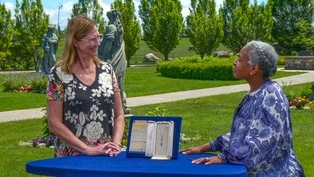
Preview: S30 Ep11 | 30s | Preview: Castle Farms, Hour 2 (30s)
Providing Support for PBS.org
Learn Moreabout PBS online sponsorship
- Home and How To

Hit the road in a classic car for a tour through Great Britain with two antiques experts.

Parent Hacks










Support for PBS provided by:
Funding for ANTIQUES ROADSHOW is provided by Ancestry and American Cruise Lines. Additional funding is provided by public television viewers.