
Coastal Maine Botanical Gardens, Hour 1
Season 30 Episode 7 | 52m 24sVideo has Closed Captions
See a bounty of Boothbay booty from ROADSHOW’s first-ever visit to the state of Maine.
See a bounty of Boothbay booty from ROADSHOW’s first-ever visit to the state of Maine. One romantic family heirloom is valued at $75K!
Problems playing video? | Closed Captioning Feedback
Problems playing video? | Closed Captioning Feedback
Funding for ANTIQUES ROADSHOW is provided by Ancestry and American Cruise Lines. Additional funding is provided by public television viewers.
Support provided by:


Coastal Maine Botanical Gardens, Hour 1
Season 30 Episode 7 | 52m 24sVideo has Closed Captions
See a bounty of Boothbay booty from ROADSHOW’s first-ever visit to the state of Maine. One romantic family heirloom is valued at $75K!
Problems playing video? | Closed Captioning Feedback
How to Watch Antiques Roadshow
Antiques Roadshow is available to stream on pbs.org and the free PBS App, available on iPhone, Apple TV, Android TV, Android smartphones, Amazon Fire TV, Amazon Fire Tablet, Roku, Samsung Smart TV, and Vizio.
Buy Now

ANTIQUES ROADSHOW's 2026 Production Tour
Enter now for a chance to win a pair of free tickets to one of the three stops on ANTIQUES ROADSHOW's 2026 Tour. Sweepstakes entry deadline is April 6.Providing Support for PBS.org
Learn Moreabout PBS online sponsorship♪ ♪ CORAL PEÑA: "Antiques Roadshow" has come ashore at the Coastal Maine Botanical Gardens in Boothbay.
You had this one framed beautifully-- why this one?
Because my wife said to.
(chuckles) That's good.
That's very good.
♪ ♪ PEÑA: On a small peninsula on the rural coast of Maine, you'll find the Coastal Maine Botanical Gardens, the largest garden in New England.
After 30 years of touring, it's "Roadshow's" first visit to Maine, and we couldn't be more pleased to see folks with their prized belongings coming in today.
♪ ♪ The garden's flowers are bursting with vivid colors, while our experts are bursting with excitement to see all of the treasures here in the Pine Tree State.
♪ ♪ (indistinct chatter) Um, so this is a pair of candlesticks, um, that were gifted to my great-grandmother and great-grandfather after they got married.
He was a veteran of World War I and ended up being critically wounded and was in hospital in London for months and months.
And after he was out, he sent flowers and chocolates to all of the nurses and only one sent a thank you note back.
And it turned out to be my great-grandmother.
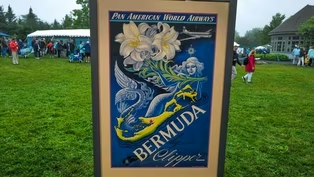
It's a gift from my father, who was a Pan Am pilot from 1940 through, uh, 1975.
And, uh, he made the acquaintance of a, uh, reservation supervisor.
And the guy gave him a year's worth of posters like this.
And how many of them do you have?
I think we brought 14 with us and there's about three or four more that we've already given to members of the family.
And yet you had this one framed, and framed beautifully.
Why-why-why this one?
Because my wife said to.
(both chuckle) That's the first thing.
(chuckles) The intent for this was to be mounted in a bathroom that has similar coloring, and it seemed to fit perfectly.
And we loved the colors.
Plus the airplane, Boeing 377, which at the time was their most luxurious airplane flying.
I am so happy that you are... ...plane familiar because part of the glory of this poster is the aircraft itself.
Boeing 377, uh, Stratocruiser.
Right.
One of the most luxurious, double decker, Mm-hmm.
inside, it was the lap of luxury, one of, one of Pan Am's great vehicles.
I believe they flew from 1947 through 1963.
Did your dad pilot one of those?
No, he did not.
However, I've ridden on one wi-with him en route to, uh, Europe one time.
And it's, it is beautiful.
There was a lounge, uh, first class lounge down at the bottom of the airplane.
It was really nice.
Amazing, yeah, they call it the golden age of travel.
It was, yup.
And that-that's really why.
It was also the golden age of travel posters, and this is a Pan Am Airline travel poster from 1949.
And it's by a Russian-American artist named Boris Artzybasheff.
Uh, he did a lot of magazine covers, so "Time" magazine, "Fortune" magazine.
He also did a lot of corporate work for Xerox, for Shell and for Pan Am.
And this poster advertising travel to Bermuda, which depicts Bermuda as this verdant island in the midst of this delightfully azure blue ocean.
We have the capital of Bermuda, Hamilton, indicated by the star.
We have this, dare I say, sexy, mermaid sort of emerging from the water as the island does, almost em-embracing it.
She's also holding these absolutely wonderful Bermuda Easter lilies.
Now, what I don't see... ...is that this poster should have white margins all the way around it, so perhaps when it was framed, those margins were covered over simply for aesthetic reasons.
And I'm hoping that they're still there.
They are.
They are still there?
So we were told.
Excellent.
(chuckling): Yes.
(chuckling): So, so you're then, so, and so you're telling me.
So what is this piece worth?
Hopefully, more than the frame.
(chuckles) (laughs, clears throat) Begs the question, how much did you pay for the frame?
About $700.
$700?
Mm.
I admire how much you love your wife.
(laughs) Uh, and how you do what she says, and I think that's great.
Assuming that the margins are still here... ...at auction, I would estimate this piece between $8,000 and $12,000.
Seriously?
Wow.
(chuckles) That's frightening.
(chuckling): That a piece of paper is worth that much.
If it turns out the margins aren't here, and what we see is what we get, it would still be a $4,000 or $5,000 piece.
Wow, very impressive, yeah.
GUEST: We call him Neptune Man.
And the rest of my family really thinks I'm crazy for buying him.
Um, I paid-- put your hands over your ears, honey.
(chuckles) (chuckling): I paid about, um, it was about $700.
Yeah, I know, but I loved it.
I just, what can I say?
Well, I know that my great-grandfather was the first employee of the Atwood & McManus Box Company in Chelsea, Massachusetts, way back when.
Um, and I know a number of members of my family worked there as well.
One of my relatives took the sign.
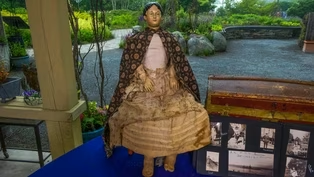
GUEST: Here you have Ms.
Louisa, and I have known Ms.
Louisa since I was about five years old.
I have a picture of my mother and Ms.
Louisa together.
And the picture was taken in 1920, when my mother was about five years old.
And this was in Pennsylvania, where my mother grew up.
So other than that, I know my mother played with her, obviously, because she was holding her.
I was not allowed to play with her.
She was just to sit quietly under the Christmas tree and look very serene and spiritual.
(laughing) So we know she's been in your family since at least 1920.
Correct.
So Ms.
Louisa is about 100 years before that almost.
Oh, wow.
So Ms.
Louisa comes about 1830.
(exhales) That's wonderful.
Yeah.
So she is an American papier-mâché and there's a cloth body that's all hand sewn under here.
And these dolls are usually Philadelphia, East Coast area.
Yeah.
She has a body similar to some of the dolls made in Philadelphia, which were Greiner dolls with these individual made fingers... Mm-hmm.
...individual stitched toes.
It is a papier-mâché, These were handmade, hand-painted.
A lot of times you see ones that are very feminine looking.
Um, this one's a little more masculine, but we do know it is a female because of that part in the middle of her face there.
Oh, okay.
She would have been a special, special-made doll.
Oh.
Huh.
So not cheap, meaning that she maybe was five dollars... Yeah.
Yeah.
...as opposed to a dollar... Yeah.
...back then, which is a lot of money.
Ms.
Louisa, in her condition that she is in, and obviously her clothing has... Eh.
...gotten old, but it's her original clothing... Mm-hmm.
Mm-hmm.
...and 1830s is a long time ago.
Mm-hmm.
So we don't expect her to look new or pristine.
Her value at a doll show would be anywhere from $2,500 to $4,000.
Oh my!
Oh, that's wonderful.
(chuckles) My kids will be super pleased.
Uh, and my mother would be, too.
(laughs) ANDY BRAND: So we're in the Giles Rhododendron and Perennial Garden.
It was the first garden that was designed and planned here at Coastal Maine Botanical Gardens.
And it's the pristine location for rhododendrons and their companions just because of the location on this gentle slope.
Rhododendrons prefer the type of, uh, habitat and cultural conditions where we have the well-drained soils.
And they've just performed really well here.
And we're fortunate to have over 175 different varieties of rhododendrons and also rhododendron species as well here in this garden.
And it's absolutely spectacular.
GUEST: This is a cast-iron birdhouse.
I remember at my grandparents' house.
It was mounted on a post, um, out in their yard.
As a little kid, we would play and it was always there, birds around it.
What is so cool about this is it's not just any house.
This is Clifton House.
And Clifton House is a house that still exists to this day in Roslyn Harbor, New York on Long Island.
Whoa... Clifton House is a Flemish, Gothic Revival-style home by architect Frederick Copley of New York, constructed in 1862 to 1863.
Just a few years later, in 1868, the Miller Iron Company in Providence, Rhode island made this model of Clifton House as a birdhouse.
It is stamped "patent 1868," and it is likely either made that year or very shortly thereafter.
The Miller Iron Company would have issued this birdhouse in plain cast-iron.
And so this was later painted by someone.
And this red roof with green detailing and white brick sides would have been an appropriate color scheme probably in the early 20th century when this entered your family's possession.
Clifton House, as it is today, is not painted in this color scheme.
And we don't know if it was ever painted this color scheme.
But this is such an important example of American Gothic Revival decorative art that examples of this have entered museum collections, including the Cooper Hewitt, Smithsonian Design Museum, and the Metropolitan Museum of Art in New York City... Whoa... Yeah.
...in their American Wing.
And examples have appeared at auction.
But none of them, except one example I have been able to find, have this, what I believe to be, original open work base that you have under the birdhouse, where this would then be mounted on a, a pole... Right.
...outside for a birdhouse.
Right, right, right.
The house is held together by a long central screw.
Here in the back, we see the top of it near the mark of the Miller Iron Company of Providence, Rhode Island.
We can see the occasional small, lacking element.
There's a small piece of this stair banister that's missing.
And a couple of lacking chimney pots, a couple of other very small lacking elements.
But overall, it's still in amazing condition considering its age.
I would advise you to insure it for... (chuckling): Okay.
...$12,000.
Wow.
Really?
I will definitely do that.
(chuckles) Because right now, it's just sitting at home on a shelf, you know, catching dust.
So that's awesome, yeah, unbelievable.
Always been a dream to be here, so that's awesome, thank you.
So this is a Gibson L-5.
Um, it's custom, from what I understand.
My great-uncle's wife's brother had polio when he was a kid, so he needed a special kind of guitar.
And we think it's maybe '50s, '60s.
Um, so this is based off of a fish that my grandfather and my dad caught back in the early '70s when my dad was about seven years old, I believe.
And my grandfather had it stored in a freezer (chuckling): for, like, over two years.
And his brother took the fish out of the freezer one day and just told him he tossed it, but he actually sent it over to a local Maine artist to have this fish carved.
As far as we know, like, a scale replica of that fish that they had.
(laughs) Today I brought a cream pot forged by Paul Revere and a diary belonging to Thaddeus Harris and his portrait.
So it's interesting that there's a contemporary journal and he was the son of the person who actually, of the man who owned this cream pitcher.
Yes, William Harris.
So the diary is depicting the night that they left Charlestown because they got intel that the Regulars were coming.
Mm-hmm.
When you say the Regulars, that means the British... The British.
...the British army.
Yes.
Yeah, the British Army.
So they grabbed a bundle of important papers and some linens, some silver plate, this cream pot and some spoons.
And obviously the wife and children... (soft chuckle) ...and the mother-in-law and fled to Lexington.
They didn't stay there long because the Battle of Concord and Lexington had just happened.
Mm-hmm.
Um, on April 19.
What year was that?
1775.
Okay.
And so they left Lexington and went out to Sterling, Mass., where they felt that they were safer.
Okay.
Paul Revere, of course, is the one maker of colonial silver that any collector would really want to have.
By colonial silver, I mean silver made before America became the United States, when it was still the 13 colonies and owned by England.
Mm-hmm.
Paul Revere was a silversmith in Boston.
His father had also been a silversmith.
This pitcher was probably relatively new at the time that this, uh, incident occurred.
It's, uh, neoclassical in style.
It's a helmet form pitcher.
And it's got some very lovely engraving on the outside of it with some initials as, as showing who it belonged to in the family.
And then the mark of Paul Revere, Jr.
on, on the back of the foot.
Mm-hmm.
A similar creamer sold this year, 2025, for a little over $25,000.
I think with the archival material that you have, the story of it relating to having been something that was saved from being stolen by the British army... Mm-hmm.
...uh, makes it a very interesting story and adds some value to it.
I would say that if this were to come up at a public auction of American silver, the pitcher combined with the archival material and the miniature portrait would bring in the neighborhood of $25,000 to $30,000.
And as its property of your family and has historical importance to your family, I'm sure you're not going to sell it.
So I would put an insurance value of $40,000 to $60,000 on it.
Wow.
That's amazing.
GUEST: I've had it probably 15 years or so.
Came from my father's basement after he was deceased and his grandfather made it, who immigrated from Sweden into Maine with my two-year-old grandmother.
When was this?
1888 they came to Maine.
Okay.
And they pretty much settled in Stockholm, Maine, where he started a business-- he built some boats and he had a cottage on Madawaska Lake.
He eventually had a store and it was like a stagecoach stop where wayfaring travelers would stay there and maybe get a meal-- he spoke no English.
He made this, I'm guessing, about 1900... Yeah.
...maybe a little bit before.
It's a Swedish soldier.
I was told it's a uniform from, like, 1865.
I'm just guessing that perhaps my great-grandfather had it on his store.
Maybe he was trying to reel in some customers or something like that.
Yeah, that's a really good guess.
As a sort of a trade figure that he had out in front of the store to attract people in.
This is solid wood.
The bottom of his jacket is made out of some sort of painted oil cloth.
His cross belt here is probably gold foil that was pressed onto the surface.
And his little medal here or his medallion here is also gold foil.
The belt is leather, and someone has punched out that piece of metal to make a military style belt.
It's fabulous.
It looks like it was at one time... ...very blue, if you can see the blue color here.
Everything about this just screams quality.
What we all love about it is the surface.
It has never been cleaned, it has never been repainted.
And that's what folk art collectors just love to see.
It's the original surface of the figure.
You can see in the guy's face, the bumping, the little crackling from where the varnish is aged and shrunk.
And same things on the paddles here.
I mean, that's fabulous, that alligatoring like that... Right.
Yeah.
...comes from age.
(chuckling): There's a story that you have about this.
What did you do with it?
Family's got a place on the lake in central Maine, and I... I s-- it was really windy.
That was yesterday.
So I wanted to put it on the dock because I wanted to see how it behaved.
He had some movement.
His arms didn't go flailing or anything like that.
But he twisted in the wind a little bit.
And I had to keep my foot on the base because I didn't want him to take a swim.
(laughs) Um, but that was the first time really I've ever spent any time with the young man.
So we all put our heads together and thought that a good auction estimate for this figure would be $8,000 to $12,000.
Hm, interesting.
If it were an American figure, we would probably have doubled that estimate.
But it's, it's a great figure.
It's the best whirligig that I've seen in 29 years on the "Roadshow."
Oh my goodness.
Don't put it out on the dock anymore.
(chuckling): No... not, not... Nah, it was just an experiment.
He twisted a little bit in the breeze-- so do I.
(laughs) GUEST: These are my grandmother's, our grandmother's.
She was born in about 1895.
It's her porridge bowl and cup.
It's got her initials on it.
It's very precious to us because it's gone through all four of my children and 11 grandchildren.
So it's a little, it didn't sit in the cupboard, it's been used.
Gonna see if anybody else loves it.
(chuckles) So this chair was left in my parents' basement by my, uh, brother-in-law.
What I do know about it is it's a high frequency therapy chair.
It would have electrodes that you can connect to your hand, ultraviolet vacuum tubes, and a lot of things I don't understand.
So I'm not a, I'm not a doctor.
And, uh, even if I was, I probably wouldn't know this medicine.
(chuckles) It's pretty old.
GUEST: This was my grandfather's watch.
He was in the Navy.
APPRAISER: Okay.
I'm not exactly sure how he came about owning it.
Mm-hmm.
I know it's a Rolex.
(laughs) Okay.
Other than that, I don't really know anything.
The watch is a Rolex GMT.
It's called a pointed crown guard, which means that the guard that holds the crown comes to a point.
Ah.
That was the early version of the GMT.
It's a model 1675.
The hands appear to be original.
The bezel insert, which is called a ghost bezel.
Mm-hmm.
This would have been blue and red, and over decades of wear, it's faded, and now the, the term is called the ghost bezel.
Ah.
The most interesting thing about it is the dial, and the dial is now called a tropical dial.
The dial would originally been a black gilt dial.
Mm.
And over the years, it's oxidized... Okay.
...and the lacquer has turned, and it how-- now has a absolutely gorgeous color, of sort of a honey brown.
(chuckling): That's lovely.
So-- I just thought it was dirty.
(laughs) So if you followed the rules and you sent the watch in as Rolex would say, every se-seven to ten years... Mm.
...that dial and hands and insert would have been changed out at least one time.
Ah... Yeah.
He didn't follow the rules?
No.
(laughs) And you're lucky at this point that he didn't... Yeah.
...because when you had service dials, they're just worth a fraction of what an original dial was worth.
Ah, okay.
So it would appear that this dial has been on, since the watch is new, which was probably right around 1960.
We can't tell if the crystal was original or not.
It's, it's very scarred.
Yeah.
It's been on there for decades.
The bracelet is an oyster bracelet.
Now, there's a date code on the bracelet which dates it to the summer of 1968.
Oh wow.
So the wa-- the watch-watch would have been about eight years old.
And more than likely, he, for whatever reason, changed the bracelet out.
Okay.
It's the original style bracelet, and all the bracelets during that time period all looked fairly similar.
Oh.
It showed two time zones simultaneous.
Oh, okay.
So it was used by a lot of service people, and they were sold on, in many of the Army and Navy stores throughout the world.
Okay.
It would have retailed for somewhere between $275 and $325.
Oh.
What do you think of value?
Honestly, I thought, like, $1,000, maybe.
The retail value of a watch in this condition would be in the $40,000 to $45,000 price range.
(laughing): Are you kidding me?
You guys really like to go for the shock value, don't you?
That's crazy.
(both laughing) I'm going to be very careful about where it goes when we get home.
A watch with a service dial and service hands would be worth in, like, the $15,000 to $16,000 price range.
Oh wow.
Yeah.
GUEST: This is an original illustration done by H.A.
Rey for the first "Curious George" book.
It was drawn in Paris just before the start of World War II.
So 85 years ago, the German army was approaching Paris, and the Reys, uh, who were German Jews, managed to escape on bicycles that Rey made himself out of bicycle parts.
And they escaped with this drawing in their backpack and made it out of France and eventually to America.
My father was... worked for the Houghton Mifflin Company that published, uh, the first H.A.
Rey books, including "Curious George."
He became sort of like an uncle to us children.
He was a wonderful character.
And so when I got married, he gave it to us as a wedding present.
What's your favorite thing about this illustration in particular?
I like the happiness.
Curious George, uh, and the whole escape of the Reys from Paris are intertwined.
They got into serious trouble in Paris and escaped.
And all of the "Curious George" books have the same theme of Curious George getting into trouble and escaping and then finding happiness.
And here he is finding happiness in the zoo.
So the work, uh, is dated from 1940, but it also is inscribed to you when he gave you the gift, uh, on your wedding.
It says, uh, "To Christopher and Mary Jane, "with love and all good wishes from the Reys.
July 20, 1968."
H.A.
Rey and, and Margret Rey were both from Germany.
They, I think, knew each other when they were quite young and then kind of got reunited later in life, and ultimately got married in 1935 and moved to the very romantic city of Paris.
As the war went on, it did become a little bit too dangerous for them to stay.
And the story of them getting out is remarkable, on bike with not very much at all, and only five manuscripts with them.
So to have something that came out of that time, left Paris with them, he thought prized enough to bring along, and to have that then given to you many years later, too.
I'm sure he entrusted it to you and, and was definitely feeling like it was a special thing to pass on.
Mm.
The work is a combination of charcoal, watercolor, colored pencil on paper.
On the back there is an inscription.
It says, "Christopher.
"This is the original drawing for the end page "of the first 'Curious George' book, "done while we were living in France.
Ancient history, isn't it?"
In the larger market of the art world and illustration art, this has everything going for it.
It's from the first book.
It's the final illustration.
George is having so much fun.
That smile.
It's what we all think of when we think of, of Curious George.
They don't come to market a lot, so they're they're also kind of quite rare in that way.
An auction estimate would be $15,000 to $25,000.
Okay.
That's great.
Thank you.
An insurance value should be $30,000.
Okay, great.
Thank you.
I'll, I'll call my broker.
(chuckles) PEÑA: Coastal Maine Botanical Gardens is known for its beautifully cultivated spaces and wild areas.
But these incredible colossal trolls, built by Danish artist Thomas Dambo, and over 150 local volunteers, have a gigantic appeal.
GRETCHEN OSTHERR: This installation is called "The Guardians of the Seeds."
And so each troll represents a different part of the tree.
And they're spread out so people have to walk through the woods to find them.
And there's a really nice kind of story and lesson that goes with them about the importance of trees and biodiversity and protecting the ecosystem.
But Thomas's art is so fantastic and magical that it kind of, you don't even realize that you're learning these lessons and that you're appreciating why protecting trees is important.
They're giant, I mean, the biggest one here is 35 feet high.
So that is the size of a tree.
And they're built out of recycled wood.
So pallets, cast offs from mills in Maine.
The faces were built in his shop over in Denmark.
So in order to build the trolls, it was a community effort.
And that's a big part of Thomas Dambo's ethos, and a big part of what we do here.
GUEST: This is an, I believe, ambrotype political pin from Abraham Lincoln.
He's without the beard.
I believe it's from 1860.
And it's been in my family since my great-great-grandfather, who lived in Searsport, Maine.
And it's been passed down through my grandmother's family to me.
And what was his name?
Um, Edwin Sargent.
Okay.
He must have purchased it or acquired it during his lifetime.
Yes.
So, it's a campaign pin.
It was used for his campaign in 1860.
He came to New York to do a lecture at Cooper Union, he had his new $100 suit on... Oh.
...which I think is close to $4,000 in today's money.
Wow, I see.
That shows you that he really wanted to... make himself very presentable and be seen in the right light.
But, uh, historians said that he still looked very frumpy in his suit.
Mm-hmm.
So I guess maybe it wasn't worth it.
He had his photograph taken by a very famous photographer, Mathew Brady, who is known for producing some of the best photographs that we have of Lincoln today.
Wow.
Now, the photograph that was originally taken shows Lincoln from the knees up.
So it's a very large, almost full-length portrait... Sure.
And obviously has been cropped down here to fit this format.
This was the first time that photographs were used for a presidential campaign to promote a candidate.
Wow.
And it played a major role... Mm-hmm.
...because this image by Mathew Brady was hugely popular.
Mm-hmm.
Made into postcards and put in "Harper's Weekly."
And, I mean, it was everywhere.
So, the back paper tells us that even though the photograph was taken by Mathew Brady, the ambrotype itself was made by George Clark.
Mm-hmm.
He's the one that was actually responsible for turning this image into the campaign pins.
Okay.
And unfortunately, that part is ripped.
And then, we look at the front, and these photographs were extremely susceptible to flaking... Mm-hmm.
...of the emulsion off of that glass plate, which is what makes an ambrotype an ambrotype.
So, unfortunately, there is a little bit of loss there.
But overall, I think that the saturation of this image is really nice for its age.
Okay.
The brass mat is in really good condition.
These photographs are very rare.
We don't see very many of them at all.
Definitely under 50.
Wow.
probably under 30.
There's one in the collection of the National Portrait Gallery.
Really, it's going to come down to how saturated that image is, how punchy it is, and the condition of that information on the back.
Right.
So it's, it's really the full package.
Mm-hmm.
I'd say, at an auction, probably $12,000 to $18,000.
Wow.
Wow, that's amazing.
I think it's really special.
Nice.
Thank you so much.
I'm so honored that it was passed down to me.
I've seen the photographs in the campaign pin format sell for upwards of $30,000.
GUEST: It's, uh, my dad's guitar.
He acquired it back in 1963.
His mother bought it for him at a music store in Ardmore, Pennsylvania, and had it shipped to him at Langley Air Force Base in Virginia that same year.
And this is your father with the picture right next to you over there?
Yes.
So, this is a picture of my father from the talent show that he was in... Mm-hmm.
...at Langley Air Force Base that he won.
He looks pretty happy right there.
(chuckles) He's a very happy guy, yeah.
You have-- indeed, it's a 1963.
I checked the, the serial number.
Mm-hmm.
Uh, Martin D-28, which is kind of the workhorse of the Martin line ever since the early 1930s, when the first one was made.
Mm.
The first-- it's called a dreadnought shape.
It's a big, booming, great guitar.
They-- even today, they still make the same guitar.
It's kind of the go-to guitar for bluegrass and folk music.
It's probably the best-known acoustic guitar in the world.
Martin moved from Germany to New York City in 1833, where he made guitars up until they moved to Nazareth, Pennsylvania, where they are today.
It's constructed of a spruce top and Brazilian rosewood back and sides and a mahogany neck.
Mm.
Uh, the Brazilian rosewood is rare wood and is on the endangered species list now.
But it was really Martin's go-to, uh, back and side wood for all of their high-end guitars.
So this is a, uh, in incredibly nice condition.
It really looks near mint.
He must have really taken care of this, uh... I wasn't even all... Wiped it down every time he used it.
Every time.
And I was not allowed to play it.
At all.
Mm-hmm, you, you could never.
Or if I did, I mean it was very like-- five minutes.
You had to sneak it, or, yeah.
Yeah.
(chuckles) As wonderful as the Martin guitar company is and was... Mm.
...back through the '50s and the '60s and the '70s, these guitars almost always needed a neck set, almost brand-new, out of the factory.
And that's the one issue with this guitar... Okay.
...is it really does need a neck set.
Okay.
Meaning that the string action is, is quite high as it comes down the fingerboard.
And I'll also mention that the nice bright green of the interior of this case, you don't see that too often, either.
Oh.
The case is original and beautiful, and the guitar is original and beautiful.
Do you have any idea what he paid for it?
His mother paid $269.50.
Mm?
For it back in 1963.
1963.
Yeah.
This guitar today, at retail, would bring between $12,000 and $12,500.
Come on.
Wow.
No way!
(chuckles) Yeah, yeah.
No, really, it, it... Holy-- wow!
I am shocked.
It's really one of the nicest D-28s I've ever seen, so.
No, come on.
Yeah, beautiful.
(sighs) He's going to be so excited.
It came from my mother's neighbor's house.
I actually had the opportunity of cleaning the house out after the neighbor passed away.
And I found this large doll collection, and this was in it.
It's a Ricky Jr.
doll, which is, uh, like, Lucille Ball and Desi Arnaz's child.
Eyes close.
I think it does make a noise.
(doll squeaks) This is a tabletop butter churn with a dasher.
Um, I got it... uh, at an auction.
It came in a lot with another butter churn.
I think I paid about $85 for both.
Uh, I don't really know a lot about butter churns, so... I thought I'd bring it and find out.
(chuckles) GUEST: It's my, uh, wife's grandparents' clock purchased by her grandfather.
My, uh, wife remembers it always being in the house, uh, growing up.
I know it's J.E.
Caldwell.
I don't know if he was the manufacturer or if he was more of a, uh, importer and reseller.
Yeah.
Well, he was actually a retailer.
And his retail shop in Philadelphia became the biggest in the city.
They became very well-known for selling clocks of the highest grade.
So the case form is called a bracket clock.
It's a form that was made for... a couple of centuries.
This is the Victorian example, meaning that it was probably made about 1880 or so.
It represents the best of its category in terms of having a very solidly built, robust mechanism with fusee compensation.
It has a, a... a number of features which are displayed here on the dial.
Here you have a shut-off for the strike portion of the clock.
You can turn this clock silent so it just ticks, or you can turn it on and it'll do the quarter-hour striking as well as the hour striking.
And then the center dial here, actually is for rating the clock.
So, uh, temperature is a variant that.. affects clocks greatly.
Warm rooms, they slow down.
Cold rooms, they speed up.
Instead of having to turn this clock around and actually adjust the pendulum, you can do some fine adjusting from the front of the dial.
Hm.
The case is mahogany, the finest wood.
And you can see that it is wonderfully adorned with, uh, all kinds of brass appointments, full Corinthian capitals on the... fluted columns, chased feet with roses, applied swags, other flowers and florals.
And here you have this classical theme just below the dome.
Five finials with floral tops.
It's just absolutely over-the-top in terms of quality.
And the tune selection helps us date the clock.
One of the tunes is "Westminster," and of course, Big Ben was installed in 1859.
(clock tone playing) And that sound of the quarter hour striking became synonymous with clocks of this period.
And this clock has that, so we know that it had to have been made after that.
So it was top of the market.
Just an absolute fabulous piece.
That's great.
In its current state, in a retail setting, this probably has a value of somewhere to $3,000 to $4,000.
Hm.
Once it's serviced, this clock should easily make somewhere in the $6,500, $7,000 price range.
Oh, that's great.
GUEST: This is a denim jacket that was owned by my dad when he was a kid.
He was born in 1936, so it likely would've been his parents that would've gotten it for him.
He was probably seven or eight-ish, and, uh, I think it just got put in a closet.
I know my grandmother held onto it for a long time, and then my mom had it for a number of years, and, uh, I've had it for a few years since then.
So this is what we call a Type 1 Levi's denim jacket.
And the years that you were giving seem about in line with what I was thinking, which is likely late '30s, early '40s.
And there's a couple things which indicate that for me.
So, firstly... this cinch on the back right here is in silver.
Mm.
In silver means that it wasn't during World War II... Mm.
...when they started making these more of a kind of a bronze color.
Mm-hmm.
As well as during World War II, they eliminated the pocket flap.
Mm.
So just kind of rationing as much as they could.
Okay.
The buttons would've also been different if it was a World War II version.
They changed the buttons to be kind of donut buttons that you would've seen on military uniforms.
Another thing which helps me pinpoint the date is the Levi's tab here, the red tab, which is very iconic.
The fact that it only has Levi's written on one side.
Also, it's Levi's with a capital E here, which people in denim and vintage world refer to as a big E tag.
Mm.
So all sources indicate that it is late '30s, early '40s.
So Levi's originally was making what they call the 506XX blouse, and that was kind of the first shirt jacket that they were making.
Mm.
The next iteration, the Type 2s, which were introduced in 1953, have two pockets, but the same silhouette overall.
Kind of boxy and cropped.
Mm-hmm.
And then afterwards, in 1962, they introduced the Type 3 jacket, which is kind of the modern trucker denim jacket that we see today... Right.
...with the two pockets, has the slanted seams running down, and also it's a little bit longer length.
There are a couple features of the Type 1 as well.
You can see these pleats here, which are actually stitched shut.
That allowed for some size adjustability... Oh, okay.
...as did the cinch on the back.
There's a couple of really strong points about this jacket.
Firstly, both here and in Japan especially, Levi's is the pinnacle for people who collect denim... Yeah.
...as they more or less invented riveted denim clothing.
It's not necessarily the rarest, but it's the most collectible brand, other than the kind of 1905 506 blouses and ones from that era, these early Type 1s are kind of the most sought-after kinds of jackets.
It's also a great color.
It still has this deep indigo wash.
There's a little bit of fading at points you'd expect, like on the elbows and around the collar.
Mm-hmm.
But overall, this is a strong kind of dark wash color.
The last thing I'd say is very strong about it is the fact that the pleats haven't been cut here.
The downside is, it's a smaller size.
Right.
These days, there's fewer people that can wear what might've been a normal medium or large or something in the 1940s.
Mm-hmm.
So, taking everything into consideration here, I would think at an auction, an estimate of $3,000 to $5,000 would be about right.
Wow, that's awesome.
That's really cool.
I think my dad would be proud to know that, and I know my family would be proud to know that.
We'll certainly take care of it.
GUEST: Supposedly it was my mother's grandfather, which would be my great-grandfather.
And I know my grandmother had it stripped and varnished, so that probably ruined it, but... (chuckles) GUEST: Well, all I can tell you that's really correct is that I got it through my father, who was in World War II in the Indochina Theater.
And for.. seven years, we got a bundle of boxes from that area to our home in Tennessee.
And this is but one of them, uh, probably the smallest of them.
GUEST: So, I inherited this when my uncle passed away in 2011.
In somewhere around 1952 through 1955-- maybe longer, I'm not really sure-- my uncle worked at I. Miller Shoes in Fifth Avenue in New York.
He was art director.
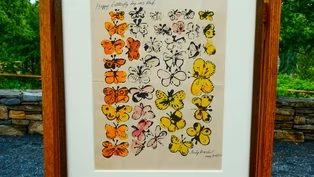
And while he was there he hired a freelance artist, Andy Warhol, and I believe this piece was given to him as a sort of thank you gift.
I remember he said when he met Andy Warhol, he said he was wearing torn dungarees and his hair was disheveled.
(chuckles) But he said his portfolio was fantastic, so he obviously hired him.
This is a wonderful window into the early work of Warhol... Mm-hmm.
...when he was, like you said, a young graphic designer.
This is before the Warhol most of us know.
And it has a dedication up at the top.
So this wonderful artwork is entitled "Happy Butterfly Day."
It's a hand-colored print.
It was made in 1955.
Warhol liked to use mechanical reproduction techniques, so he reproduced his ink drawings.
Originally, this was based on a drawing.
Okay.
And then he made an offset lithograph of his drawing.
Okay.
So he could have multiple copies.
We don't know the edition size of this.
Okay.
But then he later hand-colored ones like yours to give to people.
Mm-hmm.
And so they became each unique again, because they have each different hand coloring and different qualities, different colors.
I think one of his colleagues also received one of these... Uh-huh.
...and my uncle said that that colleague threw it away, because they... (small groan) of course, Andy Warhol was not a known artist at the time.
And then, years later, was very upset (chuckling): that he had thrown it away, so... (laughs) I, I'm sure.
Well, he may be even more upset, uh, after he, he watches the "Antiques Roadshow."
(chuckles) (chuckling): Okay.
The story that you have of this direct connection to the artist is clear.
And he did give these to people.
And so the lucky ones have these dedications in ink.
Mm-hmm.
Mm-hmm.
And then yours has this wonderful signature at the bottom.
A really strong ink signature with a small inscription.
I'm not sure what those numbers represent.
Hm.
Okay.
It might be his phone number.
(chuckles) So, most of these aren't signed.
Oh.
Uh-huh.
And some are hand-colored, but yours is hand-colored and signed... Okay.
...and dedicated by Warhol, which really makes it just a wonderful example of this great pop artist... Hm.
...at this early point in his career.
It shows a little bit of its age.
Yeah.
It has some, some handling marks... Mm-hmm.
...some things that could be improved with a little paper conservation.
Yeah.
But the colors still look strong to me.
So, at auction today,, this could do very well.
I would expect a value between $10,000 and $15,000.
Really?
Wow, okay.
That's surprising to me.
Just because it's a personalized... note.
Um, that's great, wonderful.
That's what makes it special, actually.
Oh.
It's the personal dedication as well as the signature.
Yeah.
You inherited this from someone who worked side by side with Warhol?
Mm-hmm.
Those stories are priceless.
Yeah.
PEÑA: For centuries, the Wabanaki people have gathered on the lands where Coastal Maine Botanical Gardens is located, and that continues today.
KEYANA PARDILLA: An example of the Indigenous knowledge here in this garden are the three sisters: corn, beans, and squash.
They are known as the three sisters because of their personhood within Wabanaki culture.
They're teachers.
They teach us respect, responsibility, reciprocity.
Sister Corn grows nice and tall; she's planted first.
she's the eldest sister.
Sister Bean is then planted, and Sister Bean provides nitrogen to the soil that helps the corn grow especially tall.
And the corn also provides structure for the beans to grow up on.
And the youngest sister, squash, is planted last and provides shade, keeps the soil nice and moist, and they thrive together.
And the seeds we've planted here in this garden have been saved for generations by our ancestors, and we were able to reunite them with the soil with this garden here in Boothbay.
I'm a sports fan.
I'm a baseball fan primarily, but I do love hockey and I love Wayne Gretzky.
He was at a sports show right after he broke the record, and he signed it for my dad for me.
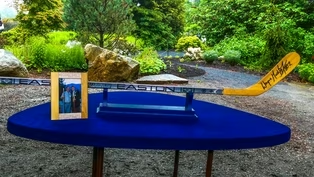
This is a stick signed by Wayne Gretzky.
It was after he broke the goal record in '94.
Mm-hmm.
So he signed it with an 802.
My dad gave it to me when I was 12.
My dad worked for Easton Sporting Goods and they used to do super shows every year.
He became well-acquainted with Wayne Gretzky.
So, yes, what we have here is a Easton game-issued stick for Wayne Gretzky.
I think most people will agree, Wayne Gretzky is the greatest hockey player of all time.
Mm-hmm.
He's the Babe Ruth of hockey.
Yeah.
March 23, 1994.
Yes.
He surpasses Gordie Howe... Mm-hmm.
...with his 802nd goal.
It was a huge deal.
Yeah.
It was one of the biggest moments in NHL history.
Now, he didn't play with this stick... Correct.
...but it was made for him with his specifications and everything else.
Mm-hmm.
And how we know that-- it has that stamp, right there.
Yes.
You have a beautiful Wayne Gretzky signature.
I mean, that's like an A-plus-plus signature.
Mm-hmm.
Mm-hmm.
And he added the 802.
So we know definitively when it's from.
It's from one of the peaks of his career... Mm-hmm.
And it's just a beautiful stick.
Now, the other great thing is this photograph.
Yeah.
(chuckles) And it's a great picture of your dad with the Great One himself, and he's holding the stick.
Yeah.
For collectors, to have that kind of provenance is, is just the best.
Mm-hmm.
You can't ask for better than that.
You might notice in the photograph, the stick looks gold.
Mm-hmm.
But that's because there's a mylar film that goes over the aluminum.
Yeah.
And the light, the way it hit it, made it look gold.
Yeah, that makes sense.
(chuckles) Game issued-sticks aren't as desirable as a game-used stick, obviously.
Mm-hmm.
But this is a different kind of animal altogether.
Mm-hmm.
Because of the autograph, because of the provenance, and it's just a good-looking stick.
Yeah.
So, I think, at an auction, I would estimate this between $2,000 and $3,000.
(exhales, chuckles) And I would insure it for no less than $5,000.
Wow.
Yeah, that's... entirely over what I thought.
(laughs) It was-- it's never going anywhere, and it's not going back in the closet.
(laughing): I will, I will take care of it properly now.
This is as good as it gets for a game-issued stick, without question.
Wow, that's incredible.
Uh, this is from my grandma's house.
She kept it in great shape, and... (creaking) Her mom got it at an auction, uh, in the '60s.
So, that's all I know.
Well, it's a big mallet, and it's been in my life for a long time.
I'm not really sure where it came from.
I don't know if it was used to strike parts of ships together or railroad ties.
Don't have any idea.
(voiceover): It's heavy.
It's really heavy.
PRODUCER: Just... let me just hold that... Oh, yeah.
PRODUCER 2: Yeah?
I'd go with 20, 20 pounds, everyone.
(laughing) All right, keep holding it.
(laughter) Keep holding it, keep holding it.
GUEST: This belonged to my husband's grandmother.
She lived in Washington D.C.
they were German Americans.
My husband's grandfather was a, uh, sort of an entrepreneur in Washington D.C.
And he would go to New York City from time to time and buy pieces of jewelry for her, and this was one of them.
I believe it was probably for their 50th wedding anniversary.
This would've probably been in the mid-'50s, I'm guessing.
I looked at it.
Mm-hmm.
I was dating it, along with my colleagues at the table, for something that was made in the early 19-teens.
(exhales) Really?
He could've bought it old, though.
It could've been... He could've bought an estate piece back in the '50s.
True.
Know anything about the maker of it?
Well, um, I've noticed that there's a mark on it that says Cartier.
Yes, it's Cartier New York.
Ah.
So it says "N.Y.
"right after the Cartier script.
It's set with two beautiful sapphires.
The main sapphire, which is the large sapphire on the bottom, it's approximately ten carats.
It could be approximately 12, but it's hard to know exactly.
Really?
Wow.
Yeah, it's bezel-set, so, conservatively, I'm saying it's about ten carats.
Hm, interesting.
It looks like a Ceylon stone, which is the region of where the stone is-- their sapphire is from, which is now Sri Lanka.
And Ceylon stones are usually powdery, more brilliant.
They're lighter, they're not as saturated as the darker stones are.
Okay.
Um, and this is very apropos for this time period as well, the 19-teens, when they were mining a lot of these around that time period.
Hm... And the smaller stone, I think is around three carats, approximation.
Oh.
Same material, though, the same saturation.
The lighter, sort of more vibrant, brilliant color of sapphire.
It's suspending from a beautiful necklace that is very, very fine.
And it's platinum, and it's so fine that some of the little detail in there that you can see, it's like little tiny wires.
Hm.
And that's appropriate for the 19-teens as well.
Ah.
It's also set with some small round-cut diamonds.
Yes.
Just little accent stones.
It's really chic.
I think a conservative value for insurance purposes... Mm-hmm.
...would be $75,000.
Okay, that's good.
That's very good.
We see a lot of nice things on "Roadshow," but this is spectacular.
Yes.
Yeah, well, thank you.
I love it.
PEÑA: This episode of "Antiques Roadshow" PEÑA: And now it's time for the "Roadshow" Feedback Booth.
This is a cherry picker dated 1870.
It's worth about $30 to $50.
And it's taken us all this time-- at least two years-- to figure out what it is.
Everyone back home laughed at us for bringing this painting, and I have one thing to say: they were all right.
This belonged to my great-grandmother Theda, and my mother asked me to bring this today.
She's 90.
She'll be tickled pink, sort of.
Um, she thought maybe Oprah Winfrey would want it.
Yes, but... Because Oprah collects these chairs.
So, Oprah, if you're listening, just... just give us a call.
And we had an awesome day at the "Roadshow," and I found out Grandma's cigarette case is worth $8,000.
I know it's precious, but my friend is more precious.
'Cause it's my birthday.
I brought my kiddush cup set that I got in Jerusalem, and I thought it was possibly silver, but it turns out it's a fake.
So, um, it's only worth about $20 or $30, but it was fun.
(laughs) I brought my, uh, bronze elephant.
It's, uh, Chinese.
It's, uh, not from the Ming dynasty.
It's from the 1970s, unfortunately.
But I still like it.
It's an original print, but he also thinks that it was-- might've been made as a joke.
So that's what I learned about my print, and I just had a great day.
And thank you, "Antiques Roadshow."
Yay!
(chuckles) PEÑA: Thanks for watching.
See you next time on "Antiques Roadshow."

Appraisal: 1940 H.A. Rey Curious George Illustration
Video has Closed Captions
Clip: S30 Ep7 | 3m 20s | Appraisal: 1940 H.A. Rey Curious George Illustration (3m 20s)
Appraisal: 1949 Pan Am "Bermuda by Clipper" Travel Poster
Video has Closed Captions
Clip: S30 Ep7 | 3m 49s | Appraisal: 1949 Pan Am "Bermuda by Clipper" Travel Poster (3m 49s)
Appraisal: 1955 Andy Warhol-inscribed Happy Butterfly Day" Lithograph
Video has Closed Captions
Clip: S30 Ep7 | 3m 25s | Appraisal: 1955 Andy Warhol-inscribed "Happy Butterfly Day" Lithograph (3m 25s)

Appraisal: 1963 C.F. Martin D-28 Guitar with Case
Video has Closed Captions
Clip: S30 Ep7 | 3m | Appraisal: 1963 C.F. Martin D-28 Guitar with Case (3m)
Appraisal: 1994 Wayne Gretzky-signed Game-issued Hockey Stick
Video has Closed Captions
Clip: S30 Ep7 | 2m 29s | Appraisal: 1994 Wayne Gretzky-signed Game-issued Hockey Stick (2m 29s)

Appraisal: Abraham Lincoln Campaign Button, ca. 1860
Video has Closed Captions
Clip: S30 Ep7 | 3m 16s | Appraisal: Abraham Lincoln Campaign Button, ca. 1860 (3m 16s)
Appraisal: American Papier-mâché Doll, ca. 1835
Video has Closed Captions
Clip: S30 Ep7 | 1m 59s | Appraisal: American Papier-mâché Doll, ca. 1835 (1m 59s)
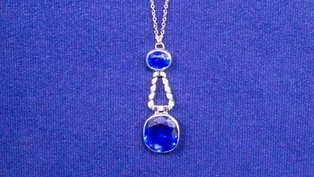
Appraisal: Cartier Sapphire Pendant, ca. 1915
Video has Closed Captions
Clip: S30 Ep7 | 2m 32s | Appraisal: Cartier Sapphire Pendant, ca. 1915 (2m 32s)
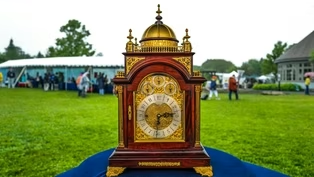
Appraisal: J.E. Caldwell & Co. Bracket Clock, ca. 1880
Video has Closed Captions
Clip: S30 Ep7 | 2m 38s | Appraisal: J.E. Caldwell & Co. Bracket Clock, ca. 1880 (2m 38s)
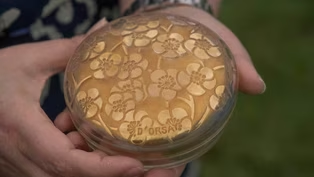
Appraisal: Lalique Glass D'Orsay Powder Box, ca. 1922
Video has Closed Captions
Clip: S30 Ep7 | 1m 4s | Appraisal: Lalique Glass D'Orsay Powder Box, ca. 1922 (1m 4s)
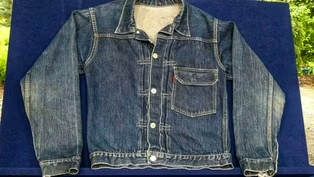
Appraisal: Levi's Type 1 Denim Jacket, ca. 1940
Video has Closed Captions
Clip: S30 Ep7 | 3m 14s | Appraisal: Levi's Type 1 Denim Jacket, ca. 1940 (3m 14s)
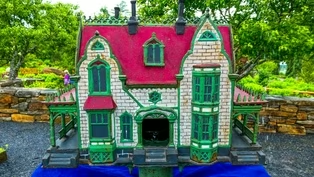
Appraisal: Miller Iron Co. Clifton House Cast-iron Birdhouse, ca. 1870
Video has Closed Captions
Clip: S30 Ep7 | 3m 2s | Appraisal: Miller Iron Co. Clifton House Cast-iron Birdhouse, ca. 1870 (3m 2s)
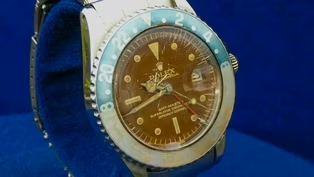
Appraisal: Rolex Stainless Steel GMT-Master 1675 Watch, ca. 1960
Video has Closed Captions
Clip: S30 Ep7 | 2m 47s | Appraisal: Rolex Stainless Steel GMT-Master 1675 Watch, ca. 1960 (2m 47s)
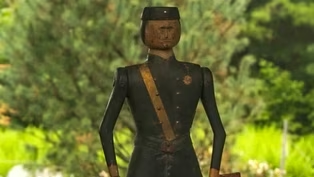
Appraisal: Swedish American Whirligig, ca. 1890
Video has Closed Captions
Clip: S30 Ep7 | 3m 8s | Appraisal: Swedish American Whirligig, ca. 1890 (3m 8s)
Preview: Coastal Maine Botanical Gardens, Hour 1
Video has Closed Captions
Preview: S30 Ep7 | 30s | Preview: Coastal Maine Botanical Gardens, Hour 1 (30s)
Providing Support for PBS.org
Learn Moreabout PBS online sponsorship
- Home and How To

Hit the road in a classic car for a tour through Great Britain with two antiques experts.

Parent Hacks












Support for PBS provided by:
Funding for ANTIQUES ROADSHOW is provided by Ancestry and American Cruise Lines. Additional funding is provided by public television viewers.