
Coastal Science
10/22/2026 | 26m 46sVideo has Closed Captions
Inside an aquarium’s fight to save the ocean, the Battleship North Carolina and bird migration.
Inside the North Carolina Aquarium at Fort Fisher’s fight to save the ocean, and how tidal flooding around the Battleship North Carolina has skyrocketed since it arrived in Wilmington in 1961. Plus, North Carolina’s coastal wildlife refuges welcome tens of thousands of birds during winter migration.
Problems playing video? | Closed Captioning Feedback
Problems playing video? | Closed Captioning Feedback
SCI NC is a local public television program presented by PBS NC
Sci NC is supported by a generous bequest gift from Dan Carrigan and the Gaia Earth-Balance Endowment through the Gaston Community Foundation.
Coastal Science
10/22/2026 | 26m 46sVideo has Closed Captions
Inside the North Carolina Aquarium at Fort Fisher’s fight to save the ocean, and how tidal flooding around the Battleship North Carolina has skyrocketed since it arrived in Wilmington in 1961. Plus, North Carolina’s coastal wildlife refuges welcome tens of thousands of birds during winter migration.
Problems playing video? | Closed Captioning Feedback
Where to Watch SCI NC
SCI NC is available to stream on pbs.org and the PBS app.
Related to This Episode
Providing Support for PBS.org
Learn Moreabout PBS online sponsorship- Coming up on Sci NC, a special episode along North Carolina's coast.
Watch tens of thousands of snow geese and tundra swans fill the sky.
Go inside the aquarium at Fort Fisher as it turns 50.
And see how coastal flooding is threatening your visit to the battleship North Carolina.
All next on Sci NC.
- Quality public television is made possible through the financial contributions of viewers like you, who invite you to join them in supporting PBS NC.
- Sci NC is supported by a generous bequest gift from Dan Carrigan and the Gaia Earth-Balance Endowment through the Gaston Community Foundation.
(upbeat music) ♪ - Hi, and welcome to Sci NC.
I'm Laura Smith coming to you from the coast.
A special episode this week.
North Carolina may be first in flight, but long before the Wright brothers, these skies belong to the birds.
Tens of thousands of birds make this their home every winter.
Let's find out more from producer Michelle Lotker.
- Holy cow, look at the snow geese landing right now.
- I know, it's just, look, it's a swarm of them.
- Can you see that?
- It's just a-- - Those are all snow geese landing there.
That is magnificent.
I never get tired of this.
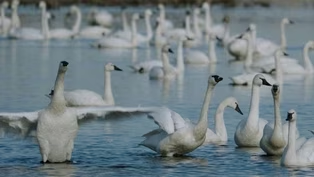
(laughs) - [Michelle] There are tens of thousands of snow geese and tundra swans gathered in this field in an incredible display of waterfowl.
- Whenever I say waterfowl, it just, it's hard to convey the actual spectacle of seeing tens of thousands of birds in a single area.
It's truly an incredible spectacle, and we're really fortunate to have large numbers of tundra swans in this area.
- [Michelle] Tundra swans and snow geese are the stars of the show in the winter months on the coast of North Carolina at the Pocosin Lakes National Wildlife Refuge.
- We are the premier wintering grounds for tundra swans.
We winter approximately 70 to 90,000 tundra swans.
The eastern population of tundra swans is just around 100 to 110.
So we're wintering close to 80% of the entire eastern population in North America, in eastern North Carolina.
Snow geese, we winter 100,000 plus in eastern North Carolina.
- Snow geese numbers would range anywhere between 20,000 to, I think, one year, I counted, like 120,000 snow geese.
- [Michelle] Why are all these birds here?
The wildlife refuge provides prime winter habitat.
These birds overwinter in refuges up and down the coast, but the pungo unit of Pocosin Lakes National Wildlife Refuge is one of the best places to spot them.
The pungo unit was established in 1963 and is part of the now 112,000 acre wildlife refuge that protects the unique Pocosin wetlands in this area.
- The pungo unit is named after Pungo Lake, which is this lake behind us.
It is a natural blackwater lake, and it's an important roosting and resting ground for migratory waterfowl, which was what led to the refuge's initial establishment.
- [Michelle] As we were talking, thousands of snow geese took flight.
- Oh yeah, there's the cloud.
That's incredible.
- [Michelle] The area around Pungo Lake includes wetlands and agricultural fields that provide habitat and food for migratory waterfowl to get through the winter and prepare for their migration back north.
- We have about 1,200 acres of cooperative farm fields, and we have agreements with local farmers to farm it.
- In exchange for being able to farm on the land, they leave a portion of their crop as rent for wildlife food.
They leave corn standing, and that provides a really high-calorie, energy-dense food source for these waterfowl and other wildlife that benefits as well.
- [Michelle] Waterfowl impoundments on the refuge are managed to hold fresh water, supporting wetland ecosystems and all of their flora and fauna.
- Those native plants provide essential minerals and nutrients that you won't find in just a corn diet and winter wheat diet.
- It's about providing habitat at the right time, the right condition, and providing the highest-quality habitat that we can in the landscape.
- One huge factor that the refuge can provide that other lands are not likely to provide is the sanctuary.
Sanctuary is where these birds can rest and maintain their body condition, because they're preparing as they overwinter.
They're gonna have to begin their migration in the spring, and that's gonna take energy.
- [Michelle] These birds aren't in North Carolina year-round.
They fly south via a route called the Atlantic Flyway each winter.
- In North America, in the 1950s, they identified four major flyways.
We're in the Atlantic Flyway, the easternmost flyway.
The swans that we're seeing behind us have come from the high Arctic, reaching from eastern Canada all the way to the north slope of Alaska.
- [Michelle] And these birds spend a big percentage of their year migrating back and forth.
- They're flying several thousand miles, likely over 3,000 miles, probably closer to 5,000 miles, and they're doing that twice a year.
So it's quite a monumental migration.
And what's unique about tundra swans and high Arctic nesting waterfowl is that they're migrating six months out of the year.
It requires a tremendous amount of energy.
- [Michelle] This migratory pathway has been in place for generations.
Parents teach their offspring the route.
- The young birds are kind of grayish, and so there's a young bird kind of in the middle of this close flock here.
If you scan, you'll see that it's all kind of a dusty color.
- [Michelle] To track how populations are doing, people survey them by air and by land.
John Hammond is one of those people.
- I am currently working as a volunteer for the Wildlife Resources System here, particularly the Coast and Lakes National Wildlife Refuge.
My wife comes out, and she's a great birder, too, and a great spotter, and she's helping me count.
Because once you get above 2,000 or 3,000 individuals, it gets really hard to track.
- [Michelle] John gave me a quick crash course in bird surveying.
How do you look at a field of thousands of birds and try to count how many of them there are?
- Well, on this field, there are huge numbers of tundra swans milling about, and it is daunting to try to figure out how many there are.
But one technique we use is to identify a few degrees worth of site and count the number of birds in that field of view.
One, two, three, four.
- Six, seven, eight.
- My first field this time, I've got about 80.
- I think that's about where I was headed.
- OK.
- You're much better at this than I am.
- [Michelle] When you've counted how many birds are in one field, keep track of a landmark and pivot your binoculars to start a new field where the first one ended.
And once you know how many fields there are-- - Then you can multiply it by the number of individuals within that first unit.
- It's also quite convenient that they're on the ground, standing relatively still, as opposed to flying through the air.
- It is much easier that way.
- Yes, I can imagine.
Well, it's such important information to have, right, to know that the populations are doing well, the way the refuge is being managed is working.
That's why we count them, right?
- That's right.
Yeah.
- [Michelle] This spectacle draws tourists from all over the world.
You don't have to be a bird nerd to be in awe of the sight and sound of this unique North Carolina experience.
- So cool.
- [Michelle] And it doesn't get old, even for people who have been working with these birds for decades.
- Oh, look at these.
Look at the swans coming in.
- I mean, this is just unbelievable.
♪ - I mean, it's just a marvel of nature.
It's almost like we can touch them.
- I know.
- I mean, we're so close.
- Wow.
- 35,000.
- Yeah, maybe 35,000.
We might have as many as 40,000 here.
I think-- what's the most you ever counted?
- The most I ever counted was like 110,000, 120,000.
And that was a conservative count.
- I mean, I just wish everybody could experience this.
I mean, what an appreciation.
It's a gift for nature.
So I mean, right here for the American public.
♪ - From the skies to the creatures under the sea, the North Carolina Aquarium at Fort Fisher is on a mission to save the endangered sand tiger shark and coral reefs.
It's undergoing a major renovation project right now as it turns 50 years old.
Take a look.
- [Laura] Extracting sharks out of a 235,000 gallon water tank that's about 23 feet deep isn't a small task.
But staff at the North Carolina Aquarium at Fort Fisher executed the task with precision, keeping animal health and safety in mind.
- Fortunately, again, it went very smooth.
I think we had both animals out of the water, I believe, in at least less than three hours.
- [Laura] Mark Neal, an aquarist at Fort Fisher, was in the tank during it all.
- They're just the power of those animals.
It's something that you don't normally get to experience unless you're in the water with them.
♪ - And he sure felt the power of the sharks on move day when he and his team pulled two sand tigers out of their habitat, one weighing 282 pounds, the other 165 pounds.
- The two large animals that we had, they recently were transported to two of our sister facilities.
- [Laura] This to give the sharks more space to swim and grow, but also ahead of a major renovation project at the aquarium.
- Then the whole idea of doing kind of the way we were doing it is, you know, we don't want to chase them around.
You're not trying to spook them.
You don't want to scare them.
Again, that increases that stress level on that animal.
It was a well-oiled machine.
And again, all of that was basically for that specific purpose, minimizing the stress on those animals, trying to facilitate an easy extraction.
- [Laura] From there, a crane lowered the sharks into a mobile tank for the drive to their new homes.
- Once the large animals were removed, then it was time to start planning, introducing the small animals.
- Neil's team at Fort Fisher welcomed three young sand tiger sharks from New England, each about four feet long and up to 27 pounds.
They'll swim here until a new 400,000-water-gallon tank is built.
- Once it was time for them to leave New England and come here, we essentially outfitted a truck and put together three separate life support systems, essentially, and then went into one of our holding facilities for a little bit of time, again, just kind of making sure they took the move well, they're settling in, they start eating.
- [Laura] And since the move, the young sharks have been eating well.
But observation continues.
- Sand tigers are kind of unique among other sharks, where they actually use air to maintain their buoyancy.
And oftentimes, they can maybe not always get that perfectly right, and so we're just-- especially when-- if they come out of the water, they'll burp it out, and so then they have to gulp it back in.
So just kind of watching them and making sure that they are adjusting in terms of getting their buoyancy, they're swimming without any real heavy, exaggerated movements, anything that would just indicate that they are not comfortable or something isn't 100% right.
♪ - [Laura] So why is there such a big focus on sand tiger sharks at North Carolina aquariums?
One, they're very common off our coast.
And two-- - They were fished pretty heavily in other parts of the world, and so they're highly endangered species.
♪ But one of the things that makes sand tigers sort of a conservation focus is they have a very, very, very low reproductive rate.
- [Laura] In fact, he says only two pups are born every other year, making it difficult to grow their numbers.
- In each of those uteri, they will start consuming each other.
There are several sharks out there that actually-- the female, the mother, will supply eggs, which the embryos will feed on those eggs to nourish and grow.
But sand tigers go to that next extreme, where they actually eat their siblings.
- [Laura] Neal says breeding sand tigers in human care is a challenge.
- As of now, we're aiming for an all-female population.
And the hope is that we may potentially be able to support some of the artificial insemination type work, and so where they would be collecting sperm from males in the wild and then implanting that into females.
And then the hope is that you can actually achieve parturition through that process.
♪ - Protecting sand tigers requires more than managing them in human care.
Scientists need to understand how they behave in the wild.
[beeping] - So what is this telling you?
- So that is telling me that that's a known individual.
- [Laura] Karissa Bearer is the aquarium's education curator and part of a research network tracking sand tigers along the entire East Coast.
- We are studying sand tiger sharks.
And we've provided acoustic arrays, which are installments of machinery underwater that can track animals that have been tagged with an acoustic tag.
♪ - [Laura] Each time a tagged shark swims past one of those receivers, it pings, logging the animal's location, movement, and timing.
- Really important for understanding migration patterns seasonally between males and females or age gaps.
- [Laura] Data fills in critical gaps, including one question that could be key to the species' survival.
- Also hoping to figure out where they're breeding.
And not only will that help us with the population numbers, as I mentioned before, but it also helps us understand better how to manage the coastal waterways for shared use.
- [Laura] That kind of population level science takes years to build.
And sand tigers aren't the only species here that need it.
♪ Coral reefs, which support roughly 25% of all marine species, are in serious decline globally.
And like sand tigers, one of the biggest obstacles is biology itself.
Corals grow very slow.
- So zoos and aquariums and other conservation organizations have been working with corals in-house to learn a little bit more about how we can create an ark for them or make them more resilient to some of the challenges that they're facing.
There's a lot of genetics work in that, but there's also propagation strategies.
- And here's where the magic happens.
The North Carolina Aquarium is growing coral, which will eventually make its way into its new home of a 10,000 gallon habitat.
Coral is alive.
- It is alive.
Yeah, it's an animal.
So all of these are made up of individual little what we call polyps.
Coral colors and pigments are a fascinating part of their biology in that, you know, partly they're getting that from the algae that lives in their tissues.
So when you hear that term bleaching, when they're not doing well, that's when they expel that.
And they end up kind of turning white so you can actually see the skeleton.
♪ - NOAA says the world is in the midst of its fourth global coral bleaching event, adding between January 2023 to September 2025.
Bleaching level heat stress has impacted nearly 85% of the world's coral reef areas, the biggest to date.
- The loss of corals is-- it's at a very high rate.
I don't want to say doom and gloom, but it's an extreme uphill battle.
- [Laura] But the work happening in these tanks is part of the fight.
The expanded coral habitat is coming as part of a massive renovation and expansion at Fort Fisher that will make it the largest aquarium in North Carolina.
♪ Director Joanna Zazzali says it will allow guests to get up close and see what it's like under the ocean.
- Most people don't ever get that opportunity unless you're a scuba diver.
- [Laura] The renovation means a temporary closure, but not a closure of its mission.
- What we decided to do was stay engaged with the community.
And how do we do that when we're closed?
- [Laura] The answer, a free pop-up aquarium at Independence Mall in Wilmington.
- Inspire people to fall in love with nature.
I would say that's the most important thing.
And once you fall in love with something, all you want to do is protect it.
That's why we're here.
And that's what we'll be able to do on a much larger scale by increasing our footprint.
♪ - Also along the coast, the battleship North Carolina.
But look around.
The water is the whole story.
Since the ship arrived in 1961, tidal flooding has continued to be a problem, increasing each year.
Back in 2025, producer Michelle Lotker showed us how they're tracking water levels here and what they're doing to make sure the ship is accessible.
- By the year 2020, we had flooding events 147 days of the year.
So almost half of the days of the year, we had flooding events that impacted the battleship.
If people can't get to our ship and can't park once they get here or are afraid to drive through the water, rightly so, afraid to walk through the water, again, rightly so, then our business model is threatened.
And we needed to find a way to solve access issues.
♪ We are in Wilmington, North Carolina.
And behind me is the USS North Carolina.
Battleship North Carolina is berthed on Eagles Island, immediately adjacent from downtown Wilmington.
Commissioned in 1941, it was the first of America's fast battleships, designed and built for the coming World War II.
Battleship North Carolina was the first major ship to enter Pearl Harbor after the bombing.
It did see action in every major event in the Pacific Theater, from six months after the bombing of Pearl Harbor to the signing of the treaty with Japan.
The Navy, in the late '50s, started to begin to decommission and sort of move ships off its rolls.
And that's when the Navy contacted representatives in North Carolina and said, this is your opportunity.
There were a group of North Carolinians who were very, very interested in bringing the USS North Carolina home to its named state.
And they launched a statewide campaign.
One of the groups that they reached out to were school groups.
And part of the campaign was if schoolchildren donated their pennies and nickels and dimes and every child in your school donated, then all the children in the school received a free ticket to the Battleship North Carolina.
And that created kind of the first wave of visitors to the Battleship North Carolina.
It also created a passion for the ship and a love of the ship.
♪ We're at an interesting place where a lot is happening in terms of hydrology.
Something that's really unique about this area is where we currently are standing.
We get both discharge from the lower Cape Fear River.
And we're low enough in the estuary that we get semi-diurnal tidal influence.
So we have two high and two low tides a day that influence this location.
So we have this confluence of river flow and tidal flow happening right here.
In coastal areas like this, we have, honestly, a multitude of potential impacts from climate change.
One of the most obvious being increased flooding from things like sea level rise or changing frequency of storm impacts.
We're on the river.
So we see the river every day.
And the conditions of your environment then becomes something that you almost unconsciously track.
And around 2015, leadership noticed that there was a change in the river.
And what was occurring, what was changing, was an increased frequency in tidal flooding.
I have an academic background.
And so I decided to do a trend analysis to find out how much the flooding may be changing over time.
Under the Cape Fear Memorial Bridge, they've been monitoring water level and therefore tides for over 100 years.
It's one of the longest running tide gauges in the state of North Carolina and, in fact, in the southeast.
NOAA realized that the conditions here at the site exactly mimic the tidal conditions at the tidal station at the foot of the Cape Fear Memorial Bridge.
So the tidal record at the bridge was a database that I could use to determine if the tide's impact was getting worse, and if so, by how much.
I did a historic trend analysis.
The results showed an over 7,000% increase in tidal flooding since the battleship arrived in Wilmington in 1961.
We went from double digit tidal flooding in the '40s, '50s, and '60s to then triple digit.
In terms of operations, our road was being flooded, sometimes very severely.
And sheet flooding across the water was moving across the road.
It wasn't stable.
It wasn't standing still.
Our parking lot then would often be flooded.
Because we're required by law to operate under revenues generated through ticket sales and gift shop sales, if visitors can't get to our site or are not comfortable parking once they get here and they turn around and leave, then our business model is threatened.
And ultimately, we will not be able to be sustainable financially.
So there was a real economic impact to our operations and the survival of the ship.
The leadership really decided to go an innovative way with Living With Water.
Rather than doing kind of standard bulkhead and wall building to try to keep the water out, we decided to do nature-based infrastructure.
Living With Water really has four components.
One is the installation of a living shoreline in areas where the shoreline had been hardened.
The second is the installation or recreation of a wetland area that has not been there for many, many decades.
The third piece of it is the elevation of the remaining parking lot area.
And the fourth piece is education.
This project is honestly one of a kind in the state.
The fact that this is several hectares, several acres of property that they are proactively creating this resilience and flood mitigation project on is almost unheard of.
I am one of three different research labs at the university.
We are monitoring a series of stations for multiple things across the whole site, mostly to examine what the baseline conditions were, so what everything started at.
We've been able to continue the monitoring through the construction process.
That is actually a piece of the science that is a big unknown.
And then several years after, to look at the potential long-term impacts.
It provides this incredible local opportunity for students to be able to come out here, be involved in a applied community project, and also collect data and learn skills that they can apply to a future professional career.
We're not unique in these impacts.
And in our circumstances, there are many communities along the coast who are similarly being impacted by rising seas and tidal flooding.
And we realized that we had an opportunity to install some unique aspects to manage our tidal flooding and to document how well they are working.
We take that role seriously in terms of being able to provide a model to other communities.
This is one of the first and largest projects to incorporate all of these different components in one site.
And that kind of holistic approach is what we need going forward.
That's the only way to tackle these kind of big picture problems, is from a holistic view.
♪ - And that's it for Sci NC this week.
I'm Laura Smith.
Thanks for watching.
(gentle music) ♪ - Sci NC is supported by a generous bequest gift from Dan Carrigan and the Gaia Earth-Balance Endowment through the Gaston Community Foundation.
- Quality public television is made possible through the financial contributions of viewers like you, who invite you to join them in supporting PBS NC.
Video has Closed Captions
Inside an aquarium’s fight to save the ocean, the Battleship North Carolina and bird migration. (20s)
Providing Support for PBS.org
Learn Moreabout PBS online sponsorship New Episode
- Science and Nature

Explore scientific discoveries on television's most acclaimed science documentary series.



 New Episode

 New Episode








Support for PBS provided by:
SCI NC is a local public television program presented by PBS NC
Sci NC is supported by a generous bequest gift from Dan Carrigan and the Gaia Earth-Balance Endowment through the Gaston Community Foundation.