
June 25, 2026 - PBS News Hour full episode
6/25/2026 | 57m 46sVideo has Closed Captions
June 25, 2026 - PBS News Hour full episode
June 25, 2026 - PBS News Hour full episode
Problems playing video? | Closed Captioning Feedback
Problems playing video? | Closed Captioning Feedback
Major corporate funding for the PBS News Hour is provided by BDO, BNSF, Consumer Cellular, American Cruise Lines, and Raymond James. Funding for the PBS NewsHour Weekend is provided by...
June 25, 2026 - PBS News Hour full episode
6/25/2026 | 57m 46sVideo has Closed Captions
June 25, 2026 - PBS News Hour full episode
Problems playing video? | Closed Captioning Feedback
Where to Watch PBS News Hour
PBS News Hour is available to stream on pbs.org and the PBS app.
Providing Support for PBS.org
Learn Moreabout PBS online sponsorshipAMNA NAWAZ: Good evening.
I'm Amna Nawaz.
GEOFF BENNETT: And I'm Geoff Bennett.
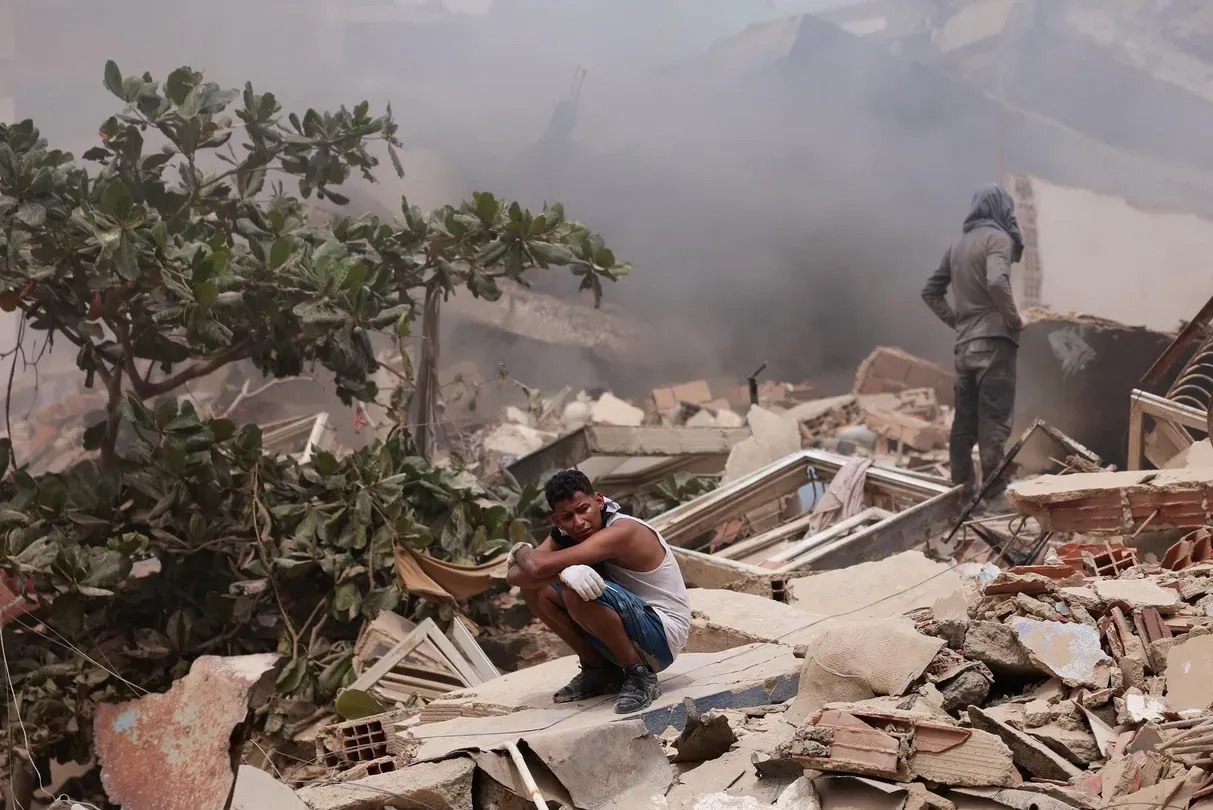
On the "News Hour" tonight: The death toll continues to rise in Venezuela following the most powerful earthquakes there in decades.
AMNA NAWAZ: The Supreme Court issues multiple major rulings, including one that allows the Trump administration to turn away asylum seekers at the U.S.
southern border.
GEOFF BENNETT: And a new bipartisan effort is under way to help workers adapt to the potential disruptions from artificial intelligence.
GINA RAIMONDO, Former U.S.
Secretary of Commerce: We want to do our part to make sure that the U.S.
leads the global A.I.
competition, but without leaving America's workers behind.
(BREAK) GEOFF BENNETT: Welcome to the "News Hour."
The fight to rescue the stranded, care for the living, and retrieve the dead accelerated today in Venezuela, following two major earthquakes that struck near the capital city of Caracas.
The damage in places appears catastrophic.
AMNA NAWAZ: The U.S.
and other nations are mobilizing relief efforts to assist the government there.
The Americans deposed and removed Venezuela's longtime leader in January.
The initial death toll stands at nearly 200, but that number is expected to rise sharply.
The U.S.
Geological Survey estimates that a disaster of this scope may have killed as many as 10,000 people.
Stephanie Sy begins our coverage.
STEPHANIE SY: The earth is still shaking, and this man calls out for his mother, filming himself and the immediate panic that breaks out when the ground beneath his neighborhood gives way.
At Simon Bolivar International Airport, debris crashed down on travelers, the violent tremor destroying this section of the terminal.
In La Guaira, the hardest-hit state, homes in this densely populated coastal community rendered to their foundations, ceilings turned into floors.
Back-to-back earthquakes, the strongest in more than a century, hit northern Venezuela close to the capital, Caracas, Wednesday afternoon, a 7.2-magnitude quake, and less than a minute later a stronger 7.5 striking the same spot, leaving the land and its people devastated.
This mother of three was separated from her 8-year-old.
DAYANA DELGADO, La Guaira, Venezuela, Resident (through translator): I'm desperate.
I just want to know where my son is, whether he's trapped or at a shelter.
I'm desperate.
STEPHANIE SY: This man says he lost everything, his apartment, his vehicles, and possibly neighbors.
CRISTIAN CARRENO, La Guaira, Venezuela Resident (through translator): I imagine there were people trapped inside who couldn't get out.
It was devastating.
Thank God we're alive.
STEPHANIE SY: A state of emergency has been declared across the country.
With thousands reported missing, rescue teams are searching for signs of life, people, and, yes, pets.
This eyewitness video captures panicked voices beneath the rubble calling out to rescuers.
The needs the needs are overwhelming, too much to shoulder alone.
Neighbors band together in search of loved ones spotted, the grasping fingers and faint calls of a woman trapped.
JUAN ALBERTO MENDANO, La Guaira, Venezuela, Resident (through translator): When we heard the scream, there was nothing we could do.
God willing, they rescue her as soon as possible.
STEPHANIE SY: This woman pleads for help.
Two generations of her family are missing.
ARMINDA GOMEZ, La Guaira, Venezuela, Resident (through translator): I lost I lost my daughter, my grandson, and my granddaughter, who was due to be born in a month please help me find my daughter and see if she's under the rubble, please.
MARCO RUBIO, U.S.
Secretary of State: The most immediate need right now is search-and-rescue efforts.
STEPHANIE SY: Today, Secretary of State Marco Rubio pledged to send teams from the U.S.
and even the Department of Defense to assist response missions.
MARCO RUBIO: We're already deploying a search-and-rescue teams from Fairfax County, Virginia, and Los Angeles.
We have a whole-of-government response.
It'll be big, it'll be fast, and it'll be effective.
STEPHANIE SY: And the State Department said the U.S.
is sending 150 million to aid groups on the ground.
In turn, acting President of Venezuela Delcy Rodriguez offered gratitude to the U.S.
amid shifting ties between the two countries.
DELCY RODRIGUEZ, Acting President of Venezuela (through translator): I want to thank President Donald Trump and his administration, who have been in constant contact with the Venezuelan government, with all our authorities providing support solidarity.
And, in the first hours, we will be receiving rescuers.
STEPHANIE SY: World leaders from Mexico to Spain are also surging aid to the disaster-stricken country.
For the rattled residents of Venezuela, it can't come soon enough.
For the "PBS News Hour," I'm Stephanie Sy.
AMNA NAWAZ: Venezuela's neighbor to the west, Colombia, was shaken by its own earthquake yesterday, but nothing near the scale of the Venezuelan tremors.
Special correspondent Monica Villamizar is in the Colombian capital of Bogota.
She has long experience reporting in Venezuela, and she joins us now.
Monica, it's good to see you.
Thanks for joining us.
MONICA VILLAMIZAR: It's great to be here, Amna.
AMNA NAWAZ: So this was an absolutely devastating earthquake in Venezuela.
Just tell us what you're learning about the scale of the damage and what you're hearing from people inside Venezuela right now.
MONICA VILLAMIZAR: I have a whole documentary crew on the ground.
And, thankfully, they're safe.
But I can tell you, Amna, that what we are hearing is that the devastation is likely to be way more severe than the reports, the official reports, we're seeing.
Communications are disrupted, to say the least.
And that means that the statistics regarding the injured, casualties are not reliable at this point in the capital, Caracas.
It's a capital of three million people.
And a lot of the buildings there, Amna, are very old.
I can tell you that by experience.
They do not follow the code or systemic regulations, so the ones that are still standing are very frail, some of those, and they can also collapse if there are aftershocks.
And, as we know, there have been aftershocks.
AMNA NAWAZ: As you well know from covering these kinds of disasters in the past, these first 24, 48 hours are absolutely critical when it comes to search-and-rescue.
What else are you hearing in terms of the challenges for the first responders?
And where's the greatest need right now?
MONICA VILLAMIZAR: Well, that's a great question.
And we are hearing reports that the emergency -- early emergency warning system did not work.
So people did not know what to do, and then there was the aftershock, very strong aftershock, indeed.
So that could have saved lives maybe.
As you know, covering so many earthquakes, these early warning systems do make a difference.
And, sadly, this did not work, apparently.
We understand and there are reports that people in neighborhoods have not seen a single ambulance or emergency rescue worker.
So that, again, is very worrying.
The critical challenges that you ask, well, Venezuela is a very polarized society right now.
However, we're hearing that there's a lot of solidarity, people helping neighbors, digging themselves, helping dig through the rubble to find their loved ones.
One thing to bear in mind, Amna, is that about eight million people have left Venezuela, so the diaspora now too a lot of anxiety because families have been separated, and they do not know what happened to their loved ones.
The Internet is down.
Communications are down.
And, on the other hand, they're seeing some of the social media videos that are really quite frightening and that we saw on your reporting.
AMNA NAWAZ: And, as we have been covering, there was so much economic and political instability before this tragedy.
This is, of course, where the U.S.
had gone in and arrested the former President Nicolas Maduro earlier this year.
What did all that mean for how this country can now respond to the emergency?
MONICA VILLAMIZAR: Absolutely.
As you say and what people are telling me is, look, we have been hit by a political crisis, economic crisis.
Let's remind our viewers that only yesterday there was news that Venezuela has one of perhaps the largest sovereign debts in the world, so a very dire situation, and now this natural disaster on top of it all.
We know Delcy Rodriguez has said and asked for help from other countries.
And the U.S.
and the State Department has pledged that some people are already on their way.
This help is much needed, because it's a very challenging situation on the ground.
There's a security situation, There's a lot of crime in Venezuela.
And the gangs and colectivos, which are like armed civil militias, but loyal to the regime, control entire neighborhoods.
So that's going to maybe hamper efforts.
And we're already hearing reports from La Guaira that there is some looting.
AMNA NAWAZ: Special correspondent Monica Villamizar joining us from Bogota, Colombia, tonight.
Monica, thank you.
MONICA VILLAMIZAR: Thanks for having me.
AMNA NAWAZ: The U.S.
Supreme Court handed down four major decisions today, including rulings that clear the way for the Trump administration to end deportation protections for many Haitians and Syrians and allow officials to continue turning back asylum seekers at the southern border.
GEOFF BENNETT: The justices also ruled that Monsanto cannot be held liable in thousands of lawsuits over its weed killer Roundup.
And it struck down a Hawaii gun law in a decision that could have implications for similar laws in other states.
"News Hour" Supreme Court analyst and SCOTUSblog co-founder Amy Howe joins us now to help unpack the rulings.
Amy, it's great to have you here.
So let's start with immigration.
The court, as Amna said, they ruled that the Trump administration can revoke Temporary Protected Status for Haitians and Syrians.
The administration moved to end it last year, and now you have the court siding with them.
What more should we know about this case?
AMY HOWE: So this was an interesting case, because the court didn't actually weigh in on whether then-Secretary of Homeland Security Kristi Noem had -- was -- properly ended the designations for Haiti or Syria.
What the Supreme Court said was that there is a provision in the statute that created the Temporary Protected Status program that bars courts from even weighing in on the secretary's decision to designate a country for TPS status or to end the designation.
And Justice Alito in his decision said that applies to the claims by the Haitian and Syrian nationals.
They had argued that they weren't challenging her decision, the substance of her decision, that they were challenging whether or not she'd complied with some of the procedural requirements of the statute.
For example, this statute requires the secretary of state to consult with other agencies before she makes that determination.
But Justice Alito said that is part of the determination, and generally the recipients of the TPS program can't challenge that.
There was also a separate claim by the Haitian TPS beneficiaries that the decision to end the protections for Haiti were based on what's known as racial animus.
Some of your viewers may remember some of the baseless claims by President Donald Trump about Haitian immigrants in Springfield, Ohio, eating pets of the residents of that town.
And the Haitian TPS beneficiaries had pointed to those kinds of comments and said that the decision to end TPS status was based on racial animus.
And Justice Alito said that it was not based on racial animus.
GEOFF BENNETT: There's another immigration case I want to ask you about.
This involves the practice of what's called metering, whereby U.S.
border authorities physically turn people back at the border before they can set foot on U.S.
soil and ask for asylum.
The challengers said that that still counts as arriving under the asylum statute.
But the court's conservative justices disagreed.
How did they see it?
AMY HOWE: Yes, so Justice Alito said that -- and Justice Sonia Sotomayor in her dissenting opinion, this really came down to how you interpret the phrase arriving in the United States.
And Justice Alito said, if you look at the ordinary meaning, arriving in the United States means that you physically have entered the United States.
And he said nobody would say if a football player is tackled at the one-yard line that he has arrived in the end zone.
And Justice Sotomayor said the meaning of arrived in can mean that you are about to enter somewhere.
And she had her own example.
She said if you land at Washington Reagan National Airport, and you call a friend and you say, I am arriving in Washington, D.C., you're not actually in Washington, D.C., because you're in Virginia, which is where the airport is located, but everybody knows that that counts as arriving in Washington, D.C.
GEOFF BENNETT: Another case, another major ruling involved Monsanto, as we said, the manufacturer of the weed killer Roundup.
GEOFF BENNETT: This was a 7-2 ruling, and they said that the company cannot be sued for failing to put a cancer warning on Roundup.
We're going to talk in more detail later in the broadcast about the implications.
But how did they get to that?
How did they get to that point?
AMY HOWE: Yes, so this is what's known as preemption, the idea that federal law can Trump state law.
So the plaintiff in this case, John Durnell, had sued Monsanto for not including a cancer warning on the label.
There's a federal law called FIFRA, the Federal Insecticide, Fungicide, and Rodenticide Act, that gives the EPA the power to regulate the labeling of pesticides.
And it also includes what's called a uniformity requirement.
It said states can't include additional or different requirements on labels.
And so what the Supreme Court said was that when Durnell brought his claim under Missouri law saying that Monsanto should have included this cancer warning that that conflicted with the federal requirement, because the EPA said this is the label, Monsanto, that you need to use, and federal law trumps state law.
GEOFF BENNETT: In the 30 seconds we have left, how might other states be affected by this Hawaii gun law?
AMY HOWE: So the Hawaii gun law, there are four other states, California, New York, New Jersey, and Maryland, that have similar laws that require you to obtain permission, even if you're a licensed gun owner, before bringing your gun onto private property.
And so it's not a lot of states, but certainly California, New York, New Jersey, Maryland.
That's a lot of people.
And so those laws under the Supreme Court's ruling today would also face being unconstitutional.
GEOFF BENNETT: Amy Howe, thanks, as always, for your insights and analysis.
We appreciate it.
AMY HOWE: Thank you.
AMNA NAWAZ: Well, to discuss the impact of today's immigration rulings, we turn now to Doris Meissner.
She served as a top official at the Immigration and Naturalization Service under President Reagan and led it under President Clinton.
She's now a senior fellow at the Migration Policy Institute.
Doris, thanks for being here.
DORIS MEISSNER, Migration Policy Institute: Thank you.
AMNA NAWAZ: Let's start with that ruling on asylum seekers in particular.
That metering process, I have seen that firsthand under the first Trump administration at the border.
The court says the administration can continue to stop people, migrants at the border, from seeking asylum.
What's your response to that?
What's the impact of that right now?
DORIS MEISSNER: Well, the impact of that right now is very little.
It's pretty moot.
I mean, this is a practice that started back in - - at the end of the Obama administration.
It's had its ups and downs in terms of the numbers of people coming across the border.
But the Trump administration has entirely shut it down.
So at this point, it's making a point in the law that, should circumstances like this arise again, the government would be in its rights of doing so.
But it has very -- it's not going to make much difference at the present time.
AMNA NAWAZ: I want to play for you a little bit of sound from White House's Stephen Miller, who reacted to that ruling, and he had this to say about asylum seekers.
Take a listen.
STEPHEN MILLER, White House Deputy Chief of Staff: In every case, they're either criminals, benefit seekers, economic migrants, welfare seekers, et cetera, et cetera.
They're coming to join family members and so forth.
But the good news for them is that you have other countries willing to take them.
AMNA NAWAZ: Doris, is that an accurate description of who is arriving at the U.S.
southern border?
And are there other countries for them to go to seek asylum?
DORIS MEISSNER: Well, they're a mixed population.
And that's what makes it very difficult.
If they were one thing, then it would be quite easy to decide what -- how to process.
But these people coming during this period of time have all kinds of claims or non-claims.
And so the difficulty is for the government to disaggregate and decide who legitimately is an asylum seeker, who legitimately might have a reason for entering and who should be turned back.
So this is painting with a very, very broad brush.
AMNA NAWAZ: I have heard this claim from Border Patrol officials, advocacy groups that, when legal pathways close, migrants seeking asylum or seeking safety will often turn to more dangerous pathways.
Cartels can even charge more money, for example.
Is that an unintended possible consequence here?
DORIS MEISSNER: That's a part of law enforcement along the border and it's a part of any law enforcement.
It's kind of the balloon effect.
You do something one place, things pop out in a different place.
But I would have to say that, right now, I think that it's less likely, because there is so much enforcement taking place.
So many resources have been poured into border enforcement and into immigration enforcement overall that I'm not at all sure that we will see any real shift.
The numbers are very low.
And there's a combination of things that are going on.
I mean, this administration has had a very, very clear view that is based on a presidential priority for mass deportations, as well as all kinds of other enforcement practices, that are creating a deterrent effect.
And there is really no willingness in this administration at this point to try to disaggregate legitimate claims from migrants in general.
AMNA NAWAZ: I want to turn now to the ruling that allows the administration to end protected status for migrants from Haiti and from Syria.
And I want to play for you what a man named Viles Dorsainvil, who's himself a TPS holder, a Haitian immigrant, a pastor, and director of the Haitian Support Center in Springfield, Ohio, said in response to the ruling.
Here he is.
VILES DORSAINVIL, Director, Haitian Community Help and Support Center: The families are here, and kids are going to schools, parents are going to work.
Folks try to commute, and as if like the Supreme Court just put all those activities on stop and put folks in limbo.
And this is so sad for us to see happening in a country such as USA.
AMNA NAWAZ: Meanwhile, Doris, the general counsel for DHS tweeted, saying that: "The T in TPS stands for temporary.
Yet, many of these designations become de facto amnesty."
He called it a win for the rule of law and common sense.
What do you make of that?
DORIS MEISSNER: Well, temporary is supposed to be temporary.
That is what it's stated in the statute.
But at the same time, the reality on the ground is that country conditions in some of these very, very troubled places of the world don't just turn around in six months or 18 months.
And so you have here -- I mean, when you think of the nationalities, this is the decision that really will affect people in terms of what the Supreme Court's cases today were.
We have about 350,000 Haitians right now that are in Temporary Protected Status, 6,000 Syrians.
This decision allows the administration to withdraw Temporary Protected Status from remaining 13 countries.
They include Afghanistan, Venezuela.
So, a lot of people have been here for a long time.
It's true that the temporary stretches out.
But, at the same time, returning those people in countries of that level of danger and just is a very, very serious matter.
And so if you think, in March about a year ago, March, right after this administration came in, we had about 1.3 million people on Temporary Protected Status of one sort or another from many countries around the world.
By probably about November this year, if the government follows through, which we have every reason to think, there will be none.
And that is a very, very consequential decision.
AMNA NAWAZ: It's a remarkable shift.
Doris Meissner of the Migration Policy Institute, thank you for being here.
DORIS MEISSNER: Thank you.
GEOFF BENNETT: As reported earlier, in a 7-2 ruling today, the U.S.
Supreme Court sided with the manufacturer of the weed killer Roundup.
The decision overturns a jury award to a man who said more than two decades of exposure to Roundup caused him to develop a type of blood cancer.
The ruling is expected to block thousands of similar lawsuits across the country.
Joining us now is Dr.
Chadi Nabhan.
He's a medical oncologist and the author of "Toxic Exposure: The True Story Behind the Monsanto Trials and the Search for Justice."
He also served as a key expert witness in three of the first Monsanto trials.
Thank you for being with us.
DR.
CHADI NABHAN, Author: Thank you, Geoff, for having me.
GEOFF BENNETT: So Roundup is one of the most widely used herbicides in the country, used on more than 300 million acres of U.S.
farmland and sold since the 1970s.
We can walk into a home improvement store right now and buy a bottle.
What does the science tell us about the potential health risks?
DR.
CHADI NABHAN: We have learned a lot about Roundup and its active ingredient, glyphosate, over the years.
Mainly, it's linked to carcinogenicity and the ability to cause cancer and specifically non-Hodgkin's lymphoma.
The IARC, the International Association on Research on Cancer, in 2015, labeled glyphosate, the main ingredient of Roundup, as a probable human carcinogen based on published data, peer-reviewed literature, based on animal studies, toxicology studies, as well as epidemiological studies.
So we know today, in 2026, way more than what we knew back then in the '70s and '80s, when Roundup came to market.
But the most important part that we know is, it's linked to carcinogenicity and specifically non-Hodgkin's lymphoma, which is the blood cancer that you were referring to earlier.
GEOFF BENNETT: So, the EPA, when it says that Roundup does not cause cancer if used properly, and they didn't require Monsanto, which was later acquired by Bayer, to have a warning label, what are they basing that on?
DR.
CHADI NABHAN: I think it's important to look at the entire picture.
The EPA usually looks at the evidence that is available to them at the time, and often that evidence is presented to them and supplied by the manufacturer of the herbicide or the pesticide.
And, of course, the evidence changes.
The evidence evolves.
Science changes and science evolves.
We know today way more things than -- when we knew many years back.
So the EPA really relies on the evidence that was presented to them.
But one of the most important things to know that - - just to give you an example, one of the papers that the EPA relied on was retracted just recently, several months ago.
It was a paper that was authored by Williams and colleagues, and that paper was retracted because of ethical concerns and research misconduct.
This is the paper that continues to be cited by everyone that says glyphosate is safe and Roundup is safe.
So if the paper that everybody says is a good paper and this is something that's safe gets retracted because we don't know the integrity of it, and the EPA relied on it at the time, then there is a problem.
Why was the paper retracted?
Because of the litigation trials, because of what surfaced in courts, because of these lawsuits that actually brought this paper to light.
GEOFF BENNETT: In a statement to the "News Hour" after today's ruling, Bayer said this in part: "The U.S.
Supreme Court decision is good for science, farmers, and industries that depend on regulatory clarity for innovation.
It should help significantly contain the Roundup litigation after nearly a decade of legal battles."
So what are the larger implications here?
DR.
CHADI NABHAN: I think there's a legal aspect of this, which I cannot comment on because I don't have the legal expertise.
But from a scientific and a medical perspective, as someone who has treated and cared for hundreds on hundreds of patients with lymphoma, it is important for us to identify and know the causes of this disease, if we can.
Many times, we can't.
Many times, a patient has a disease and they ask, why do I have it?
And we don't have an answer.
But if we're able to identify a cause, and if there is a possibility that a compound like this is causing cancer and is hurting people, it is our obligation to not have it available to the general public.
And, look, I mean, again, you -- we all know that, 50, 60 years ago, we thought tobacco was safe, didn't we?
We actually had doctors advertise for smoking.
We had people smoke in the hospitals.
There are pictures of this online.
Well, we know today that it's not.
So it's OK to admit that we know today more than we knew before.
But I believe it's a nihilistic approach to ignore the evidence and to say, well, it's very safe, do whatever you want with it, and nothing to worry about.
It's just not true.
GEOFF BENNETT: Dr.
Chadi Nabhan, thanks again for joining us.
We appreciate it.
DR.
CHADI NABHAN: Thank you for having me.
GEOFF BENNETT: In the day's other headlines: A top official at the National Park Service says the liner of Washington, D.C.
's famous for collecting pool was cut with a knife or razor earlier this month.
In a court filing, the deputy director for operations, Frank Lands, says the cut damaged the foam sealant that was installed as part of the site's $16 million renovation.
President Trump has blamed unidentified vandals for peeling paint found in the pool, but officials have not named anyone who may have been involved.
And one expert told the "PBS News Hour" that the type of sealant in question is usually puncture-resistant.
Turning now to the ongoing heat in Europe, the U.K.
has set a record for the hottest day ever recorded for the month of June for a second day in a row.
That's as people desperately wait for relief.
EMMA FITZSIMMONS, London Resident: It's not good.
It's awful.
They're climbing -- climbed last month, record temperature, climbed yesterday, record temperature, climbing today, record temperature.
They have extended the heat wave until Friday for the red warning.
So it's not good.
GEOFF BENNETT: Britain's Weather Service has issued its highest heat warning covering much of Southeastern England, including London, where temperatures could reach 100 degrees and break more records tomorrow.
More than a dozen countries are under heat alerts as forecasters predict the heat dome over the continent will shift the heat east to places like Austria, Croatia, and Serbia.
In Spain, authorities estimate that more than 200 people may have died as a result of the high temperatures.
In Boston, a federal judge today halted President Trump's executive order which aimed to regulate mail-in voting and create a federal voter list.
In her ruling, Judge Indira Talwani sided with nearly two dozen states in finding that -- quote -- "The Constitution does not grant the president any specific powers over elections."
Her decision would apply to the November midterms, though the White House plans to appeal.
Florida Governor Ron DeSantis says the detention center known as Alligator Alcatraz is closing, claiming that it has, in his words, served its purpose.
GOV.
RON DESANTIS (R-FL): It has helped remove many, many dangerous people from the street and get them out of not only the state of Florida, but the United States of America.
GEOFF BENNETT: In a press conference today, DeSantis said at least 21,000 people were deported through the facility since it opened last year.
It was seen as critical to the Trump administration's efforts to remove those here illegally, and the president himself visited last year.
But immigration advocates say the center was neither safe nor humane, and detainees described dire living conditions and poor access to lawyers.
The WNBA handed down a one-game suspension today to Alyssa Thomas after reviewing Wednesday night's game and issuing a flagrant foul penalty.
The league said Thomas recklessly pressed her fist to the throat of Caitlin Clark during the second quarter of the Phoenix Mercury's win over the Indiana Fever.
No foul was called on the floor at the time.
Thomas will serve the suspension during the team's next game Saturday against the Toronto Tempo.
The decision comes after widespread criticism of the officiating, including from Indiana coach Stephanie White, who in comments after the game called it egregious.
Clark's supporters have criticized what they see as overly physical play against the Indiana Fever star since she entered the WNBA in 2024.
In economic news, an important measure of inflation spiked to its highest level in three years last month.
The Commerce Department said consumer prices rose to 4.1 percent in May when compared to last year, due largely to a spike in gas prices.
That's about twice the Fed's preferred level, meaning a possible interest rate hike this year remains on the table.
Meantime, on Wall Street today, stocks drifted to a mixed close.
The Dow Jones industrial average added about 70 points, but the Nasdaq lost more than 100 points, or almost half-a-percent.
The S&P 500 ended virtually unchanged.
And David Clayton-Thomas, the lead singer of Blood, Sweat & Tears, has died.
On songs like "Spinning Wheel" and "When I Die" and others, Clayton-Thomas brought a bluesy tenor to a band known for its genre-bending sound.
They played at Woodstock in 1969 and a year later won the Grammy for album of the year, beating out the Beatles "Abbey Road."
Clayton-Thomas split with the group in 1972 and went on to release more than a dozen solo albums.
His publicist said he died Wednesday in Toronto.
David Clayton-Thomas was 84.
Still to come on the "News Hour": the U.S.
seeks to reassure Gulf allies, as the Strait of Hormuz is shut down again; a new national effort is under way to help workers make a successful transition to an A.I.
economy; and the country's oldest hospital turns a historic building into a new museum to preserve its rich history.
AMNA NAWAZ: Today, a U.S.
official confirmed to the "News Hour" that Iran fired a drone that hit a container ship in the Strait of Hormuz and traffic through the strait has largely stopped.
The strike came as Secretary of State Marco Rubio visited the Persian Gulf to try and reassure the American allies there that any agreement with Iran will protect their security.
Nick Schifrin reports.
NICK SCHIFRIN: Today, the world's most important oil choke point is once again closed, hundreds of ships had a standstill in the strait after a U.S.
official confirms that, off the coast of Oman, an Islamic Revolutionary Guard Corps drone struck a Singapore-flagged cargo ship.
The ships sustained damage, but kept sailing and there were no casualties, except for the momentum to open the strait.
The U.N.
says, before today, more than 50 ships left the strait this week under a new U.N.-Oman mechanism.
But, today, the U.N.
Maritime Organization Secretary-General Arsenio Dominguez said in a statement: "I have decided to temporarily pause its implementation in order to reconfirm that the necessary safety guarantees continued to be in place."
Earlier today, Iranian state media warned that ships must coordinate with Iran and use a route through the strait closest to Iran's coast in orange, instead of a route pushed by the U.S., Oman and the U.N.
near Oman's coast in yellow.
MARCO RUBIO, U.S.
Secretary of State: If ships are moving as they should be moving, then that's what we're going to judge and that's what we're going to react to.
NICK SCHIFRIN: Earlier today, Secretary of State Marco Rubio warned that the U.S.
would never accept Iran closing the strait.
He's in Bahrain visiting the Gulf Cooperation Council... MAN: Today, we see a glimmer of hope.
NICK SCHIFRIN: ... to try and reassure the U.S.'
Gulf allies that the U.S.-Iran negotiations will protect their security after they bore the brunt of Iran's wartime assaults.
MARCO RUBIO: There is no part of this deal that's undertaken that in any way undermines the security, the stability, or the prosperity of any of our partners in the Gulf region.
NICK SCHIFRIN: And, tonight, the Gulf Cooperation Council released a joint statement with the United States emphasizing the importance of the strait reopening without any Iranian tolls and calling for restrictions on Iran's missiles and proxies.
But those are two issues not addressed by the U.S.-Iran memorandum of understanding.
To discuss today's drone strike and whether the Gulf and the region are reassured by Secretary Rubio's trip, I'm joined by Hussein Ibish of the Arab Gulf States Institute.
Hussein Ibish, thanks very much.
Welcome back to the "News Hour."
Let's start with this drone strike that we saw in the strait.
Is this Iran reminding everyone of its leverage as these negotiations proceed?
HUSSEIN IBISH, Senior Resident Scholar, Arab Gulf States Institute: That's exactly what it is.
It's a pure power flex.
It's a message saying, hey, how easy it is for us to hit a ship?
We can do it in a way where we don't sink the ship and we don't kill anybody, but we do strike it.
Ha, ha.
What more could we do if we wanted?
It's really easy.
It's drones.
It's cheap.
We have got -- we can produce them for $10,000, $20,000 each and just keep chugging them out.
So you're at our mercy.
That's the Iranian message here.
And it's really very disconcerting to see them doing that at a time when they are supposed to be lifting restrictions on shipping in the Strait of Hormuz, rather than reinforcing a sense of fear and intimidation, which is what they're doing.
NICK SCHIFRIN: And it's not only reinforcing fear intimidation when it comes to what I just asked about, just its own leverage, but does it also reinforce the concerns that Gulf Arab allies of the United States already had about how these talks are proceeding?
HUSSEIN IBISH: Very much so.
Look, they feel they were against the war.
They felt they would be hit.
They felt it would go badly.
They didn't think it was thought through.
They didn't trust Trump's judgment, honestly, and they have been proven right on all of those points so far.
Now they're looking at a situation where Iran is strategically strengthened in many ways, even though it's been battered to some extent militarily.
Strategically, it's in a better place.
It's really learned to use its power in the Strait of Hormuz and potentially through the Houthis in Yemen, their allies, of the Bab-el-Mandeb Strait, which could cut off the Red Sea and the Suez Canal as well.
So they are really looking very strong at the moment.
And there's a deeper fear here, which is not just it the U.S.
is unreliable, that the U.S.
may come or go or something.
There's even a sneaking suspicion that the U.S.
might be looking to kind of switch partners here and do a deal with Iran and really kind of abandon them completely.
And that -- they were afraid of that when Obama did the JCPOA nuclear deal in 2016, and they're afraid of that now.
I don't think it's going to happen because Iran is not a status quo power, and the U.S.
is.
So I don't see how we could partner with them.
But that's a Gulf fear as well.
So they're afraid of everything right now.
NICK SCHIFRIN: And I have certainly asked U.S.
officials exactly that, and they say what you just said.
It's they're not likely to, in their mind, at least Trump administration officials' mind, repeat the errors of the Obama JCPOA.
But, to your point, Rubio is in the region trying to provide reassurance.
He said today that any deal would not undermine the security, stability, or prosperity of any of our partners.
Does that message provide reassurance?
HUSSEIN IBISH: No.
No, because it already has.
And the war has.
The war was mainly visited on these Gulf countries.
Over half of the strikes from Iran, well over half, were on the UAE alone.
And every single country, even Iran-friendly Oman, was hit by Iran multiple times.
Kuwait's new airport was badly damaged.
And every country took a real hit.
Even the whole sort of conceptual model behind Dubai's rise in global prominence has been attacked by this threat of violence.
So it's all very, very bad for them.
And they - - look, they just don't trust the intentions of the Trump administration.
They don't trust the judgment the consistency, the steadfastness, and the fundamental reliability of this administration.
And I don't think anything that they have seen since the MOU was signed, or in the MOU, or from J.D.
Vance, or from the president has really calmed their nerves.
They are very rattled.
NICK SCHIFRIN: But, as you know, when I talk to some of these Gulf officials, they acknowledge some of these concerns, but they also say, look, we get it, we understand, you have to deal with a little bit of ups and downs of President Trump.
Ultimately, we are still -- our eggs are still in the American basket.
We have no other choice.
We don't want to go elsewhere.
And while we're dealing with Israel, at the very least, we want to work with the U.S.
to create a better region.
They still don't have anywhere else to go, right?
HUSSEIN IBISH: Oh, I think that's absolutely right.
Yes, they don't.
There is no other country that could provide them the military hardware and training that we do, the kind of support that at least theoretically is there.
There is an argument that the liberation of Kuwait in 1991 and 1990 was sort of the exception that proves the rule, the one time we really did come to their aid.
But I think they need to keep the U.S.
government onside.
They need to protect their relationship with Washington.
So they're not going to come out and tell you bluntly what I just said.
But what I'm telling you is also true.
You are absolutely right.
They're not going anywhere.
They want to work on fixing relations with the United States.
It's a number one priority.
But, right now, they are dismayed, disheartened, and highly, highly anxious because of everything that's happened.
They did not want this war, because they could foresee all of this and more, and it's all coming true in a very kind of living your nightmare scenario.
NICK SCHIFRIN: Hussein Ibish of the Arab Gulf States Initiative, thank you very much.
HUSSEIN IBISH: Oh, thank you, yes.
AMNA NAWAZ: As businesses rapidly adopt artificial intelligence to boost productivity and economic growth, parallel fears of a wave of job displacement continue to grow.
One Reuters/Ipsos poll last year found over 70 percent of Americans fear A.I.
will lead to permanent job loss, raising questions about what's being done to prepare workers, companies, and local economies for what's to come.
A new nonprofit called RAISE US aims to bring together states, major businesses, and A.I.
firms to do just that.
It's a bipartisan effort co-founded by Republican Eric Holcomb, the former two-term governor of Indiana, and Democrat Gina Raimondo, former secretary of commerce under President Biden and former governor of Rhode Island.
I spoke with Gina Raimondo all of this yesterday.
Secretary Raimondo, welcome to the "News Hour."
Thanks for being with us.
GINA RAIMONDO, Former U.S.
Secretary of Commerce: Thank you.
Nice to be with you.
AMNA NAWAZ: So tell us what's already in the works when it comes to this new effort called RAISE US.
You're working with four pilot states, Arkansas, Maryland, Utah, and Connecticut, to roll out initiatives.
What does that look like?
GINA RAIMONDO: Yes, thank you.
So we have a single mission.
We want to do our part to make sure that the U.S.
leads the global A.I.
competition, but without leaving America's workers behind.
And, to do that, I think we need like a deliberate, planned transition.
And so that's what this is about.
So -- and also it has to be an all-hands-on-deck moment, right?
We need the A.I.
companies to be part of the solution.
We need America's biggest and best companies to be part of the solution.
We need policy changes to support workers, to provide incentives for companies, not just to lay folks off.
And we need very significant changes in the way we do work force training.
So we don't have the solutions.
I'm sorry to say I'm not launching this with a solution.
But we believe it's a time in America to do something big and bold, so Americans aren't left behind.
And we're bringing everybody together to get to get that done.
AMNA NAWAZ: So why these four states in particular?
Very different states, different populations, different politics, for sure.
Are you trying to show that this can work and should work everywhere?
GINA RAIMONDO: Yes, exactly.
So, like any start-up, which is what we are, we begin with the coalition of the willing, and these are four states, two Democrats, two Republicans, all over the country.
These governors have raised their hand to say they want to work with us to make sure that their states are A.I.-ready and the people of their states don't get left behind.
These are just the first four.
You know, I hope, a year from now, we have many more.
This isn't a Democrat-Republican issue.
This is an American issue.
I don't think that this country is prepared for this transition.
Unemployment insurance was created 100 years ago in the Great Depression.
It hasn't been updated since.
It needs to be updated.
College is largely the same as it was 50, 60, 70 years ago.
So what we are trying to do here, it's ambitious, but we're trying to, like I said, have an all-hands-on-deck effort.
We want to design some new policies and then pilot them in these states with a coalition of companies to see what works and scale what works.
AMNA NAWAZ: I want to ask you more about those companies and their involvement, because you have some foundation support, but some big-name corporate partners already on board, and I know the list continues to grow.
We see a few here, including Accenture, Anthropic, Bank of America, IBM, UPS.
You have talked recently about the need for companies to be invested in the transition.
I just want to play a little clip of what you had to say in a recent TED Talk.
Take a listen.
GINA RAIMONDO: Right now, the incentives are such that a company lays a lot of people off today, and their stock price surges tomorrow.
It is too easy to hit the easy button of layoffs.
Companies need different incentives.
Quite frankly, we need a new system where it's more expensive to abandon workers than to retrain them.
AMNA NAWAZ: So, Secretary Raimondo:, for companies who are worried about their bottom line, how do you incentivize them to be involved in this transition?
GINA RAIMONDO: Yes.
So, again, this is exactly what we want to do, work with employers, work with states, figure out new ideas.
But you could imagine it's productive for a state to give a tax incentive of some kind to companies that redeploy workers, instead of laying them off.
We have to find a path whereby companies can both implement A.I.
so they're innovative, but also continue to employ Americans in these companies.
I'm somebody who spent four years getting the CHIPS Act passed and working to get semiconductor manufacturing back in the U.S.
Why did we lose it in the first place?
Because the market did not price in national security.
And so company after company after company shut down manufacturing, sent those jobs to China or Taiwan, and 20 years later we woke up massively vulnerable, and now we are spending tens of billions of dollars of taxpayer money to incentivize companies to manufacture again.
Let's not make that mistake now.
I don't want to allow every company to act individually, and we wake up in five years wishing that we had had a planned transition, which is in everyone's interest.
Quite frankly, it's in every company's interest.
So this is an effort to get ahead of it before we regret not having a deliberate transition.
AMNA NAWAZ: If I can ask too, I know some of this mission is more personal for you.
You have known what it's like to live through that job loss that your father went through during a different period of American economic transition.
Tell me how that informs this work you do now and what you're trying to avoid in terms of history repeating.
GINA RAIMONDO: In many ways, I think that what this country did when it just allowed manufacturing to wither, and millions of Americans, including my dad and all of his friends, they just lost their job, precipitously one day lost their job, and those jobs went overseas.
And at that time, my dad was in his late 50s, ironically, about the age that I am now.
And he always said -- he always said, "I understand the economics of why we want to become more of a services country," but he would say, "I deserved a bridge to another chapter of work."
And millions of Americans felt that way.
And it hurt, hurt our family.
And it isn't just a paycheck.
It's pride.
It's confidence.
It's communities.
And I would argue that, today, still, decades later, this country is reeling from the mistakes we made by not having a proper plan to transition workers from manufacturing to something else, right?
It still plays out today in our divisive politics, increasingly violent politics.
Whole communities were left behind.
It did not have to happen that way.
And we have to do better now.
AMNA NAWAZ: That is former U.S.
Commerce Secretary Gina Raimondo joining us tonight.
Secretary Raimondo, good to speak with you.
Thank you so much.
GINA RAIMONDO: Thank you.
GEOFF BENNETT: There's a new museum in Philadelphia, but its building and mission date back to before this country was founded.
Senior arts correspondent Jeffrey Brown went to see past and present meet at the Pennsylvania Hospital Museum, part of our ongoing coverage of health and arts for our Canvas series.
MAN: Welcome to Pennsylvania Hospital Museum.
JEFFREY BROWN: An old hospital, the oldest chartered hospital in the nation, celebrating its 275th anniversary.
MAN: It was founded specifically as the first hospital in the colonies for the care of the poor.
JEFFREY BROWN: And now a new museum.
MAN: Everything you see is original.
JEFFREY BROWN: Philadelphia's Pennsylvania Hospital was founded in 1751 by Dr.
Thomas Bond and none other than Benjamin Franklin for, as its charter put it, "the reception and cure of poor sick persons free of charge."
Today, it continues as a high-tech teaching hospital, part of the larger University of Pennsylvania Health System.
but its original Pine Building is now a museum preserving and displaying some of its rich history, an effort led by archivist and curator Stacey Peeples, who combed through boxes and old records for hidden and other treasures that tell the life of the institution.
By her own account, she was an unlikely person for the job.
STACEY PEEPLES, Archivist and Curator, Pennsylvania Hospital Museum: You know, I remember when I was younger and I was afraid to go into hospitals, right?
JEFFREY BROWN: You?
STACEY PEEPLES: Like, there -- I was.
They're scary places.
If somebody had told me I would spend the next 25 years walking into a hospital, I would have laughed.
But it's when you feel that at a different level, when you experience the community that exists here... JEFFREY BROWN: And the history and everything that goes with it, yes.
STACEY PEEPLES: And the history of it -- it all comes together.
JEFFREY BROWN: Emphasize here the hospital's long-running place in its community, its focus unusual for the time on maternity and mental health, the caring of soldiers from the Revolution on, pandemics from Yellow Fever in 1793 to COVID-19.
There's a reconstruction of the hospital's apothecary, a preserved medical library, the nation's first, with books dating to the 18th century, and individual items, including the original petition for the hospital written by Franklin, and receipt books capturing details on staffing and inventories.
So it's the life of an institution in a way you don't usually see it.
STACEY PEEPLES: It is.
You know, we don't have a door that we can open and magically see what it would have looked like to be here.
But when you see these records and you kind of think about people coming in, getting their pay, also interacting with the people who were dropping off the food for the hospital, the linens that we need, all of the activity that it would take to make this institution run every single day.
It is a beautiful window into that, probably the best window that we're going to have.
NOAH WYLE, Actor: Good vitals.
JEFFREY BROWN: No, this isn't "The Pitt," which so intensely brings viewers inside a modern emergency room.
NOAH WYLE: Good morning, Mr.
String (ph).
Do you want to go home?
ACTOR: Hell yeah.
JEFFREY BROWN: Instead, the nation's first surgical amphitheater dating to 1804, where a different kind of performance by surgeons teaching students took place in an earlier era.
STACEY PEEPLES: I like to say, what did surgeons do?
They performed surgery in here.
JEFFREY BROWN: They performed, literally performed, yes.
STACEY PEEPLES: Yes, indeed.
They were performing because they had an audience.
So unlike -- yes.
JEFFREY BROWN: OK, so it was for learning.
STACEY PEEPLES: Education, absolutely.
So you would have people viewing so that they would be able to learn.
Of course, these surgeries were performed without anesthesia.
STACEY PEEPLES: We can take this person and we can start to remove layers all the way down to the skeleton.
JEFFREY BROWN: Today, contemporary visitors can get inside bodies in less invasive ways through a high-tech Anatomage Table.
Another focus here highlighted for us by Pennsylvania Hospital CEO Alicia Gresham, the hospital's role is a trailblazer in medicine.
ALICIA GRESHAM, CEO, Philadelphia Hospital: This is a great example of not just pioneering the care and pioneering the science, but also creating space for leaders, women leaders, for women leaders of color.
JEFFREY BROWN: It's important for you to highlight.
ALICIA GRESHAM: Exactly.
It's an important part of the history that we don't often get a chance to talk about.
JEFFREY BROWN: Most relevant, perhaps most urgent, the parallels to today, including issues of cost and access to medical care.
ALICIA GRESHAM: When you think about care that was provided in the late 1700s, it was only to people -- you could only get a doctor if you had money and the doctor would come to your house.
And so when Dr.
Thomas Bond thought about the idea of a public hospital, the idea was that now anybody could get care.
JEFFREY BROWN: For archivist Stacey Peeples, that's the point in connecting past and present.
STACEY PEEPLES: I want people to come in here, and I want them to have that kind of interaction.
So if you're looking at a document, what is something in there that you can take away from that, inspiring anyone to come in and to learn a little bit more about health care and about medicine and how that has evolved.
So what has changed and what has not changed dramatically?
JEFFREY BROWN: For the "PBS News Hour," I'm Jeffrey Brown at the Pennsylvania Hospital Museum in Philadelphia.
GEOFF BENNETT: Online right now, a look at the affordability gains and potential pitfalls in the first major housing bill passed by Congress in decades.
That's at PBS.org/NewsHour.
AMNA NAWAZ: And that is the "News Hour" for tonight.
I'm Amna Nawaz.
GEOFF BENNETT: And I'm Geoff Bennett.
For all of us here at the "News Hour," thanks for spending part of your evening with us.
America's first hospital traces nation's history of medicine
Video has Closed Captions
America's oldest hospital preserves the nation's history of medicine and health care (5m 42s)
Analyzing the Supreme Court's immigration and gun rulings
Video has Closed Captions
Analyzing the Supreme Court decisions on immigration, gun control and Monsanto (5m 35s)
How the Supreme Court rulings could impact asylum
Video has Closed Captions
How the Supreme Court immigration rulings could impact asylum in the U.S. (6m 2s)

Nonprofit aims to help workers displaced by AI
Video has Closed Captions
Nonprofit aims to help displaced workers as businesses adopt artificial intelligence (7m 58s)
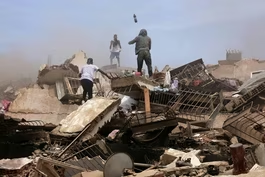
Thousands feared dead in Venezuela after twin earthquakes
Video has Closed Captions
Thousands feared dead in Venezuela after twin earthquakes flatten buildings (4m 20s)

U.S. moves to reassure Gulf allies after new Hormuz shutdown
Video has Closed Captions
U.S. moves to reassure Gulf allies after latest Strait of Hormuz shutdown (8m 22s)
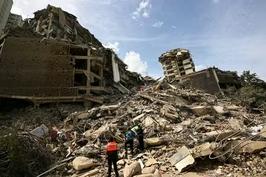
Venezuela's earthquake response hindered by crises
Video has Closed Captions
Venezuela's earthquake response hindered by economic and political crises (4m)
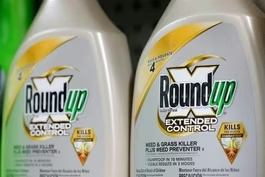
What science tells us about the health risks of Roundup
Video has Closed Captions
What science tells us about the health risks of Roundup (5m 12s)
Providing Support for PBS.org
Learn Moreabout PBS online sponsorship New Episode
- News and Public Affairs

Today's top journalists discuss Washington's current political events and public affairs.

- News and Public Affairs

FRONTLINE is investigative journalism that questions, explains and changes our world.
Urban Consulate Presents
 New Episode
 New Episode
 New Episode
 New Episode
 New Episode
 New Episode

 New Episode
 New Episode
Support for PBS provided by:
Major corporate funding for the PBS News Hour is provided by BDO, BNSF, Consumer Cellular, American Cruise Lines, and Raymond James. Funding for the PBS NewsHour Weekend is provided by...