
June 8, 2026 - PBS News Hour full episode
6/8/2026 | 56m 46sVideo has Closed Captions
June 8, 2026 - PBS News Hour full episode
June 8, 2026 - PBS News Hour full episode
Problems playing video? | Closed Captioning Feedback
Problems playing video? | Closed Captioning Feedback
Major corporate funding for the PBS News Hour is provided by BDO, BNSF, Consumer Cellular, American Cruise Lines, and Raymond James. Funding for the PBS NewsHour Weekend is provided by...
June 8, 2026 - PBS News Hour full episode
6/8/2026 | 56m 46sVideo has Closed Captions
June 8, 2026 - PBS News Hour full episode
Problems playing video? | Closed Captioning Feedback
Where to Watch PBS News Hour
PBS News Hour is available to stream on pbs.org and the PBS app.
Providing Support for PBS.org
Learn Moreabout PBS online sponsorshipAMNA NAWAZ: Good evening.
I'm Amna Nawaz.
Geoff Bennett is away.
On the "News Hour" tonight: Israel and Iran agree to halt their attacks after a series of strikes threatened to reignite the war and upend us peace efforts.
California's primary ballots are still being counted, and the days-long process is leading to unfounded claims of election fraud, including from the president.
And millions of families lose food assistance, as Republicans' signature legislation is enacted across the country.
SARA NAOMI BLEICH, Harvard University: What we're seeing is that eligible people are leaving the program because it's become too difficult to document and to maintain their eligibility, and that is deeply concerning.
(BREAK) AMNA NAWAZ: Welcome to the "News Hour."
Israel and Iran traded long-range missile strikes for the first time since the cease-fire went into effect two months ago.
Both countries appear to have agreed to stop their attacks, but not before sparking fears of a return to full combat in the region.
Both President Trump and Russia regional mediators are now in a scramble to try and salvage a deal to end the war with Iran.
Here's Ali Rogin.
ALI ROGIN: Tonight, the guns have gone silent for now after a precarious Sunday evening.
Iranian missiles streaked across the night sky threatening to return the region to wider war, their target, Israel, for the first time since fighting was stopped by a fragile April truce.
The missiles soared over Western Iran on state broadcasts to music and cheers.
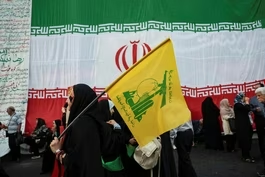
Crowds waved both Iranian and Hezbollah flags in a nod to Israel's continued strikes against Iran's ally inside Lebanon.
And their missiles came with messages, including "You will regret."
(SIRENS BLARING) ALI ROGIN: Air raid sirens sounded across Jerusalem by daybreak, as the strikes forced Israelis, including hospital patients, to shelter underground.
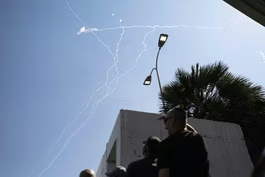
Like grim fireworks, interceptions of the long-range missiles could be seen across the sky.
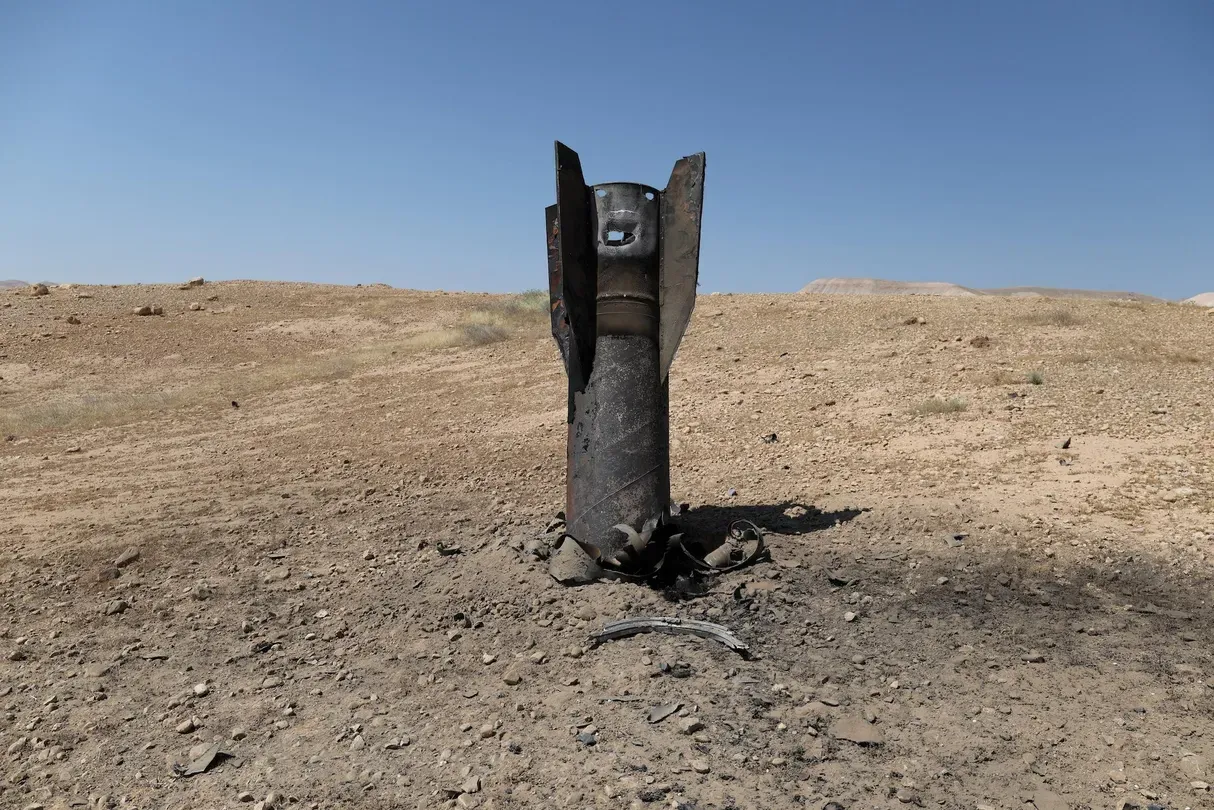
Others broke through, but did not explode, standing like headstones in the soil in both the occupied West Bank and as far as Damascus, Syria, reminders that this escalation could once again embroil the entire region.
Tehran said its latest attacks were in retaliation for Israeli strikes this weekend against Hezbollah strongholds in the Lebanese capital of Beirut.
Earlier today, Iran urged the United States to rein in its ally.
ESMAEIL BAGHAEI, Iranian Foreign Ministry Spokesman (through translator): The United States bears clear responsibility.
Whether such violations are carried out by the Zionist Israeli regime in Lebanon or through its coordination with the United States in our region, the direct responsibility of the United States is unequivocal.
And the consequences of any escalation of tensions will also rest with the United States.
ALI ROGIN: Israel's military responded to Iran's attacks by striking a petrochemical facility in Southwestern Iran, as well as other unspecified targets.
And within hours of Israel and Iran exchanging fire another of Tehran's allies, the Houthis of Yemen, brandished video claiming missile attacks against Israel.
And the group renewed threats against Israeli-linked ships in the Red Sea.
With regional war threatening to erupt again and the cease-fire with Iran on the brink, President Trump urged restraint on social media, saying both countries must immediately stop shooting, adding, "Final negotiations on peace are proceeding, subject to ignorance or stupidity getting in its way," that perhaps a reference not just to Iran, but to the president's confrontation with Israeli Prime Minister Benjamin Netanyahu, who has defied Mr.
Trump by continuing to operate against Hezbollah inside Lebanon, including with new strikes in Southern Lebanon just today.
Iran has said a cease-fire in Lebanon is the only way it will pursue U.S.
talks.
In a video address, Netanyahu said his fight with Iran was stopped for the moment.
BENJAMIN NETANYAHU, Israeli Prime Minister (through translator): Right now, the fire at the front is contained because, after we hit the terrorist regime in Tehran, it stopped attacking us.
If the terrorist regime in Iran makes the mistake and attacks us again, we will respond forcefully.
ALI ROGIN: Trump recently voiced his displeasure with Netanyahu, telling The Financial Times: "I call all the shots."
He later told Axios that if Netanyahu went back to war with Iran, he might find himself fighting alone.
And in an interview taped before today's back-and-forth attacks, the president insisted that this was not becoming an endless war.
DONALD TRUMP, President of the United States: I don't like these endless wars.
This is not an endless war.
We have been doing this for three months.
Much of it has been under the form, a pretty good form of cease-fire.
KRISTEN WELKER, Moderator, "Meet the Press": During your 2016 campaign, you called the Middle East a quagmire.
DONALD TRUMP: It is.
KRISTEN WELKER: What makes you so sure this won't become a quagmire?
DONALD TRUMP: We're not going to be there.
KRISTEN WELKER: You're convinced this won't become a quagmire?
DONALD TRUMP: It's not a quagmire.
I just wiped out the military of a very dangerous country.
ALI ROGIN: Yet, clearly, Iran's military retains its ability to launch long-range strikes.
And one of Iran's top negotiators today said both the U.S.
and Israel are neither committed to a cease-fire nor believe in dialogue, as a deal to permanently end the conflict remains out of reach.
For the "PBS News Hour," I'm Ali Rogin.
AMNA NAWAZ: And a short time ago, the Israeli military said it had intercepted what it called a -- quote -- "suspicious aerial element" in the far south of Israel.
The IDF said the incursion was from Yemen, where an Iran-backed proxy group is based.
To help us understand how this latest escalation will affect a host of issues, I'm joined now by Miad Maleki.
He's a senior fellow at the Foundation for Defense of Democracies and previously served as a senior U.S.
sanctions strategist in both the first Trump and Biden administrations.
And, from Jerusalem, David Makovsky, he is a distinguished fellow at the Washington Institute for Near East Policy and host of the podcast "Decision Points."
Gentlemen, welcome to you both.
And, Miad, I will start with you.
It's fair to say Iran has long said a cease-fire in Lebanon is a condition to peace talks.
The shift from words to action is a big deal.
Why would Iran choose to strike Israel now?
MIAD MALEKI, The Foundation for Defense of Democracies: Well, it is a big deal.
I think Iran is very clear that, for Iranians, the regime has been supporting these proxy groups for decades now, arming them, funding them.
This is a very first time that they're actually stepping into help one of its proxy - - one of the proxy groups militarily.
I mean, this is the first time Iran is going into help one of these proxy groups.
And it really -- it is very significant in that term.
And I think what really happened here is, Secretary Rubio came out right before the conflict in Lebanon and before their strikes in Lebanon and said, we're not going to give Iran any sanctions relief.
The only thing Iran is going to get from opening the Strait of Hormuz is the lifting of the blockade.
And it's very clear that Iran's economy is under pressure, probably more than any other economies, from the closure of Strait of Hormuz.
They need the strait to be open.
But also they need some kind of a sanctions relief.
I mean, if they go back economically, they're going to have to deal with a population that is going to deal with inflation rate of 87 percent, food inflation rate of 200 percent.
And if they're not getting the sanctions relief up front, things are going to get very difficult for them domestically.
Now they sense a few things.
One, President Trump wants a deal, and they need -- have the leverage to now get some kind of sanctions relief.
Two, I think they sense some disagreements between President Trump and Prime Minister Netanyahu.
And I think they really try to exploit that in a way that they can get some leverage out of this and turning Hezbollah into a negotiating asset.
They never -- Iranian regime never agreed to bring its proxy groups into negotiations.
They only wanted to negotiate over the nuclear program.
Now they're using Hezbollah as a negotiating asset.
That's -- I think that's very significant.
AMNA NAWAZ: So, David, if you can respond to what Miad just said there, you're in Israel.
How have the Iranian attacks there impacted or changed the discussion about the war?
And is there a wedge between the U.S.
and Israel when it comes to Israel's war in Lebanon?
DAVID MAKOVSKY, Senior Fellow, Washington Institute for Near East Policy: Well, I think here you eat there's a bunch of variables that they're trying to juggle.
The country has gotten used to going in and out of safe rooms, shelters at a time of missile strikes.
And then life just goes back to being normal.
It's almost like a flash mob.
They all come together and then they all go back to normal.
But the prime minister is in a rough spot here because every day on the TV and on the radio, he's getting slammed by mayors of Northern Israel, who are saying, you have abandoned us.
You have become the vassal of Donald Trump by -- he doesn't want you to hit in Lebanon, you don't hit.
But there have been like 15 soldiers I think that have been killed in the last couple of weeks.
There are these fiber-optic drones that Hezbollah operates that the IDF, for all of its technological prowess, has not found an answer to.
And these very well-publicized attacks of Trump on Netanyahu, don't act in Lebanon, I think has led Netanyahu to be in this unusual position where he's being outflanked on the right by these mayors, saying that Northern Israel could turn into a ghost town if you keep going on this way.
And so I think he was under a lot of pressure to strike, to come up with this new formula, which is an attack on a Northern Israel means an attack on Dahiyeh.
That's the Hezbollah stronghold in Southern Beirut.
And I think that's somewhat the backdrop.
And then Iran upped the ante and said, well, to can play this game.
And you say an attack on Northern Israel is an attack on Dahiyeh.
Well, an attack on Dahiyeh is an attack on Iran.
And then it was off to the races last night with the Iranian attacks on Israel that accelerated and this dramatic phone call which seems like took place before 7:00 a.m.
this morning, D.C., time, Eastern time, where it seems the president really restrained Netanyahu from a much more dramatic strike that was about to unfold from Israel against Iran a few hours later.
AMNA NAWAZ: So, Miad, Iran, as David has said, has now upped the ante.
How would you describe the status of the cease-fire?
What does this mean for the future of any peace talks?
MIAD MALEKI: Well, I think at this point it's very clear President Trump is willing to put pressure on Prime Minister Netanyahu to calm things down, go back to the talks and see what they can get with Iran.
Now, Iran has changed the way things were as a couple of days ago.
Now you don't just have Israel having been deterred to a point to not engage militarily in Iran, but you also now going to see probably Houthis that start coming into the combat and engaging both Israel and potentially some issues that they can cause in the Strait of Bab-el-Mandeb, another strategically important strait that Iran can control through its whole proxy group Houthis that are going to be more emboldened now.
They economically are in a bad spot.
Yemen's economy is in a very bad shape, the Houthi-controlled area.
They probably need to get some leverage.
They're probably hoping they can get some kind of deal with the U.S.
and the West, get some sanctions relief.
So they wouldn't be just carrying the water for the Iranian regime, but also they can get some kind of deal themselves.
And they can see a President Trump that is really interested in opening up their Strait of Hormuz and putting an end to the conflict.
So they might want to leverage that.
AMNA NAWAZ: David, how would you look at this in the future of peace talks?
Also this issue that Netanyahu is now facing pressure from Trump, who is dealing with a very unpopular war here, but also, as Miad has pointed out, empowered Iranian proxies and Iran looking for more leverage in those talks.
How much flexibility does Bibi Netanyahu have?
DAVID MAKOVSKY: Well, he doesn't have a lot because the government of Lebanon on one hand is a government for the first time in decades that wants to take its country back from Hezbollah that's been a state within a state, because, in the Middle East, if you fire the shots, you call the shots.
And the government in Lebanon and Israel actually have a convergence to say Iran should not be the arbiter of Lebanon's future.
That's the good news.
The bad news is, is that there are all these structural problems here, because, for all their nice intentions of the government of Lebanon, they're not really willing to send troops to disarm Hezbollah in the south.
And it's a no-man zone and they just keep firing in Israel.
There's no government there.
And so Israel's stuck.
And my concern is that the Iranian -- as much as Israel is trying to decouple the Lebanon front from the Iranian front, the Hezbollah might have found the wedge they're looking for now that Iran has brought themselves closer to Hezbollah, that what Hezbollah says is, hey, this is great for me because it incentivizes me to create a rift between Trump and Netanyahu.
If Iran's going to say -- in other words, the keys are in my hand, Hezbollah.
I could fire on Israel.
Israel's going to retaliate.
But then Iran's going to hit.
And then Trump is going to come down on Israel like a ton of bricks.
So I am concerned that this cease-fire could hang by a thread because Hezbollah has every incentive to increase the friction between Trump and Netanyahu.
And that's what the Iranian linkage of these last 24 hours has done.
And that's why we should be aware of it.
Yes, it's true Iran is not 10 feet tall.
None of their rockets, missiles got through, all intercepted by Israel, no injuries in Israel at all.
But I am concerned that Hezbollah has found the key to deepen friction between both the -- both Trump and Netanyahu.
AMNA NAWAZ: David Makovsky, Miad Maleki, we thank you both so much for joining us.
DAVID MAKOVSKY: Delighted to be with you, as always.
AMNA NAWAZ: In the day's other headlines: Authorities say there are now three more cases of New World screwworm, bringing the total number to at least five and sparking new concerns for the nation's cattle industry.
The initial cases were discovered last week in two calves located within a few miles of each other in South Texas.
These latest ones were found hundreds of miles apart, one in a calf near San Antonio, another in a goat near Austin, and a third in a dog in New Mexico.
In a press conference today, Agriculture Secretary Brooke Rollins said every effort is being made to control any further cases.
BROOKE ROLLINS, U.S.
Secretary of Agriculture: We now know what the enemy looks like.
We now understand what we have to do.
This is not a virus.
It is not a disease.
It is a pest.
And so we obviously are treating it as such.
AMNA NAWAZ: Agricultural officials have sounded the alarm about the threat of infestation since a case was detected in Mexico in late 2024.
The insect was a scourge for cattle ranchers for years until it was largely eliminated in the U.S.
in the 1960s.
In Boston, a federal judge struck down President Trump's hefty fee on H-1B visas for highly skilled foreign workers.
U.S.
District Judge Leo Sorokin called the $100,000 fee an unlawful tax that Congress never authorized.
Before Trump announced the charge last September, employers typically paid between $2,000 and $5,000 in fees.
The H-1B program was created in 1990 and offers visas to some 85,000 people each year, many involved in the tech sector.
The Trump administration had argued that the program aims to replace, rather than supplement, American workers.
In New York City, an investigation is under way into a stabbing at Penn Station that left six people injured, one of them seriously.
Authorities apprehended a suspect, but did not immediately release details about the person's identity or potential charges.
It happened yesterday evening in one of the nation's busiest transportation hubs located just below Madison Square Garden, the site of tonight's game three of the NBA Finals.
President Trump is set to be there, becoming the first sitting president to attend a Finals game.
A local watch party was canceled due to the increased security, and police officials are asking city residents to avoid the area.
JESSICA TISCH, New York City Police Commissioner: The message is simple.
Celebrate the Knicks, but avoid the MSG area tonight if you do not have tickets for the game or some other valid reason to be there tonight.
AMNA NAWAZ: Tonight is the first time that Madison Square Garden is hosting an NBA finals game since 1999.
The New York Knicks lead the San Antonio Spurs in the best of seven series two games to none.
College quarterback Brendan Sorsby won a temporary injunction today against the NCAA, despite his history of gambling on games.
That means the 22-year-old could play for Texas Tech this fall.
Sorsby had been suspended after admitting to gambling on college football games, including during his time at Indiana when he was on the roster.
Current NCAA rules call for a permanent loss of eligibility for players who bet on their own team, but Sorsby only faces a two-game suspension.
In response, the organization set it -- quote -- "strongly disagrees with the ruling," saying it -- quote -- "undermines and corrupts the integrity of sports."
In the Philippines, a 7.8-magnitude earthquake has killed at least 35 people and injured more than 200 others.
The offshore quake caused extensive damage in southern coastal areas.
It also triggered tsunami warnings in Indonesia, Japan and Australia, though they have since been lifted.
Philippine President Ferdinand Marcos Jr.
ordered classes to be canceled and disaster response agencies to begin helping affected areas.
The U.S., France and other nations have also offered their support.
On Wall Street today, stocks steadied a bit after Friday's sell-off.
The Dow Jones industrial average slipped about 80 points to start the week, but the Nasdaq rose more than 200 points, or almost 1 percent.
The S&P 500 also managed a modest gain.
And a new musical which pokes fun that the golden age of musicals was crowned best musical at last night's Tony Awards.
WOMAN: "Schmigadoon!"
(CHEERING) AMNA NAWAZ: In his speech, "Schmigadoon!"
producer and "SNL" creator Lorne Michaels said -- quote -- "Sometimes, singing, dancing, a lot of jokes, and a happy ending is really all you need."
"Ragtime" won best musical revival, and its star, Joshua Henry, earned his first Tony Award after three prior nominations.
And the Arthur Miller classic "Death of a Salesman" raked in the most awards of the night, six in all, including best revival of a play.
Still to come on the "News Hour": new data show just how many people are losing food stamps due to stricter requirements; Amy Walter and Tamara Keith break down the latest political headlines; and Dave Eggers discusses his newest novel and supporting the next generation of authors.
Well, ripple effects and strong opinions are still flowing out of a lengthy interview with President Trump on NBC's "Meet the Press" over the weekend.
Among the points of contention, Trump's baseless claims about the 2020 election results and the security of current elections.
Our Lisa Desjardins has more.
LISA DESJARDINS: Trump walked out of the NBC interview after he repeatedly made false, unproven accusations that the California elections were, in his words, rigged, while also asserting the same about his loss in 2020.
Here's a portion of that interview.
DONALD TRUMP, President of the United States: Your elections are crooked and you're crooked, and Meet the Press is crooked.
KRISTEN WELKER, Moderator, "Meet the Press": But, Mr.
President... DONALD TRUMP: And so is ABC and CBS and CNN.
KRISTEN WELKER: But, Mr.
President... DONALD TRUMP: You're a one-sided crooked network.
Sorry.
Let's call it quits because I've had enough.
LISA DESJARDINS: Joining us now to sort out fact from fiction is Tammy Patrick.
She's the chief executive officer of programs at the National Association of Election Administrators.
She was also an elections official in Arizona for 11 years.
Tammy, let's start with 2020.
We're still talking about this, unbelievably, but six years later, what do we know about any evidence of fraud in that election?
TAMMY PATRICK, National Association for Election Administrators: Well, it's great to be here talking about the 2020 election once again.
It's important to remember the 2020 election was audited, it was recounted, all court challenges were heard and ruled on, and there was no evidence to dispute the official results of who won the 2020 presidential election.
It's long past time we move on.
LISA DESJARDINS: Now, President Trump does want one thing that is generally popular in polling, and that is the idea of more voter I.D.
But he also wants some very unpopular ideas, like banning voting machines and in addition limiting or entirely banning mail-in voting.
And he is actually taking action on that front.
So, under his order, the Postal Service itself last week proposed new rules.
They would standardize ballot envelopes, but also would require that states give the federal government all the names and addresses of every voter that is slated to get mail-in ballots.
That, of course, faces some serious court challenges.
But I want to ask you, for those skeptical about mail-in voting, which has been a drumbeat for President Trump since 2016, what do you say to them about the chances of fraud from mail-in ballots?
TAMMY PATRICK: All across the country, voter eligibility is verified, and the voter is authenticated both when they request a ballot and also when the ballot is returned to the election official.
Now, this can be done in a variety of ways depending on state laws, and every state has a law about this.
In some cases, it's a comparison between the signature on the envelope and the signature on the voter's file.
But in every case, the voter's eligibility is authenticated using what that state law has determined is correct in the state.
And we ensure that the ballot packet is from the intended voter.
LISA DESJARDINS: Do we know how hard it is to fake a signature in that case?
TAMMY PATRICK: So I have taken forensic signature training, and I will tell you it's pretty difficult, because it's not just that everyone signs their signature exactly the same each time, because we don't.
We're creatures of habit, but we are not perfect.
So there are other things that are taken into account, the slant and slope, the line orientation.
It turns out some people are what we call floaters, where you sign your name above the line or the signature is bifurcated by the line.
It's that sort of characteristic of how someone signs their signature that someone wouldn't know who's just randomly trying to forge a signature.
So that's part of the security in the system.
LISA DESJARDINS: All right, now let's go to California, which Trump referenced the results as they are coming in right now.
Let's look at the L.A.
mayor's race right now, the top two move on to November.
Currently, that is two Democrats, Republican and former reality star Spencer Pratt you see there has fallen to third.
Again, results are still coming in.
President Trump wrote today: "Not possible for Spencer Pratt to have lost the L.A.
run-offs after the big lead he had.
Third World nation.
Rigged elections."
And also, not long ago, Speaker Johnson also raised sort of vague doubts about California.
California is an outlier in terms of how long it takes to count votes.
But why do results change there?
And is there an opening for fraud?
TAMMY PATRICK: For voters, it's important to realize that, for the election professionals conducting our elections, it's about the process, not the outcome of the election.
So while it's true that California has the largest certification period based on their state's law, in every state in the nation, there's a period of time after Election Day where the election officials are checking to make sure that all eligible ballots are in fact correctly adjudicated, that they're counted if they're supposed to be counted, and that they shouldn't be counted that they are kept from the final tabulation.
So, in California it doesn't really take that much longer than the rest of the nation.
On election night, the press project who they think the winner will be, but when the elections are close, we pay closer attention to the process in those days after election.
There's a lot of discussion about, well, why can't it be like Florida?
Well, the truth of the matter is, in Florida, they're also counting ballots after Election Day.
But unless the race is close, people are not paying as close of attention.
So what's really important here to understand is that part of the reason it takes a while is because of the security of the system.
And it's not so much that it's opening up for fraud.
It's the fact that it's securing it from any other influence outside of the voter's intent on marking their own individual ballot.
LISA DESJARDINS: In just our last few seconds here we know there are some documented instances of fraud that conservatives track, some alleged, some proven.
The Heritage Foundation, a conservative group, cited 43 in 2024.
But that doesn't mean that these are mass attempts at fraud.
Are these generally just individual cases, in our last few seconds?
TAMMY PATRICK: It is.
I mean, I want to make really clear that voter fraud is exceedingly rare.
The number of instances is not zero, but it's also not in the triple digits, even as millions of ballots are being counted.
We can't point to a single election where voter fraud changed the outcome of the election.
And don't get me wrong, we want to make sure that's as little as possible.
But that's why election professionals all across the country have so many security processes in place.
And that's why our elections are transparent and observable, with observers able to watch as the whole process plays out, no matter how long it takes.
LISA DESJARDINS: Tammy Patrick, thank you for covering so much ground in such a short time.
We appreciate it.
TAMMY PATRICK: Thank you for having me.
AMNA NAWAZ: Enrollment in the Supplemental Nutrition Assistance Program, or SNAP, formerly known as food stamps, has fallen sharply nationwide since the passage of the One Big Beautiful Bill Act last summer.
There are over 38 million people getting the food assistance, but more than 3.5 million of them have lost access as states are implementing a series of new eligibility requirements and stricter processes for applying.
Our William Brangham has more on what's happening and the concerns.
WILLIAM BRANGHAM: That's right, Amna.
Last year's Republican center peace budget law is projected to cut $186 billion in federal spending on SNAP over the next decade.
But it's not only about funding cuts.
The new law changed eligibility criteria, like raising the age limit for work requirements from 54 to 64 and increasing the amount of documentation required to enroll.
Since then, every state has seen a decline in people enrolled in SNAP, led by Arizona, where participation has fallen by 51 percent, according to some estimates.
And those who are still eligible are receiving much lower benefits and often facing longer reauthorization times.
Here's what 27-year-old Presley Nassise told us about the experience.
He's a SNAP recipient, has a chronic illness, and works two jobs.
PRESLEY NASSISE, SNAP Recipient: I went from having a little over $200 a month for groceries from SNAP funds to having absolutely nothing for three months.
I lost weight.
I ate less.
I had one, 1.5 meals a day, instead of two or three.
I pinched pennies.
I saved food from the jobs I work at where they have free snacks.
I took things home.
And then when I was recertified, they renewed me for a significantly lower amount.
So I now get $50 a month.
WILLIAM BRANGHAM: So, for more on the state of food assistance in America, we are joined now by Sara Naomi Bleich.
She's a professor of public health policy at Harvard and previously worked at the USDA during the Biden and Obama administrations.
Thank you so much for being here.
Agriculture Secretary Brooke Rollins and others in the Trump administration have been celebrating this decline in SNAP benefits, arguing that it's happening because the economy is better, they argue, that wages are getting better, and that they're rooting out fraud.
How accurate is that?
SARA NAOMI BLEICH, Harvard University: So I would say that that's not accurate.
And thank you very much for having me.
So there are three main reasons why SNAP caseloads would decline.
One is that the economy improves, since SNAP is designed to get smaller when the economy gets better.
But the economy has not measurably improved since H.R.1 passed in July of 2025.
And we can all probably agree that affordability, including high costs of food, remain an enormous challenge for families in this country.
Another reason SNAP caseloads could decline is that the rules change, and, as a result, eligibility is constricted.
That has happened.
There are stricter time limits, meaning that folks have to prove they are working 20 hours a week or 80 hours a month to receive benefits.
And the number of people subject to those time limits has gone up a lot, and that greatly increases the paperwork burden, since, each month, individuals have to document their hours, and then the state has to certify it.
And the third reason that SNAP caseloads could decline is that states take actions which contract eligibility.
So states face an enormous fiscal penalty if they don't get their payment error rates under control.
So that refers to how much a person is under- or over-paid for their monthly SNAP benefits.
As a result, some states like Arizona are being overzealous in their implementation of the rules, making it much harder for eligible people to obtain or maintain benefits.
And at the same time, most states, including Arizona, are understaffed.
So they lack the capacity to process all this paperwork.
And so when a person is applying for the first time or recertifying or confirming their hours work to comply with the time limit, there is a 30-day deadline.
Even if an eligible person submits all the required information on time, if the state does not process it by the deadline, that person is automatically removed and has to start the process all over again.
WILLIAM BRANGHAM: I see.
What about the argument about fraud that they make, that this is -- the declining numbers are because people who should not be on the system are out of the system?
SARA NAOMI BLEICH: So, fraud is actually very low in the SNAP program.
It's about 1.6 percent, which is actually low relative to other federal safety net programs.
And the new rules actually don't target fraud at all.
They're targeting payment error rates, which is, again, referring to how much someone is over- or under-paid for their SNAP benefits.
And so these changes will have no impact on fraud rates, which are very low already in the SNAP program.
WILLIAM BRANGHAM: There are other people who argue that this decline is also a sign of just a return to normalcy post-pandemic, that the pandemic caused all of this incredible need in the country, SNAP responded, but now we are moving back to a more normal period of life.
We talked to Jack Salmon.
He's at the conservative Mercatus Center.
Here's how he described this.
JACK SALMON, Mercatus Center, George Mason University: The SNAP program is -- it tends to be pretty cyclical.
So what that means is, during economic crises, like we saw in 2008-2009, when the unemployment rate goes up, we see the program participation also goes up with that, as families struggle more during times of economic strain.
What then happens after the crisis, as the unemployment rate comes down and the sort of business cycle improves, we then see the SNAP numbers come down as well.
But following the COVID pandemic, it remained elevated for quite a few years, really through the end of 2024.
And I think now we're seeing somewhat of a sharper return to normalcy.
WILLIAM BRANGHAM: What do you make of that, return to normalcy?
SARA NAOMI BLEICH: So this is not a return to normalcy, because it is true that SNAP caseloads are going down, but they're decreasing for the wrong reasons.
They're not decreasing because all of a sudden we have a much stronger economy.
They're decreasing because what we're seeing is that eligible people are leaving the program because it's become too difficult to document and to maintain their eligibility.
And that is deeply concerning.
WILLIAM BRANGHAM: As we heard from Presley Nassise earlier, describing just all of these different hoops, he also described having to submit all sorts of bank payments from Venmo and cash apps and letters from neighbors testifying to the fact that he was actually living in the conditions that he described.
How much of this -- I mean, the landscape has really, seemingly changed for people who want to participate in the program.
SARA NAOMI BLEICH: Yes.
And states have made it -- states are introducing a lot more -- I won't say that there are additional rules, but states are making it harder for people to submit the necessary paperwork.
So there's all the things you have to submit, which is a big challenge for people that are trying to participate or maintain in the program.
That's one challenge.
But another challenge is, then all this paperwork comes in and states have to process it.
And just about every state is facing major staffing challenges, which makes it hard then to process everything on time.
And if it's not processed on time, within that 30-day requirement, folks are going to fall off the program.
WILLIAM BRANGHAM: And what do you make of the argument that some might argue, which is, it's good to have these kinds of strictures, it's a big, important program, we ought to make sure that only the people who really are deserving are in that program?
SARA NAOMI BLEICH: I wholeheartedly agree that it's important that we are good stewards of public dollars and we want to make sure that people that are in the program are in the program.
And that is largely the case.
What's happening is, these new rules are making it such that eligible people who should be in the program are unable to participate.
And that's not consistent with the mission of SNAP.
WILLIAM BRANGHAM: Going forward, if there are no changes and we stay in this current protocol, what do you imagine happening with SNAP benefits in the country?
SARA NAOMI BLEICH: We're going to see many, many fewer families have access to benefits.
So, just between the period of July of 2025 and February of 2026, so about six months, 3.5 million people lost access to benefits.
That is likely going to increase.
And with that means that people will have higher rates of food insecurity, meaning they don't have enough to eat.
And if you have higher food insecurity, your health is at risk.
You have higher likelihood of heart disease and diabetes and obesity.
And so we are likely to see that people will not only lack resources, but there will be negative health and even economic effects because of these changes.
WILLIAM BRANGHAM: Sara Naomi Bleich of Harvard University, thank you so much for being here.
SARA NAOMI BLEICH: Thank you for having me.
AMNA NAWAZ: President Trump walks out under tough questioning from NBC, Democrats face character questions ahead of a battleground Senate race, and President Trump's influence is once again on the ballot in South Carolina.
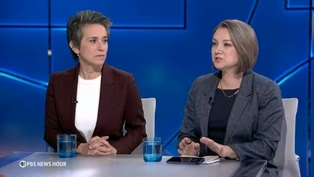
Here to unpack it all is our Politics Monday duo.
That's Amy Walter of The Cook Political Report With Amy Walter and Tamara Keith of NPR.
Great to see you both.
AMY WALTER, The Cook Political Report: Good to be here.
AMNA NAWAZ: Let's start with this interview that's getting a lot of attention.
I think it's fair to say Trump officials proudly talk about how accessible this president is to the press.
We know he takes a lot of questions on the fly in the Oval Office, before leaving from the South Lawn, and even on very brief phone calls from reporters all the time, where he ends the conversation when he wants to.
He rarely sits down for extended, rigorous one-on-one interviews like the one with Kristen Welker on NBC's "Meet the Press."
As we played earlier, he got very frustrated, Tam, under questioning about his anti-weaponization fund and about rigged election claims she was asking for evidence about.
What stood out to you about how angry the president got in response?
TAMARA KEITH, National Public Radio: Well, so much of the questions that he takes, as you described, the calls, all of that, is on his terms.
He's calling on the questions that -- he's answering the questions that he wants.
And when he gets a question that he doesn't like, he very frequently attacks the journalists, most especially female journalists, and he attacks them in very personal terms.
You saw at various points during this interview him criticizing -- going after Kristen Welker and her questioning and her professionalism.
She stood up for herself.
But this -- at the end, as he's walking out, he was being pressed on this -- the soft spot for him, which is the 2020 election and his whole idea that the election was stolen and the election rigging and all of the things that he's been talking about for all of these years.
AMNA NAWAZ: Baseless ideas, we should underscore here, right?
TAMARA KEITH: Yes.
And that is why it is -- it is central to his identity.
And it continues to be something where he doesn't have a good answer to the question of, where's the evidence?
AMNA NAWAZ: Amy, how did you look at this, and also this larger argument where the White House is always saying, he's so available, he's very accessible to the press?
AMY WALTER: Right.
Well, listen, if you said why do you think the president chose to go on to a major platform, a Sunday show, I would say, well, probably because we're in a war in Iran, although which he calls not really a war, but there's that.
And voters are very upset, number one, about the actions being taken in Iran and the repercussions of it, namely higher inflation, gas prices, and that here's an opportunity for the president to explain his thinking, where are we going in Iran, what's the timeline, to give some clarity to that, and to also empathize with Americans who are saying, yes, but my gas price went up Inflation is still high.
They're in a farm state.
Fertilizer is too expensive.
That was a great opportunity to do that.
He provided none of that in this interview.
So, really, I think he uses it, to Tam's point, as an opportunity for him to say what he wants to say, be on the record for the issues that matter to him.
I do think it's more, though, than just obsessing about 2020 that becomes problematic.
And Lisa obviously did a whole piece on this before we came on of really undermining the integrity of elections and the idea that, as we go into 2026 election time, the president's numbers aren't looking particularly strong.
the difficulty that Republicans are going to have to hold on to both houses in this upcoming election.
Undermining this as a rigged election is only going to further the frustration, division that we have in this country about how our elections are handled and what it means to actually have a free and fair election that Americans can agree, whether they won or lost, was actually valid.
AMNA NAWAZ: Well, I know you have both been following the lead-up to the primary elections in Maine tomorrow very closely.
Fair to say, barring -- barring, rather, any kind of extraordinary upset, Graham Platner is likely to win the Democratic nomination.
Susan Collins is likely to win the Republican nomination.
And, of course, there's a number of scandals around Platner that have only grown in recent weeks from this list, I have to say, from the Nazi tattoo to sexting while married to ex-girlfriends alleging violence.
Platner denies any violence, we should say, but on everything else he says he's transformed.
And this is how one of his supporters actually sees it.
Take a listen.
GALEN LOWE, Graham Platner Supporter: It's refreshing to have someone actually own up to stuff that they have done and say, yes, that wasn't such a great idea.
I'm working to be a better person.
Why?
Because that's what we all need to do.
We all have flaws.
It's not a perfect world.
AMNA NAWAZ: So, Tam, not for Republicans, because I think President Trump has moved the bar so far, but, for Democrats, this sort of stuff would have been disqualifying not long ago.
What's changed?
TAMARA KEITH: I think that if you talk to a lot of Democrats, they would say Susan Collins.
They really see Maine as a solid pickup opportunity.
And any chance that there was for Democrats to put forward a different candidate -- and establishment Democrats absolutely did want to put forward a different candidate, Governor Janet Mills, who was seen as a strong recruit by Chuck Schumer and the Senate Democrats.
By the time she got into that race, Graham Platner already had huge momentum.
He was like riding a wave and she's there paddling and she can't - - she just can't catch it.
It was too late by the time she got in.
And so now, at this point, Democrats have the front-runner that they have.
And I think that there are lots of nuances here.
And a Democratic primary is also different than a general election.
And I think that we really will see a test not just in Maine, but also in Texas, where Ken Paxton, the Republican nominee in the Senate race, all of his dirty laundry was aired in that primary, and he won anyway.
And so I think there is a question of whether primary electorates are different than general electorates or whether we're in a new era where the sort of scandals that would have taken down a politician don't matter anymore.
AMY WALTER: Yes, and the -- by the time some of those first Reddit posts came out, Graham Platner had already built and established this sort of grassroots following.
I was actually up in Maine the day or the day after those first Reddit posts were revealed.
And sitting at an event, someone comes up to introduce Graham Platner and said, well, we all know this is probably the Democrats in Washington who leaked this.
So, the lack of faith and trust in the establishment, whether it is the candidates that they pick in Maine establishment, or whether it's the -- quote, unquote -- "establishment" in Washington, and the lack of faith too in how rumors like this get into the mainstream media, also important.
But I think Tam's point about the primary is also critical.
I don't think Graham Platner is losing support from Democrats.
This is a blue state.
So theoretically, you only need to win Democrats to win.
But this is where Susan Collins comes in.
If you look at her success over the years, it's not because she is winning Republicans, more Republicans.
It's that people who voted for Joe Biden in 2020 crossed over and voted for Susan Collins.
And the number one group to do this were women.
She won women by three points.
Joe Biden won women in that state by more than 23 points.
If Graham Platner is going to win in Maine, he's got to win women who crossed over to vote for Susan Collins.
We're not going to find out whether he can do that tomorrow night.
AMNA NAWAZ: Let me ask you too about South Carolina, because their gubernatorial primary, the Republican primary is also tomorrow.
From Louisiana to Texas, Amy, as you have seen, we have seen President Trump's influence in being able to oust incumbents for his pick to make it ahead.
In South Carolina, he's pushing for Lieutenant Governor Pam Evette.
How do you look at this?
What's going to happen here?
AMY WALTER: Yes, I think she's definitely a front-runner in this.
But these are also -- South Carolina and many of these Southern states have run-offs.
And so getting that nod is really important.
Where the president has yet to weigh in is in Georgia, which has a -- actually, next week, has a run-off in the Senate race there.
I think that is also notable.
TAMARA KEITH: Yes, and I will just say, in South Carolina, a governor's race is different than a Senate race or a congressional race.
And so I am certainly watching whether President Trump's influence is as strong when you're looking at a state race versus a federal race that has federal implications for how he's able to govern.
AMNA NAWAZ: Tamara Keith, Amy Walter, thank you both very much.
TAMARA KEITH: You're welcome.
AMY WALTER: You're welcome.
AMNA NAWAZ: Bestselling author Dave Eggers has a new novel out this week telling the story of two art-obsessed friends over many decades.
And there's much more to the author's own story as well.
Senior arts correspondent Jeffrey Brown reports from San Francisco for our arts and culture series, Canvas.
JEFFREY BROWN: Bicycle?
DAVE EGGERS, Author, "Contrapposto": Yes.
I bike around the Embarcadero a lot.
JEFFREY BROWN: For Dave Eggers, his latest project began on a bike ride.
DAVE EGGERS: I found this giant door open in this pier and I discovered it was completely empty.
JEFFREY BROWN: And some thought or lightbulb went off.
DAVE EGGERS: Yes, I'm always looking for empty space, I guess.
Like, how do you fill it?
JEFFREY BROWN: It's perhaps not the thought most would have, but Eggers walked into the 100,000-square-foot emptiness of San Francisco's Pier 29 and did what he often does, imagine new ways to allow creativity to flourish, accessible to all.
DAVE EGGERS: How do we make the arts free?
How do we make them accessible so that they're never exclusive?
And that's an obsession.
Like how do you make it so that there's never an economic barrier to being creative?
And that's something that -- you know, you got to fight for that.
JEFFREY BROWN: This new vision, a project called Art + Water, intended to provide space for arts education and work studio, with the students learning under the tutelage of established artists.
The goal, to address one small piece of this expensive city's affordability crisis.
DAVE EGGERS: So, if you look at a raw space like this, immediately the easiest use is maybe one of the most necessary too, is, like, to try to put visual artists back in San Francisco.
JEFFREY BROWN: Eggers himself, now 56, is best known as a writer.
His 2000 memoir with the brash title "A Heartbreaking Work of Staggering Genius" was a bestseller and something of a generational sensation.
He's written 39 books in all, fiction, nonfiction, works for young readers and children.
But early on, he trained as a painter at the University of Illinois and still makes art, here screen-printing.
And his new novel, "Contrapposto," centers on a young would-be artist in the Midwest named Cricket, his childhood friend and love interest, Olympia, and their adventures together and apart in the art world over decades into their 70s.
DAVE EGGERS: I have been working on this book off and off for 20 years.
I mean, it's been in my head since I was in art school myself.
JEFFREY BROWN: Really?
DAVE EGGERS: Yes.
JEFFREY BROWN: Because it seemed like a formative experience or something you wanted to address?
DAVE EGGERS: Both.
But I wanted to sort of - - also sort of write about a 60-odd-year friendship and that kind of devotion.
I don't - - you don't see it that often in fiction.
JEFFREY BROWN: The book's title refers to a position of the human figure in art, a counterpose.
Think Michelangelo's David.
The characters, well, they took shape in Eggers mind long ago and wouldn't leave.
DAVE EGGERS: I got to know Cricket and Olympia so well that I just was transcribing their conversations.
I didn't have to write.
JEFFREY BROWN: Oh, that's how you felt?
DAVE EGGERS: Oh, it was just -- just keeping up with what they're saying in your head.
You don't -- you're not writing anymore for a while.
You're just trying to transcribe quickly enough to get it down, because these are just, like, people I knew for 20 years.
JEFFREY BROWN: Eggers' own life drawings appear in the novel, an unusual touch for an author.
But then much about his own life and work is unusual.
He founded his own publishing house, McSweeney's, putting out books, a literary quarterly, "The Believer" magazine and more.
WOMAN: This week, we are going to start organizing our articles.
JEFFREY BROWN: Perhaps his most important work, youth writing programs.
In 2002, we helped start 826 Valencia, a nonprofit after school program teaching writing skills to children aged 6 to 18.
Its success led to the creation of 826 National and a network of youth writing centers across the country and abroad, some 70 in all to date.
Eggers credits teachers in his childhood for opening up his world.
DAVE EGGERS: so I wanted to give that same experience to these kids, to one, know -- to tell them that their work and their thoughts at this stage in their life are valid and matter and they're worth writing down and publishing.
JEFFREY BROWN: And now many of the results, books, are gathered in the-year-old International Library of Youth Writing, billed as the first of its kind, shelves of writing from around the world, photos of young authors in a warm, cozy space with hidden rooms, a secret Narnian wardrobe passageway.
DAVE EGGERS: And I thought, OK, it's time to have a library where we display all of these books over the last 20-odd years and... JEFFREY BROWN: Which you love to be surrounded by.
DAVE EGGERS: Yes, I was so happy.
I mean, every one of these books has dozens of kids that worked their butts off through draft after draft, held to professional standards, and all of their thoughts and hopes and fears and everything are contained forever in these in these really well-made books.
JEFFREY BROWN: We watched a writing session for 8-to-11-year-olds from around the city.
WOMAN: I just wanted to talk about the facts of an event.
JEFFREY BROWN: Pencils and paper, even typewriters, no screens.
DAVE EGGERS: We're finding that, in this digital age, kids are so desperate to get back to something tactile.
JEFFREY BROWN: You're seeing that, you're feeling that?
DAVE EGGERS: Every day.
Like, for sure, they will use a screen if you put it in front of them.
But I do think, if you give them a better alternative, something really kind of fun, and if you ask them to express themselves in a book that will be made permanent, they will choose the latter.
JEFFREY BROWN: And why do it when you're a successful writer?
DAVE EGGERS: Feeling useful as a writer is not a everyday occurrence.
You can spend 18 months, two years or whatever on writing something that you don't know if it's going to come anything, but you can be sent into a middle school with 826 and feel like in, two hours, boy, you have -- really have an impact.
JEFFREY BROWN: Some old-fashioned ideas in a fast-changing world, helping kids write books... STUDENT: I added what you said, put it in my own words, and used it.
JEFFREY BROWN: Helping artists find a way and space to learn and create.
Art + Water has a planned opening later this year.
Dave Eggers' own new book, "Contrapposto," is now out.
For the "PBS News Hour," I'm Jeffrey Brown in San Francisco.
AMNA NAWAZ: Don't forget, you can find many more stories and follow the latest news on our Web site, PBS.org/NewsHour."
And that is the "News Hour" for tonight.
I'm Amna Nawaz.
On behalf of the entire "News Hour" team, thank you for joining us.

Dave Eggers on ‘Contrapposto’ and supporting young writers
Video has Closed Captions
Dave Eggers on ‘Contrapposto’ and supporting the next generation of writers (6m 54s)

Fact-checking Trump’s claims of election fraud in California
Video has Closed Captions
Former election official fact-checks Trump’s claims of election fraud in California (7m 5s)
Israel and Iran exchange strikes, threatening ceasefire
Video has Closed Captions
Exchange of missile strikes between Israel and Iran threatens fragile ceasefire (4m 48s)

Millions lose SNAP benefits as stricter requirements kick in
Video has Closed Captions
Millions lose SNAP benefits as One Big Beautiful Bill’s stricter requirements kick in (9m 18s)

News Wrap: 3 more screwworm cases found in Texas, New Mexico
Video has Closed Captions
News Wrap: 3 more screwworm cases found in Texas and New Mexico (5m 27s)
Tamara Keith and Amy Walter on Trump’s NBC interview walkout
Video has Closed Captions
Tamara Keith and Amy Walter on Trump’s walkout from NBC interview (9m 34s)
What Iran and Israel’s escalation means for peace efforts
Video has Closed Captions
What Iran and Israel’s escalation means for efforts to end regional conflict (9m 1s)
Providing Support for PBS.org
Learn Moreabout PBS online sponsorship New Episode
- News and Public Affairs

Today's top journalists discuss Washington's current political events and public affairs.

- News and Public Affairs

FRONTLINE is investigative journalism that questions, explains and changes our world.
Urban Consulate Presents
 New Episode
 New Episode
 New Episode
 New Episode
 New Episode
 New Episode

 New Episode
 New Episode
Support for PBS provided by:
Major corporate funding for the PBS News Hour is provided by BDO, BNSF, Consumer Cellular, American Cruise Lines, and Raymond James. Funding for the PBS NewsHour Weekend is provided by...