
May 13, 2026 - PBS News Hour full episode
5/13/2026 | 57m 46sVideo has Closed Captions
May 13, 2026 - PBS News Hour full episode
May 13, 2026 - PBS News Hour full episode
Problems playing video? | Closed Captioning Feedback
Problems playing video? | Closed Captioning Feedback
Major corporate funding for the PBS News Hour is provided by BDO, BNSF, Consumer Cellular, American Cruise Lines, and Raymond James. Funding for the PBS NewsHour Weekend is provided by...
May 13, 2026 - PBS News Hour full episode
5/13/2026 | 57m 46sVideo has Closed Captions
May 13, 2026 - PBS News Hour full episode
Problems playing video? | Closed Captioning Feedback
Where to Watch PBS News Hour
PBS News Hour is available to stream on pbs.org and the PBS app.
Providing Support for PBS.org
Learn Moreabout PBS online sponsorshipAMNA NAWAZ: Good evening.
I'm Amna Nawaz.
GEOFF BENNETT: And I'm Geoff Bennett.
On the "News Hour" tonight: President Trump arrives in China for a meeting with Xi Jinping amid disputes over trade, Taiwan and the Iran war.
HENRY WANG, President, Center for China and Globalization: We cannot change each other, but then we can probably find a way to coexist peacefully.
AMNA NAWAZ: A court overturns the double murder conviction of Alex Murdaugh, whose case captured national attention.
GEOFF BENNETT: And as Asian Americans remain the fastest growing demographic group in the U.S., why their history and the discrimination they've endured is so often overlooked.
MICHAEL LUO, Author: It is that question that we have been wrestling with for much of the history of the American republic of who gets to be an American.
(BREAK) GEOFF BENNETT: Welcome to the "News Hour."
President Trump is in Beijing tonight for a state visit to America's chief global competitor and increasingly its chief geopolitical rival.
AMNA NAWAZ: Mr.
Trump has long targeted China as an economic foe of the U.S., while cultivating a relationship with its president, Xi Jinping, the most powerful Chinese leader since Mao Zedong.
As Nick Schifrin reports from Beijing, a host of global issues are on the table.
NICK SCHIFRIN: Tonight, for the first time in nearly a decade, an American president landed in China onto a red carpet and into a synchronized ceremony by a country seeking stability.
But President Trump also arrived to China confident and hosting an embattled American president at war with a Chinese ally.
Iran survived five weeks of war and now maintains a choke hold over the Strait of Hormuz, through which 20 percent of the world's oil and natural gas usually flows.
To help open the strait and make a diplomatic deal, a senior U.S.
official says that President Trump will -- quote -- "pressure Xi Jinping" to exert his influence over Iran.
Beijing hosted Iran's foreign minister just last week and buys 90 percent of Iran's oil.
But a separate senior U.S.
official told "PBS News Hour" it's unlikely that Xi Jinping will use leverage over Iran, a point shared by President Biden's assistant secretary of defense for Asia, Ely Ratner.
ELY RATNER, The Marathon Initiative: Even though China does have major stakes, it's going to maintain an arm's-length distance, so not to get sucked in to the crisis itself.
NICK SCHIFRIN: China could benefit from the U.S.
fighting a Middle East war with no obvious end.
But China's also the world's largest consumer of oil transported through the strait.
ELY RATNER: It's certainly to China's benefit to see the United States stuck in yet another quagmire in the Middle East, losing diplomatic strength and using up military power on the other side of the world.
But the fact is that the energy crisis and the economic crisis emerging from the Strait of Hormuz has major implications for China.
NICK SCHIFRIN: Taiwan holds even greater implications.
The Trump administration recently authorized the largest weapons sale ever to Taiwan and has teed up an even larger sale.
QUESTION: Do you think we should still be selling them weapons, the United States?
DONALD TRUMP, President of the United States: Well, I'm going to have that discussion with President Xi.
President Xi would like us not to.
And I'll have that discussion.
NICK SCHIFRIN: That statement despite 40 years of U.S.
assurance to Taiwan it will not consult the People's Republic of China on arms sales.
ELY RATNER: That is not something the United States should do.
We should not be in the business of negotiating Taiwan arms sales packages with Beijing.
And we should not be viewing America's relationship with Taiwan as somehow a part of the U.S.-China relationship.
NICK SCHIFRIN: China also wants the U.S.
to change diplomatic language set in 1998 by President Clinton during a trip to Shanghai.
BILL CLINTON, Former President of the United States: We don't support independence for Taiwan.
NICK SCHIFRIN: China wants President Trump to be more declarative to say -- quote -- "We oppose independence for Taiwan."
LIN JIAN, Chinese Foreign Ministry Spokesperson (through translator): The Taiwan question is the very core of China's core interests and the bedrock of the political foundation of China-U.S.
relations.
NICK SCHIFRIN: China's Taiwan asks have sparked a letter from eight bipartisan senators this week declaring to President Trump: "You can make clear to Beijing that, as you seek to level the economic playing field, American support for Taiwan is not up for negotiation."
ELY RATNER: While there are some concerns that Trump may say things that undermine the U.S.
policy toward Taiwan, what is actually most important is, again, what the United States does after.
Does Trump after this visit return to the business of supporting Taiwan diplomatically and supporting Taiwan's defense and resilience?
NICK SCHIFRIN: Beyond the national security issues, much of the focus of this trip and deliverables from the summit are economic.
President Trump arrives here with a delegation of prominent CEOs.
The U.S.
and China are discussing extending their trade truce and they are considering launching a board of trade and investment alongside Chinese purchases of American products.
That includes Boeing jets and agriculture, including American beef and American pork.
And despite bipartisan concern that Chinese investments could pose national security threats, President Trump recently said the U.S.
is open for business.
DONALD TRUMP: Because, now, if they want to come in and build a plant and hire you and hire your friends and your neighbors, that's great.
I love that.
Let China come in.
NICK SCHIFRIN: That provides an opening to an already confident Xi Jinping, confident because, as China expands its military and nuclear forces, it has withstood President Trump's tariffs and found its own leverage.
China restricted the export of rare earths and rare earth magnets that the world needs for everything from electric vehicles to fighter jets.
GRACELIN BASKARAN, Center for Strategic and International Studies: The United States is going to need those export controls lifted.
Outside of China, very little supply currently exists for many of these materials and magnets.
NICK SCHIFRIN: Gracelin Baskaran is a mineral economist at the Center for Strategic International Studies.
She says, as part of last year's trade, truce China agreed to lift export restrictions, but it hasn't followed through.
GRACELIN BASKARAN: Quite recently, a number of aerospace manufacturing companies here in the U.S.
have raised the alarm that, if imports from China don't increase, they may have to pause manufacturing.
So even though the formal restrictions are on pause, the imports have not resumed to the levels that we'd like.
NICK SCHIFRIN: The U.S.
has its own leverage.
It restricts the export of the most advanced computer chips that China needs for A.I.
And the U.S.
could re-raise tariffs as the Chinese economy faces headwinds.
But the Chinese feel confident, as I discussed today with Henry Wang, the president of the Beijing think tank Center for China and Globalization.
HENRY WANG, President, Center for China and Globalization: This 2026 summit is so different with the 2017 summit, because, at that time, China was not near-peer status.
And China's GDP has gone up in almost 70 percent of the U.S., and China has become a leading power on the green transition.
So I think, in that aspect, China has achieved counter-capability with the U.S.
So, as I said, there's a mutual assurance deterrence now.
So we have to really find a way to work together.
NICK SCHIFRIN: China does have leverage over Iran.
Is it willing to use that leverage if President Trump asks for it?
Or, no, is it more interested in seeing this war continue?
HENRY WANG: No, I think it's not in the Chinese interest to see this war continue.
China was passively brought into this war, this kind of mediating process.
China would certainly like to do more.
But also it depends on how well the U.S.
treats China.
If the U.S.
treats China as a friend, as an equal partner, as a workable partner, then they should give China some respect and maybe look after China's core interests as well.
NICK SCHIFRIN: Core interests meaning Taiwan.
HENRY WANG: Yes.
I think China is very concerned about Taiwan being supported by the U.S.
for the separatist and independent tendency.
So that is really, I think, important that our friends in the U.S.
has to understand.
So I think selling weapons to Taiwan, Trump is a businessman.
He may want to pursue that.
But I think China is certainly against that.
I mean, no matter what kind of weapon system China -- Taiwan may have, it's - - comparing with mainland, it's peanuts.
NICK SCHIFRIN: But how much is China willing to actually do when it comes to Iran, when the U.S.
sanctions, so-called teapot refineries, that buy some of the Iranian oil, Beijing told the refineries not to listen to the U.S.
sanctions, to oppose the sanctions?
I mean, it seems to me that Beijing has resisted us attempts to try and use its leverage over Iran.
HENRY WANG: Yes, that's true.
I think gone are the days that the long-arms jurisdiction like the U.S.
is -- act as international law.
China is big enough not to follow the U.S.
law.
NICK SCHIFRIN: What does Beijing want to achieve at this summit?
HENRY WANG: To assure the global community, OK, the two largest economy, two strongest leader are meeting in Beijing.
We cannot change each other.
But then we can probably find a way to coexist peacefully.
We need to work together as two biggest country in this world.
NICK SCHIFRIN: And tomorrow's meeting will help determine whether the U.S.
and China embrace collaboration over confrontation.
For the "PBS News Hour," I'm Nick Schifrin.
GEOFF BENNETT: In the day's other headlines: The Senate voted to confirm Kevin Warsh as the new chair of the Federal Reserve.
MAN: The eyes are 54.
The nays are 45.
The nomination is confirmed.
GEOFF BENNETT: The vote landed mostly along party lines and comes as the Central Bank faces a difficult economic environment and ongoing challenges to its historic independence.
President Trump has been pushing the Fed to cut interest rates, despite rising inflation.
That included frequent criticism of outgoing Chair Jerome Powell, who has said he plans to stay on the Fed's board after his term ends on Friday.
The Trump administration is freezing some new Medicare enrollments as part of an effort to crack down on what it says is fraud in federal health programs.
Vice President J.D.
Vance announced the initiative today, warning that states could lose their funding if they don't cooperate.
J.D.
VANCE, Vice President of the United States: If they do not aggressively prosecute Medicaid fraud, we are going to turn off the money that goes to these anti-fraud units.
GEOFF BENNETT: Vance also announced a $1.3 billion deferral in Medicaid reimbursements to California over suspected fraud.
California Governor Gavin Newsom's office pushed back, saying -- quote -- "We hate fraud, but that's not what this is."
Newsom says the dispute involves a state program that provides home-based care to low-income and disabled residents, helping keep them out of more expensive nursing homes.
In Louisiana, Republican state senators are pushing forward with a plan that would eliminate one of the state's two majority-Black districts.
The proposed map could help the GOP pick up another seat in Congress in this year's midterms.
It leaves one Democratic stronghold remaining, largely based around New Orleans, and follows a U.S.
Supreme Court ruling that struck down the state's current House map.
It was a topic of discussion on Capitol Hill today for Republican and Democratic leaders.
REP.
HAKEEM JEFFRIES (D-NY): It's disgusting.
And Republicans are doing it openly in plain sight, targeting African American communities.
This is who they are.
REP.
MIKE JOHNSON (R-LA): The ultimate election integrity concern is to ensure that you don't have an election on an unconstitutional map.
And when the highest court in the land says your map is unconstitutional, you cannot proceed.
You can't have an election on an unconstitutional map.
GEOFF BENNETT: Also today, Georgia Governor Brian Kemp called lawmakers for a special session next month to redraw maps there.
Georgia joins Tennessee, Alabama, and others in reassessing their maps after the U.S.
Supreme Court last month gutted the landmark Voting Rights Act and said districts could not be drawn with consideration for race.
Health officials in Spain and Italy say at least 17 people have tested negative for possible hantavirus infection.
That means the current number of cases stemming from a cruise ship outbreak stands at 11, with nine confirmed.
Meantime, European health officials say a French patient is critically ill and is breathing with the help of an artificial lung.
They also say the outbreak likely started with a single animal-to-human transmission, as is typical for such infections.
Here in the U.S.
: JAKE ROSMARIN, Travel Blogger and Photographer: Good morning, everyone.
It is my second day here at the National Quarantine Unit in Omaha, Nebraska, and I just wanted to give you a little tour of my room.
GEOFF BENNETT: Travel blogger Jake Rosmarin gave the world a glimpse of life in his quarantine.
He's one of 18 Americans who were brought back home.
He's asymptomatic, but expects to spend more than 40 days in quarantine to be safe.
In the U.K.
today, King Charles laid out the government's legislative agenda, as Prime Minister Keir Starmer fights for his political future.
The king's ceremonial speech is steeped in tradition, but the words themselves are not written by the monarch.
They're written by the government in power.
This year's address focused on areas like energy policy, defense and national security, but it's unclear whether Mr.
Starmer will be able to see those priorities through.
He's facing growing calls from within his own party to step down and a possible leadership challenge from his health secretary.
But Starmer has said he's not leaving.
In the Philippines, that country's Senate was thrown into chaos after apparent gunshots erupted inside the chamber during a live session in Manila.
GEOFF BENNETT: No injuries were reported.
The incident came after a close ally of former President Rodrigo Duterte claimed police were moving to arrest him.
Senator Ronald dela Rosa once led Duterte's brutal anti-drug crackdown, which rights groups say left thousands dead.
Dela Rosa and Duterte are both facing crimes against humanity charges before the International Criminal Court in The Hague.
Duterte is already in custody there awaiting trial.
On Wall Street today, stocks ended mixed after another discouraging report on inflation.
The Dow Jones industrial average gave back nearly 70 points, but the Nasdaq enjoyed a strong session, adding more than 300 points.
The S&P 500 also ended higher on the day.
Still to come on the "News Hour: a look at why much of Asian American history and the discrimination many have faced so often remains overlooked; Uganda's open door refugee policy comes under increasing strain due to regional conflicts; and we remember the career and impact of Jason Collins, the NBA's first openly gay player.
A murder conviction that gripped the nation and touched on power and privilege in the South is being tossed out.
Former South Carolina prosecutor Alex Murdaugh was found guilty of killing his wife and son on their estate.
But, today, the state's Supreme Court threw out his double murder conviction.
Our Lisa Desjardins has more.
LISA DESJARDINS: In a unanimous opinion, the justices overturned Murdaugh's life sentence for the murders, pointing to shocking jury interference by a court clerk during the trial.
Murdaugh was convicted of killing his wife Maggie and son Paul on a summer night in 2021 at their secluded family compound.
He took the stand insisting he was innocent, but had to acknowledge he lied about his initial claim that he was not at the murder scene, disproven by incredible cell phone video taken by his son shortly before his death.
No murder weapon was found, but the jury deliberated just three hours before convicting him.
State Attorney General Alan Wilson says he will hold another trial.
Meantime, the disbarred lawyer Murdaugh will remain in prison, where he is serving a separate decades-long sentence for stealing more than $12 million from his clients.
No one knows this case better and what it means than Valerie Bauerlein from The Wall Street Journal, the author of "The Devil at His Elbow: Alex Murdaugh and the Fall of a Southern Dynasty."
Valerie, this is a dramatic decision, but is it surprising?
VALERIE BAUERLEIN, Author: Well, Lisa, there have been so many surprising moments in this case.
But, yes, this is -- and here there is another one.
It is surprising, I think in a couple regards.
It was a unanimous decision by a Supreme Court.
That just sends a message that it was not even a close call, that they felt like the behavior of the clerk of court, I think they said it was breathtaking and disgraceful, and was enough, in spite of all of Alex's many misdeeds.
And they called out the judge and the lawyers for their -- for running a good proceeding.
But they just felt like her errors were so egregious that they had no choice but to grant him a new trial.
So, yes, I was -- it is surprising to be where we are.
LISA DESJARDINS: Let's talk about that clerk, Becky Hill.
You interviewed her at length before the book in the past.
At one point, she was going to write a book.
But can you spell out exactly what she did here?
VALERIE BAUERLEIN: Well, I think it's important to remember that Walterboro, South Carolina, where the trial was held, is a really small town, about 5,000 people.
And Becky knew many of the jurors.
And she did write a book.
She -- it was later pulled from publication.
She acknowledged plagiarizing some parts of it.
But it caused additional problems for her, because there were some members of the jury who took umbrage at some of the things they said, and I think partly is how we got here.
There were jurors, they said, well, that's not how it happened.
And they wanted to set the record straight in some regards.
LISA DESJARDINS: In terms of the accusation that she tampered with the jury in favor of conviction, what exactly did she do?
VALERIE BAUERLEIN: Well, it's - - there was a real -- there was a real question in the mind of these justices.
I went down in February for a long hearing, where they aired their concerns about the case.
And their chief concern, were Becky's errors harmless?
Did she say a few things offhandedly to the jurors in passing, and they didn't change their view, or were they so -- is it so egregious for a member of the court to speak to jurors in a proceeding like that, is that just a structural error that can't be denied?
But what they agreed in their filing that she did do, according to the jurors that were interviewed by the courts, she talked to them, a couple of them, around the time that Alex Murdaugh took the stand.
He referenced it, this kind of bombshell two days on the stand where he told his version of events.
And said things -- the jurors said that Ms.
Hill said things like: "Don't listen to what he said, watch his actions, or be careful as he testifies," things like that.
But the judges -- the justices just felt like there's no remedy except for a new trial if someone, and they said, places their finger on the scales of justice.
And they further said, justice is supposed to be blind and court officials are supposed to be mute.
LISA DESJARDINS: So we return to this ecosystem that really was that incredible trial.
Is there going to be a new trial?
The attorney general says yes, but his term is up in January.
He's running for governor.
Do you think the next attorney general and the state will in fact have a new trial?
VALERIE BAUERLEIN: Yes.
And the attorney general, Alan Wilson, wasted no time in saying today that he would try him again.
And credit where credit is due.
There's an outlet in North -- in South Carolina called FITSNews.
And they surveyed a week or so ago all the candidates, the four candidates who are running for attorney general, and to a person they said they would retry him.
The question is, where?
Dick Harpootlian told me some weeks ago that if they -- the head defense lawyer -- if they got a new trial, they would request a change of venue.
So we're not exactly sure in the state where that might happen and when.
There's a desire, I think on both sides, for a speedy trial, but what does that mean here kind of halfway through 2026?
It would be difficult to find a term of court for a couple weeks or however long they might need this calendar year, even early into next year.
So it's not clear when and where that trial might take place.
LISA DESJARDINS: Now, so much has changed, including that the location of the murders was sold and that scene itself was destroyed.
Is this going to be much harder to prosecute now that so much time has gone by?
VALERIE BAUERLEIN: Well, I think a lot of things have changed.
Moselle, the property where Maggie Murdaugh and Paul Murdaugh were killed, has been sold and broken up kind of into pieces.
There's some question.
Dick Harpootlian mentioned to me that there would be real questions about whether Alex Murdaugh might take the stand again.
And the justices, in their ruling, it's about 20 pages, what they had to say.
And they had said a couple of things about all that financial evidence that we heard of, the millions of dollars he stole from -- he pleaded guilty to stealing from the least of these, his personal injury clients.
There was some warning from the justices about treading lightly there.
There might be -- just be careful how much of that comes in, in order not to prejudice a jury.
So it'll be a different proceeding.
And I think -- and we all sense it every day.
I think technology has changed so much.
We may have access to some parts of the records that make a little different sense than they did at the time.
So we will see.
But, no, it's a different landscape, for sure.
And there wouldn't be that same kind of bombshell evidence that you referenced, the video on Paul Murdaugh's phone that was found fairly late in the game, proving that Alex was lying about where he was that night.
So it'll be -- I plan to be there every day, for sure.
LISA DESJARDINS: Valerie, let me ask you the big question.
For those who may not have paid attention, why do you think this case has generated so much thought?
VALERIE BAUERLEIN: Well, it was -- we have to remember, this -- it was a six-week trial in 2023, by far the most streamed court proceeding in this country ever.
There was something so kind of baroque about it.
But I really also think a couple things.
It was -- there's this duality between the family that looks so perfect on paper, right, this beautiful, clothing, furs, property, smiling, family.
And then what was going on underneath the surface, there were so many secrets.
And I also think we're really drawn to the South, the rural South, the Deep South, where this happened.
There's something about the South that just evokes this picture in our minds.
And I think the setting was a big part of this too, for sure.
LISA DESJARDINS: Valerie Bauerlein, author of "The Devil at His Elbow," we will keep watching along with you.
VALERIE BAUERLEIN: Thanks so much for having me.
AMNA NAWAZ: President Trump's visit to China is a reminder of the long, intertwined history between the two countries.
Asian Americans are the fastest growing demographic group in the United States, yet across 250 years of American history, their stories and the discrimination they faced have often been overlooked.
Tonight, Judy Woodruff looks at how that past continues to shape the question of who belongs in America.
It's part of her series America at a Crossroads.
JUDY WOODRUFF: In the early morning light, Manhattan's Chinatown is already in motion.
Vendors unpack for the day.
Children head to school, and in Seward Park, tai chi warm-ups slow and steady.
But this neighborhood also holds a darker story of arrival, exclusion and resistance.
MICHAEL LUO, Author: This is kind of where Chinatown in New York City really got its start.
JUDY WOODRUFF: I met up with journalist and author Michael Luo, whose latest book, "Strangers in the Land," traces that history across the United States, beginning in California.
MICHAEL LUO: As the hostility towards the Chinese got worse and worse on the West Coast, they started to come East, and they ended up here on Mott Street.
And the story of Chinatown in the United States is a story of exclusion, because these were essentially ethnic ghettos where people were just kind of clustered together in the Chinese Quarter.
JUDY WOODRUFF: To stay safe.
MICHAEL LUO: Yes.
JUDY WOODRUFF: But for Luo, the son of Taiwanese immigrants and now an executive editor at "The New Yorker," the story began far from Chinatown with a confrontation with a stranger on Manhattan's Upper East Side in 2016.
MICHAEL LUO: She turned and said, "Go back to China."
And so I, with the adrenaline flowing, trying to think of something smart to say in response, I yell: "I was born in this country."
And it just felt so pathetic.
JUDY WOODRUFF: Luo sees his own personal experience growing out of a much deeper pattern in the country, one that was tested time and time again.
MICHAEL LUO: It is that question that we have been wrestling with for much of the history of the American republic of who gets to be an American.
JUDY WOODRUFF: We sat down inside Cooper Union's Great Hall, a stage for American debate for more than a century.
At one point, I think you said the precarity of the Asian American experience.
MICHAEL LUO: Precarity, I think, is a good word, because it might be easy for some Asian Americans to feel like, oh, we are in these rooms and we are successful and that kind of thing.
But if there's some sort of shock to the system, like COVID, like an economic downturn, that precarity is revealed.
And we have seen throughout American history the way that happens.
Extraordinary place that preserves this history.
JUDY WOODRUFF: Luo took us to the Museum of Chinese in America, which highlights that history, including the massive influx of Chinese laborers during the gold rush.
After that faded, many went on to help build the transcontinental railroad, segregated from white workers and paid far less.
MICHAEL LUO: This is a famous photo because there are no Chinese in it.
JUDY WOODRUFF: Even though they played an enormous role.
MICHAEL LUO: Yes.
JUDY WOODRUFF: That gap between contribution and belonging kept widening, and by the 1870s economic fear and political division were growing.
MICHAEL LUO: That is when you start to see just legions of unemployed, underemployed white working men, as they called them.
And also I think the country was really politically polarized.
It sounds familiar.
JUDY WOODRUFF: Yes.
MICHAEL LUO: All this all sounds very familiar.
Both the Republicans and Democrats -- and, remember, the Republicans were the party of Lincoln, freed the slaves, stood for equality and all these great ideals.
They became just as ugly and vociferous in their rhetoric about the Chinese as the Democrats.
And the reason is because they were trying to win the votes on the West Coast, and so they needed California, Washington, Oregon, these young states that had a heavy influence of Chinese arrivals, and there was a growing hostility there.
JUDY WOODRUFF: That backlash led to the Chinese Exclusion Act of 1882, the first U.S.
law to bar entry to the United States based explicitly on race and nationality.
MICHAEL LUO: Nearly 200 communities in the American West expelled the Chinese from their communities, in many cases violently.
And historians call this period the Driving Out.
But the Chinese were still coming in, and communities were upset, and they took matters into their own hands.
JUDY WOODRUFF: In 1871, a mass lynching in Los Angeles killed at least 17 Chinese immigrants, 14 years later, another attack in Rock Springs, Wyoming.
Anti-Chinese policies intensified.
The 1892 Geary Act forced Chinese residents to register and carry papers or face deportation.
On the West Coast, many were detained at Angel Island.
MICHAEL LUO: This is a photograph of an interrogation.
And so you would come in, get off the boat, you would be sent to Angel Island and they'd be interrogating you about your story, and so... JUDY WOODRUFF: He looks young.
It's a young man.
MICHAEL LUO: Yes.
Yes.
It's a boy.
JUDY WOODRUFF: Maybe even a teenager.
MICHAEL LUO: Yes.
JUDY WOODRUFF: During his research, Luo found a notebook from a sheriff.
MICHAEL LUO: It's almost like mug shots.
JUDY WOODRUFF: Tracking Chinese residents.
MICHAEL LUO: It's like a record of surveillance, which is really haunting.
JUDY WOODRUFF: It's creepy.
MICHAEL LUO: And so some of these things, like, "Gone to China for good, 1900, went to China," and then you start to see this one.
You see this one.
It says "dead."
But when you look into their faces, like, you're just kind of curious who they are, what their stories are.
JUDY WOODRUFF: As restrictions grew, so did the resistance, like here at Cooper Union, where Chinese activists gathered in 1892 to protest, led by Wong Chin Foo.
MICHAEL LUO: It's kind of extraordinary.
JUDY WOODRUFF: We found a signature from the civil rights organization he co-founded hidden deep within the archives.
MICHAEL LUO: You come down to September 22, and it says Chinese Equal Rights League.
JUDY WOODRUFF: Other Chinese community leaders ordered people to refuse registration.
It was also during this period that the nationality of San Francisco-born Wong Kim Ark was challenged.
MAN: Everybody in this country gets due process and equal protection.
JUDY WOODRUFF: Leading to the landmark Supreme Court ruling on birthright citizenship that is again being tested in the courts today.
For Luo, all this history reveals a consistent thread.
MICHAEL LUO: Difference is hard, I think, in our personal lives, I think in our companies, in our churches, in our schools, and so I think just human nature.
I think this is why this kind of experiment that was happening in California, this multiracial experiment, really was a test for us as a country.
And we didn't do particularly well in it.
NARRATOR: In San Francisco... JUDY WOODRUFF: The exclusion era lasted 83 years.
Restrictions eased slightly during World War II, but full immigration equality didn't come until 1965, when President Lyndon Johnson signed the Immigration and Nationality Act here in New York at the feet of the Statue of Liberty.
That change helped drive a new wave of migration, including Luo's own parents.
Today, the United States is home to the largest Chinese diaspora outside of Asia.
MICHAEL LUO: This is not just the story of the Chinese in America.
It's the story of any number of immigrant groups who have been treated as strangers.
JUDY WOODRUFF: Is the United States held to a higher standard than other countries?
MICHAEL LUO: I think we should be, perhaps, when you look at our founding documents that we hold these truths to be self-evident that all men are created equal.
I mean, America has always been a place driven by that, the idea of America.
We have stood for these ideals, and so maybe we should be judged by a higher standard.
JUDY WOODRUFF: For the "PBS News Hour," I'm Judy Woodruff in New York City.
GEOFF BENNETT: The ongoing conflict in the Middle East has drawn attention away from other devastating wars around the world, including in Sudan, where millions of civilians have been displaced and many forced to flee to neighboring countries.
The crisis comes as many donor nations sharply reduce refugee assistance, leaving humanitarian agencies scrambling to adapt.
Special correspondent Fred de Sam Lazaro reports now from Uganda, long one of the region's leading destinations for refugees.
FRED DE SAM LAZARO: In a world that seems ambivalent, even hostile toward refugees, Uganda stands apart.
PATRICK OKELLO, Ugandan Commissioner for Refugees: One hundred or less.
FRED DE SAM LAZARO: Patrick Okello is commissioner of refugee affairs, overseeing what he readily calls an open door policy.
PATRICK OKELLO: This is a very small number.
Today has been a good day.
FRED DE SAM LAZARO: Every morning, just outside his Kampala offices, hundreds of recent arrivals gather, on this day most from Ethiopia, Eritrea and Somalia.
The vast majority are approved for asylum.
PATRICK OKELLO: In terms of rejection, it's about 2 percent, which is the lowest number anywhere in the East African region and even in the world.
FRED DE SAM LAZARO: We travel to Kiryandongo, about three hours from Uganda's capital, where tens of thousands of refugees have settled and where hundreds continue to arrive every week.
Uganda has perhaps the world's most liberal refugee policy, and over the recent decades up to two million people fleeing conflict in surrounding countries have come here.
They're given work permits, a small plot of land to cultivate, things to start life over.
That's never been easy in a low-resource setting, but after cutbacks in international aid programs in the last couple of years, it's become exponentially more difficult, and the government's been forced to make some tough decisions.
Refugees here have come mostly from South Sudan in recent years.
That country, carved out of Sudan in 2011 after decades of brutal civil war, has been beset by internal conflict since.
Then, about three years ago, Sudan itself became racked by violence, sending waves of Sudanese into a neighborhood now occupied mostly by their former South Sudanese antagonists.
Beatrice Emani arrived here several years ago and settled into this home built with assistance from a nongovernment group and tends a small plot of land.
This used to be yours.
Then a chunk of it was recently taken from her, she says.
BEATRICE EMANI, South Sudanese Refugee (through translator): They told me they had a lot of Sudanese coming in, so I had to give them some of this land.
FRED DE SAM LAZARO: Food assistance she used to get in commodities, and later cash, that too went away.
BEATRICE EMANI (through translator): They said they are going to give us food again, but that has not happened.
Maybe those people are taking all the support.
FRED DE SAM LAZARO: Resentment and conflict have arisen here and even killings, driven as much by scarcity as old animosity, officials say.
JASON HEPPS, Representative, UNHCR: The stability of the situation in the settlements is something that is extremely worrying.
FRED DE SAM LAZARO: Jason Hepps heads the Uganda office of the U.N.
High Commissioner for Refugees.
UNHCR has for years provided support to the Ugandan government, but this year it's raised just 10 percent of the funds it says are needed here.
JASON HEPPS: And so you have to triage.
FRED DE SAM LAZARO: Because they are new here, the Sudanese get priority, but they don't get much; 37-year-old Aisha Adan Moussa, separated from her soldier husband, fled here from the Darfur region with four small children.
Unlike arrivals in earlier years, there's no assistance to build her a sturdier home than this tent-like structure.
She receives just under $75 in food assistance, which must stretch for two months.
AISHA ADAN MOUSSA, Sudanese Refugee (through translator): I get some maize, yams, cooking oil.
Sometimes, I can buy tomatoes.
I go to the market and around the neighborhood to collect clothes to wash so I can get something extra.
I can make porridge with sugar for the kids.
FRED DE SAM LAZARO: Her children will not likely see a school any time soon.
JASON HEPPS: This year, tens of thousands, if not hundreds of thousands of children, will just not -- it will be a lost year for them.
FRED DE SAM LAZARO: There's simply no money, he says, as most donor nations have reduced their assistance budgets.
The U.S., by far the largest donor, cut its global humanitarian assistance to one-third of what it was two years ago.
Hepps says health care funding has fallen through the floor.
JASON HEPPS: We had about, all told, $30 million.
That was '24.
In '25, that was reduced to about 15, and this year, we started the year with about $2 million.
FRED DE SAM LAZARO: At the Panyadoli Health Center, serving some 300,000 people in the area, the staff has been trimmed from 133 two years ago to about 50 today, among them just two doctors.
DR.
ALEX TEZITA, Panyadoli Health Center: I'm delivering 85 to 90 women per week.
FRED DE SAM LAZARO: One of them is Alex Tezita.
And 45 beds to accommodate these women.
And the rule, you say, is, if you have a normal delivery, you're on the floor.
If you have a C-section, you have first dibs on a bed.
DR.
ALEX TEZITA: Yes, to try to prevent complications, infections and so on.
FRED DE SAM LAZARO: Caesarean sections are common among the Sudanese patients, he says, due to the practice of female genital cutting.
DR.
ALEX TEZITA: Out of five, you will find that three by C-section.
FRED DE SAM LAZARO: Wow, three out of five.
DR.
ALEX TEZITA: Yes.
FRED DE SAM LAZARO: As we spoke, I had to quickly duck out of the way, as the family of a patient just behind us sought the doctor's attention.
The patient had just delivered, and her blood pressure was spiking.
DR.
ALEX TEZITA: Let me first bring my gloves.
Last year, I didn't lose a mother, but I have lost babies.
I lost around 67 babies.
FRED DE SAM LAZARO: Sixty-seven babies.
How many of these would have been preventable if you had the amenities that you would need?
DR.
ALEX TEZITA: Around 50 of them would be preventable.
FRED DE SAM LAZARO: He's worked to better the odds for babies, landing donations of incubators and improvising, this contraption with three naked lightbulbs, for example.
DR.
ALEX TEZITA: That thing was my phototherapy, for babies that have jaundice, yellowing of the eyes and the skin.
FRED DE SAM LAZARO: Yes, yes, yes.
FRED DE SAM LAZARO: Overall, the survival rate of newborns here climbed from 90 to 96 percent between May 2024 and May 2025.
Mothers and babies are just one part of the workload here.
On any given day, there are hundreds of patients with HIV, T.B.
and malaria, with hypertension, diabetes and heart disease.
Dr.
Tezita says he hasn't taken a vacation since at least 2024, and he's been awake most of the time.
How many hours do you sleep?
DR.
ALEX TEZITA: A maximum of three, sometimes two.
Yesterday, I left this place at 3:00.
FRED DE SAM LAZARO: You left this place at 3:00 a.m.
DR.
ALEX TEZITA: A.m.
FRED DE SAM LAZARO: And woke up?
DR.
ALEX TEZITA: Six-thirty, I was here.
FRED DE SAM LAZARO: In response to U.N.
appeals, the United States recently announced a $2 billion grant for humanitarian assistance worldwide.
The funds are to kick in later this year, with Uganda's share at $75 million.
JASON HEPPS: That will cover a lot of the humanitarian immediate lifesaving needs for health workers, for medicine, in what we are calling a bridge.
FRED DE SAM LAZARO: A bridge that will span only a part of a sea of humanitarian need, he says, in a region where conflict seems unrelenting.
PATRICK OKELLO: Hosting refugees is a global shared responsibility.
It should not be left entirely to Uganda alone.
We have given land, but the refugees need shelter.
We have given land.
The refugees need food.
We have given land.
Children have to go to school.
Children need health services.
The women need to deliver children in decent hospital environment.
FRED DE SAM LAZARO: For the "PBS News Hour," I'm Fred de Sam Lazaro in the Kiryandongo refugee settlement, Uganda.
AMNA NAWAZ: A pioneer in the world of sports has died.
Jason Collins was the first openly gay athlete to play in one of the four major American sports leagues.
Today, tributes are pouring in for a man remembered as a beloved friend, a fierce competitor, and a tireless advocate for equality.
He was a barrier-breaking basketball pro whose bravery inspired a generation.
ANNOUNCER: Jason Collins becomes the first openly gay athlete to play in any of this country's four major professional sports.
AMNA NAWAZ: Jason Collins, a 7-footer known for his hustle defense, played 13 seasons in the NBA for six different teams.
But it was this 2013 essay he wrote for "Sports Illustrated" that made history, where he announced in the first three sentences: "I'm a 34-year-old NBA center.
I'm Black.
And I'm gay."
The country was still two years away from legalizing gay marriage, and the revelation sent shockwaves through professional sports.
Collins told ABC News that day he was at peace.
JASON COLLINS, Former NBA Player: I think the country is ready for supporting an openly gay basketball player.
GEORGE STEPHANOPOULOS, ABC News: Twelve hours later, how does it feel?
JASON COLLINS: It's incredible.
You just try to live an honest, genuine life, and next thing you have the president calling you.
GEORGE STEPHANOPOULOS: What did he say?
JASON COLLINS: He was incredibly supportive.
AMNA NAWAZ: Despite that high-profile support, in the macho world of the NBA, the reaction was mixed.
Some responded with homophobia.
Others, like Kobe Bryant, who just two years before had been fined by the league for using an anti-gay slur on the court, praised him, tweeting: "Proud of Jason Collins.
Don't suffocate who you are because of the ignorance of others."
L.Z.
GRANDERSON, The Los Angeles Times: For Jason to come out in 2013, pre-marriage equality, we're talking about a hostile culture.
It's easy for us to forget what we were like as a nation, but we were not kind, and the NBA was not kind.
AMNA NAWAZ: Sportswriter L.Z.
Granderson covered Collins' career and was a friend.
L.Z.
GRANDERSON: It was a starting center for a team that was in the NBA Finals.
You don't get to be the starting center of a team that good unless you are excellent at what you do.
And Jason Collins was an excellent basketball player.
The league was forced to confront its internal homophobia within its organization and say, there's no way we can justify keeping out a veteran player who has been excellent in his career and caused no problems without looking like we're homophobic.
AMNA NAWAZ: After retirement in 2014, Collins became an ambassador for the NBA.
Last night, NBA all-star Jason Kidd, who played with and later coached Collins, called him a pioneer.
"He had courage like you have never seen," Kidd wrote.
"Those who knew him were blessed to call him a friend.
You are already missed, my brother.
Rest in power."
L.Z.
GRANDERSON: You know, I was blessed to be at his wedding.
And the day before, I spent time with his uncle, who he has talked about before.
His uncle came out first in the family and sort of took the brunt of the shock of it all from the family.
So when Jason came out, he's remarked that it was a lot easier because of his uncle.
We have come a long way as a nation.
And Jason was a major step in that progress in terms of us coming a long way.
AMNA NAWAZ: Collins announced last year he was undergoing treatment for stage four glioblastoma, an aggressive form of brain cancer.
Granderson remembers his friend as much more than an athlete.
L.Z.
GRANDERSON: So, in addition to being a true competitor in the highest sense, And a professional in the highest sense, he was a wonderful friend.
He was a wonderful brother, husband, son, uncle.
And he was a wonderful friend.
And I'm going to miss him a lot.
The world is going to miss him a lot.
AMNA NAWAZ: Collins tackled his diagnosis with the support of his friends and family and the same courage he'd shown in his career.
JASON COLLINS: I'm not afraid to break through a wall or try to do everything possible, I think because I'm so surrounded by love and I know that my family is so strong and they will be OK.
AMNA NAWAZ: Jason Collins was 47 years old.
GEOFF BENNETT: Even though half of the world's population will experience menopause, it's still a misunderstood phase of life, under-researched and rife with misinformation.
On "Horizons" from PBS News, which airs as both a broadcast and a podcast, our William Brangham recently discussed why with two menopause practitioners.
WILLIAM BRANGHAM: Let's do a little bit of medical breakdown here.
Menopause and perimenopause.
Walk us through just some definitional understanding of what those two stages are.
DR.
SHARON MALONE, Chief Medical Adviser, Alloy Health: OK, well, menopause is a little bit easier to define, because it does have a bright line, and that is the time at which either you're overly stopped functioning naturally as a result of age, or you may have had surgery, you may have had chemotherapy, things that prematurely plunge you into menopause.
So that's easy.
It also marks the end of your reproductive years.
So that's menopause.
Perimenopause is, I think, where people start to get confused, because they kind of know what menopause is, but the phase beforehand, which can go on anywhere from four to 10 years before you get to menopause... WILLIAM BRANGHAM: Wow.
DR.
SHARON MALONE: ... is where the confusion lies.
And I think that a lot of doctors don't understand that this is a yearslong process that needs to be dealt with.
A lot of the symptoms that we associate with menopause, such as hot flashes and mood swings and night sweats and sleeplessness, happen during perimenopause and oftentimes are worse doing perimenopause than after you... WILLIAM BRANGHAM: Oh, interesting.
So it can be more volatile?
DR.
SHARON MALONE: Oh, yes, yes, because what's happening, there are two different things going on hormonally.
And when you're in perimenopause, it's not that your hormones are low and completely gone.
They're fluctuating wildly, and that is having effects throughout your body mentally, physically, all that... WILLIAM BRANGHAM: Hormonal roller coaster.
DR.
SHARON MALONE: All of that hormonal change.
So, some days, your hormones are too high.
Some days, it's too low.
And that is what you are constantly feeling, sort of out of sorts, because you're not in the normal balance that you would have been in your premenopausal years.
And then once you get to menopause and not until you -- four to 10 years.
Well, how do you know how long it's going to be?
You don't until you get... WILLIAM BRANGHAM: You don't get a telegram in the mail saying, bingo?
DR.
SHARON MALONE: You don't.
No gives you an expiration date.
And I think that the experience of menopause differs for different ethnicities.
Black women in this country, even though we say that menopause average four to seven years, for Black women, that perimenopausal transition takes as long as 10 years.
And it starts earlier and their symptoms are more severe as they go through this transition.
And yet they are the women who are least likely to have a discussion and to be prescribed hormones, even when they're symptomatic.
WILLIAM BRANGHAM: I want to ask you, Dr.
Streicher, about this what I have come to learn is a sort of seminal moment in the treatment of menopause.
DR.
LAUREN STREICHER, Clinical Professor: Yes.
WILLIAM BRANGHAM: And this was in the early 2000s, when a decade-long study that was being run by the NIH about the effects of hormone replacement therapy was suddenly stopped because the study's authors said, well, we have detected a signal of real health implications.
I'm going to just put this graphic up and say, this was the Women's Health Initiative study.
And it said -- quote - - "Long-term use increases the risk of breast cancer by 26 percent, stroke by 41 percent and heart attacks by 29 percent."
I know you were both treating women back at the time.
WILLIAM BRANGHAM: Tell me a little bit about what the impact of that -- we will talk about the study in a moment, but the impact of that study must have been like a thunderclap.
DR.
LAUREN STREICHER: It was -- I called it the flush that you heard around the world, because every single woman took her hormone therapy, flushed it down the toilet.
And not only were they terrified.
They were angry.
They were angry that I have been sold a bill of goods and, quite frankly, first of all, I just want to be very clear the study was an excellent study.
A lot of people say, oh, that study was a flawed study, it was a bad study.
It was a very good study.
The problem is, is that the women in the study were not reflective of most women when they're going through perimenopause and menopause today; 70 percent of the women in that study were over the age of 60, completely different population.
They were given a form of hormone therapy that we do not routinely use today.
And it was the progestogen, the synthetic progesterone, that was actually the culprit in terms of increasing the risk of breast cancer.
It was not the estrogen, the conjugated equine estrogens, which we know actually is protective when it comes to the breast.
The biggest issue, though, is your folks.
It was the media.
The media completely misrepresented the data that was frightening both to women and to physicians, quite frankly, who did not read it correctly and analyze it.
And the truth of the matter is, is, the study was actually reassuring; 98 percent of the women in this study did very, very well.
And once we realized that it was really the progestogen that was the culprit and changed that out to use something else, estrogen therapy, hormone therapy is very, very safe.
But unlike any other study, I think, that we have ever dealt with in our lifetime... DR.
SHARON MALONE: Right.
DR.
LAUREN STREICHER: ... in our careers as physicians, it just doesn't go away.
The repercussions of this keep on going on and on and on, and we're still explaining it away today.
GEOFF BENNETT: You can watch that episode of "Horizons" on our YouTube channel or wherever you get your podcasts.
And tune in for new episodes every weekend on your local PBS station.
AMNA NAWAZ: Meanwhile, the sixth season of the podcast "On Our Minds" is out now.
It's brought to you by the teens in PBS News' Student Reporting Labs, which is our high school journalism training program.
GEOFF BENNETT: And this season marks America's 250th anniversary by exploring what it's like to be young in every corner of the country.
HELENA ORTIZ, Co-Host, "On Our Minds": On our minds is a teen life podcast produced by us, for us.
ZACK CASTRUITA, Co-Host, "On Our Minds": With PBS News' Student Reporting Labs.
We're your hosts, Zack from Southern California.
HELENA ORTIZ: And Helena from North Carolina.
This year, we're taking you on an audio road trip.
ZACK CASTRUITA: Indiana is full of stories.
HELENA ORTIZ: Minneapolis is anything but ordinary.
ZACK CASTRUITA: Driving through Winter Park, I remembered a part of me that had been lost to time.
HELENA ORTIZ: So we started dancing, pretending we could play along with the sculptures.
ZACK CASTRUITA: You will hear stories from young people all across the country.
HELENA ORTIZ: So buckle up and hop in.
ZACK CASTRUITA: Because you're coming with us on the "On Our Minds" road trip.
AMNA NAWAZ: And you can find the "On Our Minds" series anywhere you get your podcasts.
Meanwhile, that is the "News Hour" for tonight.
I'm Amna Nawaz.
GEOFF BENNETT: And I'm Geoff Bennett.
For all of us here at the "News Hour," thanks for spending part of your evening with us.

Asian American history and the struggle for belonging
Video has Closed Captions
The overlooked history of Asian Americans and the struggle for belonging (9m 8s)
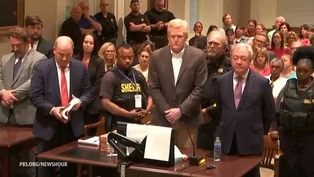
Court overturns Alex Murdaugh's double murder conviction
Video has Closed Captions
Why a court overturned Alex Murdaugh's double murder conviction (8m 13s)

The impact of Jason Collins, the first openly gay NBA player
Video has Closed Captions
Remembering the impact of Jason Collins, the NBA's first openly gay player (4m 41s)
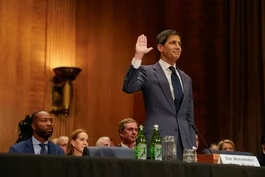
News Wrap: Senate confirms Warsh as new Fed chair
Video has Closed Captions
News Wrap: Senate confirms Kevin Warsh as new chair of Federal Reserve (5m 25s)
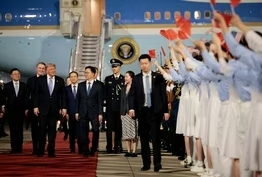
Trump arrives in China for talks on trade, Taiwan, Iran war
Video has Closed Captions
Trump arrives in China for high-stakes talks on trade, Taiwan and Iran war (8m 43s)

Uganda's refugee policy under strain as conflicts intensify
Video has Closed Captions
Uganda's open-door refugee policy under strain as regional conflicts intensify (9m 7s)
Providing Support for PBS.org
Learn Moreabout PBS online sponsorship New Episode
- News and Public Affairs

Today's top journalists discuss Washington's current political events and public affairs.
 New Episode
- News and Public Affairs

FRONTLINE is investigative journalism that questions, explains and changes our world.
Urban Consulate Presents
 New Episode
 New Episode
 New Episode
 New Episode
 New Episode
 New Episode
 New Episode
 New Episode
Support for PBS provided by:
Major corporate funding for the PBS News Hour is provided by BDO, BNSF, Consumer Cellular, American Cruise Lines, and Raymond James. Funding for the PBS NewsHour Weekend is provided by...