
May 15, 2026 - PBS News Hour full episode
5/15/2026 | 57m 46sVideo has Closed Captions
May 15, 2026 - PBS News Hour full episode
May 15, 2026 - PBS News Hour full episode
Problems playing video? | Closed Captioning Feedback
Problems playing video? | Closed Captioning Feedback
Major corporate funding for the PBS News Hour is provided by BDO, BNSF, Consumer Cellular, American Cruise Lines, and Raymond James. Funding for the PBS NewsHour Weekend is provided by...
May 15, 2026 - PBS News Hour full episode
5/15/2026 | 57m 46sVideo has Closed Captions
May 15, 2026 - PBS News Hour full episode
Problems playing video? | Closed Captioning Feedback
Where to Watch PBS News Hour
PBS News Hour is available to stream on pbs.org and the PBS app.
Providing Support for PBS.org
Learn Moreabout PBS online sponsorshipAMNA NAWAZ: Good evening.
I'm Amna Nawaz.
Geoff Bennett is away.
On the "NewsHour" tonight: President Trump's trip to China ends with few concrete deals, but many questions about Taiwan, trade and the future relationship of the two global powers.
Jerome Powell wraps up his tenure as chair of the Federal Reserve.
The legacy he leaves behind as President Trump's pick takes over.
And artificial intelligence supercharges financial scams targeting older Americans, costing seniors billions with hyper-realistic voice cloning.
JANE DEAN, Scam Victim: I've always protected myself and paid attention to red flags.
And when I was on the phone with the scammers, my red flags did not work.
(BREAK) AMNA NAWAZ: Welcome to the "News Hour."
Tonight, President Trump is returning to Washington after a summit with Chinese leader Xi Jinping.
The president announced China would buy hundreds of Boeing jets, and Beijing confirmed the two sides would launch a board of trade and investment.
But, beyond that, there are few specifics.
Nick Schifrin reports on the pageantry and the policy from Beijing.
NICK SCHIFRIN: Today in Beijing, Xi Jinping brought President Trump into the Communist Party's inner sanctum.
The president showed admiration for the grounds and his guide.
DONALD TRUMP, President of the United States: I like this place.
NICK SCHIFRIN: And a summit the president proclaimed would produce deals instead ended with few details, even fewer Chinese concessions, and an apparent U.S.
endorsement for what Xi Jinping called a new era of constructive strategic stability.
DONALD TRUMP: President Xi is an incredible guy.
NICK SCHIFRIN: But flying back on Air Force One, President Trump admitted that Xi pushed him on the single most contentious issue, U.S.
arms sales and support for Taiwan.
DONALD TRUMP: On Taiwan, he does not want to see a fight for independence, because that would be a very strong confrontation.
NICK SCHIFRIN: That an apparent reference to China's demand the U.S.
changed diplomatic language from "We don't support independence for Taiwan" to "We oppose independence for Taiwan," a change to which the president did not commit.
DONALD TRUMP: No, I didn't make -- I didn't make a comment on it.
I heard him out.
NICK SCHIFRIN: But President Trump also did not commit to approving $14 billion worth of arms sales to Taiwan that are already teed up.
DONALD TRUMP: I'm going to see.
I have to speak to the person that right now, as you know -- you know who he is -- that's running Taiwan.
NICK SCHIFRIN: China's leverage over the U.S.
increased dramatically last year when, in response to U.S.
tariffs, it withheld rare earth magnets that the U.S.
and the world need for everything from electric vehicles to fighter jets.
WU XINBO, Center For American Studies, Fudan University: China decided, well, enough is enough.
You can never satisfy him by making concessions.
NICK SCHIFRIN: Wu Xinbo directs the Center for American Studies at Fudan University in Shanghai.
He says China learned during the first Trump administration appeasement does not work.
WU XINBO: We need to fight back.
You have leverage.
I also have my leverage, which may be more powerful.
NICK SCHIFRIN: And as Beijing has acknowledged its own power and leverage, does that coincide with the belief that Beijing has that the United States is A diminishing power?
WU XINBO: In the past, maybe we look upon the U.S.
like this, oh, such a powerful country.
Today, maybe just like you and I, we look at each other even.
And from time to time, we think, OK, we are ahead of the United States in many regards already.
NICK SCHIFRIN: And he says Xi's most serious message was about Taiwan.
WU XINBO: If you do not accommodate my concern on Taiwan issue, you are not going to have a real strategic stability.
If you are going to sell weapons to Taiwan again, can you expect to get permission to visit Premier Xi in September?
NICK SCHIFRIN: So you think that, if that arms sale goes through, there will be no visit?
WU XINBO: Very difficult.
NICK SCHIFRIN: Beyond all the politics of this summit, we spoke to young Chinese here, and they say they value the leadership dialogue because they would like to see improved people-to-people connections and increased access to each other's societies.
Zhi Ming Chen is a Beijing-based TikTok influencer who posts online car reviews from all around the world.
So he gave me a ride in a brand-new Chinese electric XPeng P7.
ZHI MING CHEN, TikTok Influencer: OK, auto-drive.
NICK SCHIFRIN: Auto-drive?
ZHI MING CHEN: Yes, auto-drive.
You can feel many interesting functions in this car.
NICK SCHIFRIN: So I'm feeling a massage right now.
ZHI MING CHEN: Yes.
Yes.
Yes.
NICK SCHIFRIN: It feels pretty nice.
ZHI MING CHEN: Yes.
NICK SCHIFRIN: China is the world's E.V.
leader.
Today, 60 percent of all new Chinese car sales are electric.
ZHI MING CHEN: You can use this.
NICK SCHIFRIN: Now I can wash Trump and Xi.
ZHI MING CHEN: Yes.
Yes, yes, yes.
NICK SCHIFRIN: What would you like to see come out of the Xi Jinping meeting with President Trump?
ZHI MING CHEN: I think maybe someday we can drive our Chinese car, like E.V.
or some hybrid car, to the U.S.
NICK SCHIFRIN: And so there are some lawmakers who want to ban Chinese E.V.s from the United States.
What do you say to them?
ZHI MING CHEN (through translator): I think they haven't experienced how good Chinese electric cars are.
NICK SCHIFRIN: How's business?
YANG SHENG, A.I.
Entrepreneur: It's quite good.
NICK SCHIFRIN: Yang Sheng is an A.I.
entrepreneur who's also been an actor and a video game maker.
YANG SHENG: We want more and more conversation, because conversation makes people understand each other.
It can make the market bigger.
NICK SCHIFRIN: He says a high-level summit where two leaders both embrace -- quote -- "strategic stability" is exactly what young Chinese entrepreneurs want.
YANG SHENG: As a start-up, also a businessman, we want stable.
NICK SCHIFRIN: Stability.
YANG SHENG: Yes, stability.
NICK SCHIFRIN: That's what the leaders pledged.
But after years of rivalry, rapprochement could prove easier said than done.
For the "PBS News Hour," I'm Nick Schifrin in Beijing.
AMNA NAWAZ: From more perspective on the summit, we turn now to Nicholas Burns.
He served as U.S.
ambassador to China during the Biden administration.
He's now professor of the practice of diplomacy and international relations at Harvard University.
Ambassador Burns, welcome back to the "News Hour."
It's good to see you.
NICHOLAS BURNS, Former U.S.
Ambassador to China: Thank you, Amna.
AMNA NAWAZ: So let me ask you what we heard from Chinese state media, who have been reporting after the summit that Trump and Xi reached a new series of common understandings, a new vision of the U.S.-China relationship.
What are they saying here?
And is that good for the U.S.?
NICHOLAS BURNS: The Chinese want a strategic stability initiative, as they're calling it, with the United States.
It's really a set of -- as I understand it, of formal obligations of one to the other.
That could be a poison pill.
For instance, they might want to say to us, and I think they would, you can't criticize us in public because we have this formal stability relationship.
Well, of course, we can't abide that, given the enormous differences we have on issue after issue.
I was reassured that the Trump administration did not pick up on it.
You didn't hear President Trump or Secretary of State Rubio say that they were intrigued by it.
They have tried this in the past, Amna.
We have always turned them down.
AMNA NAWAZ: What about what we did hear from President Trump during this trip?
He was very upbeat about all the meetings.
He called them extremely positive, very productive.
He praised Xi Jinping quite a bit, called him a great leader, said repeatedly what an honor it was to be there and to be his friend.
What did you make of that approach?
NICHOLAS BURNS: It's understandable that President Trump wanted to be polite and civil.
He's visiting someone else's country.
That's -- I think all Americans would want him to be polite and civil.
But to effusively praise Xi Jinping as a great leader in positive terms and that he -- he, President Trump, will have a fantastic relationship with him, which is the word he used, I thought it was over the top.
And from Chinese ears, it sounded like President Trump was a supplicant and therefore in a weakened position in cultural terms.
And think about what President Trump was saying.
Xi Jinping is a great leader?
Xi Jinping is the leader who commanded these cyberattacks against the American grid and the American economy.
He's the leader whose military is trying to overtake our military in the Indo-Pacific.
He's also a major human rights violator.
So, frankly, I thought it was a mistake for President Trump to do this.
You didn't see Xi Jinping reciprocate that kind of elaborate, over-the-top praise for President Trump.
He stuck to his issues.
And I thought it made us look weak as a country and China look strong.
And that's not a good look for us.
AMNA NAWAZ: So, in concrete terms -- and, again, we don't have a lot of details yet, but, so far, what do you think was accomplished on this trip that is in the U.S.
interest?
NICHOLAS BURNS: I think there are several things.
First, it was very important that they met, because there were the two leading economies, two strongest militaries.
China is a top-down government.
Xi Jinping is the ultimate decision-maker for nearly everything.
And so our president has to have a good working relationship with him.
President Biden did, and now President Trump does.
So I thought that the effort that President Trump made to go there with his Cabinet, with the business delegation, made sense.
It makes sense to invite Xi Jinping back to the United States.
They want to take -- talk three or four times this year.
All that, good.
In addition, the Chinese have agreed to a major purchase of American agriculture.
China is the largest market for our farm and ranch community.
This is very important for soybean farmers, wheat farmers, pork products.
And so it should be a shot in the arm to our farm economy.
You announced -- or they announced this Boeing deal, where China will purchase at least 200 commercial airliners from Boeing, which is also important.
And what was little noted, Amna, but I think very important perhaps, was what President Trump said today, and Scott Bessent seconded it, that China apparently has agreed to have a set of conversations with us on artificial intelligence and the security implications of some of these powerful new A.I.
models, the Mythos model of Anthropic, for instance, which, in the wrong hands, a cyber terrorist group or a criminal group could be enormously damaging to the global economy.
It makes sense that we would talk to China about this.
And I thought all of those were accomplishments of this trip.
AMNA NAWAZ: Ambassador, the issue of U.S.
arms sales to Taiwan, you heard President Trump say that Xi Jinping pressed him on U.S.
support for Taiwan.
He said he wouldn't commit to it either way.
What do you take away from that?
NICHOLAS BURNS: I'm worried about it.
The Taiwan Relations Act, which is United States law, was passed in 1979 by Congress.
And it says that the United States government must provide defensive military technology to Taiwan to defend itself and build up its deterrence.
Every American president since 1979 has done so, and no American president has actually talked to the Chinese or debated or discussed with the Chinese whether we should do that.
President Trump today on Air Force One, when he gave his press conference, equivocated on this.
In fact, he left the impression that he might decide not to proceed with the arms sales.
I think that would overturn our entire policy towards Taiwan.
It would send a very, very negative message to our allies in the region, very close to Taiwan, Japan, the Philippines, South Korea.
It would make the United States look like we were backing away from our responsibilities.
Now, he hasn't said he will not sell, but he did leave that impression today.
I thought it was a really difficult conversation to understand at times on Air Force One.
But I'm worried that we might be backing away.
And I hope very much that the president will determine to go ahead with the arms sales.
Because Xi Jinping, Amna, his major message at the summit yesterday morning, was to try to intimidate the United States, that if you cross our red lines, he said, on Taiwan, that we will end up in a conflict.
We should not be intimidated or coerced by the Chinese president.
No prior president has.
AMNA NAWAZ: That is former U.S.
Ambassador to China Nicholas Burns.
Ambassador Burns, always great to speak with you.
Thank you for your time.
We start the day's other headlines in Colorado, where Governor Jared Polis says he is commuting the sentence of election denier Tina Peters.
The former mesa county clerk had served less than two years of her roughly nine-year sentence for her role in a plot to examine voting machines after the 2020 election.
Governor Polis, a Democrat, outlined his reasoning in a letter to Peters today, writing that -- quote - - "You deserve to spend time in prison for these offenses.
However, this is an extremely unusual and lengthy sentence for a first-time offender who committed nonviolent crimes."
President Trump has pressured Colorado's leaders to free Peters.
She's set to be released on parole on June 1.
The Justice Department announced the arrest of an Iraqi national accused of plotting at least 18 terror attacks in retaliation for the war in Iran.
Mohammad Baqer Saad Dawood al-Saadi appeared in a New York courtroom to face charges that he provided material support to Iranian-backed terrorist groups.
Officials say he and his associates were behind a shooting at a U.S.
Consulate in Toronto and the stabbing of two Jewish men in London, among others.
They say al-Saadi, seen here on the right, also sought to attack a New York synagogue last month.
Al-Saadi's lawyers say he's a political prisoner.
He was not legally required to enter a plea.
The Justice Department also said today it's seeking the death penalty for the man accused of killing two Israeli Embassy staff members in Washington, D.C., last year.
Elias Rodriguez faces federal hate crime and murder charges in the shooting deaths of Yaron Lischinsky and Sarah Milgrim as they left the Capital Jewish Museum after an event last may.
According to court documents, Rodriguez said shortly after the shooting -- quote -- "I did it for Palestine.
I did it for Gaza."
He's pleaded not guilty to all 13 counts against him.
Health officials in Gaza say Israeli strikes today killed at least seven Palestinians, including a child.
Israel says its attack targeted Hamas' top military chief there, Izz al-Din al-Haddad, though his fate is unclear.
Footage from our producer in Gaza shows the crowds and the chaos at the high-rise where the strikes hit.
Locals rushed to evacuate people, including many women and children.
Al-Haddad is the most senior Hamas official to be targeted by Israel since a cease-fire went into effect last October.
Separately, State Department officials say Israel and Lebanon have extended their ongoing cease-fire by another 45 days, following talks today in Washington, though both sides have accused the other of breaking that truce.
Africa's leading public health agency says an Ebola outbreak has killed at least 65 people in the Democratic Republic of Congo.
Officials say more than 240 suspected infections have been reported so far in the remote northeastern province of Ituri; 13 cases have already been confirmed.
The World Health Organization says it has a team there investigating the outbreak and a stockpile of vaccines ready to go, depending on what strain of Ebola this turns out to be.
DR.
MARIA VAN KERKHOVE, World Health Organization: We also have vaccines that can be prepositioned.
The DRC has experience with working with vaccines before.
So, as this outbreak unfolds, as more information becomes available, we are ready to provide those through mechanisms that already exist should it turn out to be a strain that can be a vaccine -- where a vaccine can be used.
AMNA NAWAZ: In a statement, African health officials say they hope to know soon which specific type of virus is spreading in Ituri.
Meantime, officials in neighboring Uganda say a Congolese man died after being admitted to a hospital there.
They say his case was -- quote -- "imported from Congo" and that Uganda has not yet confirmed any local infections.
Tennessee Congressman Steve Cohen is ending his bid for reelection and says his state's redistricting effort is the reason.
REP.
STEVE COHEN (D-TN): I don't want to quit.
I'm not a quitter.
But these districts were drawn to beat me.
They were drawn to defeat me.
AMNA NAWAZ: The 76-year-old Democrat told reporters today that it was -- quote -- "the most difficult moment I have had as an elected official," but added that he would reconsider if Tennessee reverses course on its new map.
Cohen has represented his Memphis-based district for about two decades.
Tennessee was the first state to pass new congressional districts after the U.S.
Supreme Court largely gutted the Voting Rights Act last month.
Republicans in Louisiana, Alabama, and South Carolina have taken similar steps.
President Trump announced plans for a sculpture garden honoring prominent Americans in Washington, D.C.
's West Potomac Park.
The area is located along the Potomac River, near the Lincoln Memorial and not far from the National Mall.
It's also home to several fields and volleyball courts.
In a social media post, the president said the National Garden of American Heroes would feature statues of -- quote -- "our illustrious founding fathers, military warriors, religious leaders, and more."
But there are questions about whether the project would need congressional approval, given that the area is on federal land.
A judge in New York declared a mistrial today in a case against Harvey Weinstein that has already gone to trial three times.
The jury was deadlocked on whether the disgraced former Hollywood mogul raped actress and hair stylist Jessica Mann in a New York hotel room in 2013.
His lawyers had argued that the encounter was consensual.
Weinstein's been convicted of other sex crimes and remains behind bars.
A hearing is scheduled for next month, when prosecutors are expected to confirm whether they will seek a fourth trial.
On Wall Street today, stocks pulled back from their recent highs.
The Dow Jones industrial average dropped more than 500 points on the day.
The Nasdaq lost 400 points, or more than 1.5 percent.
The S&P 500 also closed sharply lower to end the week.
Still to come on the "News Hour": Louisiana's Republican Senate primary is the latest test of President Trump's grip on the GOP; David Brooks and Jonathan Capehart weigh in on the president's China summit; and artificial intelligence supercharges financial scams targeting older Americans.
Jerome Powell's eight-year role as chair of the Federal Reserve ends today.
His term will be remembered as one of the most turbulent and politically charged in the Central Bank's history.
Kevin Warsh will take the helm in the coming days.
William Brangham looks at Powell's impact.
WILLIAM BRANGHAM: Amna, it is hard to think of a Fed chair who has been more maligned by the president who nominated him.
Jerome Powell has been routinely insulted, threatened repeatedly that he be fired, and was the target of a federal investigation seemingly ordered by the president.
But Jay Powell steered the Federal Reserve and the U.S.
economy through major events, most recently the war in Iran.
During the pandemic, he helped prevent a financial crisis.
But Powell's critics argue some of his interventions were too costly and that he didn't respond quickly enough to inflation and may have even helped fuel it.
So, for more on Powell's legacy, we are joined by Jason Furman.
He teaches economic policy at the Harvard Kennedy School and was former chairman of the Council of Economic Advisers in the Obama administration.
Jason, thank you so much for being back on the "News Hour."
Today's Jerome Powell's last day as Fed chair, though he will stay on at the board.
You recently wrote a piece in The New York Times lauding his tenure, largely.
How should history judge his tenure?
JASON FURMAN, Former Chair, White House Council of Economic Advisers: First of all, for any normal Fed chair history is mostly going to remember, to the degree they remember anything, what happened to variables like inflation and unemployment.
In Powell's case, that's an important part of it and we can talk more about it.
But the main thing that's going to be in the history book is that he is the person who stood up to the most intense bullying the Fed has ever experienced and left the Fed even stronger and more independent and more credible than it was when he walked in the building eight years ago because it survived that test.
WILLIAM BRANGHAM: Yes, Jay Powell has endured an incredible barrage of insults from the president, including being called an enemy of the United States.
Does that -- so that independence, in your view, stands above all else in his record?
JASON FURMAN: Yes, absolutely.
You should understand, economists have studied independent central banks for decades, and they're the closest thing macro economists have to a free lunch, where you can get lower unemployment without any tradeoff in the long run in terms of higher inflation or anything else.
You get better unemployment, better inflation, better outcomes.
It's the closest thing we have to a free lunch.
Countries that have violated the independence of their central bank have seen some really terrible outcomes.
We have seen it all around the world.
And so, for me as an economist, that is the most important thing, not any day-to-day decision, but are you protecting the institution?
And he's done a superb job of that.
WILLIAM BRANGHAM: During the pandemic, as I mentioned, he aggressively slashed interest rates.
He cut bank regulations.
He supported the PPP loan program.
And then, post-pandemic, he raised rates to avoid a very deep recession.
Some do argue that he really was too slow responding to inflation.
I'm going to play a little bit of sound from Michael Strain, who's an economist at the conservative AEI.
And he admires a lot of Powell's tenure for what you said, but he says this on inflation: MICHAEL STRAIN, American Enterprise Institute: The $1.9 trillion Biden stimulus package was signed into law in March of 2021.
That led to a pretty immediate increase in the rate of inflation.
The Fed waited for 12 months to raise rates, 12 months of inflation coming in above target.
And the Fed only acted to raise rates when CPI inflation hit 8 percent.
And so I think the Fed was too slow.
The Fed misunderstood the nature of inflation.
The Fed misunderstood the strength in the economy.
WILLIAM BRANGHAM: Too slow, misunderstood the rate of the economy.
What's your reaction to that?
JASON FURMAN: Let me react to that.
But let me just first go off of the first part of your question.
We forget that we didn't have a financial crisis after COVID.
We almost take that for granted.
That took enormous amounts of effort, creativity, and being ahead of the curve.
And it was so effective that we didn't have a problem, so we almost forget to thank the people, of which Jay Powell was a very important one who made that possible.
Then, absolutely, I do agree with Michael Strain that the Fed was too late in raising rates.
They spent too long talking about how inflation was transitory.
And that was sort of a -- to my mind, a black-and-white error.
They were completely wrong.
I'm not sure how important it was how wrong they were.
Most of the inflation came from other sources, both the fiscal expansion and the supply shocks.
If they'd raised rates six months earlier, we would have had most of that inflation anyway.
So it was definitely a bright line error, just not necessarily a quantitatively large one.
And then there's the third part of the story, which is how quickly they corrected that error.
And part of why I appreciate that so much is, I was out there saying, you need to raise rates, maybe even raise them by 50 basis points over the course of this year, half-a-percentage point.
They ended up doing 75 basis points per meeting for four meetings in a row.
They did an enormous aggressive effort to clean up their mistake that was actually more aggressive than what any other critics, including me, and I think even including Michael Strain, had recommended.
WILLIAM BRANGHAM: Now, Kevin Warsh takes over the job of Fed chair.
He will have the same issue, certainly, that -- of President Trump wanting him to do his bidding with regards to interest rates.
How do you see that playing out?
JASON FURMAN: Kevin Warsh has a hard job ahead of him.
Economically, it's a hard job because, with the Iran war, we have surging inflation, but we also have more concerns about slowing economic growth.
And then compounding that, you have a president who will continue to put his pressure on the Fed.
I'm cautiously optimistic that Warsh has both the economic and the political skills to navigate this minefield, that he correctly understands that the Fed needs to make its operational decisions independently, that he does not want history thinking he's the person who gave into pressure, nor does he want the whole committee voting against him because the committee thinks that he's just doing the bidding of Donald Trump, rather than what the economy needs.
So, cautiously, I'm hopeful about what will happen under Warsh, but I will be watching closely because the things he needed to do to get the job are not something that you ever really want to see happen in this process.
WILLIAM BRANGHAM: Jason Furman of the Harvard Kennedy School, thank you so much for being here.
JASON FURMAN: Thanks for having me.
AMNA NAWAZ: Tomorrow, Louisiana primary voters could oust a sitting U.S.
senator for the first time in nearly 100 years.
Backing the insurgency against Senator Bill Cassidy is President Donald Trump.
The pair have been at political odds since Cassidy voted to convict Trump in his second impeachment trial more than five years ago.
Liz Landers looks into the tight three-way race likely to be decided by the president's popularity.
LIZ LANDERS: Days before a critical primary election, voters in Louisiana were tucking into steaming plates at a crawfish boil in Lafayette.
WOMAN: Thank you for your role in the community.
LIZ LANDERS: The Southern state finds itself in one of the most heated Republican Senate primaries this campaign cycle.
NARRATOR: Bill Cassidy, he turned his back on us.
NARRATOR: John Fleming wants a taxpayer-funded bus system to bring illegals into our communities.
NARRATOR: She got rich trading stocks that have business before her committee.
LIZ LANDERS: Incumbent U.S.
Senator Bill Cassidy is fighting for his political life, challenged by both Congresswoman Julia Letlow and former Congressman and Trump White House aide John Fleming.
All three candidates have embraced Trump, but Trump has embraced only Letlow.
DONALD TRUMP, President of the United States: Well, I'm thrilled to give my complete and total endorsement to your next United States senator from Louisiana, Julia Letlow.
LIZ LANDERS: Who did you vote for and why?
KYLE HEASLIP, Republican Voter: I voted for Letlow.
I do stand behind Trump stands for as far as where we need to go in the direction of this country.
So I do like his endorsements.
LIZ LANDERS: There's still no clear leader in the race, despite Trump's endorsement, popularity in the state, and social media broadsides against Cassidy, writing in a recent post: "Hopefully, all the great Republican people of Louisiana will be voting Bill Cassidy out of office."
How big of a factor is President Trump in this race?
Why didn't his endorsement skyrocket Julia Letlow's campaign?
JIM ENGSTER, Host, "Talk Louisiana": He has helped her.
The question is how much, because she started late and she has taken a strategy of running a stealth campaign, with a few exceptions, and that's a risky maneuver.
LIZ LANDERS: Louisiana radio talk show host Jim Engster has covered Pelican State politics for decades.
He says the endorsement carries even greater weight because there's so little separating the candidates on policy.
Even so, Engster's callers have had plenty to say about the state of the race.
JIM ENGSTER: Craig in Natchitoches.
Craig, you're on.
CALLER: What if Cassidy somehow, some way, wins the Republican primary?
LIZ LANDERS: Cassidy's cardinal sin in Trump's eyes?
He voted to convict President Trump following his second impeachment trial, concluding the president spurred on the January 6 attempts to forcefully overturn the results of the 2020 election.
Here's how Cassidy explained his vote at the time: SEN.
BILL CASSIDY (R-LA): I took an oath to support and defend the Constitution.
I take that seriously.
Everything I considered pointed towards not putting one person above the Constitution.
LIZ LANDERS: More recently, Cassidy has been a reliable vote for Trump.
He provided critical votes of approval for many Trump nominees, including Health and Human Services Secretary Robert F. Kennedy Jr.
SEN.
BILL CASSIDY: There's multiple studies establishing the safety of measles and hepatitis B vaccine.
LIZ LANDERS: Though the physician has also had some high-profile clashes with Kennedy over vaccine safety.
JIM ENGSTER: In this state, if you're a Republican, you're not going to buck the president because it would be political suicide.
And Bill Cassidy, who did it once, has learned the hard way that it's hard to walk that back.
LIZ LANDERS: As Cassidy does try to walk it back, he's also trying to win support from Democratic voters after the state did away with the nonpartisan free-for-all, replaced by a GOP primary where only Republicans or those without a party can vote.
But Democrats we met at the polls say it's not worth making the switch.
ERIC JOHNSON, Democratic Voter: I feel like it really is six in one hand, half-a-dozen in the other.
I mean, pick the lesser of two evils.
LIZ LANDERS: Governor Jeff Landry led the move to close the primary process here, which some think was designed to kneecap Cassidy's reelection chances.
WILL KELLNER, Republican Voter: Like, you're going to want to pinch it like that.
LIZ LANDERS: OK.
WILL KELLNER: And then you can do it.
Had you done it like you... LIZ LANDERS: Back at the boil and over a tray full of crawfish, Will Kellner says his top voting issue is separation of powers and not federalizing every issue.
He sees national politics looming over the Senate primary.
Who are you leaning towards?
WILL KELLNER: I think having somebody like Cassidy, who's got some experience in his committee assignments and institutional knowledge, is important.
LIZ LANDERS: How much does Trump's endorsement matter in this primary?
WILL KELLNER: I think a lot here in South Louisiana and across the South.
His voice still matters.
LIZ LANDERS: But the night's cook, a crawfish farmer in Louisiana, Jake Mouton, who spent the evening serving up his Cajun meals at the crawfish boil, told us that he's still undecided on who he will vote for.
But he says Cassidy's vote to convict in the impeachment trial matters.
Have you voted for Cassidy in the past?
JAKE MOUTON, Republican Voter: Yes.
LIZ LANDERS: Why did you vote for him in the past and why are you maybe not sure now?
JAKE MOUTON: He resonated with people from Louisiana.
And he's still that candidate.
But at the same time, I feel like there's always a newcomer and somebody that could maybe freshen things up.
JIM ENGSTER: This is Jim Engster, and welcome to "Talk Louisiana."
LIZ LANDERS: Engster says, on the issues, the three competitive candidates don't differ much, but there are style points that may determine how the race goes and margin matters.
If any candidate receives 50 percent support, they can avoid a primary run-off late next month.
Cassidy has tried to brand Julia Letlow as liberal Letlow.
NARRATOR: You can't trust liberal Julia Letlow.
LIZ LANDERS: Is that sticking here?
JIM ENGSTER: I think he has defined her to some extent.
And if it were a head-up race between the two of them, it might have mattered.
But he's got John Fleming.
And he of the three was considered the one least likely to win, but now he is in position where I think any one of the three could win and likely any two of the three could be in a run-off.
LIZ LANDERS: Looming in the background of this Senate race are the delayed U.S.
House primaries in Louisiana.
Those were suspended when Governor Landry declared a state of emergency after the Supreme Court told Louisiana to redraw their -- quote -- "unconstitutional maps."
Senator Cassidy is even reminding voters that the Senate primary hasn't changed.
NARRATOR: Election Day is still May 16.
LIZ LANDERS: Those House primaries haven't been rescheduled yet, so it's possible whichever candidate doesn't make the run-off would have the option to run in another race.
For the "PBS News Hour," I'm Liz Landers in Baton Rouge, Louisiana.
AMNA NAWAZ: At the end of this week that included President Trump's trip to China, let's turn now to the analysis of Brooks and Capehart.
That's "The Atlantic"'s David Brooks and Jonathan Capehart of MS NOW.
Great to see you both.
JONATHAN CAPEHART: Hey, Amna.
DAVID BROOKS: Great to see you.
AMNA NAWAZ: Let's start with the president's trip.
He's now returned from China.
The visit, most analysis seems to show, big on pageantry, kind of short on concrete deals.
And, David, we did see the president talk earlier about the fact that Taiwan came up with Xi Jinping, that he was pressed about it, about the U.S.
arms sales in particular, and he said he wouldn't commit either way.
That worries a lot of U.S.
analysts looking at this.
How did you look at that?
DAVID BROOKS: Yes, I thought the summit was a net positive.
First, the phrase everybody was using was stability.
And if you're going to have two world superpowers that are sort of enemies and friends at the same time, stability is a good thing, compared to the melodrama we have had over the last year.
The second thing, as far as we know, Trump did not make concessions on advanced technology that would allow China to compete on A.I.
And I was a little worried about that.
So that seems to be good news.
Now, on to the worry side.
The first is Taiwan, as Nick Burns said earlier in the program, a little waffling there from President Trump about giving the arms -- doing the arms deal with Taiwan and, even rhetorically, a little, like, ambiguity, which didn't radiate strength.
Second, decoupling.
We really are decoupling our economies, and that's been happening over the last two presidencies.
And that's necessary.
We can't be so reliant on China.
And if we can get goods made in Vietnam, that's better than goods made in China.
And are we reversing that?
He sent this big delegation.
Are we reversing the decoupling effort, which I think is necessary?
And then the third worry is the long-term picture.
Both sides used stability.
What Xi Jinping means by stability is you, Americans, you're in the toilet, you're going down, we're going to outlast you, and we're going to take over.
What we mean by stability is, you Chinese think we're going down, but we're rearming, we're rebuilding, we're decoupling, and we're going to be a stronger adversary.
So we still have completely opposite pictures of what the future is going to look like.
But, on the whole, the fact that there's no drama, that we're not about to go to war with each other, I will take that as a plus.
AMNA NAWAZ: Jonathan, how do you look at it?
JONATHAN CAPEHART: I was asked earlier, did the summit do more harm than good or no harm at all or less harm?
And it didn't do more harm, but it didn't do any good.
I mean, I take all of your points, David.
But, to me, as an American watching the American president go to Beijing, and then hearing the way the president has been talking about it, particularly this notion -- I cannot pronounce the name of the Greek philosopher that the Chinese president mentioned, the... DAVID BROOKS: Thucydides Trap.
AMNA NAWAZ: Thucydides.
JONATHAN CAPEHART: Thucydides, yes.
That was a little -- that was some high-class shade of the Chinese president to -- of the American president standing right there, to your point about Xi Jinping feeling that China is ascendant, especially with an American president who has looked at the world in spheres.
Trump wants the Western Hemisphere.
He seems to be perfectly fine with China exerting its influence in the Pacific, which is why, to my mind, his waffling on Taiwan is very troubling.
I mean, I'm old enough to remember when there were some sacrosanct beliefs of the American president.
We were there for Europe's defense and strong a proponent of NATO.
That is now not so certain, and also that the United States would stand by Taiwan, rhetorically so far, never had to do it militarily.
But it doesn't seem like that that is the case, if the American president isn't willing to say, yes, that -- the $49 billion worth of arms, yes, we're down with that.
We're still going to go for that.
And he did not do that.
If I were the Taiwanese leader, I would be very worried.
AMNA NAWAZ: I should say, despite what the president said, Senator Marco -- or Secretary Marco Rubio said that the U.S.
policy has not changed.
So we will have to see how this all plays out in real terms.
But I do want to ask about what happened here in Washington last night, House Republicans once again narrowly rejected a war powers resolution.
This was related, of course, to the U.S.
and Israeli war in Iran.
It was the first vote that they have taken since that crossed the 60-day legal deadline that requires Congress to authorize force.
And, of course, the White House argues that the cease-fire stopped that clock.
But there were three Republicans who voted with Democrats this time to lead it to a tie, which means it didn't pass.
Those three Republicans were Thomas Massie of Kentucky, Brian Fitzpatrick of Pennsylvania and Tom Barrett of Michigan.
Jared Golden was the lone Democrat to oppose it.
Jonathan, I will start with you.
What did those Republican votes at this point in time say to you?
JONATHAN CAPEHART: It says to me that the president's hold on the Republican Conference might be weakening with Republicans, that these Republicans -- well, Thomas Massie has always been like a permanent no against the president.
But these are folks who have been back in their home districts, and this is their first week back since being away.
They're hearing from their constituents, who are probably not happy about the United States being in a war, but also the impacts of those -- of the war on the economy.
These are folks who are driving their -- seeing their gas prices through the roof.
So I would like to think that they're reflecting their constituents' anger back at home.
And if there is another vote, we will know if that is indeed the case if those three Republicans are joined by more Republicans.
AMNA NAWAZ: Massie, we should point out, is also facing this Republican -- his election on Tuesday as well.
JONATHAN CAPEHART: Right.
AMNA NAWAZ: David, go ahead.
DAVID BROOKS: Yes, I mean, I am clearly -- inflation's at 3.8 now.
So that's up.
Clearly, the people who supported the war are beaming to waiver.
The people who opposed the war are like, yes, we were right.
And so that's just the vibe, and that's just the reality.
As for the War Powers Act I'm old, and the War Powers Act has been invoked, as far as I know, three times in my lifetime.
Well, it was created in the '70s.
I was still a little kiddie.
(LAUGHTER) DAVID BROOKS: But I think it was the two Iraq wars and Afghanistan... AMNA NAWAZ: Yes.
DAVID BROOKS: ... is the only time Congress -- and all presidents have said, no, I'm not going to Congress.
And, sometimes, it's because they stopped the war at 60 days, but sometimes they just run over Congress.
And I wish there would be a War Powers Act.
I wish that -- because we would have had a national debate about this.
AMNA NAWAZ: Yes.
DAVID BROOKS: And we would have to make the case for why this was a good thing or not a good thing.
It would have really helped President Trump to have that debate.
But having Congress at this stage, when Trump is clearly trying to get out, to pull the rug out from him, I think that would be harmful to the U.S.
negotiating position.
JONATHAN CAPEHART: One way we could have that debate you're talking about is to -- is for Senator Murkowski of Alaska to follow through on her, not so much a threat, But to offer an authorization for the use of military force.
You have that conversation about what the president can and can't do, how long it should last.
And at least Congress then would at least try to establish some guardrails, but I haven't heard anything whether that's even going anywhere.
AMNA NAWAZ: Well, clearly, the economic pressure is at play when it comes to how lawmakers are looking at this.
Related to that, I'm sure you heard earlier in the week, before he left for China, the president was asked about how much he's taking into account Americans' financial concerns right now when it comes to the policy in Iran.
Take a listen to how he answered.
DONALD TRUMP, President of the United States: Not even a little bit.
The only thing that matters when I'm talking about Iran, they can't have a nuclear weapon.
I don't think about Americans' financial situation.
I don't think about anybody.
I think about one thing.
We cannot let Iran have a nuclear weapon.
That's all.
AMNA NAWAZ: David, do you think he regrets saying that?
DAVID BROOKS: I'm trying to think of his staff when he said that.
(LAUGHTER) DAVID BROOKS: And then I'm trying to think of the Democratic ad makers.
Woo!
(LAUGHTER) DAVID BROOKS: And so he clearly shouldn't have said it.
But I understand why he said it.
He's trying to send a signal to Iran that I'm not soft here.
I'm not on the ropes here.
But if you're going to try to intimidate us, it's not going to work.
I assume that was in his mind.
But the actual words that came out of his mouth were impolitic.
To tell the American people, I don't really care about your economic circumstance, not a thing too many presidents or politicians say.
So it was a stupid comment, but I sort of understand why he made it.
AMNA NAWAZ: I mean, to be fair, it did make it into Democratic attack ads within like an hour after it hit the airwaves.
(LAUGHTER) AMNA NAWAZ: Jonathan?
JONATHAN CAPEHART: But maybe the president actually does feel that way.
I mean, how else to explain launching a war with Iran and discounting the generals' warnings that they could cut off the Strait of Hormuz and all the consequences that would cascade from that?
That's why no other president has tried to do anything like this.
So, to my mind, President Trump said the not-so-quiet part out loud for everyone to hear.
And I haven't heard him try to backtrack from that at all.
It's really -- it's highly insensitive to say that when people are suffering with gas that's approaching $5 a gallon.
AMNA NAWAZ: We have mere seconds left.
I will ask for a quick sentence from each of you in terms of what you're looking for when it comes to the new Fed chair, who's already been confirmed, will soon be sworn in, Kevin Warsh.
What do you think?
DAVID BROOKS: Armor, suits of armor for Christmas.
(LAUGHTER) DAVID BROOKS: Just on Jay Powell, I thought we were going to have a recession when he tried to pull that inflation down, and we did not.
AMNA NAWAZ: Yes.
DAVID BROOKS: That's a remarkable achievement.
AMNA NAWAZ: Jonathan.
JONATHAN CAPEHART: We will see if Chairman Warsh has the same intestinal fortitude to resist the president's demands when it goes against economic sense.
AMNA NAWAZ: He has a tough job ahead.
We will be watching.
Jonathan Capehart, David Brooks, great to see you both.
Thank you.
JONATHAN CAPEHART: Thanks, Amna.
Well, if it feels like it's getting harder and harder to avoid being scammed, that's because it is.
As our dependence on technology grows, so do scammers' efforts to take advantage of us.
It can be through your cell phone, your laptop, misleading Web sites, and now, in the age of A.I., impersonations that can sound very real.
Seniors are often the target.
Paul Solman reports on the problem and what you can do to protect yourself.
PAUL SOLMAN: It came clear out of the blue.
JANE DEAN, Scam Victim: My scam started in the evening with a phone call from Amazon.
Someone is trying to purchase a MacBook and they're using your name, your account number, and also your bank account number.
PAUL SOLMAN: Was 72-year-old Jane Dean suspicious?
JANE DEAN: My normal rational, logical mind was subsumed by the anxiety and the panic that I was feeling.
PAUL SOLMAN: So she followed the instructions.
JANE DEAN: They transferred me to their fraud department and they said, oh, OK, well, then we need to transfer you to the Social Security Administration.
PAUL SOLMAN: That last guy was the scammer, to whom she actually sent $26,000, was about to send another 30 when her local bank manager smelled a rat, searched the address online and showed it to her.
JANE DEAN: It's an empty house at a new homes construction site and he said, you are being scammed.
PAUL SOLMAN: So was Dean unusually unwarned, unarmed?
JANE DEAN: I have always protected myself and paid attention to red flags.
And when I was on the phone with the scammers, my red flags did not work.
PAUL SOLMAN: She'd simply panicked, like so many have.
Fraudsters bilked Americans out of an estimated $200 billion in 2024, and A.I.
may make that a lowball number.
KATHY STOKES, AARP: I think of it as the Industrial Revolution for fraud criminals.
PAUL SOLMAN: Kathy Stokes runs fraud protection at AARP.
KATHY STOKES: It just ups their game so much.
They can scale.
They can perfect.
And when we can't tell fact from fiction, it's a pretty bad place to be in.
PAUL SOLMAN: AARP focuses on seniors, of course, more likely than most to be gulled into what it calls going under the ether, but old folks at home aren't the only ones.
KATHY STOKES: It doesn't just happen to older people because they have some cognitive decline, maybe they're not tech-savvy.
If that was the case, we wouldn't have seen year in and year out more younger adults reporting fraud losses than older adults.
PAUL SOLMAN: And, hey, who hasn't been barraged with scam calls, scam texts?
I get at least a dozen a week.
SCAM CALL: Our records indicate you have been earmarked for a reserved offer for a personal loan in the range of $50,000.
KATHY STOKES: If your number was out there for a scammer to call you, it's out there on other lists.
Scary thing is, even if you pick up the phone because you're like, I know it's a scammer, so I'm just going to waste their time, the longer you're on the phone with them, the hotter your phone number is, and so they can get more money when they sell it.
PAUL SOLMAN: So we bought a cheapo burner phone to check out the daily loan offer.
SCAM CALL: The team that would handle that is currently unavailable to assist at the moment.
PAUL SOLMAN: And again and again.
SCAM CALL: All of our agents are currently unavailable to take your call.
PAUL SOLMAN: Yes, they weren't taking calls from numbers not on their target list.
And then there's this daily plague.
SCAM CALL: My name is Lilliana Castillo with the Special Resolution Unit.
I have been checking through some files that got flagged before the 2026 IRS deadline and yours is still showing a few unresolved items.
PAUL SOLMAN: These folks did pick up the burner callback.
Lilliana wasn't there.
SCAM CALL: The reason of the call is, we're checking an individual if they have an federal IRS tax debt.
PAUL SOLMAN: You don't know if I owe any money to the IRS?
You're just asking me if I owe?
SCAM CALL: Yes.
PAUL SOLMAN: So it seems a phishing mission for folks who actually owe taxes.
I reset my cell phone, not in my contacts, straight to voice-mail.
KATHY STOKES: I think that it's really good if you have a message instead of answering it.
But don't think that that's the end of it.
PAUL SOLMAN: Nope, because some still ring.
And now I'm getting e-mail invites supposedly from folks I know.
Advice, don't open.
AENEA VANNONI, Red-Button: The complexity of attacks has increased significantly with A.I.
PAUL SOLMAN: Cybersecurity pro Aenea Vannoni.
AENEA VANNONI: Before, it was a one-to-one ratio, one person for one scam.
Now it is one person for hundreds, if not thousands of scams.
PAUL SOLMAN: So what's a target supposed to do?
Like the joke about guys chased by a bear, don't outrun it, just those running with you.
Vannoni uses a different analogy.
AENEA VANNONI: They're not trying to attack the Pentagon.
They're walking down the street and seeing which bike doesn't have a lock on it.
And you need to be someone who has that lock on it.
PAUL SOLMAN: Vannoni does have three suggestions, though.
One, create a verbal family password.
AENEA VANNONI: Finding keywords that you share with those that you trust, if you're on a call with someone and you think that there's something suspicious going on, you can drop it in conversation in a way that doesn't arouse suspicion.
And then, if they don't respond likewise or they don't uphold their end of that code, then you know that you're being scammed.
PAUL SOLMAN: Two, for anything suspect: AENEA VANNONI: You're getting a call from a friend or even someone at your local bank, you hang up, you call them back on their legitimate number, and you make sure that what you were hearing is the truth.
PAUL SOLMAN: Like this call, supposedly from me, to a fictional grandchild.
FAKE SCAM CALL CREATED BY AENEA VANNONI: Hey, Jackie.
Sorry.
It's your grandmother.
She's just been hit by a car, and we've got to go to the hospital.
PAUL SOLMAN: Vannoni created it in 10 minutes for free from my voice online.
FAKE SCAM CALL CREATED BY AENEA VANNONI: Jackie, I need you to send me your bank details.
Oh, crap, I have to go.
Love you.
PAUL SOLMAN: Think of what he could have done with more time and a little money.
OK, protection three, your software.
AENEA VANNONI: Make sure everything is updated.
I'm not going to come here and say that you should have state-of-the-art cybersecurity software, but the bare minimum to significantly decrease the likelihood that you will be attacked is update everything when it needs to be updated.
KAREN COURINGTON, Google: We take scams really seriously, and we know that bad actors are getting more targeted in their approach.
PAUL SOLMAN: Karen Courington runs Consumer trust and safety at Google.
KAREN COURINGTON: That's why we take that detection and we try to improve with our A.I.-powered defenses.
Gmail is using A.I.-powered defenses to detect and block 99.9 percent of spam, phishing and malware e-mails before they ever reach people.
PAUL SOLMAN: Google has partnered with AARP, other tech companies, banks and governments to share data and scam trends to frustrate the fraudsters.
It is a kind of eternal cat-and-mouse game, right?
KAREN COURINGTON: As tactics evolve, as we see new adversarial tactics, we are always trying to stay ahead of the scammers.
PAUL SOLMAN: Do you or people at Google ever have any misgivings about promoting, developing A.I., which has the side effect of helping scammers figure out how to scam?
KAREN COURINGTON: With any new technology, we know that A.I.
can be used for good and important breakthroughs like in health care and medicine, as well as for bad, like in more and different complex scams.
Our mission is to use our technology to stay one step ahead and keep the Internet safe for everyone.
PAUL SOLMAN: But the mission of the scam squad, stay one step ahead of the thwarters with ever more tools at their disposal.
Nonetheless, says AARP's Kathy Stokes: KATHY STOKES: I think that one of the most hopeful things right now is that this issue is getting so much more attention than it ever has.
PAUL SOLMAN: Thanks to folks like Jane Dean.
JANE DEAN: I look around the room and I say, someone in this room right now is either being scammed or has been scammed in the past, but is too ashamed to share with anyone what has happened to them.
And you can't go through this alone.
You have got to talk to someone.
PAUL SOLMAN: And think before you act.
So she ends her talk with a jolt meant to scare the audience straight.
JANE DEAN: Stop!
PAUL SOLMAN: Sound counsel, no matter what scams the future may hold.
For the "PBS News Hour," Paul Solman.
AMNA NAWAZ: Well, be sure to tune into "Washington Week With the Atlantic" later tonight right here on PBS.
Moderator Jeffrey Goldberg and his panel look at the unresolved issues between the U.S.
and China after President Trump and Xi's high-profile summit.
And we hope you will watch "Horizons" this weekend.
William Brangham explores the water crisis facing the 40 million Americans who depend on the Colorado River.
And on this week's episode of "Compass Points," Nick Schifrin speaks with historian Simon Morrison about Moscow's complicated history.
You can check out "Horizons" and "Compass Points" on our YouTube channel, wherever you get your podcasts, or on your PBS station.
Check your local listings.
And that is the "News Hour" for tonight.
I'm Amna Nawaz.
On behalf of the entire "News Hour" team, thank you for joining us.
Have a great weekend.
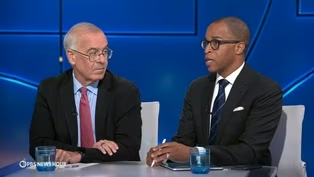
Brooks and Capehart on Trump's trip to China
Video has Closed Captions
Brooks and Capehart on Trump's trip to China (10m 12s)
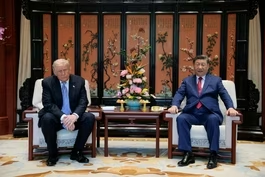
Ex-ambassador: Trump's praise of Xi made U.S. look weak
Video has Closed Captions
Trump's 'elaborate' praise of Xi at China summit made U.S. look weak, ex-ambassador says (6m 26s)

How to recognize and block AI-powered scam attempts
Video has Closed Captions
How to recognize and block AI-powered scam attempts (8m 51s)
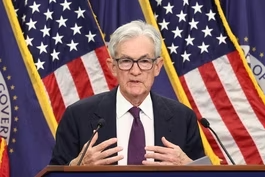
Jerome Powell's impact and legacy at the Federal Reserve
Video has Closed Captions
Jerome Powell's impact and legacy at the Federal Reserve (7m 44s)

News Wrap: Colorado governor commuting Tina Peters' sentence
Video has Closed Captions
News Wrap: Colorado Gov. Polis commuting sentence of Tina Peters (6m 33s)
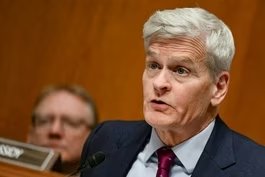
Primary challenge to Sen. Cassidy tests Trump's grip on GOP
Video has Closed Captions
Primary challenge to Louisiana Sen. Cassidy tests Trump's grip on GOP (6m 56s)
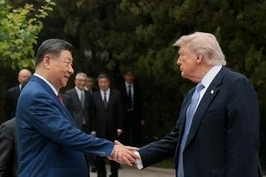
Trump, Xi tout strategic stability but key questions remain
Video has Closed Captions
Trump and Xi pledge 'strategic stability' but key questions remain unanswered (5m 9s)
Providing Support for PBS.org
Learn Moreabout PBS online sponsorship New Episode
- News and Public Affairs

Today's top journalists discuss Washington's current political events and public affairs.
 New Episode
- News and Public Affairs

FRONTLINE is investigative journalism that questions, explains and changes our world.
Urban Consulate Presents
 New Episode
 New Episode
 New Episode
 New Episode

 New Episode
 New Episode
 New Episode
 New Episode
Support for PBS provided by:
Major corporate funding for the PBS News Hour is provided by BDO, BNSF, Consumer Cellular, American Cruise Lines, and Raymond James. Funding for the PBS NewsHour Weekend is provided by...