
Police cameras help solve crimes, but spark privacy debate
Clip: 7/15/2026 | 7m 13sVideo has Closed Captions
Police say Flock cameras help solve crimes, but critics call them an invasion of privacy
Law enforcement agencies in the U.S. use AI-powered cameras to scan billions of vehicles each month, often without drivers ever realizing. Supporters say the technology is a tool for solving crimes. But critics warn it's creating a nationwide surveillance network, raising urgent questions about how much privacy Americans are willing to sacrifice in the name of safety. Paul Solman reports.
Problems playing video? | Closed Captioning Feedback
Problems playing video? | Closed Captioning Feedback
Major corporate funding for the PBS News Hour is provided by BDO, BNSF, Consumer Cellular, American Cruise Lines, and Raymond James. Funding for the PBS NewsHour Weekend is provided by...
Police cameras help solve crimes, but spark privacy debate
Clip: 7/15/2026 | 7m 13sVideo has Closed Captions
Law enforcement agencies in the U.S. use AI-powered cameras to scan billions of vehicles each month, often without drivers ever realizing. Supporters say the technology is a tool for solving crimes. But critics warn it's creating a nationwide surveillance network, raising urgent questions about how much privacy Americans are willing to sacrifice in the name of safety. Paul Solman reports.
Problems playing video? | Closed Captioning Feedback
Where to Watch PBS News Hour
PBS News Hour is available to stream on pbs.org and the PBS app.
Providing Support for PBS.org
Learn Moreabout PBS online sponsorshipGEOFF BENNETT: Law enforcement agencies across the country use A.I.-powered cameras to scan billions of vehicles each month, often without drivers even knowing they're being recorded.
Supporters say the technology helps solve crimes.
Critics warn its rapid expansion is creating a nationwide surveillance network, raising questions about the balance between public safety and personal privacy.
Paul Solman dives into that debate.
PAUL SOLMAN: A quiet Saturday afternoon last September.
Denver resident Chrisanna Elser gets an alert from her doorbell camera.
A nearby Columbine Valley police officer has come calling.
MAN: Do you know why I'm here?
CHRISANNA ELSER, Denver Resident: No.
MAN: Ok CHRISANNA ELSER: He pulled out a picture of my truck and accused me of stealing a package.
MAN: We have cameras everywhere in that town.
You can't get a breath of fresh air in or out without us knowing.
PAUL SOLMAN: Police-operated cameras had recorded her driving near the scene of the crime.
Only problem, she had nothing to do with it.
CHRISANNA ELSER: They caught me 20 times driving through the neighborhood that we drive through to go to work every day.
PAUL SOLMAN: Police had simply matched their video with doorbell footage of the theft, showing a blot, like Elser.
CHRISANNA ELSER: Well, can I see this video?
MAN: If you go to court, you can.
If you're going to deny it, I'm not going to extend you any courtesy.
If you're going to lie to me, I am not going to extend you any courtesy.
CHRISANNA ELSER: It was shocking to have somebody come in so strong and rely on the digital evidence.
PAUL SOLMAN: Small black cameras mounted on utility poles began appearing around the neighborhood in 2024.
But, so what, says Elser.
CHRISANNA ELSER: I took the stance that everybody else takes that, eh, big deal, it's up there.
If I'm not doing anything wrong, then why am I worried about it?
PAUL SOLMAN: Turns out these cameras extend far beyond Denver.
Today, more than 100,000 are installed across all 50 states, according to crowdsourced data from anti-surveillance organizations, the vast majority owned by security tech company Flock Safety.
NARRATOR: Let's shape a safer future together.
JOSH THOMAS, Flock Safety: We build hardware and software that helps cities solve crime.
PAUL SOLMAN: Flock's Josh Thomas says they make other devices to detect gunshots, for instance, but- JOSH THOMAS: Our bread and butter product is a license plate reader.
We are pinpoint-focused on the back of a vehicle to identify the make model color, the license plate, the state of the license plate.
PAUL SOLMAN: Time stamps, locations.
But Flock's A.I.-powered cameras also record bumper stickers, dents to match against local and national law enforcement hot lists.
JOSH THOMAS: So when there's a wanted person, an outstanding warrant, a hit-and-run, a missing person, they will add those license plates to the list.
So, in real time, if one of those vehicles drives by a Flock Safety device, we will send an alert to local law enforcement.
PAUL SOLMAN: The data is also stored on a searchable cloud database for 30 days.
And so misuse can happen, as with Chrisanna Elser, among others documented in local reporting.
But it's rare, says Thomas.
What's far more common, he says, the technology helps solve crimes.
JOSH THOMAS: They're helping solve somewhere between 800,000 to a million crimes every calendar year.
So, roughly about 20 to 25 percent of all reported crime in America is being solved in some way or another with Flock technology.
TODD CHAMBERLAIN, Aurora, Colorado, Police Chief: You can always take the stories of the worst-case scenario, but what's unfortunately and doesn't seem to get hit a lot are the stories of the best-case scenario.
PAUL SOLMAN: Todd Chamberlain, chief of police in Aurora, Colorado.
TODD CHAMBERLAIN: And there are some stories where lives have been changed through the use of this technology.
PAUL SOLMAN: As in Denver last December.
TODD CHAMBERLAIN: A woman had put her child, a 14-month-old baby, into her vehicle.
She had her car idling.
Somebody came along, saw an opportunity to steal that car, and that mother was basically left watching her car drive away with her 14-month-old baby in it.
PAUL SOLMAN: Flock tracked the car, reunited mother and child.
WOMAN: Thank you guys so much.
TODD CHAMBERLAIN: Without that Flock technology, we might not have found that for two or three days later.
That technology saved that 14-month-old baby's life.
PAUL SOLMAN: So, on balance, technology for the good?
Well, Chrisanna Elser, for one, might disagree.
And Flock allows search data to be shared with police nationwide, potentially tracking Chrisanna Elsers anywhere.
JOSEPH COX, 404 Media: When you have a national database of these cameras that can be queried by law enforcement without a warrant, that qualitatively shifts something about the surveillance.
PAUL SOLMAN: Joseph Cox is a journalist with 404 Media.
JOSEPH COX: This isn't a small beat local police officer just looking into local crimes necessarily.
You can have an officer on the other side of the country search for vehicles on the other side of the country as well.
PAUL SOLMAN: On behalf of ICE, for example.
JOSEPH COX: And that has clearly worried a lot of people who are now having a conversation about, do we actually want these cameras in our community?
BENN JORDAN, YouTuber: A few weeks ago, using a commercial search engine, I very easily found the administration interfaces for dozens of Flock Safety cameras.
PAUL SOLMAN: And last December, YouTuber Benn Jordan gained access to over 60 Flock video feeds in cities across the country.
JOSEPH COX: All this is relying on is knowing where exactly to look.
And with that, we were able to see just how powerful some of these cameras are.
PAUL SOLMAN: But Flock's Thomas says the leak was caused by cameras mistakenly configured to be public-facing, rather than private feeds.
JOSH THOMAS: We have hundreds of thousands of sensors out in the world.
A very, very small number had a public-facing I.P.
address.
He did find those.
And the second we found those, within 48 hours, all of those were changed.
PAUL SOLMAN: Which is either reassuring or not.
WOMAN: There are YouTube videos that can teach you how to hack these cameras.
PAUL SOLMAN: Meanwhile, opposition is growing.
MAN: If this camera sees, you will be put on a database alongside every other law-abiding resident of the city.
WOMAN: We are asking for the Flock contract to be terminated in full.
PAUL SOLMAN: In the past year, dozens of cities have canceled contracts following public backlash.
And Flock now says it's willing to talk about how its tech should be regulated.
JOSH THOMAS: There's kind of no denying that it has clear benefits to cities.
But the question, I think, is a very real one, which is, what's the trade-off we're making in society?
Are we comfortable with that level of trade-off?
And I think those are fair questions to ask.
PAUL SOLMAN: Back in Denver, Chrisanna Elser parried the charges against her with surveillance tech of her own.
CHRISANNA ELSER: I gave them a Google map of where I was.
I gave them the video from my truck that showed where I drove, gave them the video of the business I was at.
PAUL SOLMAN: She spent real money on tech defense.
Why?
CHRISANNA ELSER: That there's digital evidence out there that somebody has of you, you should have your own digital evidence.
PAUL SOLMAN: You mean this is like "Spy vs.
Spy" or... CHRISANNA ELSER: Well, it was all kind of like, what do I have in my arsenal to prove myself innocent?
PAUL SOLMAN: Her own digital evidence ultimately cleared her, which is why she suggests that you, me, and everyone should have an arsenal of our own.
But that's assuming, of course, that we can afford it.
For the "PBS News Hour," Paul Solman.
 New
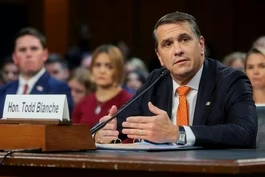
NewBlanche questioned on Jan. 6 cases and Epstein files
Video has Closed Captions
Senators question Blanche on Trump loyalty, Jan. 6 cases and Epstein files (5m 19s)
 New
NewDaniel Umemezie on using his words to bridge worlds
Video has Closed Captions
National Youth Poet Laureate Daniel Umemezie on using his words to bridge worlds (6m 32s)
 New
NewLawmakers push to make daylight saving time permanent
Video has Closed Captions
What to know about the latest push to make daylight saving time permanent (5m 27s)
 New
NewNews Wrap: Trump ends pause on ICE traffic stops
Video has Closed Captions
News Wrap: Trump ends pause on ICE traffic stops (5m 57s)
 New
NewSubpoenas over NYT report raise press freedom concerns
Video has Closed Captions
Subpoenas over New York Times report on Air Force One raise press freedom concerns (5m 57s)
 New
NewTrump's DNI nominee refuses to say who won 2020 election
Video has Closed Captions
Trump's intelligence nominee refuses to say who won 2020 election (8m 9s)
 New
NewWhy fewer Americans are reading for pleasure
Video has Closed Captions
'Post-literate age': Why fewer Americans are reading for pleasure (7m 47s)
Providing Support for PBS.org
Learn Moreabout PBS online sponsorship
- News and Public Affairs

FRONTLINE is investigative journalism that questions, explains and changes our world.
 New Episode
- News and Public Affairs

Today's top journalists discuss Washington's current political events and public affairs.
Urban Consulate Presents


 New Episode
 New Episode

 New Episode
 New Episode

Support for PBS provided by:
Major corporate funding for the PBS News Hour is provided by BDO, BNSF, Consumer Cellular, American Cruise Lines, and Raymond James. Funding for the PBS NewsHour Weekend is provided by...