
What El-Sayed's primary win means for Democrats in November
Clip: 8/5/2026 | 6m 44sVideo has Closed Captions
What El-Sayed's primary win means for Democrats in November
A progressive who has never held elected office defeated an establishment-backed congresswoman in Michigan's Democratic Senate primary. Abdul El-Sayed defeated Haley Stevens in a race that exposed divisions within the party. He will face Republican Mike Rogers in November's general election. Geoff Bennett discussed the results and more with Democratic strategist Lis Smith.
Problems playing video? | Closed Captioning Feedback
Problems playing video? | Closed Captioning Feedback
Major corporate funding for the PBS News Hour is provided by BDO, BNSF, Consumer Cellular, American Cruise Lines, and Raymond James. Funding for the PBS NewsHour Weekend is provided by...
What El-Sayed's primary win means for Democrats in November
Clip: 8/5/2026 | 6m 44sVideo has Closed Captions
A progressive who has never held elected office defeated an establishment-backed congresswoman in Michigan's Democratic Senate primary. Abdul El-Sayed defeated Haley Stevens in a race that exposed divisions within the party. He will face Republican Mike Rogers in November's general election. Geoff Bennett discussed the results and more with Democratic strategist Lis Smith.
Problems playing video? | Closed Captioning Feedback
Where to Watch PBS News Hour
PBS News Hour is available to stream on pbs.org and the PBS app.
Providing Support for PBS.org
Learn Moreabout PBS online sponsorshipAMNA NAWAZ: Welcome to the "News Hour."
We begin tonight in Michigan, where a progressive who has never held elected office defeated an establishment-backed congresswoman in the Democratic primary for U.S.
Senate.
GEOFF BENNETT: Abdul El-Sayed won the Democratic nomination, defeating moderate Haley Stevens in a closer-than-expected race that exposed divisions within the party.
Outside groups poured more than $60 million into advertising, backing Stevens, making it one of the most expensive primaries in the country.
El-Sayed made that spending a central issue throughout his campaign, casting it as a symbol of outside influence.
And he returned to it in his victory speech today.
ABDUL EL-SAYED (D), Michigan Senatorial Candidate: What we showed is that the power of our many is greater than the power of their money.
What we showed is that if you're willing to build a movement brick by brick, if you're willing to go and travel your state and have the conversations in rooms big and small, starting in moments when people aren't even paying attention to an election, but are paying attention to the price of gas and the price of groceries and the price of housing and the price of health care, that you can build a conversation that builds into a movement that defeats Goliath.
GEOFF BENNETT: El-Sayed will face off against Republican nominee Mike Rogers in the fall.
To discuss those results and more, we turn now to Democratic strategist Lis Smith.
She worked for the campaign of another Democrat, Mallory McMorrow, who dropped out of the race last month.
Lis, it's always great to see you.
So let's start with the headline here.
El-Sayed, he faced a nearly 9-1 spending advantage held by his rival.
He was opposed by the sitting governor, popular Governor Whitmer, and he embraced many positions that until recently Democrats considered politically toxic, and yet he wins this Senate primary in a swing state.
What's the lesson from that?
LIS SMITH, Democratic Strategist: I think what it tells us is less maybe about the ideology and more about the mood of where Democrats are.
After the 2024 election, Democrats are pretty angry at the establishment.
They're pretty angry about what happened with Joe Biden, and they're really angry that we lost to Donald Trump a second time.
And they want something different.
And that was what Abdul El-Sayed was offering in this race.
And as much as we can talk about it as a victory for El-Sayed, I think we need to look at it as a massive loss for the establishment that, as you said, went in with over $65 million in spending on Haley Stevens' behalf, tried to win ON the field for her, and picked her out because she had the traditional political biography, had been in Congress for a long time, could raise a lot of corporate cash, had all the right insider connections.
Twenty years ago, that type of candidate may well have won this primary.
In this environment, it was the exact wrong resume.
GEOFF BENNETT: And El-Sayed, he also made U.S.
policy toward Israel and the role of outside spending, particularly by AIPAC, a defining issue in this race.
How much of his victory reflects Democratic views on the war in Gaza and U.S.
support for Israel?
LIS SMITH: That was definitely a big part of it.
And 10 years ago, where Haley Stevens stood on the -- stands on the issue of Israel, which is giving them unconditional aid, was the standard position for people in the Democratic Party.
But, today, where Abdul El-Sayed is, saying we should not be giving a blank check to Netanyahu's government -- you know, he calls it a genocide.
A lot of -- not everyone does.
But I think where he stands on this issue is much closer to where the median Democratic voter stands.
But another thing I would say is, yes, he went out and he attacked AIPAC regularly.
But, in some ways, in a lot of these Democratic primaries, an attack on AIPAC isn't really just a foreign policy conversation.
It signals that you are willing to take on powerful interests.
You are willing to take on the big money that can get behind sort of corporate establishment Democrats and establish your independence.
And that was a key part of his message too.
GEOFF BENNETT: How can a message that won a Democratic primary also build the broader coalition needed to bring in independents and swing voters in November?
LIS SMITH: Well, Geoff, that's the million-dollar question.
And that is the hard work that Abdul El-Sayed needs to start today, because I watched that campaign, and I would have loved to have seen him close it on a broader note, a more conciliatory note.
But, instead, at the end, he was still really running a very far leftist campaign, inviting far left members of the Democratic Party media in to campaign for him.
And that's going to have to change between now and November.
Because the reality is this.
Michigan's a purple state.
And so he's going to have to figure out, how do I build the tent?
And I will just say some of his tone in this campaign has been my way or the highway.
You're either with me or you're bought off.
And I just don't think that's going to work if you want to win people over.
GEOFF BENNETT: And big picture, we should say that, yes, progressives scored notable victories last night, but elsewhere you have establishment-backed candidates prevailing, like Wesley Bell's win over Cori Bush in Missouri.
So, taken together, what do what do all of these victories say about where the Democratic Party is headed?
LIS SMITH: What it says is that the Democratic Party is in the middle of a post-2024 reckoning.
Call it an identity crisis.
Call it an interparty debate.
And I think we're trying to figure out, do we move on ideology?
How hard do we fight?
How do we talk about the role of money in our party, corporate money, the millions of dollars that organizations like AIPAC are funding?
And how do I view the establishment and the leadership of our party?
Democratic voters have said post-2024 that the Democratic leadership is too old, they are out of touch, and we want new leaders, and we want new leadership.
And so I think all of these right now are questions that are being litigated in this election.
And we will have a better idea about all of these things after November.
GEOFF BENNETT: Democratic strategist Lis Smith, always good to see you.
Thanks for making time for us.
LIS SMITH: Yes, thank you for having me, Geoff.
 New
NewHow new ovarian cancer findings may help reduce risk
Video has Closed Captions
How new findings on ovarian cancer origins may help reduce risk (6m 45s)
 New
NewNews Wrap: Senate confirms Erica Schwartz as CDC director
Video has Closed Captions
News Wrap: Senate confirms Dr. Erica Schwartz as CDC director (6m 5s)
 New
NewRetired Army colonel explains Patriot missile capabilities
Video has Closed Captions
Retired Army colonel explains why Patriot missiles are so valuable and in short supply (6m 25s)
 New
NewRussian attacks expose weakness in Ukraine's air defense
Video has Closed Captions
Russian missile attacks on Kyiv expose weakness in Ukraine's air defense (3m 33s)
 New
NewTennessee secretary of state on redistricting, low turnout
Video has Closed Captions
Tennessee secretary of state on redistricting, election security and low voter turnout (7m 14s)
 New
NewWhat scientists can learn from debris crashing into the moon
Video has Closed Captions
What scientists are learning after SpaceX debris crashed into the moon (5m 7s)
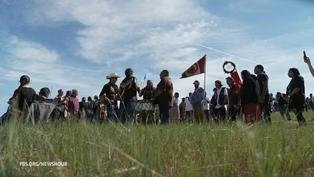 New
NewWhy the Battle of the Little Bighorn still resonates today
Video has Closed Captions
How the Battle of the Little Bighorn reshaped U.S. policy toward Native Americans (10m 9s)
Providing Support for PBS.org
Learn Moreabout PBS online sponsorship New Episode
- News and Public Affairs

Today's top journalists discuss Washington's current political events and public affairs.

- News and Public Affairs

FRONTLINE is investigative journalism that questions, explains and changes our world.
Urban Consulate Presents


 New Episode
 New Episode
 New Episode
 New Episode

 New Season
Support for PBS provided by:
Major corporate funding for the PBS News Hour is provided by BDO, BNSF, Consumer Cellular, American Cruise Lines, and Raymond James. Funding for the PBS NewsHour Weekend is provided by...