
Washington Week with The Atlantic full episode, 6/5/26
6/5/2026 | 26m 46sVideo has Closed Captions
Full Washington Week with the Atlantic broadcast from June 5, 2026.
Full Washington Week with the Atlantic broadcast from June 5, 2026.
Problems playing video? | Closed Captioning Feedback
Problems playing video? | Closed Captioning Feedback
Major funding for “Washington Week with The Atlantic” is provided by Consumer Cellular, Otsuka, Kaiser Permanente, the Yuen Foundation, and the Corporation for Public Broadcasting.
Washington Week with The Atlantic full episode, 6/5/26
6/5/2026 | 26m 46sVideo has Closed Captions
Full Washington Week with the Atlantic broadcast from June 5, 2026.
Problems playing video? | Closed Captioning Feedback
Where to Watch Washington Week with The Atlantic
Washington Week with The Atlantic is available to stream on pbs.org and the PBS app.
Buy Now
10 big stories Washington Week covered
Washington Week came on the air February 23, 1967. In the 50 years that followed, we covered a lot of history-making events. Read up on 10 of the biggest stories Washington Week covered in its first 50 years.Providing Support for PBS.org
Learn Moreabout PBS online sponsorshipJeffrey Goldberg: President Trump's successful campaign to end the Congressional careers of Republicans he deems insufficiently loyal may be backfiring.
These lawmakers now comprise the so-called YOLO caucus, happy, even eager, to defy Trump and vote against his legislative agenda, and they're going to be in Congress for another six months.
Tonight, is the president losing his grip over the Republican-controlled Senate?
That, plus the latest on Nazi tattoos, next.
Jeffrey Goldberg: Good evening, and welcome to Washington Week.
So, back in the day, Newt Gingrich understood something that Donald Trump doesn't understand.
Gingrich's speakership was short and tumultuous and ultimately unsuccessful, but he knew that there was more than one flavor of Republican Congress, and so he famously gave moderate and progressive Republicans some running room and some forgiveness when they disagreed with him.
But President Trump values only loyalty, and Senators Thom Tillis, Bill Cassidy, and John Cornyn apparently didn't give him enough of that.
Now, they're on the way out of the Senate, and they owe nothing, less than nothing, really, to the president, already they've been showing signs of defiance.
Joining me tonight to discuss this and more, Stephen Hayes, the CEO and editor of The Dispatch, Annie Linskey is a White House reporter at The Wall Street Journal, Michael Scherer is a staff writer and a White House correspondent at The Atlantic, makes you sound very busy, and Nancy Youssef is a staff writer and a Pentagon correspondent at The Atlantic, also very busy.
Thank you all for joining me.
We're going to do -- this is going to be like one of those Jeopardy potpourri rounds.
It's going to be a lot of stuff.
So we're going to get to a lot of stuff tonight.
Steve, let's start with you.
The president got his immigration bill through, but he's having more and more trouble keeping Republican senators in line.
What gives?
Stephen Hayes, Editor, The Dispatch: Well, I mean, the first point that has to be made, and that we've discussed on this very show many times, this is not new frustration with Donald Trump.
It's emerging frustration with Donald Trump.
Like a lot of these Republicans who are now voicing their frustration and willing to speak out have been frustrated with him behind the scenes, in some cases, for a decade.
They're now just more willing to talk about it.
I think there are two primary reasons.
One, they're deeply offended by Trump's choice to endorse Ken Paxton in Texas over John Cornyn.
They like John Cornyn.
They raised money for John Cornyn.
They've known him for years, and they think he was going to win.
They're worried about Ken Paxton.
They know that it makes it less likely that Republicans will keep the Senate, because that money is going to be flowing to other states.
It's going to be sucked to Texas instead of flowing to other states.
And then the second thing is he's asking them to publicly defend more and more preposterous things.
This -- you know, whether it's the ballroom and the changing of funding in the ballroom, firing the parliamentarian, whether it's the slush fund, $1.776 billion of a slush fund that they know was going to go, at least in part, to the people who attacked the Capitol and tried to attack them on January 6th.
Nobody wants to defend that.
They're sick of it.
They're done.
So, between those two things, I think they're sort of, let's go, let's talk about it.
Jeffrey Goldberg: Yes, but what is done?
I mean, Annie what does done look like in the next six months?
How far do these YOLO guys go?
Annie Linskey, White House reporter, The Wall Street Journal: Yes.
Well, one thing I will say is one major thing that changed is three of those members, three of those Republicans that have suddenly become quite eager to voice publicly and vote against the president in some cases, have been pushed out by the president.
Jeffrey Goldberg: Right.
Annie Linskey: And that's a group that, you know, some people are in D.C.
call the YOLO caucus.
It turns out in the Senate, they call themselves the Wounded Bear caucus because -- Jeffrey Goldberg: Dangerous, wounded bear is very dangerous.
Annie Linskey: A wounded bear is very dangerous.
Jeffrey Goldberg: I call them the Janis Joplin -- Annie Linskey: Oh, okay.
Jeffrey Goldberg: -- caucus.
Freedom's just another word for nothing left to lose.
Annie Linskey: Oh, I love it.
Jeffrey Goldberg: Thank you very much.
Thank you.
Annie Linskey: But they have -- you know, the next six months, they have the ability to make life difficult for Donald Trump, particularly around his nominations.
I mean, he may want to replace some cabinet members.
In fact, he has wanted to replace some cabinet members.
And they suddenly have a sort of more -- they can be a little more demanding in what they want from the president.
Jeffrey Goldberg: Right.
What else can they do, Michael?
Michael Scherer, Staffer Writer, The Atlantic: When the president put out his budget this year for 2027, there was $10 billion for the Interior Department for D.C.
beautification, $10 billion with a B. When the House just referred the bill up, the appropriators, they had zero for that.
I mean, there's a lot of spending stuff that's going to be happening.
And like we saw with the fund for the Justice Department, I think Cassidy and Cornyn know the Senate, they know the rules.
We haven't mentioned Mitch McConnell, who's on his way out.
He knows it better than anybody else.
Jeffrey Goldberg: He's a permanent YOLO now.
Michael Scherer: Right.
We have Susan Collins, we have Lisa Murkowski, we have Rand Paul on foreign policy.
I mean, like it's a big group, and we're talking about a Senate with just a very small margin.
And then we haven't talked about the House.
The House had a vote this week where four Republicans broke with the president, basically a symbolic vote saying that he needs an authorization for use of force in Iran if he wants to go back to fighting that war.
But I think it's breaking down in the House as well.
And the amazing -- if you talk to Senate Republican leaders, they will just be amazed at how unforced this error was.
You know, he didn't need to put himself with this sort of premature lame duck status at this point in his presidency.
Jeffrey Goldberg: Right.
Well, that's the point about giving people a little bit of room to maneuver, but that's not -- I mean, you both cover this guy every day.
I mean, that's not his move.
Absolute loyalty is the move, right?
Annie Linskey: Right.
I mean, he has held a grudge against Cornyn for quite a while now.
And, you know, he had signaled that he was going to endorse Cornyn.
I think that's what makes it so much more difficult for Cornyn's colleagues is it -- the signal was there that Cornyn was going to have the endorsement.
Jeffrey Goldberg: Right.
Annie Linskey: And then for Trump to go ahead and go with Paxton was just this big sort of nuclear bomb that went off in this Senate, which still is collegial, and that that caused just this, you know, heart breaking for days and days.
Jeffrey Goldberg: Right.
Stephen Hayes: And it's not just those YOLO members as well.
I mean, you know, John Thune, who's not going to ever go nuclear the way that Thom Tillis, for instance, did, has made very clear that he's not happy with some of the things the president has done in his very understated way, like, oh, I'm just learning about this, this is new to me, I don't understand what the purpose of the slush fund was, or Tom Cotton, when he was asked about this nomination of Bill Pulte to be the acting director of the National Intelligence, Cotton, who's chairman of the Intelligence Committee, said, I have no observations on this matter.
Jeffrey Goldberg: Right.
Stephen Hayes: He didn't say a lot.
He didn't need to go sort of nuclear, but he made very clear what he thinks.
Jeffrey Goldberg: Yes.
Nancy?
Nancy Youssef, Staff Writer, The Atlantic: I think it's notable, though, on the Paxton support that came after it was clear that he was going to win, and a signal of Trump trying to show his continued influence on the party even though the race was already going the way it ended up going.
So, it's interesting that he's both affecting his -- Jeffrey Goldberg: Were you 100 percent sure that Paxton was going to win without that endorsement?
Nancy Youssef: I don't -- I think it was going -- yes.
(CROSSTALKS) Jeffrey Goldberg: So, you're just saying he was just getting on the winning horse?
Nancy Youssef: Well, I just think it's interesting that he's both sort of creating these fissures within his party, and at the same time, trying to show that he has influence anytime he can leverage that sort of message, whether it's actually affecting the outcome of the elections or not.
Annie Linskey: But, ultimately, it means Republicans are going to have to defend, you know, Paxton, and that is what Republicans -- some Republican strategists are calling it like, a $100 million mistake.
Like they will have to put a lot of money into this.
Jeffrey Goldberg: Yes, right, right.
Nancy, go back to the point being made earlier on the war powers.
How does this loosening of loyalty affect the Iran war and whatever, Cuba, Greenland, whatever he's planning in the near future?
Nancy Youssef: Well, Michael's right.
The vote itself was largely symbolic, but it comes at a time when the president is trying to negotiate with Iran, has really struggled to reach a deal.
And the idea that we're starting to see fissures within his own party, I think, potentially gives Iran some leverage in terms of pushing for a deal that is more favorable to them.
What's been interesting throughout this is that we've seen the president really toggle between trying to end this war as quickly as possible and also get some wide-reaching, headline-grabbing outcome out of it.
And so if you're the Iranians and you're seeing these splits start to happen within the president's own party, they might see that as an opportunity to push for things, like greater control over the straits or greater economic relief.
Jeffrey Goldberg: Right.
Annie, before I jump to Iran, because I want to talk about the current status of the war, not that anybody understands the current status of the war, but we're going to try.
Annie, I just wanted to ask you very quickly, what does a Trump presidency look like if the House does go Democratic or the Senate goes Democratic?
Annie Linskey: We've talked about this too, this idea of Democrats having a subpoena cannon ready to go.
I mean, those subpoenas and the investigations are coming if the Democrats win.
I mean, my sense is they are drafted, and there's a very clear target list for Democrats.
So, it becomes a very different Washington for Trump.
He's had two years of being in full control, and he's going to have much nastier legal fights, and so are his allies, which also makes things harder.
Jeffrey Goldberg: Right.
Let's go to the war, and I want you to watch what the president had to say about the new supreme leader of Iran.
Reporter: And we've heard you want to meet with the new ayatollah, the new supreme leader.
Donald Trump, U.S.
President: I don't want to meet, but if I did meet, I'd be honored to meet him.
I'd like to see if we make a deal.
But if we make a deal, it's possible that I would meet him.
I'd be okay with it.
I would say I'm not his favorite person.
But with that being said, he's probably a -- I don't know him.
He's probably a professional.
In some circles, he has a very good reputation actually, you know?
Sometimes people say bad, but a lot of people say bad about me.
It's totally false, of course.
Jeffrey Goldberg: My first question is, in what circles does Ayatollah Mojtaba Khamenei have a good reputation?
Like your bowling league, PTA, I don't even -- I can't -- so, Nancy, make that make sense.
Nancy Youssef: I'll try.
I mean, remember that that this was someone he called a lightweight, someone whose father he killed, someone whose family members he killed, someone whose country he invaded and said his regime and that of his father needed to fall, and that the U.S.
was ready to do anything to make that happen.
Putting that all aside, I actually think that these kinds of comments hurt the U.S.
in their negotiating because again, what it's signaling that the U.S.
really wants a deal.
And so at a time when the Iranians are closing the strait and can sustain that for months, while the U.S., it's much harder to keep that strait closed.
It creates a ticking time bomb in terms of the impact on the global economy.
Jeffrey Goldberg: Right.
Nancy Youssef: So, I think it hurts the deal itself that they're trying to reach, and also it goes against the stated objectives of this war and what Israel wanted to see out of this war the U.S.
partner during the invasion and the attacks itself.
Jeffrey Goldberg: All right.
Steve, you and I have covered Middle East wars for 30 years.
These latest round of comments from the president strike me as a kind of -- a guy who walks into a car dealership and says I'm not leaving here without a car, and the salesmen are like, great, yes, super, We could do that.
I mean, where is this heading?
And has he turned America's allies in the Middle East, not just Israel, but UAE and other Gulf allies, into kind of suckers here?
Stephen Hayes: I mean, I'm glad you asked me where this is heading because I know exactly and I'm prepared here to tell you exactly where this is going.
Jeffrey Goldberg: If we had commercials, I would say, after the commercial break, Steve is going to tell us how the war ends.
Stephen Hayes: Nice tease.
You're a T.V.
pro.
Jeffrey Goldberg: Yes.
Stephen Hayes: Look, I don't have a clue where this is heading.
I mean, I think part of the problem is the president will say one thing one day and he'll say something entirely different the next day.
You know, earlier this week, he said that he couldn't care less about the negotiations at all.
He was bored of them.
He didn't care where they were going.
He was sort of done with it.
And then he had this, you know, blow up with Benjamin Netanyahu because he believes that Israel is threatening the success of the negotiation.
So, on two different days, he's saying two completely different things, and that, I think, is basically what we're seeing with his approach to the entire war.
I mean, we're waging a war that he said today wasn't really a war.
We're engaged in a ceasefire that's not actually a ceasefire.
We wanted regime change.
We haven't changed the regime, and now he wants to meet with the leader of the new regime, which is basically the same as the old regime.
Jeffrey Goldberg: Who's the wounded son of the previous leader.
Stephen Hayes: Yes.
I mean, it's just incoherence all around.
And we can try to make sense of it, but we're probably better off saying, you know what?
It's just incoherence.
Jeffrey Goldberg: Yes.
Let's talk about this Netanyahu-Trump relationship because the one thing that -- and, Nancy, you know this, the Middle East correspondent, one thing an Israeli prime minister up for re-election can't be seen as is a sucker in his population.
And it seems like Trump is yelling at Netanyahu now in a way that -- Nancy Youssef: That he did, yes.
Jeffrey Goldberg: -- no -- I mean, he confirmed it in a way that no previous president ever spoke to Netanyahu, and he's been around for a long time, obviously.
What do you make of where this relationship is going, and how does this actually affect Netanyahu's own standing in his own country?
Nancy Youssef: Well, as you know, the Israeli parliament dissolved itself in preparation for elections, so we know that they're coming up soon in a matter of weeks.
And Netanyahu now finds himself in a position stuck between an American ally that wants to see this war end quickly and an Israeli population that wants to see resolution in these various Iranian-backed factions posing a threat to him.
And so he's stuck in between.
And I think you've seen in the polls in Israel itself the waning support.
It's one of the reasons the parliament was dissolved.
And so it is again another reason where I think it makes negotiations harder when you have this seemingly strong alliance being fractured over how to end the war that they had started together with such lofty aims.
Jeffrey Goldberg: Michael, I mean, Netanyahu put all of his chips on Trump.
He kind of -- maybe the Democrats were leaving the Israel cause behind anyway, but he accelerated that.
Where does this -- where do you think this heads?
Michael Scherer: Well, I think in the short-term it gives Iran more leverage, because this is one of Iran's goals, to split these two powers away from each other.
So, why make a deal now?
I mean, if you've got the leader of Israel and the leader of the United States fighting with each other over what's going on every day in Lebanon, like why make a deal?
This is a perfect situation for them to draw out.
Netanyahu's been on thin ice with American administrations for, what, a decade?
I mean, like -- Jeffrey Goldberg: More.
Michael Scherer: Yes, more.
I mean, like he has upset every president I've covered.
And even before this Iran invasion, you know, I was talking to White House officials who were constantly complaining about the bad behavior of Netanyahu.
And so he was always walking this fine line.
And I think, you know, he's a survivor.
I don't know what's going to happen, and I don't know Israeli politics very well.
But I think, you know, it's safe to say that like the bipartisan unity behind supporting the U.S.
relationship with Israel that has reigned for decades in the United States is basically reset now.
And I don't see in the short-term a clear path for it to be rebuilt, definitely in the Democratic Party, and I think increasingly in the Republican Party.
Jeffrey Goldberg: Before we get to Maine oyster farming, I want to ask you, Nancy, one more question about the Iran war.
Stockpiles of key weapons and munitions are very low.
Iran is a third tier adversary of the United States.
How does this look right now to the rest of the world?
Nancy Youssef: Well, it looks like that we are not the force that can go after multiple threats in Asia and Europe and the Middle East at the same time.
For example, Ukraine is asking for more ammunition, saying, we desperately need more, and the U.S.
can't provide them, can't give them a sort of guarantee of what we're going to provide.
The munitions that the U.S.
dispensed during the war will take years to replace and billions of dollars.
They shot down drones that were thousands of dollars and take days or weeks to build.
And that disparity is why the U.S.
finds itself sort of limited in what it can do in terms of really being a power that can stand by allies and on multiple parts of the world.
And so it's a real problem.
And I think a factor in the president's inability or unwillingness to go back and do more strikes because the threats are not just to the munition stockpiles that we have, but for Gulf allies who have taken the brunt of Iran's response to U.S.
strikes.
Jeffrey Goldberg: We'll talk about that in future shows obviously.
I want to go to Maine.
Graham Platner, putative Democratic nominee for Senate, has 99 problems.
Yes, let's start with one of them.
Here he is with Chris Hayes talking about the small issue of the Nazi tattoo.
Let's watch that.
Chris Hayes, Host, MS NOW: The Times basically reported that they saw texts of hers in which she's basically said that you had a, quote, Nazi tattoo, and she joked about how she's going to go volunteer for Collins.
This is in August.
How does she know it's a Nazi tattoo in August of last year and you don't know it's a Nazi tattoo in August of last year?
Graham Platner (D), U.S.
Senate Candidate, Maine: Well, she certainly didn't send that text to me.
So, whoever she sent it to and was talking to.
That's -- I can't say why, but I will say that I certainly didn't know.
And the text messages she's sending to friends who may have recognized it, that's -- they didn't tell me that.
So -- Jeffrey Goldberg: Annie?
Annie Linskey: Yes, amazing.
Jeffrey Goldberg: Yes.
Annie Linskey: Look, that's not a particularly satisfying answer to that question.
Jeffrey Goldberg: Well, you're the master of understatement.
Annie Linskey: Yes, I come from -- Jeffrey Goldberg: My ex-girlfriend knows that my tattoo on my body is a Nazi tattoo, but I don't know that it's a Nazi tattoo, but her friends say that it's a Nazi tattoo because -- it's not working.
Stephen Hayes: And she's to blame because she never told me.
Annie Linskey: Right, right.
Jeffrey Goldberg: She didn't tell me that it's a Nazi tattoo but I told her it was a -- this is not flying.
Annie Linskey: This is -- no, it's not.
Look, these are -- when there's a major event, like a major story that comes out like this, like The New York Times piece did, how a candidate responds to it in the ensuing, you know, 24, 48, 72 hours is really important.
And that was probably not his best moment in moving on from this.
I mean, the thing to look for is, does he start losing support from Democrats?
Do they start stop giving him money?
Do they start -- stop appearing with him at events, and does more come out?
Jeffrey Goldberg: They need -- the Democrats need Susan Collins defeated to take the Senate.
How panicked are the Democrats right now about this continuing this tsunami of ridiculousness?
Michael Scherer: I think the key word there is continuing.
If this continues, it's a serious problem.
Platner is this new breed of candidate whose whole appeal is, I'm not one of them, right?
I come from a different world, I have PTSD, I drank a lot, I've done bad stuff, but I can talk straight to you, and I'm going to give it to you like it is in a different format.
The problem is his credibility is core to that message.
And when he's on Chris Hayes giving interviews like that and saying, yes, I was drinking a lot, but I never grabbed anyone's arm, or, you know, things like that.
If the drip, drip continues, his credibility's going to be shot, and that's going to undermine his candidacy.
I think if the drip, drip does not continue, we're a long way from the election.
And he is a pretty good candidate on the trail.
Jeffrey Goldberg: Yes.
Stephen Hayes: But I think what makes that problematic is this is the continuation, right?
I mean, this story broke, what, six, eight, nine months ago.
So -- and you had Democratic leaders, Bernie Sanders, Elizabeth Warren, and others endorse him after the emergence of the initial story about this Nazi tattoo.
It's not a Nazi-adjacent tattoo.
It's not a Nazi-like tattoo.
It's a Nazi tattoo.
We know it's a Nazi tattoo.
He's a military history buff.
His initial denials that he didn't know what it was were preposterous, and they all chose to set those aside.
Then there was this wave of Reddit posts that he made that suggested, man, we thought the Nazi thing was bad.
These are bad, too.
And they said, we're doubling and tripling down.
And they were doing that until just the last couple weeks.
Jeffrey Goldberg: Well, I think this is probably not the last time we'll be talking about Graham Platner and his various excitements.
Maine politics has never been this exciting, but we are going to have to leave it there for now.
I want to thank our guests for joining me, and I want to thank you at home for watching us.
We hope to see you again here next week for a special one-hour edition of Washington Week, America the Next 250, in front of a live studio audience.
That's next Friday right here on PBS.
I'm Jeffrey Goldberg.
Good night from Washington.
---
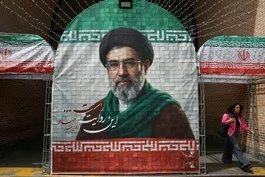
The state of negotiations to end Trump’s stalled war in Iran
Video has Closed Captions
The state of negotiations to end Trump’s stalled war in Iran (11m 49s)
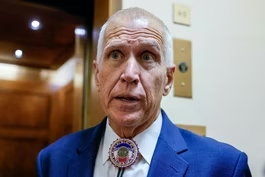
Why ‘YOLO’ Republicans are defying Trump in Congress
Video has Closed Captions
Why ‘YOLO’ Republicans are defying Trump in Congress (8m 45s)
Providing Support for PBS.org
Learn Moreabout PBS online sponsorship New Episode
- News and Public Affairs

Top journalists deliver compelling original analysis of the hour's headlines.
 New Episode
- News and Public Affairs

FRONTLINE is investigative journalism that questions, explains and changes our world.
 New Episode
 New Episode
 New Episode
 New Episode
 New Episode
 New Episode
 New Episode


Support for PBS provided by:
Major funding for “Washington Week with The Atlantic” is provided by Consumer Cellular, Otsuka, Kaiser Permanente, the Yuen Foundation, and the Corporation for Public Broadcasting.