
Home Is Where the Heart Is
Season 7 Episode 1 | 26m 47sVideo has Closed Captions
Meet North Carolinians making a difference in their communities.
Meet North Carolinians making a difference in their communities. Discover how they are changing lives, breaking barriers and giving back to neighbors who need a hand and a little inspiration.
Problems playing video? | Closed Captioning Feedback
Problems playing video? | Closed Captioning Feedback
My Home, NC is a local public television program presented by PBS NC
Home Is Where the Heart Is
Season 7 Episode 1 | 26m 47sVideo has Closed Captions
Meet North Carolinians making a difference in their communities. Discover how they are changing lives, breaking barriers and giving back to neighbors who need a hand and a little inspiration.
Problems playing video? | Closed Captioning Feedback
How to Watch My Home, NC
My Home, NC is available to stream on pbs.org and the free PBS App, available on iPhone, Apple TV, Android TV, Android smartphones, Amazon Fire TV, Amazon Fire Tablet, Roku, Samsung Smart TV, and Vizio.
Watch My Home, NC on YouTube
Enjoy a unique look at the food, music, people and culture that make North Carolina our home on the My Home, NC YouTube channel.Providing Support for PBS.org
Learn Moreabout PBS online sponsorship[piano intro] - [host Heather Burgiss] Today we visit some remarkable folks who are inspiring and making a difference in their communities.
- The face of hunger sometimes looks so different and people don't realize that that person sitting next to you is hungry.
If you tell me you need a meal then you're gonna get a meal.
- [Heather] They are breaking barriers, changing lives and giving back to their neighbors who need a hand.
- Who's 31?
Look at you.
Good to see you.
There is.
- Begin to invest in yourself.
Begin to think about the future.
You know, you're not your environment.
- [Heather] It's all on My Home, coming up next.
[train engine roaring] [upbeat music] All across the state.
We're uncovering the unique stories that make North Carolina, My Home.
♪ Come home ♪ ♪ Come home ♪ [upbeat music] - Historically, the barbershop, you know, the one with the stripe pole, it's a centerpiece of any community.
You'll see folks gathering around to come get their haircut but they're also coming for something greater.
It's a convening power to have their voices heard and be inspired.
- There's a certain way to conduct yourself personally but there is a way to conduct yourself as a business person.
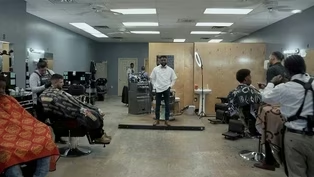
- I can't wait for you to meet Rodney Bullock of Greenville, North Carolina.
He's an inspiring man.
He's not just teaching people how to cut hair as a master barber, but he's changing lives and making a difference with passion and heart.
[upbeat music] - My grandfather said when I was a young boy he was like, "Listen, if you want to be respected, "you gotta dress like you want respect."
[upbeat music] I am the owner of Altitude Academy LLC.
We are a barber school and I am the lead instructor.
And I help people become proficient in the art of barber science.
[upbeat jazz music] Here at Altitude, we do a lot of life coaching.
Guys as barber instructors I get the opportunity to groom, groom hair, groom people, groom attitudes, groom opportunities.
Grooming is what I do every day.
My name is Rodney Bullock, and my home is Greenville, North Carolina.
[upbeat jazz music] I am a barber because I didn't have a choice in the matter.
It kind of made its way to me.
It's kind of always been a staple throughout my life even though gone to do other things.
I've always come back to barbering and it has always managed to find me.
The very first reason I became a barber is because my father decided it would be a great idea to save the family money by cutting mine and my brother's hair.
There was one time when he gave me the best haircut I had received and he says, "Hey, listen I noticed I missed a couple of stray hairs, "have a seat really quickly."
He went over the top and knocked those strays off but he forgot to put the guard back on.
And so there was like a landing strip.
And the first words out of his mouth were not, oh, son, I'm so sorry.
Or, oh my goodness, what can we do to fix it?
He said, "You're going to school tomorrow."
And I made up in my mind that very day that I was never going to allow him to cut my hair again.
And if I wanted to be able to do that and carry it out I had to learn how to barber.
And so that's when it really started.
[upbeat music] Growing up as a child going to the barbershop, it was like an adventure to me.
I really love the fact that I got to sweet hair to make money.
And so that's the first time I experienced real commerce.
And I saw so many other things that were kind of on the heels of spending time with my father in a place where older men socialize.
So we learned how to socialize with one another in that place.
We learned how to dress well, we wanted that persona.
The barber was always dress well, spoke well, always reached out to the community, always helped.
And the added layer on top that was that he was a black man.
So I was like, oh my goodness.
I can be that.
I took so many moving parts away from that situation to form what we've got going on now and share that with other people.
[upbeat music] Intrinsic motivation.
Internally you don't need anybody to spur you on.
Extrinsic motivation is the responsibility of something outside yourself that motivates you to get the job done.
[upbeat music] Listen don't put yourself out the game before the game gets started.
Business is not about your emotion.
There needs to be an absence of attitude.
It's about your skillset and your intuition.
What tool are you going to use to attract somebody to become your client?
- Rodney can be a friend, can be a counselor.
You know what mean?
Like he gives you a lot of guidance and he's a teacher here as well as your outside life.
- He wasn't just teaching us barber.
He was teaching us life itself, like how to live regularly without having to mix the two.
And what was more important, building a life in the right way or having to, you know, sacrifice what you have.
Teaching us the importance of how to dress when you go talk to people.
All that he did kind of reflect on me.
So now what he pour in me now I can pour into others.
Now I think that Rodney is great guy.
You know, call him Mr. Rodney, but he's more like a brother to me.
- When I leave school, I go home and I cut hair, but I feel like I would never be able to do that without my classmates and without Mr. Rodney supporting me and like giving me guide in this really important.
Without the support system I wouldn't even be able to do this.
[upbeat music] - The barber shop for the black community historically is a place I like to say all the time, it's the center of the universe meaning that everything is birthed there and it spreads out and reaches so many different facets.
So many different at genres.
Encompasses so many different things that are all really good.
[upbeat music] The barbershop historically in the black community is where black men would serve.
They would barber.
They would shave.
They would give haircuts to their white counterparts all throughout the day.
They would listen.
They would learn, but they would be silent in that moment of servitude.
And the times that they were serving were also the times they were educating themselves on the conversations that were being had.
And so after the close of the regular business they were allowed to serve their own.
And so the black community would come in, they would sit and they would have a lesson about the things that were spoken about in the other parts of their communities that they weren't privileged enough to be privy to during the day.
So in the evening they got a education.
They also got barbered.
They learned how to mobilize.
They learned how to socialize in ways that were different than they normally did between one another.
And it became what made a movement in every black community.
[upbeat music] I want my legacy to be that I was ridiculously good husband at, I was an outstanding father.
I was my son's father, but I was also his friend.
My wish for the community is that when they look at our school, our organization is that they see a family.
[upbeat music] That we are consistent in what we do and that if we can do it extremely well they can use it as a model to do the same thing.
My father used to say to me all the time I don't want to hear your excuse because they're only satisfying you.
I want the community to have an example of people that don't make excuses.
Consistently grooming, consistently trying to cut away the things that are dead or are not gonna be a benefit to us down the road so that they can see all the beautiful things that come from trimming off the dead weight, taking away all of the fat meat.
So you can get to the thing that really matters.
And that is the beauty of the life we are living.
[upbeat music] - We are driving to the farm, actually two farms.
They're two farms that F.A.R.M Cafe uses to locally source their food.
And they're also all about the mission of helping everyone being able to provide food to those who can't afford it.
So we're gonna go check that out and it's raining.
So we're hoping it clears up a little bit.
[upbeat music] - In America, the face of hunger sometimes looks so different and people don't realize that that person sitting next to you is hungry or that person, that child in school is hungry because they're not talking about it.
[upbeat music] My name is Renee Boughman, and my hometown is Boone, North Carolina.
The F.A.R.M Cafe started out as a concept where we would be able to feed people of less means and do it in a community restaurant setting where people could come together and eat together in a way that gave dignity and allowed them to share their stories, if they chose to.
Hey, Gina, how you doing this morning?
- Hey.
- Are you volunteering with us again today?
- Yes.
- What makes the F.A.R.M Cafe so different and so unique as a nonprofit is that we are a regular operating business restaurant but food is the means to create community.
That's our whole goal here.
[upbeat music] - We're of course standing in the middle of one of the farms that you partner with.
And this is a special place for you.
Tell me where we are.
- We are at Against the Grain which is a locally owned farm.
It's a family run farm.
Holly Whitesides, and her husband Andy and their daughter Beatrice, they have been doing this farm for several years and we purchase seasonally from them because they contribute to a great organization called the High Country CSA.
So we purchase from the CSA which gives us access to five to seven local farms - For you it's really like kind of, it's part of the mission of what you guys are doing here.
- Yeah so it's always been really important to us to feed, help feed people that need some help.
And so to team up with the F.A.R.M Cafe as a drop off location for that has been a way that our farm can really plug in and help support a program like that and support a cafe with a mission like the F.A.R.M Cafe so - When people know who grew their food and where that food came from and then they get to talk to those people.
It's the greatest thing in the world.
[upbeat music] When you come in the door we have a buffet style of service.
We'll usually have five or six even seven items through drink and dessert.
You step up and we have a suggested donation.
What that donation does is cover the cost of the food.
It doesn't really touch the overhead.
If you're able to add a little more to help your neighbor then you've helped someone else have a meal.
- We've got two soups, backups, we've got the pot ready for potatoes.
- Okay.
- Green beans are done.
- Yeah, they're ready to go out actually.
What I like to say is this place allows you to being human because it allows you the opportunity to meet people that you just are not gonna meet in other places.
When I've got a homeless person sitting at the counter beside the college professor, beside the lawyer and they're all enjoying the food together and they're talking about the food together, well, that's just fantastic.
All the barriers that are out there it just needs to dissolve away.
The fabric of that needs to go away so that people can see each other for who we are, because in the end, you know we're all, we talk about the gardens but we're all going back into the dirt.
[Renee laughing] [upbeat music] - What does it feel like for you to hear something like where one of your students who has trained in here goes out for his first flight and just does such an amazing job.
How does that make you feel?
- It feels like we are on the right road, we are on the right track.
That's what we need to be doing.
[upbeat music] In the early days of affirmative action I was probably ninth, 10th or 11th, African American to fly for an airline at that time, anywhere, not just Piedmont.
And as I was retiring, I became aware of the fact that the airlines they're gonna retire 40% of their pilots within the next 10 years, kids aren't learning to fly.
So I start this program to try to fix it so they could have a means of learning to fly and cut down the expense of it.
[plane engine roaring] [upbeat music] I was fortunate enough to be an airline pilot at age 22.
You really need to have a devotion of doing what you're doing and liking what you're doing.
I like to say it's because it's a wonderful thing to do if you love flying.
My name is Warren Wheeler, and my home is Durham, North Carolina.
- So you bought the simulator.
Why is it important in what you do, in how you teach?
- Well, we take kids when they're first end of high school we do everything in here for the first two years.
Plus we do ground school to teach them about the aviation and the regulations and all the other things they need to know.
I started this program to try to fix it so they could have a means of learning to fly.
So this is a great time for any kid to get into it and get qualified and be ready for that job.
[upbeat music] - I'm very pleased to be able to help Airolina with their program of bringing young people with enthusiasm for aviation.
I have always been a big believer in pay it forward helping other people up the hill.
Somebody helped me I was young and I believe it's my role to help other people along.
[soft music] - I think it's very important to have programs like this because everyone can join and have fun and also make a career for their life.
- Clear prop.
[plane engine roaring] [upbeat music] - When I was very small my dad used to get me airplanes, the ones that you threw in the sky.
And so ever since then, I just liked to fly airplanes.
I like flying because when I'm in the air I feel free.
[soft music] I've learned so much throughout this program and you can learn so many things that will help you throughout school and your life.
Mr. Willard, he helps me fly throughout the simulators and he really gets the experience involved.
[soft music] - This was your home church growing up.
This was where you would come.
- This building that we're in now was the church I used to, my parents took me to every Sunday.
They moved further down the road and built a new church and they turned this into a community center.
But to me, when I sit in the sanctuary I have all those memories, 'cause everything is the same.
The place has a special feeling to it.
Just like there's a special feeling from, I get flying.
[soft music] I had somebody tell me when I started this program, oh these kids, they don't want to do anything.
They're all hanging around on the streets, which is not true.
Once they get exposed to the opportunity whether it be flying an airplane or whether it be becoming an electronic engineer, if they get exposed to it.
Now our kids do need to be, to have the opportunity to be exposed to different possibilities.
We need to work harder on that.
[upbeat music] - So I have to tell you, I have to tell you one of my favorite things is the chicken hat.
Cause I did see, hear about it.
- Here it is.
- The infamous chicken hat.
- He kinda was a little angry though, do we?
- Yes well, he's not happy.
He lives outside you know?
And so somebody called me, they were at the Halloween store and said, "Ma'am there's a chicken hat over here "and you have got to have this."
[upbeat music] I saw an article in January of 2013, I guess.
And it was some guys standing around warming their hands in a tent camp.
And they looked really cold and I started thinking about it and I thought, there must be surely there's something I could do.
So I went over to a chicken restaurant and Church's Fried Chicken on Spring Garden Street.
Walked into the restaurant.
And I said, "Do you ever have any "leftover fried chicken?"
And he said, "Yeah, last night we threw away 40 pieces."
And I said, "Well, could I have it?
"I mean, we could give it to the people."
And he goes, "Yeah, you can have it."
So I said, "All right, well, how do we do it?"
And that's how it started.
[upbeat music] My name is Amy Murphy, and my home is Greensboro, North Carolina.
And some people call me the chicken lady.
A lot of the issues that people dealing with homelessness have, people that are living inside also have.
They're not different than the people that live outside.
It's just that those people didn't have any social support.
They didn't have any help.
Oh, how are ya?
Here we go.
- How does it make you guys feel now where that chicken's going, that you're not throwing it away and what you're doing, where it's going?
- Man it's just something that we try to do our part.
You know what I'm saying?
We just wanna do our part.
And even if we don't have nothing, we'll cook something, we'll cook something.
She know how we do.
We take care of them.
- This is what I wear every Monday morning.
[Amy laughing] - That's cute.
- Have y'all seen this?
- That's cute, that's cute.
- I know I'm not crazy, but y'all wear that everywhere.
- Why need to get them some.
- Y'all need one of these.
[upbeat music] - You better at that.
- Here's the foil.
- I liked how you said that you're not feeding the homeless that you're serving your friends.
- Yeah because feeding the homeless sounds like you're not the same.
It sounds like you're not part of the same community.
But if I invite you over and serve you dinner it's because you're my friend.
And because we're part of the same community, we're the same.
[upbeat music] I get there about 7:15.
And it's like a popup restaurant in 15 minutes we set up this whole thing.
It's like a convergence.
All these cars pull up and everybody unloads all this stuff and sets up all this big buffet on the stable coffee.
- Okay let's eat.
- Yes its freezing chicken lady warming me up right now yep.
- My friend Lawrence, he's the numbers guy.
He hands out numbers for coming through the line.
Where'd you sleep last night.
- Outside.
- You slept outside.
Why you didn't go to the shelter?
- It was full.
- The shelter was full but so you didn't try the emergency shelter.
- No ma'am.
- But you might try tonight?
- Yes ma'am.
[Amy Laughing] - You know, one of the things that I think about sometimes the capacity for love of a human spirit.
Every one of them knows that I go home to a warm bed in a warm house every night.
And they love me anyway.
Instead of resenting me, they care for me.
- What I learned this lady, God made her.
This right here like I said, she's a mother figure, a grandma alright, whoever you want to be.
She quit her job just to help these people out here.
And I respect her for a lot of stuff she do.
- I can't imagine not saying this anymore.
I care about this people.
I care what happens to 'em.
I celebrate their joys.
I feel like a part of their lives.
They're a part of mine.
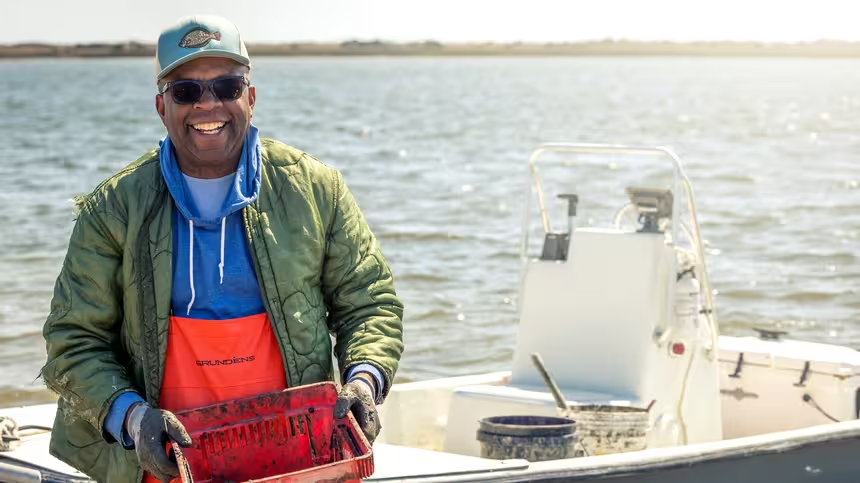
[upbeat music] - [Heather] Next time on My Home, meet us on the farm with a chili harvest of Carolina oysters.
- People really trust us to bring them the freshest oyster.
They know that we're harvesting it that day.
- [Heather] Next to visit with some hungry goats and mushroom farming in the Piedmont.
- Hello, good job Sarah.
Oh, that's so big.
- I have two mushrooms.
- You have two mushrooms now?
- Goats here with a light body and a dark head.
We've done a, job for a guy and he was talking about that goat being way up the tree.
And it must have been 25 feet off the ground.
- The goats normally climb trees like that?
- No, not, a rare one but.
- And then some sweet family farming legacies high in the mountains.
- We're able to make those connections and build relationships that continue to survive and thrive for years after someone's visit Ash.
- And they take a little piece of Asheville home with them.
- Exactly.
[upbeat music] ♪
Preview | Home Is Where the Heart Is
Video has Closed Captions
Preview: S7 Ep1 | 30s | Meet North Carolinians making a difference in their communities. (30s)
Providing Support for PBS.org
Learn Moreabout PBS online sponsorship











Support for PBS provided by:
My Home, NC is a local public television program presented by PBS NC