
May 1, 2026 - PBS News Hour full episode
5/1/2026 | 57m 46sVideo has Closed Captions
May 1, 2026 - PBS News Hour full episode
Friday on the News Hour, Trump rejects Iran’s latest proposal to end the war. Prosecutors release new video showing the gunman at the White House Correspondents’ Dinner breaching security. The battle for the Senate comes into sharper focus with a prominent contender’s exit in Maine. Plus, Palestinian and Israeli authors of a new book about peace discuss their work to bridge divides.
Problems playing video? | Closed Captioning Feedback
Problems playing video? | Closed Captioning Feedback
Major corporate funding for the PBS News Hour is provided by BDO, BNSF, Consumer Cellular, American Cruise Lines, and Raymond James. Funding for the PBS NewsHour Weekend is provided by...
May 1, 2026 - PBS News Hour full episode
5/1/2026 | 57m 46sVideo has Closed Captions
Friday on the News Hour, Trump rejects Iran’s latest proposal to end the war. Prosecutors release new video showing the gunman at the White House Correspondents’ Dinner breaching security. The battle for the Senate comes into sharper focus with a prominent contender’s exit in Maine. Plus, Palestinian and Israeli authors of a new book about peace discuss their work to bridge divides.
Problems playing video? | Closed Captioning Feedback
How to Watch PBS News Hour
PBS News Hour is available to stream on pbs.org and the free PBS App, available on iPhone, Apple TV, Android TV, Android smartphones, Amazon Fire TV, Amazon Fire Tablet, Roku, Samsung Smart TV, LG TV, and Vizio.
Providing Support for PBS.org
Learn Moreabout PBS online sponsorshipGEOFF BENNETT: Good evening.
I'm Geoff Bennett.
AMNA NAWAZ: And I'm Amna Nawaz.
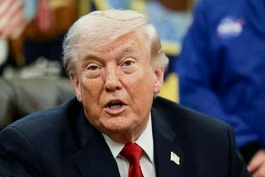
On the "NewsHour" tonight: President Trump rejects Iran's latest proposal to end the war.
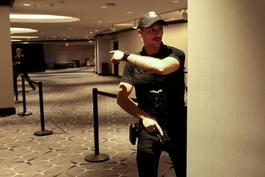
GEOFF BENNETT: Prosecutors release new video showing the suspect at the White House Correspondents' Dinner breaching the security perimeter.
AMNA NAWAZ: And Palestinian and Israeli authors of a new book about peace discuss their work to bridge divides.
AZIZ ABU SARAH, Co-Author, "The Future Is Peace": We are together.
We are not against each other.
It's not Israelis versus Palestinians.
It's those of us who believe in justice, equality, and peace versus those who don't yet.
(BREAK) GEOFF BENNETT: Welcome to the "News Hour."
Iran today submitted a new proposal to the U.S.
aimed at breaking a diplomatic deadlock, but President Trump rejected it and said he's reviewing new military options to relaunch the war.
AMNA NAWAZ: It's been 60 days since the war began, which means today is a legal deadline for the administration to seek congressional authorization.
But the White House informed Congress it didn't need to get its approval because the war had been -- quote - - "terminated" during the current cease-fire.
Nick Schifrin is here.
He's been following all of this.
So, Nick, tell us more about what the president said today.
NICK SCHIFRIN: Amna, the president not only rejected Iran's new proposal.
He expressed a deep skepticism that Iran could ever submit a proposal that would satisfy him.
DONALD TRUMP, President of the United States: So, they want to make a deal, but I don't -- I'm not satisfied with it, so we will see what happens.
They have made strides, but I'm not sure if they ever get there.
There's tremendous discord.
There's tremendous -- they're having a tremendous problem getting along with each other in Iran.
NICK SCHIFRIN: So, on the one hand no deal and little prospect for a deal, but the president also acknowledged yesterday receiving a briefing from his top Middle East commander, Admiral Brad Cooper, what President Trump told FOX News' Peter Doocy were two main options.
DONALD TRUMP: Do we want to go and just blast the hell out of them and finish them forever, or do we want to try and make a deal?
And those are the options.
PETER DOOCY, FOX News Senior White House Correspondent: Do you want to go and blast the hell out of them?
DONALD TRUMP: I would prefer not.
On a human basis, I would prefer not.
But that's the option.
Do we want to go in there heavy and just blast them away?
Or do we want to do something?
They're a very disjointed leadership, as you can understand, Peter, very disjointed.
I mean, they're not getting along with each other, and it puts us in a bad position.
One group wants to make a certain deal.
The other group wants to make a certain deal, including the hard-liners.
NICK SCHIFRIN: So, all that said, a U.S.
official tells me, Amna, tonight the options are actually not as black and white as the president proposes.
This official says there is on the one hand little appetite by the administration to restart the war in full, but at the same time there is an impatience with what this official called Iran dragging its feet.
So, as always, there are multiple military options, including what the official said was one that would try to accelerate a deal without blowing up the possibility of a deal and without restarting the war in full.
And what that could be is trying to reopen the strait, trying to reduce Iran's ability to launch drones, launch cruise missiles at ships, at ports in the strait, and while the economic pressure, while the diplomatic efforts would continue.
And, remember, the president and the military have many options, because there are still many U.S.
military assets in and around the Persian Gulf, and there's still a U.S.
blockade that the president and U.S.
other officials really believe are really choking Iran's economy.
AMNA NAWAZ: So Iran's proposal that the president rejected, what do we know about what was in that proposal?
NICK SCHIFRIN: We don't know exactly, but for the president, it's clearly not enough of a change from the proposal that Iran submitted just last weekend that I reported, according to a regional and Iranian official, was that if -- that Iran would reopen the strait if the U.S.
lifts its blockade, unfreezes Iranian assets, and, crucially, pauses any negotiation of Iran's nuclear program.
The president said today "Iran is asking for things that I can't agree to," but didn't provide any specifics.
AMNA NAWAZ: So, as you mentioned, today is that 60-day deadline required by the War Powers Act for the White House to get congressional authorization to continue that war.
They say they don't need that authorization.
Why not?
NICK SCHIFRIN: Well, the president argued today the War Powers Act is unconstitutional, which is an argument that every president, as you know, since Richard Nixon, since 1973, has made.
But the president's lawyers are taking it seriously apparently, because the White House released this letter that it sent to Congress, and it said this -- quote -- "There has been no exchange of fire between United States forces and Iran since April 7, 2026.
The hostilities that began on February 20, 2026, have terminated," terminated, even though, of course, Amna, we just talked about how the president said himself that he could restart the war at any time.
We spoke to Harold Koh, professor of Yale Law School and President Obama's former top State Department lawyer, and he said it's as if the president is trying to rewrite the war powers resolution and add a pause button.
HAROLD HONGJU KOH, Former State Department Official: It's misunderstanding the text of the war powers resolution, which says that 60 days after U.S.
armed forces are introduced, which is 60 days after February 28, the president shall terminate any use of the U.S.
armed forces that were made at that time, in other words, pull all the troops that have been sent in out.
He's not doing that.
This is not a shot clock in basketball.
It's the game clock.
It's ticking down from 60 days.
And those 60 days are up.
NICK SCHIFRIN: Now, all of this said, Amna, as of now, Republicans in Congress have not been willing to enforce the war powers resolution.
There have been six votes so far that would have required the administration to withdraw all U.S.
military forces from war in Iran unless Congress authorized the use of military force in Iran.
All six votes have failed.
But our colleague Lisa Desjardins has been reporting that there is private concern, private concern, among Republicans that could become public votes against the administration if the president were to relaunch full combat operations.
And Harold Koh argues the point here, the bottom line point here, is that, even if Congress isn't willing today to enforce the War Powers Act, it maintains the threat to do so.
HAROLD HONGJU KOH: The decision points will mount.
And what this is like is when you have parked in a parking space and time is up.
You may not get a ticket for a while, but you're certainly under pressure to figure out some kind of solution to legalize it or to get out.
And that's what he's feeling.
AMNA NAWAZ: Meanwhile, Nick, some news late today about U.S.
troops in Germany.
What's the latest?
NICK SCHIFRIN: Yes, the spokesperson for Pete Hegseth, secretary of defense, has confirmed this afternoon to me and other reporters that the U.S.
will withdraw 5,000 troops from Germany.
There are about 36,000 or so troops in Germany right now, so 70,000 troops in Europe.
So a portion of what the U.S.
has in Europe, of course, coming after a bit of a war of words between President Trump and chancellor of Germany, Friedrich Merz, Merz criticizing the president for not having an exit plan, the president criticizing those comments.
And here you go, 5,000 troop withdraw over the next six to 12 months.
AMNA NAWAZ: Nick Schifrin beginning our coverage tonight.
Nick, thank you.
NICK SCHIFRIN: Thank you.
GEOFF BENNETT: The Justice Department released high resolution video showing the moment an armed man stormed past security at the White House Correspondents' Dinner.
The incident is raising serious questions about the security posture surrounding the president at high-profile public events.
We're joined now by Juliette Kayyem of the Homeland Security Project at Harvard's Kennedy School.
She previously served as assistant DHS secretary in the Obama administration.
Juliette, it's great to see you.
So, look, there are lots of questions, as you know, about the shot that struck the U.S.
Secret Service agent.
The U.S.
attorney for the District of Columbia, Jeanine Pirro, says there's no evidence of friendly fire.
But the video, this single video, is not definitive.
What does this footage show us and what does it not show us?
JULIETTE KAYYEM, Former U.S.
Department of Homeland Security Assistant Secretary: So it shows us, it shows the suspect going through a security metal detector, essentially.
It also -- it shows him speeding up.
It shows him trying to reach a gun.
And then the frame-by-frame shows some dust, sort of a dust-up literally up above, which would suggest that there had been a gun fired, because afterwards you then see the Secret Service pick up their guns.
So the prosecutors will say this shows that he had deadly intent and that the Secret Service were responding.
But I will be honest with you, the frame-by-frame is not dispositive in any way.
What the government released was on different speeds.
It's sort of slowed down and sped up.
So a good defense attorney is going to wonder why that is happening.
What you also don't see is, you any movement like, a sort of a muzzle from his gun go off.
So it's a long way of saying lawyers are going to debate this in court.
It's certainly not definitive.
The more important thing is, why is -- I don't quite understand why the government is sort of going for broke on this issue.
Friendly fire is known to happen.
It's not like a moral outrage.
It happens when bad people come with guns to areas with police presence.
And so I don't -- I don't quite know why the administration is so stuck on this issue.
Even if there were friendly fire, they're still intent to kill the president by the assassin.
GEOFF BENNETT: Well, on that point, the Secret Service director, Sean Curran, in defending his agents says the site was set up perfectly.
The video -- this is about a half-hour into the dinner.
The video shows the agents, some of them, removing the magnetometers and the suspect appears to exploit that exact moment.
He's got that running start as he sort of barrels through.
Is that what a perfect setup looks like?
JULIETTE KAYYEM: I would never say perfect ever, and I would certainly not say it after there was an attempted assassination attack, only because the truth is, is, the -- Director Curran, if you said to him, you have to do this again next year, he would in no way do it the same way.
We all know that there were vulnerabilities.
So in the Secret Service's defense, in other words, where do I look for the highlights of this planning, they had a secure zone.
That secure zone was never breached.
And the president was truly not under any direct threat.
They got him out of there in time.
So if you look at from the perspective of the security zone, nothing bad ever happened.
Of course, the fear -- the shooting and all the badness outside the secure zone, of course, impacts everyone.
And so I think the question for Director Curran is sort of both this or what we call the mixed environment, the public and private at a hotel like this.
Do you really want to have those for a president, for President Trump or any president?
And also, at some stage, the secure zone may need to be extended further because of the nature of gun violence and political violence in this country.
GEOFF BENNETT: Well, say more about that, because this is now the third attempted attack on President Trump.
So, from a protection standpoint, does that fundamentally change the model?
JULIETTE KAYYEM: It probably does in one way, which is you're just going to be more conscious and do a lot more planning for the president's non-home, sort of when he gets out of the house, out of the White House.
And the reason why I say that is because I look at these three assassination attempts.
One happens in a open air political rally.
The second happens at a private golf course and the third in the basement of a hotel.
So any time he's going to get out, there's going to be vulnerabilities.
Now, the White House has been saying that means he needs more protection or a ballroom at the White House.
That's not how it works, in between a White House that no one's invited to and the fact we have a democracy, where you want your president to engage with people and not just the people around him, but you want presidents to engage the public.
There's a lot more that we can do security wise in particular, maybe extending that security zone.
But almost every planner I have talked to since last weekend said, like, just don't have it in the hotel.
Go to the Convention Center in D.C.
Secure the area around the Convention Center.
You won't have residents, and you won't have a public.
It's not rocket science, actually.
GEOFF BENNETT: You mentioned the president talking up his ballroom, his desired ballroom.
Do you think the administration is treating this primarily as a security failure to fix or as a political moment to message around?
JULIETTE KAYYEM: I mean, I was thinking about the past week.
I take presidential assassinations seriously, as we all should.
And I sort of think about the line of the story since last Saturday, which is, it's very scary for a democracy to have people, and people with whatever motives, but in this case left-wing motives, to go after a president.
So you have discussion of a ballroom.
You have going after Comey, the FBI director.
And then you have going after a late-night host for what he said about the president.
None of those are related to the president's safety and security.
And I think the White House might make all of us take security more seriously if they did not politicize it within hours of an assassination attempt against the president of the United States.
GEOFF BENNETT: Juliette Kayyem.
Juliette, thanks, as always.
JULIETTE KAYYEM: Thank you.
AMNA NAWAZ: In the day's other headlines: President Trump says he's raising tariffs next week to 25 percent on cars and trucks from the European Union, accusing the E.U.
of not complying with their trade deal.
The new levies come at a time when the global economy is already reeling from the Iran war.
Speaking to reporters at the White House, Mr.
Trump didn't elaborate on how he'd hike the tariffs or why he chose to do so now.
DONALD TRUMP, President of the United States: We raised the tariffs because they were not -- as usual, they were not adhering to the agreement that we have.
We have a trade deal with the European Union.
They were not adhering to it.
AMNA NAWAZ: Mr.
Trump was referring to a deal reached with the E.U.
last summer that set levies on most European goods at 15 percent.
The Supreme Court then ruled in February that much of his tariff agenda was illegal.
The Pentagon says it's made deals with seven major tech companies to use their A.I.
tools within the department's classified networks.
They include SpaceX, OpenAI, Google, Microsoft, and Nvidia, some of which already had deals with the Defense Department.
Officials say the companies will allow the Pentagon to employ their technology for any -- quote -- "lawful use."
That standard lies at the heart of a legal dispute involving Anthropic, which was not listed in today's announcement.
The A.I.
start-up has objected to its technology being used for fully autonomous weapons and domestic surveillance.
In Florida, a former Miami congressman with ties to Secretary of State Marco Rubio was convicted today of secretly lobbying for Venezuela.
A jury found David Rivera guilty on all counts, including failure to register as a foreign agent and conspiracy to commit money laundering.
The case centered on a $50 million lobbying campaign to convince the first Trump administration to ease sanctions on then-President Nicolas Maduro's government.
Rubio himself testified, though he's not been accused of any wrongdoing.
Rivera was taken into custody and faces around 10 years in prison.
In Texas, an investigation is under way into what caused a small plane to crash in the state's Hill Country, killing all five people on board.
The Cessna aircraft went down shortly before midnight last night in Wimberley, Texas, nearly 40 miles southwest of Austin.
An air traffic controller observed the plane moving erratically, and a nearby pilot says the plane emitted a distress signal before the crash.
The names of those on board have not yet been released, but a local pickleball club says they were members who were flying to a tournament.
In Washington state, police arrested a high school student suspected of wounding five people in a stabbing rampage.
The attack happened yesterday at Foss High School in Tacoma, just south of Seattle.
A police spokesperson says first responders were called after reports of a fight among students.
The campus briefly went into lockdown and classes were canceled for today.
Authorities say all the victims are now in stable condition, as well as the suspect, who was hospitalized with minor injuries.
Around the world, events have been taking place to mark May Day, also known as International Workers' Day, which honors the efforts of the global labor movement.
In Madrid, activists chanted "Long live the working class" and marched for collective bargaining in Seoul.
In Istanbul's Taksim Square, demonstrations turned violent.
Turkish police detained hundreds of protesters amid the clashes.
In many cases, rallies highlighted the ripple effects of the Iran war, like rising energy costs and commodity prices, as laid out by this protester in the Philippines.
MARY ANN CASTILLO, May One Movement (through translator): At first, you might think there's no connection.
But as we saw when the war in the Middle East broke out, crude oil and gasoline prices shot up.
There's a domino effect.
Prices increase across the board.
AMNA NAWAZ: Here in the U.S., May Day is not a public holiday, like it is in many other parts of the world, but cities including New York and Chicago saw marches and boycotts, where opposition to the policies of President Trump was a common theme.
On Wall Street today, stocks ended mixed following some strong corporate earnings.
The Dow Jones industrial average slipped about 150 points.
The Nasdaq rose more than 200 points, or nearly 1 percent.
The S&P 500 ended the week at a new all-time high.
And it's a case of lost and found with a Hollywood ending.
Lufthansa apologized to a Russian director today for briefly losing his Academy Award on a transatlantic flight.
Pavel Talankin and his co-director, David Borenstein, won the Oscar for their documentary "Mr.
Nobody Against Putin."
Borenstein posted on social media yesterday that TSA agents in New York told Talankin he couldn't bring his Oscar on board because it could be considered a weapon.
They sent it under the plane in a box instead.
After an international outcry, the airline said the statuette has been found and is being returned to its rightful owner.
Still to come on the "News Hour": the battle for the Senate comes into sharper focus with the exit of a prominent contender in Maine; David Brooks and Jonathan Capehart weigh in on the week's political headlines; and a new PBS series showcases the often overlooked history of Muslims in the United States.
GEOFF BENNETT: Much of the focus this midterm season has been on the fight for the U.S.
House, with redistricting battles dominating the headlines.
But this week also brought new developments in the race for the U.S.
Senate.
Our congressional correspondent, Lisa Desjardins, has more.
LISA DESJARDINS: The Upper Chamber with direct power over Supreme Court and other nominations is increasingly in the 2026 conversation.
A total of 35 Senate seats will be on the ballot, but just 11 are rated as remotely competitive by The Cook Political Report With Amy Walter.
Republicans in red are on defense in more of those seats than Democrats, but Democrats need a long shot sweep, a net gain of four seats to take control of the chamber.
For a closer look, we're joined by Jessica Taylor, Senate and governors editor at The Cook Political Report.
Thank you for joining us, Jessica.
JESSICA TAYLOR, The Cook Political Report: Great to be here, Lisa.
LISA DESJARDINS: Let's start with Maine.
We had some news there this week when the Democrat candidate of choice, Governor Janet Mills, dropped out.
It now looks like progressive upstart candidate Graham Platner, who's an oyster farmer and a retired Marine, will be the one to face off with Susan Collins, Republican, in the fall.
He has brought a lot of passionate supporters to the table, but he also has controversy, past comments blaming sexual assault survivors, and also a tattoo that was also a past Nazi symbol.
He's apologized for those things.
This is all a long buildup to a question.
You had rated this race in Maine as a toss-up.
Is it still a toss-up?
JESSICA TAYLOR: It is still a toss-up, and I think that's because of the national environment.
Susan Collins' seat, she's the only Republican defending a seat that Harris carried.
In fact, Republicans have not won Maine at the presidential level since 1988.
So it's been a while, and she's managed to win this seat.
She's the only person -- she's Democrats' white whale, really, that she's been able to hold this seat even at times when Trump carried her seat in 2020.
But Platner is a risky choice.
As you said, he brings a lot of energy.
He's -- they talk about sort of this movement that he's created there in Maine, and ousting the sitting governor is not easy.
But it's not just those comments, that Mills did not have the money to prosecute the case against him.
Republicans will.
They have already reserved millions of dollars in advertising.
So if this backfires against Democrats, that's a real problem for them as they need to get these four seats.
LISA DESJARDINS: Let's talk about that.
As we have said, there's four seats that need to switch net for Democrats.
And if we look at the map here again, there's roughly 11 seats that you say are in play.
But, really, there's only three toss-ups at this point.
How realistic is it for Democrats to try and take over the chamber, to net four?
And where do they need to look?
JESSICA TAYLOR: Democrats have to pitch a perfect game.
It is now within the realm of possibility, which I could not say at this time a year ago.
And that's because they have recruited successful candidates in states that I think could only put their seats into play.
Now, someone like the former Governor Roy Cooper in North Carolina, that's a race we actually recently moved from toss-up to lean Democrat.
So that gets them one pick up if that race -- if he continues to have a lead in that contest.
Ohio -- former Ohio Senator Sherrod Brown, we have recently moved that race from lean Republican to toss-up.
He lost last cycle, but this is a much better political environment for him.
And then they were able to get someone like former Congresswoman Mary Peltola in Alaska.
We rate that race as lean Republican.
So that race needs to move a little bit more onto the map for them to get to four.
But, again, that means that they keep -- that they are able to flip Maine.
And then Democrats, also, they're playing defense in places some -- a state like Georgia.
We moved that one to lean Democrat as well recently, so that's the state that they're looking better in, but a state like Michigan, where they have a very messy primary that's not going to be over until August.
So there's minefields for Democrats on this map still as well.
LISA DESJARDINS: Let's talk about Texas.
I know it is the perennial question for Democrats, almost a siren call for them that they hope to win a Senate seat in Texas.
But we have a vicious primary there.
Does that help Democrats?
Is this the year, I hesitate to ask, where Democrats have a chance in the Senate?
JESSICA TAYLOR: I feel like, for as long as I have been doing this, which is almost two decades, Democrats have been talking about turning Texas blue.
But if Paxton defeats Cornyn in that primary... LISA DESJARDINS: The sitting Senator, John Cornyn... JESSICA TAYLOR: Right.
LISA DESJARDINS: ... and the attorney general, Ken Paxton.
JESSICA TAYLOR: Yes, then that makes it that much easier, because we're talking about Graham Platner's baggage in Maine.
Ken Paxton has a ton of baggage.
He was impeached.
There's questions -- his wife -- he's a very evangelical -- has an evangelical base in the state.
His wife left him for biblical reasons, which were interpreted as he had multiple affairs.
And so James Talarico has had a lot of money, the Democratic nominee, but he's going to need it because Texas is such an expensive state.
LISA DESJARDINS: What's a state that's a little bit off the grid that you're watching that people might not be talking about?
JESSICA TAYLOR: Iowa is my canary in the coal mine.
There is a really interesting governor's race there where, actually, Republicans' polling even has the Democrat, Rob Sand, who's the state auditor up there.
And that is an open Senate seat as well.
Joni Ernst is retiring.
Iowa is a state that's been hit hard by tariffs, hit hard by soybeans that they haven't been able to trade to China.
So even though it's a very Republican state, could there be enough things that could go right there?
National Democrats would feel a lot better if it's Josh Turek, who's a four-time Paralympian, two-time gold medal winner.
He's in a wheelchair from spina bifida that he contracted because of his father's service in Vietnam and Agent Orange.
He's won - - he's a state representative who's won in red areas.
They feel much better about that matchup against Ashley Hinson, who's the Republican congresswoman.
So that's a state that could be more on the map.
LISA DESJARDINS: She's a strong campaigner, but I think Republicans too, they can't take anything for granted, and that's a place where I think they're looking as well.
JESSICA TAYLOR: Exactly.
It's the national environment.
This all comes down to Trump, it really does, and where his approval winnings are, where gas prices are, what's happening with Iran in a couple of months as we get closer to voters going to the polls.
LISA DESJARDINS: Jessica Taylor, as we get closer, we will be hoping to talk to you more and more.
JESSICA TAYLOR: Excellent.
Thank you, Lisa.
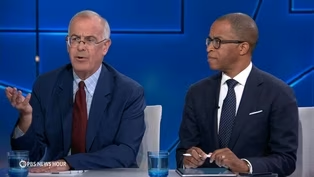
AMNA NAWAZ: Fallout from the third alleged assassination attempt of President Trump, another indictment of a former FBI director, and a consequential Supreme Court ruling made it a busy week in politics.
To discuss that all, we turn now to the analysis of Brooks and Capehart.
That is "The Atlantic"'s David Brooks and Jonathan Capehart of MS NOW.
Great to see you both.
JONATHAN CAPEHART: Hey, Amna.
DAVID BROOKS: Good to see you.
AMNA NAWAZ: Let's start with the White House Correspondents' Dinner because we know a lot more now than we did a week ago, when it first happened.
We know about the suspect, his alleged plans.
We have seen the video examined from multiple angles.
We have also seen conspiracy theories abound that it was a staged event to distract from President Trump's low approval ratings or help him to fuel this argument to build a ballroom.
But, David, almost a week after the event, how are you looking back on it and what it meant and what it changed, if anything?
DAVID BROOKS: I look at it as part of a climate of rising violence, both against -- obviously against Donald Trump, but against all of us, against a climate of verbal violence that seems omnipresent.
There are certain moments in history when you get these rising climates of violence.
I'm thinking of the period around the French Revolution.
I'm thinking of Reconstruction.
I'm thinking the 1970s.
The older viewers, if we have any, may remember the Baader-Meinhof Gang, the Red Guards.
When I was a little kid in Grace Church School in New York, I overheard the Weathermen accidentally blow themselves up in the townhouse.
That was a period.
You get these moments when there's low sense of legitimacy for ruling institutions and a great sense that we don't have any shared values.
And then people just resort to violence.
And we're clearly in one of those periods.
And I look at the 2028 election with a great sense of foreboding.
And if you look at who thinks violence is justified, it tends to be younger people by a lot.
Most progressives and most conservatives oppose violence, but you get 2.5 times as many progressives say it's justified than not.
But what strikes me about this guy, about the guy who shot in Butler, about the guy who shot Charlie Cook -- Kirk, they don't seem to have thought about it that much.
It's not like they have -- they're radicals who have a big manifesto and an ideology.
It seems almost flippant the way they go into these things, almost like half thought through and jokey.
And I can't quite make sense of what -- that kind of light-hearted nihilism that drives people to, on a whim almost, do something that is horrific and life-changing.
AMNA NAWAZ: Jonathan, how do you look at it?
JONATHAN CAPEHART: Well, excuse me, I'm not going to just let the comment that progressives more than folks on the far right are -- think that violence is justified.
It is something that the American people feel -- they're a little more comfortable with it than they were, say, five, 10 years ago.
Amna, you and I were in that room.
We walked through the magnetometers together.
We stood in that spot.
AMNA NAWAZ: Right.
JONATHAN CAPEHART: The thing now a week out that I have been thinking about, and I keep coming back to it, is that, when I heard the five bangs, I remember hearing five very loud bangs, my immediate action was so instinctive, drop to the floor under the table and be quiet.
I have never been in a situation like that.
But as an American and certainly as a journalist, having to cover all of these things and to listen to the recordings and the films, you sort of learn through osmosis what to do.
And, to me, the bigger issue here is gun violence, that why was I not surprised that this had happened?
And I have been to that dinner at least a dozen times since 2000.
And so, yes, there's an issue of people feeling that political violence is the way to go and that we are in a highly charged atmosphere.
But what's been sort of a specter over all of us for even longer is the scourge of gun violence.
AMNA NAWAZ: Which has not been, interestingly, part of the conversation post that event.
Lots more to talk about that in the weeks ahead.
But I want to ask you about the other big headline this week, which was, of course, former FBI Director Jim Comey being indicted for a second time for this post from a year ago, seashells on a beach that prosecutors allege threatened the president with this "8647" message, and also a parallel headline, the common thread here is -- I will show in a moment -- but the FCC going after ABC for its licenses.
That was a day after the first lady and the president publicly said that ABC should dump Jimmy Kimmel after he made a joke about Melania Trump being widowed.
David, President Trump has repeatedly said ABC needs to dump Jimmy Kimmel.
He's repeatedly said the DOJ needs to go after Comey.
So is this just government agencies doing the president's bidding now?
DAVID BROOKS: Yes, more or less.
I thought the Comey photograph was tasteless.
I thought the Kimmel joke was extremely tasteless.
But there should be social sanction when people do that.
There should be social norms, say -- somebody at whatever network Jimmy Kimmel is at should say, hey, we have standards here.
We don't tell jokes about the president dying and his wife becoming a widow.
We just don't do that.
But there's a big difference between that, the sort of social enforcement that should exist, than the president using force of law to prosecute people for this sort of behavior, which is clearly not illegal.
It's not terrorism.
It's not anything like that.
And so this is the president once again neglecting to understand that his job should come with some sense of limits.
And being president doesn't give you permission to use the federal government to do whatever the hell you want.
And he has never really recognized that.
And he's using that.
And I'm -- you see signs of some resistance within the Department of Justice.
But they have seen what's happened to others.
And if they want to keep their jobs, they probably can't resist too hard.
JONATHAN CAPEHART: Well, another example when it comes to Kimmel of the president being thin-skinned, can't take a joke or doesn't want to be the butt of a joke.
And yet just, what, a few months ago, we were talking about him posting pictures of the Obamas as apes.
So I will just leave that there.
But when it comes to the indictment of Comey, I mean, yes, the president has all been all about retribution.
He campaigned on it.
He's been governing that way.
But there's another dynamic here that is even more troubling, and that is, acting Attorney General Todd Blanche appears to be actively campaigning for the job.
And what we know about the president is, he's - - when you know he's paying attention to you, you do everything you can to please him.
Everything -- anyone who's testified before Congress or, in the case of acting Attorney General Todd Blanche, trying to get the nod for the top job, it is all about, what can I do to make him happy?
And so, going after James Comey, who the president has loathed since his first term in the White House, that's -- to my mind, that is a surefire way for Todd Blanche to get a notch, a point in his favor in the president's mind for the big job.
AMNA NAWAZ: And I'm going to ask you about another big story this week that deserves way more attention in time that we can give it right now, but the Supreme Court decision that prompted headlines like this, USA Today saying "The Supreme Court sides against Black voters in a blow to the landmark civil rights law."
Politico said "The Voting Rights Act is now a dead letter."
Reuters said "The U.S.
Supreme Court under Roberts takes a wrecking ball to the Voting Rights Act."
David, as you know, this is a 6-3 decision along partisan lines.
It's about a Louisiana map, right, that created a second Black -- majority-Black congressional district.
And there's now been a series of rulings that have weakened the VRA over time.
What does all this mean?
DAVID BROOKS: I wasn't a fan of the original gerrymandering rules that were set up mostly in the early '90s.
And they did the noble thing of increasing Black representation in the House, but they did it by cramming all the Democrats into one little district so there would be more Republicans.
And so what happened is, there were a rise of Black members.
But you also see Republican majorities.
And that was the deal they cut with each other.
And I thought it was not a deal that was good for democracy, because it created fewer and fewer swing districts.
That era looks like the pinnacle of Periclean democracy compared to where we are today.
Now we have all seen what's happened in Texas and California and places like that.
But this will turn that over the next several years into super-drive.
And so we're looking at like 2030, when the census comes around again, we will have marginally barely any swing districts in America.
And that would mean voters have barely any opportunity to throw one party out or another for bad behavior.
It also means we will be stuck for the foreseeable future with an evenly divided House.
And all those things are terrible for democracy.
And it's going to be up to some post-Trump president to say, this is a national problem.
We're going to solve it all at once with a coalition, obviously, of the states.
And we're going to redraw these maps.
JONATHAN CAPEHART: The Voting Rights Act of 1965 is what killed Jim Crow.
The VRA is only 61 years old.
When it was passed and became law, it was the first time America truly was a democracy, meaning that the words in the Constitution equally applied to all of its citizens, including African Americans, by giving them the right to vote, 61 years.
I am 58 years old.
My mother is 84.
So my mother is older than true American democracy.
And so for those justices in the majority to say that, oh, well racism is over in voting and we don't need this anymore, I keep thinking about what Justice Ginsburg said in her dissent in the Shelby v. Holder case, which invalidated Section 5, the preclearance portion.
And she wrote: "Throwing out preclearance, when it has worked and is continuing to work to stop discriminatory changes, is like throwing away your umbrella in a rainstorm because you are not getting wet."
And so for Justice Alito to focus on the elections of 2008 and 2012, when there was a Black man on the ballot, to say that racial disparities are no longer a problem, and then ignoring that Shelby in 2013 led to just a rush of changes in voting laws in the states, is to ignore reality and to ignore history and to drag us back to a time when America was not America.
AMNA NAWAZ: As I say, it deserves a lot more time than we can give it here.
But I thank you both, Jonathan Capehart, David Brooks.
Always good to talk to you.
JONATHAN CAPEHART: Thanks, Amna.
GEOFF BENNETT: The October 7 terrorist attack in Israel and the war in Gaza that followed have left countless families grappling with profound loss.
For many others, the grief stretches back even further, tied to years of violence that predate this latest chapter.
For two men, one Israeli, the other Palestinian, the killing of loved ones by those seen as enemies could have deepened the divide.
Instead, it set them on an unexpected path toward understanding and reconciliation.
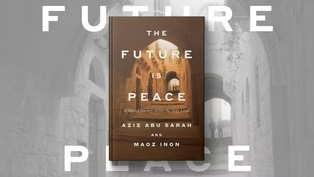
They tell that story in their new book, "The Future Is Peace."
Our Ali Rogin recently spoke with them.
ALI ROGIN: Aziz Abu Sarah, Maoz Inon, thank you so much for being here with me.
This book documents your literal and figurative journey together.
How did you start down this path?
MAOZ INON, Co-Author, "The Future Is Peace": The joint journey started only a few days after October 7.
On October 7, I lost both my parents.
They lived a quarter-mile from the border in Gaza.
And they were among the first victims of the Hamas attack.
And, on that day, I lost many of my childhood friends, people I knew my entire life.
And three days after, Aziz reached out to, offering his condolences.
And it was literally like a hand reaching out saving me from drowning into the ocean of sorrow and pain.
And in the last 2.5 years, we have been working together, co-authoring "The Future Is Peace."
And now I can say it very proudly and I'm privileged that I'm able to say it few times a day that, yes, I lost my parents and I lost so many, but I won Aziz.
I won Aziz as a brother.
ALI ROGIN: Aziz, you also, like Maoz, lost loved ones at the hands of those who you had been conditioned throughout your life to fear, to hate.
AZIZ ABU SARAH, Co-Author, "The Future Is Peace": Yes.
ALI ROGIN: How do you constantly not let the anger win?
Because you both made a conscious decision at one point or another not to pursue revenge.
AZIZ ABU SARAH: It's very hard when you lose a family member.
My brother Tayseer arrested by Israeli soldiers from home, an allegation of throwing rocks.
He was 18 at the time.
I was 9 years old.
He refused to confess to the charges, so he was tortured in prison, which resulted in untreated internal injuries.
And by the time he was released, he was pretty much on the deathbed.
And soon after he died, when he was 19 years old and I was 10 years old.
People want to hurt those who hurt them, and especially when you're 10.
And that's what I did for the next eight years.
That's what filled me the desire and the feeling of making those who killed my brother pay.
It stopped only when I went to study Hebrew in an ulpan and met Israelis for the first time who treated me like a human being, like an equal.
That's why I reached out to Maoz, because I understand -- my life changed because of somebody who reached out to me.
And I felt it's important for me to also reach out to those who have a terrible reality after Maoz's parents were killed.
We are together.
We are not against each other.
It's not Israelis versus Palestinians.
It's those of us who believe in justice and equality and peace versus those who don't yet.
ALI ROGIN: Why was it so important for you to take this journey of healing together?
AZIZ ABU SARAH: Yes.
So the way we wrote "The Future Is Peace" is as a journey, because both of us come from tourism backgrounds.
And the book follows that journey.
Israeli, Palestinian meet together and guide the readers and youth through this journey of eight days.
And this journey, we visit Maoz's hometown where he grew up, meet with people inside Gaza and tell us their stories.
We go through Jerusalem and Jaffa and Nazareth and Galilee, the West Bank.
We interview people who lost family members in the kibbutzim and in Gaza, for example.
And then we talk about the future.
And I think that's what make "The Future is Peace" very unique, because it's important to talk about the current reality and analyze and political things, very important, but that's not enough.
If you don't have a vision to where we're going, we will fail, and we will never get out of the hell we live in today.
MAOZ INON: There is anger within us, but we have decided, and it's a choice, we are offering it to everyone, to channel the bitterness, the sorrow, the pain, the trauma to create a different future, not to let those feelings destroy us.
Only two days after losing our parents, we were sitting together, three sisters, my young brother, and myself, every morning, and my young brother asked us to take a family decision, advising us to reject revenge, and telling us that we should not avenge the death of our parents, because avenging their death will only escalate the cycle of bloodshed, terror and trauma that we both, Palestinian and Israelis, have been trapped within for a century.
But I was still -- there was still a lot of bitterness within me, and a lot of anger, and I wanted to punish the Israeli government, because I hold the Israeli government accountable for the safety and security of my parents and so many of my childhood friends, because, again and again, the Israeli government promised us that wars will bring security and bombs will bring quiet.
But it totally failed on October 7.
And we are modeling and manifesting the future by the brotherhood that we have forged together, even though we was destined to be on opposite sides, but we choose to be on the same side, the same side of humanity, the same side of equality, of dignity, justice, and peace.
ALI ROGIN: In the book, you ask many difficult questions.
You have difficult conversations, and you talk about the importance of that.
Why is it so important to have difficult conversations, and what types of breakthroughs have you experienced in asking those tough questions?
AZIZ ABU SARAH: And one of the stories we share is my dad coming to a peace meeting and asking if the Holocaust really happened.
And he keeps going on, did it happen?
Is it just because Israel want to use it to justify their occupation?
And he keeps digging more and more.
And, eventually, when he finishes, there was silence, because people are not used -- I have to say, even within the peace movement, aren't used to those kind of questions.
We sometimes do walk over eggshells.
And Rami Elhanan, whose daughter was killed by a Palestinian suicide bomber, stood up.
And he said: "You know what?
I don't expect you to believe in something you never learned about.
So why don't you let my dad" -- his father was in Auschwitz before -- "take you to the Holocaust Museum and tell you his story?"
And 70 other Palestinians, all of them had lost family members in the conflict, stood up and said: "Actually, we also had the same question, but we didn't want to ask it."
And they went.
And it was very hard.
People cried.
People were upset at times.
People -- there were comparisons made that made people upset.
There's a photo in the Holocaust Museum of people standing at checkpoint, and the Palestinians passing by saying, this is like us in the morning going through the checkpoints.
And, for the Israelis, for the people who were -- experienced all this, they're like, no, no, it's not the same.
By the end, though, everyone was hugging.
Everyone was in tears.
Everyone understood so much.
And then the Israelis came and said, we want to learn about the Palestinian history after.
Can you take us to a Palestinian village that was destroyed in 1948?
Again, there were many questions, hard questions.
The Israelis asked things like, why did you run away?
You could have stayed.
And the Palestinians were going like, no, we didn't choose.
We were bombed.
What do you want us to do?
And they're going back and forth.
And asking those questions was important to build relationships.
Without it, I think the relationships be fake relationships.
ALI ROGIN: The spark that lit this fire that has become this book and this journey for you was really your shared grief over the loss of your loved ones.
They're not with us anymore on this Earth, but I wonder, how do you think they would feel about the work that you're doing now?
MAOZ INON: In moments like this one that we are sharing now, I feel them.
I feel Tayseer is here.
I feel my parents are here.
And they are very proud of us.
AZIZ ABU SARAH: I wish they were here so we could ask them.
But if they were here, this is what I hope they would say.
And it's a poem by Samih al-Qasim, a Palestinian Druze poet, who says: "The day I'm killed, my killer rifling through my pockets will find travel tickets, one to peace, one to the fields and the rain, and one to the conscience of humankind.
So I beg you, my dear killer, do not ignore them.
Do not waste such a thing.
I beg you to use these tickets and go traveling."
And that's what we believe our family members are saying.
And what we hope everyone who's listening, watching, reading "The Future Is Peace" is going to do, is to travel with us on this journey.
We will fail on our own.
The only way we can succeed is if people join us.
ALI ROGIN: The book is "The Future Is Peace."
Aziz Abu Sarah, Maoz Inon, thank you so much.
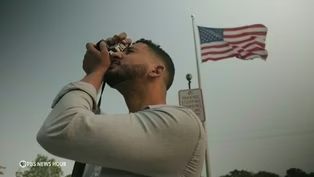
GEOFF BENNETT: Starting this weekend, a new series on PBS dives into the early history of Muslims in the U.S., looking at notable figures, communities, and spanning more than 200 years uncovering stories that few people have heard.
MAN: There's never been an America without Muslims.
WOMAN: I'm one of three journalists following the trail.
MAN: Each of us exploring a defining moment in American history.
WOMAN: Tracing a legacy that's coming back into view.
MAN: That's Jefferson's initial.
MAN: There was one of the founding fathers imagining Muslim Americans.
WOMAN: A completely new nation that included more than just Christians.
GEOFF BENNETT: It's a six-part documentary called "American Muslims: A History Revealed."
It launches this weekend on PBS stations across the country and on the PBS app.
Asma Khalid of the BBC is one of three hosts exploring all of this and joins us now.
Great to see you.
ASMA KHALID, BBC: Great to see you.
Thanks for having me.
GEOFF BENNETT: So what's the story that you're aiming to tell with this documentary series?
And why does it matter right now?
ASMA KHALID: So, Geoff, I've been a long-time political reporter.
I covered a lot of campaigns.
And I will say that there's long been an active debate in our country about who gets to be an American.
And I think that those conversations and that debate has become even more right now as we're inching closer to our nation's 250th birthday, debates over who is an American, what it means to be an American, and whose story is told.
And I think what's really interesting about this series and what attracted me to being a part of it is ultimately that the story is a lot more complex, it's a lot more nuanced.
And I think that that's what people will find when they would see the series, is that there's a really diverse part of America that we're not always told about, not just sort of on the margins, but central, stories around slavery, around the founding of this nation, a Muslim who was involved in the Civil War.
And I just love the idea that we're really engaging with that as our country... GEOFF BENNETT: Well, let's talk more about that, because there's one episode where you focus on a man who had been enslaved who ultimately becomes a property owner in Georgetown.
Let's take a look.
NARRATOR: We know that some African Muslims left their names.
They show up in plantation records and runaway slave ads.
Others left their writings, many of them in Arabic.
A few left their image.
Among them was Mamadou Yarrow, also known as Yarrow Mamout.
He was painted not once, but twice.
It's one of the things that makes him stand out.
PRECIOUS RASHEEDA MUHAMMAD, Author and Lecturer: He gives us a story of what it was like to gain freedom and then live after that and practice as a free person.
I don't think we have any other story like that.
GEOFF BENNETT: What did you learn about his life that really stayed with you?
ASMA KHALID: So, I would say what stayed with me the most is that I didn't know this story.
I didn't really know the details of it all yet.
And, Geoff, I admit I'm embarrassed to say that, because Mamadou Yarrow was a slave in Montgomery County, Maryland, where I live.
As you say, he bought a house.
He lived in Georgetown, the streets that I have walked so many times.
And I just wasn't intimately familiar with his story.
We used primary sources in a lot of these documentaries relying on letters, archive material, portraits, as you say.
I mean, Mamadou Yarrow's portrait hangs now in the Philadelphia Art Museum.
And, to me, that was just so important to know that here I am walking these same streets and there's a part of American history that resonates back with Muslims being here also for generations and generations that I had not really known.
GEOFF BENNETT: The series also traces Muslim communities coming to the U.S.
from South Asia.
What's the through line there?
ASMA KHALID: Yes, I mean, there's a lot of stories that we looked at that I think are grappling with some of the key debates that we're grappling with now as a nation, right, around issues of religious freedom, around issues of immigration.
And the episode that you mentioned there around South Asian migration dates back to the early, let's say, 20th century.
We had people coming from what is now India and Pakistan, which was then the British Empire, coming, settling in sort of California, Arizona, often intermarrying with Mexican women because of the racial laws at that time period.
And long story short, there is a lot in those conversations and those stories that deal with immigration and questions of exclusion and inclusion that we are to this day dealing with around our immigration system.
GEOFF BENNETT: When viewers finish this series, what do you want them to walk away with or to understand differently that they might not have known before?
ASMA KHALID: I'd love for people to get a sense that the American story is a lot more complex than perhaps we all initially thought, right, and that Muslims are a part of that story.
I think often, candidly, as a Muslim, I think people sometimes might see you as being foreign or other or a secondary person who moved here later.
And I loved what the story showed, because they showed that Muslims were a part of shaping our American story.
And that's been really meaningful for me as well to report on.
GEOFF BENNETT: Asma Khalid, one of the hosts of "American Muslims: A History Revealed" airing this weekend on PBS.
ASMA KHALID: Thank you.
GEOFF BENNETT: Great to see you.
ASMA KHALID: Great to see you.
AMNA NAWAZ: Remember, there's always a lot more online, including how communities are organizing against the construction of large-scale data centers.
That is on our YouTube page.
GEOFF BENNETT: Be sure to tune into "Washington Week With The Atlantic" tonight here on PBS.
Moderator Jeffrey Goldberg and his panel discussed the fallout from President Trump's alleged assassination attempt.
AMNA NAWAZ: And, on "Horizons" this weekend, William Brangham talks to Khan Academy founder Sal Khan about the rise of A.I.
in education.
GEOFF BENNETT: And on "Compass Points," moderator Nick Schifrin sits down for a rare interview with the CIA station chief in Pakistan during the successful bin Laden raid, which happened 15 years ago this weekend.
You can check your local listings for all of that.
Well, that is the "News Hour" for tonight and this week.
I'm Geoff Bennett.
AMNA NAWAZ: And I'm Amna Nawaz.
On behalf of the entire "News Hour" team, thank you for joining us, and have a great weekend.
 New
NewBrooks and Capehart on the Correspondents’ Dinner shooting
Video has Closed Captions
Brooks and Capehart on fallout from the White House Correspondents’ Dinner shooting (11m 2s)
 New
NewNew PBS series explores American Muslims’ overlooked history
Video has Closed Captions
New PBS series explores the often-overlooked history of American Muslims (5m 17s)
 New
NewNews Wrap: Trump announces 25% tariffs on cars from the EU
Video has Closed Captions
News Wrap: Trump announces 25% tariffs on cars and trucks from the EU (5m 43s)
 New
NewPalestinian and Israeli writers bridge divides in new book
Video has Closed Captions
Palestinian and Israeli writers reflect on bridging divides in ‘The Future is Peace’ (9m 39s)
 New
NewTrump rejects Iran proposal as he considers relaunching war
Video has Closed Captions
Trump rejects Iran’s latest proposal as he reviews new military options to relaunch war (6m 45s)
 New
NewWHCD shooting raises questions about presidential security
Video has Closed Captions
New video of Correspondents’ Dinner shooting raises questions about presidential security (6m 30s)
 New
NewWhich states to watch as battle for Senate control heats up
Video has Closed Captions
Which states to watch as the battle for Senate control heats up ahead of 2026 midterms (6m 23s)
Providing Support for PBS.org
Learn Moreabout PBS online sponsorship
- News and Public Affairs

Today's top journalists discuss Washington's current political events and public affairs.

- News and Public Affairs

FRONTLINE is investigative journalism that questions, explains and changes our world.
Urban Consulate Presents











Support for PBS provided by:
Major corporate funding for the PBS News Hour is provided by BDO, BNSF, Consumer Cellular, American Cruise Lines, and Raymond James. Funding for the PBS NewsHour Weekend is provided by...