
May 18, 2026 - PBS News Hour full episode
5/18/2026 | 57m 46sVideo has Closed Captions
May 18, 2026 - PBS News Hour full episode
Monday on the News Hour, San Diego police respond to a shooting an Islamic center that they're calling a hate crime. The DOJ creates a $1.8 billion fund that could compensate Trump supporters. We sit down with former FBI Director James Comey, who has been indicted for a second time. Plus, an Ebola outbreak has claimed more than a hundred lives.
Problems playing video? | Closed Captioning Feedback
Problems playing video? | Closed Captioning Feedback
Major corporate funding for the PBS News Hour is provided by BDO, BNSF, Consumer Cellular, American Cruise Lines, and Raymond James. Funding for the PBS NewsHour Weekend is provided by...
May 18, 2026 - PBS News Hour full episode
5/18/2026 | 57m 46sVideo has Closed Captions
Monday on the News Hour, San Diego police respond to a shooting an Islamic center that they're calling a hate crime. The DOJ creates a $1.8 billion fund that could compensate Trump supporters. We sit down with former FBI Director James Comey, who has been indicted for a second time. Plus, an Ebola outbreak has claimed more than a hundred lives.
Problems playing video? | Closed Captioning Feedback
Where to Watch PBS News Hour
PBS News Hour is available to stream on pbs.org and the PBS app.
Providing Support for PBS.org
Learn Moreabout PBS online sponsorshipAMNA NAWAZ: Good evening.
I'm Amna Nawaz.
GEOFF BENNETT: And I'm Geoff Bennett.
On the "News Hour" tonight: San Diego police respond to a fatal shooting at an Islamic center that authorities are calling a hate crime.
AMNA NAWAZ: The Justice Department says it's created a $1.8 billion fund that could compensate Trump supporters who say they were mistreated by previous administrations.
GEOFF BENNETT: We sit down with former FBI Director James Comey, who's been indicted for a second time.
JAMES COMEY, Former FBI Director: Whether it's this case or something else, they're going to come after me as long as Donald Trump is obsessing about it.
AMNA NAWAZ: And the U.S.
restricts travel from parts of Africa hit by the Ebola outbreak that's infected at least one American and claimed more than 100 lives.
(BREAK) GEOFF BENNETT: Welcome to the "News Hour."
As we come on the air tonight, we're following a developing story out of San Diego, an attack at an Islamic center.
AMNA NAWAZ: Police officials say three adult males were killed, including a security guard.
They also say the two teenage suspects, believed to be 17 and 19 years old, were later found dead, apparently from self-inflicted gunshots.
There was a massive police response this afternoon at the center located about nine miles north of downtown San Diego.
The site also houses a school.
And, as the situation unfolded, children could be seen being escorted to safety.
At a press conference this afternoon, San Diego's police chief thanked law enforcement for their efforts, especially when it came to those kids.
SCOTT WAHL, San Diego, California, Police Chief: I cannot express the gratitude, the willingness to step into harm's way, and I tell you what got me, watching the kids come running out just thankful to be alive.
GEOFF BENNETT: At that same press conference, the center's imam called this a time of sorrow and a time of sadness.
IMAM TAHA HASSANE, Islamic Center of San Diego: We have never experienced a tragedy like this before.
It is extremely outrageous to target a place of worship.
Our Islamic Center is a place of worship.
People come to the Islamic Center to pray, to celebrate, to learn, not only Muslims, but we have people from all walks of life.
GEOFF BENNETT: Officials say they're treating the shooting as a hate crime until proven otherwise.
AMNA NAWAZ: Today's shooting comes at a time of heightened concerns across a number of religious institutions.
In March, a man attacked a synagogue outside Detroit with a truck before dying in a confrontation with security guards.
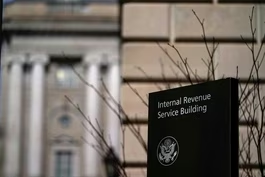
GEOFF BENNETT: Another story we're covering tonight, the Justice Department said today it's creating a nearly $1.8 billion fund that could compensate Trump supporters who say they were wrongly investigated or prosecuted by previous administrations.
AMNA NAWAZ: The announcement came as part of a settlement with President Trump to drop a $10 billion lawsuit he filed against the IRS over the leak of his tax returns in 2019.
The "News Hour"'s Liz Landers asked the president why taxpayers should foot the bill for the new fund.
DONALD TRUMP, President of the United States: This is reimbursing people that were horribly treated, horribly treated.
It's anti-weaponization.
They have been weaponized.
They have been, in some cases, imprisoned wrongly.
They paid legal fees that they didn't have.
They have gone bankrupt.
Their lives have been destroyed.
And they turned out to be right.
AMNA NAWAZ: Joining us now with more is our justice correspondent, Ali Rogin.
So, Ali, let's start with that lawsuit the president had filed against the IRS.
What was that about and how is it connected to this fund?
ALI ROGIN: Yes, this was filed earlier this year.
The Trump -- President Trump and members of his family filed this lawsuit, $10 billion, against the IRS, alleging that a leak of classified tax returns during his first administration caused financial and reputational harm to the Trump family and the Trump Organization.
We should note that the leaker was a federal contractor who is currently serving a five-year prison sentence.
This lawsuit set up an unprecedented situation where the president would be suing an agency of the government that he leads.
And since the DOJ also represents the federal agencies in courts, this lawsuit would have pitted President Trump suing -- against -- would have pitted President Trump against the Department of Justice, whose agenda the president obviously has helped steer.
And, of course, that agenda has included punishing his political adversaries.
AMNA NAWAZ: So was this announcement today, was it entirely a surprise?
ALI ROGIN: We had been hearing from Trump lawyers that they were signaling that they wanted to settle this out of court.
There were many open questions, though, about how that would take shape.
Now we know.
Trump's lawyers have dropped this lawsuit and the DOJ is going to set up what they're calling this anti-weaponization fund.
It will be made available to people who claim to have suffered what the DOJ calls - - quote -- "weaponization and lawfare."
Today's announcement did not define those terms, but recently the DOJ has made similar payments to former Trump White House and campaign officials who say they were victims of weaponized prosecution during the Biden administration, Amna.
AMNA NAWAZ: So, what more do we know about this so-called anti-weaponization fund?
Because it is a lot of money.
So what do we know about how it operates?
ALI ROGIN: It's a significant amount of money.
It has up to $1.776 billion available to be paid out.
Yes, that is 1776.
We don't yet know how much people can apply to receive.
We don't really know much about how they can apply in the first place.
What we do know is that this money comes from an existing fund that the DOJ has access to that allows them to settle and pay out cases.
In terms of criteria for who's able to claim, what they would need to show to be awarded, all the DOJ says on that score is that there are no partisan requirements to do so.
We also know that in terms of the people who are deciding these payouts, there will be a commission of five members appointed by the attorney general, one of whom will be done in consultation with Congress.
But we don't know who any of those five might be.
AMNA NAWAZ: So all of those questions have drawn strong backlash to these reports, the announcement of the fund, from Democrats and former government officials as well.
The big question here is, could President Trump stand to benefit himself?
Do we know?
ALI ROGIN: The Department of Justice says that as a condition of this fund going into effect and the settlement of this case out of court, President Trump cannot apply to be a claimant.
However, sources have told ABC News and others that it is possible that people associated with President Trump may not -- will not be barred from filing claims.
Amna, I also want to mention that there has been significant Democratic backlash from this.
Almost 100 House Democrats have filed suit to block what they are calling this slush fund.
Senator Elizabeth Warren today was on social media calling it -- quote -- "corruption on steroids," Amna.
AMNA NAWAZ: Our justice correspondent, Ali Rogin, thank you so much.
ALI ROGIN: You bet.
GEOFF BENNETT: Former FBI Director James Comey faces trial later this summer on charges he threatened President Trump's life.
The case stems from this Instagram post a year ago, a photo of shell spelling out 8647.
Prosecutors say the slang term 86 meant intent to do harm to Mr.
Trump, the 47th president.
It is the second indictment against the former FBI director in one of several investigations and lawsuits involving people President Trump sees as his political enemies.
Comey also has a new crime novel out, "Red Verdict."
It's a legal thriller centered on Russian espionage.
I spoke with him earlier today.
Former FBI Director James Comey, welcome to the "News Hour."
JAMES COMEY, Former FBI Director: Great to be with you.
GEOFF BENNETT: I want to start with your reaction to this DOJ announcement today.
The department says it's creating a nearly $1.8 billion fund, taxpayer money, to compensate Trump allies who say they were unfairly targeted by the previous administration.
What kind of precedent does this set?
JAMES COMEY: I have never heard of it.
And I first thought it was an Onion piece when I read about it.
I don't know how it will work and how it will be administered.
I kiddingly, want to know, do I get to apply?
Do all victims of weaponization get to ask for attorney's fees?
We will have to see.
GEOFF BENNETT: Would you submit a claim?
JAMES COMEY: I might, maybe just to be humorous about the whole thing.
But if it's for people who've been targeted for reasons other than the normal standards of the Department of Justice, I'm ready to get in line.
GEOFF BENNETT: On the DOJ case against you, the acting U.S.
attorney general, Todd Blanche, as you well know, he says this case goes far beyond a single Instagram post of a section of seashells on the beach.
Here's what he said on "Meet the Press" two weeks ago.
TODD BLANCHE, Acting U.S.
Attorney General: This is not just about a single Instagram post.
This is about a body of evidence that the grand jury collected over the series of about 11 months.
That evidence was presented to the grand jury.
And it's not the government, it's not the Department of Justice, it's not Todd Blanche that returned an indictment against James Comey.
It's a grand jury.
GEOFF BENNETT: So, you know how grand juries work.
Without discussing your defense, what do you think the government is trying to prove here?
JAMES COMEY: Yes, I don't know what he means.
It would be great if he would bone up on the rules that govern out-of-court statements.
I can't talk about the case.
He shouldn't be talking about the case.
We'll find out as the case goes forward.
GEOFF BENNETT: Were you aware that you've been under investigation for nearly a year?
JAMES COMEY: I can't answer that one.
I'm tempted to, but I really can't.
GEOFF BENNETT: Your lawyers, as I understand it, they're arguing selective and vindictive prosecution.
There's a fairly high bar for that.
Are you confident that a judge will dismiss this case or do you think it goes to trial?
JAMES COMEY: Well, we'll see how this case plays out.
In the last case that was thrown out, we made a vindictive and selective prosecution motion that I think was very strong.
It didn't get a chance to be granted because of the other problems with the case.
We'll have to see how this one goes.
GEOFF BENNETT: Right,.
That case was thrown out on a technicality, not the merits.
Are you concerned that the government in this go-round is being more careful and more intentional about how they prosecute this case?
JAMES COMEY: Yes, I don't want to comment on how they're doing this case.
Whether it's this case or something else, they're going to come after me as long as Donald Trump is obsessing about it and John Brennan and other people, his so-called enemies list.
That'll go on until he leaves office.
GEOFF BENNETT: Well, on that point, do you think the administration and President Trump, particularly, are they focused on securing a conviction or is the process itself a form of punishment?
JAMES COMEY: The last case, it struck me that the process was the punishment.
It didn't matter to them how it turned out.
They sacrificed the careers of lots of good people who resigned, rather than be part of it, or got fired, and they still pressed on.
So I think it feels more to me like it's about punishing.
GEOFF BENNETT: President Trump has been publicly fixated on you for nearly a decade, since 2017.
Do you have a sense of why?
Does it extend beyond what has been publicly established about your role in the Russia investigation?
JAMES COMEY: Yes, I don't know.
But there's no doubt there's an obsession there.
I'm kind of a relationship he can't get over it.
It doesn't go both ways.
I don't wake up at 3:00 a.m.
thinking about him and needing to talk about him on social media.
But I don't know what it is.
People have said it's you're too tall or it's something else.
I really don't know.
GEOFF BENNETT: You've said that people with credibility and institutional standing should be speaking out.
And yet we've heard nothing from Merrick Garland, from Lisa Monaco, from Chris Wray, from Bill Barr of late.
What do you make of their silence?
JAMES COMEY: I don't know, because I don't - - I'm not in their shoes.
I don't know what the limitations their career or their family circumstances present to them.
Everybody who can -- and I'm not saying they can, but everybody who can ought to be speaking, because it's dangerous to use the Department of Justice in the way they used it in charging me or in going after John Brennan.
So everybody who has a voice and the ability to speak ought to.
GEOFF BENNETT: Do you think, is -- silence itself these days is a form of complicity?
JAMES COMEY: Well, it depends upon the reason the person is silent.
But if you have the ability to speak and you're not speaking up and you know enough about how the rule of law matters, then it gets you into a zone of complicity.
I've said, look, I need to someday tell my grandchildren when they're teenagers, what did pop do during this time?
And I don't want to say he was afraid or he thought they would come after him.
That's not something you can look your grandchildren in the eye and tell them.
GEOFF BENNETT: How much damage under President Trump do you think has been done to the Justice Department?
And is it irreparable?
JAMES COMEY: Tremendous damage in the loss of talented people, in the demoralization of lots of people who are hanging on, in the reputation by taking off the blindfold that we like to use to depict Lady Justice and instead going after people for reasons that a Department of Justice never should.
All of those things have damaged the Department of Justice.
It's easily fixed.
Once these characters are gone, hundreds of people, including some I'm related to, I expect will flow back in and it can be rebuilt, because we've done it before.
It was done by Gerald Ford when he appointed Edward Levi, the president of the University of Chicago, to take over and become attorney general after one of the prior attorney generals went to jail.
So we've done it before 50 years ago.
We can do it again.
GEOFF BENNETT: Easily fixed?
JAMES COMEY: I think it is easily fixed, because it's all about the character of the people.
Get a great leader in there, pick strong people, and show your work to the American people.
That's what they did during Ed Levi's two years after Watergate, and it changed how people thought about the department.
GEOFF BENNETT: You have become something of a symbol of resistance to some on the anti-Trump left, but there are lots of Democrats who believe that your decision to announce the reopening of the Clinton e-mail investigation 11 days before the 2016 election, that that decision ultimately handed the presidency to Donald Trump.
You have said that you would make that same call again.
Do you ever sit with the possibility that everything that you're going through now is an extension of that decision?
JAMES COMEY: Yes, I have thought about it.
Someone asked me, what -- did I create a Frankenstein that then consumed me or something?
I don't think in that lyrical way, but it was -- yes, I mean, it's a decision that I would make today.
Would give anything not to have been involved and make it at all.
And I kind of doubt, after seeing 2020 and then 2024, that we had an impact on the election, but we went into it assuming that it could.
And it was just less bad than the other option.
GEOFF BENNETT: At the same time the Clinton investigation was announced, the FBI, we later learned, was also investigating the Trump campaign for ties to Russia.
You said nothing about that.
Voters went in knowing that Hillary Clinton was under scrutiny, not knowing about Donald Trump.
How is that not a thumb on the scale?
JAMES COMEY: That's actually us being consistent in the way we're treating these things.
The Clinton investigation was a criminal investigation that was not only public.
It was closed by us publicly.
And then I and the attorney general defended the work all summer.
The Trump-related investigation was a counterintelligence investigation that had just begun in the summer of 2016, where the candidate was not the subject of the investigation.
And so, actually, I don't remember any conversation about whether we ought to be publicizing a classified early investigation.
So they're just very different things.
GEOFF BENNETT: Let's talk about this book.
This new book, "Red Verdict," it centers on Russian counterintelligence, institutional vulnerability.
How much of it is fiction and how much is rooted in genuine concern about the country's ability to defend itself right now?
JAMES COMEY: Well, the work is a work of fiction.
So the stories I tell are made up.
What it is real in capturing is the nature of the people involved, sort of the zeitgeist of the counterintelligence work that they do, and the continuing threat from Russia.
And our adversaries in the counterintelligence space overwhelmingly were and are China, Russia and Iran.
And so here I have chosen to write about a fictional, but all too real threat from Russia.
GEOFF BENNETT: You know, in speaking with you prior to this interview and watching some of your other interviews, there is an optimism that you have.
I wonder what accounts for it, despite the firing, the indictments, your own family's sacrifice.
What gives you confidence that any of this comes back?
JAMES COMEY: Because I believe in the people who make up these institutions.
I just came from talking to a room full of college students who are burning to get involved and to make a difference.
And I know a little bit about our history, how screwed up America has been in my lifetime and before, and I believe America's line is a jagged line.
We make progress, we retreat, we make progress.
Our progress always exceeds the last retreat.
And so we're about to see a U-turn in this country that will make Hungary look like a pimple.
We are going to have a tremendous releasing of energy and progress.
And then, probably while I'm still alive, we will have another retreat, and then it will go on and on.
That's the American story.
GEOFF BENNETT: Former FBI Director James Comey, his new book, a crime novel, is called "Red Verdict."
Thank you so much for speaking with me.
JAMES COMEY: Thanks for having me.
GEOFF BENNETT: In the day's other headlines: President Trump says he's called off a strike on Iran that was planned for tomorrow.
In a social media post, Mr.
Trump said he did so at the request of Gulf allies and because -- quote -- "Serious negotiations are now taking place."
Iran's Foreign Ministry also said today that dialogue is ongoing, with Iran's top diplomat meeting with Pakistani officials today in Tehran.
Pakistan has been acting as a mediator in the talks.
Meantime, Treasury Secretary Scott Bessent is meeting with his G7 counterparts in Paris to address the economic challenges brought on by the war.
Bessent says more pressure on Iran is a top priority.
SCOTT BESSENT, U.S.
Treasury Secretary: We call upon all our G7 and indeed all of our allies and the rest of the world to follow the sanctions regime, so that we can crack down on the illicit finance that is fueling the Iranian war machine and give this money back to the Iranian people.
GEOFF BENNETT: Separately, Israeli airstrikes continue to hit Southern Lebanon today, as health officials there say more than 3,000 people have now died during recent fighting between Israel and the Iran-backed Hezbollah group.
The two sides agreed to a cease-fire last month, but have continued carrying out strikes ever since.
In California, a fast-moving brushfire north of Los Angeles is forcing tens of thousands of residents to flee their homes.
Aerial footage shows smoke rising over Simi Valley earlier today as windy conditions fanned the flames.
State fire officials say the fire started this morning shortly before 11:00 a.m.
local time and quickly grew to more than 180 acres.
Local TV footage showed at least one home on fire, and nearby schools canceled outdoor activities because of poor air conditions.
In New York, hundreds of thousands of commuters were left scrambling today after negotiators failed to settle a strike at the Long Island Railroad.
PROTESTER: What do we want?
PROTESTERS: Contract!
PROTESTER: When do we want it?
PROTESTERS: Now!
PROTESTER: What do we want?
PROTESTERS: Contract!
PROTESTER: When do we want it?
PROTESTERS: Now!
GEOFF BENNETT: Workers at the nation's largest commuter rail system are seeking higher wages, among other demands.
They walked off the job shortly after midnight on Saturday after talks with transit officials fell apart.
Unions and the MTA have been negotiating a new contract since 2023.
The strike has shut down the entire network, which serves more than 250,000 passengers each day between Long Island and New York City.
Talks between the two sides are ongoing.
An investigation is under way into the collision of two Navy jets during an air show at a military base in Idaho yesterday.
Eyewitness video shows the aircraft colliding midair near the base about 50 miles south of Boise before tumbling toward the ground.
You see it there.
Moments later, four parachutes deploy as the jets continued their descent, crashing and erupting on impact.
A Navy spokesperson says the aircraft, EA-18G Growlers, were performing an aerial demonstration at the time.
Officials say the base was locked down following the crash.
All four crew members are said to be in stable condition.
In Ukraine, military officials say a barrage of more than 500 Russian drones and missiles wounded more than two dozen people nationwide overnight.
Most of the injuries were in the southeastern city of Dnipro.
The strikes were in response to Ukraine's own attacks on Russia this weekend.
At least four people were killed, including three near Moscow.
It was one of Kyiv's biggest attacks against the Russian capital in over a year, and it comes as Ukraine is expanding its long-range capabilities.
Today Ukraine's Defense Ministry unveiled the country's first domestically produced glide bombs that can strike deep inside Russia.
Well, on Wall Street today, stocks ended mixed, as uncertainty over the Iran war keeps investors on edge.
The Dow Jones industrial average gained more than 150 points to start the week, but the Nasdaq lost ground, falling more than 130 points.
The S&P 500 ended a touch lower.
Still to come on the "News Hour": a jury throws out Elon Musk's lawsuit against OpenAI CEO and former colleague Sam Altman; Tamara Keith and Amy Walter break down the latest political headlines; and Muslims in Eastern India face intensifying political persecution at the hands of the government there.
AMNA NAWAZ: Health officials are racing to contain a rapidly expanding outbreak of a rare strain of Ebola in Central Africa.
The World Health Organization declared an international public health emergency over the weekend.
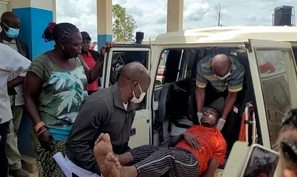
So far, at least 116 suspected deaths and more than 300 other cases have been reported in the Democratic Republic of Congo and neighboring Uganda.
Today, the CDC confirmed at least one American has contracted the disease, a medical missionary who had been working in a hospital in the DRC.
That country's health minister pleaded with residents to visit new government treatment centers if they had symptoms.
DR.
SAMUEL ROGER KAMBA, Democratic Republic of the Congo (through translator): This is not a mystical disease.
Make yourself known.
Make yourself known so that you can be taken care of and so that we can prevent the disease from spreading.
AMNA NAWAZ: For more, we're joined now by Dr.
Craig Spencer.
He's an associate professor of public health and emergency medicine at Brown University.
He also contracted Ebola himself while working as a physician in West Africa during a 2014 outbreak.
Dr.
Spencer, welcome back to the "News Hour."
Thanks for joining us.
DR.
CRAIG SPENCER, Brown University School of Public Health: Thank you for having me on to talk about this.
AMNA NAWAZ: So, on top of all this other news today, the U.S.
announced an entry ban for noncitizens who've been in the DRC, Uganda or South Sudan in the last three weeks.
Let me just ask you, what concerns you most about this outbreak given what we know right now?
DR.
CRAIG SPENCER: What concerns me most is that we learned way too much, way too quickly for this to be anything but really bad.
I am concerned about the next few weeks or the next few months.
We have found ourselves weeks, maybe months behind when this first started spreading.
Over the last year, we have lost a lot of the response capacity, particularly here in the U.S.
And I'm also concerned about the fact that this is in a really tough region, not just because of this outbreak, not just because it's at a border, but because it's a place with a lot of conflict with mobile populations.
This would be a hard outbreak to manage in an ideal situation.
This is absolutely not the ideal situation.
AMNA NAWAZ: OK, let's take some of those piece by piece here, because the timeline of this, it's now believed the very first suspected case was about three weeks ago, a man who died in late April in DRC.
What is it about this strain or about the circumstances that took so long for us to know what was going on?
DR.
CRAIG SPENCER: Well, I will posit that the first case was likely well before that.
I say that because you don't go from one case a few weeks ago to hundreds and hundreds of cases this quickly.
So I think this has been spreading a lot longer.
And as we get genomic analysis, we're going to be able to get a better idea of how long this has been going on.
But your question stands, why did it take so long for us to recognize this?
I think part of it is that this health zone, the health zones that are impacted have limited health infrastructure.
They are plagued by a lot of conflict and instability.
It's a place that I have worked a lot in the last 15 years.
It's a place that is really difficult to provide health care, to get around.
And I also think that there were delays at the testing level, particularly because this Bundibugyo strain is different than the majority of outbreaks in the past that have been caused by either the Zaire strain or the Sudan strain, which are much more common causes of Ebola outbreaks.
AMNA NAWAZ: Tell us more about what we know about this strain, the Bundibugyo strain, as you mentioned.
Do we know enough to know how the response should be different?
DR.
CRAIG SPENCER: For all intents and purposes, primarily from the health care side, this is exactly like and the management is very much the same as any other type of Ebola.
There's only been two other Bundibugyo outbreaks.
This is already the largest., in fact, this is one of the larger Ebola outbreaks in history after the 2014 outbreak and a 2018 outbreak in the same area in D.R.
Congo where there's currently an outbreak.
What's different about this strain is that, unlike the Zaire strain that caused the 2014 outbreak that I was infected with, we don't have FDA-approved treatments for Bundibugyo.
We do for Zaire.
We have vaccines.
We have treatments that can help drive down the death rate.
But, for this strain, we have no investigational, no approved vaccines, no approved treatments, which means that responding to and controlling this outbreak is going to require good epidemiology, good contact tracing and good bread-and-butter public health, which, again, is going to be really difficult in a place that is plagued by conflict, that has a lack of good health infrastructure and providers, and is quite suspicious of outsiders.
AMNA NAWAZ: I just want to give folks a sense of what it's like for people on the ground who are experiencing this, the sense of fear, because people in the DRC and the neighboring area are really frightened right now.
This is a man named Franck Amani, who's from the Eastern city of Goma, sharing what it's like.
FRANCK AMANI, Resident of Goma, Democratic Republic of Congo (through translator): I'm very scared because we have heard about Ebola in previous years.
And now we're hearing that Ebola is in Goma.
I'm calling on the local authorities to intervene because we're also scared because of the war and now because of Ebola., We're really scared.
AMNA NAWAZ: Dr.
Spencer, you have worked on the ground in DRC, in this region in particular.
Do they have what they need to respond to this?
DR.
CRAIG SPENCER: Absolutely not, no.
I don't think anyone in Congo would tell you that they do either.
Look, this was a region that was already a really tough spot to work before last year, when the U.S.
cut a lot of its support to USAID and other NGO partners that were working in the region, not only for health care, but for a whole host of other humanitarian support.
I have been told that there's not sufficient personal protective equipment.
I know, from working in many of these clinics, that there's not the basics like gloves or in some places even running water, which can be helpful in preventing transmission.
And, as you mentioned, this is a place that has been plagued by a lot of instability for decades.
We have already seen how that's - - that has contributed here to a lot of movement around the region.
We also know that there are cases in Goma, which is a very large city.
It's also a big connection point to other places throughout Congo.
And we have seen cases unrelated to each other in Kampala, the most populous city in Uganda, hundreds of kilometers away, all of which makes me realize, one, this is going to get a lot worse before it gets better, and two, we still don't have a full handle on what exactly we're grappling with yet.
AMNA NAWAZ: In the 30 seconds or so we have left, what do you want to see the U.S., other international actors doing right now?
DR.
CRAIG SPENCER: We need to surge, not just because we're worried that there will be more Americans infected or that it will get on a plane, but because this outbreak is already big.
Over the last year, anti-American sentiment has surged because of the way that we pulled out our support overnight.
We need to fully engage our CDC.
We need to get back on the ground, make sure that U.S.
support, financial, logistical, and medical support, can help end this outbreak before it gets worse.
Otherwise, it's going to be a problem, not just for the region, but for the rest of the world.
AMNA NAWAZ: Dr.
Craig Spencer with Brown University, thank you so much for your time.
DR.
CRAIG SPENCER: Thank you.
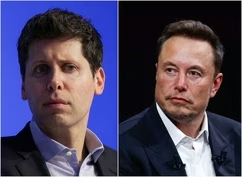
GEOFF BENNETT: The trial pitting two of the world's biggest tech billionaires against each other has come to an end.
A federal judge in California today dismissed a lawsuit from Elon Musk against the maker of ChatGPT after a jury found that he exceeded the statute of limitations.
Musk claimed that OpenAI, which he co-founded, had betrayed its original mission of developing artificial intelligence for the good of humanity when it added a for-profit arm.
OpenAI's other co-founders, including Sam Altman, said that Musk knew of the company's plans all along.
In a social media post, Musk called the verdict a -- quote -- "terrible precedent" and vowed to appeal.
For more on this, we are joined now by Gerrit De Vynck.
He's a tech reporter for The Washington Post who covered the trial.
Gerrit, it's always good to see you.
So you have got these two tech titans, three weeks in court, and the case gets thrown out on statute of limitations grounds?
So Musk's team knew that this was going to be a hurdle, so why bring the case anyway?
GERRIT DE VYNCK, Tech Reporter, The Washington Post: Yes, I mean, it's interesting.
I mean, this definitely came up before the trial.
A lot of people are asking, wait, if this was statute of limitations, why did we even go to a trial?
And the judge ordered this trial because there was a fact discrepancy.
There was different opinions about when Elon Musk knew what about OpenAI's transition.
And it was a bit of an open question.
And a part of the trial was definitely trying to figure out, OK, did Elon Musk know that OpenAI had made certain steps towards becoming a for-profit, towards taking on investment from outside investors?
Elon Musk said that he was kind of sort of paying attention, but not really aware because he's very busy, even saying certain documents that have been sent to him, that he only read the first page and decided not to keep going.
And so that's really what the jury said.
So there was a trial here.
There was a trial saying, when did he know what?
And, of course, we talked about a lot of other things that did not actually come to play in the jury's decision.
But, yes, we're here on statute of limitations.
Elon Musk says he will appeal.
So maybe we will get another run at this.
GEOFF BENNETT: So, during the case, what was OpenAI's response to Elon Musk's argument?
GERRIT DE VYNCK: Yes, so Elon Musk's argument, if you go beyond the statute of limitations, a complicating factor was that OpenAI stole a charity, that this was a nonprofit, it was meant to be founded for the benefit of all humanity, and that you can't turn that into a for-profit, that then the people who are invested in it become fabulously wealthy, which is true in terms of some of the OpenAI investors, including some of its executives.
The company said, look, you were there when we had all these conversations about starting a for-profit arm, you agreed with it at the time, and the company is still controlled by a nonprofit board.
So there's really nothing here for you to complain about.
And so those are kind of the questions that we are not sure exactly how the jury would have ruled if they had gotten to them, but that's really what a lot of the trial was about.
GEOFF BENNETT: And what more did we learn about Sam Altman, especially from his former colleagues who questioned his trustworthiness?
GERRIT DE VYNCK: Yes, I mean, one of the really interesting things here is that, even though OpenAI walks away from this with a win, it was a pretty damaging and sort of embarrassing season for them, right?
I mean, we had a lot of details about fighting going on at this company early on when it was founded.
And we got a lot more details about the incident when Sam Altman back in 2023 was fired and then rehired five days later.
A lot of the former OpenAI board members, former OpenAI executives who worked very closely with Sam Altman reiterated their claims in court that he is manipulative, that he has shown a pattern of lying.
And so even though Sam Altman is still in this position, the people he works with now publicly support him, these are questions that have kind of swirled around him for many, many years.
And this trial definitely boosted those questions.
And I don't think that they're going away any time soon.
GEOFF BENNETT: Does this make it harder for OpenAI to go public?
GERRIT DE VYNCK: I think it will probably be a question that OpenAI's critics kind of throw at it.
What about Sam Altman?
Is he trustworthy?
But at the same time, Sam Altman has been the boss of this company when it's seen some of the most incredible growth of any company, I would say, in history.
And so I think the people who really run the show at OpenAI, its big investors, Microsoft, SoftBank, its current board members, they all support Sam Altman.
He's working for them.
He's making things work.
They're all making a lot of money.
And so I think, when this company goes public, it will be not as much of an issue as maybe people like Elon Musk wanted to be.
And the fact that he's now had his lawsuit thrown out is something that OpenAI can draw on and say, look, a judge signed off on our situation.
There's nothing nefarious going on here.
Why don't you guys just leave us alone and let us continue being the company that we are?
GEOFF BENNETT: And, Gerrit De, for people who might see this as a high-profile schoolyard fight, a well-funded schoolyard fight, certainly, why does this matter?
GERRIT DE VYNCK: Yes, I mean, I think it matters because we had these two extremely powerful men on the stand.
They were under oath and they were asked questions.
We had a lot of information brought up through discovery and through evidence that was presented in the trial about how OpenAI operates, how wealthy its leaders are.
We know detailed information about the personal investments of people like Sam Altman.
That all helps people like me, historians who are going to be writing this chapter about the A.I.
revolution really understand what happened here.
And I think this trial just brought a lot of transparency to one of the most important companies of our day.
And so I think, regardless of the outcome, that is definitely something that will benefit the public's understanding of the A.I.
revolution.
GEOFF BENNETT: Gerrit De Vynck of The Washington Post, thank you for sharing your reporting with us.
Always good to see you.
GERRIT DE VYNCK: Any time.
AMNA NAWAZ: President Trump has successfully ousted a Republican senator who voted to convict him in his impeachment trial five years ago.
After losing his bid for a third term, Louisiana's Bill Cassidy took a thinly veiled swipe at the president last night.
SEN.
BILL CASSIDY (R-LA): Sometimes, it doesn't turn out the way you wanted to, but you don't pout, you don't whine, you don't claim that election was stolen.
You thank the voters for the privilege of representing the state or the country for as long as you have had that privilege.
AMNA NAWAZ: It's another sign of Trump's grip on the party, even as his popularity sinks to all-time lows.
Here to unpack this weekend's results in Louisiana and the next big test in Kentucky tomorrow, it's our Politics Monday duo, Amy Walter of The Cook Political Report With Amy Walter and Tamara Keith of NPR.
It's great to see you both.
AMY WALTER, The Cook Political Report: Hello.
TAMARA KEITH: Good to be here.
AMNA NAWAZ: As you well know, Bill Cassidy, yes, voted to convict President Trump in 2021.
Also, he was the deciding favorable vote for Pete Hegseth's confirmation, for RFK Jr.
And, Amy, as you know, he didn't just lose.
He finished third behind the Trump-backed candidate -- that's Representative Julia Letlow -- and State Treasurer John Fleming, who now go to a run-off.
What's the lesson here?
AMY WALTER: Yes, well, I think there are three ways to get elected right now as a Republican, to win a Republican primary.
Either get endorsed by Donald Trump, don't run against someone who has been endorsed by Donald Trump, and don't vote to impeach him.
There's been one person, one senator, who has been able to go the opposite of all three of those and still survive.
And that's Lisa Murkowski, the senator from Alaska.
She's able to win -- she was able to win reelection in 2022 because of the way that they vote in Alaska.
It's an all-party primary, so Democrats and independents can vote for her.
When Cassidy made that vote, by the way, in 2021, Louisiana had that same system, a very similar system.
The governor, Republican governor of the state, scrapped that system.
And so for the first time, he now had to run with just Republicans.
But I'm glad you put that clip on, Amna, about what he said at his concession speech, because I think that's the more interesting thing looking forward.
He clearly has nothing left to lose, but he's in Washington until January.
So does he use this time, where -- as he chastised the president for saying, you can't just do these things because you're unhappy that somebody stood up for the Constitution, is he going to follow through now and maybe become a real pain for the administration, maybe deny certain people from getting a nomination to a Senate-confirmed slot?
AMNA NAWAZ: Say the things he wasn't willing to say before, in other words.
AMY WALTER: Correct.
AMNA NAWAZ: What about you, Tam?
TAMARA KEITH: Yes, and Senator Thom Tillis of North Carolina is another person who, it's like, are retired, they can say whatever they think finally.
TAMARA KEITH: And you have already seen Cassidy, not just in that speech, but in just the last several hours, speaking out against policies from the Trump administration he doesn't support.
So I think that you're seeing that already.
In terms of the president's power within the party, he is proving that, in Republican primaries, his power is still mighty.
And what that means is that he is able to exact revenge against people who stand up to him.
You saw that in those Indiana state Senate primaries that I covered, where five out of the seven challengers won.
You also saw that in Louisiana.
And Trump's team is pretty confident that you're going to see that again in the Massie race in Kentucky.
We will wait for those results, obviously.
But this is about power.
Even though, as you said, President Trump's approval rating is in a really bad place, and he is starting to see some creep with some Republicans starting to separate from him a little bit, that is, in polls, he is able to maintain his power by proving that he can punish people who cross him.
And so, while he still has the House and the Senate, he is able to get them to do what he wants and not really push back on the things that a robust balance of power would call for.
AMNA NAWAZ: So let's bring folks up to speed on what we could expect to see in Kentucky, because tomorrow is the culmination of the most expensive House primary ever.
The incumbent, as you mentioned, Thomas Massie, is in a dead heat with former Navy SEAL Ed Gallrein.
Massie, just as a reminder for folks, voted against the so-called One Big Beautiful Bill.
He said it was concerned about how much it added to the debt.
He also pushed for the release of the Epstein files.
And we heard President Trump today talk about that race and weigh in.
Take a listen.
DONALD TRUMP, President of the United States: Massie's the worst congressman in the history of our country, always voting against Republicans and good values.
So get rid of Thomas Massie.
AMNA NAWAZ: Amy, is he going to have the same influence in Kentucky?
AMY WALTER: Yes, so here's the real question for voters in this district.
Remember, Thomas Massie's been in Congress since 2012, so he's not brand-new.
This is not new the way he -- voting against the Republican leadership in the House is something he's done consistently.
So, are voters here going to feel that the bigger issue is he was disloyal to Trump?
Or will they look at him and say, but actually he was loyal to this sort of - - his sort of iconoclastic brand, which is, he feels very strongly about certain things and he votes that way, and voters in the state will reward him for standing up on those values, many of them driven on issues like the deficit?
He's libertarian on some other issues.
AMNA NAWAZ: Yes.
AMY WALTER: But I think you're right.
I think it was the Epstein issue itself that became the real flash point.
AMNA NAWAZ: Tam, what do you think?
TAMARA KEITH: Yes.
And this is a Republican primary in a red state.
So it is a pretty small electorate that's going to show up for a Republican primary in a red state, even though so much money has been spent on it.
But that message from President Trump really just clearly shows how much this matters to him politically to be able to vanquish anyone who dares to cross him.
He also has now gone after Congresswoman Lauren Boebert, who campaigned with Massie.
She also supported the Epstein legislation.
AMNA NAWAZ: I want to ask you both too about a story we reported on earlier about the DOJ creating this $1.8 billion fund that could compensate allies of President Trump who claimed they were targeted by previous administrations.
And that was all part of the president dropping his lawsuit against the IRS for releasing - - leaking of his confidential tax returns.
This is a lot of money, Amy, billions of dollars we're talking about, on top of another billion dollars we talk about for security for the White House ballroom.
How does that line up with how American voters are looking at this?
AMY WALTER: Right.
Well, they're not feeling very great about the economy or the president's handling of it.
The New York Times -- I just had to write down what this was, the New York Times poll out this weekend.
Voters' perception of how Trump's handling the economy, 28 percent approval rating on handling the -- I'm sorry -- the cost of living.
And so this is not an issue in which the president is looking particularly strong.
But, fundamentally, I think the issue for voters right now, what's really driving this, is Iran.
And while the ballroom and the DOJ fund certainly do not help make the case or help Republicans make the case that they care about the cost of living, the biggest impediment right now to making things affordable is the Strait of Hormuz being closed.
And while that is still closed, it's going to be very hard really for anybody to feel confident about the economy going forward.
TAMARA KEITH: Yes, and there is a straight line from the way President Trump campaigned in 2024 to this settlement.
He said, I am your retribution.
He has spent -- he has focused on other things, but one consistent through line in his entire first year-and-a-half is seeking retribution against those who he believes have wronged him.
And he feels that the Biden Justice Department was weaponized against him and his supporters.
And so this settlement fund -- although President Trump is claiming he doesn't know anything about it and he's hearing it's well-received, this settlement fund is part of a broader effort from President Trump to rewrite history about that era from 2021 through him winning reelection again.
And in some ways, this was baked in the cake when he won.
AMNA NAWAZ: Tamara Keith, Amy Walter, thank you so much.
TAMARA KEITH: You're welcome.
AMY WALTER: You're welcome.
GEOFF BENNETT: Earlier this month, political violence erupted in Eastern India after Prime Minister Narendra Modi's party won key elections amid allegations of voter suppression targeting Muslims.
That campaign was marked by allegations of anti-Muslim hate speech, calls for violence, and a controversial citizenship crackdown targeting Muslims in the Indian border states of Assam and West Bengal.
Producer Zeba Warsi reports from Assam on families now fighting to prove they belong in the only country they have ever known.
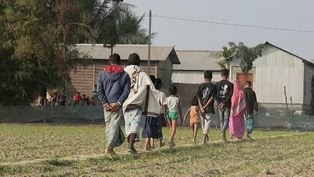
ZEBA WARSI: In this remote village in Northeast India, three generations of one family could soon become stateless.
The patriarch, we will call him Ramzan to protect his identity, is a husband yearning for his wife, who was taken from him because of their ethnicity.
"RAMZAN," Resident of Assam, India (through translator): I can't explain how my days are going.
I don't know what to do, how to live.
I'm barely surviving without her.
ZEBA WARSI: Ramzan's wife is in immigration detention.
This is the first time in 50 years that they have been separated.
Theirs is a love story written across time, born and raised on this land just years after India gained independence from British colonial rule in 1947.
They grew up side by side.
"RAMZAN" (through translator): We loved each other all our lives.
We have had no fights all these years.
We were each other's peace.
ZEBA WARSI: But that peace was shattered when state authorities labeled both of them doubtful citizens.
In the key Eastern Indian states of Assam and West Bengal, both bordering predominantly Muslim Bangladesh, authorities have asked tens of thousands of residents like them to prove their citizenship.
India shares a 2,500-mile border with Bangladesh, a country that once was a part of pre-independence India.
In recent years, human rights activists say Assam's administration, ruled by Indian Prime Minister Narendra Modi's political party, has revived a decades-old immigration law, one that critics say disproportionately targets Bengali-speaking Muslims, who historically have lived on both sides of the India-Bangladesh border.
We are in Guwahati, the capital city of the Indian northeastern state of Assam, which is now at the center of the Modi administration's citizenship policies.
But, beyond that, the millions of Bengali Muslims here have been the target of hate speech and a crackdown that has sparked concerns of a similar crackdown being launched across India against its religious minorities.
Nearly 12 years of Modi's rule in India has been marked by democratic backsliding.
Here's a young Muslim boy being beaten by state authorities.
Critics say India's 200 million Muslims, the world's third largest Muslim population, have been hardest hit with a sharp rise in discrimination and hate crimes.
Now the Modi administration has also launched a controversial revision of electoral roles that has excluded millions of people, mostly Muslims, stripping them of their right to vote.
In Assam the past year, more than 1,000 people have reportedly been deported to Bangladesh, often without due process.
ANGANA CHATTERJI, University of California, Berkeley: Prejudicial laws and policies have weaponized citizenship in India, and a pivotal objective of the Hindu nationalist party has been to alter the basis of Indian citizenship.
ZEBA WARSI: Angana Chatterji is an anthropologist and a scholar of South Asia studies at U.C.
Berkeley.
She said the citizenship crackdown in Assam is an extension of the Modi administration's anti-Muslim policies.
ANGANA CHATTERJI: They have sought to amplify the ascent of a majoritarian state in India.
The Assam experiment is a case in point where they want to demonstrate both to their own cadre and constituency that they are in fact targeting Muslims and to Muslims to send a reverberating message that they are not welcome, that they are outsiders, that they are not of the nation.
ZEBA WARSI: Ramzan's family has worked this land for generations.
In India, citizenship is by descent.
If both Ramzan and his wife lose their case, their children and grandchildren could become stateless and lose everything.
"RAMZAN" (through translator): How can we be Bangladeshi when we were born here, lived all our life here?
I am ready to die for India.
I don't know what I would do if they deported my wife.
I feel like dying is better than a life without her.
ZEBA WARSI: The state government did not respond to "News Hour"'s requests for comment, but has previously said it is only acting against illegal immigrants.
But the Washington-based research group Center for the Study of Organized Hate has documented 32 instances of hate speech and eight calls for violence in Assam last year.
Last month, the state went to polls and the campaign was also marked by dozens of hate speech events.
At his own election rallies, Modi invoked anti-Muslim rhetoric, referring to Bengali Muslims as infiltrators.
NARENDRA MODI, Indian Prime Minister (through translator): Our government has rooted out these infiltrators from millions of acres of land.
Don't you want these infiltrators out of Assam?
Shouldn't these infiltrators be expelled?
Who can get this done?
Your vote to the BJP will get this done.
ZEBA WARSI: But some of the most incendiary remarks came from the state's chief minister, Himanta Biswa Sarma, Modi's man in Assam, who has just been reelected and has vowed to intensify his crackdown against Bengali Muslims.
HIMANTA BISWA SARMA, Chief Minister of Assam, India (through translator): We broke their hands and legs politically.
This time, we will break the very backbone of the Bengali Muslims.
ZEBA WARSI: Since taking office in 2021, Sarma has been accused of weaponizing existing forest protection laws and colonial era land laws to evict at least 50,000 people, most of them Muslims, from their homes.
As we traveled from village to village, we saw thousands of homes reduced to rubble.
Behind me, on the banks of one of India's largest rivers, is a makeshift relief camp put up not by humanitarian aid agencies, but by displaced families themselves.
It is one of many such camps that have come up across the state.
They rebuilt what they could.
This is flood-prone land.
When the river rises, this will disappear.
But for now, it holds life, barefoot children somersaulting in the sand, teenage friendships, women gathered in bright, worn saris, survival, not stability.
AMNA KHATOUN, Displaced Resident (through translator): We cried a lot.
All the people you see here were crying that day.
ZEBA WARSI: Amna Khatoun home was bulldozed by state authorities.
She's trying to be brave for her family.
But that moment haunts her.
AMNA KHATOUN (through translator): We labored hard for other people all our lives to build a house for ourselves.
And they demolished it in a few minutes.
They snatched everything from us.
ZEBA WARSI: She's a mother of four.
And like any mother, she fears for their future.
The day we met this community, about 100 miles away, state authorities bulldozed more than 1,000 additional homes, displacing even more families.
On our way back to the city, the "News Hour" crew was stopped by local police and questioned for nearly two hours, a tactic often used to intimidate journalists reporting on marginalized communities, like families in this village of fish net weavers.
Dozens of them have for years been asked to prove their citizenship.
SULEIMAN NISA, Resident of Assam, India (through translator): We are from this country.
We are not from Bangladesh.
Even my grandfather was born in India.
They're prosecuting us through this foreigner tribunal, even though we have never been foreigners to this land.
ZEBA WARSI: The Foreigners Tribunal is a quasi-judicial body that critics say arbitrarily decides if someone is an Indian citizen or a foreigner.
Suleiman Nisa and her husband were both accused of being illegal immigrants.
She won her case, proving that she's Indian, but lost everything, the love of her life, her husband.
SULEIMAN NISA (through translator): He was a simple good man who earned an honest living and took care of all of us.
ZEBA WARSI: Families in this village make not more than $100 a month.
When her husband first received a tribunal notice, he borrowed money for legal fees, sinking into a debt of $3,000, far beyond his means.
Just when they believed the case was over, the tribunal demanded more evidence.
Her husband then took his own life.
SULEIMAN NISA (through translator): It feels as if he would return to me like he used to return after work every day.
All I want is that no other woman be made to go through what I have.
ZEBA WARSI: That is the plea of a wife who has lost her husband and the desperation of a husband who fears losing his wife.
But, with this election, the administration they say has targeted them appears only further emboldened.
For the PBS "News Hour," I am Zeba Warsi in Guwahati, India.
GEOFF BENNETT: As always, there's a lot more online, including a look at a former prison guard who testified today in the Epstein investigation.
That's at PBS.org/NewsHour.
AMNA NAWAZ: And that is the "News Hour" for tonight.
I'm Amna Nawaz.
GEOFF BENNETT: And I'm Geoff Bennett.
For all of us here at the "News Hour," thanks for spending part of your evening with us.
Bengali Muslims face persecution and displacement in India
Video has Closed Captions
Bengali Muslims in India face persecution and displacement amid citizenship disputes (9m 26s)
Doctor who survived Ebola shares concerns about new outbreak
Video has Closed Captions
Doctor who survived Ebola shares concerns about latest outbreak in Central Africa (7m 5s)
DOJ says $1.8B fund could compensate 'targeted' Trump allies
Video has Closed Captions
DOJ creates $1.8 billion fund that could compensate 'targeted' Trump allies (4m 34s)
Jury throws out Musk's lawsuit against OpenAI and Sam Altman
Video has Closed Captions
Jury throws out Musk's lawsuit against OpenAI and Sam Altman (5m 54s)
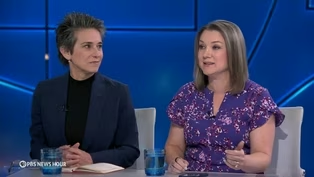
Tamara Keith and Amy Walter on Trump's grip on GOP primaries
Video has Closed Captions
Tamara Keith and Amy Walter on Trump's power in pushing out 'disloyal' Republicans (8m 56s)
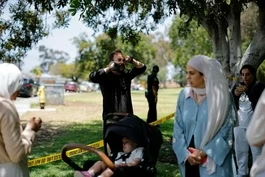
Teenage gunmen open fire on Islamic center, police say
Video has Closed Captions
Teenage gunmen open fire on Islamic Center of San Diego, police say (1m 55s)
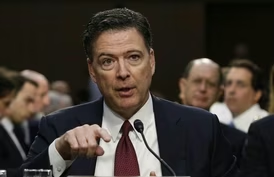
'There's an obsession there,' Comey says of Trump
Video has Closed Captions
'There's an obsession there,' Comey says of Trump after 2nd indictment (10m 1s)
Providing Support for PBS.org
Learn Moreabout PBS online sponsorship New Episode
- News and Public Affairs

Today's top journalists discuss Washington's current political events and public affairs.
 New Episode
- News and Public Affairs

FRONTLINE is investigative journalism that questions, explains and changes our world.
Urban Consulate Presents
 New Episode
 New Episode
 New Episode
 New Episode
 New Episode
 New Episode
 New Episode
 New Episode
 New Episode
Support for PBS provided by:
Major corporate funding for the PBS News Hour is provided by BDO, BNSF, Consumer Cellular, American Cruise Lines, and Raymond James. Funding for the PBS NewsHour Weekend is provided by...