
Luis Valdez's play commented on identity and assimilation
Clip: 10/6/2026 | 3m 6sVideo has Closed Captions
Luis Valdez's play, "Los Vendidos," or the sellouts, was a commentary on assimilation and identity.
Luis Valdez's television play, "Los Vendidos," or the sellouts, was a commentary on assimilation and cultural, racial, and political identity. Valdez's inspiration for the play came from his older brother, Frank, who looked for happiness within American values, yet saw how much racism prevailed in the U.S.
Problems playing video? | Closed Captioning Feedback
Problems playing video? | Closed Captioning Feedback
Support for American Masters is provided by AARP, The Rosalind P. Walter Foundation, Thea Petschek Iervolino Foundation, Burton P. and Judith B. Resnick Foundation, The Philip and Janice Levin Foundation,...
Support provided by:

Luis Valdez's play commented on identity and assimilation
Clip: 10/6/2026 | 3m 6sVideo has Closed Captions
Luis Valdez's television play, "Los Vendidos," or the sellouts, was a commentary on assimilation and cultural, racial, and political identity. Valdez's inspiration for the play came from his older brother, Frank, who looked for happiness within American values, yet saw how much racism prevailed in the U.S.
Problems playing video? | Closed Captioning Feedback
Where to Watch American Masters
American Masters is available to stream on pbs.org and the PBS app.
Buy Now
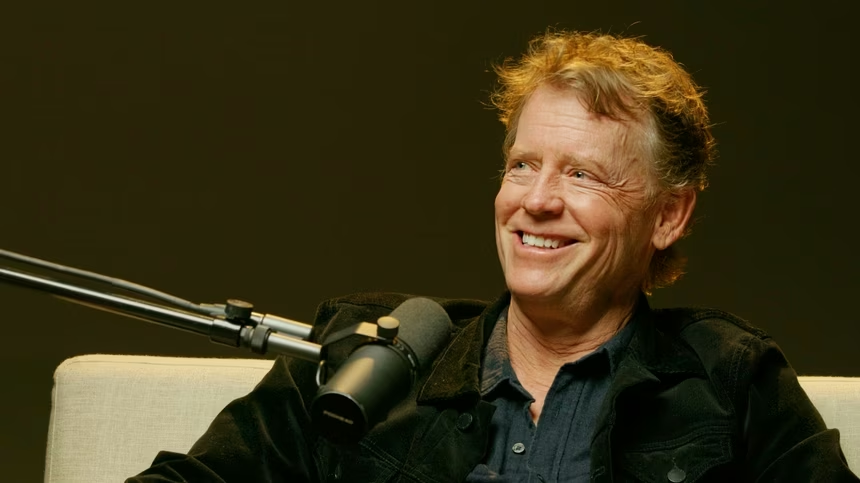
A front row seat to the creative process
How do today’s masters create their art? Each episode an artist reveals how they brought their creative work to life. Hear from artists across disciplines, like comedian Chris Fleming, actor Greg Kinnear, sports journalist Taylor Rooks, and more on our video podcast "American Masters: Creative Spark."Providing Support for PBS.org
Learn Moreabout PBS online sponsorship(upbeat music) (horn honking) - [Luis] One of the first pieces that we developed on television was a play called "Los Vendidos," the sellouts.
- I'm Honest Sancho, and this is my shop.
Más antes, I used to be a labor contractor, now I'm a businessman, que suave, no?
- And he is selling various kinds of Mexicans.
- We're looking for a Mexican type model for our administration.
- Well, you came to the right place, señorita.
- These are automatons.
That's the pretense.
We have Honest Sancho selling these used Mexicans.
And so she goes to the litany of several types.
- Listen to this.
(clicker snapping) - Viva Villa!
- That's awfully loud.
- Oh, well, he's got a volume control.
(clicker snapping) - Viva Villa!
(clicker snapping) - That's better.
- They dressed me up like a very middle class educated person.
- I've never see any of those.
- It even drove the message in deeper about this assimilation, this "sellout" is the word "vendido."
It's true, we need Mexicans such as these, but it's more important that he be American.
- American?
- Yes.
- Mexican, but American.
- That's correct.
- Introducing our Mexican American.
(humming) (clicker snapping) - Oh, my goodness.
Where have you been hiding this one?
- [Honest] He just arrived on the plane this morning.
- Yeah.
She marches out thrilled that she's got this Mexican American.
- Bye, Senorita and don't forget.
- And then in a moment's time, the Honest Sancho character runs out of power.
The twist is he's the robot and those guys, the other characters that are there, they are the real people.
How much did she end up paying?
15,000 bucks, that ain't bad.
- This was now dealing with issues of identity, cultural, as well as racial, and political identity, because the objective of this little shop was to create enough Mexican Americans that would be bought and sold within the system to integrate the whole of American society, to go and infiltrate and become part of American society.
- Listen, according to the map, we've got Chicanos infiltrating every major urban center in the U.S.
- All right.
- Look at this.
Los Angeles, San Francisco.
(light music) - The idea of that show came from my older brother.
Frank was looking for his happiness in terms of the values that America has always espoused.
But at the same time, he would tell you how much racism there was on this military base and that he was having troubles because he was brown.
- I come before you tonight as a Mexican American to tell you of the problems of the Mexican.
He needs to think American, (hands banging) American, American, American, American, (hands banging) American, American, American.
(hands banging) God bless America, (hands banging) God bless America, (hands banging) God bless America.
(hands banging) - Oh, my, he's patriotic too.
- Yes.
He loves that word.
Let me just make a little minor adjustment.
- Yes.
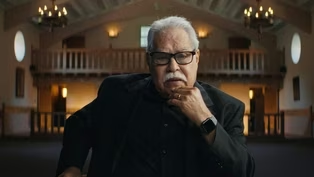
American Pachuco: The Legend of Luis Valdez
Video has Closed Captions
Discover filmmaker and playwright Luis Valdez, a founding figure of the Chicano Movement. (2m 10s)
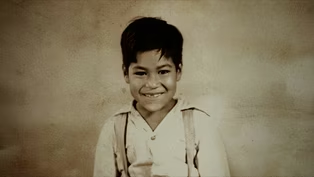
Luis Valdez's farmworker origins
Video has Closed Captions
Luis Valdez was born in a farm labor camp in Delano, California to farmworker parents. (57s)
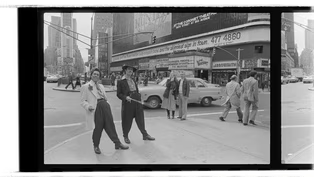
When "Zoot Suit" reached Broadway
Video has Closed Captions
Luis Valdez's "Zoot Suit" was the first Chicano play on Broadway. (1m 12s)
Providing Support for PBS.org
Learn Moreabout PBS online sponsorship











Support for PBS provided by:
Support for American Masters is provided by AARP, The Rosalind P. Walter Foundation, Thea Petschek Iervolino Foundation, Burton P. and Judith B. Resnick Foundation, The Philip and Janice Levin Foundation,...