
The Story: LIFE & DEATH
Episode 4 | 24m 51sVideo has Closed Captions
Death is a certainty in life, and we must all learn to walk with grief.
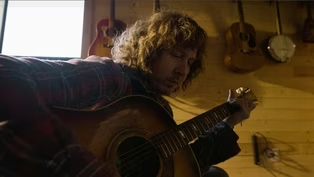
Death is a certainty in life, and we must all learn to walk with grief. Featured stories involve a traveling hospice nurse in one of the state’s most remote counties and a father who grapples with his son’s death the only way he knows how: through music.
Problems playing video? | Closed Captioning Feedback
Problems playing video? | Closed Captioning Feedback
Made Possible By: H-E-B and Texas Parks & Wildlife Foundation
The Story: LIFE & DEATH
Episode 4 | 24m 51sVideo has Closed Captions
Death is a certainty in life, and we must all learn to walk with grief. Featured stories involve a traveling hospice nurse in one of the state’s most remote counties and a father who grapples with his son’s death the only way he knows how: through music.
Problems playing video? | Closed Captioning Feedback
How to Watch Texas Monthly Presents: The Story
Texas Monthly Presents: The Story is available to stream on pbs.org and the free PBS App, available on iPhone, Apple TV, Android TV, Android smartphones, Amazon Fire TV, Amazon Fire Tablet, Roku, Samsung Smart TV, LG TV, and Vizio.
Providing Support for PBS.org
Learn Moreabout PBS online sponsorship- [Sasha] Loss and grief are universal experiences.
- [Dina] I was pretty immersed in writing about grief my own and other people's.
- Like, I need to actually just walk through this instead of run away from it.
- [Sasha] She's one person making an incredible difference in the face of the absolute worst grief.
You have to find ways to kind of walk with it.
(soft music) (no music) (spirited music) - [Sasha] Isolationism kind of goes hand in hand with a sense of freedom.
I think some people feel truly free in cities where you're among the throngs of people and you feel anonymous.
But for me, that sense of freedom comes most in places like West Texas.
But the systems that exist in big cities just don't extend out there.
And so, they're sort of forgotten.
They're forsaken.
Loss and grief are universal experiences, but access to healthcare is not.
My name is Sasha von Oldershausen.
I'm a staff writer with "Texas Monthly" magazine, and I wrote "To Live and Die in Far West Texas" (wind chimes tinkling) - Hi Juan!
How are you?
What you doing out in this wind?
- What?
- I said, you better be careful you don't get blown away.
You doing okay?
- Yeah, I'm doing alright.
- Alright.
Let's get you in and checked out.
- [Sasha] For a really long time, people who lived their whole lives in this area would die in a city that was completely unfamiliar to them because they had to go to a hospital and be taken care of in a clinical setting.
Whereas hospice care is often in the comfort of a person's home.
- My name is Karen Ramirez.
I'm a RN that works for Angels Care Hospice.
I've been a resident in Brewster County for 31 years.
Raised my three kids here.
- [Sasha] Brewster County is the biggest county in Texas.
It's made up of just three tiny towns, Alpine, Marathon, and Terlingua.
But geographically, it's enormous.
It's larger than the state of Connecticut.
Hospice care hadn't existed in Brewster County until recently.
Angels Care hired nurse Karen Ramirez to serve this large territory where there was a clear need.
She was the one functioning hospice nurse in town.
I learned about Karen Ramirez through my friend, Sage.
(soft music) Her dad was dying of pancreatic cancer.
And around that same time, my partner's sister was dying of ovarian cancer.
A lot of our experiences felt parallel and analogous.
- [Sage] This is one of the last happy family photos we have.
- [Sasha] The critical difference between us was that Sage's dad was in Alpine, Texas.
And Tamara, my partner's sister, was being treated in Boston where she had access to some of the finest healthcare available.
- I think at that point, he kind of knew that his body only had so much left.
- [Sasha] Sage's father was being treated at MD Anderson in Houston.
His treatment options were becoming increasingly limited, so they made the decision for their family to choose hospice care.
- [Sage] My parents were both teachers and my dad was a coach, so she knew them through having her kids in the school.
- [Sasha] Karen knew Rick, and she knew all of Sage's family, so she would never refer to him by his first name.
She'd always call him "Coach" - I believe that everybody should be given the chance to have their loved ones at home.
Let them be comfortable and let them spend whatever time doctors say they have left and whatever time God gives them to be at home and be comfortable.
- [Sasha] Karen decided to do hospice care after her own mother was dealing with a terminal illness.
- [Karen] Mom wanted to be comfortable at home, so we went on hospice palliative care.
- [Sasha] She saw the impact that it could make on a person's life, and she was really drawn to that.
Karen spends a lot of her day driving.
Driving enormous distances to get from one house to the next.
- [Karen] I never know what time my day's gonna start.
I've gotten woken up at five o'clock in the morning, gone to Fort Stockton 75 miles away, come back, and did two Alpine visits at our local, and then drove Terlingua which is 102 miles away.
So that day, I logged in over 400 miles.
You're on call 24/7.
And no matter what kind of day you had, no matter what kind of weather it is, you've got to go.
People are counting on you.
It can be intimidating.
There are days that you're like, "I can't drive anymore, I was up until 11 o'clock last night."
But once you start driving, you're okay with it.
I mean, if you look around, this is my office.
My office is beautiful.
- [Sasha] So much of Texas is rural, made up of small towns with little access to just basic resources.
And they have to live life and experience death the way that the rest of us do.
But with much less available to them.
- [Karen] How's your pain today?
- About around 3.
- [Karen] About a 3?
Is it to your hips?
Or some to your hips?
- My hip, yeah.
- Alright.
Deep breath in and out.
Just relax.
I'm gonna take a listen to your heart.
Okay, let's go and see how chubby you are.
Let me get your cane.
(Karen exclaims) I'm so proud of you!
You are up to 114 pounds!
Good job, Juan!
We're gonna have to write that one down for the books.
You gained 0.2 pounds.
- [Sasha] Karen is someone you get the sense just from talking to her that she's deeply caring.
- [Karen] Oh, we need a refill on that.
- I can call her anytime.
You know?
Night and day.
First contact, it's her.
- Your oxygen level is perfect, and I'm so proud of you for gaining weight!
So if you need anything, you just give me a call.
- Okay.
- Alright.
I'll be back.
I'll be back tomorrow with your meds.
- [Juan] Thank you!
- You're welcome!
(wind chimes tinkling) - [Sasha] Before people who had spent their whole lives living in a specific place were suddenly uprooted in those most vulnerable moments at the end of their lives.
Karen provided a necessary medical resource, but she also provides permission to allow families to be together in those last moments.
- Yeah, it just didn't feel like you were bringing a stranger in to like watch this really vulnerable moment.
It kind of felt like really comfortable having this person who... Was connected with who he was and also, you know, she shed some tears herself the first day that she got there.
'Cause she was like, you know, understood the gravity of who we were losing and who this town was losing.
It was just exactly what we needed to come home and have somebody really know who he was and really be ready to receive us and support us.
- [Sasha] Sage's dad passed away just a few days after he returned home.
But he was able to be home surrounded by his wife and his daughters.
And the comforts of all that was familiar to him his whole life.
(soft music) I think people squirm from the term "hospice care" because they see it as going hand in hand with death.
But really it's about allowing people to enjoy as much as they can.
Those last moments in life.
She's one person, but she's making an incredible difference in this community.
Incredible difference.
And I think if we can sink more resources into programs like that, that can give hope to communities like this.
(soft music) ♪ - [Dina] I think one of the hardest things about grief is the helplessness.
There's nothing you can do.
You cannot bring them back, there's no magic wand, there's no spell.
How do you function in the world?
Especially when it's a parent losing a child in the face of the absolute worst grief, how does anybody get out of bed?
And find ways to go on with their life?
My name's Dina Gachman, and I'm a contributor to "Texas Monthly" And I wrote the piece "Ben Kweller is Playing Through the Pain" (guitar strumming) When this story came to me, it was actually from an editor at "Texas Monthly" She had reached out to me and said, did I know about Ben Kweller, did I know his music, and did I know his story.
- [Ben] One, two, three.
(song playing) - [Dina] In the '90s, he right outta the gate as a teenager was huge.
I had heard his music, but I found this old New Yorker profile.
And they described him as if the Beatles had gone to India and they met Pearl Jam instead of the Maharishi.
He was this kid from Greenville, Texas who had this crazy musical talent.
He became this really beloved indie rocker.
Moved to New York, came back to live in Austin to record his country album.
Moved with the family, they lived in Austin for a little bit and then found this 30-acre spread in Dripping Springs.
And have made that their home.
Ben and Liz and Dorian and Judah.
And then in 2023, an absolute horrible tragedy changed the Kwellers' life forever.
Ben's son, Dorian was at a friend's house.
And he was driving home.
And a truck swerved into his lane, which forced Dorian to have to go off the road.
On February 27th, Dorian was killed.
And it's just an absolute horrible tragedy.
I lost my mom in 2017 to cancer and then my sister, Jackie two years later to alcoholism.
I was pretty immersed in writing about grief, my own and other people's.
And so when the story came along, it felt like a good fit.
He was game to do it and so, I just kind of dove right in with him.
(wind chimes tinkling) - [Ben] Are the wind chimes too much?
The sound?
- [Person] Yeah, I can try to stop it.
- That's just Dorian, bro.
I got wind chimes everywhere.
People give me wind chimes.
That's like a thing, and I love 'em.
(wind chimes tinkling) Let's go to a different location.
(gentle upbeat music) - [Dina] Just walking through their home helped me get to know Dorian.
- Him and his little brother, Judah.
They grew up here, I mean this is their land.
- [Dina] He was a skater.
There was a picture of him in his like high school marching band outfit with his hair in braids.
- [Ben] He was such a beast.
Dorian was all about just like whatever you're passionate about, you just do it.
You know?
- [Dina] It's a house that's very much bathed in music.
Ben's childhood piano's in the house.
There's instruments everywhere.
And so, Dorian growing up with that was immersed in music.
- [Ben] My father, when I was 7, he got his drum set out of the attic and taught me how to play drums.
So then when I had Dorian, I was like, "Obviously, we're gonna jam together."
And so I got him and his first drum set when he was 2.
And he was a natural.
That's actually how we found out he was right-handed.
(drums playing) (audience cheering) - That was amazing!
- [Person] Dorian, that was the best!
(somber music) - [Ben] His energy's still all around.
And so, I have to embrace like this new relationship with my son.
Because I wanna hold onto him, like however I can.
- [Dina] Dorian's room is the same.
I don't think they've changed anything.
It's a really special place for them now.
- This is Dorian's room in here.
This is his piano that all of his friends would decorate every time they'd come over.
- [Dina] Dorian was like his dad, a musician.
When he wasn't skating or in the band or at school, he was making music.
- [Ben] One of the last songs that Dorian was working on, I remember hearing him in his bedroom singing it.
He was in here playing on this guitar.
The door was shut, and I just heard him singing the chorus.
♪ 'Cause when I hear your voice ♪ ♪ Makes me rethink every choice ♪ ♪ So I don't make a noise ♪ ♪ 'Cause you trapped me every time ♪ ♪ Now I'm gone ♪ ♪ Yeah, I'm free ♪ ♪ But I wish you were with me ♪ ♪ That's just how it has to be ♪ ♪ 'Cause you trap me every time ♪ - I love it so much because when I sing it, it puts me right back to being 16.
We never really recorded it, but we knew it was a really special song and it was gonna go on the "Zev" album that he was crafting.
- [Dina] Dorian recorded his music under the name "Zev" It's his middle name, it means "wolf" I didn't know what to expect before listening to "Zev" Is this a vanity thing?
Is this a kid who's kind of riding his dad's coattails?
And it wasn't at all.
This a true talent.
(song playing) - [Ben] It's really like the last year of his life that he started releasing songs.
He dropped a song like the week before he died.
The day he died, we got a call that he was gonna be on the cover of the skate magazine 'cause he was a skater.
There was just like so many things happening for him.
(friends exclaiming) - [Dina] He was just on the cusp.
Just about to break out with his music.
He was gonna go on this tour with his father over the summer and open for his dad.
The logistics were in place.
They had their venues, everything was set, and then the accident happened.
And so, he had a decision to make.
- [Ben] My first thought, I was like, "Well, maybe we have to cancel that."
But a week or two later I had, you know, I had to come back somewhat to reality 'cause there was stuff on the calendar and people's lives that this affected.
(piano playing) - [Dina] Rather than canceling, he was gonna turn what would've been Dorian's opening act into a tribute.
It was just a very like physical visceral thing to experience those shows.
(gentle morose music) - [Ben] Hello!
So, it wasn't supposed to be me to walk up here right this second.
It was gonna be Dorian, my son.
He was 16.
A lot of you in this room knew him and loved him, and he loved you back.
And this was gonna be his first concert.
- [Dina] Death is a very scary thing for people to talk about.
And so, I think we tend to avoid it and that really can hurt a grieving person.
And this was the complete opposite of that.
This was like, "We are facing this thing head on."
- We decided to continue forward and walk through the fire for Dorian.
He would've obviously wanted that.
- And so to me, that's part of the power of this story is that he did that.
In the face of the absolute worst grief.
He was saying, "I want to talk about Dorian."
Show after show, he would walk right out there and say, "My son died, and this is a tribute for him."
And instead of "Zev" opening, I'm gonna turn that into a slideshow with his music.
It was as if Ben was saying, "Please hold this with me."
That was such a powerful element of those tribute shows.
And then at the end of every show, he went and he got on stage.
And it makes me wanna cry even thinking about it.
Like he played his son's music.
- Thank you for being here.
This is "Zev," this is "How I Am" (song playing) It felt good to play.
And that is the moment that I really felt like, "Okay," like "I need to actually just walk through this instead of run away from it."
His music was so big in his life.
And that's really like how I'm communicating with him is through the music.
(song playing) (audience cheering) - I love you, Zev.
I love you all.
(audience cheering) - [Dina] I was at the Scoot Inn Show in Austin.
(Ben singing) There were a lot of Dorian's friends there.
And so, I talked to several parents of the kids from Dripping Springs.
One mom that I talked to, you know, I asked her, "What compelled you to come?"
And she said that they wanted to show their children what healing looked like.
People were getting a communal experience of grief and walking through it with Ben.
(all singing) - Every time when we were talking about like, "How are we keeping ourselves up through this?"
And it was community connecting with the fans.
It was huge for us.
- [Interviewer] What's next for Ben?
- So Ben has been working on a new album.
Some of those songs are about Dorian, some like Dorian was writing.
- [Ben] Through the whole making of my new album, he's been with me.
And I really hope maybe it'll find some people that need the comfort as well, who's definitely helping me get through all of this.
- [Dina] They're keeping their son's name out in the world in a really beautiful way to honor him.
(song playing) - [Ben] I like a fairytale ending.
And so, even amongst all of this horror that's happened and like the greatest loss, like I'm still looking for the light at the end of the tunnel through it.
I don't know, that's just my personality.
Like I'll never give up on hope or love.
- [All] 1, 2, 3, Zev!
(soft music) - Years before this, when they moved to the property, Ben got in his mind that he wanted to be buried on the land.
And so when Dorian died, he went back to that original idea and he talked to Hayes County judge.
- He called me back in an hour and he said, "Mr.
Kweller, you're not gonna believe this, but the state of Texas is green lighting this burial on your property.
Everyone in the community loved your boy, and they want to make this happen."
And so, they said just you know, "Get him in the ground, and we'll deal with all the paperwork later."
That was actually the first good thing that ever happened after Dorian died.
And the first thing that we were able to feel in control of.
You know?
'Cause he was taken away from us and he was just trying to drive back home, you know?
So, we were able to bring him home.
(wind chime tinkling) (guitar playing) - [Dina] You know, it's been several years since my mom died.
I still have moments where I'm like, "This is so unfair."
And there's nothing I can do to change it.
So, I feel like it's crucial to talk about it.
(Ben singing) - I think we should be having more conversations about death.
It's something that every single person will experience.
The loss of life can bring people together in the memory of that person.
♪ Oh, Dorian ♪ ♪ Where did you go ♪ - [Sasha] I think that grief never ends.
It is in you forever.
You can play music, you can go to the movies, you can have a joyous life.
But that grief will always be with you.
♪ I'll just call your name ♪ - [Sasha] You have to find ways to walk with it.
♪ I can't wait to hang with you again ♪ (wind chime tinkling)
Video has Closed Captions
Preview: Ep4 | 30s | Death is a certainty in life, and we must all learn to walk with grief. (30s)
Providing Support for PBS.org
Learn Moreabout PBS online sponsorship












Support for PBS provided by:
Made Possible By: H-E-B and Texas Parks & Wildlife Foundation